


 Скачать презентацию TRANSLATOR A TRANSlator from LAnguage TO Rules David
1da2e825c300e85367602902ede0ef8e.ppt
- Количество слайдов: 24
 TRANSLATOR: A TRANSlator from LAnguage TO Rules David Hirtle David R. Cheriton School of Computer Science University of Waterloo (Work done at the University of New Brunswick) October 13, 2006
 Outline • • Introduction Translating Language to Rules Attempto Controlled English Discourse Representation Structures Rule Markup Language Future Work Conclusion 2
 Introduction • Semantic Web still not widely used – Focus: machine-readable (meta)data • facts, rules and ontologies – Problem: only experts can contribute • formal standards like RDF and OWL (and soon RIF) are difficult to learn • need to lower the barrier to entry 3
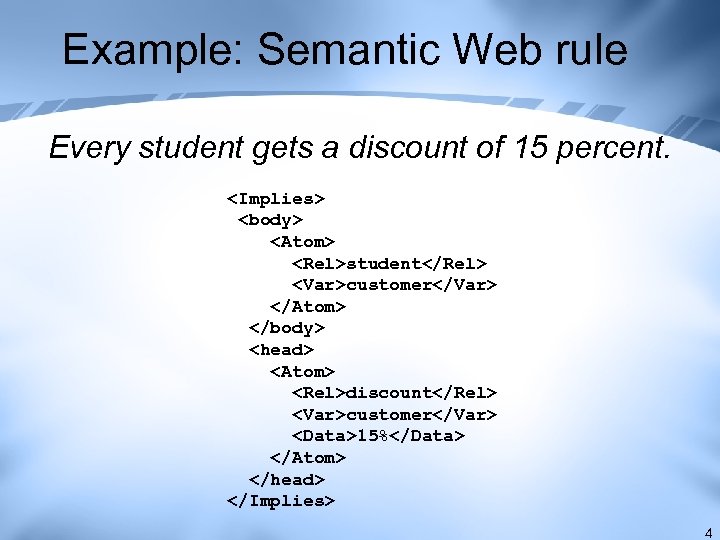 Example: Semantic Web rule Every student gets a discount of 15 percent.
 Our Approach • Provide a user-friendly format – why not English? • • easy familiar expressive but ambiguous – “controlled English” avoids ambiguity • formal, yet natural 5
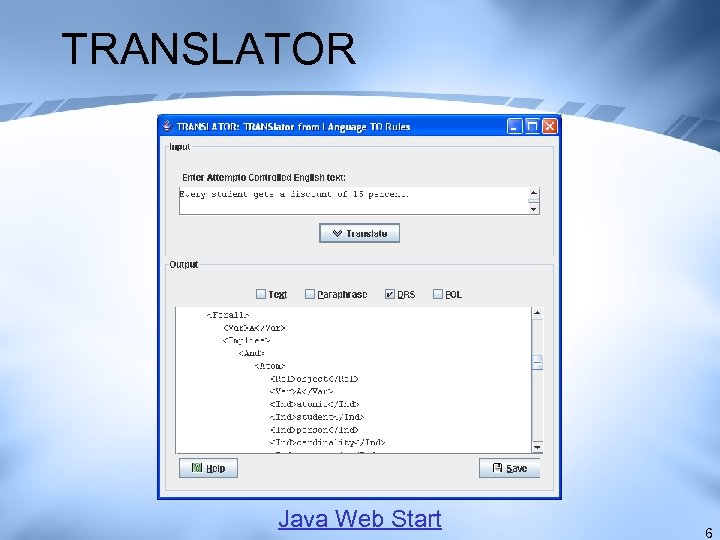 TRANSLATOR Java Web Start 6
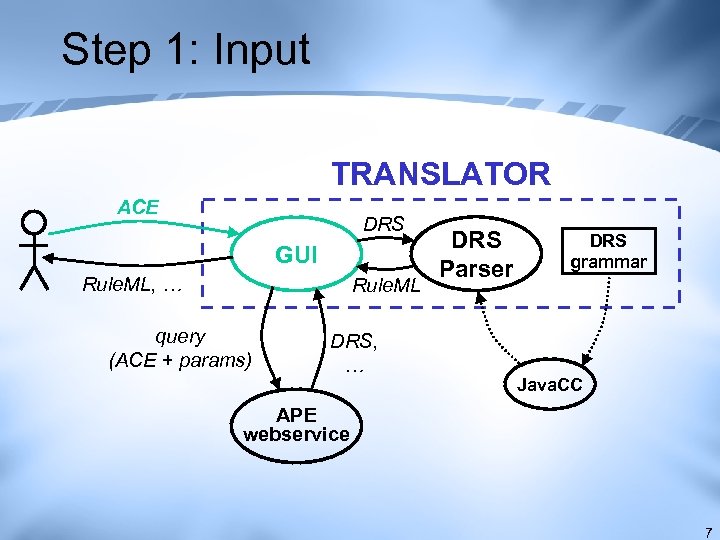 Step 1: Input TRANSLATOR ACE DRS GUI Rule. ML, … Rule. ML query (ACE + params) DRS, … DRS Parser DRS grammar Java. CC APE webservice 7
 Attempto Controlled English (1) • Looks like English – Every honest student who does not procrastinate receives a good mark and easily passes the course. • Actually a formal language, like RDF – tractable subset of English • all ACE sentences are English, but not vice versa – unambiguously translatable into logic 8
 Attempto Controlled English (2) • Strategies for handling ambiguity: – exclude imprecise phrasings • Students hate annoying professors. – interpretation rules • The student brings a friend who is an alumnus and receives a discount. – Who receives the discount? » in ACE, student does (by default) » repeat relative pronoun for other interpretation The student brings a friend who is an alumnus and who receives a discount. 9
 Attempto Controlled English (3) • How can rules be expressed? – in natural language, many different forms • e. g. , Everyone is mortal. All humanity is mortal. Every human being is mortal. For each person the person is mortal. If there is a member of the human race then he/she is mortal. – all above are valid ACE – further embellishment • negation, relative clauses, etc. 10
 Attempto Controlled English (4) • What can’t yet be easily expressed? – “infix” implication • The student is happy if there is no class. • but TRANSLATOR supports it – just swap condition(s) and conclusion(s) » result: If there is no class then the student is happy. – production and reaction rules • involve actions – If a student is caught cheating then send a report to the registrar’s office. • require imperative mood (not yet in ACE) 11
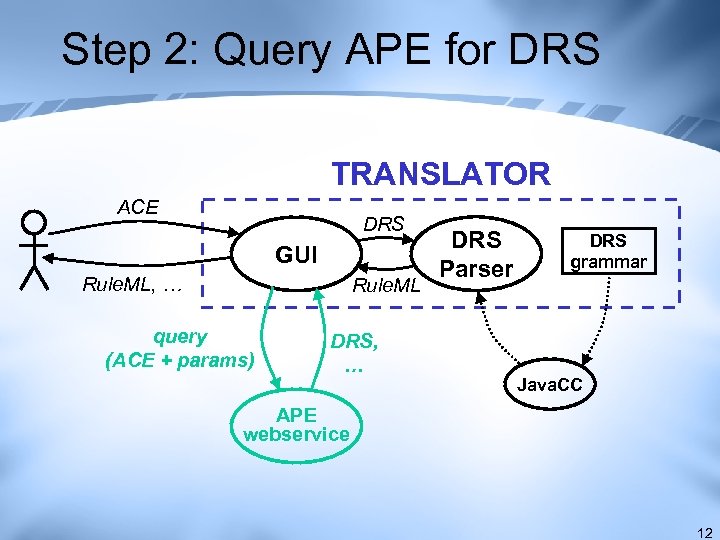 Step 2: Query APE for DRS TRANSLATOR ACE DRS GUI Rule. ML, … Rule. ML query (ACE + params) DRS, … DRS Parser DRS grammar Java. CC APE webservice 12
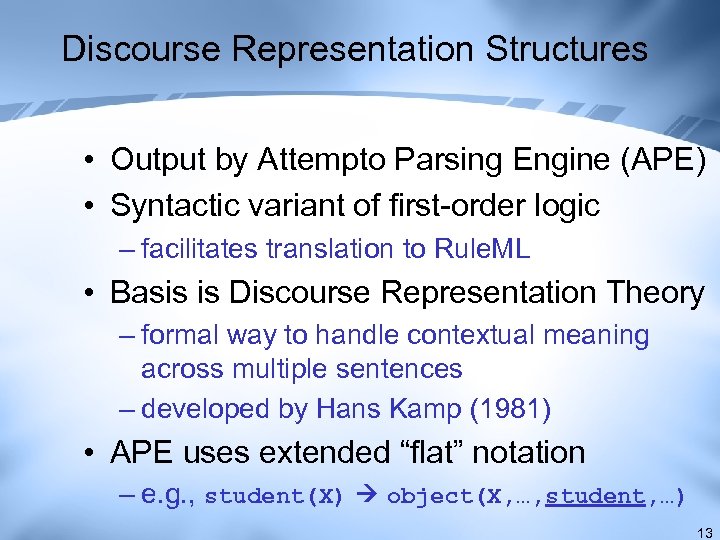 Discourse Representation Structures • Output by Attempto Parsing Engine (APE) • Syntactic variant of first-order logic – facilitates translation to Rule. ML • Basis is Discourse Representation Theory – formal way to handle contextual meaning across multiple sentences – developed by Hans Kamp (1981) • APE uses extended “flat” notation – e. g. , student(X) object(X, …, student, …) 13
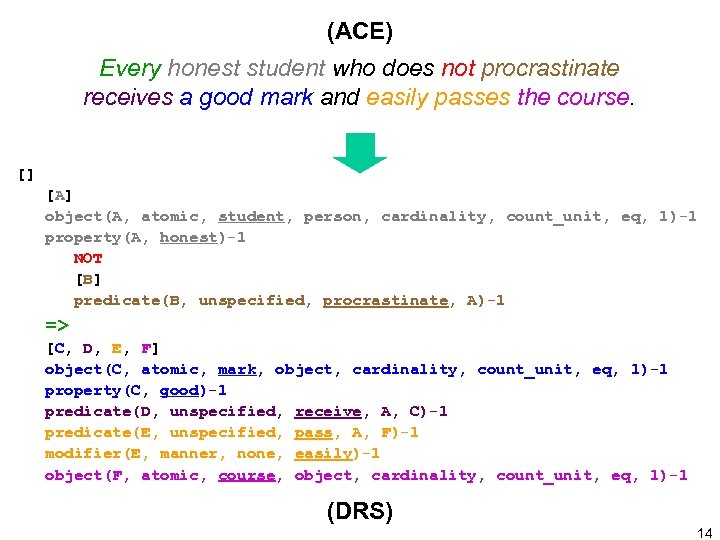 (ACE) Every honest student who does not procrastinate receives a good mark and easily passes the course. [] [A] object(A, atomic, student, person, cardinality, count_unit, eq, 1)-1 property(A, honest)-1 NOT [B] predicate(B, unspecified, procrastinate, A)-1 => [C, D, E, F] object(C, atomic, mark, object, cardinality, count_unit, eq, 1)-1 property(C, good)-1 predicate(D, unspecified, receive, A, C)-1 predicate(E, unspecified, pass, A, F)-1 modifier(E, manner, none, easily)-1 object(F, atomic, course, object, cardinality, count_unit, eq, 1)-1 (DRS) 14
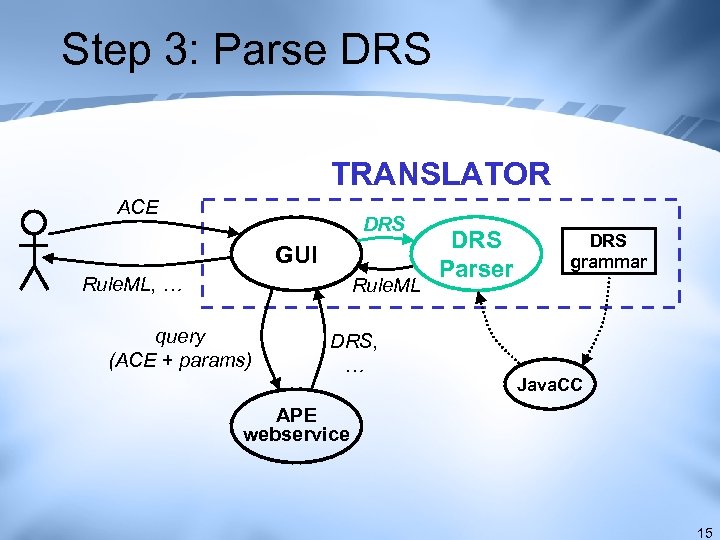 Step 3: Parse DRS TRANSLATOR ACE DRS GUI Rule. ML, … Rule. ML query (ACE + params) DRS, … DRS Parser DRS grammar Java. CC APE webservice 15
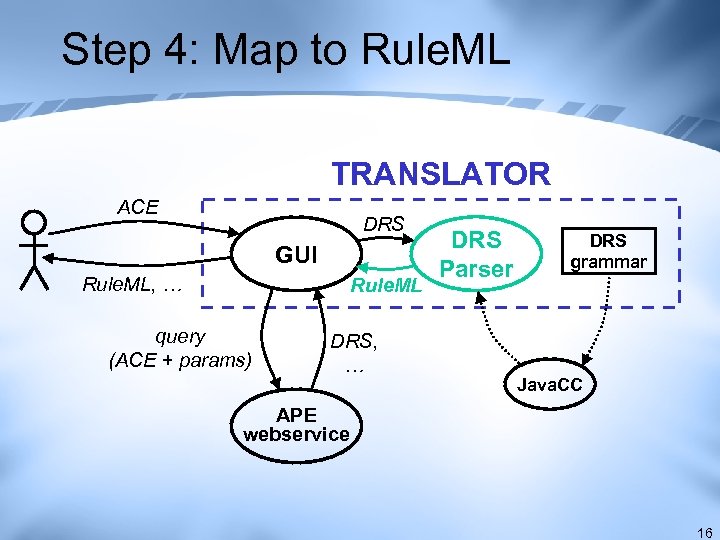 Step 4: Map to Rule. ML TRANSLATOR ACE DRS GUI Rule. ML, … Rule. ML query (ACE + params) DRS, … DRS Parser DRS grammar Java. CC APE webservice 16
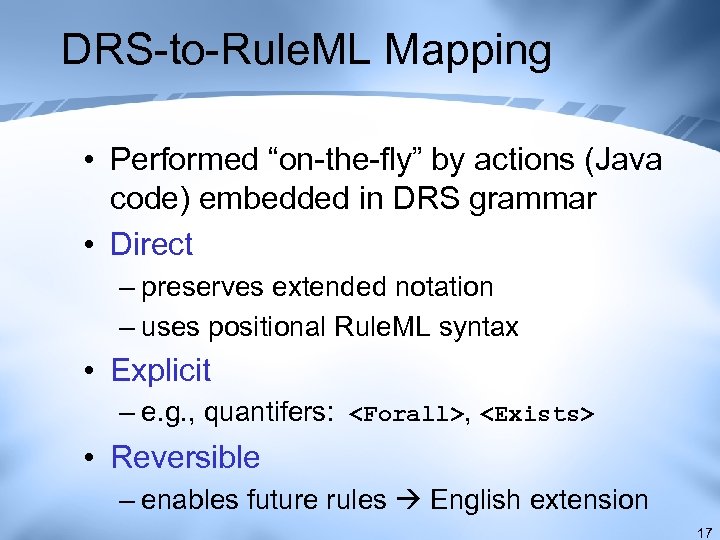 DRS-to-Rule. ML Mapping • Performed “on-the-fly” by actions (Java code) embedded in DRS grammar • Direct – preserves extended notation – uses positional Rule. ML syntax • Explicit – e. g. , quantifers:
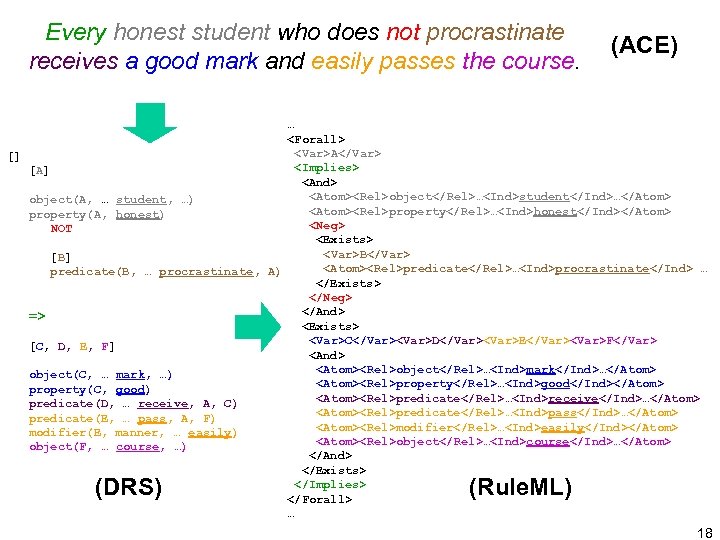 Every honest student who does not procrastinate receives a good mark and easily passes the course. (ACE) …
 Rule Markup Language (1) • Goal is interoperable rule markup – XSLT translators to other Semantic Web languages • Family of “sublanguages” – modular XML Schemas – each represents well-known rule system – TRANSLATOR uses First-Order Logic sublanguage 19
 Rule Markup Language (2) • Why use Rule. ML? – ease of interchange (XML) – compatibility with RDF, OWL and SWRL • also major input to W 3 C’s upcoming RIF – availability of tools • OO j. DREW, Mandarax, Nx. BRE, … – wide variety of features • negation-as-failure, data types, weights, etc. 20
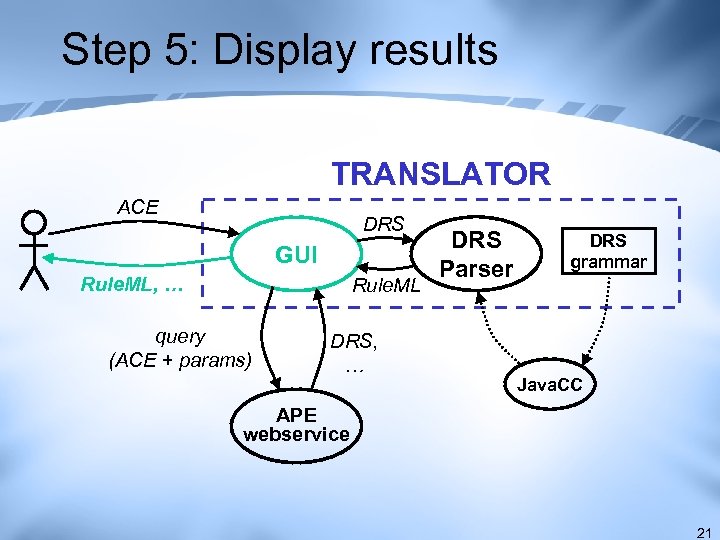 Step 5: Display results TRANSLATOR ACE DRS GUI Rule. ML, … Rule. ML query (ACE + params) DRS, … DRS Parser DRS grammar Java. CC APE webservice 21
 Future Work • Support new extensions in ACE 5 – modality • If a student procrastinates and an assignment's due date is near then the student must work quickly. • If the student misses the due date then he can only beg the professor for an extension. – negation as failure and passive voice • If a transaction is not recorded by the bank then it is not provable that the transaction happens. • Investigate adding option for “non-flat” notation • Extend TRANSLATOR to be bidirectional (also capable of “verbalizing” rules) 22
 Conclusion • TRANSLATOR allows non-experts to write facts and rules for the Semantic Web – critical factor in success of original Web? • Automated mapping from controlled English input to formal representation – ACE DRS Rule. ML • Ongoing development by Attempto team 23
 For more information dhirtle@cs. uwaterloo. ca http: //www. ruleml. org/translator (includes Java Web Start demo) http: //www. ifi. unizh. ch/attempto/tools 24