


 Скачать презентацию TRANSLATING PHILOSOPHY AND SOCIAL SCIENCES 22 11 2017
IKBFU_RS_Tr_social_sc_and_philo_presentation.pptx
- Количество слайдов: 17
 TRANSLATING PHILOSOPHY AND SOCIAL SCIENCES 22. 11. 2017 Yves GAMBIER Turun Yliopisto / University of Turku, Finland I. Kant Baltic Federal University, Kaliningrad, Russia
 TRANSLATING PHILOSOPHY AND SOCIAL SCIENCES: outline • Social sciences; philosophy • Between literary translation and technical tr. ? • Types of knowledge and types of discourse; knowledge and power • Subprojects • Working methods
 Social Sciences and Philosophy • Social sciences: history, sociology, psychology, ethnology, anthropology, women studies • Not included in the project (? ): Religion studies, economy, linguistics, translation studies, cultural studies, communication studies, education, pedagogy, political science, international relations, law, criminology, archeology, demography, geography, urbanism/city planning, tourism,
 Social sciences and Philosophy • Philosophy: History of ideas/knowledge/ sciences, semiotics, philosophy of language, metaphysics, ontology, aesthetics, logic, political philosophy, ethics, philo. of science, different schools/ traditions/trends (through different periods of time and in different contexts: Aristotelian philo. , Chinese philo, Continental philo. , Analytical philo. , etc. ), key philosophers
 GENERAL PROBLEMATIC • Between literary tr. (expressive texts) and technical tr. (informative/operative texts)? • Cultural theoretical discourse? Essays (structuring and structured ”object”) • Tr. social sciences: not halfway between tr. concepts and tr. Style • Question of legitimacy: Who knows how to translate? Who have the right to translate?
 Social Sciences and philosophy: Knowledge and power - 7 issues 1. Knowledge and theoretical discourse ØNotion of domain/area studies; discipline: epistemological and socioinstitutional aspects ØNotions of legitimacy and authority; struggle and strategies for discourse control
 Social sc. and philo. : Knowledge and power 2. Terminology Ø Term, concept; system/network of concepts Ø Old and new concepts; tr. as a vehicule for the travel of seminal concepts Ø Moving concepts between cultures, disciplines, authors, or conceptual change in a discipline; Polysemy in philosophy, connotations Ø Metaphorization/differences between languages Ø How can the epistemological gap between the Russian and English terms be bridged?
 Social sc. and philo: Knowledge and power • 3. Textual composition ØRhetoric, logic, coherence, intertextuality ØNorms/conventions/patterns of textual organization; genres ØContrastive rhetoric; writing issues and intercultural differences ØNon-verbal dimension
 Social sc. and philo: Knowledge and power • 4. Comprehension (co-construction of meaning, role of the readers) ØSubjectivity, presupposition, assumption, implicit/shared knowledge, expectations ØParatext: peritext and epitext Ø The translator as a reader
 Social sc. and philo: Knowledge and power • 5. Production and movement of thoughts/texts • Discourse and scientific communities, schools, trends (sociology of knowldege) • Process of transfer (selection, procedures): Role of journals, conferences, anthologies • Function of the publishing houses; copyrights; censorhips; sociology of books • Transmission: Impact of Info and Communication Technology (ICT); open access; collaborative translation
 Social sc. and philo: Knowledge and power • 6. English as a lingua franca ØQuestions related to linguistic + academic + ideological hegemony ØIllusions of transparency and universality ØLanguage policy, Translation policy, Publishing policy
 Social sc. and philo: Knowledge and power • 7. Translation, self-translation Ø Translation strategies ØIs there a staged process in the dissemination of foreign knowledge? Paraphrastic stage + scholarly publication (with glosses, annotations, commentaries, etc. ) + sourcetext oriented version (? ) – cf. The three ”epochs” of tr. according to Goethe (”serviceable prose” version + ”parodistic” second phase + interlinear version)
 SUBPROJECTS Each subproject must have: • a clear problematic and explicit objectives • research questions and hypotheses • theoretical/conceptual framework + references to the specialised literature • methodology (data collection, data analysis, interpretation) • + schedule, planning • + key references
 SUBPROJECTS Possible subprojects with social sciences: • • Publishing policy and translation policy Self-translation Collaborative translation, team work Retranslation Intertextuality Popularization and translation Translating questionnaires, tests, etc. Reception of classical texts
 SUBPROJECTS • Bibliometric analysis of (papers in sociology from Russian scholars into English) • Translators’ competences in social sciences • Paratexts in translated texts of social sciences • Evolutionary stages of translations of a given author • Translation strategies • Elements for a genetic criticism • Toward a history of translations in social sc. /philo
 SUBPROJECTS Possible subprojects with philosophy: Same as in social sciences but referring to a school, a canonical text, a period of time, a pair of languages (from old Greek, Arabic, German, English, French… into Russian and reverse), or an author (from Aritotle, Plato to Descartes, Locke, Kant, Leibniz, Nietzche…and to Heiddeger, Habermas, Deleuze, etc. ).
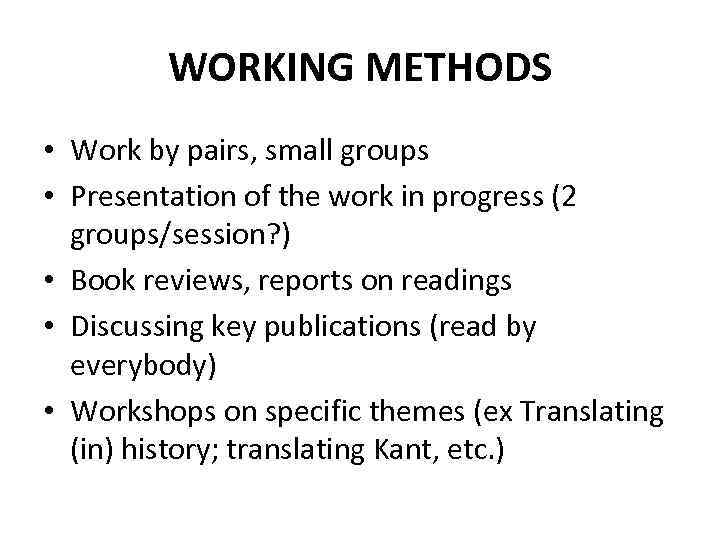 WORKING METHODS • Work by pairs, small groups • Presentation of the work in progress (2 groups/session? ) • Book reviews, reports on readings • Discussing key publications (read by everybody) • Workshops on specific themes (ex Translating (in) history; translating Kant, etc. )