


 Скачать презентацию Translating and adapting tests Outline Outline What
Translating and adapting tests.pptx
- Количество слайдов: 31
 Translating and adapting tests
 Outline Outline: What is a good translation? History: Two generations First generation ◦ Focus on close translations ◦ Translation - back translation Second generation: From translations to adaptations ◦ Integration of perspectives Linguistic Cultural Psychometric ◦ Multiple tests of quality Conclusion
 What Does “Equivalent” Mean? Eusebius Hieronymus (St. Jerome, famous bible translator from Greek and Hebrew to Latin; ± 347— 419/420): ◦ 2 types of translations: “words” and “meanings” (he favored the latter)
 Translatability A psychological test/item is Well translatable if linguistic and psychological features yield the same translation Poorly translatable if linguistic and psychological features do not entirely converge (e. g. , translation of slang: meaning is translatable, but conciseness is lost) Non-translatable if there is a complete or nearly complete nonoverlap (e. g. , Jabberwocky)
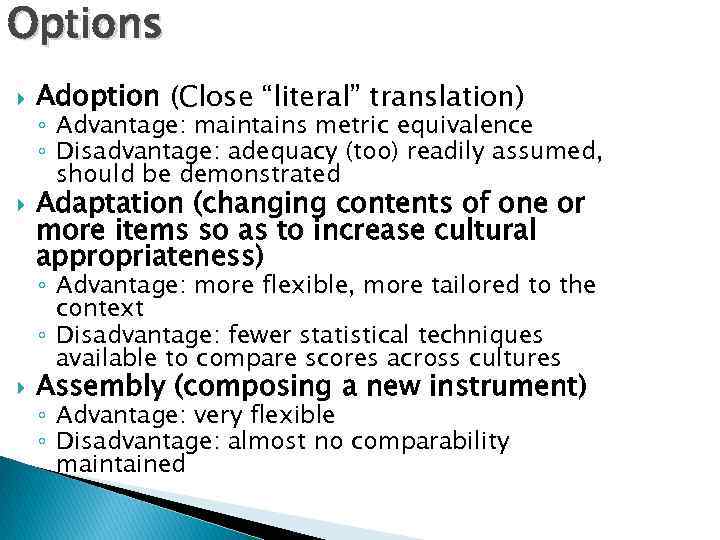 Options Adoption (Close “literal” translation) ◦ Advantage: maintains metric equivalence ◦ Disadvantage: adequacy (too) readily assumed, should be demonstrated Adaptation (changing contents of one or more items so as to increase cultural appropriateness) ◦ Advantage: more flexible, more tailored to the context ◦ Disadvantage: fewer statistical techniques available to compare scores across cultures Assembly (composing a new instrument) ◦ Advantage: very flexible ◦ Disadvantage: almost no comparability maintained
 Comparative Studies: The First Generation Preparing Stimulus Materials ◦ Emphasis on Use of the same instrument in various places Close / literal translations Quality assurance (Brislin, 1970) ◦ Forward translation and independent back translation as quality check
 Problems with the Approach Emphasis on translations of existing materials ◦ Capitalizes on equivalence, not on how the new cultural context could be different ◦ Instruments developed in a Western context may not provide a good measure in a new context
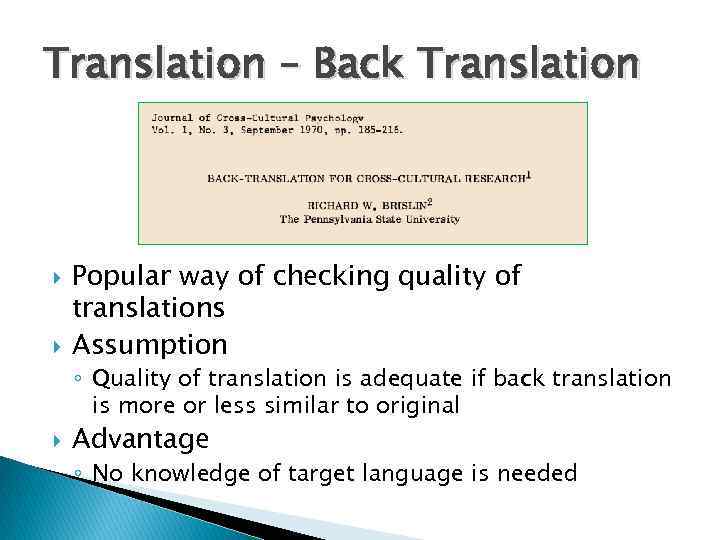 Translation – Back Translation Popular way of checking quality of translations Assumption ◦ Quality of translation is adequate if back translation is more or less similar to original Advantage ◦ No knowledge of target language is needed
 Translation – Back Translation Problems ◦ ◦ Can produce unnatural language No check on readability, natural flow Assumes high level of translatability Easy to cheat when translators know that their text will be back translated
 Initiatives to Enhance Quality In 1992 the International Test Commission (ITC) began a project to prepare guidelines for translating and adapting tests and psychological instruments, and establishing score equivalence across language and/or cultural groups Associations involved European Association of Psychological Assessment European Test Publishers Group International Association for Cross-Cultural Psychology International Association of Applied Psychology International Association for the Evaluation of Educational Achievement ◦ International Language Testing Association ◦ International Union of Psychological Science. ◦ ◦ ◦
 Core Elements of New Approach Translation adaptation Multiple types of expertise required Adaptation affects the whole research process ◦ Requires both qualitative and quantitative aspects ◦ Relevance of quality assurance as chain management
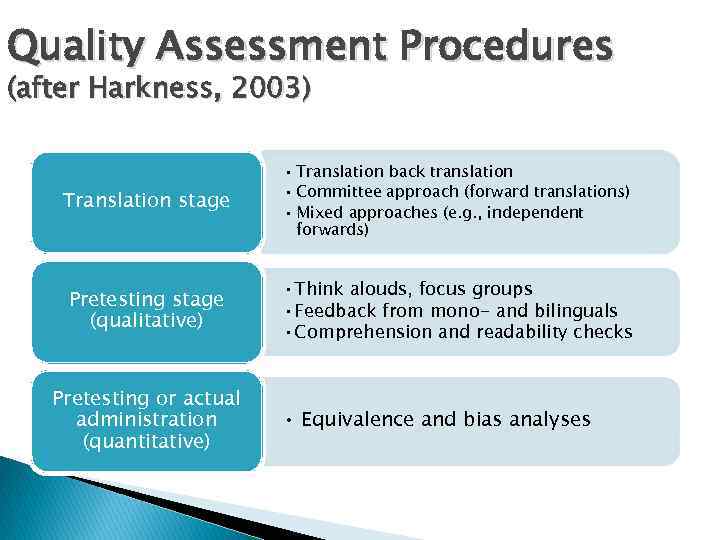 Quality Assessment Procedures (after Harkness, 2003) Translation stage • Translation back translation • Committee approach (forward translations) • Mixed approaches (e. g. , independent forwards) Pretesting stage (qualitative) • Think alouds, focus groups • Feedback from mono- and bilinguals • Comprehension and readability checks Pretesting or actual administration (quantitative) • Equivalence and bias analyses
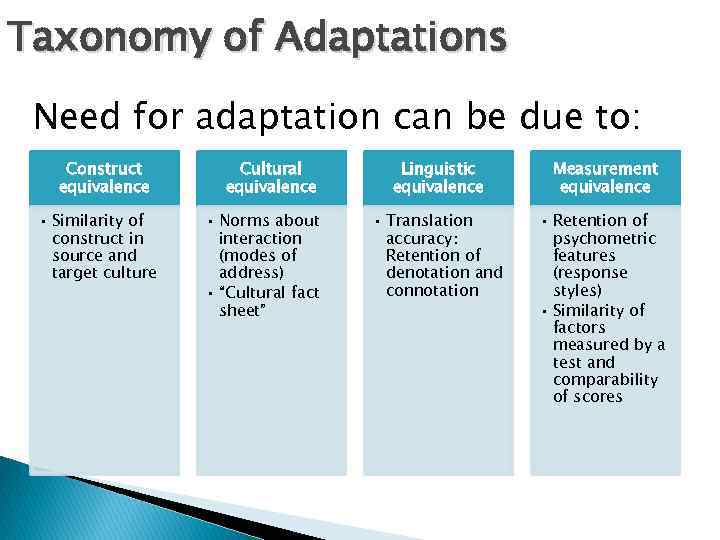 Taxonomy of Adaptations Need for adaptation can be due to: Construct equivalence • Similarity of construct in source and target culture Cultural equivalence • Norms about interaction (modes of address) • “Cultural fact sheet” Linguistic equivalence Measurement equivalence • Translation accuracy: Retention of denotation and connotation • Retention of psychometric features (response styles) • Similarity of factors measured by a test and comparability of scores
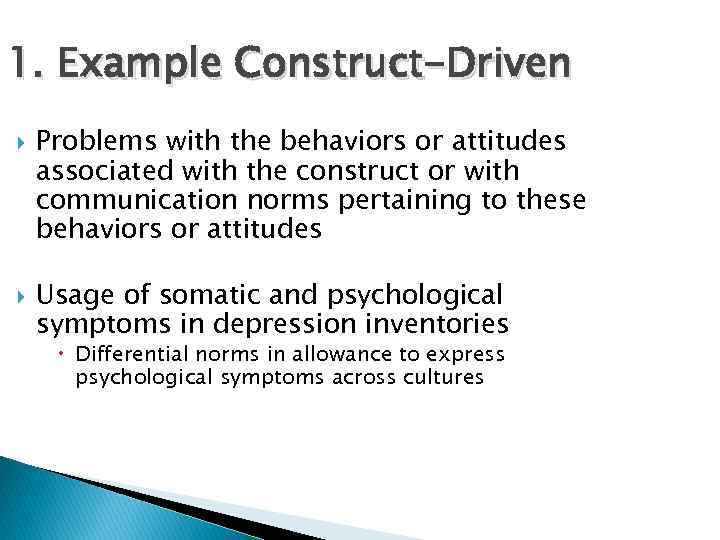 1. Example Construct-Driven Problems with the behaviors or attitudes associated with the construct or with communication norms pertaining to these behaviors or attitudes Usage of somatic and psychological symptoms in depression inventories Differential norms in allowance to express psychological symptoms across cultures
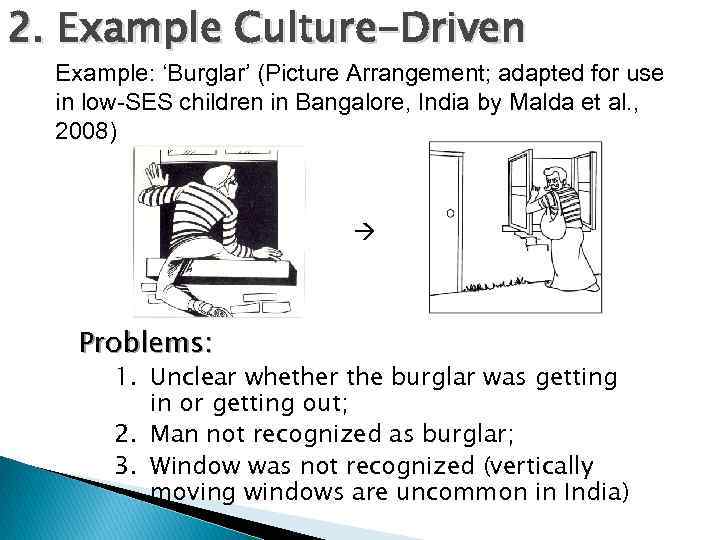 2. Example Culture-Driven Example: ‘Burglar’ (Picture Arrangement; adapted for use in low-SES children in Bangalore, India by Malda et al. , 2008) Problems: 1. Unclear whether the burglar was getting in or getting out; 2. Man not recognized as burglar; 3. Window was not recognized (vertically moving windows are uncommon in India)
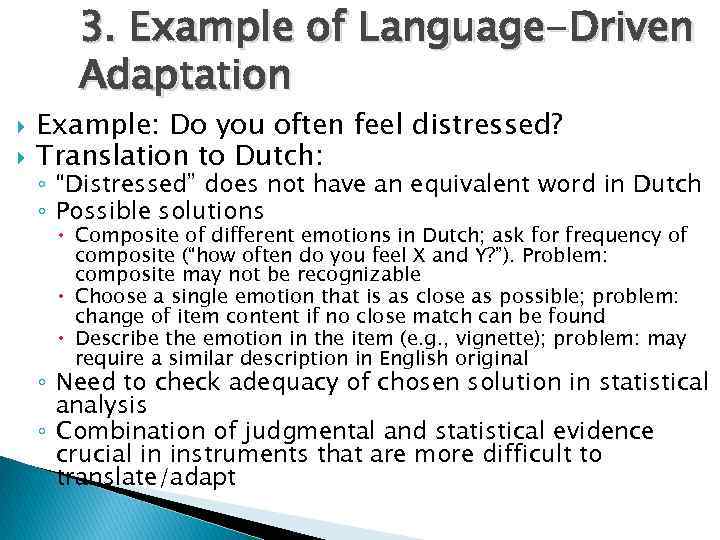 3. Example of Language-Driven Adaptation Example: Do you often feel distressed? Translation to Dutch: ◦ “Distressed” does not have an equivalent word in Dutch ◦ Possible solutions Composite of different emotions in Dutch; ask for frequency of composite (“how often do you feel X and Y? ”). Problem: composite may not be recognizable Choose a single emotion that is as close as possible; problem: change of item content if no close match can be found Describe the emotion in the item (e. g. , vignette); problem: may require a similar description in English original ◦ Need to check adequacy of chosen solution in statistical analysis ◦ Combination of judgmental and statistical evidence crucial in instruments that are more difficult to translate/adapt
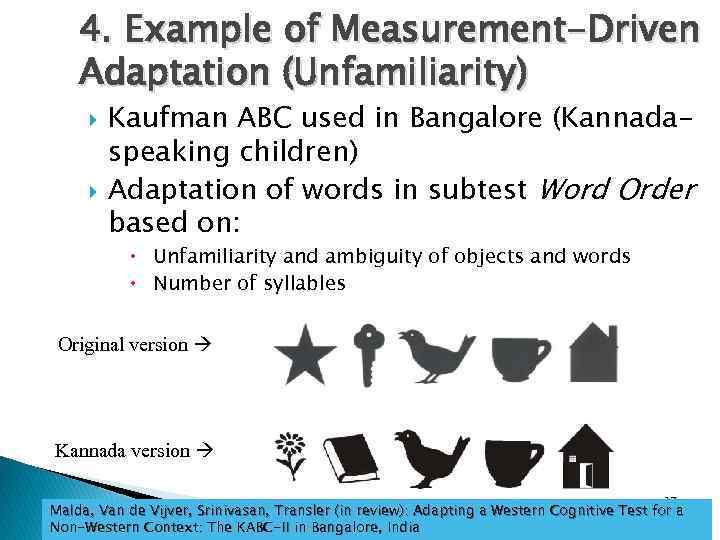 4. Example of Measurement-Driven Adaptation (Unfamiliarity) Kaufman ABC used in Bangalore (Kannadaspeaking children) Adaptation of words in subtest Word Order based on: Unfamiliarity and ambiguity of objects and words Number of syllables Original version Kannada version 17 Malda, Van de Vijver, Srinivasan, Transler (in review): Adapting a Western Cognitive Test for a Non-Western Context: The KABC-II in Bangalore, India
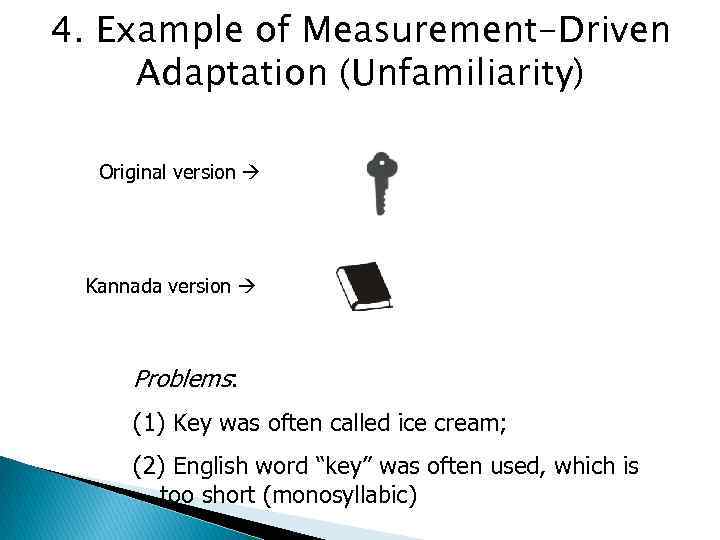 4. Example of Measurement-Driven Adaptation (Unfamiliarity) Original version Kannada version Problems: (1) Key was often called ice cream; (2) English word “key” was often used, which is too short (monosyllabic)
 Conclusion What have we learned ? ◦ Need for multidisciplinary approach New methods ◦ Combine QUAL and QUAN approaches ◦ Combine types of expertise
 Cognitive interviewing is an approach to evaluate sources of measurement error in survey questionnaires.
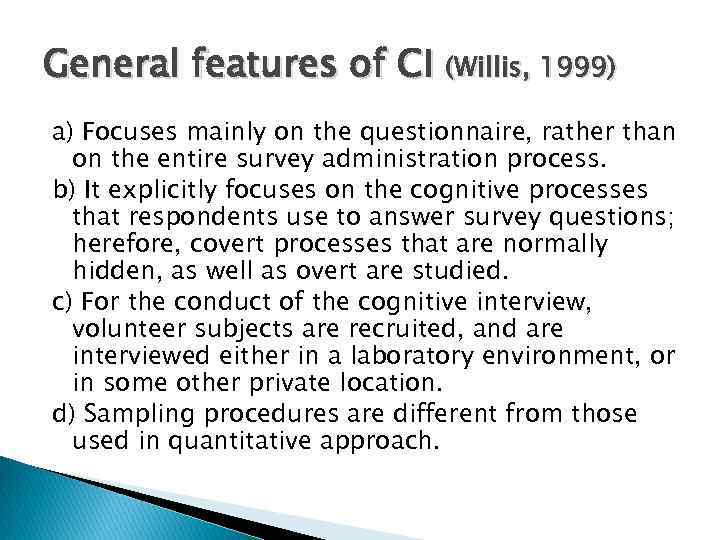 General features of CI (Willis, 1999) a) Focuses mainly on the questionnaire, rather than on the entire survey administration process. b) It explicitly focuses on the cognitive processes that respondents use to answer survey questions; herefore, covert processes that are normally hidden, as well as overt are studied. c) For the conduct of the cognitive interview, volunteer subjects are recruited, and are interviewed either in a laboratory environment, or in some other private location. d) Sampling procedures are different from those used in quantitative approach.
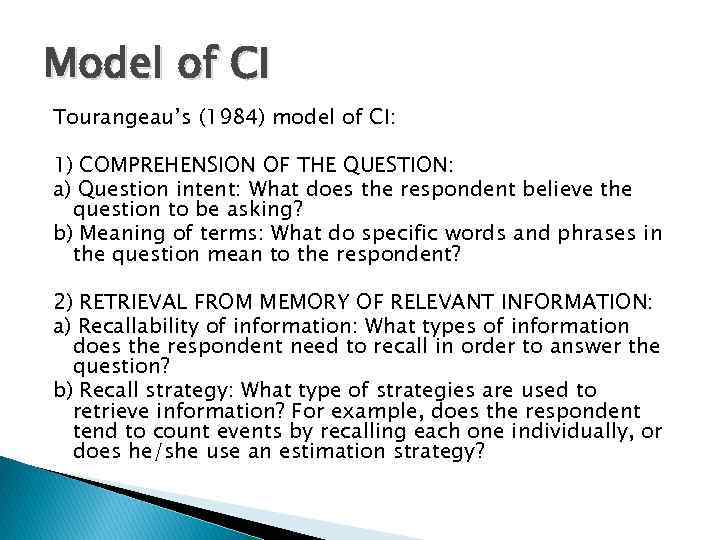 Model of CI Tourangeau’s (1984) model of CI: 1) COMPREHENSION OF THE QUESTION: a) Question intent: What does the respondent believe the question to be asking? b) Meaning of terms: What do specific words and phrases in the question mean to the respondent? 2) RETRIEVAL FROM MEMORY OF RELEVANT INFORMATION: a) Recallability of information: What types of information does the respondent need to recall in order to answer the question? b) Recall strategy: What type of strategies are used to retrieve information? For example, does the respondent tend to count events by recalling each one individually, or does he/she use an estimation strategy?
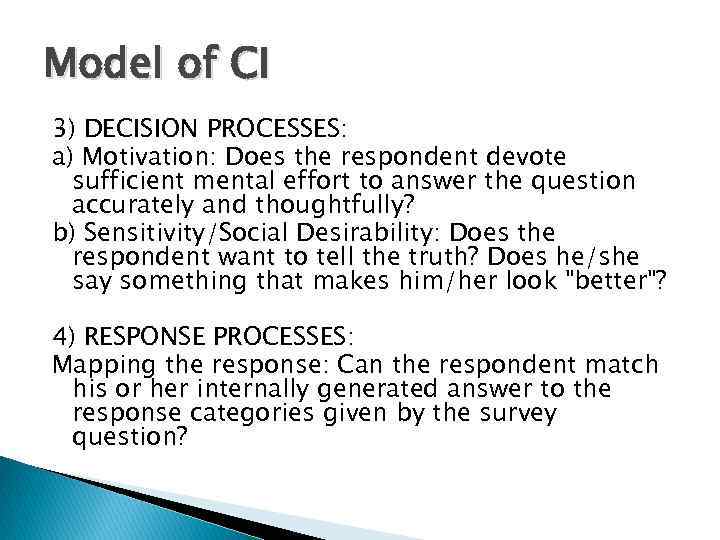 Model of CI 3) DECISION PROCESSES: a) Motivation: Does the respondent devote sufficient mental effort to answer the question accurately and thoughtfully? b) Sensitivity/Social Desirability: Does the respondent want to tell the truth? Does he/she say something that makes him/her look "better"? 4) RESPONSE PROCESSES: Mapping the response: Can the respondent match his or her internally generated answer to the response categories given by the survey question?
 CI techniques Think-aloud (Ericsson and Simon, 1980) Cognitive/ Verbal probing (Willis, 1999)
 CI techniques: Think-aloud Advantages of the think-aloud technique: a) Freedom from interviewer-imposed bias b) Minimal interviewer training requirements c) Open-ended format
 CI techniques: Think-aloud Disadvantages of the think-aloud technique: a) b) c) d) e) Need for subject training Subject resistance Burden on subject Tendency for the subject to stray from the task Bias in subject information processing
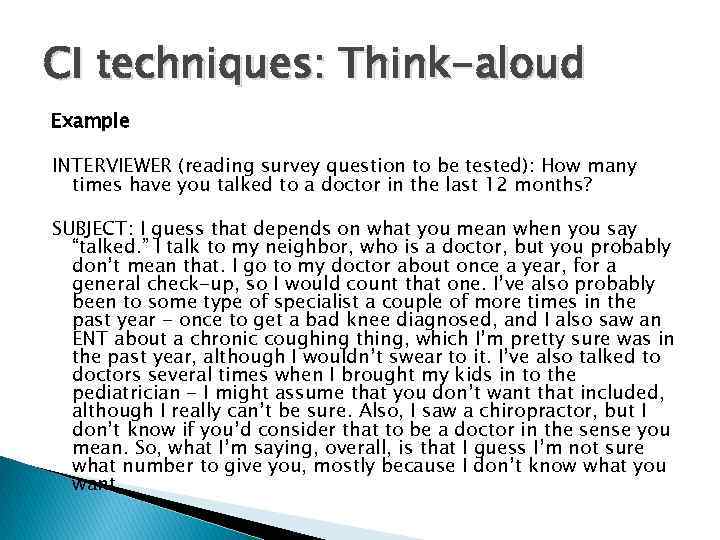 CI techniques: Think-aloud Example INTERVIEWER (reading survey question to be tested): How many times have you talked to a doctor in the last 12 months? SUBJECT: I guess that depends on what you mean when you say “talked. ” I talk to my neighbor, who is a doctor, but you probably don’t mean that. I go to my doctor about once a year, for a general check-up, so I would count that one. I’ve also probably been to some type of specialist a couple of more times in the past year - once to get a bad knee diagnosed, and I also saw an ENT about a chronic coughing thing, which I’m pretty sure was in the past year, although I wouldn’t swear to it. I’ve also talked to doctors several times when I brought my kids in to the pediatrician - I might assume that you don’t want that included, although I really can’t be sure. Also, I saw a chiropractor, but I don’t know if you’d consider that to be a doctor in the sense you mean. So, what I’m saying, overall, is that I guess I’m not sure what number to give you, mostly because I don’t know what you want.
 CI techniques: Verbal Probing Advantages of the Verbal Probing technique: a) Control of the interview b) Ease of training of the subject Disadvantages of probing techniques: a) Artificiality b) Potential for Bias
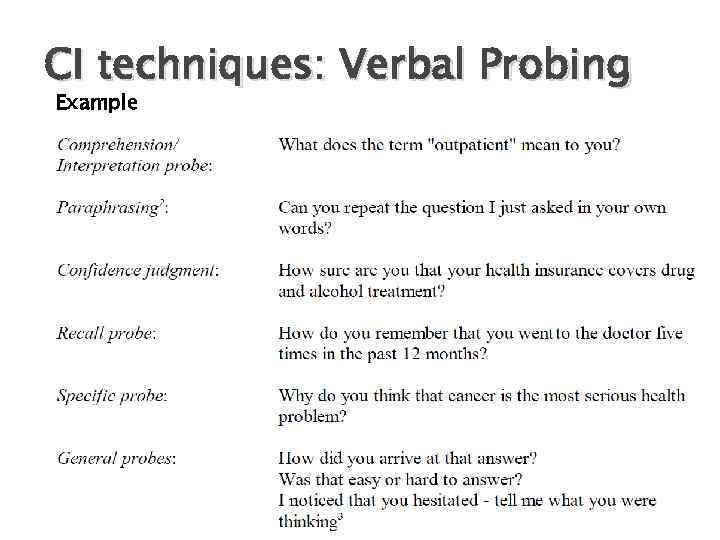 CI techniques: Verbal Probing Example
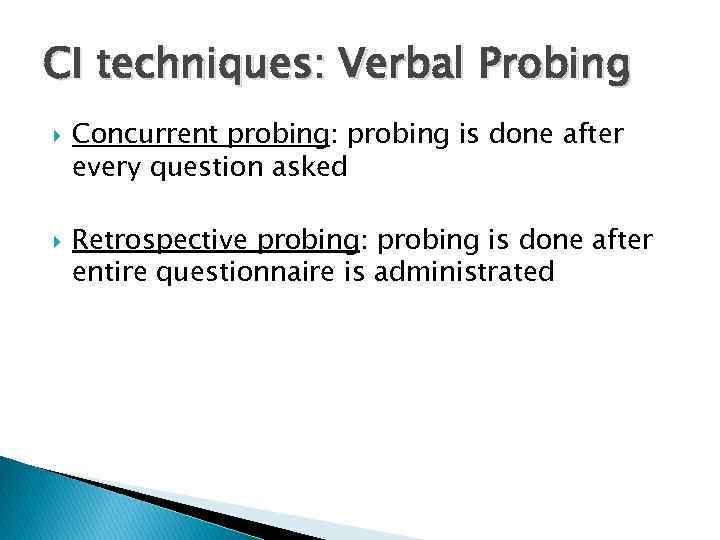 CI techniques: Verbal Probing Concurrent probing: probing is done after every question asked Retrospective probing: probing is done after entire questionnaire is administrated
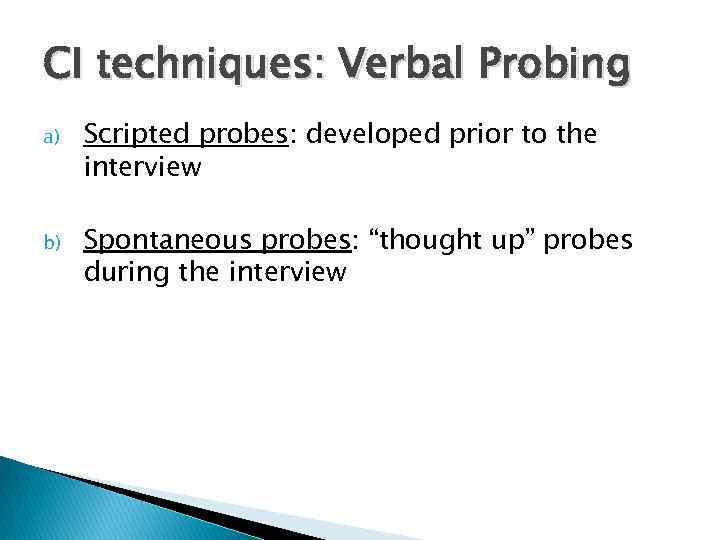 CI techniques: Verbal Probing a) Scripted probes: developed prior to the interview b) Spontaneous probes: “thought up” probes during the interview