


 Скачать презентацию Transition to High School Sarah Diatta Academic Counselor
b3243fb3f56184b479ee6d488d920cd4.ppt
- Количество слайдов: 28
 Transition to High School Sarah Diatta Academic Counselor
 Agenda ²Differences between middle school and high school ²Graduation requirements ²Special programs and resources at Leland ²What to do if your student falls behind ²Ways that you can support your high school student ²Introduction to Naviance Disclaimer: This workshop will not cover college admissions
 Upcoming Parent Night Events 9 th Grade ² Transition to High School- September 4 th, 2014 ² High School Planning- February 5 th, 2015 10 th Grade ² College Requirements - October 16 th, 2014 ² College Entrance Exams (PSAT) –December 11 tth, 2014 11 th Grade ² 11 th/12 th grade Timeline- October 23 rd, 2014 ² College Application Process – April 9 th, 2015 12 th Grade ² College Night - September 25 th, 2014 ² Financial Aid Night – January 13 th, 2015 9 th-11 th Grade ² Paying for College – March 5 th, 2015
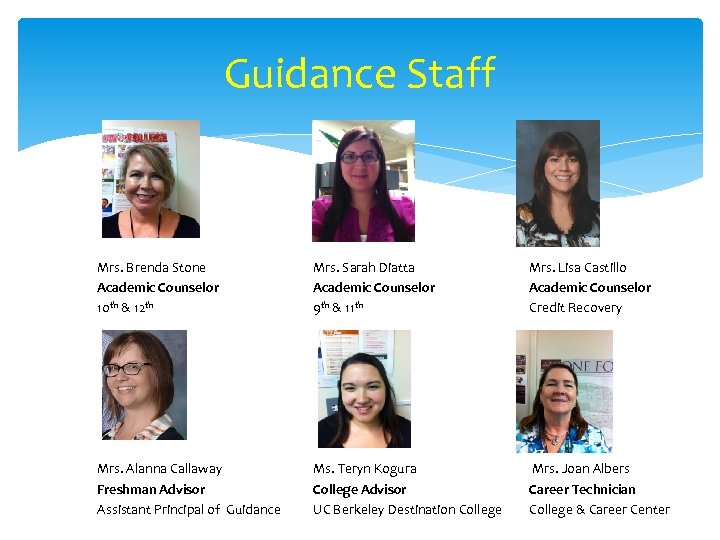 Guidance Staff Mrs. Brenda Stone Academic Counselor 10 th & 12 th Mrs. Sarah Diatta Academic Counselor 9 th & 11 th Mrs. Lisa Castillo Academic Counselor Credit Recovery Mrs. Alanna Callaway Freshman Advisor Assistant Principal of Guidance Ms. Teryn Kogura College Advisor UC Berkeley Destination College Mrs. Joan Albers Career Technician College & Career Center
 Middle School - vs - High School Teachers call home about poor grades or behavior Teachers help with organization Students do not receive credits Teachers expect students to be responsible for their own grades Teachers do not tell students how to be organized Students must pass their classes to earn credits Biggest Difference=GRAD REQUIREMENTS!
 Graduation Requirements Complete 220 credits Pass the CAHSEE California High School Exit Exam English & Math Complete State Requirements: Safety/First Aid Health Certificate Algebra 1 Complete 40 community service hours
 CAHSEE Must pass this test to earn a diploma! Two parts: English & Math Multiple choice & two essays Take it in March of 10 th grade Get six chances to pass
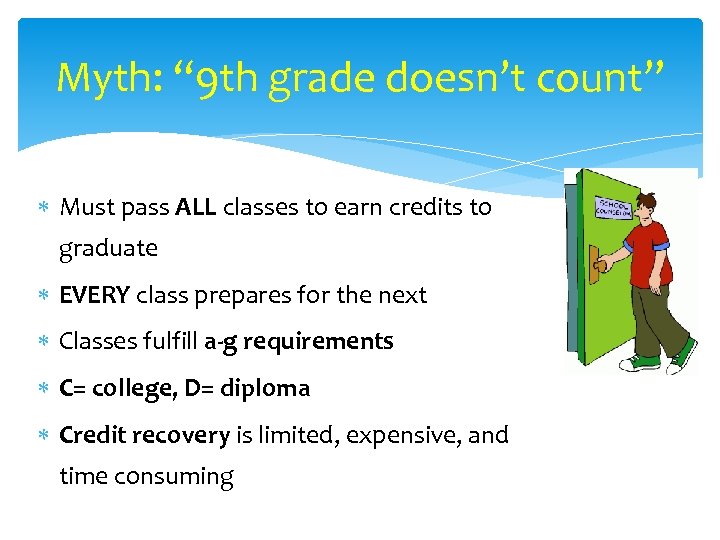 Myth: “ 9 th grade doesn’t count” Must pass ALL classes to earn credits to graduate EVERY class prepares for the next Classes fulfill a-g requirements C= college, D= diploma Credit recovery is limited, expensive, and time consuming
 What is A-G? ² Subject area requirements ² Academically challenging courses ² Must be certified by UC
 A-G & High School Requirements • (A) Social Science, 2 years for • (F) Visual Performing Art, 1 year college (3 years for high school) for college, (2 years for high school) • (B) English, 4 years • (G) Electives, 1 year for college (3 • (C) Mathematics, 3 years for high school) • (D) Science, 2 lab sciences for • Physical Education, 2 years college (3 years for high school) • (E) Language Other Than English, 2 years of the same language
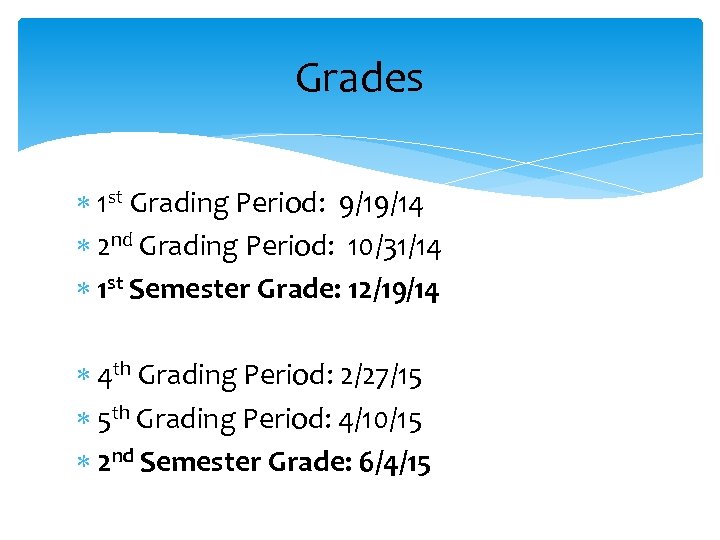 Grades 1 st Grading Period: 9/19/14 2 nd Grading Period: 10/31/14 1 st Semester Grade: 12/19/14 4 th Grading Period: 2/27/15 5 th Grading Period: 4/10/15 2 nd Semester Grade: 6/4/15
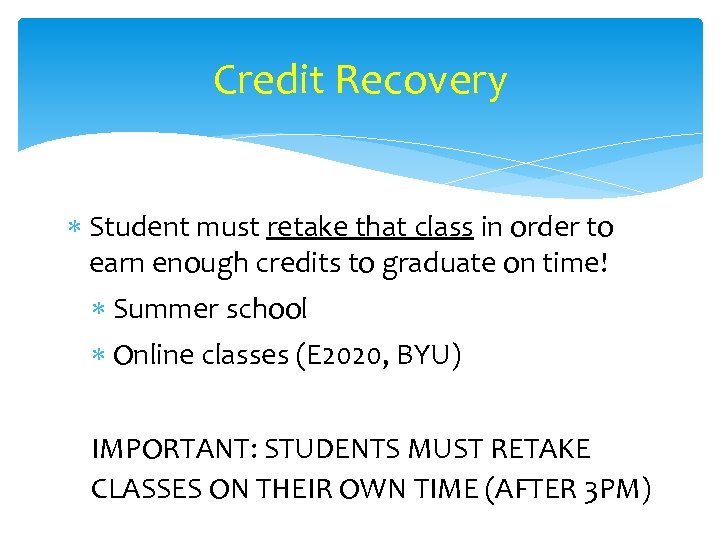 Credit Recovery Student must retake that class in order to earn enough credits to graduate on time! Summer school Online classes (E 2020, BYU) IMPORTANT: STUDENTS MUST RETAKE CLASSES ON THEIR OWN TIME (AFTER 3 PM)
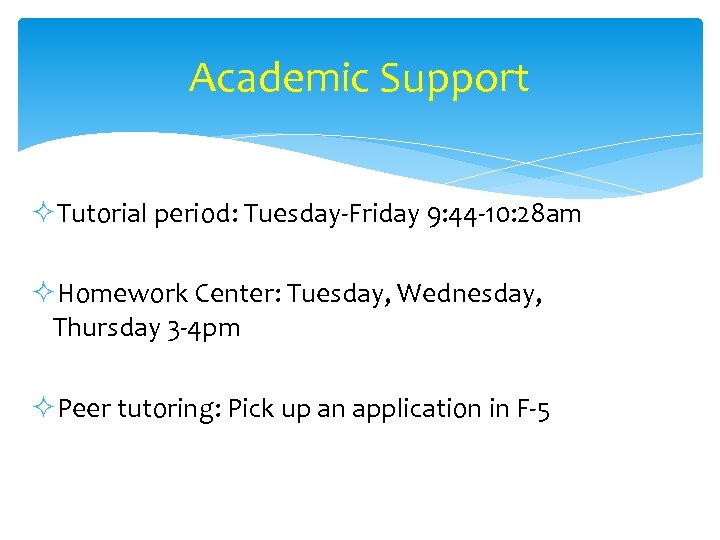 Academic Support ²Tutorial period: Tuesday-Friday 9: 44 -10: 28 am ²Homework Center: Tuesday, Wednesday, Thursday 3 -4 pm ²Peer tutoring: Pick up an application in F-5
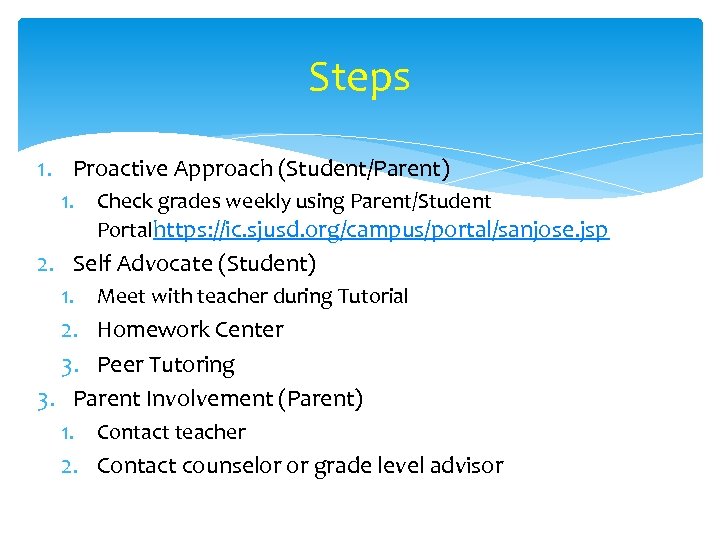 Steps 1. Proactive Approach (Student/Parent) 1. Check grades weekly using Parent/Student Portalhttps: //ic. sjusd. org/campus/portal/sanjose. jsp 2. Self Advocate (Student) 1. Meet with teacher during Tutorial 2. Homework Center 3. Peer Tutoring 3. Parent Involvement (Parent) 1. Contact teacher 2. Contact counselor or grade level advisor
 Support Services o Academic Counselors & College Advisor Provide academic counseling to students anytime and by appointment to parents o Almaden Valley Counseling Services Provide service to students in need of social/ emotional support
 Understanding Different Courses ²College Prep: Courses that have been approved by UC as rigorous enough to prepare students for college (a-g requirements). ²All academic courses at Leland are college prep and are accepted by 4 year universities. ²Accelerated: Students will study the same things as in regular classes but at a faster pace and in more detail.
 Understanding Different Courses ²Honors: Same curriculum as regular classes but are tailored for high achieving students – covering additional topics or some topics in greater depth. ²Student earn an extra GPA point. ²Advanced Placement (AP): Provides motivated students with the opportunity to study and learn at college level. ²Student earn an extra GPA point. ²Students can potentially earn college credit.
 Prerequisites For course descriptions and prerequisite requirements, please check to SJUSD Course Catalog: http: //www. sjusd. org/pdf/students. HS_Course_Catalog_English. pdf
 Academic Programs Speech & Debate (consistently ranked of the best teams in the country) Students of all levels compete in interpretive, improvisational, creative and debate based events Project Lead the Way Hands on, project based engineering courses San Jose City College at Leland Chinese, Japanese, Sign Language, Differential Equations
 Extra Curricular Activities ²Robotics ²Student run organization devoted to promoting science and technology www. 604 robotics. com ²Athletics lelandathletics. olinesports. com ²Clubs http: //www. sjusd. org/leland/Club_List_2013. pdf
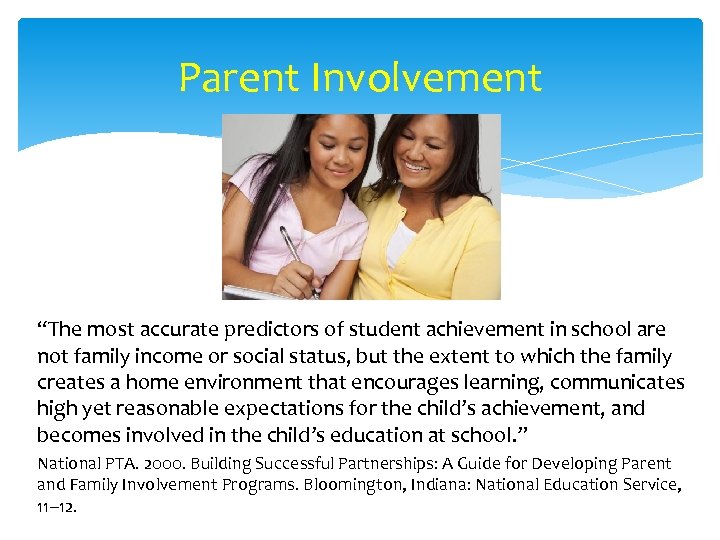 Parent Involvement “The most accurate predictors of student achievement in school are not family income or social status, but the extent to which the family creates a home environment that encourages learning, communicates high yet reasonable expectations for the child’s achievement, and becomes involved in the child’s education at school. ” National PTA. 2000. Building Successful Partnerships: A Guide for Developing Parent and Family Involvement Programs. Bloomington, Indiana: National Education Service, 11– 12.
 Over-Involvement (Unhealthy Support) ²Sends an unintentional message to a student that he/she is not competent. ²Doesn’t give the student the opportunity to practice problem solving skills. ²Creates anxiety in both child and the parent. ²Study shows that students who perceive that they had less autonomy and competence were also more likely to be depressed in college. Holly H. Schiffrin, et al. (2013, Feb. 9). Helping or Hovering? The Effects of Helicopter Parenting on College Students’ Well-Being. Journal of Child and Family Studies, 23 (3), 548 -557.
 Healthy Ways to Support Your Student ²Set realistic goals/expectations with your student ² Goals should be student driven. ²Work with your student to make a plan on how to meet the goals/expectations. ² Student will be more motivated to stick with a plan that he/she helped create. ²This will also give the student an opportunity to think creatively and develop problem solving skills.
 Healthy Ways to Support Your Student ²Step back. Your child will be more proud of something he accomplished himself. ²Let your child accept the natural consequences of his efforts so he/she will develop resiliency and tenacity. ²“The most important support parents can give their children is to communicate that love does not depend on achievements, that they are loved and valued for who they are. ” http: //www. aboutourkids. org/articles/are_you_overly_involved_parent
 Model Good Learning Behavior ²Let your child see that learning does not end when we leave school ²Model behavior that shows an interest in learning new things ²Show your student that you are not afraid to make mistakes and learn from them ²Demonstrate discipline: finish difficult tasks before having fun
 Extracurricular Activities How many should my child do? What kind of extracurricular activities do colleges prefer?
 Answer: Video
 Questions? Email: sdiatta@sjusd. org