


 Скачать презентацию Transition and End State Issues in Complex Emergencies
b5c7632d54c042fab491e2d08dd6ad56.ppt
- Количество слайдов: 32
 Transition and End State Issues in Complex Emergencies
 Since the end of the cold war the UN, Regional Organizations, the US, and other Nations have been involved in more than a dozen peace operations that involved internal conflicts. Despite limited operational success, sustainable peace has proven elusive.
 Concerns • • Managing the Political Process to an End State Translating the Political Mandate Managing the Transition to Sustainable Peace Lack of Support from International Stakeholders • Insufficient Preparation of the Military for the Complex Emergency • The Lack of Surge Capacity in the Civilian Side of Peace Operations • Failure to Resource Critical Aspects
 The question that must be answered is, “What is the desired End State? ”
 Evaluating Effective End states A transition from peace operation to local government (end state) was determined to be completely effective if: q Significant armed conflict did not begin again q There were no politically-motivated violent disruptions of civil society q The political system survived an indigenously and internationally recognized national level election From a presentation prepared for OSD/OASD PK/HA 1997
 Examine the possible “end state or country conditions at exit” using seven categories. Political Resolution Demilitarization Basic Needs Public Security Governance Economy Civil Society
 Political Resolution • An agreed Peace Plan – scope and objectives meet the major political goals • Political will of the factions/parties to resolve issues • Supporting role of external parties – International actors – Neighboring states • Implementation of the mandate • Buy-in from the major stakeholders
 Demilitarization • Political Role - establish constitutional control of forces • Cease-fires and separation of forces • Removal of foreign troops • Internal Security Functions • Control of Heavy Weapons • Reduction in Light weapons
 Demilitarization - cont. • Demobilization of Military forces / militias to reasonable level • Reintegration of Former combatants into society • Restructure of Forces • Reduction in civil unrest • Control lawlessness of combatants
 Basic Needs • • Food and Water Availability of Shelter De-mining Health Support System in place Re-housing of Internally Displaced Return of refugees - repatriation to former homes Freedom of Movement Infrastructure Restoration - power, sewage, running water, medical facilities, transportation • Market availability of food products
 Public Security • Political Role - re-establish reliable security apparatus • Provide for the physical security of the population • Compliance with security aspects of Peace Agreement • Restructure of Police • Training of police • Police - Civil relations
 Public Security - cont. • • • Re-establishing the Judicial structure Judges - trained and working Legal constructs - Rule of law Re-establish the Prison System Banditry reduced
 Governance • • National Electoral process Electoral Laws established Political process - opposition party process Administrative Bureaucracy restored Judicial system operating Reduction in levels of corruption Restoration of local government structures
 Economic • • Jobs Control of the Inflation rate Access to secure Banking Access to consumer Goods Economic reconstruction Structural adjustment programs Access to loans/investment capital
 Civil Society • Media, both government and opposition established • Freedom of Speech • Norms of Human rights guaranteed • Grievance /reconciliation process • Presence of national private/ NGO organizations • Education system re-established
 The question is: “Should every aspect of these requirements be met? ” Examine the minimum requirement - Sustainable Security
 Sustainable Security • The capacity of a society to solve it’s own problems peacefully without an external administrative or military presence • A common conceptual approach and a common standard of sustainable security will greatly assist the determination of an end state. Pauline Baker & Angeli Weller
 Minimum Standards of Sustainable Security • Political Framework – Acceptable Agreement – Political will • Provide for the basic needs of the people – – – Security Shelter Food & Water Medical Care Basic Economy • Rebuild four Key State Institutions – – Military Police Judiciary Civil Service
 Benefits of the Sustainable Security Approach • • Define the mission more precisely Develop Measures of Effectiveness Evaluate success criteria Assess the military, humanitarian and political end state • Develop the transition plan to hand over to civil authorities
 MOEs & Endstate Primary Use: • Evaluate whether mission is succeeding or failing Secondary Uses: • Establishes planning partnerships • Brings together organizations that need to support each other • Establish a common approach • Minimizes confusion & risk • Provides end-point or trend analysis
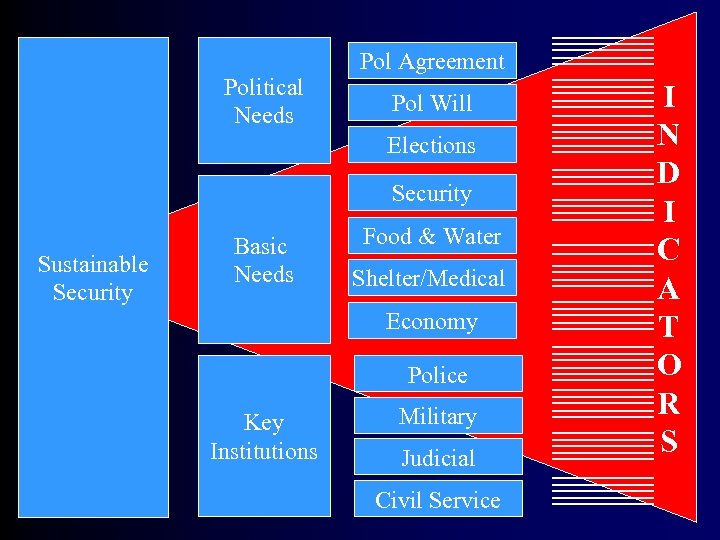 Political Needs Pol Agreement Pol Will Elections Security Sustainable Security Basic Needs Food & Water Shelter/Medical Economy Police Key Institutions Military Judicial Civil Service I N D I C A T O R S
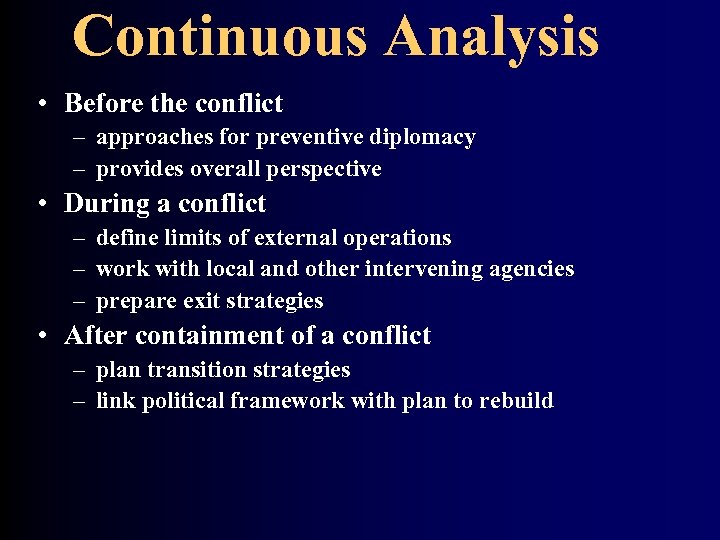 Continuous Analysis • Before the conflict – approaches for preventive diplomacy – provides overall perspective • During a conflict – define limits of external operations – work with local and other intervening agencies – prepare exit strategies • After containment of a conflict – plan transition strategies – link political framework with plan to rebuild
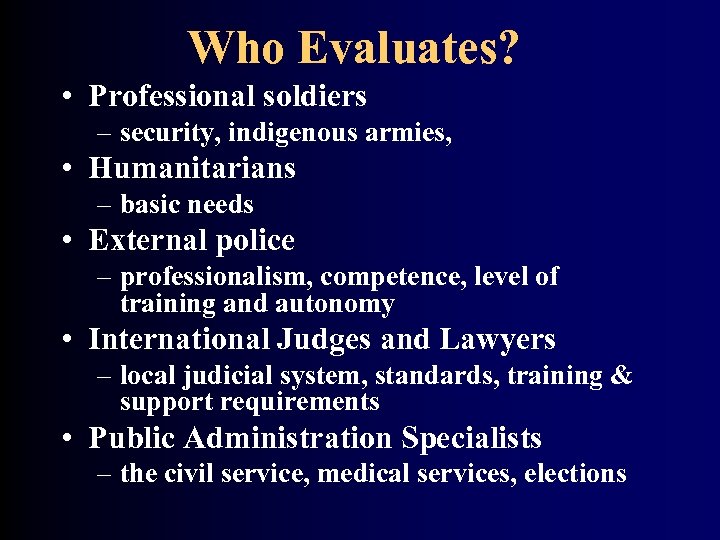 Who Evaluates? • Professional soldiers – security, indigenous armies, • Humanitarians – basic needs • External police – professionalism, competence, level of training and autonomy • International Judges and Lawyers – local judicial system, standards, training & support requirements • Public Administration Specialists – the civil service, medical services, elections
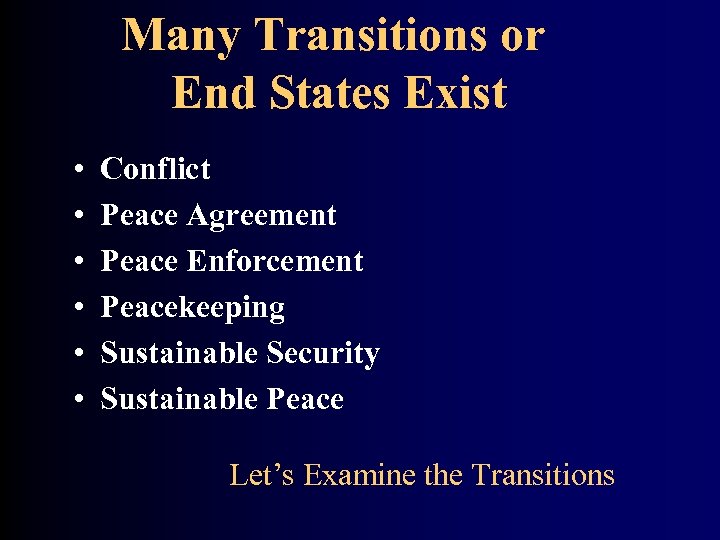 Many Transitions or End States Exist • • • Conflict Peace Agreement Peace Enforcement Peacekeeping Sustainable Security Sustainable Peace Let’s Examine the Transitions
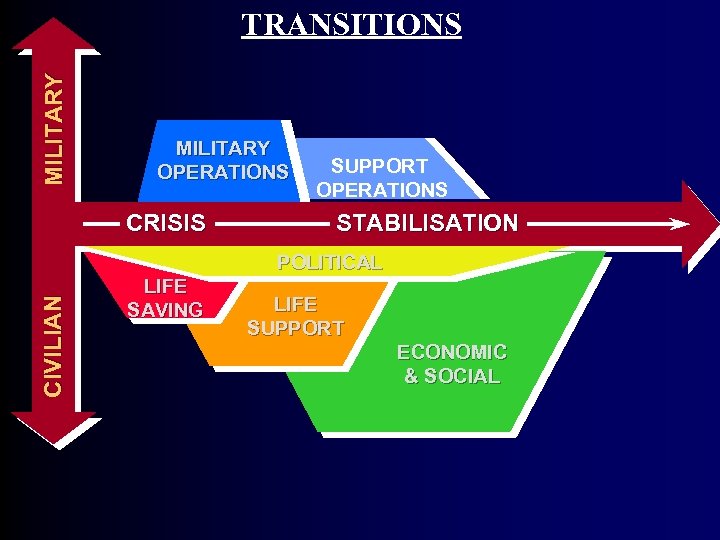 MI L I T A R Y TRANSITIONS MILITARY OPERATIONS CRISIS SUPPORT OPERATIONS STABILISATION CI V I L I AN POLITICAL LIFE SAVING LIFE SUPPORT ECONOMIC & SOCIAL
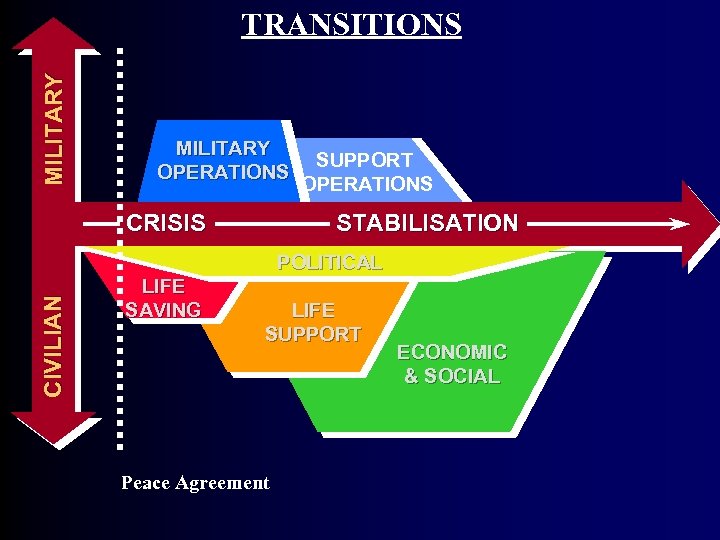 MI L I T A R Y TRANSITIONS MILITARY OPERATIONS SUPPORT OPERATIONS CRISIS STABILISATION CI V I L I AN POLITICAL LIFE SAVING LIFE SUPPORT Peace Agreement ECONOMIC & SOCIAL
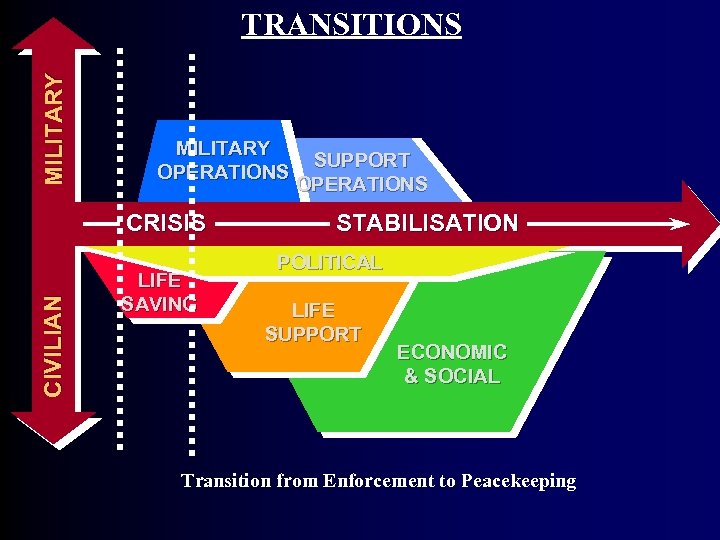 MI L I T A R Y TRANSITIONS MILITARY OPERATIONS SUPPORT OPERATIONS CI V I L I AN CRISIS LIFE SAVING STABILISATION POLITICAL LIFE SUPPORT ECONOMIC & SOCIAL Transition from Enforcement to Peacekeeping
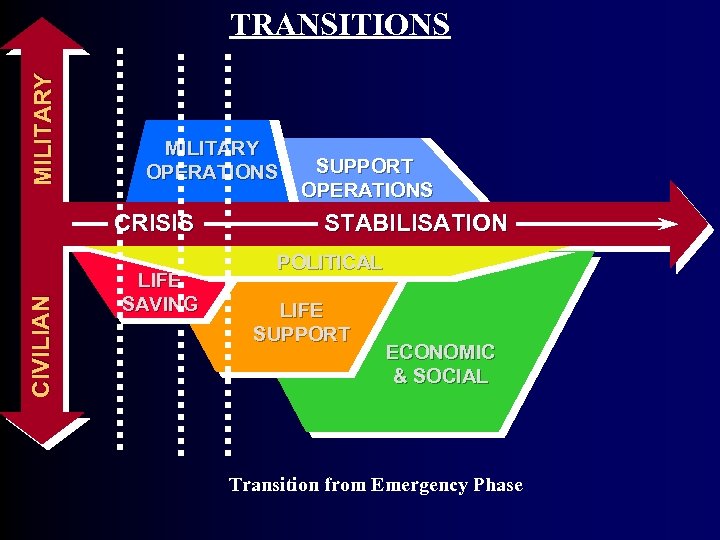 MI L I T A R Y TRANSITIONS MILITARY OPERATIONS SUPPORT OPERATIONS CI V I L I AN CRISIS LIFE SAVING STABILISATION POLITICAL LIFE SUPPORT ECONOMIC & SOCIAL Transition from Emergency Phase
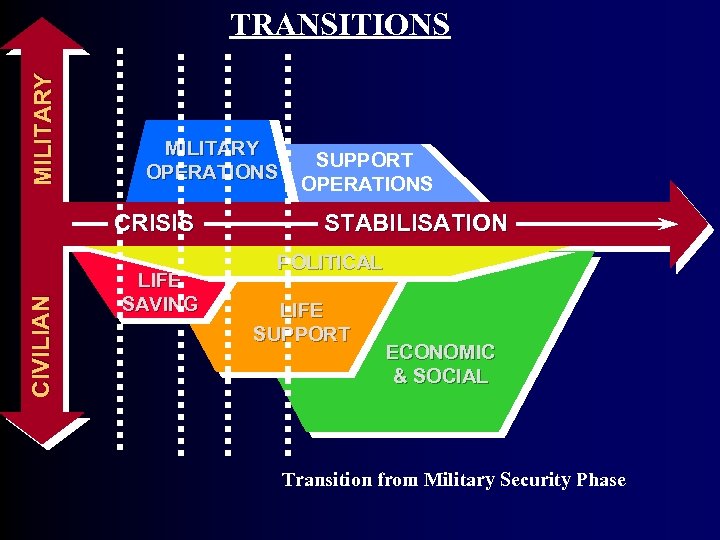 MI L I T A R Y TRANSITIONS MILITARY OPERATIONS SUPPORT OPERATIONS CI V I L I AN CRISIS LIFE SAVING STABILISATION POLITICAL LIFE SUPPORT ECONOMIC & SOCIAL Transition from Military Security Phase
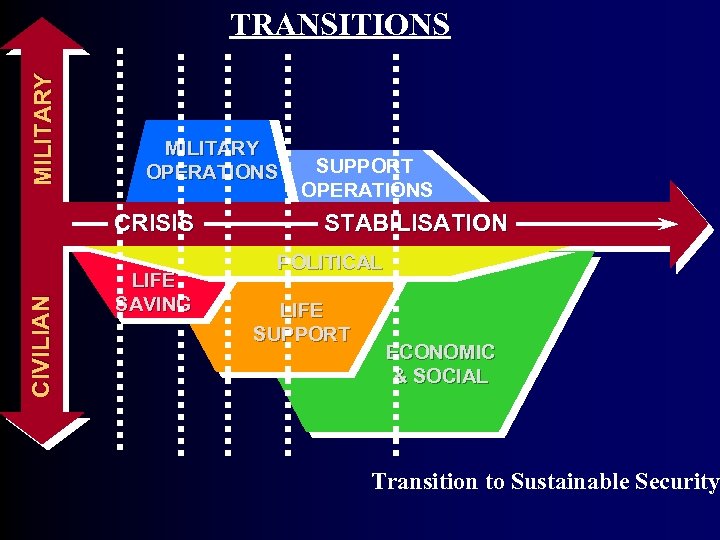 MI L I T A R Y TRANSITIONS MILITARY OPERATIONS SUPPORT OPERATIONS CI V I L I AN CRISIS LIFE SAVING STABILISATION POLITICAL LIFE SUPPORT ECONOMIC & SOCIAL Transition to Sustainable Security
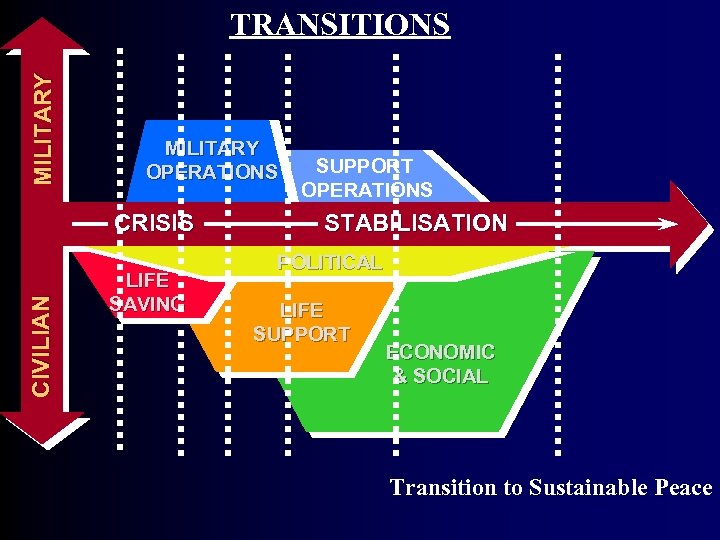 MI L I T A R Y TRANSITIONS MILITARY OPERATIONS SUPPORT OPERATIONS CI V I L I AN CRISIS LIFE SAVING STABILISATION POLITICAL LIFE SUPPORT ECONOMIC & SOCIAL Transition to Sustainable Peace
 Considerations for Transition & End State • Plan for transition when you plan for intervention plan in conjunction with others • Transition or end-state for one component is not necessarily the same for another • Your successful transition may depend on others • Develop MOEs based on success in the key areas of sustainable security • Use working elements of indigenous capacity • Understand the transition strategy will evolve • Support elements in the domain of other components