


 Скачать презентацию Transition Age Youth State Team for Children Families
6ad3b379b6b8d2370e03d82cfa5d9a89.ppt
- Количество слайдов: 34
 Transition Age Youth State Team for Children, Families and Individuals September 25, 2006
 Purpose of Today Ø Understand what the data say about transition age youth Ø Develop a multi-agency and interdisciplinary approach for transition age youth Ø React to and build on the emerging recommendations
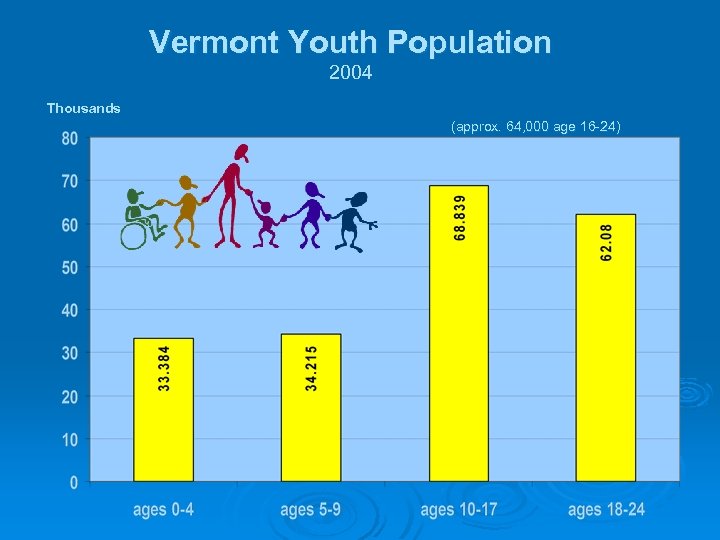 Vermont Youth Population 2004 Thousands (approx. 64, 000 age 16 -24)
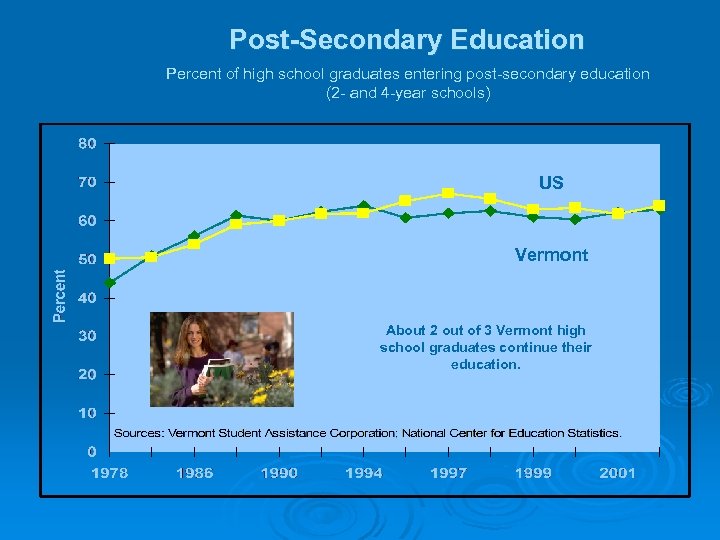 Post-Secondary Education Percent of high school graduates entering post-secondary education (2 - and 4 -year schools) US Vermont About 2 out of 3 Vermont high school graduates continue their education.
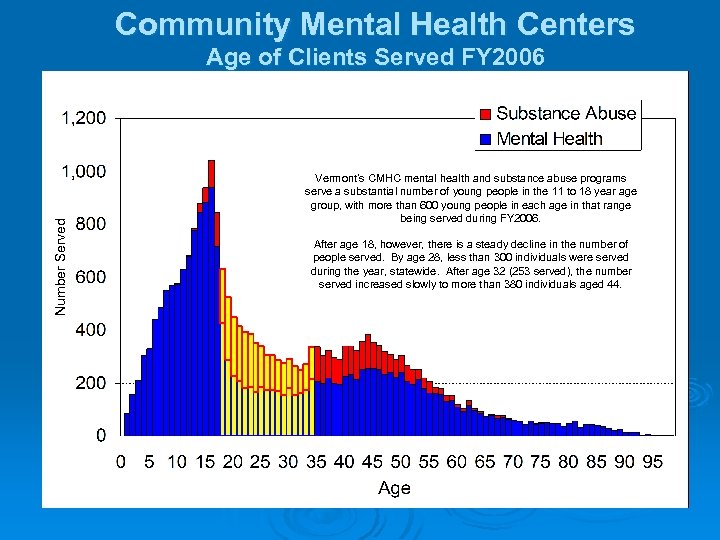 Community Mental Health Centers Number Served Age of Clients Served FY 2006 Vermont’s CMHC mental health and substance abuse programs serve a substantial number of young people in the 11 to 18 year age group, with more than 600 young people in each age in that range being served during FY 2006. After age 18, however, there is a steady decline in the number of people served. By age 28, less than 300 individuals were served during the year, statewide. After age 32 (253 served), the number served increased slowly to more than 380 individuals aged 44.
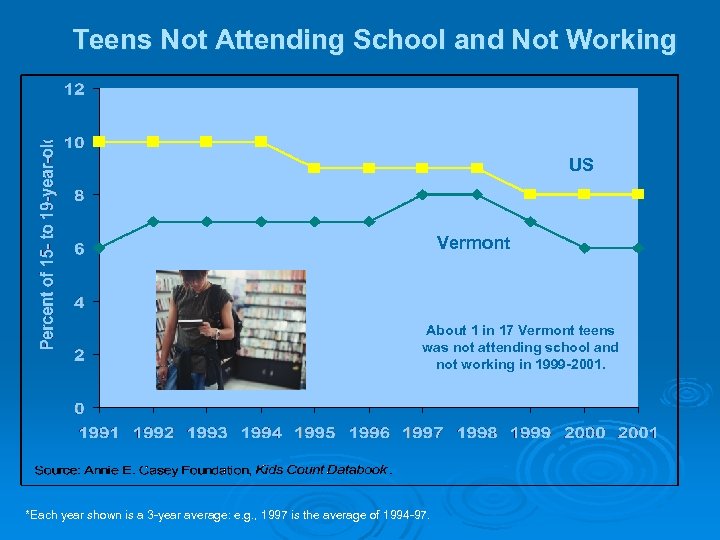 Teens Not Attending School and Not Working US Vermont About 1 in 17 Vermont teens was not attending school and not working in 1999 -2001. *Each year shown is a 3 -year average: e. g. , 1997 is the average of 1994 -97.
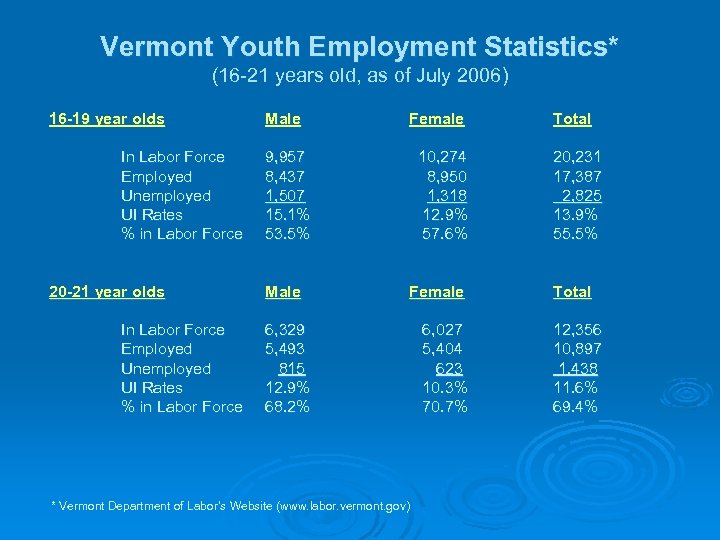 Vermont Youth Employment Statistics* (16 -21 years old, as of July 2006) 16 -19 year olds In Labor Force Employed Unemployed UI Rates % in Labor Force 20 -21 year olds In Labor Force Employed Unemployed UI Rates % in Labor Force Male Female Total 9, 957 8, 437 1, 507 15. 1% 53. 5% 10, 274 8, 950 1, 318 12. 9% 57. 6% 20, 231 17, 387 2, 825 13. 9% 55. 5% Male Female Total 6, 329 5, 493 815 12. 9% 68. 2% 6, 027 5, 404 623 10. 3% 70. 7% 12, 356 10, 897 1, 438 11. 6% 69. 4% * Vermont Department of Labor’s Website (www. labor. vermont. gov)
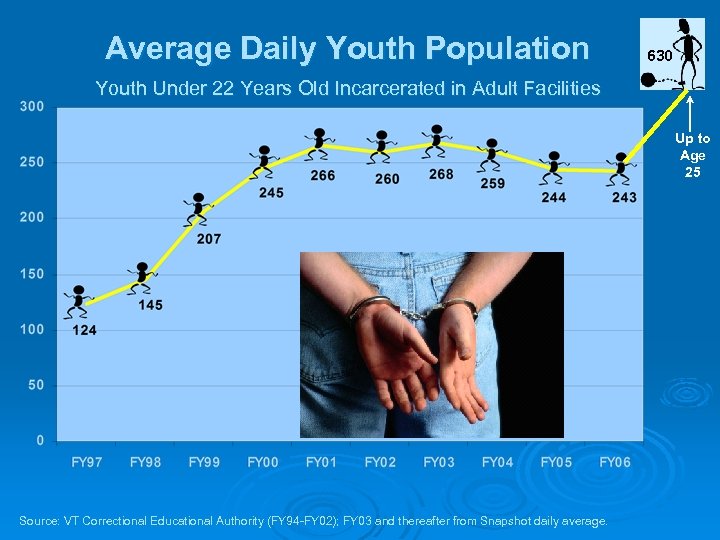 Average Daily Youth Population 630 Youth Under 22 Years Old Incarcerated in Adult Facilities Up to Age 25 Source: VT Correctional Educational Authority (FY 94 -FY 02); FY 03 and thereafter from Snapshot daily average.
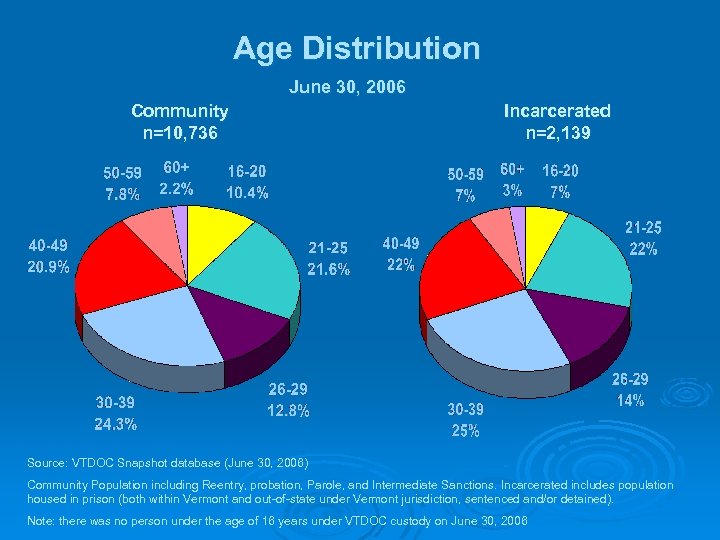 Age Distribution June 30, 2006 Community n=10, 736 Incarcerated n=2, 139 Source: VTDOC Snapshot database (June 30, 2006) Community Population including Reentry, probation, Parole, and Intermediate Sanctions. Incarcerated includes population housed in prison (both within Vermont and out-of-state under Vermont jurisdiction, sentenced and/or detained). Note: there was no person under the age of 16 years under VTDOC custody on June 30, 2006
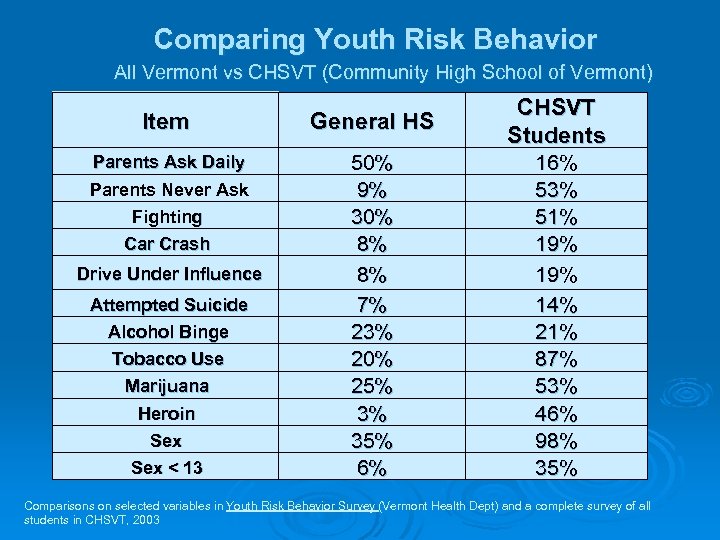 Comparing Youth Risk Behavior All Vermont vs CHSVT (Community High School of Vermont) Item General HS CHSVT Students Parents Ask Daily Parents Never Ask 50% 9% 30% 8% 8% 7% 23% 20% 25% 3% 35% 6% 16% 53% 51% 19% 14% 21% 87% 53% 46% 98% 35% Fighting Car Crash Drive Under Influence Attempted Suicide Alcohol Binge Tobacco Use Marijuana Heroin Sex < 13 Comparisons on selected variables in Youth Risk Behavior Survey (Vermont Health Dept) and a complete survey of all students in CHSVT, 2003
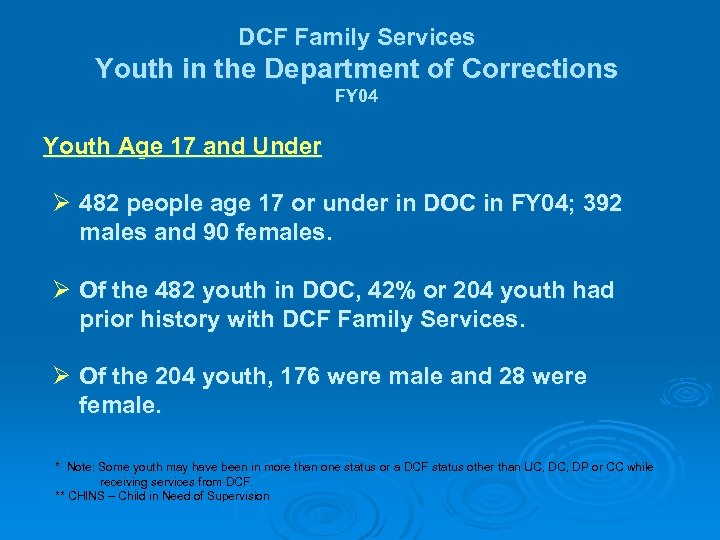 DCF Family Services Youth in the Department of Corrections FY 04 Youth Age 17 and Under Ø 482 people age 17 or under in DOC in FY 04; 392 males and 90 females. Ø Of the 482 youth in DOC, 42% or 204 youth had prior history with DCF Family Services. Ø Of the 204 youth, 176 were male and 28 were female. * Note: Some youth may have been in more than one status or a DCF status other than UC, DP or CC while receiving services from DCF. ** CHINS – Child in Need of Supervision
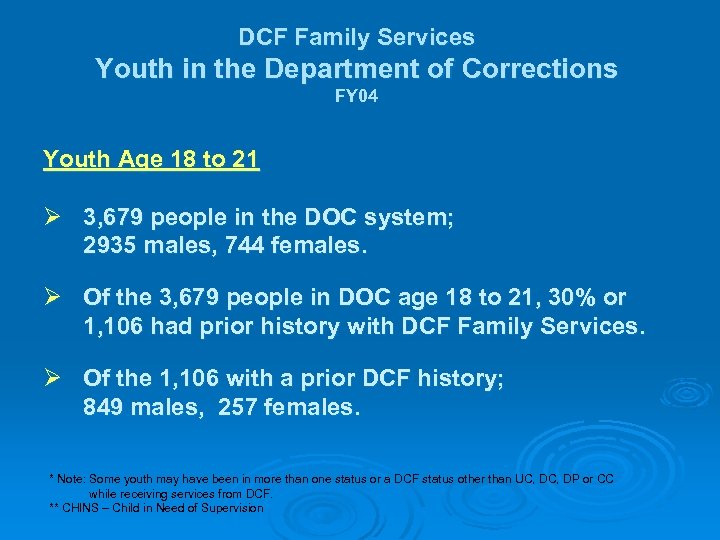 DCF Family Services Youth in the Department of Corrections FY 04 Youth Age 18 to 21 Ø 3, 679 people in the DOC system; 2935 males, 744 females. Ø Of the 3, 679 people in DOC age 18 to 21, 30% or 1, 106 had prior history with DCF Family Services. Ø Of the 1, 106 with a prior DCF history; 849 males, 257 females. * Note: Some youth may have been in more than one status or a DCF status other than UC, DP or CC while receiving services from DCF. ** CHINS – Child in Need of Supervision
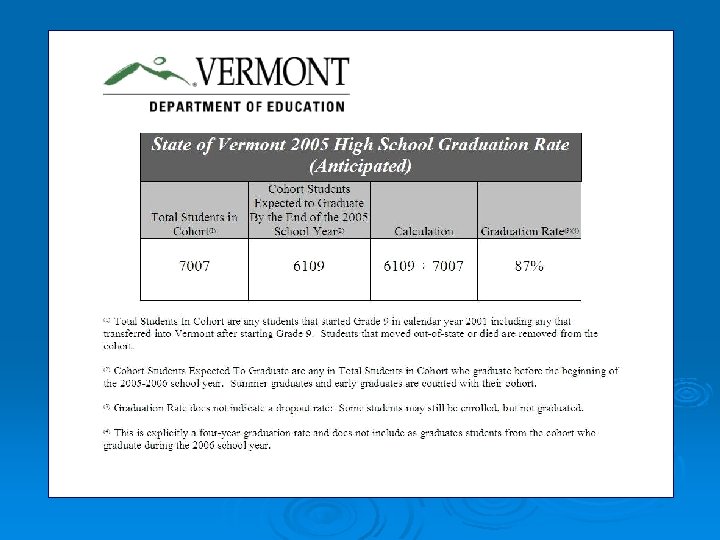
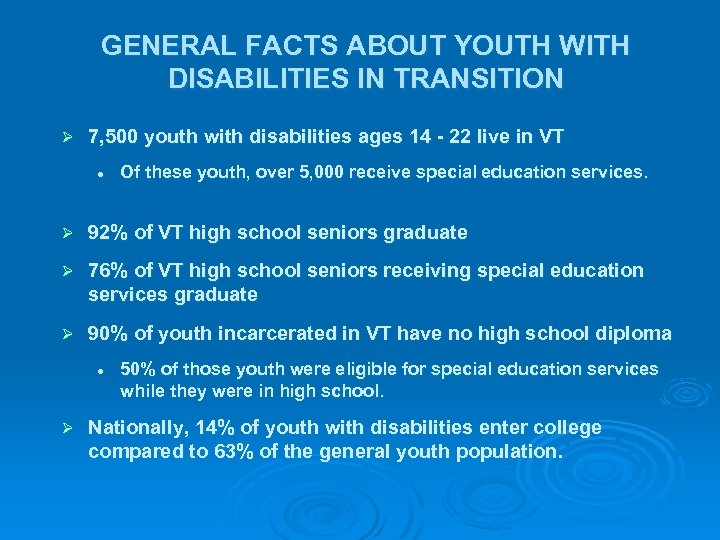 GENERAL FACTS ABOUT YOUTH WITH DISABILITIES IN TRANSITION Ø 7, 500 youth with disabilities ages 14 - 22 live in VT l Of these youth, over 5, 000 receive special education services. Ø 92% of VT high school seniors graduate Ø 76% of VT high school seniors receiving special education services graduate Ø 90% of youth incarcerated in VT have no high school diploma l Ø 50% of those youth were eligible for special education services while they were in high school. Nationally, 14% of youth with disabilities enter college compared to 63% of the general youth population.
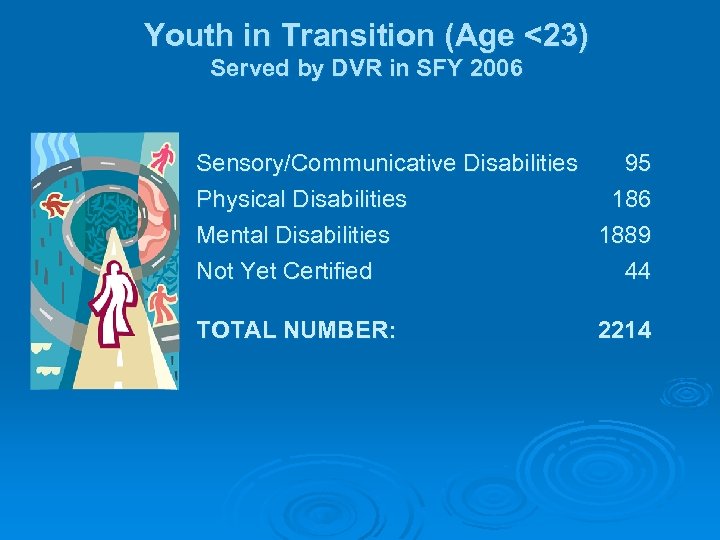 Youth in Transition (Age <23) Served by DVR in SFY 2006 Sensory/Communicative Disabilities 95 Physical Disabilities 186 Mental Disabilities 1889 Not Yet Certified 44 TOTAL NUMBER: 2214
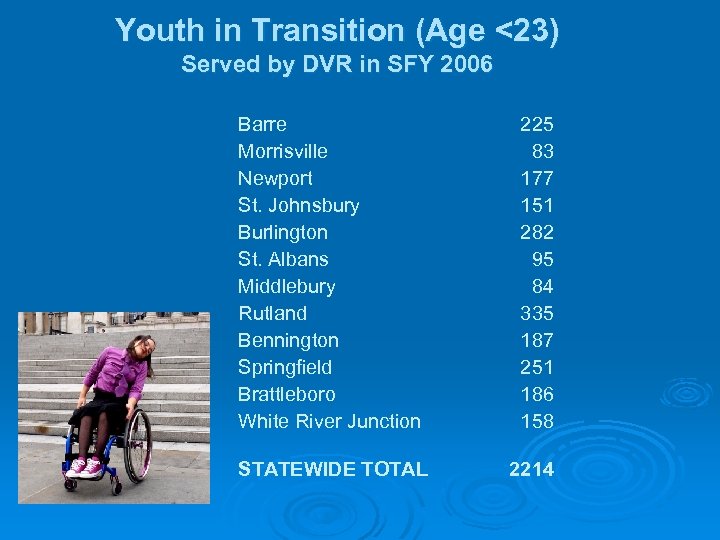 Youth in Transition (Age <23) Served by DVR in SFY 2006 Barre Morrisville Newport St. Johnsbury Burlington St. Albans Middlebury Rutland Bennington Springfield Brattleboro White River Junction 225 83 177 151 282 95 84 335 187 251 186 158 STATEWIDE TOTAL 2214
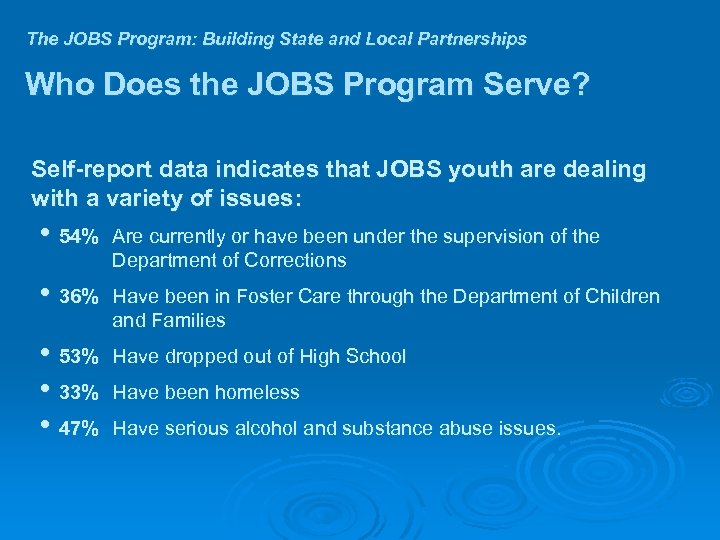 The JOBS Program: Building State and Local Partnerships Who Does the JOBS Program Serve? Self-report data indicates that JOBS youth are dealing with a variety of issues: • 54% Are currently or have been under the supervision of the Department of Corrections • 36% Have been in Foster Care through the Department of Children and Families • 53% • 33% • 47% Have dropped out of High School Have been homeless Have serious alcohol and substance abuse issues.
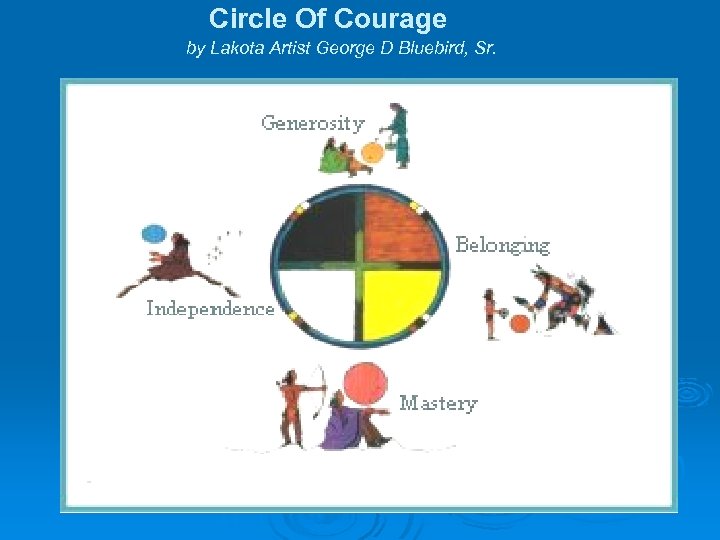 Circle Of Courage by Lakota Artist George D Bluebird, Sr.
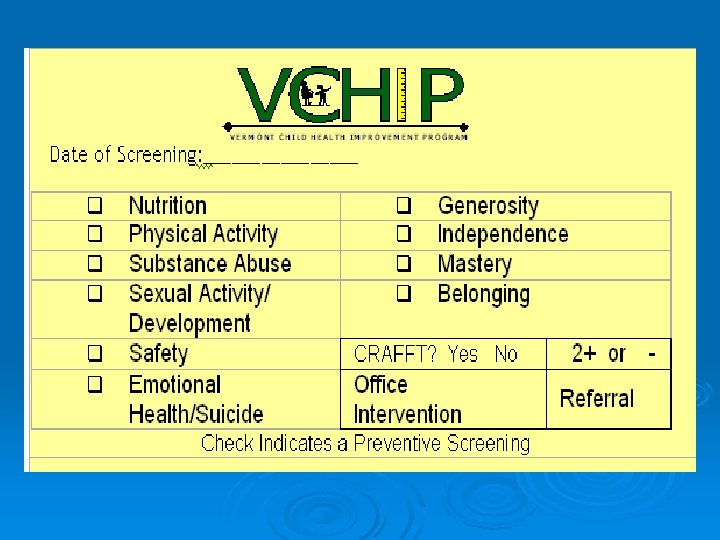
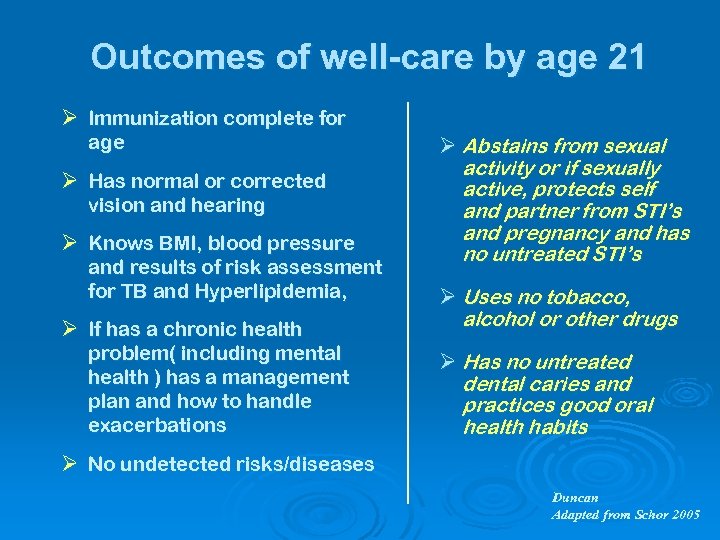 Outcomes of well-care by age 21 Ø Immunization complete for age Ø Has normal or corrected vision and hearing Ø Knows BMI, blood pressure and results of risk assessment for TB and Hyperlipidemia, Ø If has a chronic health problem( including mental health ) has a management plan and how to handle exacerbations Ø Abstains from sexual activity or if sexually active, protects self and partner from STI’s and pregnancy and has no untreated STI’s Ø Uses no tobacco, alcohol or other drugs Ø Has no untreated dental caries and practices good oral health habits Ø No undetected risks/diseases Duncan Adapted from Schor 2005
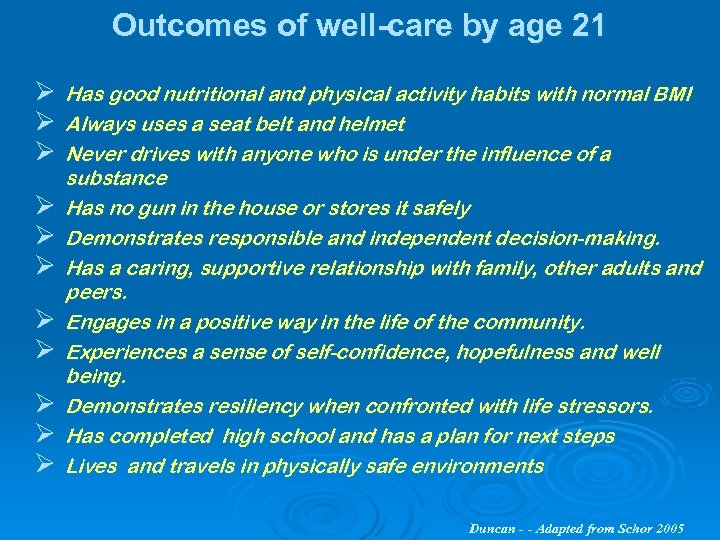 Outcomes of well-care by age 21 Ø Has good nutritional and physical activity habits with normal BMI Ø Always uses a seat belt and helmet Ø Never drives with anyone who is under the influence of a Ø Ø Ø Ø substance Has no gun in the house or stores it safely Demonstrates responsible and independent decision-making. Has a caring, supportive relationship with family, other adults and peers. Engages in a positive way in the life of the community. Experiences a sense of self-confidence, hopefulness and well being. Demonstrates resiliency when confronted with life stressors. Has completed high school and has a plan for next steps Lives and travels in physically safe environments Duncan - - Adapted from Schor 2005
 Emerging Recommendations Ø Voc. Rehab Ø DCF – Family Services
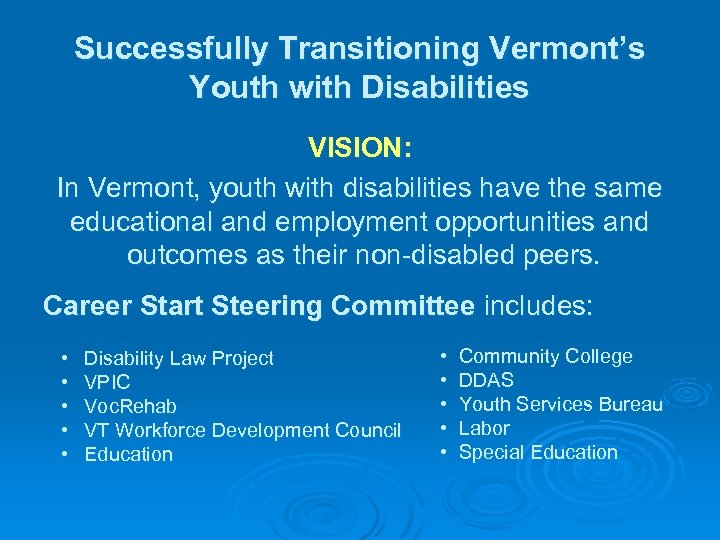 Successfully Transitioning Vermont’s Youth with Disabilities VISION: In Vermont, youth with disabilities have the same educational and employment opportunities and outcomes as their non-disabled peers. Career Start Steering Committee includes: • • • Disability Law Project VPIC Voc. Rehab VT Workforce Development Council Education • • • Community College DDAS Youth Services Bureau Labor Special Education
 Present Challenges Ø Transition planning Ø Employment Ø System of care Ø Baseline data and accountability
 Recommendations for State Agencies and Statewide Organizations Ø Make transition planning for youth with disabilities a priority of AHS, DOE and DOL Ø Invest in training and professional development Ø Ensure equal access to transition services throughout the State Ø Develop a data-driven system for improved strategic planning Ø Engage the business community
 Recommendations for Local Communities Ø Engage local partners Ø Provide career preparation and work-based learning experiences Ø Involve and support parents, families and other caring adults Ø Encourage youth development and leadership
 Next Steps Ø Fall 2006: Career Start Steering Committee will widely disseminate the report Ø January 2007: Begin implementation of recommendations Ø Fall 2007: Assess progress to date; review evolving priorities
 What do we know about youth aging out of foster care in the DCF Family Services Division? ? ?
 Demographics Ø Family Services serves as the legal custodian for 1500 children & youth daily Ø 150 youth “age out” of care every year Ø 50 return to family or guardians Ø 100 “age out” without a permanent connection to an adult
 Recommendations of the Task Force to Support Youth Aging Out of Foster Care Ø Personal & Community Engagement Ø Ongoing Support for Living Arrangements Beyond Age 18 Ø Improving Casework & Permanency Outcomes
 Recommendations Continued… Ø Emphasis on Higher Education Ø Coordinated Employment & Vocational Training Ø Safe and Affordable Housing Ø Accessible Health Care
 Next Steps Ø Fall 2006 - Finalize the Report of the Governor’s Task Force on Youth Aging Out of Foster Care Ø Ongoing coordination for youth in transition with other efforts system wide Ø 2007 – Implementation of Recommendations
 Policymaker and Partners Fishbowl