


 Скачать презентацию Transforming Organizations through Open Source Software Walt Scacchi
64a45c1f982f228ea9df204859952632.ppt
- Количество слайдов: 63
 Transforming Organizations through Open Source Software Walt Scacchi Institute for Software Research University of California, Irvine, CA 92697 -3425 USA wscacchi@ics. uci. edu http: //www. ics. uci. edu/~wscacchi 15 June 2005
 2
2
 3
3
 4
4
 5
5
 Overview • • • Open source software development OSSD business models Organizational forms for OSSD Governance structures for OSSD Transforming organizations via OSS 6
 Open Source Software Development 7
 What do we know so far about OSSD? • What is it, what is it not • Who is participating or investing? • Recent research results 8
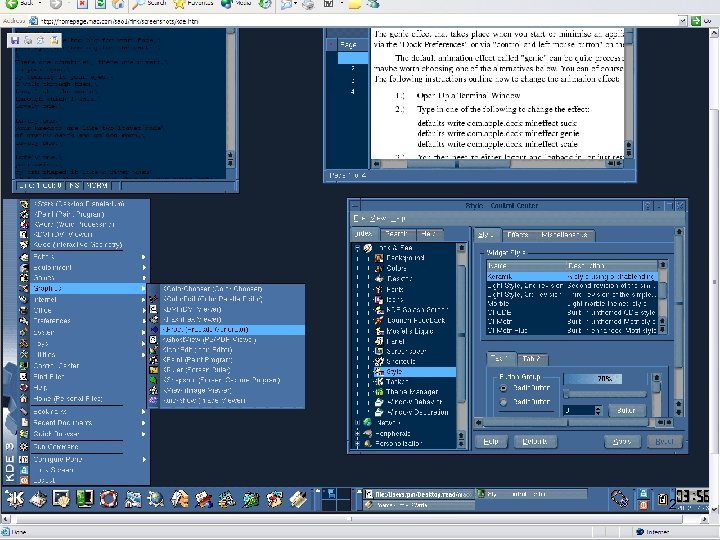
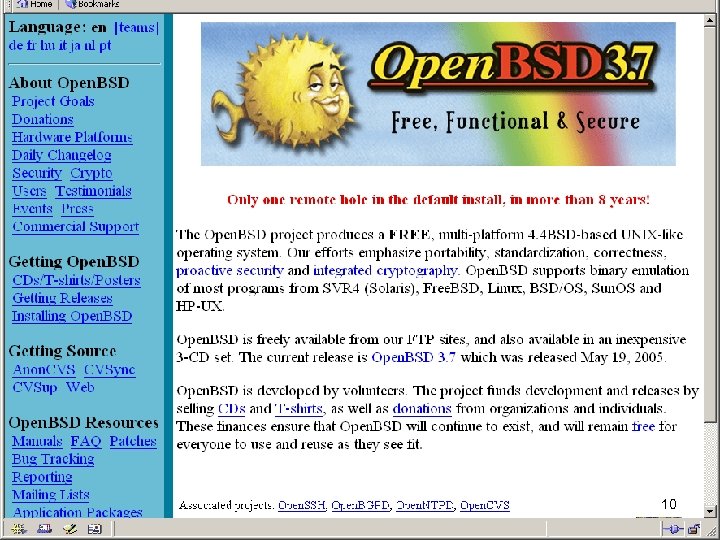
 What is OSSD, what is it not? • Free (as in “freedom”) vs. open source software – Freedom to access, browse/view, study, modify and redistribute the source code – Free is always open, but open is not always free • F/OSSD is not “software engineering” – Different: F/OSSD can be faster, better, and cheaper than SE – SE “-ilities” may not apply in the same way to OSSD • F/OSSD involves more software development tools, Web resources, and personal computing resources 9
 10
10
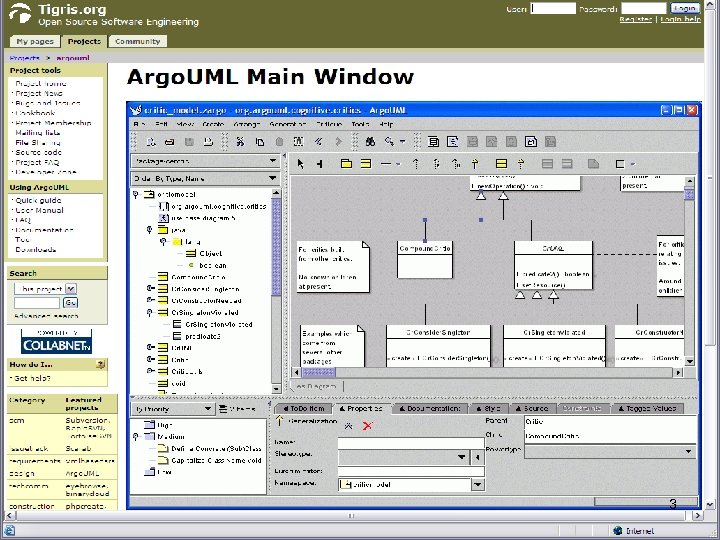
 Who is investing in OSS? • Large corporations/enterprises: – IBM-Eclipse, Sun-Net. Beans and Open. Office, HPGelato, Apple-Darwin, Microsoft Research-Rotor, etc. – Barclays Global Investors, DKW, Merrill Lynch, etc. – Do. D, Do. E, NSF, NIH, NASA, etc. – MIT, Stanford, CMU, UC, UMichigan, etc. • Mid-size corporations: – Red. Hat, Novell, Borland • Small (start-up) companies: – Active. State (now part of Sophos), Collab. Net, Jabber, Ximian (now part of Novell), JBoss, Compiere, etc. 11
 Recent research results • OSS project demographics • OSSD processes and practices – Software requirements and design – Architectural practices – Configuration management and work practices – Evolution dynamics – Project management and career contingencies – Software technology transfer 12
 13
13
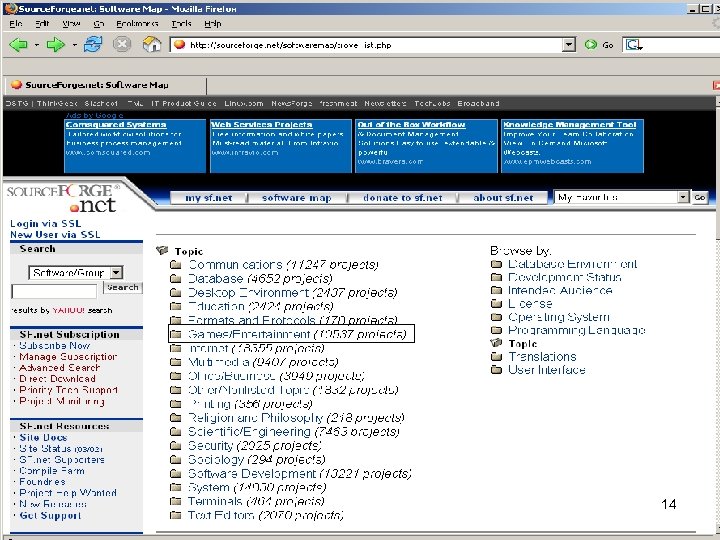 14
14
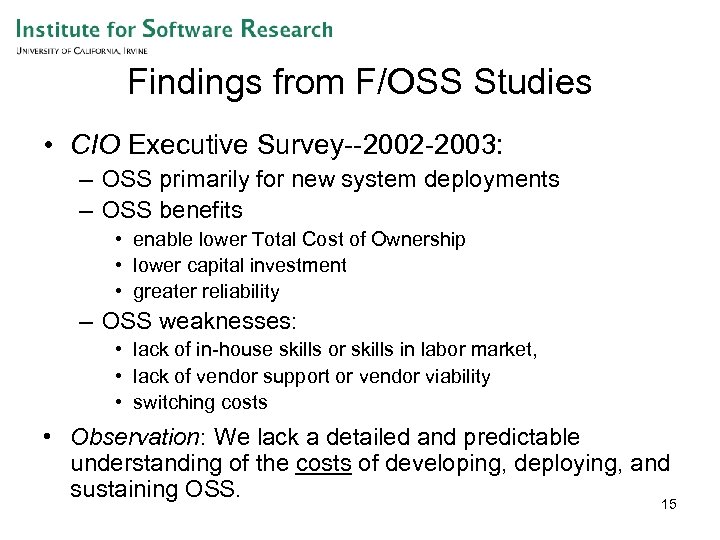 Findings from F/OSS Studies • CIO Executive Survey--2002 -2003: – OSS primarily for new system deployments – OSS benefits • enable lower Total Cost of Ownership • lower capital investment • greater reliability – OSS weaknesses: • lack of in-house skills or skills in labor market, • lack of vendor support or vendor viability • switching costs • Observation: We lack a detailed and predictable understanding of the costs of developing, deploying, and sustaining OSS. 15
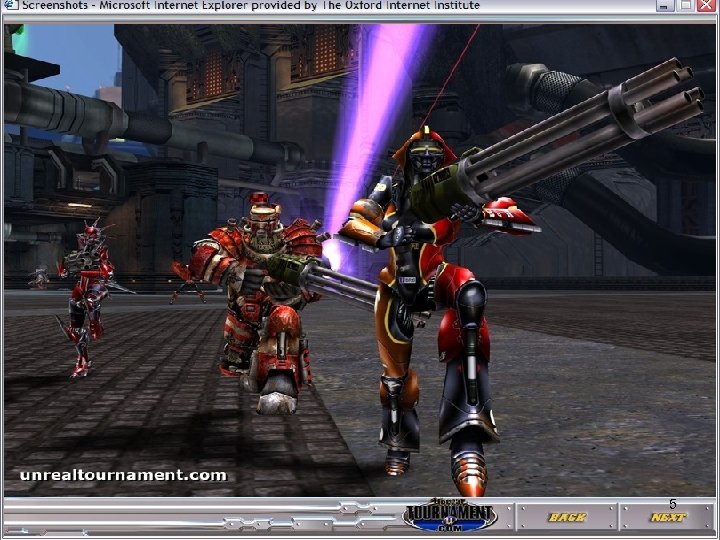
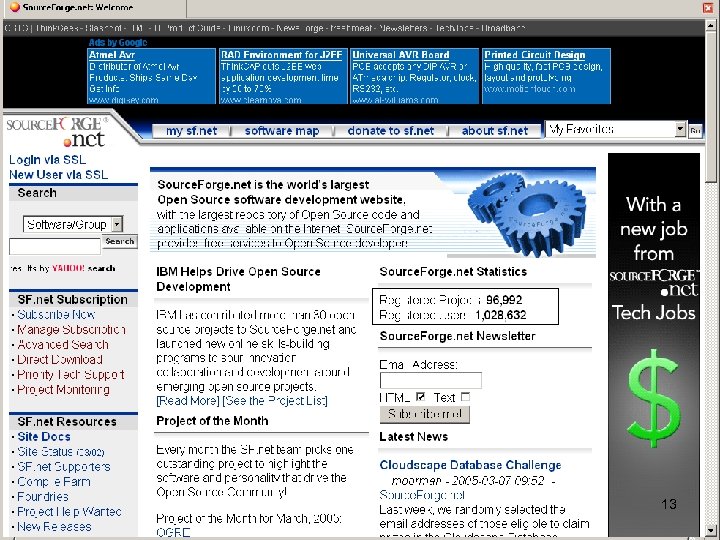
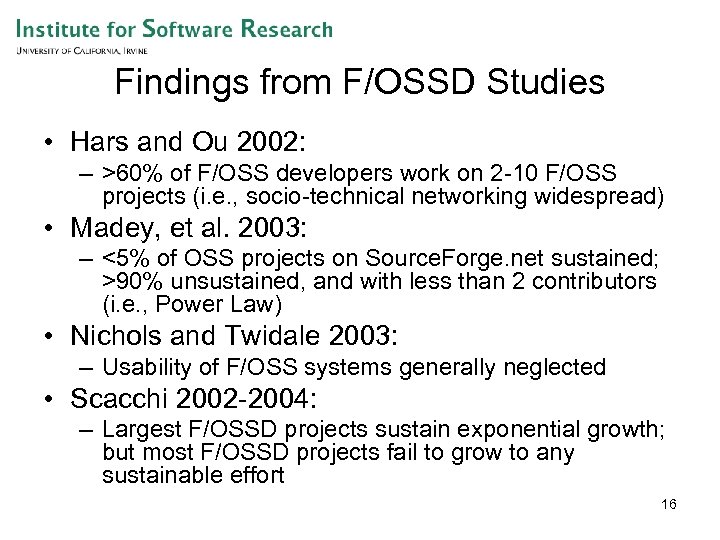 Findings from F/OSSD Studies • Hars and Ou 2002: – >60% of F/OSS developers work on 2 -10 F/OSS projects (i. e. , socio-technical networking widespread) • Madey, et al. 2003: – <5% of OSS projects on Source. Forge. net sustained; >90% unsustained, and with less than 2 contributors (i. e. , Power Law) • Nichols and Twidale 2003: – Usability of F/OSS systems generally neglected • Scacchi 2002 -2004: – Largest F/OSSD projects sustain exponential growth; but most F/OSSD projects fail to grow to any sustainable effort 16
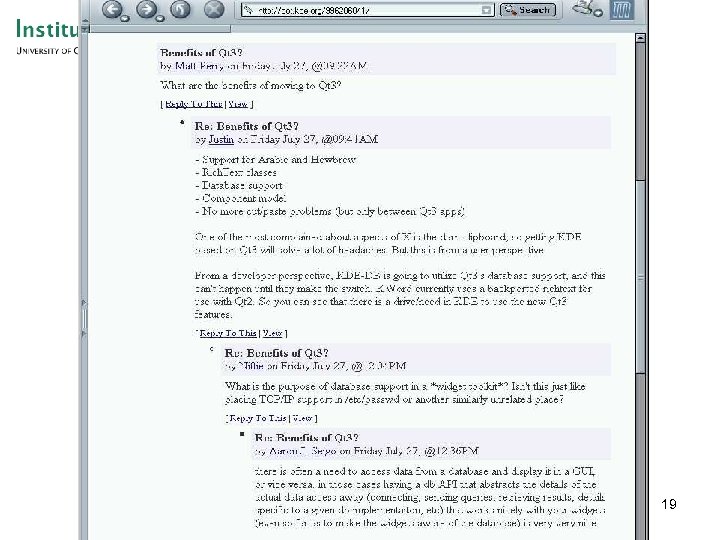
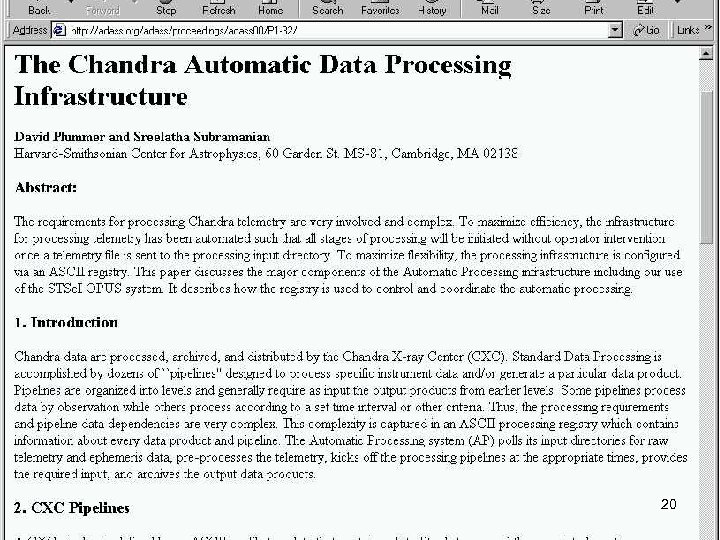
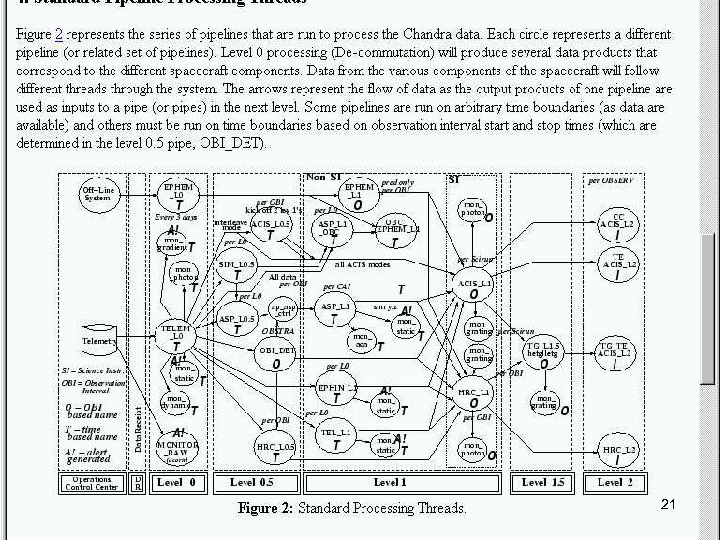
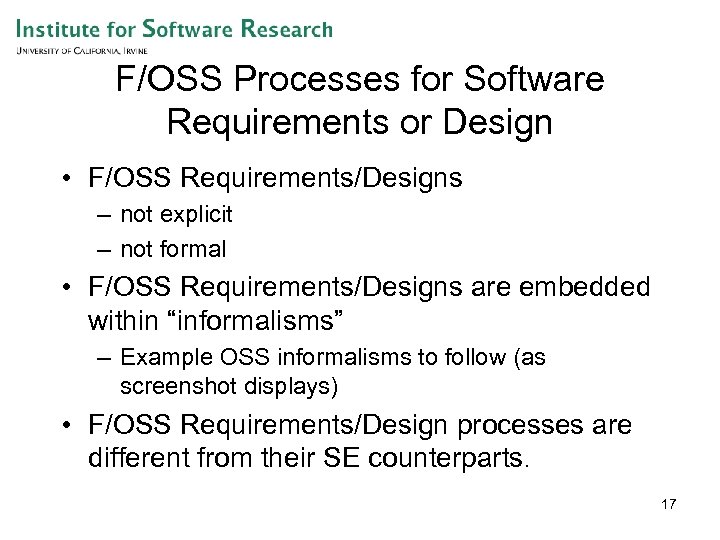 F/OSS Processes for Software Requirements or Design • F/OSS Requirements/Designs – not explicit – not formal • F/OSS Requirements/Designs are embedded within “informalisms” – Example OSS informalisms to follow (as screenshot displays) • F/OSS Requirements/Design processes are different from their SE counterparts. 17
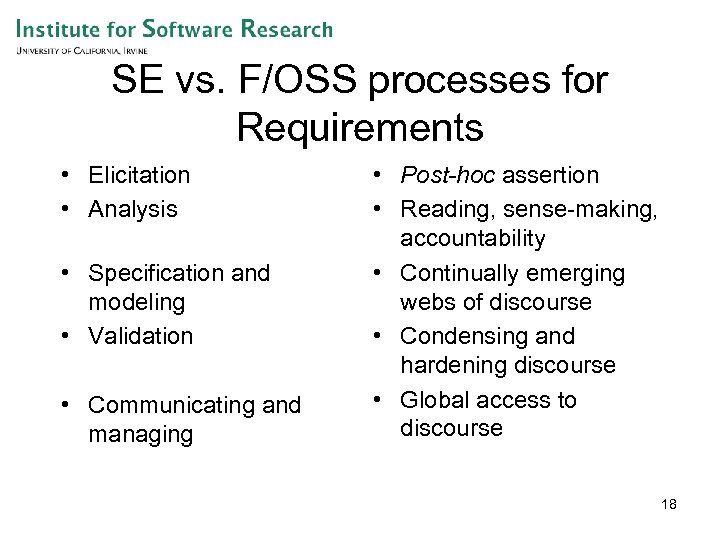 SE vs. F/OSS processes for Requirements • Elicitation • Analysis • Specification and modeling • Validation • Communicating and managing • Post-hoc assertion • Reading, sense-making, accountability • Continually emerging webs of discourse • Condensing and hardening discourse • Global access to discourse 18
 19
19
 20
20
 21
21
 OSS architectural issues • Source code as API – Unpredictable evolution of product line • Bricolage – Unanticipated composition of heterogeneous software components • Social networks and software configurations: Conway’s law revisited – OSS are socio-technical systems 22
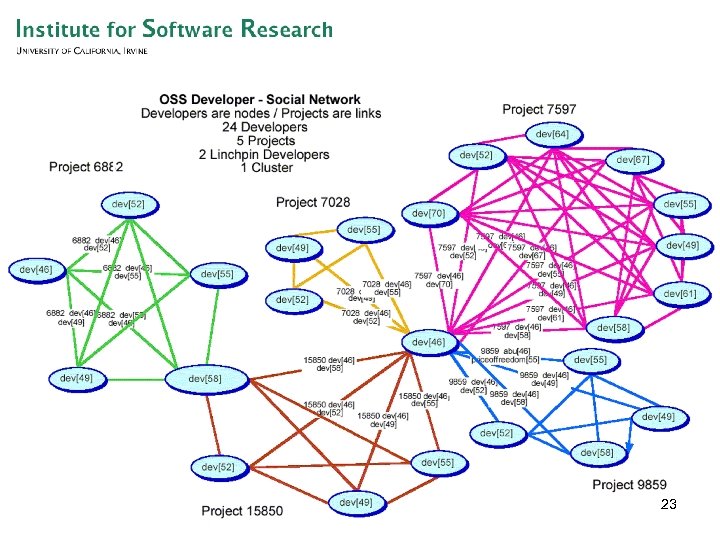 23
23
 Configuration management and work coordination • Use CM to coordinate and control who gets to update what part of the system/online artifacts – Many F/OSSD projects use CVS (single centralized code repository with update locks) and frequent releases (daily releases on active projects) – Collab. Net and Tigris. org: Subversion (CVS++) – Apache: Single major release, with frequent “patch” releases (e. g. , “A patchy server”) – Linux Kernel: Bit. Keeper (multiple parallel builds and release repositories)—being replaced by Git – GNU arch seeks to develop Free CM unification 24
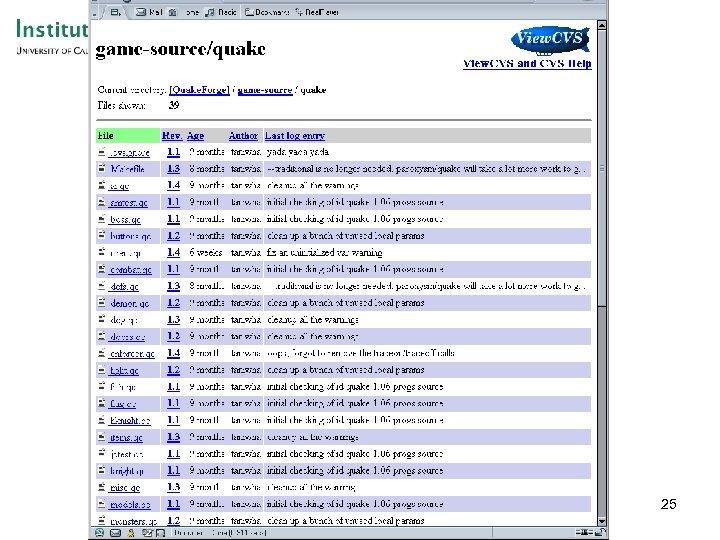 Concurrent version system (CVS) for coordinating source code updates 25
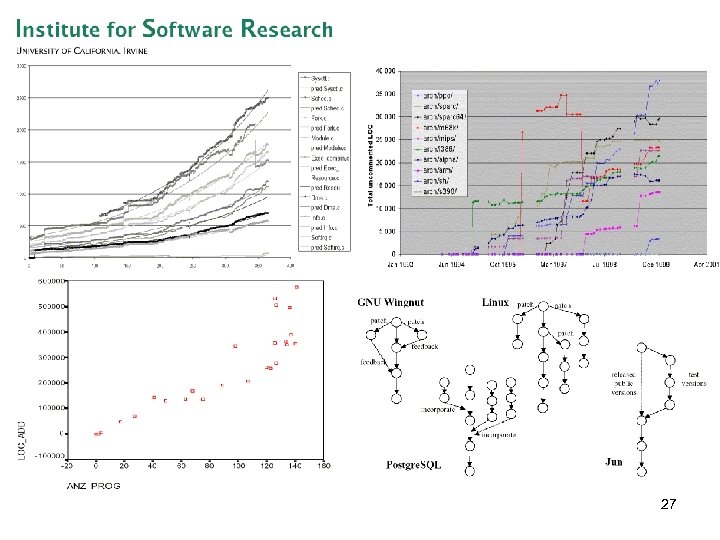
 Evolutionary redevelopment, reinvention, and redistribution • Overall evolutionary dynamic of F/OSSD is reinvention – Reinvention enables continuous improvement • F/OSS evolve through minor mutations – Expressed, recombined, redistributed via incremental releases • F/OSS systems co-evolve with their development community – Success of one depends on the success of the other • Closed legacy systems may be revitalized via opening and redistribution of their source – When enthusiastic user-developers want their cultural experience with such systems to be maintained. 26
 27
27
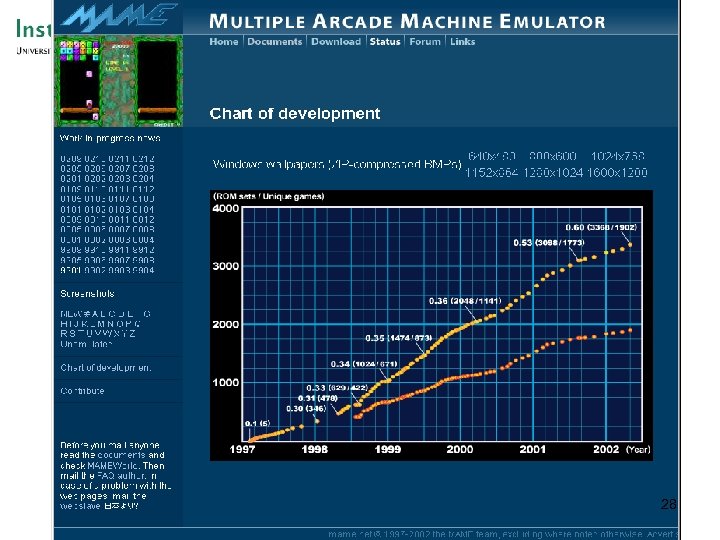 Revitalizing legacy applications via open source example 28
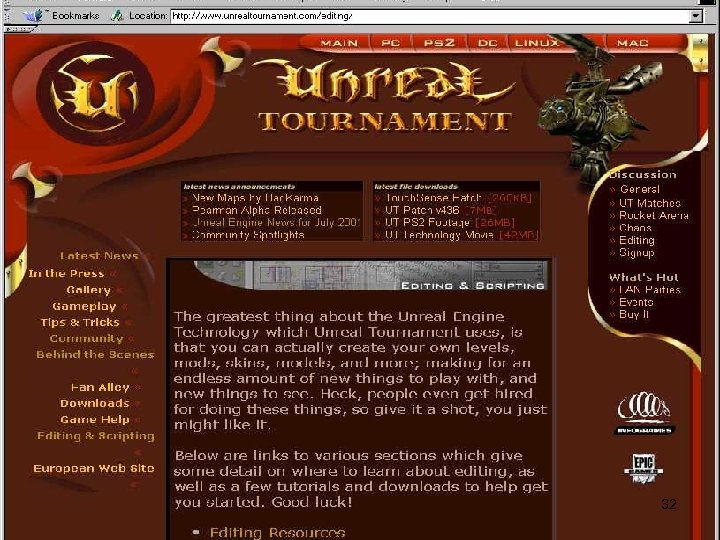
 Project management and career development • F/OSSD projects self-organize as a pyramid meritocracy via virtual project management – Meritocracies embrace incremental mutations over radical innovations – VPM requires people to act in leadership roles based on skill, availability, and belief in project community • F/OSS developers want to learn about new stuff (tools, techniques, skills, etc. ), have fun building software, exercise their technical skill, try out new kinds of systems to develop, and/or interconnect multiple F/OSSD projects. 29
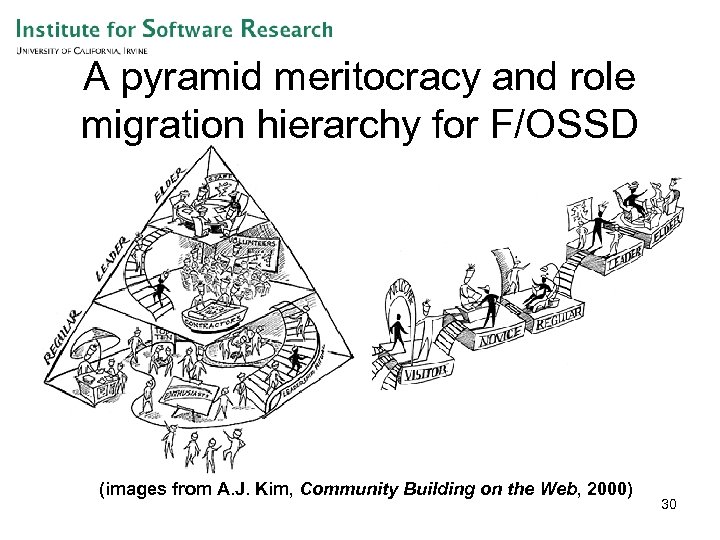 A pyramid meritocracy and role migration hierarchy for F/OSSD (images from A. J. Kim, Community Building on the Web, 2000) 30
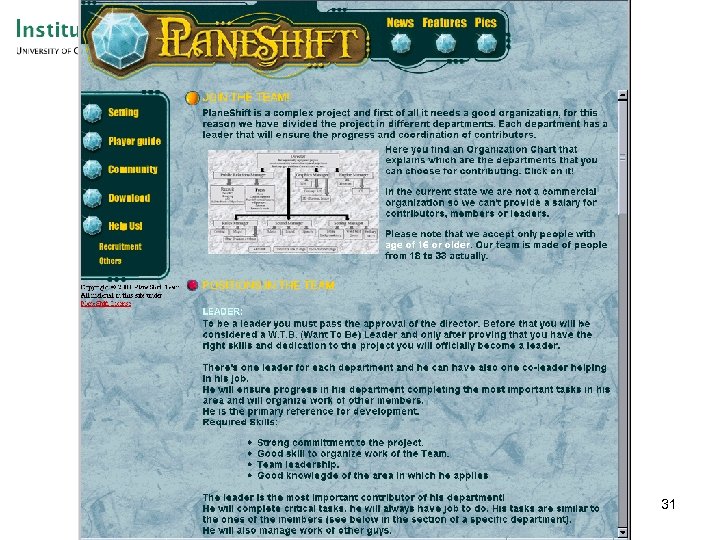 Virtual project management example 31
 32
32
 Software technology transfer and licensing • F/OSS technology transfer from existing Web sites is a community and team building process – Not (yet) an engineering process – Enables unanticipated applications and uses – Enables F/OSSD to persist without centrally planned and managed corporate software development centers 33
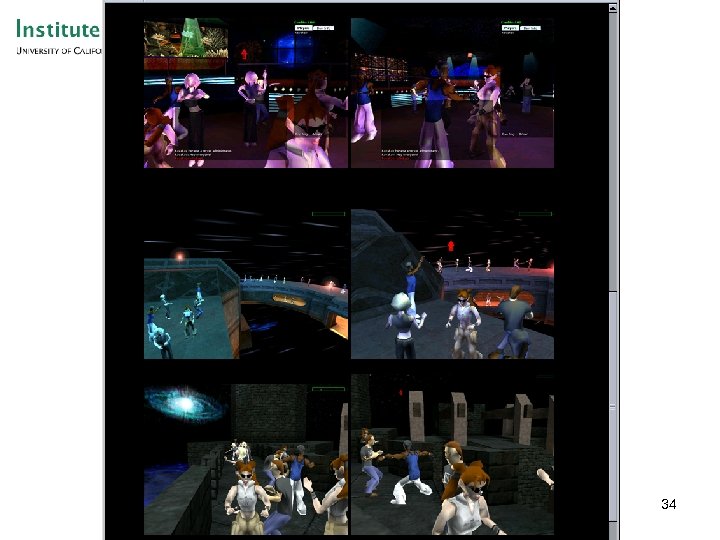 Example of F/OSS technology transfer that enabled creation of new kind of application (e. g. , online virtual dancing) 34
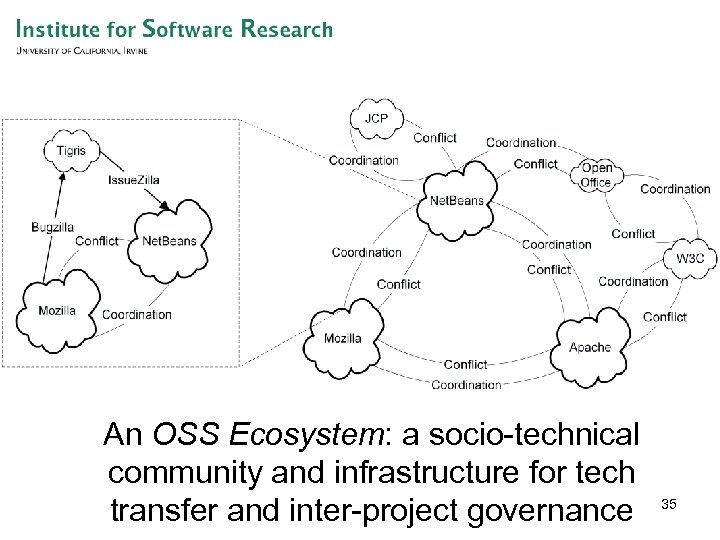 An OSS Ecosystem: a socio-technical community and infrastructure for tech transfer and inter-project governance 35
 Implications • F/OSSD is a community building process – not just a technical development process – F/OSS peer review creates a community of peers • F/OSSD processes often iterate daily versus infrequent singular (milestone) Software Life Cycle Engineering events – F/OSSD: frequent, rapid cycle time (easier to improve) vs. – SLC: infrequent, slow cycle time (harder to improve) 36
 Conclusions regarding OSSD • Developing F/OSS is different than software engineering – not better, not worse, but different and new – more social, more accessible, more convivial • F/OSS developers may not seek the goals and benefits from classic software engineering 37
 OSSD Business Models 38
 Traditional software production business models • • • Custom software product engineering Cost reduction Agile production Revenue maximization Profit maximization Market dominance M. Cusumano, The Business of Software : What Every Manager, Programmer, and Entrepreneur Must Know to Thrive and Survive in Good Times and Bad , Free Press, 2004. 39
 OSSD Business Models • Free software (General Public License) • Open source (BSD/MIT license) • Dual license – F/OSS and proprietary licenses • • Corporate sponsored (SUN, IBM, Apple, HP) Corporate Source (Hewlett-Packard in-house) Shared Source (Microsoft Research) Community Source (SAKAI, Westwood, etc. in Higher Education) 40
 Organizational Forms for OSSD 41
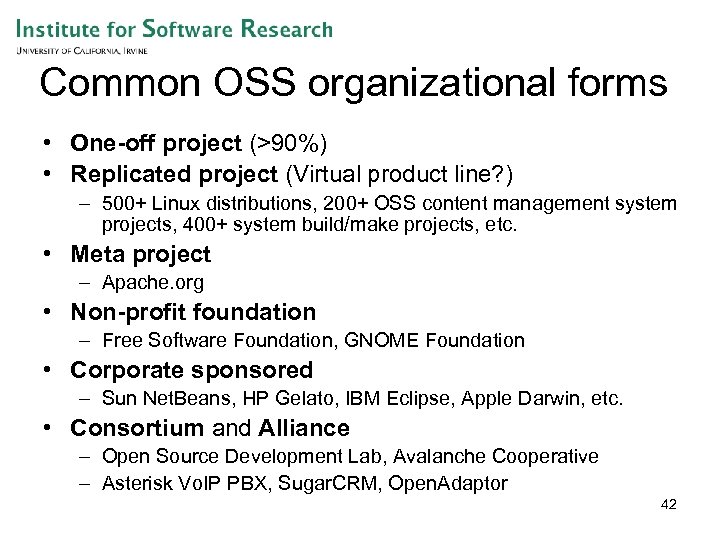 Common OSS organizational forms • One-off project (>90%) • Replicated project (Virtual product line? ) – 500+ Linux distributions, 200+ OSS content management system projects, 400+ system build/make projects, etc. • Meta project – Apache. org • Non-profit foundation – Free Software Foundation, GNOME Foundation • Corporate sponsored – Sun Net. Beans, HP Gelato, IBM Eclipse, Apple Darwin, etc. • Consortium and Alliance – Open Source Development Lab, Avalanche Cooperative – Asterisk Vo. IP PBX, Sugar. CRM, Open. Adaptor 42
 Governance Structures for OSSD 43
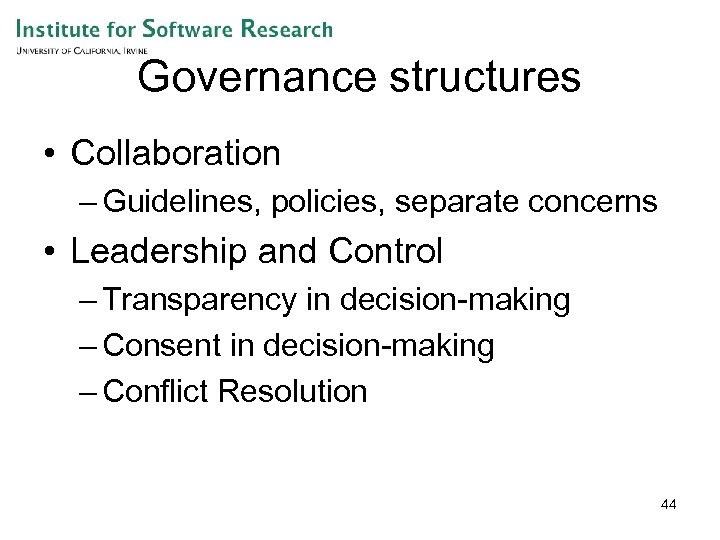 Governance structures • Collaboration – Guidelines, policies, separate concerns • Leadership and Control – Transparency in decision-making – Consent in decision-making – Conflict Resolution 44
 Transforming Organizations via OSS 45
 Transforming organizations • • Concepts Methods Tools Case studies 46
 Concept • Transforming organization target from as-is condition to to-be form via here-to-there transformations • Transformation goal: Aligning organizational form, processes, strategy, and information technology – – Organizational forms Open source processes Business model strategy Web-centric OSS infrastructure 47
 Methods • Change management – Empowering organizational participants to embrace, lead, and affect organizational transformation • Process engineering – Proving participants with the concepts, techniques, tools, and authority to transform their organization in a process-centric manner 48
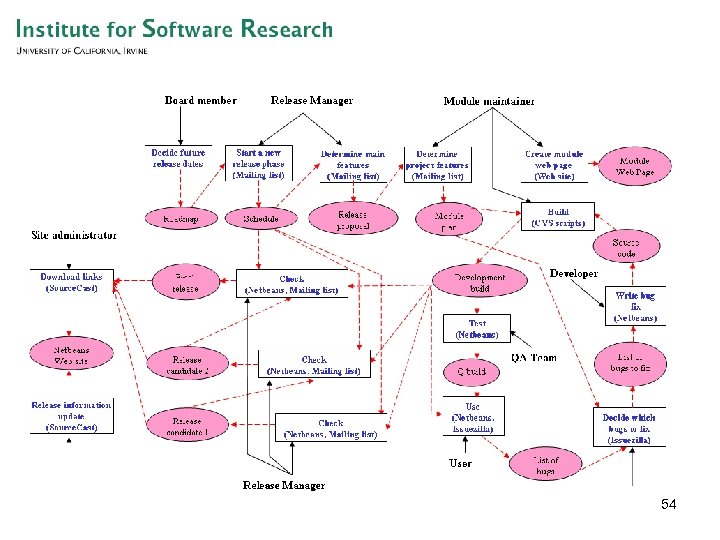
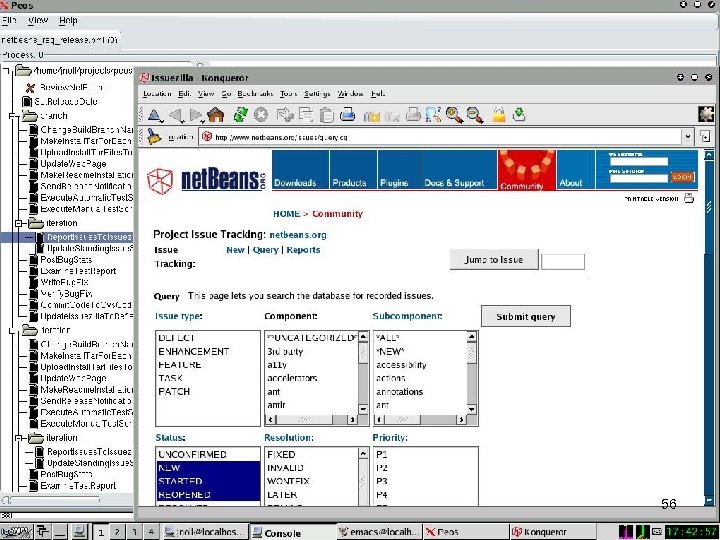
 Tools (1) • Organizational process modeling, analysis, simulation, visualization, re-enactment, and redesign – Supports capture, description, and application of causal and interrelated knowledge about what can affect software development (from empirical studies). – Requires an underlying computational model of process states, actions, plans, schedules, expectations, histories, etc. in order to answer dynamic "what-if" questions. 49
 Tools (2) Organizational transformation collaboratory • An immersive environment where participants can take a first-person view of simulated organizational processes, before, during, and after transformation • Using either an organizational process simulator, or a game-based computer supported collaborative organizational learning environment (CSCOLE) 50
 Case Studies Core process transformation at ONR – Process engineering using organizational transformation laboratory • Supporting long-term, large-scale transformation – MMORPG-based computer supported collaborative organizational learning environment • Massively, multi-player online role playing game • Transforming a software productivity crisis at “Big. Sys. Co” – Process engineering and process simulator 51
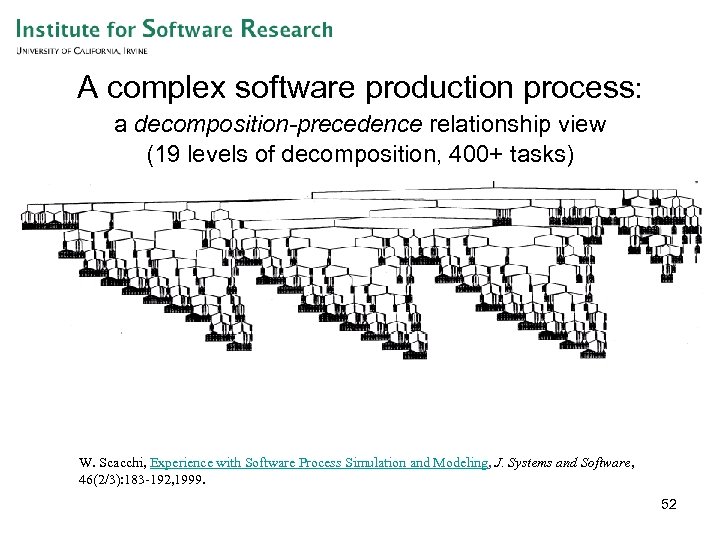 A complex software production process: a decomposition-precedence relationship view (19 levels of decomposition, 400+ tasks) W. Scacchi, Experience with Software Process Simulation and Modeling, J. Systems and Software, 46(2/3): 183 -192, 1999. 52
 53
53
 54
54
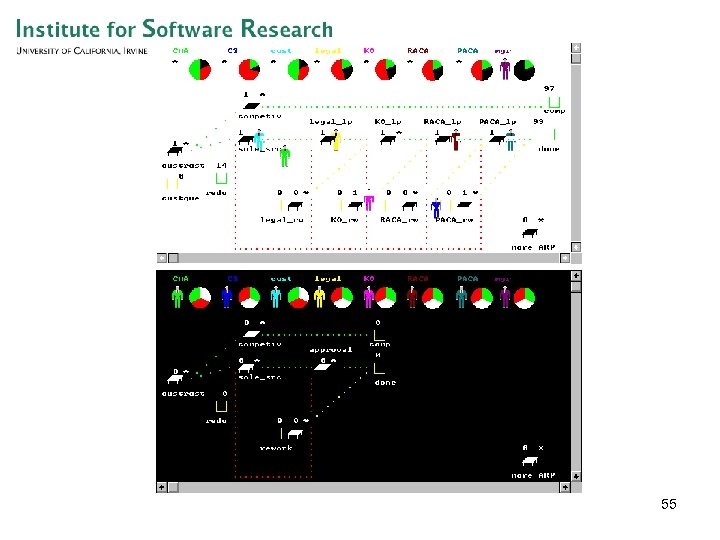 As-is vs. to-be process 55
 56
56
 Identify and cultivate software productivity drivers • Why are software developers so productive in the presence of technical and organizational constraints? • Software developers must realize the potential for productivity improvement. – The potential for productivity improvement is not an inherent property of new software development technology. – Technological impediments and organizational constraints can nullify this potential. • Thus, a basic concern must be to identify and cultivate software productivity drivers. – Examples include workplace incentives and alternative software business models 57
 Open source processes • Free/open source software does not embody the processes for how to develop, deploy, use or sustain them – Deploying free/open source software is low-cost, but often inefficient and sub-optimal • Closed source software development, deployment, use, and support is also inefficient and sub-optimal – Explicit open source processes could also help closed source systems. 58
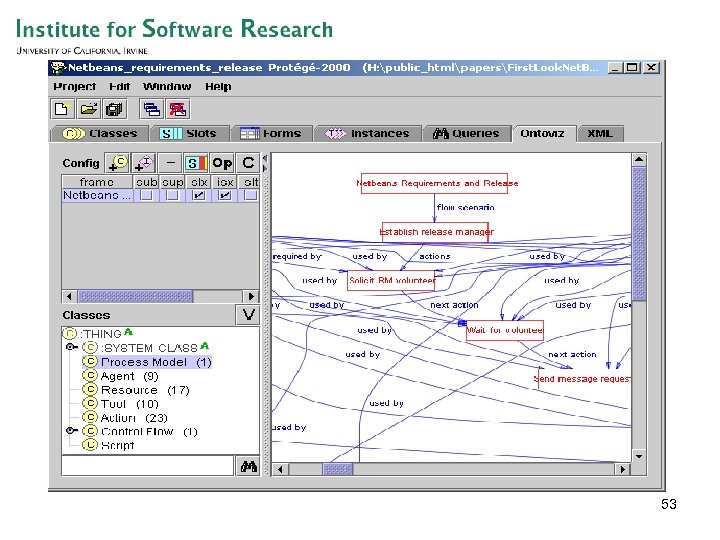
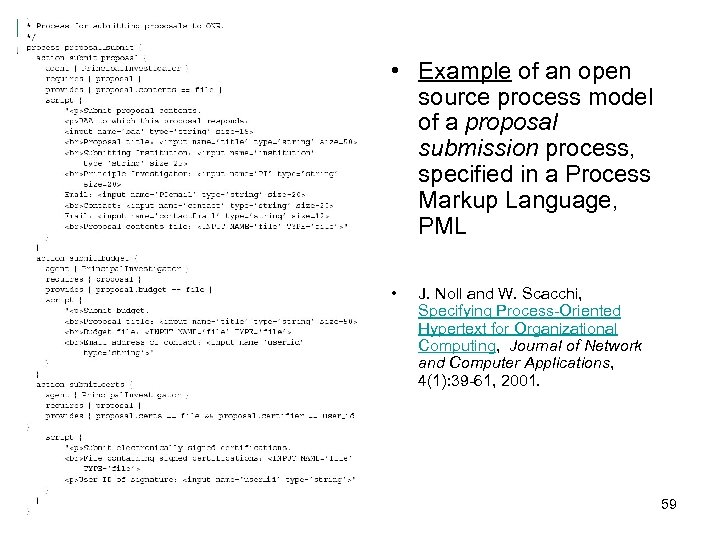 Open source process example • Example of an open source process model of a proposal submission process, specified in a Process Markup Language, PML • J. Noll and W. Scacchi, Specifying Process-Oriented Hypertext for Organizational Computing, Journal of Network and Computer Applications, 4(1): 39 -61, 2001. 59
 Questions? 60
 61
61
 Acknowledgements • Project collaborators: – – – Mark Ackerman, UMichigan, Ann Arbor Les Gasser, UIUC John Noll, Santa Clara University Margaret Ellliot, Chris Jensen, UCI-ISR And others at UCI-ISR • Funding support: – National Science Foundation, ITR#-0083075, ITR#-#0205679, ITR#-0205724, and ITR#-#0350754 • No endorsement implied. 62
 References • W. Scacchi, Understanding the Requirements for Developing Open Source Software, IEE Proceedings--Software, 149(1), 2439, 2002. • W. Scacchi, Free/Open Source Software Development Practices in the Computer Game Community, IEEE Software, 21(1), 59 -67, January/February 2004. • C. Jensen and W. Scacchi, Experiences in Discovering, Modeling, and Reenacting Open Source Software Development Processes, Proc. Software Process Workshop, Beijing, China, May 2005. • W. Scacchi, Understanding Free/Open Source Software Evolution, in N. H. Madhavji, M. M. Lehman, J. F. Ramil and D. Perry (eds. ), Software Evolution, John Wiley and Sons Inc, New York, (to appear). • More at www. isr. uci. edu/research-open-source. html 63