


 Скачать презентацию Transforming New Zealand employment relations The role played
ada2758eb1063bc74376e19017c954dc.ppt
- Количество слайдов: 9
 Transforming New Zealand employment relations: The role played by employer strategies, behaviours and attitudes Erling Rasmussen, Barry Foster & Deidre Coetzee AUT & Massey University, New Zealand © Rasmussen, Foster & Coetzee 2013
 Overview Major context & ER changes since late 1980 s Rise in individualism & employer workplace power Why hasn’t the outcomes been better? Our focus: employer attitudes & strategies General theme: more employer-driven flexibility Limited research => our surveys of employers 2009 -10 surveys: employer attitudes to collective bargaining => find limited active support Current surveys focus on legislative changes © Rasmussen, Foster & Coetzee 2013
 Path-breaking legislative change Arbitration system (1894 -1991) Employment Contracts 1991 Radical path-breaking ‘non-prescriptive’ framework Fits with other ‘individualising’ Acts & interventions Employment Relations Act (ERA) 2000 Explicit support of collective bargaining & unions BUT it doesn’t bring about revival of CB & unions • Private sector union density falls sharply to below 10% Key Q: why have outcomes been poor? © Rasmussen, Foster & Coetzee 2013
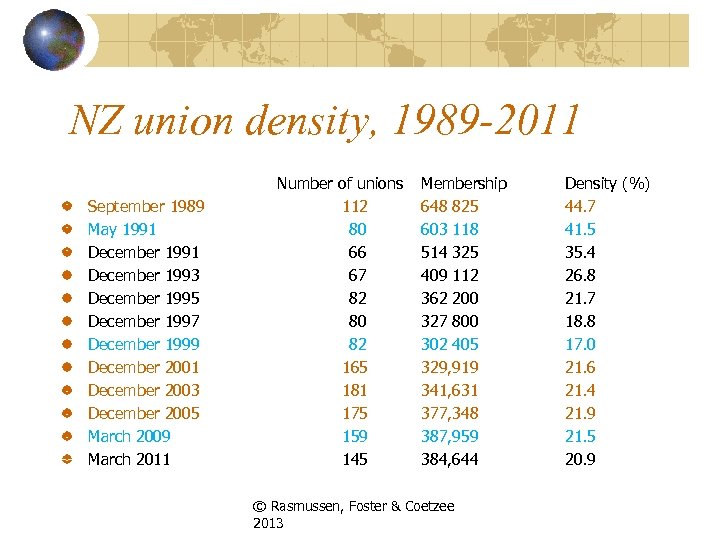 NZ union density, 1989 -2011 September 1989 May 1991 December 1993 December 1995 December 1997 December 1999 December 2001 December 2003 December 2005 March 2009 March 2011 Number of unions 112 80 66 67 82 80 82 165 181 175 159 145 Membership 648 825 603 118 514 325 409 112 362 200 327 800 302 405 329, 919 341, 631 377, 348 387, 959 384, 644 © Rasmussen, Foster & Coetzee 2013 Density (%) 44. 7 41. 5 35. 4 26. 8 21. 7 18. 8 17. 0 21. 6 21. 4 21. 9 21. 5 20. 9
 Outcomes have disappointed Productivity growth has been low Relative decline for several decades • Explanations vary: many SMEs, management skills, limited investments, skills, short-term focus, etc. Inequality has grown above OECD average “Living Wage” campaign has started recently Low wages have prompted ‘brain drain’ Post 2008 policies: encourage low ER standards Recently: regulatory failures & ER conflicts © Rasmussen, Foster & Coetzee 2013
 ERA & role of employer attitudes Several well-known factors behind union decline: employer attitudes is just one factor Including: ‘representation gap’, no MECAs, apathy Earlier surveys find 2 groups of employers Are employers engaged or not engaged in CB? Many employers see unions as ‘irrelevant’ Shift in employer attitudes & behaviours Employers are seeking fewer regulations Diverse employment outcomes & ‘working poor’ © Rasmussen, Foster & Coetzee 2013
 Current surveys 1 Results are based on first survey Employers in South Island Lower North Island Mail survey with response rate 16% • Follow-up in-depth interviews of some employers Another survey will provide full national coverage Overall support of legislative changes Emphasis on employer prerogative (less PG rights), holiday buy-out & union avoidance • Highlights long-term employer concerns © Rasmussen, Foster & Coetzee 2013
 Current surveys 2 Appear to have had limited impact 1/3 of employers: new regulations have impacted significantly on their business 2/3: have had no or limited impact from new regs ER has been impacted: ~23% score yes but ~73% score limited or no impact Results need to be analysed further Is there a time lag; is it only certain types of employers who have seen an impact; does it cover particular groups of employees; does it…. . ? © Rasmussen, Foster & Coetzee 2013
 Conclusion Major employer influence on reform agenda Surveys: employers support less legislation Allows for more employer-determined flexibility Will mainly influence “lower-end” types of jobs? Doesn’t have a major ER & business impact? Early days yet & new 90 -day rule appear to be used frequently for certain employee groups Can more ‘flexibility’, lower taxes & less (employer) compliance raise productivity? © Rasmussen, Foster & Coetzee 2013