


 Скачать презентацию Transforming knowledge to have policy impact Professor Judith
b02f9cd06f28420e037d318fbe89dc62.ppt
- Количество слайдов: 26
 Transforming knowledge to have policy impact Professor Judith Petts
 Questions: What challenges do academics face in trying to produce policy relevant work? o When working with policy institutions how is it possible to retain a critical and reflexive edge? o How might the process of writing for policy audiences inform theoretical work? o What are the implications of the impact challenge for institutions? o
 Why? o Demonstration of impact is now integral part of the environment in which HEIs operate o Funding of research – impact statement o Assessment of quality of impact – REF o Future QR of HEIs will be dependent in part on assessment of impact
 ESRC Royal Charter 1994 o To advance knowledge and provide trained social scientists which meet the needs of users and beneficiaries thereby contributing to the economic competitiveness of Our United Kingdom, the effectiveness of public services and policy and the quality of life
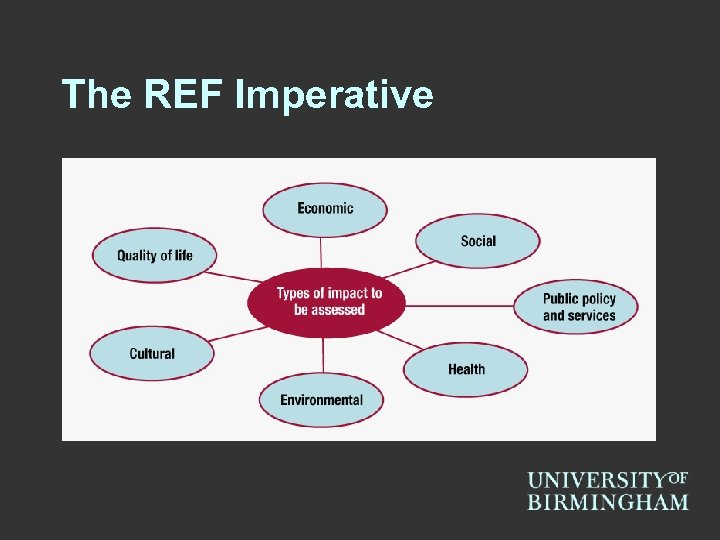 The REF Imperative
 RCUK – excellence with impact o Productive economy o Healthy society o Sustainable world
 Some Draft REF Indicators (!) o o o Changes to legislation/regulations/government policy Changes to public services practices/guidelines Measures of improved public services Staff exchanges with government organisations Participation on policy/advisory committees Influence on public policy debate
 Recognised Challenges o o o o Can be difficult to articulate at proposal stage Not only applied research – ‘pure’ research has often generated some of most significant returns Time lags – not just months or years but decades Multiple scales of impact – project, people, organisation – diversity across research portfolio Subject level granularity Attribution - not a linear route Not all impacts are expected or can be planned Verification of claims of impact
 The ‘Impact’ of Measurement? o ‘If we measure then we change thing we measure’ (Prof. Sir Martin Taylor, Royal Society) o Does formalising anything take away from what made it special? o Don’t want to end up with a fixation on process rather than impacts
 Defining the science/policy boundary o Boundary work – ways in which scientists construct, negotiate and defend the boundary between science & policy (Gieryn, 1983; Jasanoff, 1990) o Preferable sense is of working in and around the boundary (between science and policy)
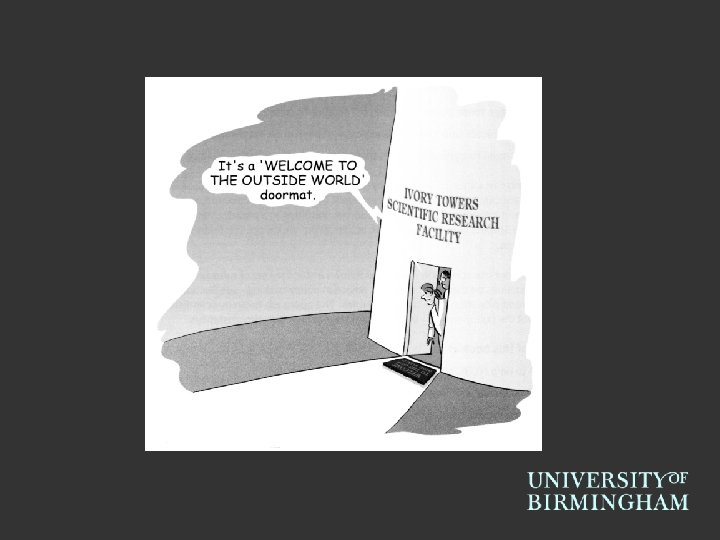
 o ‘We prided ourselves that the science we were doing could not, in any conceivable circumstances, have any practical use. The more firmly one could make that claim the more superior one felt’ (C P Snow, Rede Lecture, 1964)
![o ‘neither the academic [n]or the political has a particularly well-articulated sense of the](https://present5.com/presentation/b02f9cd06f28420e037d318fbe89dc62/image-12.jpg "o ‘neither the academic [n]or the political has a particularly well-articulated sense of the") o ‘neither the academic [n]or the political has a particularly well-articulated sense of the other’s agendas, practices and discourses, and still less of the possibilities for creating productive conjunctions’ (Jasanoff, 1996)
o ‘neither the academic [n]or the political has a particularly well-articulated sense of the other’s agendas, practices and discourses, and still less of the possibilities for creating productive conjunctions’ (Jasanoff, 1996)
 Timing is all…. Useable knowledge at the right time Knowledge not available at the critical moment is effectively not available at all o Some policy areas surrounded by strong regulatory drivers see policy developing ‘at a pace’ o Policy makers often don’t have the personal time to seek out research projects and findings o Research, if it influences policy, is only one of many drivers o o
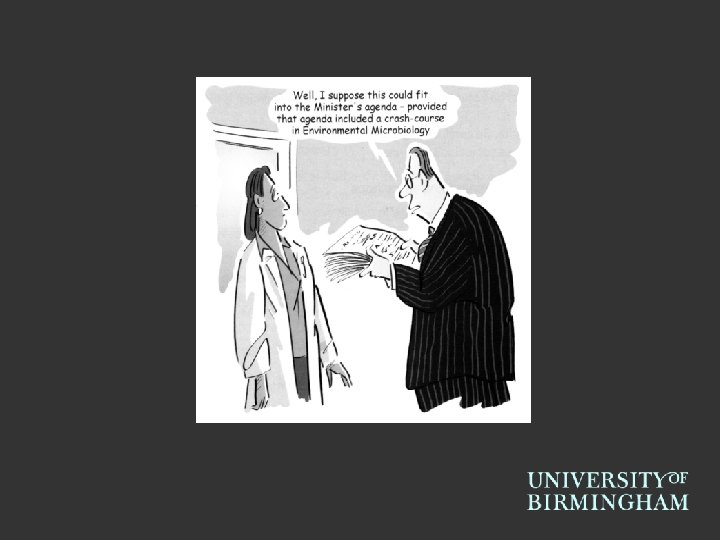
 Framing is all… o Being asked to produce answers to what is thought to be the wrong question o But reframing questions can seem threatening to the policy world o ‘Re-inventing the world’ o Often policy world does not appreciate the complexity of socio-technical systems
 Simplicity is all…. o Tension between the nuanced findings of much research and the demand on the part of policy makers for relatively simple/uncomplicated messages o Fine-line between digestibility and misleading selectivity o Tailoring conclusions to understanding of the policy limits
 So – Evidence-Based Policy? ? Huge enthusiasm for the concept – Cabinet Office; OSI/DIUS; Environmental Research Funders’ Forum; European Commission…. o But – social science research over decades has problematised the linear-rational model – why have the messages not got through? o In an era that privileges co-production of knowledge – how can this happen without it becoming crudely instrumental? o Learning from the Nutt case? o
 Personal Policy boundaries o o o o Major hazard risk and planning controls - Health & Safety Executive Contaminated land risk management – Do. E/DETR/Environment Agency/Various public sector landowners Waste strategy development; facility siting and public engagement – local authorities; waste companies; DTi; Environment Agency Waste management – House of Commons, House of Lords Health risk communication – Department of Health; Health & Safety Executive Science in society – OST/DIUS/NERC/EPSRC Royal Commission on Environmental Pollution
 Reflecting on ‘Personal Training’ o o o o Serendipitous not formal Thrown in at the deep end – human geographer in chemical engineering Secondment for 1 year to HSE Interdisciplinary research Teaching professionals Working with consultants Researching the real world
 Reflecting on the academic challenges in producing policy relevant work o Resisting instrumentalism o Writing for dual audiences o Demands of the short time-scale o Career impacts – have to feel that there is space for this work and it will be rewarded o Being viewed as too applied (ie. . Not quality) by academic colleagues – essential to engage with theoretical
 Reflecting on means to retain reflection Only take projects where a more fundamental research question can be addressed – either directly or indirectly o Be willing to challenge the terms of reference o Go to them with research ideas and proposals o Test out potential policy questions through ongoing and informal engagement o
 Reflection on informing theoretical work Find space and time for sharing knowledge o Test out theoretical ideas of empirical research with academic audiences o Take the questions prompted by policy work and turn them into new research projects o ESRC Transdisciplinary Seminar Series – bring mixed audiences together o
 KT as the impact process o o o Policy papers Consultancy Expert reports Evidence to select committees Workshops Schools’ events o o o Public lectures Production of decision -making toolkits Pod casts/blogs/video casts Patents or licences Spin-out companies
 Institutional Role o o o Embed - firmly embed within research strategy: knowledge generation AND transformation Encourage – uptake of funding sources Reward – embed as a criterion in promotion, impact awards Support – training, research and business development support, publicity/marketing, funding of workshops, podcasts etc Develop – provide for secondments, exchanges etc Expose – the institution to the policy world
 Final Personal Observations o Have to have confidence in your own discipline and understanding but respect that of others o Have to understand the policy world o Caring about the environment means I have to engage with the policy world o Its fun – try it!