


 Скачать презентацию Transforming Healthcare Delivery to a Service Industry Jerome
ecdb89d7bee6e7a9e1596844c6260fe2.ppt
- Количество слайдов: 18
 Transforming Healthcare Delivery to a Service Industry Jerome H. Grossman, MD Director, Health Care Delivery Policy Program American Re Healthcare March 29, 2004
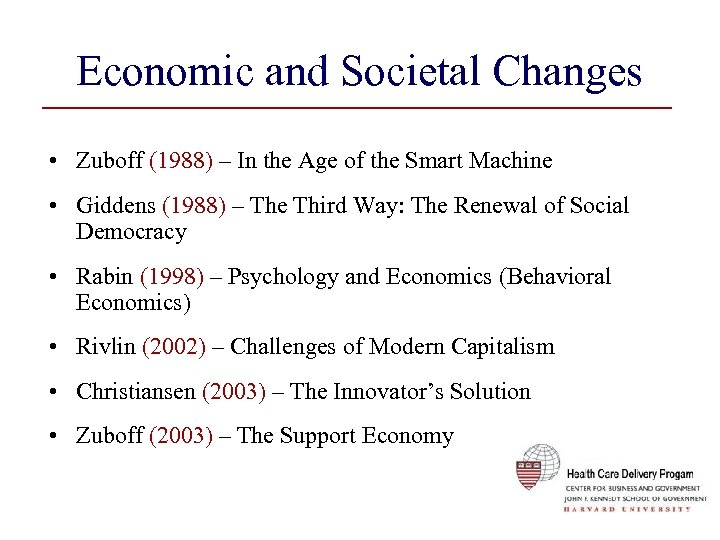 Economic and Societal Changes • Zuboff (1988) – In the Age of the Smart Machine • Giddens (1988) – The Third Way: The Renewal of Social Democracy • Rabin (1998) – Psychology and Economics (Behavioral Economics) • Rivlin (2002) – Challenges of Modern Capitalism • Christiansen (2003) – The Innovator’s Solution • Zuboff (2003) – The Support Economy
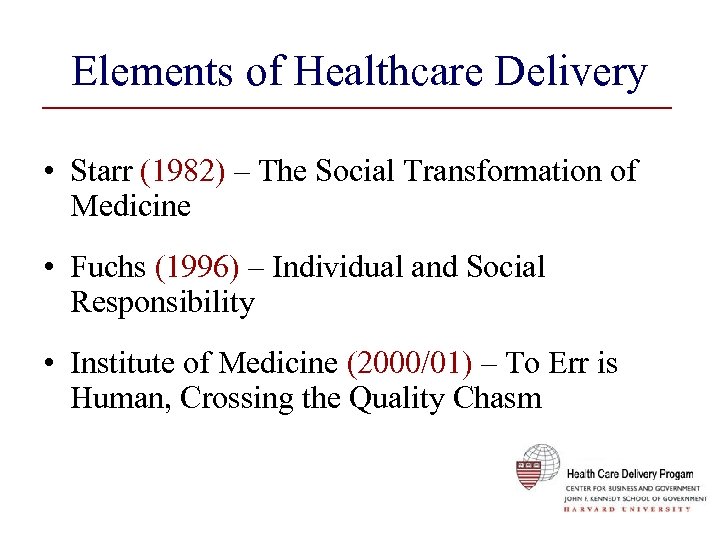 Elements of Healthcare Delivery • Starr (1982) – The Social Transformation of Medicine • Fuchs (1996) – Individual and Social Responsibility • Institute of Medicine (2000/01) – To Err is Human, Crossing the Quality Chasm
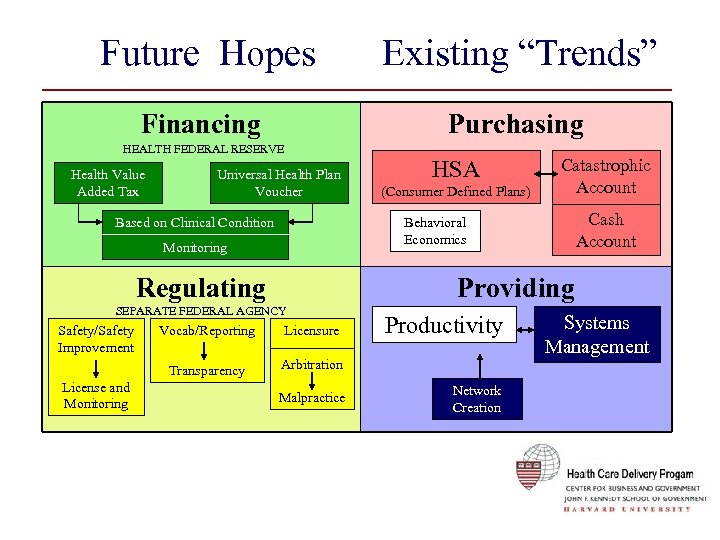 Future Hopes Existing “Trends” Financing Purchasing HEALTH FEDERAL RESERVE Health Value Added Tax Universal Health Plan Voucher Based on Clinical Condition Regulating Cash Account Providing SEPARATE FEDERAL AGENCY Vocab/Reporting Licensure Transparency License and Monitoring (Consumer Defined Plans) Catastrophic Account Behavioral Economics Monitoring Safety/Safety Improvement HSA Productivity Arbitration Malpractice Network Creation Systems Management
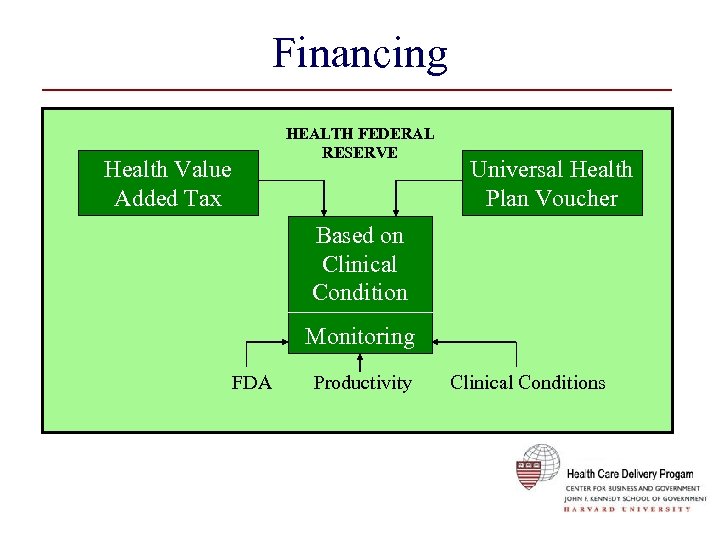 Financing HEALTH FEDERAL RESERVE Health Value Added Tax Universal Health Plan Voucher Based on Clinical Condition Monitoring FDA Productivity Clinical Conditions
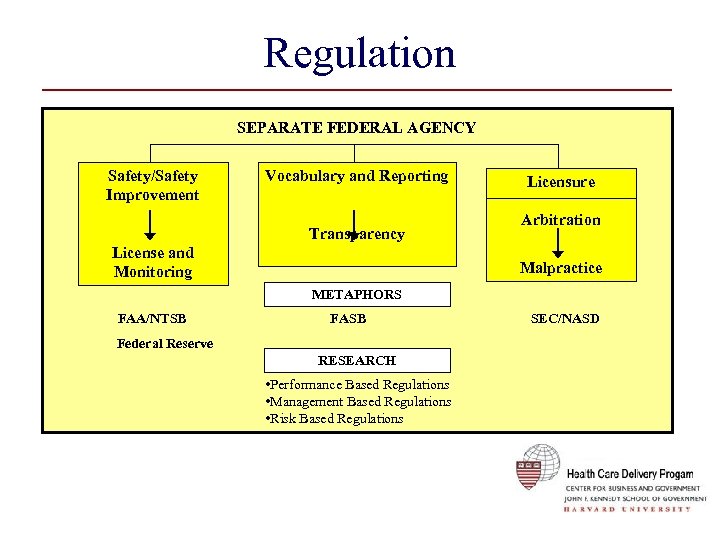 Regulation SEPARATE FEDERAL AGENCY Safety/Safety Improvement Vocabulary and Reporting Transparency License and Monitoring Licensure Arbitration Malpractice METAPHORS FAA/NTSB FASB Federal Reserve RESEARCH • Performance Based Regulations • Management Based Regulations • Risk Based Regulations SEC/NASD
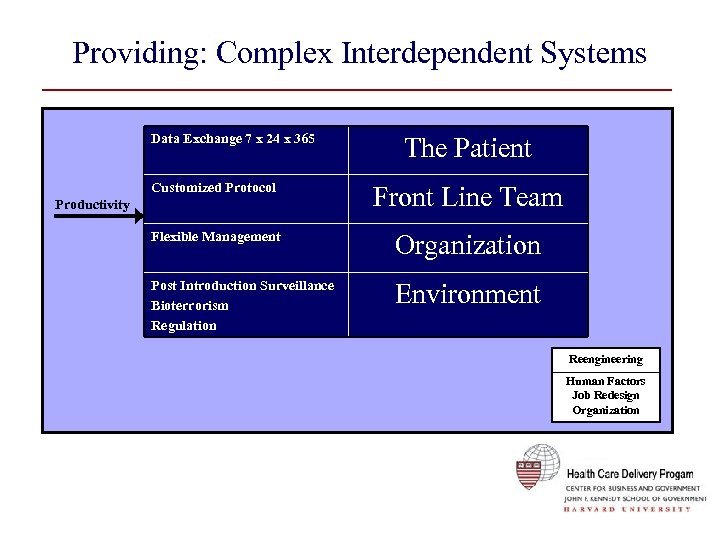 Providing: Complex Interdependent Systems Data Exchange 7 x 24 x 365 The Patient Customized Protocol Front Line Team Flexible Management Organization Post Introduction Surveillance Bioterrorism Regulation Environment Productivity Reengineering Human Factors Job Redesign Organization
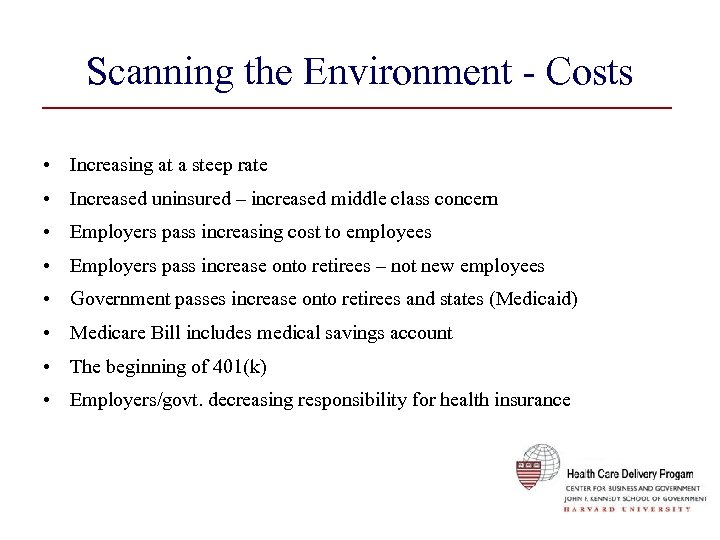 Scanning the Environment - Costs • Increasing at a steep rate • Increased uninsured – increased middle class concern • Employers pass increasing cost to employees • Employers pass increase onto retirees – not new employees • Government passes increase onto retirees and states (Medicaid) • Medicare Bill includes medical savings account • The beginning of 401(k) • Employers/govt. decreasing responsibility for health insurance
 Quality • Quality focus dominates media and legislation • However progress stays neutral – Scattered successes balanced by new revelations of error • Strategy shifting from projects to “systems thinking” • Lack of transparency and safety oversight becoming larger issue – Finance has SEC – Civil Air Transport has FAA – Health has JCAHO – malpractice (mainly self-regulation)
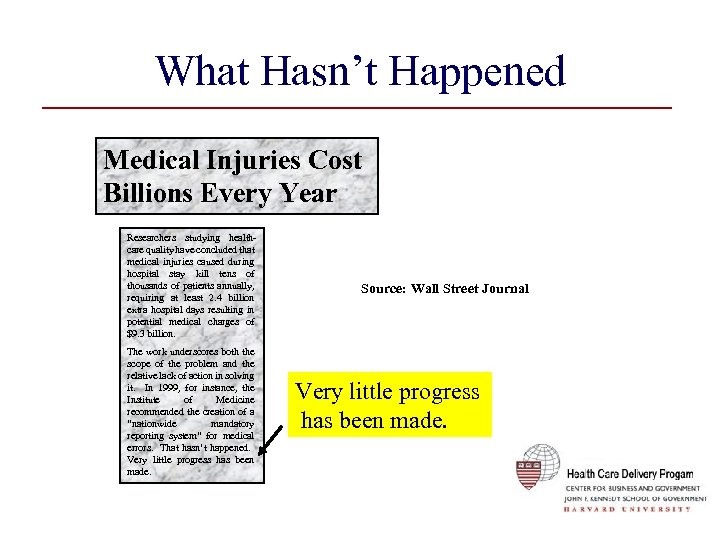 What Hasn’t Happened Medical Injuries Cost Billions Every Year Researchers studying healthcare quality have concluded that medical injuries caused during hospital stay kill tens of thousands of patients annually, requiring at least 2. 4 billion extra hospital days resulting in potential medical charges of $9. 3 billion. The work underscores both the scope of the problem and the relative lack of action in solving it. In 1999, for instance, the Institute of Medicine recommended the creation of a “nationwide mandatory reporting system” for medical errors. That hasn’t happened. Very little progress has been made. Source: Wall Street Journal Very little progress has been made.
 “ A” Perfect Market • Large numbers of consumers and firms • Free entry and exit • Marketability of all goods and services including risk • Symmetric information with zero search costs Key Failures in Health • Asymmetric information/costly search • Marketability of risk
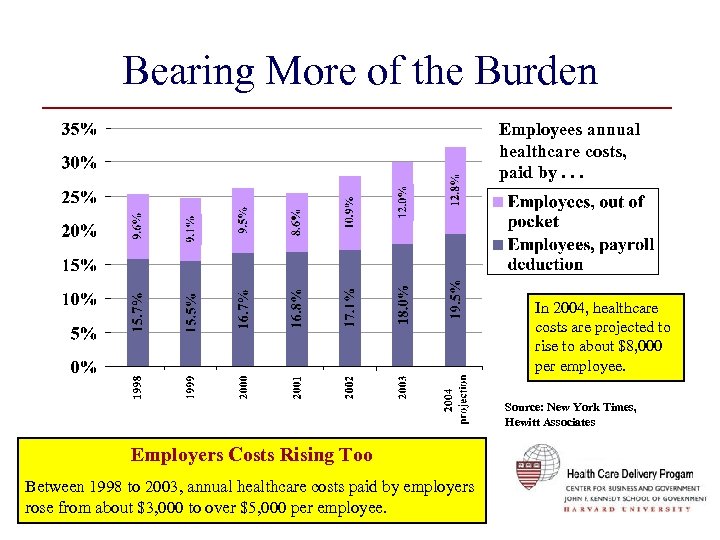 Bearing More of the Burden Employees annual healthcare costs, paid by. . . In 2004, healthcare costs are projected to rise to about $8, 000 per employee. Source: New York Times, Hewitt Associates Employers Costs Rising Too Between 1998 to 2003, annual healthcare costs paid by employers rose from about $3, 000 to over $5, 000 per employee.
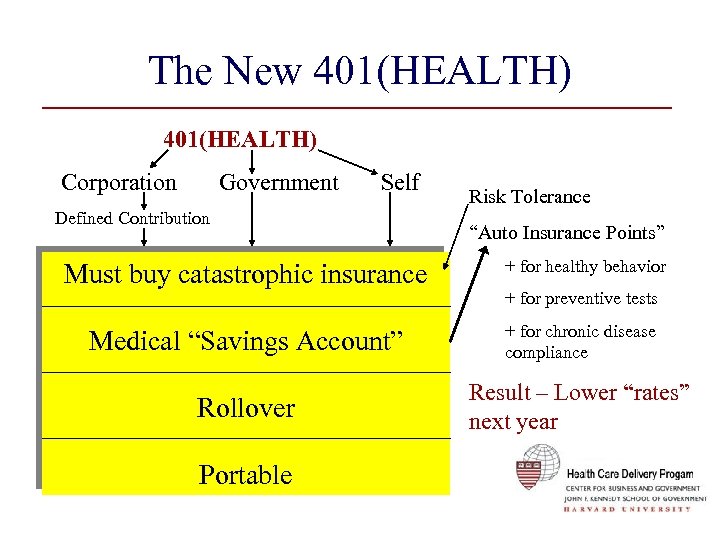 The New 401(HEALTH) Corporation Government Self Defined Contribution Risk Tolerance “Auto Insurance Points” Must buy catastrophic insurance + for healthy behavior Medical “Savings Account” + for chronic disease compliance Rollover Result – Lower “rates” next year Portable + for preventive tests
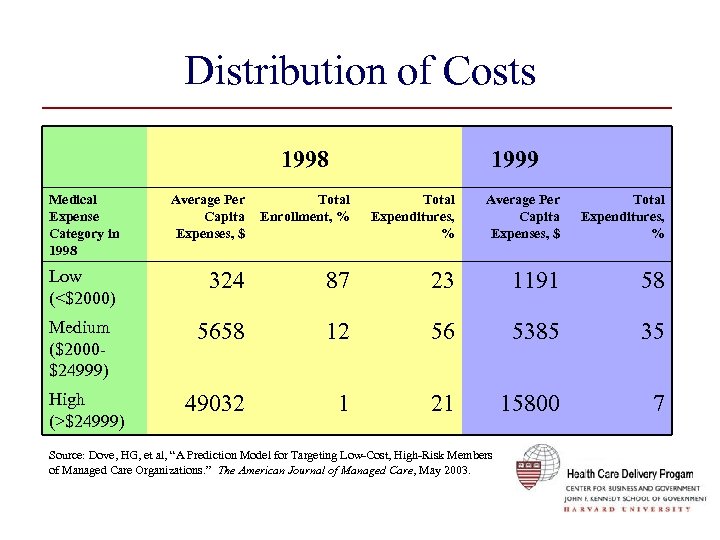 Distribution of Costs 1998 1999 Medical Expense Category in 1998 Average Per Capita Expenses, $ Total Enrollment, % Total Expenditures, % Average Per Capita Expenses, $ Total Expenditures, % Low (<$2000) 324 87 23 1191 58 5658 12 56 5385 35 49032 1 21 15800 7 Medium ($2000$24999) High (>$24999) Source: Dove, HG, et al, “A Prediction Model for Targeting Low-Cost, High-Risk Members of Managed Care Organizations. ” The American Journal of Managed Care, May 2003.
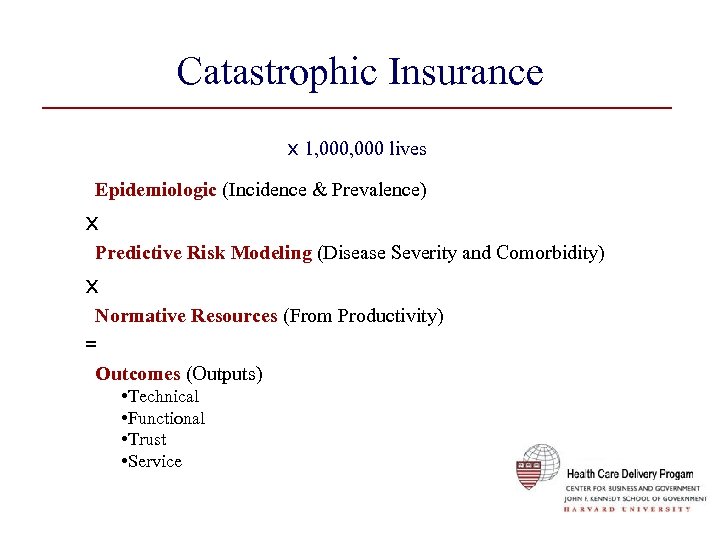 Catastrophic Insurance x 1, 000 lives Epidemiologic (Incidence & Prevalence) x Predictive Risk Modeling (Disease Severity and Comorbidity) x Normative Resources (From Productivity) = Outcomes (Outputs) • Technical • Functional • Trust • Service
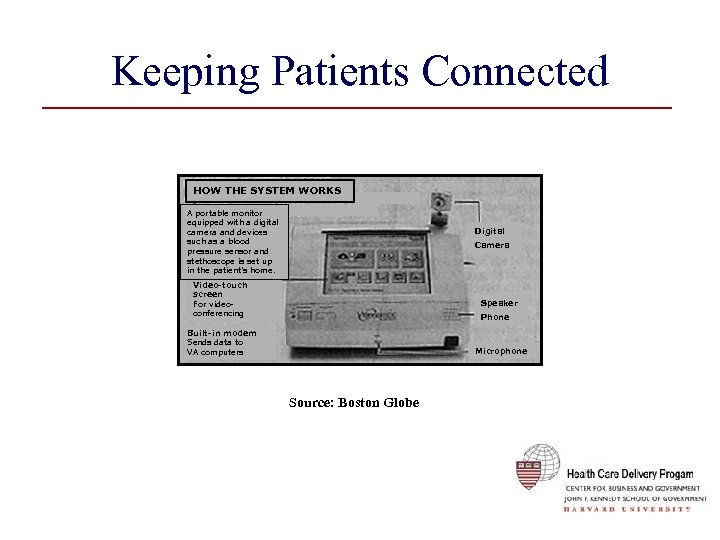 Keeping Patients Connected HOW THE SYSTEM WORKS A portable monitor equipped with a digital camera and devices such as a blood pressure sensor and stethoscope is set up in the patient’s home. Digital Camera Video-touch screen For videoconferencing Speaker Phone Built-in modem Sends data to VA computers Microphone Source: Boston Globe
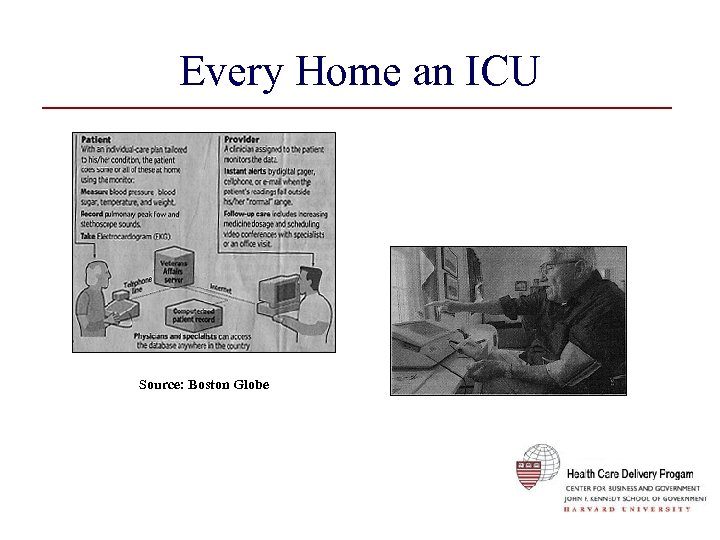 Every Home an ICU Source: Boston Globe
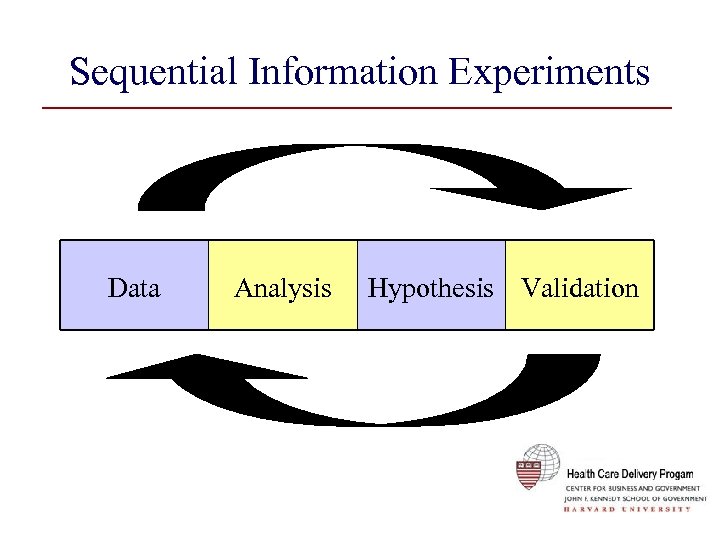 Sequential Information Experiments Data Analysis Hypothesis Validation