


 Скачать презентацию Transforming Child and Adolescent Mental Health Mark D
c04dc6d21498d72aad99a71c67d2ab8f.ppt
- Количество слайдов: 60
 Transforming Child and Adolescent Mental Health Mark D. Weist, Ph. D. Department of Psychology, University of South Carolina Appalachian State University, 4. 19. 13
 Thanks to Ø Ø Ø Ø Ø Vittoria Anello Jason Bird Lori Chappelle Kendra De. Loach Melissa Dvorsky Melissa George Lucille Eber Johnathan Fowler Nancy Lever Bobby Markle Ø Ø Ø Heather Mc. Daniel Kurt Michael Elaine Miller Samantha Paggeot Sharon Stephan Kathy Short Joni Splett Leslie Taylor John Terry Rachel Williamson Eric Youngstrom
 Center for School Mental Health* University of Maryland School of Medicine http: //csmh. umaryland. edu *Supported by the Maternal and Child Health Bureau of HRSA and numerous Maryland agencies

 Outline Ø Realities Ø Expanded school mental health Ø Achieving evidence-based practice Ø Interconnection with PBIS Ø Other collaborative projects Ø Progress, …but many challenges Ø A National Community of Practice
 Reality 1 Ø Child and adolescent mental health is among the most if not the most neglected health care need in the US
 Reality 2 Ø Children, youth and families are not getting to places where mental health services are traditionally delivered
 Reality 3 Ø Schools are under-resourced to address mental health issues, and may view this as beyond their mission
 “Expanded” School Mental Health Ø Full continuum of effective mental health promotion and intervention for students in general and special education Ø Reflecting a “shared agenda” involving school-family-community system partnerships Ø Collaborating community professionals (not outsiders) augment the work of school-employed staff
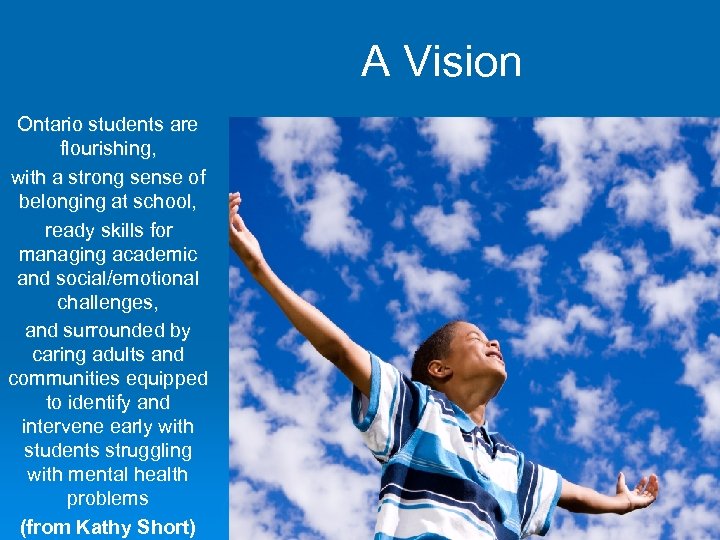 A Vision Ontario students are flourishing, with a strong sense of belonging at school, ready skills for managing academic and social/emotional challenges, and surrounded by caring adults and communities equipped to identify and intervene early with students struggling with mental health problems (from Kathy Short) A Vision for Student Mental Health and Well. Being in Ontario Schools
 Research Supported Programs Ø Substance Abuse and Mental Health Service Administration’s National Registry of Effective Programs and Practices Ø www. nrepp. samhsa. com Ø Roughly 56 of 170 research supported interventions can be implemented in schools
 Research Supported Programs Involve Ø Strong training Ø Fidelity monitoring Ø Ongoing technical assistance and coaching Ø Administrative support Ø Incentives Ø Intangibles
 Practice in the trenches Ø Involves NONE of these supports
 Johns Hopkins Center for Prevention & Early Intervention Leads: Nick Ialongo, Phil Leaf, Catherine Bradshaw http: //www. jhsph. edu/prevention/
 Barriers to Evidence-Based Programs in Schools Ø Clinician Ø School Setting Ø Funding/Resources
 Clinician Related Barriers Ø Limited prior training on evidence-based practices Ø Resistance Ø Role constraints Ø Need for administrative support Ø Need for ongoing coaching and technical assistance
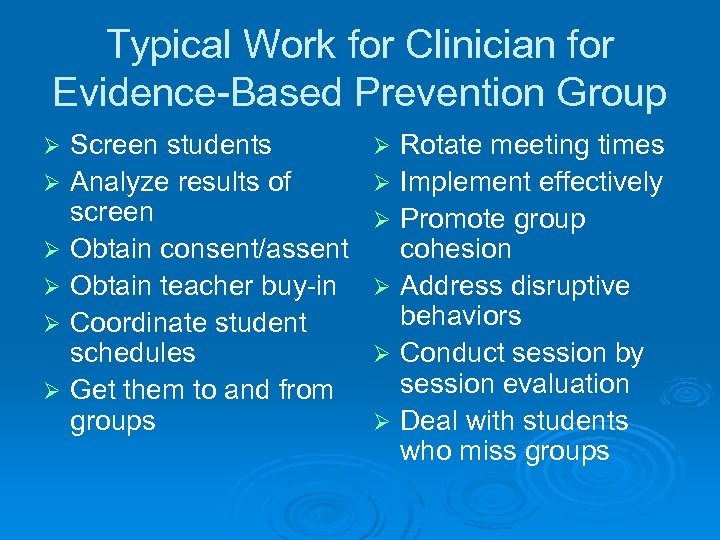 Typical Work for Clinician for Evidence-Based Prevention Group Ø Ø Ø Screen students Analyze results of screen Obtain consent/assent Obtain teacher buy-in Coordinate student schedules Get them to and from groups Ø Ø Ø Rotate meeting times Implement effectively Promote group cohesion Address disruptive behaviors Conduct session by session evaluation Deal with students who miss groups
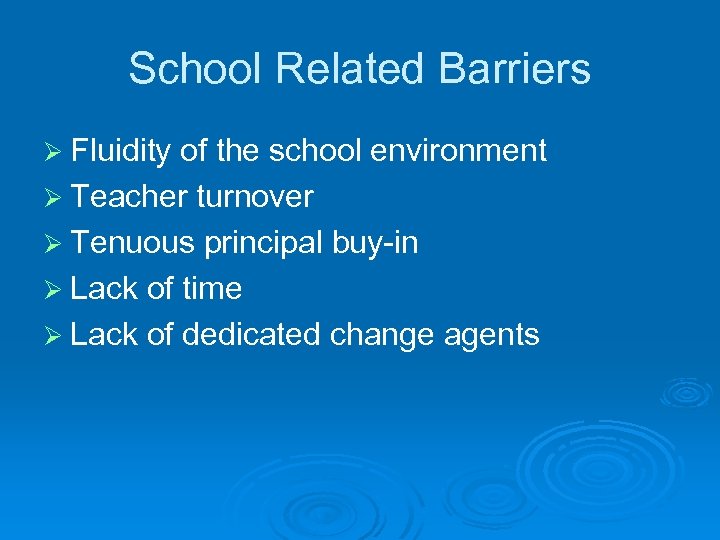 School Related Barriers Ø Fluidity of the school environment Ø Teacher turnover Ø Tenuous principal buy-in Ø Lack of time Ø Lack of dedicated change agents
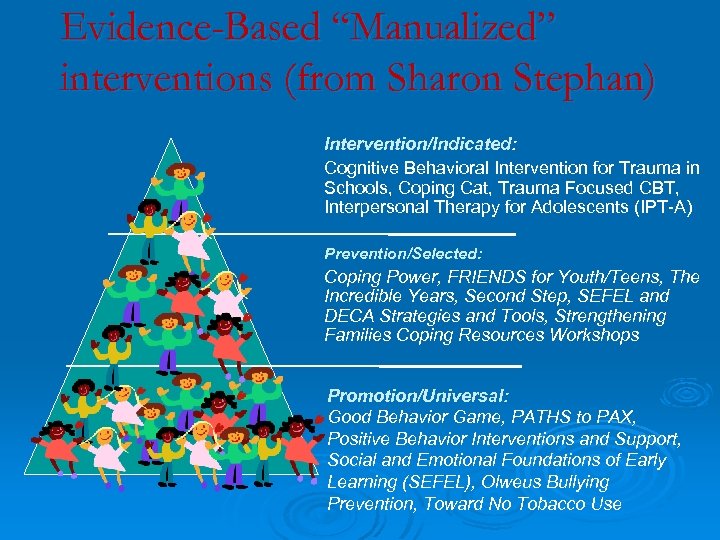 Evidence-Based “Manualized” interventions (from Sharon Stephan) Intervention/Indicated: Cognitive Behavioral Intervention for Trauma in Schools, Coping Cat, Trauma Focused CBT, Interpersonal Therapy for Adolescents (IPT-A) Prevention/Selected: Coping Power, FRIENDS for Youth/Teens, The Incredible Years, Second Step, SEFEL and DECA Strategies and Tools, Strengthening Families Coping Resources Workshops Promotion/Universal: Good Behavior Game, PATHS to PAX, Positive Behavior Interventions and Support, Social and Emotional Foundations of Early Learning (SEFEL), Olweus Bullying Prevention, Toward No Tobacco Use
 “Packaging” Problem Ø Blind commitment to parameters of manuals (e. g. , hour long sessions, too many sessions), without consideration of school realities Ø Instead group key intervention components in “phases” and deliver flexibly l See Steve Evans, Julie Owens, Ohio University
 Strengthening School Mental Health Services
 Study Overview NIMH, R 01 MH 081941 -01 A 2, 2010 -14 (building from a prior R 01) 46 school mental health clinicians, 34 schools Randomly assigned to either: Personal/ Staff Wellness (PSW) Clinical Services Support (CSS)
 CSS: Four Key Domains Ø Quality Assessment and Improvement Ø Family Engagement and Empowerment Ø “Modular” Evidence Based Practice Ø Implementation Support
 Quality Assessment and Improvement (QAI) Principles Emphasize access Ø Tailor to local needs and strengths Ø Emphasize quality and empirical support Ø Active involvement of diverse stakeholders Ø Full continuum from promotion to treatment Ø Committed and energetic staff Ø Developmental and cultural competence Ø Coordinated in the school and connected in the community Ø
 Working Effectively with Students and Families Ø Engagement Ø Support Ø Collaboration Ø Empowerment l see the work of Kimberly Hoagwood and Mary Mc. Kay
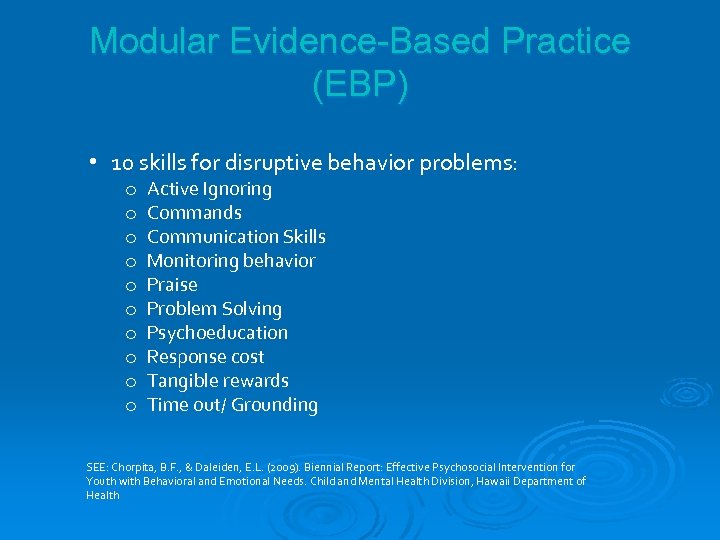 Modular Evidence-Based Practice (EBP) • 10 skills for disruptive behavior problems: o o o o o Active Ignoring Commands Communication Skills Monitoring behavior Praise Problem Solving Psychoeducation Response cost Tangible rewards Time out/ Grounding SEE: Chorpita, B. F. , & Daleiden, E. L. (2009). Biennial Report: Effective Psychosocial Intervention for Youth with Behavioral and Emotional Needs. Child and Mental Health Division, Hawaii Department of Health
 Implementation Support Interactive and lively teaching Off and on-site coaching, performance assessment and feedback, emotional and administrative support Peer to peer support User friendliness Ø Ø l see Dean Fixsen, Karen Blasé, National Implementation Research Network (NIRN)
 A “Transformative” Impact? Largest and most prominent SMH program in SC Ø In a network of SMH in all jurisdictions Ø Strong interest in the study across all relevant sectors Ø Pursuing integrated QAI – Wellness strategy now Ø Given positive findings, the study approach is set up for rapid replication in SC and beyond Ø
 But Ø SMH programs and services continue to develop in an ad hoc manner, and Ø LACK AN IMPLEMENTATION STRUCTURE
 Positive Behavior Intervention and Support (www. pbis. org) Ø In 17, 000 plus schools Ø Decision making framework to guide selection and implementation of best practices for improving academic and behavioral functioning l l Data based decision making Measurable outcomes Evidence-based practices Systems to support effective implementation
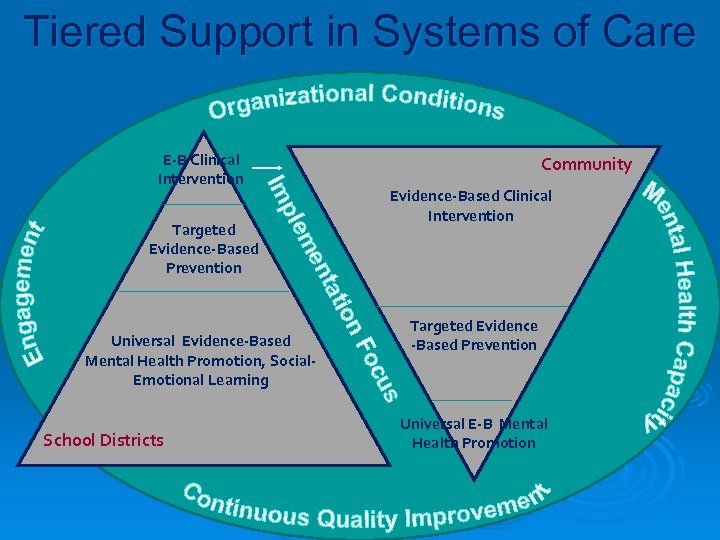 Tiered Support in Systems of Care ion tat en s cu Fo Universal Evidence-Based Mental Health Promotion, Social. Emotional Learning School Districts Evidence-Based Clinical Intervention m ple Targeted Evidence-Based Prevention Community Im E-B Clinical Intervention Targeted Evidence -Based Prevention Universal E-B Mental Health Promotion
 Interconnected Systems Framework (ISF) for SMH-PBIS Ø Strategy for interconnection of two systems across multiple tiers Ø Emphasizes state teams working with district teams and schools, and strong team planning and actions at each tier Ø Two national centers (for SMH and PBIS) and a number of states involved Ø Numerous training events and a monograph in progress
 ISF Defined l l A strong, committed and functional team guides the work, using data at three tiers of intervention Sub-teams having “conversations” and conducting planning at each tier Evidence-based practices and programs are integrated at each tier SYMMETRY IN PROCESSES AT STATE, DISTRICT AND BUILDING LEVELS
 ISF cont. l l Key stakeholders from education and mental health are involved and these people have the authority to reallocate resources, change roles and functioning of staff, and change policy There is a priority on strong interdisciplinary, cross-system collaboration
 Old Approach Ø Each school works out their own plan with Mental Health (MH) agency New Approach Ø District has a plan for integrating MH at all buildings (based on community and school data)
 Old Approach Ø A MH counselor is housed in a school building 1 day a week to “see” students New Approach Ø MH person participates in teams at all 3 tiers
 Old Approach Ø No data to decide on or monitor interventions New Approach Ø MH person leads classroom, group or individual interventions based on data
 ISF, School Readiness Assessment 1) High status leadership and team with active administrator participation Ø 2) School improvement priority on social/emotional/behavioral health for all students Ø 3) Investment in prevention Ø 4) Active data-based decision making Ø 5) Commitment to SMH-PBIS integration Ø 6) Stable staffing and appropriate resource allocation Ø
 ISF, Indicators of Team Functioning Ø Strong leadership Ø Good meeting attendance, agendas and meeting management Ø Opportunities for all to participate Ø Taking and maintaining of notes and the sense of history playing out Ø Clear action planning Ø Systematic follow-up on action planning
 Team Members *School psychologist Ø *Collaborating community mental health professional Ø School counselor Ø Special educator Ø l *co-leaders Assistant principal Ø School nurse Ø General educator Ø Parent Ø (Older student) Ø
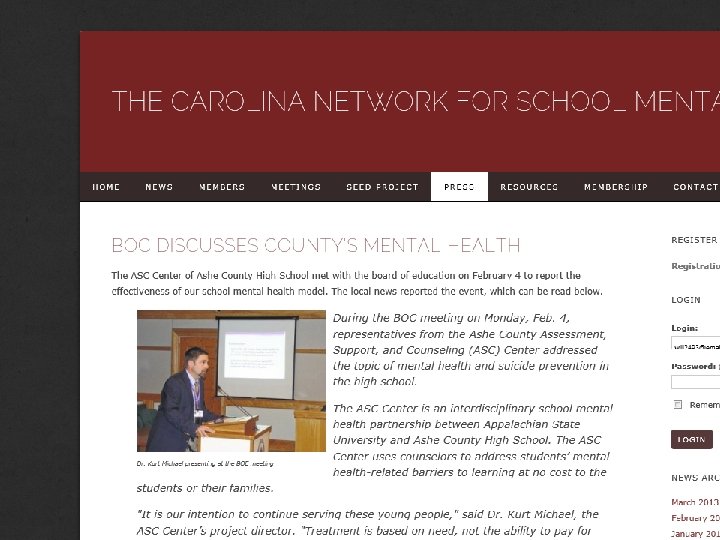
 Student Emotional and Educational Development (SEED) Ø Interdisciplinary, evidence-based intervention for youth with mood disorders in schools Ø USC, ASU and UNC Ø More than 20 student participants and promising data Ø Likely big grant application by this fall
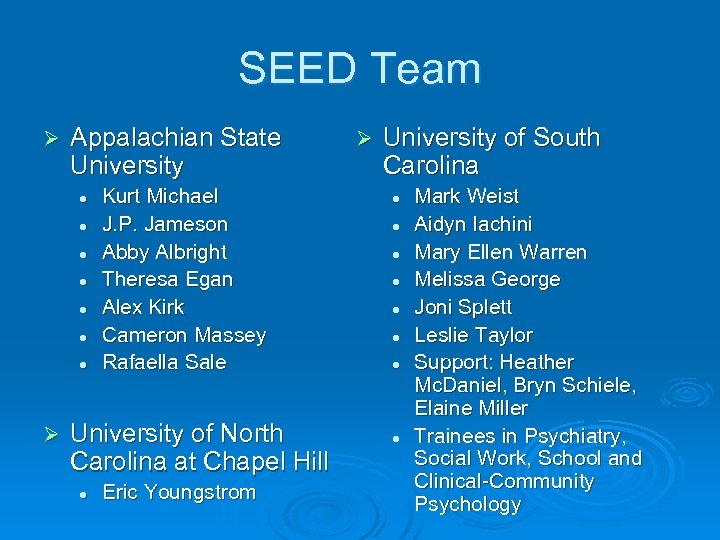 SEED Team Ø Appalachian State University l l l l Ø Kurt Michael J. P. Jameson Abby Albright Theresa Egan Alex Kirk Cameron Massey Rafaella Sale University of North Carolina at Chapel Hill l Eric Youngstrom Ø University of South Carolina l l l l Mark Weist Aidyn Iachini Mary Ellen Warren Melissa George Joni Splett Leslie Taylor Support: Heather Mc. Daniel, Bryn Schiele, Elaine Miller Trainees in Psychiatry, Social Work, School and Clinical-Community Psychology
 CLIMB Ø Changing Lifestyles to Improve Mind and Body (Melissa George et al. ) Ø 10 middle school participants, 6 sessions integrated into work of SMH clinicians (enhanced exercise and/or reduced screen time, increased fruit and vegetable intake and/or reduced junk food) Ø Strong feasibility and acceptability and preliminary evidence of impact
 Progress, but…. many other challenges Ø Suspension Ø Expulsion Ø Very poor transitions Ø Schools and people doing what they are used to doing (and being highly resistant to change)
 Roles of School-Employed MH Staff (in some instances) Ø Course scheduling Ø Attendance monitoring Ø Examination monitoring Ø Career guidance Ø Logistics assistance l See Steve Evans, Ohio University
 Significant Accountability Issues Ø “Optimizing” l l School staff doing rote administrative work Community mental health staff seeing same clients and delivering passive, eclectic, non evidence-based interventions
 Special Education Challenges Schools and staff as gatekeepers Ø “Social maladjustment” Ø Highly variable labeling Ø “Manifestation” hearings Ø Increasing but not decreasing restrictiveness Ø Pro-forma meetings and poor follow-up Ø Accomodations Ø
 A National Community of Practice (COP); www. sharedwork. org Ø CSMH and IDEA Partnership (www. ideapartnership. org) providing support Ø 30 professional organizations and 16 states Ø 12 practice groups Ø Providing mutual support, opportunities for dialogue and collaboration
 Example Practice Groups Ø Learning the Language Ø Quality and Evidence-Based Practice Ø Family Involvement Ø Youth Leadership Ø SMH and PBIS Ø SMH and Special Education Ø SMH and Systems of Care Ø Military Families
 Sixteen States Hawaii Ø Illinois Ø New Hampshire Ø North Carolina Ø Maryland Ø Minnesota* Ø Missouri Ø Montana* Ø New Mexico Ø Ohio Ø Pennsylvania Ø South Carolina Ø South Dakota Ø Utah* Ø Vermont Ø West Virginia Ø
 Ohio Mental Health Network for School Success (http: //www. omhnss. org) Ø Since 2001 Ø Ohio Department of Mental Health Ø Ohio Department of Education Ø Center for School-Based Mental Health Programs at Miami University (http: //www. units. muohio. edu/csbmhp) Mission To help Ohio’s school districts, community-based agencies, and families work together to achieve improved educational and developmental outcomes for all children — especially those at emotional or behavioral risk and those with mental health problems
 Montana’s Integrated School Mental Health Initiative
 The Carolina Network for School Mental Health
 Participating Universities and Agencies Ø Ø Ø Ø American Foundation for Suicide Prevention, South Carolina Appalachian State University Clemson University Eastern Carolina University Medical University of South Carolina North Carolina Department of Public Instruction South Carolina Department of Education South Carolina Department of Mental Health University of North Carolina at Chapel Hill University of North Carolina at Greensboro University of North Carolina at Pembroke University of South Carolina Wake Forest University
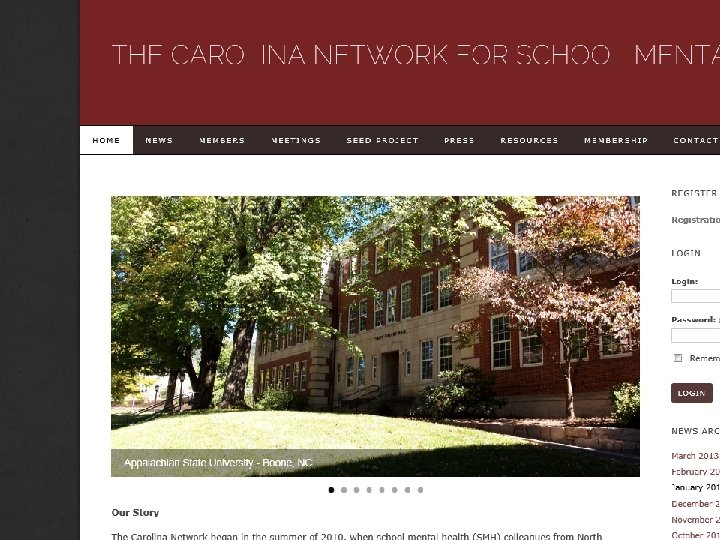
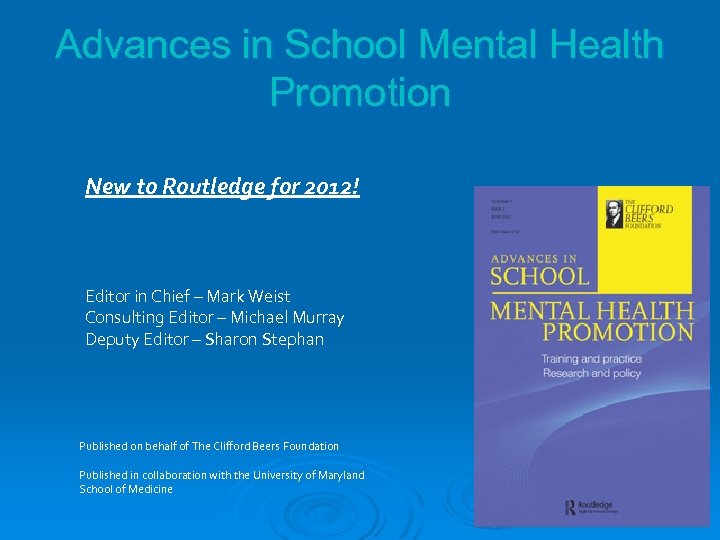 Advances in School Mental Health Promotion New to Routledge for 2012! Editor in Chief – Mark Weist Consulting Editor – Michael Murray Deputy Editor – Sharon Stephan Published on behalf of The Clifford Beers Foundation Published in collaboration with the University of Maryland School of Medicine
 18 th Annual SMH Conference Crystal City, Arlington, Virginia October 3 -5, 2013
 Contact Information Ø Department of Psychology University of South Carolina 1512 Pendleton St. , Room 237 D Ø Columbia, SC 29208 Ph: 803 777 8438 weist@mailbox. sc. edu