 Скачать презентацию Transformational Strategies for Flexible E-Learning Delivery Athabasca University
af4e372d6d321c14bbfc9e1e256a4ee0.ppt
- Количество слайдов: 67



Transformational Strategies for Flexible E-Learning Delivery: Athabasca University as a case study Dominique Abrioux
Overview l Flexible E-Learning – – – Institutional Programmatic Course module l Athabasca University and Flexible Learning l E-Learning Opportunities for Flexible Learning l Key Flexibility Factors – – – l Institutional motivation Organizational culture Infrastructure Concluding Remarks
Flexible E-Learning
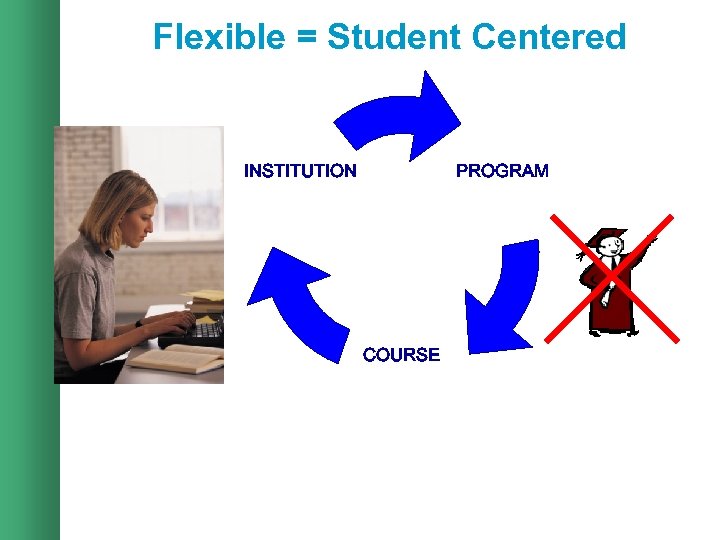
Flexible = Student Centered INSTITUTION PROGRAM COURSE
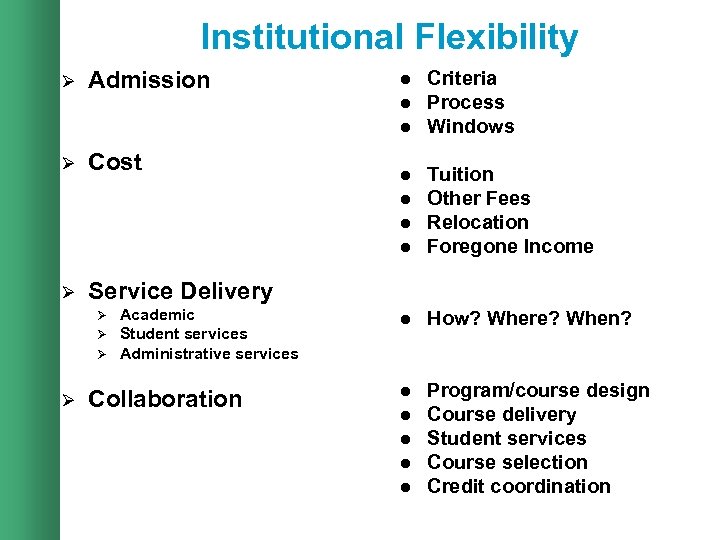
Institutional Flexibility Ø Admission l l l Ø Cost Criteria Process Windows l Tuition Other Fees Relocation Foregone Income l How? Where? When? l Program/course design Course delivery Student services Course selection Credit coordination l l l Ø Service Delivery Ø Ø Academic Student services Administrative services Collaboration l l
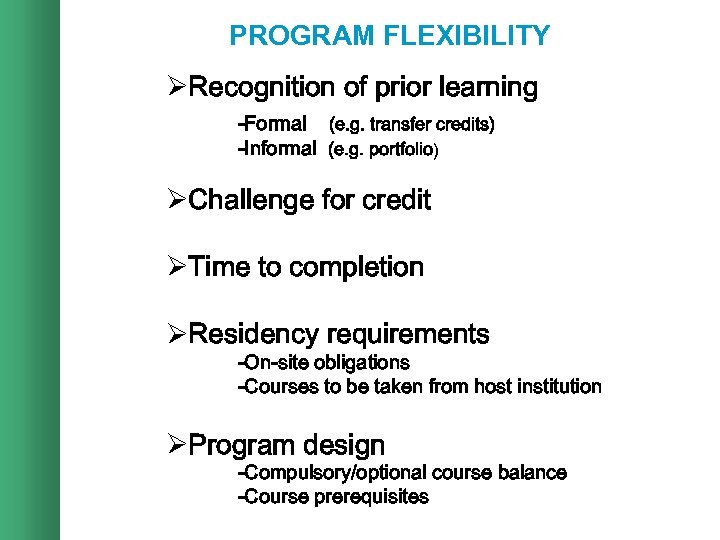
PROGRAM FLEXIBILITY ØRecognition of prior learning -Formal (e. g. transfer credits) -Informal (e. g. portfolio) ØChallenge for credit ØTime to completion ØResidency requirements -On-site obligations -Courses to be taken from host institution ØProgram design -Compulsory/optional course balance -Course prerequisites
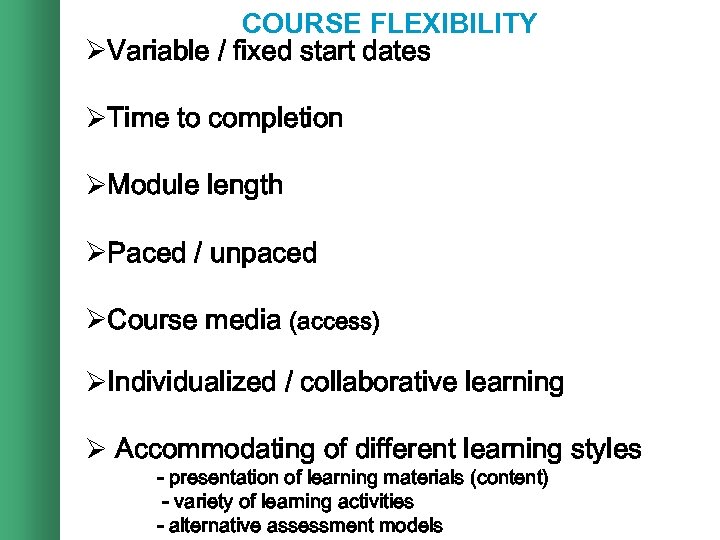
COURSE FLEXIBILITY ØVariable / fixed start dates ØTime to completion ØModule length ØPaced / unpaced ØCourse media (access) ØIndividualized / collaborative learning Ø Accommodating of different learning styles - presentation of learning materials (content) - variety of learning activities - alternative assessment models

Athabasca University Primer
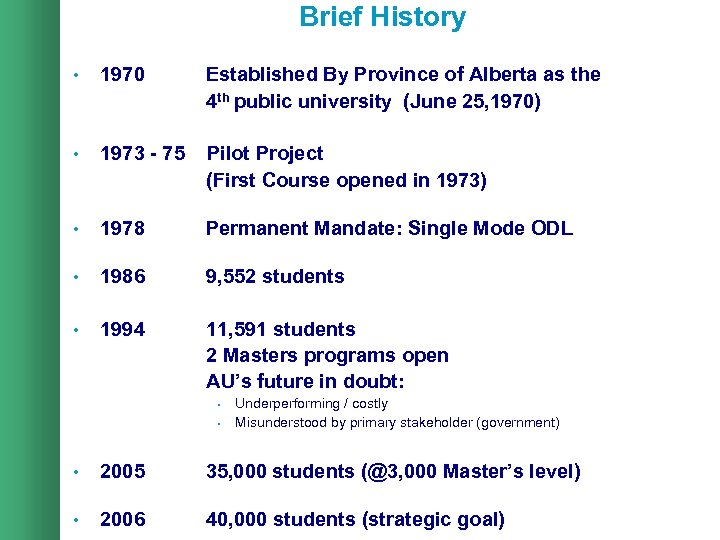
Brief History • 1970 Established By Province of Alberta as the 4 th public university (June 25, 1970) • 1973 - 75 Pilot Project (First Course opened in 1973) • 1978 Permanent Mandate: Single Mode ODL • 1986 9, 552 students • 1994 11, 591 students 2 Masters programs open AU’s future in doubt: • • Underperforming / costly Misunderstood by primary stakeholder (government) • 2005 35, 000 students (@3, 000 Master’s level) • 2006 40, 000 students (strategic goal)
AU’s Distinguishing Mission • Removing barriers to access and success in university-level studies § § § geographical prior education financial

ENROLMENT DATA & LEARNER DEMOGRAPHICS
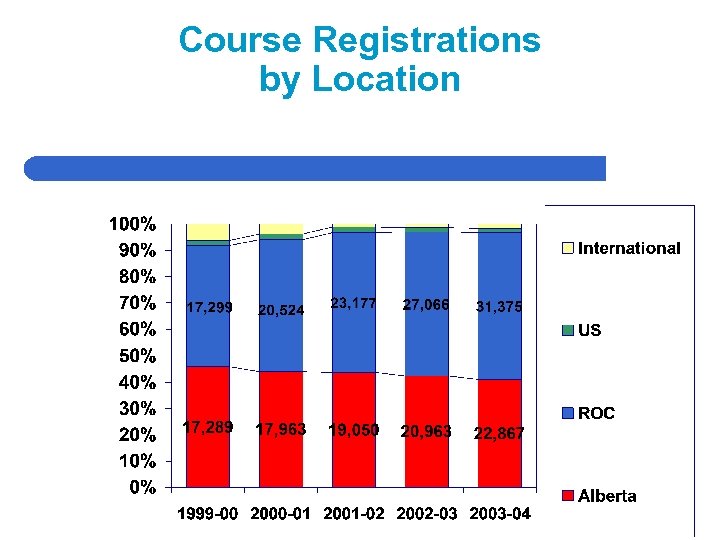
Course Registrations by Location
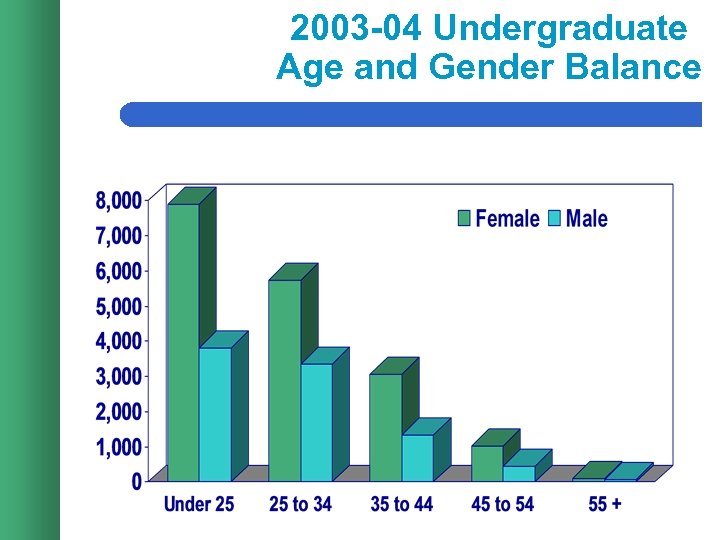
2003 -04 Undergraduate Age and Gender Balance
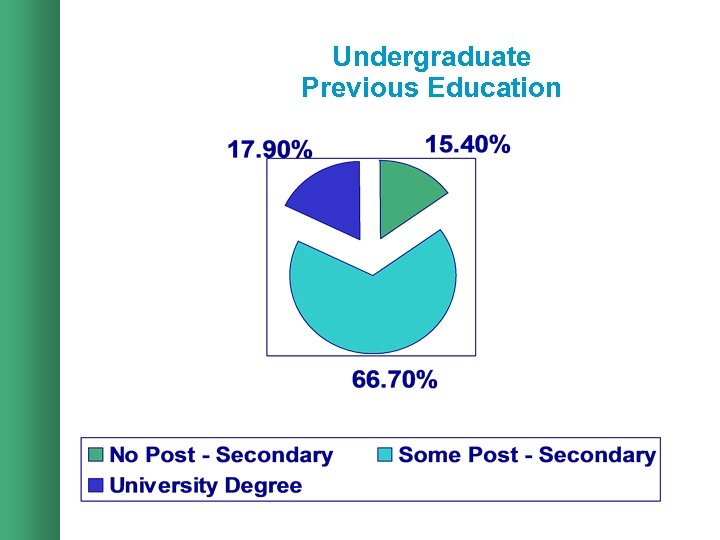
Undergraduate Previous Education
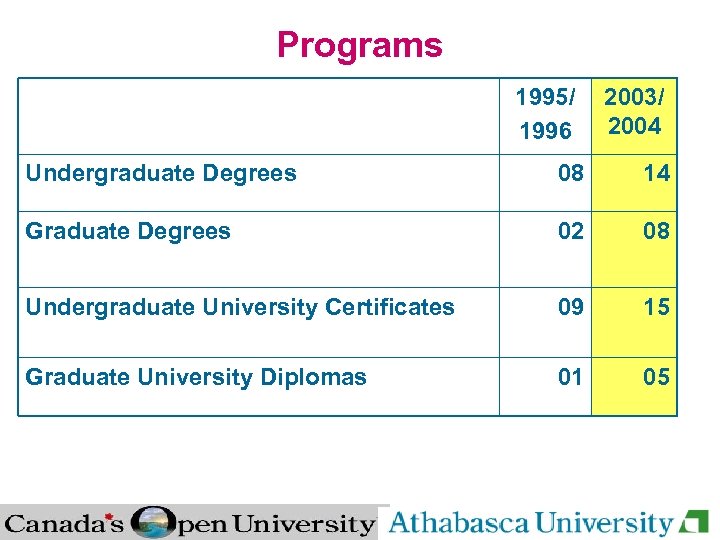
Programs 1995/ 1996 2003/ 2004 Undergraduate Degrees 08 14 Graduate Degrees 02 08 Undergraduate University Certificates 09 15 Graduate University Diplomas 01 05
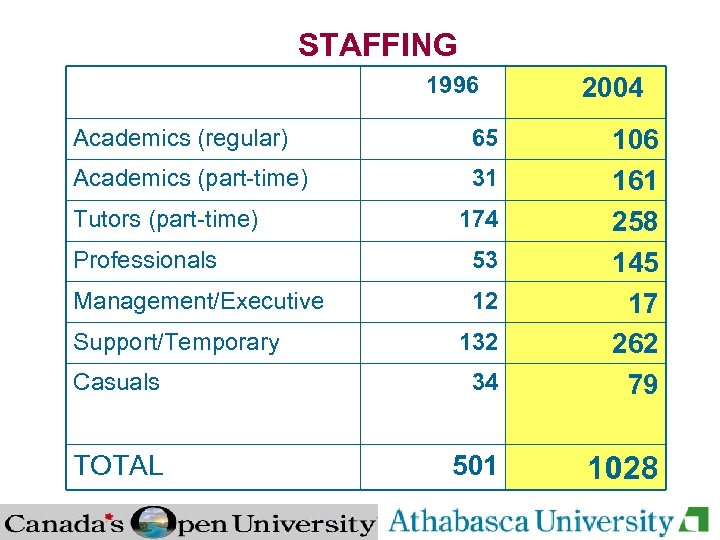
STAFFING 1996 Academics (regular) 65 Academics (part-time) 31 2004 Casuals 34 106 161 258 145 17 262 79 TOTAL 501 1028 Tutors (part-time) 174 Professionals 53 Management/Executive 12 Support/Temporary 132
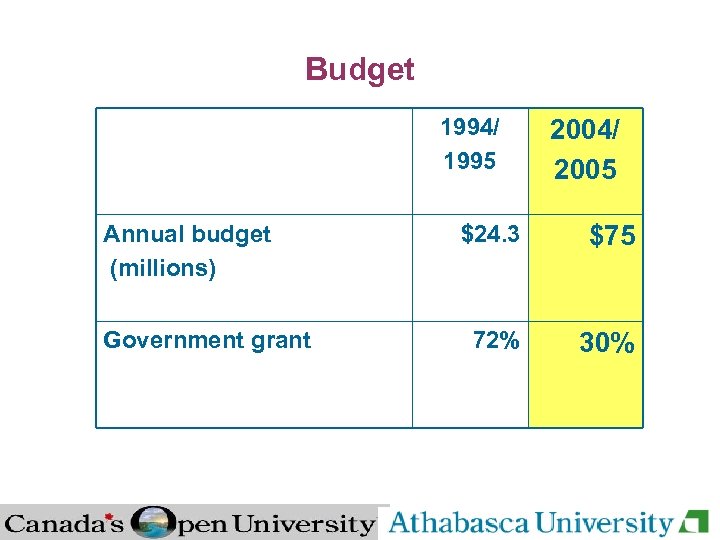
Budget 1994/ 1995 Annual budget (millions) Government grant 2004/ 2005 $24. 3 $75 72% 30%
AU FLEXIBILITY REPORT CARD
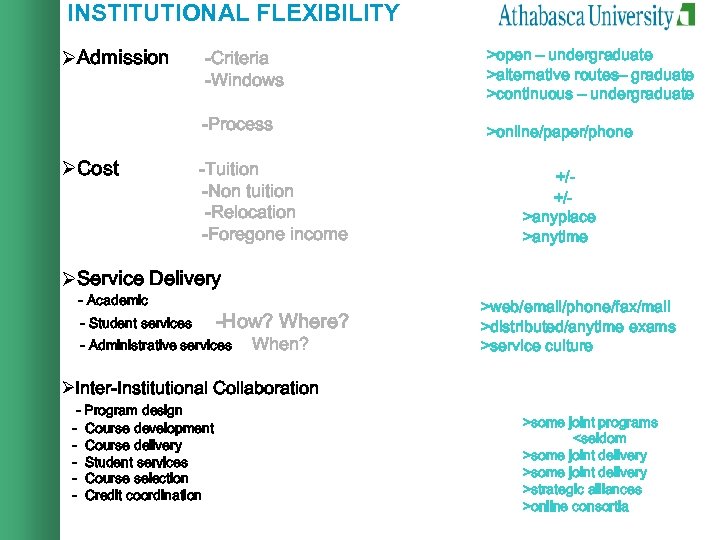
INSTITUTIONAL FLEXIBILITY ØAdmission -Criteria -Windows -Process ØCost -Tuition -Non tuition -Relocation -Foregone income >open – undergraduate >alternative routes– graduate >continuous – undergraduate >online/paper/phone +/+/>anyplace >anytime ØService Delivery - Academic - Student services -How? Where? - Administrative services When? >web/email/phone/fax/mail >distributed/anytime exams >service culture ØInter-Institutional Collaboration - Program design - Course development - Course delivery - Student services - Course selection - Credit coordination >some joint programs <seldom >some joint delivery >strategic alliances >online consortia
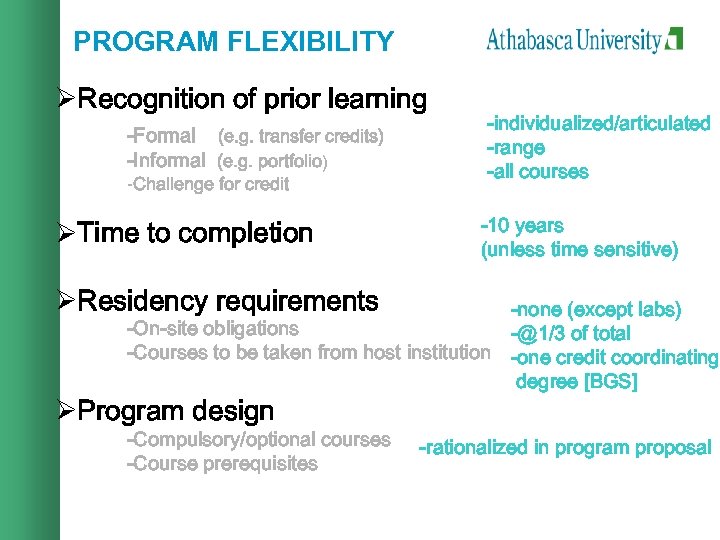
PROGRAM FLEXIBILITY ØRecognition of prior learning -Formal (e. g. transfer credits) -Informal (e. g. portfolio) -Challenge for credit ØTime to completion -individualized/articulated -range -all courses -10 years (unless time sensitive) ØResidency requirements -none (except labs) -On-site obligations -@1/3 of total -Courses to be taken from host institution -one credit coordinating degree [BGS] ØProgram design -Compulsory/optional courses -Course prerequisites -rationalized in program proposal
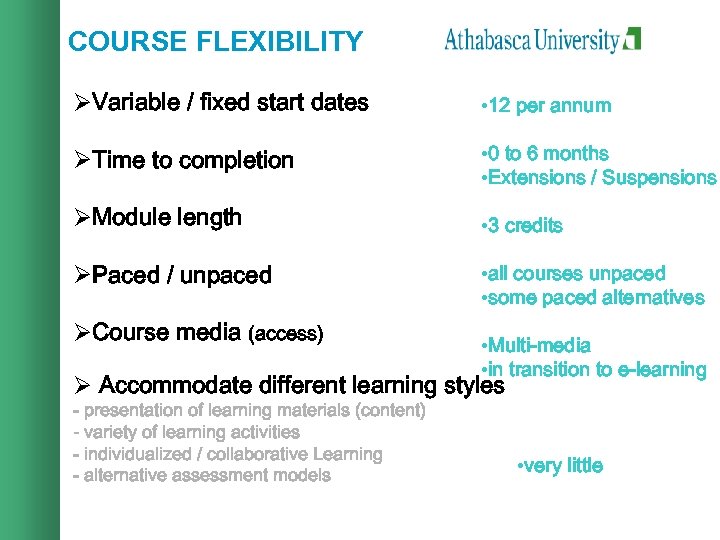
COURSE FLEXIBILITY ØVariable / fixed start dates • 12 per annum ØTime to completion • 0 to 6 months • Extensions / Suspensions ØModule length • 3 credits ØPaced / unpaced ØCourse media (access) • all courses unpaced • some paced alternatives • Multi-media • in transition to e-learning Ø Accommodate different learning styles - presentation of learning materials (content) - variety of learning activities - individualized / collaborative Learning - alternative assessment models • very little
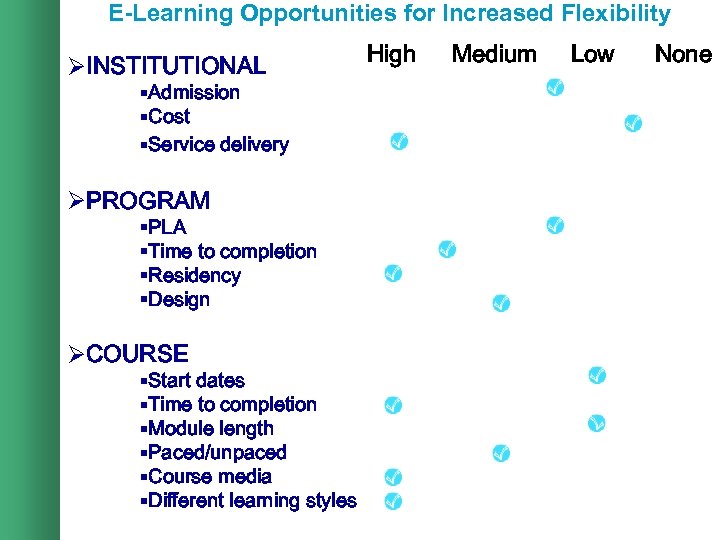
E-Learning Opportunities for Increased Flexibility ØINSTITUTIONAL §Admission §Cost §Service delivery ØPROGRAM §PLA §Time to completion §Residency §Design ØCOURSE §Start dates §Time to completion §Module length §Paced/unpaced §Course media §Different learning styles High Medium Low None
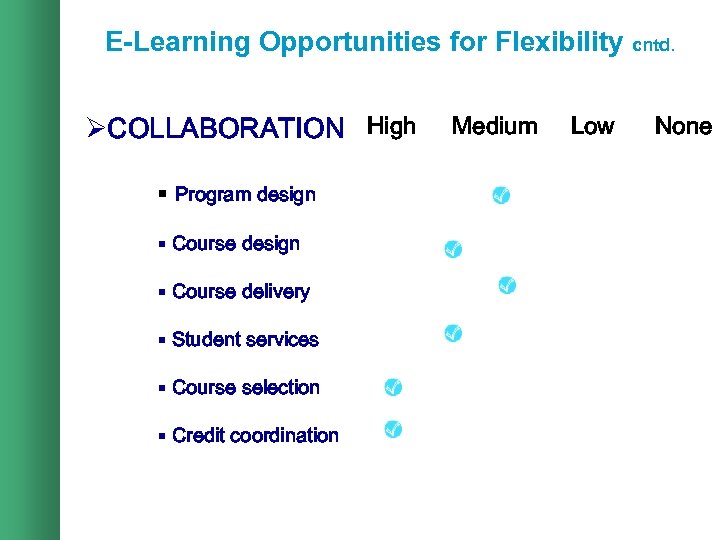
E-Learning Opportunities for Flexibility ØCOLLABORATION High § Program design § Course delivery § Student services § Course selection § Credit coordination Medium Low cntd. None
CORE FACTORS IMPACTING FLEXIBLE LEARNING AS A STRATEGIC INSTITUTIONAL GOAL
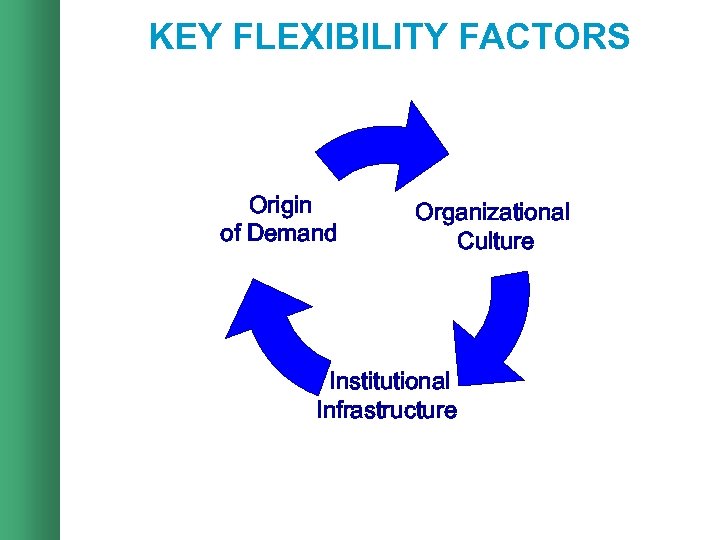
KEY FLEXIBILITY FACTORS Origin of Demand Organizational Culture Institutional Infrastructure
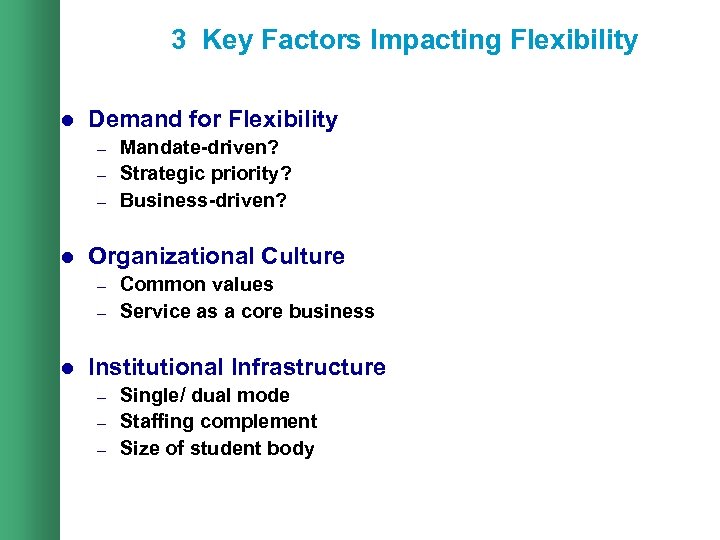
3 Key Factors Impacting Flexibility l Demand for Flexibility – – – l Organizational Culture – – l Mandate-driven? Strategic priority? Business-driven? Common values Service as a core business Institutional Infrastructure – – – Single/ dual mode Staffing complement Size of student body
DEMAND FOR FLEXIBILITY - Mandate-driven? - Strategic priority? - Business-driven?
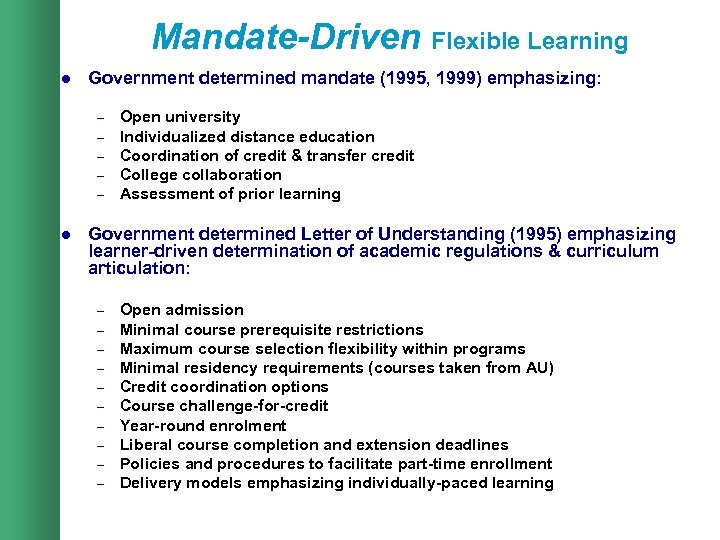
Mandate-Driven Flexible Learning l Government determined mandate (1995, 1999) emphasizing: – – – l Open university Individualized distance education Coordination of credit & transfer credit College collaboration Assessment of prior learning Government determined Letter of Understanding (1995) emphasizing learner-driven determination of academic regulations & curriculum articulation: – – – – – Open admission Minimal course prerequisite restrictions Maximum course selection flexibility within programs Minimal residency requirements (courses taken from AU) Credit coordination options Course challenge-for-credit Year-round enrolment Liberal course completion and extension deadlines Policies and procedures to facilitate part-time enrollment Delivery models emphasizing individually-paced learning
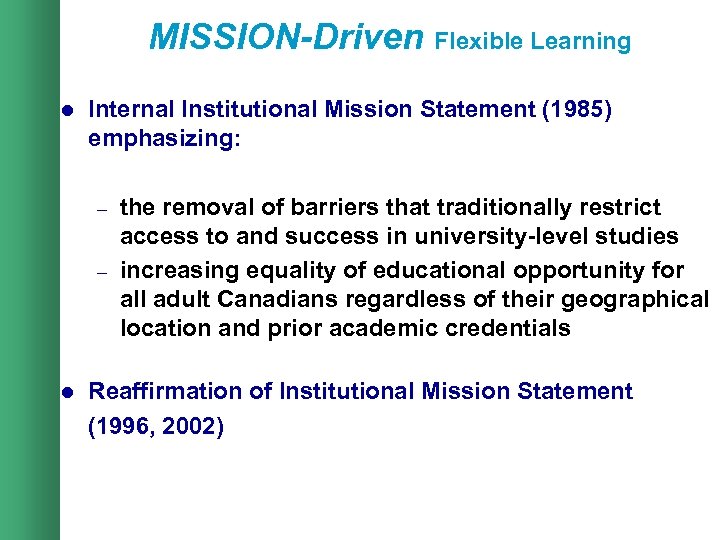
MISSION-Driven Flexible Learning l Internal Institutional Mission Statement (1985) emphasizing: – – l the removal of barriers that traditionally restrict access to and success in university-level studies increasing equality of educational opportunity for all adult Canadians regardless of their geographical location and prior academic credentials Reaffirmation of Institutional Mission Statement (1996, 2002)
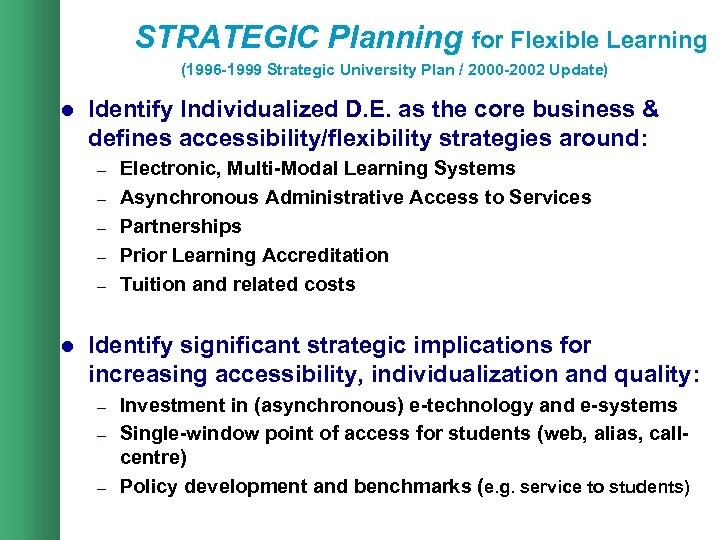
STRATEGIC Planning for Flexible Learning (1996 -1999 Strategic University Plan / 2000 -2002 Update) l Identify Individualized D. E. as the core business & defines accessibility/flexibility strategies around: – – – l Electronic, Multi-Modal Learning Systems Asynchronous Administrative Access to Services Partnerships Prior Learning Accreditation Tuition and related costs Identify significant strategic implications for increasing accessibility, individualization and quality: – – – Investment in (asynchronous) e-technology and e-systems Single-window point of access for students (web, alias, callcentre) Policy development and benchmarks (e. g. service to students)
STRATEGIC Planning for Flexible Learning cntd. (2002 -2006 Strategic University Plan) l Builds on previous SUPs and assigns primordial strategic importance to Meeting Learners’ Needs through flexible learning systems that exploit: – – Open, individualized DE E-learning pedagogy that engages students in asynchronous learning and assessment activities Asynchronous, online e-services to learners (e. g. library) Quality courses, programs, and student support services
BUSINESS-Driven Flexible Learning (1995 – present) l 1995 Reality Check – – – l No growth during past 10 years Highest tuition, highest grant per FLE Lowest performance on KPI’s External environmental assessment (1996 SUP) – – – Diminishing public resources Performance-based funding Increased demands for accountability Greater competition Rapid technological change Uncertainty in all things economic, political, social, and technical
BUSINESS-Driven Flexible Learning cntd. Continuous assessment of marketplace “Increased competition, both from out of province/out of country providers of DE and from institutions that historically have not exploited DE systems means that AU’s growth depends on its ability to continue to distinguish itself from competitors. This can best be achieved by building on the learner-centered philosophy…” 1999 SUP Update
BUSINESS-Driven Flexible Learning Continuous assessment of marketplace “Post-secondary institutions will increase offerings of grouped-study online offerings, particularly in undergraduate and graduate professional programs… Competition based on the cost and quality of learning opportunities and support services will increase… Athabasca University’s learning flexibility and openness is unparalleled…” 2002 SUP cntd.
BUSINESS-Driven Flexible Learning l cntd. Institutional 4 -Year Business Plan – Premised on 10% growth per annum – Links growth with meeting learners’ needs for flexibility – Importance of flexibility represents key attraction of AU to its learners
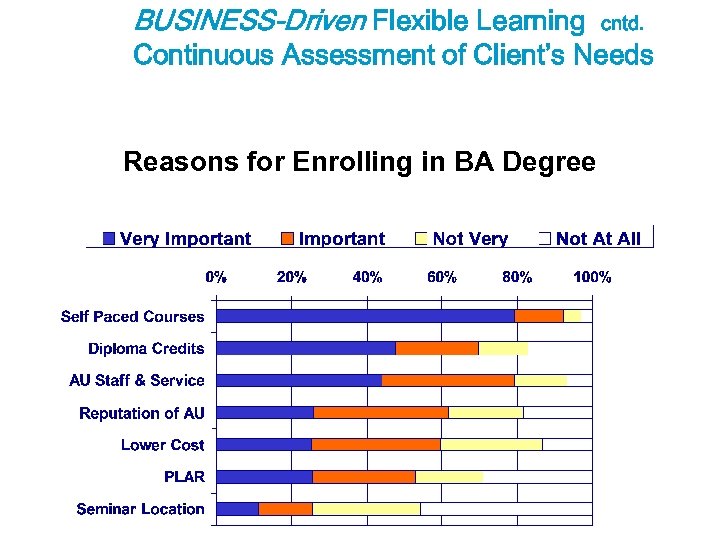
BUSINESS-Driven Flexible Learning cntd. Continuous Assessment of Client’s Needs Reasons for Enrolling in BA Degree
ORGANIZATIONAL CULTURE - Common values - Flexibility & service culture
Our Values (2002 SUP) EXCELLENCE LEARNING SCHOLARLY RESEARCH FREE EXCHANGE OF IDEAS OPENNESS AND FLEXIBILITY DIVERSITY AND INCLUSIVENESS OUR EMPLOYEES ACCOUNTABILITY
Our Values (2002 SUP) EXCELLENCE LEARNING Student learning and satisfaction are the measures of our success SCHOLARLY RESEARCH FREE EXCHANGE OF IDEAS OPENNESS AND FLEXIBILITY Reducing barriers to education enhances access and social equity DIVERSITY AND INCLUSIVENESS Diversity and inclusiveness enhance the quality both of learning and of the workplace OUR EMPLOYEES ACCOUNTABILITY We are accountable to students, to each other, and to the public
Flexible Learning & Service Culture • Online student have high, ever escalating service-related expectations • Competition is regional, national, global • Unlike campus-based education, there is no protected market • Delivering online education is part of the service industry
Turning Values into Practice Flexible Service as a Core Business l Define/Publicize/Monitor/Review/Revise Benchmarks l Implement l Develop l Provide Systematic l Monitor service levels and benchmarks Systems Policies Training
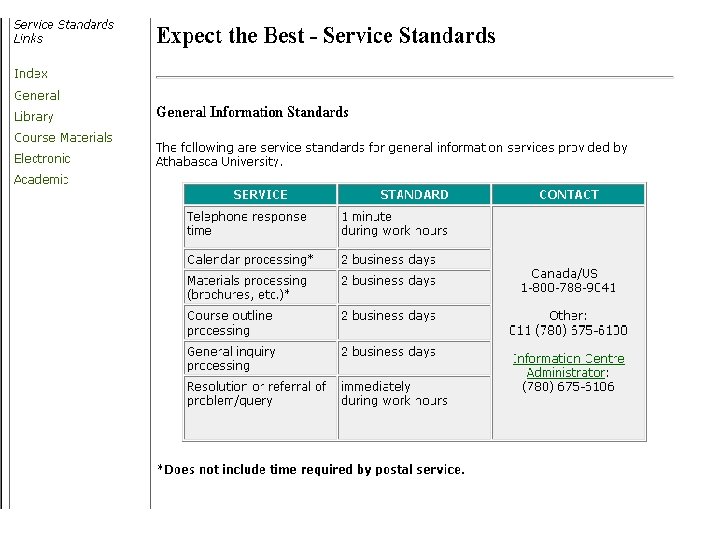
EXPECT THE BEST AU Service Standards l Your Colleagues: Give and Expect the Best l Expect the Best: Student Service Standards
Give and Expect the Best l Staff at AU have a right to expect the best as well. Every day each of us serves our colleagues to assist them with their work in serving other colleagues or students. The standards identified here are meant to provide information about the level of service staff members should expect of each other.
Give and Expect the Best cont. Qualitative Service Standards In many ways, these are the standards that speak to a "culture of respect" in which we would all like to work. When asked what aspects reflect a respectful interaction, staff members cite: §addressing the colleague in a respectful way §ensuring not to interrupt a colleague who is busy §asking, not demanding assistance §allowing time for response and action §providing an opportunity for problem solution rather than approaching the supervisor §understanding that at times a colleague may be under stress and need some special consideration §thanking a colleague for a service performed §refraining from sending e-mail when angry §respecting your colleague’s expertise
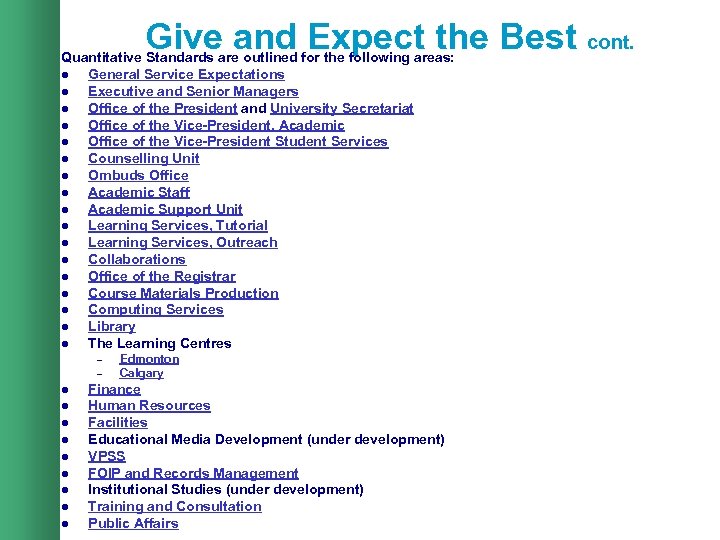
Give and Expect the Best cont. Quantitative Standards are outlined for the following areas: l General Service Expectations l Executive and Senior Managers l Office of the President and University Secretariat l Office of the Vice-President, Academic l Office of the Vice-President Student Services l Counselling Unit l Ombuds Office l Academic Staff l Academic Support Unit l Learning Services, Tutorial l Learning Services, Outreach l Collaborations l Office of the Registrar l Course Materials Production l Computing Services l Library l The Learning Centres – – l l l l l Edmonton Calgary Finance Human Resources Facilities Educational Media Development (under development) VPSS FOIP and Records Management Institutional Studies (under development) Training and Consultation Public Affairs
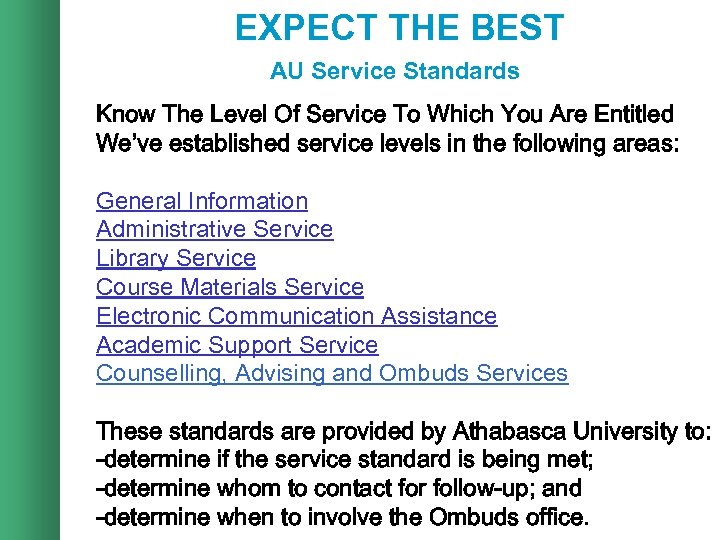
EXPECT THE BEST AU Service Standards Know The Level Of Service To Which You Are Entitled We’ve established service levels in the following areas: General Information Administrative Service Library Service Course Materials Service Electronic Communication Assistance Academic Support Service Counselling, Advising and Ombuds Services These standards are provided by Athabasca University to: -determine if the service standard is being met; -determine whom to contact for follow-up; and -determine when to involve the Ombuds office.
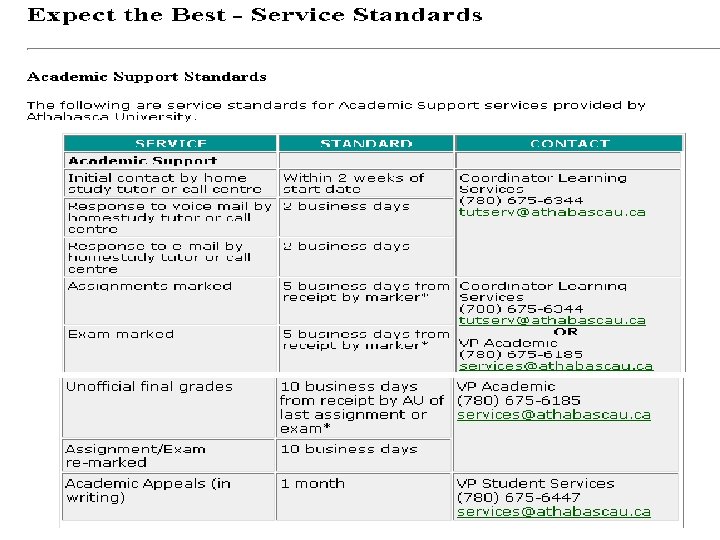
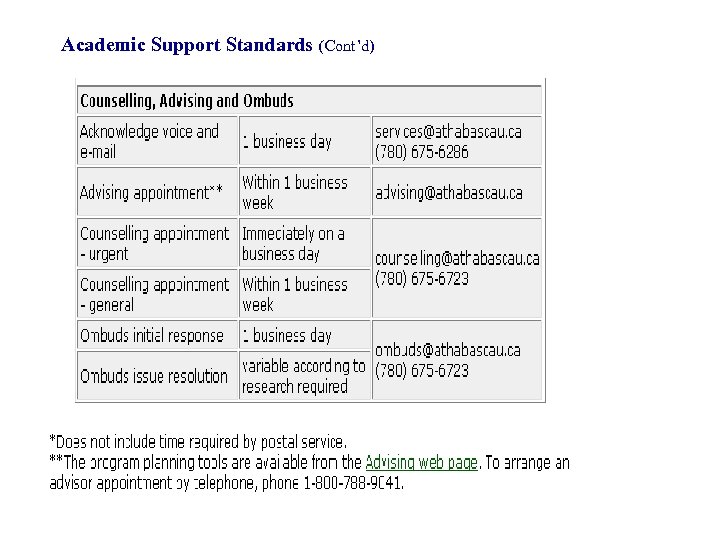
Academic Support Standards (Cont’d)
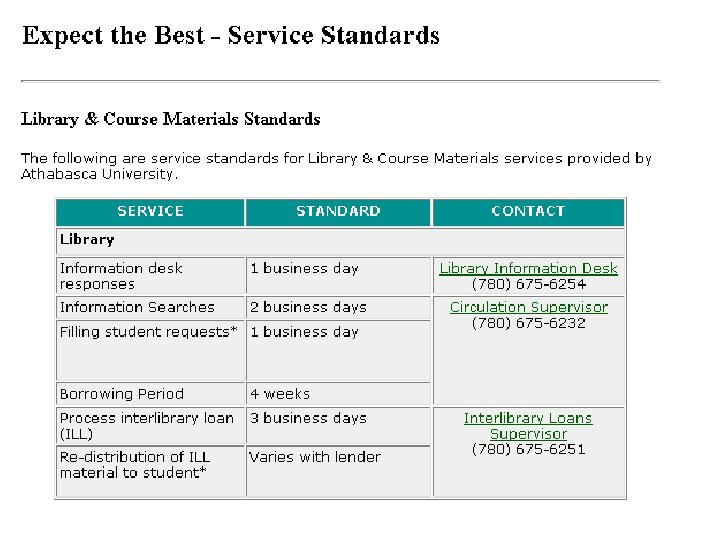
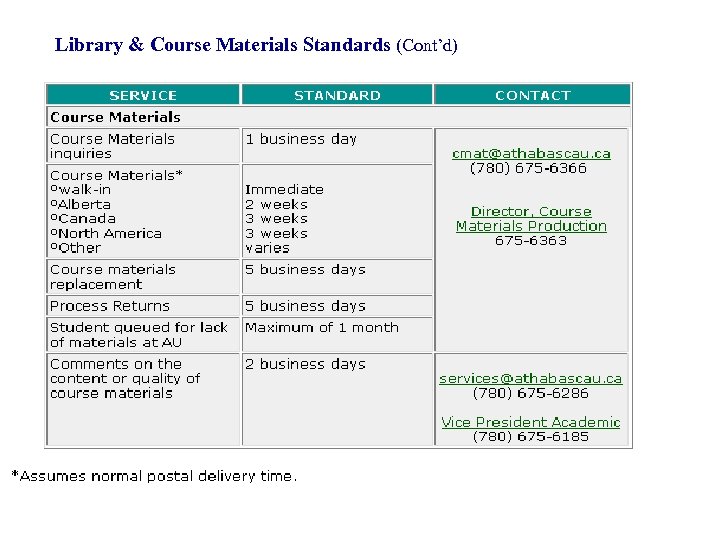
Library & Course Materials Standards (Cont’d)
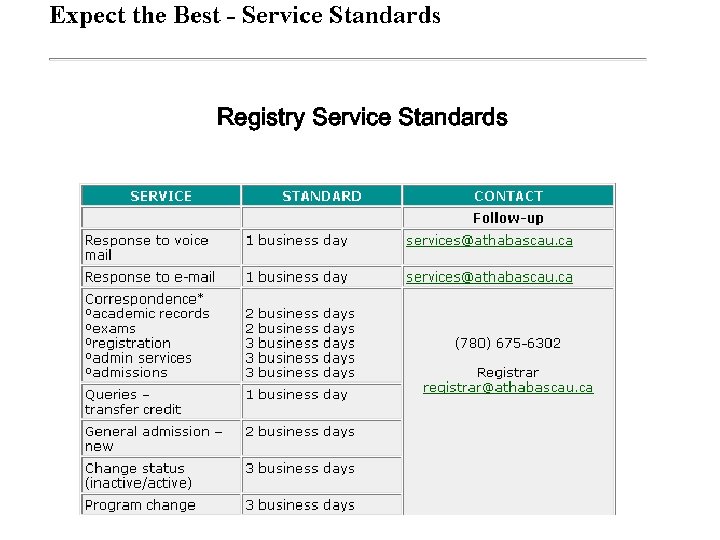
Registry Service Standards
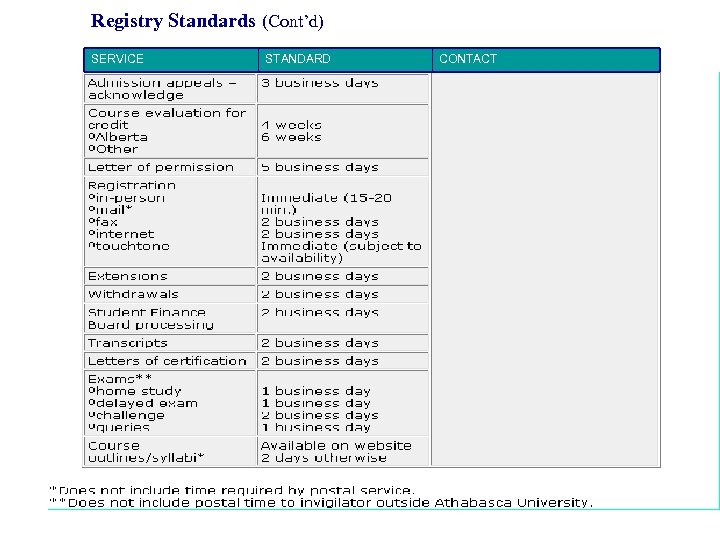
Registry Standards (Cont’d) SERVICE STANDARD CONTACT
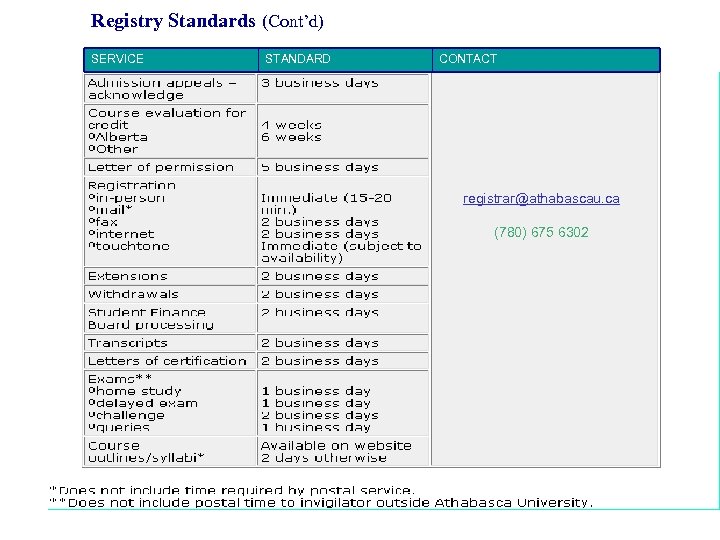
Registry Standards (Cont’d) SERVICE STANDARD CONTACT registrar@athabascau. ca (780) 675 6302
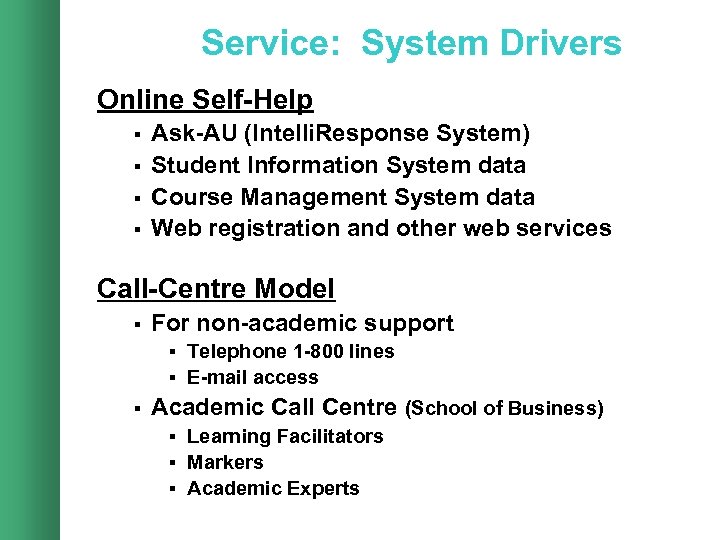
Service: System Drivers Online Self-Help § § Ask-AU (Intelli. Response System) Student Information System data Course Management System data Web registration and other web services Call-Centre Model § For non-academic support Telephone 1 -800 lines § E-mail access § § Academic Call Centre (School of Business) Learning Facilitators § Markers § Academic Experts §
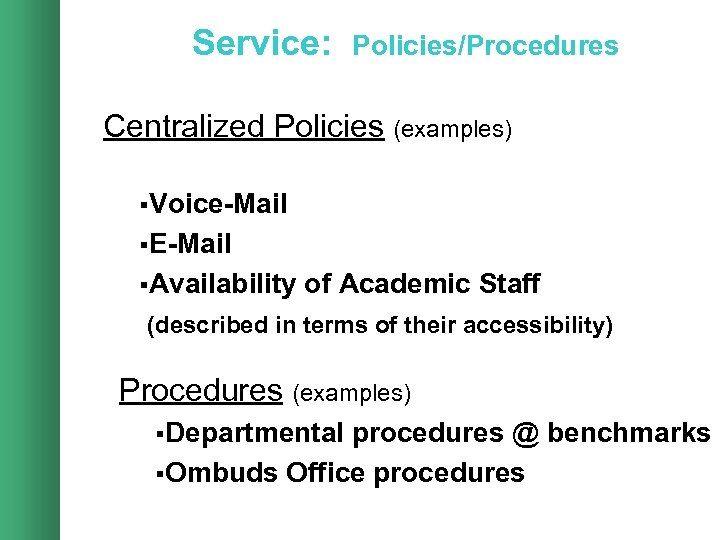
Service: Policies/Procedures Centralized Policies (examples) §Voice-Mail §E-Mail §Availability of Academic Staff (described in terms of their accessibility) Procedures (examples) §Departmental procedures @ benchmarks §Ombuds Office procedures
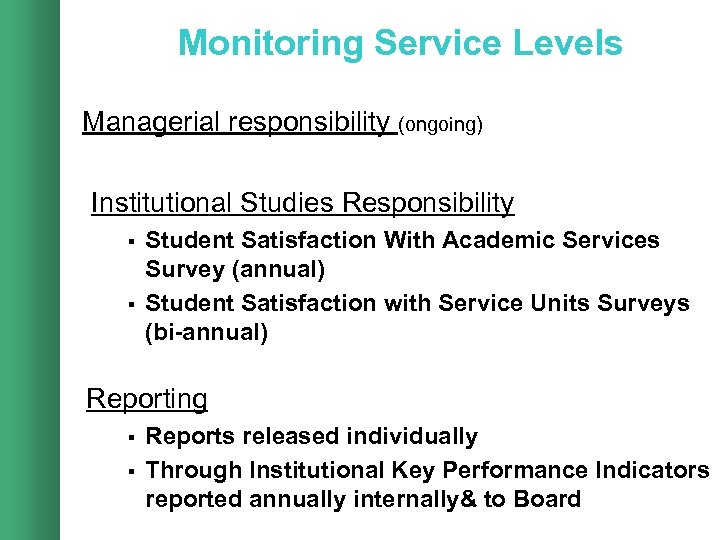
Monitoring Service Levels Managerial responsibility (ongoing) Institutional Studies Responsibility § § Student Satisfaction With Academic Services Survey (annual) Student Satisfaction with Service Units Surveys (bi-annual) Reporting § § Reports released individually Through Institutional Key Performance Indicators reported annually internally& to Board
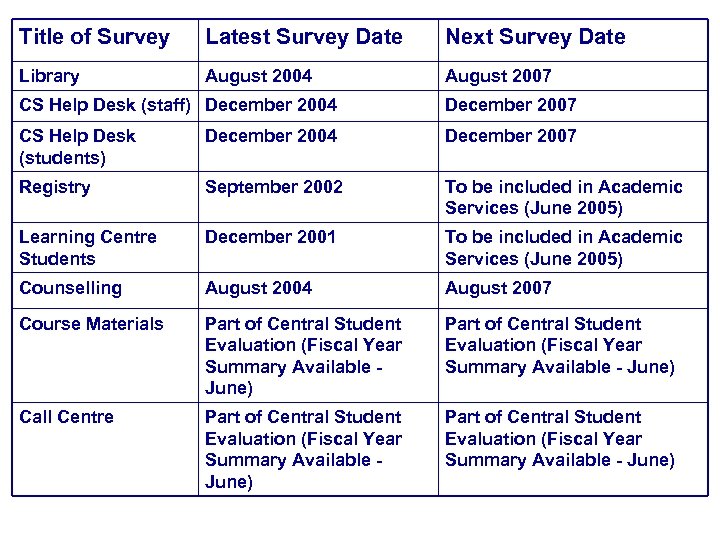
Title of Survey Latest Survey Date Next Survey Date Library August 2004 August 2007 CS Help Desk (staff) December 2004 December 2007 CS Help Desk (students) December 2004 December 2007 Registry September 2002 To be included in Academic Services (June 2005) Learning Centre Students December 2001 To be included in Academic Services (June 2005) Counselling August 2004 August 2007 Course Materials Part of Central Student Evaluation (Fiscal Year Summary Available June) Part of Central Student Evaluation (Fiscal Year Summary Available - June) Call Centre Part of Central Student Evaluation (Fiscal Year Summary Available June) Part of Central Student Evaluation (Fiscal Year Summary Available - June)
INSTITUTIONAL INFRASTRUCTURE -Single / dual mode -Staffing complement -Size of student body
Single / Dual Mode Infrastructures & Flexible Student Learning l Flexible learning is more easily achieved in a dedicated, single mode ODL institution – – l Differentiated mission minimizes sub-cultures Institution-wide commitment to FSL more readily achievable Flexible academic regulations and modes of delivery can be the rule rather than the exception Organizational infrastructure conceived and developed with a view to FSL Collaboration across single mode ODL institutions create more opportunities for FSL
AU/Téluq Alliance l In place since Sept. 1999 l Each institution delivers its own courses l Courses from either institution accepted as meeting institutional requirements of both institutions l Student advising coordinated across institutions l Students pay fees set by their home institution and register with their home institution l Quasi seamlessness from learner’s perspective
l Official launch Fall 2000 l Current membership of ten provincial universities l Open to any chartered (AUCC) Canadian university l Common online course catalogue l Unable to deliver on principles around seemlessness – E. g. Transferability, residency, duplicate fees
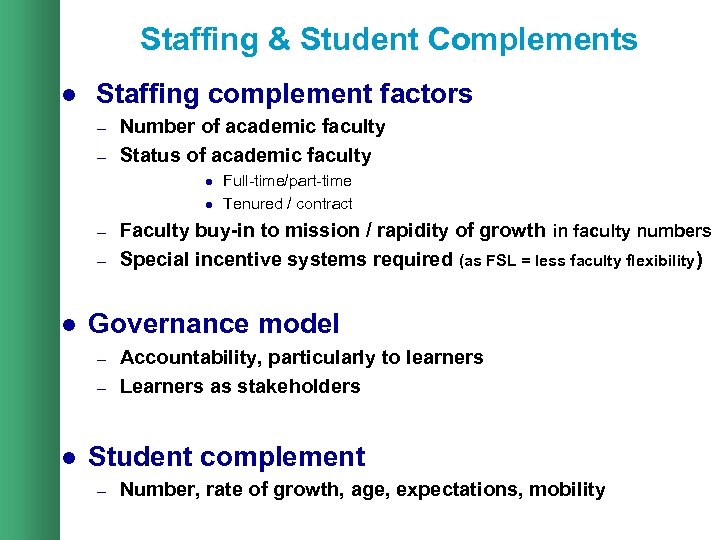
Staffing & Student Complements l Staffing complement factors – – Number of academic faculty Status of academic faculty l l – – l Faculty buy-in to mission / rapidity of growth in faculty numbers Special incentive systems required (as FSL = less faculty flexibility) Governance model – – l Full-time/part-time Tenured / contract Accountability, particularly to learners Learners as stakeholders Student complement – Number, rate of growth, age, expectations, mobility
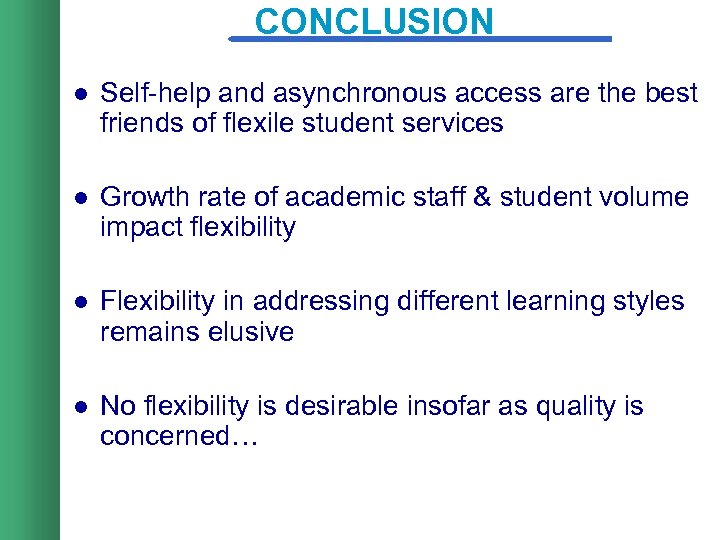
CONCLUSION l Self-help and asynchronous access are the best friends of flexile student services l Growth rate of academic staff & student volume impact flexibility l Flexibility in addressing different learning styles remains elusive l No flexibility is desirable insofar as quality is concerned…



Student Satisfaction Results Alberta University Survey 2002
Скачать презентацию Transformational Strategies for Flexible E-Learning Delivery Athabasca University
af4e372d6d321c14bbfc9e1e256a4ee0.ppt