 Скачать презентацию Transferable Indigenous Knowledge TIK Education Process and Policy
ffc527773b076ab6ab30027110908760.ppt
- Количество слайдов: 13



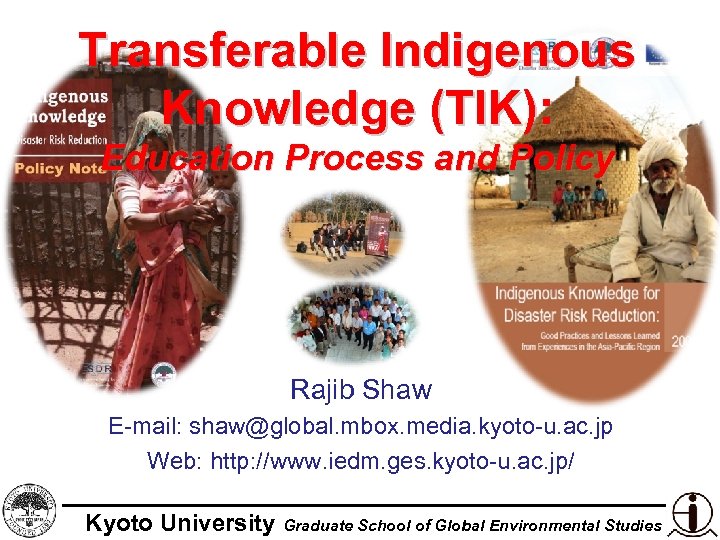
Transferable Indigenous Knowledge (TIK): Education Process and Policy Rajib Shaw E-mail: shaw@global. mbox. media. kyoto-u. ac. jp Web: http: //www. iedm. ges. kyoto-u. ac. jp/ Kyoto University Graduate School of Global Environmental Studies
Idea Workshop 2007 Defining TIK • Indigenous knowledge is the knowledge that people in a given community have developed over time, and continue to develop. It is based on experience, often tested over centuries of use, adapted to local culture and environment, dynamic and changing. Source: IIRR, Philippines, 1996: Recording and using indigenous knowledge: A manual. • Transferable indigenous knowledge is the traditional art of disaster reduction that is indigenous to specific region (s) but having potential to be applied to other regions and having time-tested reliability Kyoto University Graduate School of Global Environmental Studies
Idea Workshop 2007 Criteria for TIK • • • Originated within communities, based on local needs, and specific to culture and context (environment and economy) Provides core knowledge with flexibility for local adaptation for implementation Uses local knowledge and skills, and materials based on local ecology Has been proven to be time tested and useful in disasters Is applied or applicable in other communities or generations Kyoto University Graduate School of Global Environmental Studies
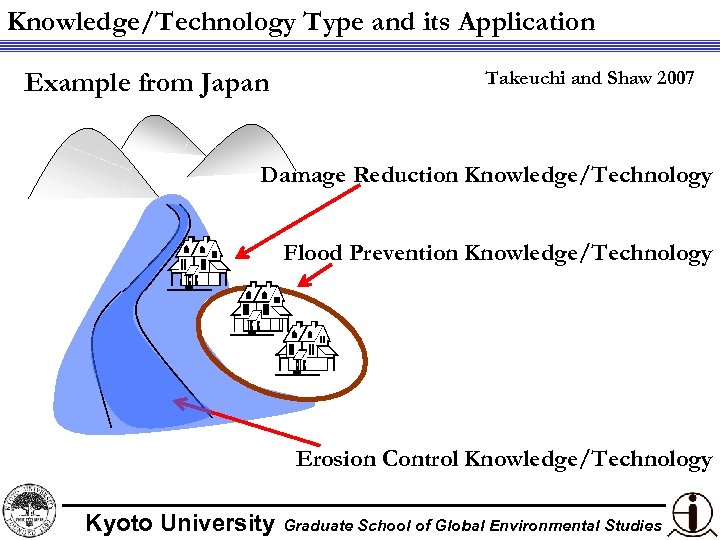
Knowledge/Technology Type and its Application Example from Japan Takeuchi and Shaw 2007 Damage Reduction Knowledge/Technology Flood Prevention Knowledge/Technology Erosion Control Knowledge/Technology Kyoto University Graduate School of Global Environmental Studies
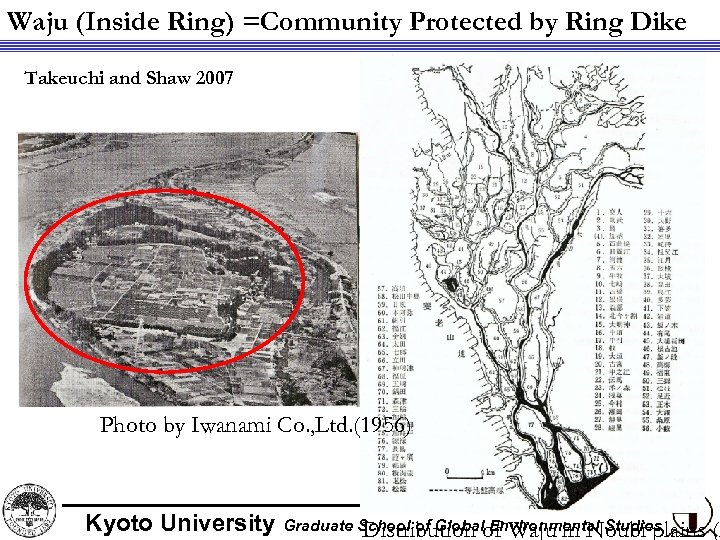
Waju (Inside Ring) =Community Protected by Ring Dike Takeuchi and Shaw 2007 Photo by Iwanami Co. , Ltd. (1956) Kyoto University Graduate School of Globalof Waju in Noubi plains (A Distribution Environmental Studies
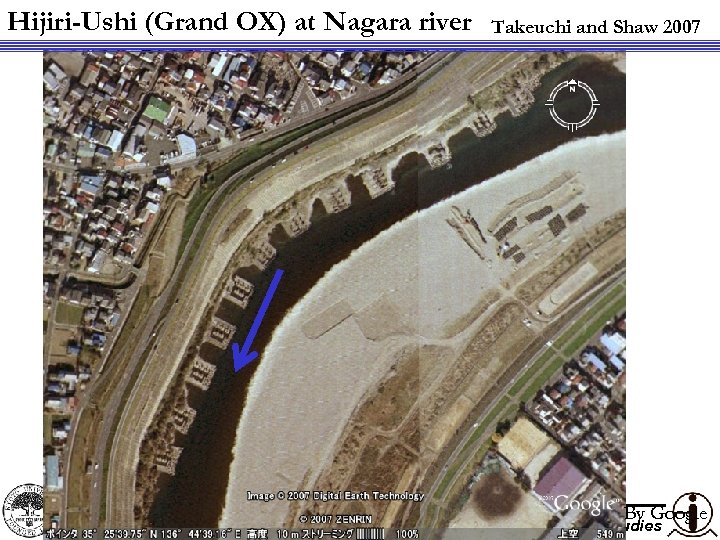
Hijiri-Ushi (Grand OX) at Nagara river Takeuchi and Shaw 2007 By Google Kyoto University Graduate School of Global Environmental Studies
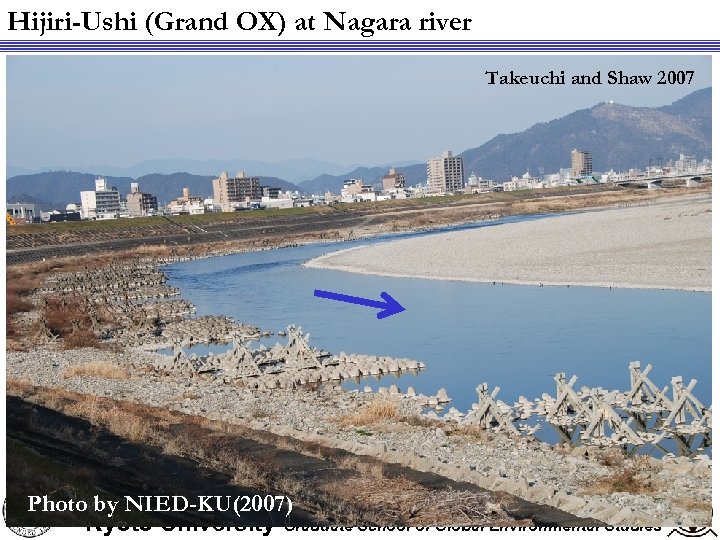
Hijiri-Ushi (Grand OX) at Nagara river Takeuchi and Shaw 2007 Photo by NIED-KU(2007) Kyoto University Graduate School of Global Environmental Studies
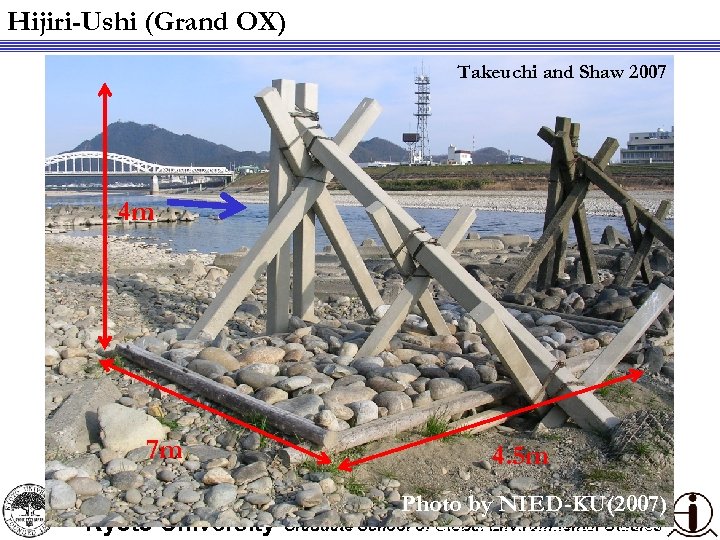
Hijiri-Ushi (Grand OX) Takeuchi and Shaw 2007 4 m 7 m 7 m 4. 5 m Photo by NIED-KU(2007) Kyoto University Graduate School. Photo by NIED-KU(2007) of Global Environmental Studies
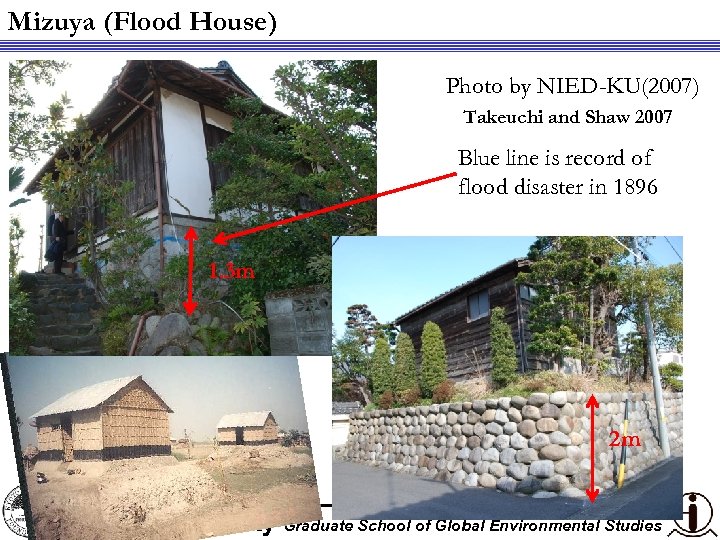
Mizuya (Flood House) Photo by NIED-KU(2007) Takeuchi and Shaw 2007 Blue line is record of flood disaster in 1896 1. 3 m 2 m Kyoto University Graduate School of Global Environmental Studies
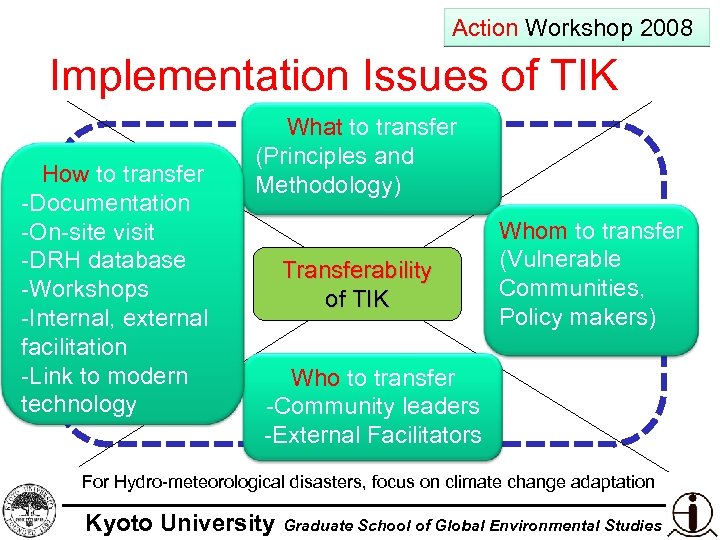
Action Workshop 2008 Implementation Issues of TIK How to transfer -Documentation -On-site visit -DRH database -Workshops -Internal, external facilitation -Link to modern technology What to transfer (Principles and Methodology) Transferability of TIK Whom to transfer (Vulnerable Communities, Policy makers) Who to transfer -Community leaders -External Facilitators For Hydro-meteorological disasters, focus on climate change adaptation Kyoto University Graduate School of Global Environmental Studies
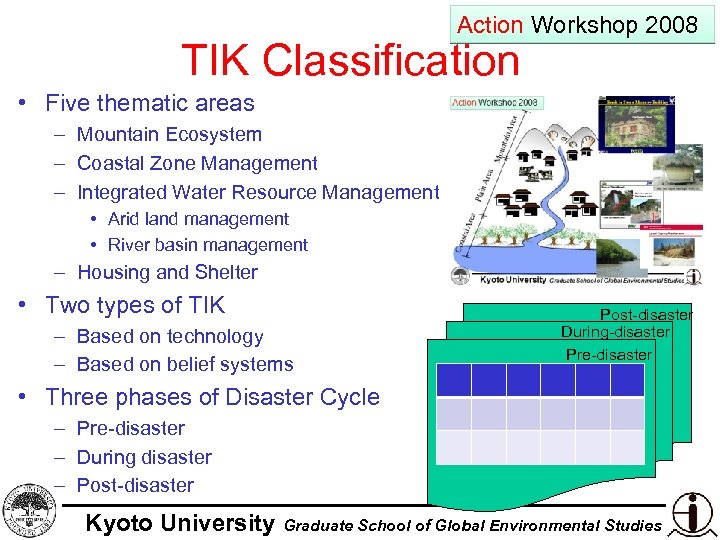
Action Workshop 2008 TIK Classification • Five thematic areas – Mountain Ecosystem – Coastal Zone Management – Integrated Water Resource Management • Arid land management • River basin management – Housing and Shelter • Two types of TIK – Based on technology – Based on belief systems Post-disaster During-disaster Pre-disaster • Three phases of Disaster Cycle – Pre-disaster – During disaster – Post-disaster Kyoto University Graduate School of Global Environmental Studies
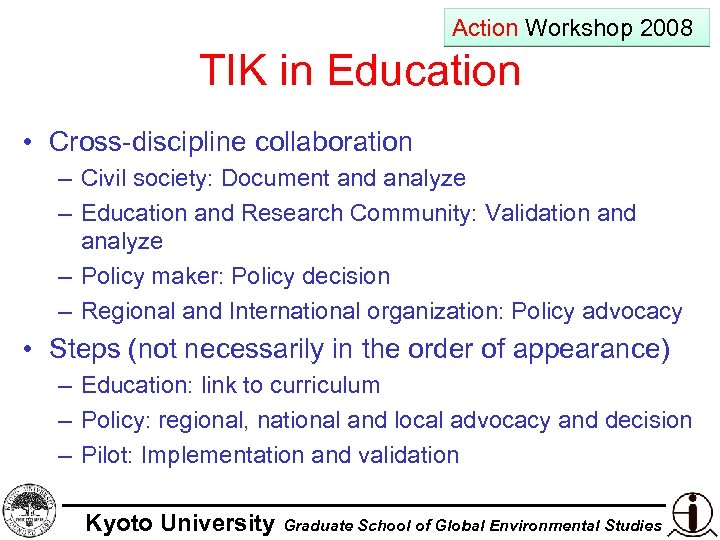
Action Workshop 2008 TIK in Education • Cross-discipline collaboration – Civil society: Document and analyze – Education and Research Community: Validation and analyze – Policy maker: Policy decision – Regional and International organization: Policy advocacy • Steps (not necessarily in the order of appearance) – Education: link to curriculum – Policy: regional, national and local advocacy and decision – Pilot: Implementation and validation Kyoto University Graduate School of Global Environmental Studies
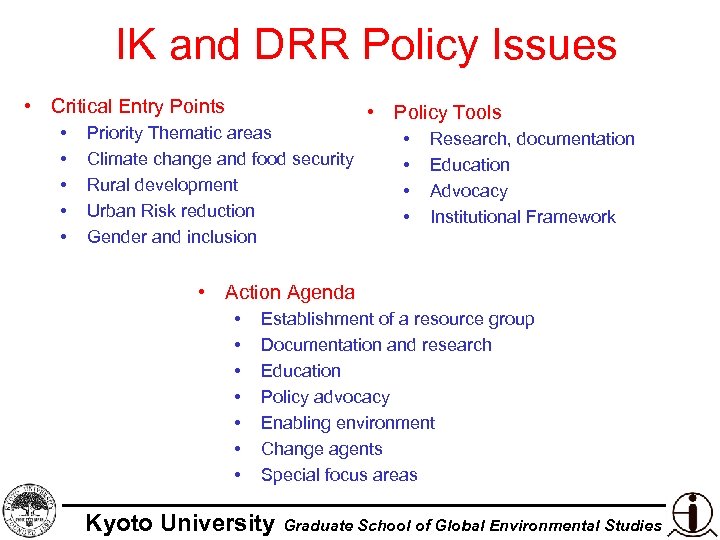
IK and DRR Policy Issues • Critical Entry Points • • • Policy Tools Priority Thematic areas Climate change and food security Rural development Urban Risk reduction Gender and inclusion • • Research, documentation Education Advocacy Institutional Framework • Action Agenda • • Establishment of a resource group Documentation and research Education Policy advocacy Enabling environment Change agents Special focus areas Kyoto University Graduate School of Global Environmental Studies
Скачать презентацию Transferable Indigenous Knowledge TIK Education Process and Policy
ffc527773b076ab6ab30027110908760.ppt