 Скачать презентацию Transfer Pricing Prof C S Balasubramaniam Why
88cfd2a99fe7a39429f5b781d5117bdc.ppt
- Количество слайдов: 18



Transfer Pricing Prof. C. S. Balasubramaniam
Why Transfer Pricing ? • More & more organizations are decentralized & divisionalized in product lines /territory /country • supplier units for raw materials accessories and consumables ancillaries, spare parts , power &fuel supplies procurement outsourcing • manufacturing /processing units • Assembling units • Marketing /distribution agencies • After sales/service units • If there are no transactions , TP does not arise
Why Transfer Pricing ? • But if there are substantial material transactions involving expenses/costs among the units, TP arises as a) The expenses /costs of one unit have to be recovered when they are selling to another unit of the same company b) The services rendered by the service units to user departments , e. g. computer/IT Purchases c) Transactions between legally independent units but under the same management.
Why Transfer Pricing ? • TP becomes established for the output transferred /the services rendered to other profit centers /investment centers • “TP is the price for goods/services exchanged” • In the absence of a sound TP system, assessment of profit performance/return on capital employed cannot be made. • Further disputes arise among units following which coordination between activities of the different units suffer.
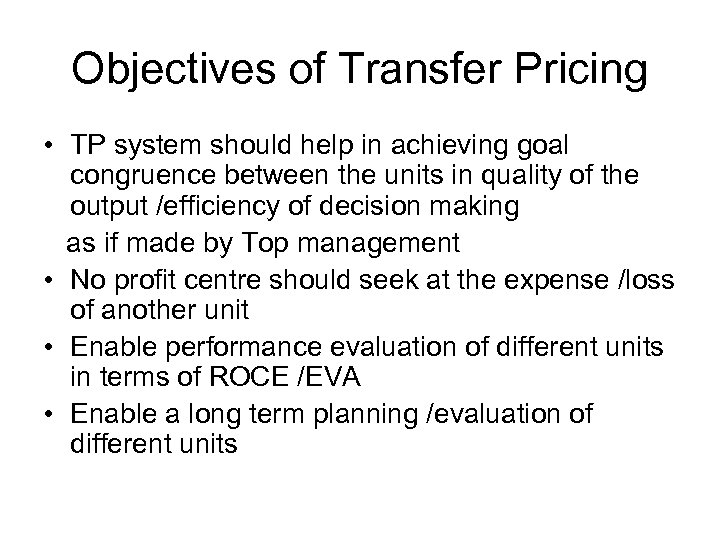
Objectives of Transfer Pricing • TP system should help in achieving goal congruence between the units in quality of the output /efficiency of decision making as if made by Top management • No profit centre should seek at the expense /loss of another unit • Enable performance evaluation of different units in terms of ROCE /EVA • Enable a long term planning /evaluation of different units
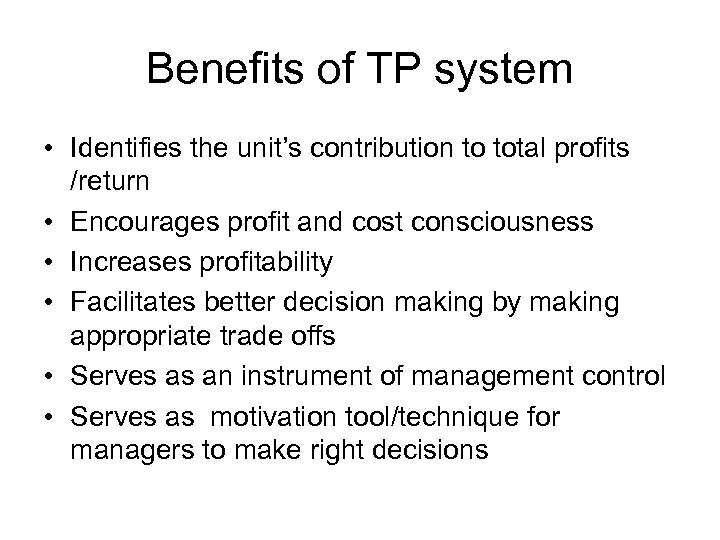
Benefits of TP system • Identifies the unit’s contribution to total profits /return • Encourages profit and cost consciousness • Increases profitability • Facilitates better decision making by making appropriate trade offs • Serves as an instrument of management control • Serves as motivation tool/technique for managers to make right decisions
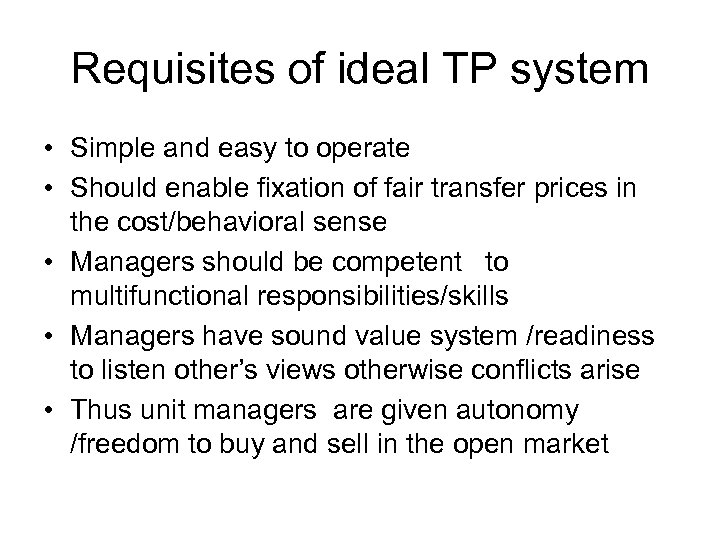
Requisites of ideal TP system • Simple and easy to operate • Should enable fixation of fair transfer prices in the cost/behavioral sense • Managers should be competent to multifunctional responsibilities/skills • Managers have sound value system /readiness to listen other’s views otherwise conflicts arise • Thus unit managers are given autonomy /freedom to buy and sell in the open market
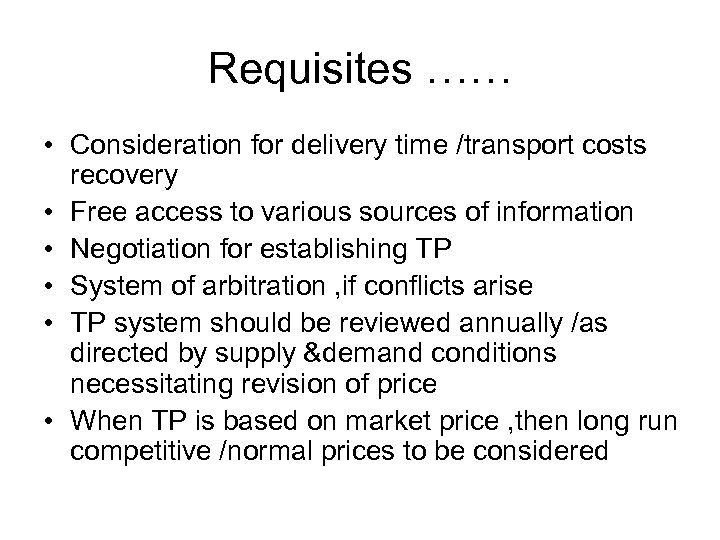
Requisites …… • Consideration for delivery time /transport costs recovery • Free access to various sources of information • Negotiation for establishing TP • System of arbitration , if conflicts arise • TP system should be reviewed annually /as directed by supply &demand conditions necessitating revision of price • When TP is based on market price , then long run competitive /normal prices to be considered
Fundamental principles of TP • Should the company produce the product inside /outside ? - “Sourcing decision” • If produced inside , at what price should the product be transferred between profit centers – “Transfer pricing decision “ • TP should be comparable to the prevailing competitive prices within the country • Cash remains within the company /does not cause working capital problems • If not , Top management’s views would prevail and accepted by all units
Basis for fixation of TP • Cost price TP in terms of actual/standard costs , full cost recovery or marginal cost based on economies of scale &costs or standard cost plus standard margin of profit • Market Price basis leads to efficient decision • Proper technique for performance motivation and evaluation
Basis for fixation of TP • When Intermediate products are transferred between one vendor and another , characteristics of imperfect competition like seller discounts , terms of trade , quality of goods, delivery schedules • If based on Landed price : freight costs foreign exchange cost recovered or Deliberate policy of encouraging indigenous products
Basis for fixation of TP • Shadow price based on linear programming /simulation model to optimize logistics cost, production /sales pattern , time constraints – e. g Oil Industry • Dual prices : Buying division may charge standard costs and manufacturing seller division may credit its revenue at the market price to take care of selling /distribution costs
Alternative framework for TP • Class A products are those products that are never likely to be produced outside the company for reasons of • Design (engine design in automobiles) • Relative importance to the final products (basic drugs in pharma ) • Risk of losing spare parts market (gears /brake systems in automobiles) • Defence equipment require specific R&D and technical know how • Difficult to obtain competitive market prices
Alternative framework • Rational basis for class A is standard cost plus standard profit margin • Standard profit means same percentage on assets employed on similar products f the same company or average profit margin of different divisions or return expected on new capital projects • This costing should be done by outside consultant to avoid any bias by one unit inside the company
Alternative framework • Class B products are those which are produced with special equipment /expertise • Sourcing cannot be changed frequently • Company produces for long time • If outside vendors are chosen, internal equipment to be scrapped. • Transfer prices for class B is long run competitive prices
Alternative framework • Class C products are those that can be produced by outside vendors without disrupting current operations of the company • Those produced by General purpose machinery e. g. voltage stabilisers, thermostats, UPS etc • Basis of TP for class C is long run competitive prices adjusted with selling /procurement costs • Negotiation on long term basis (2 to 3 years)is recommended
When not to adopt TP • When Top management compels its BUs in the interests of internal audit, secrecy, patents/intellectual property rights, data processing and information services, public relations • When goods are exchanged on peripheral reasons rather than material reasons (ITC buys filters from Tribeni Tissues and packaging services from its Monghyr Unit or Bhadrachalam Paperboards , its sister unit )
TP in a multinational setting /by MNC • Same principles discussed above apply to MNCs • Since MNCs conduct business in different countries with different tax structures, it is essential to maximize income in countries with low tax and minimize tax in high tax countries • Other criteria include number& volume of critical products exported /imported • Foreign exchange risk • Value addition to the final product • Tax planning by the parent company
Скачать презентацию Transfer Pricing Prof C S Balasubramaniam Why
88cfd2a99fe7a39429f5b781d5117bdc.ppt