 Скачать презентацию Transfer Function of the Quadrupoles And Expected b-Beating
c52373ea990bd36c0615333240b029e1.ppt
- Количество слайдов: 23



Transfer Function of the Quadrupoles And Expected b-Beating at injection. S. Sanfilippo and P. Hagen, J. -P. Koutchouk, M. Giovannozzi, T. Risselada Acknowledgments: S. Fartoukh, A. Lombardi, Y. Papaphilippou S. Sanfilippo Stephane. Sanfilippo@cern. ch Workshop Chamonix XV 23 -27 January 2006, L'Esplanade du Lac, Divonne-les-Bains 1 / 23
Special thanks to : n L. Bottura, N. Smirnov, M. Buzio, M. Calvi, N. Sammut, G. Deferne, M. Gateau, W. Venturini-Delsolaro & his team, O. Dunkel, J. Garcia. Perez & his team, D. Cornuet and his team (AT-MTM), E. Todesco (AT-MAS) for calibration measurements and analysis, follow-up, general information and feed-back. n R. Ostojic & his team, N. Catalan-Lasheras, S. Ramberger (AT-MEL), J. Di-Marco (FNAL) for the follow-up of the measurement results and feed-back on the instrument performance. S. Sanfilippo Stephane. Sanfilippo@cern. ch Workshop Chamonix XV - 23 -27 January 2006, L'Esplanade du Lac, Divonne-les-Bains 2 / 23
Outline n n n Motivations. Sources of gradient errors. Study of the gradient errors coming from the measurements: q q n Analytical estimate of the impact of the gradient errors on the b-beating (static case): q q n n n Uncertainty of the measurement systems. Cross-calibration results and estimate of the absolute accuracy. Arc quadrupole. Stand alone magnets- impact of the magnetic history. MAD Computation of the b-beating results versus targets. Conclusions. S. Sanfilippo Stephane. Sanfilippo@cern. ch Workshop Chamonix XV - 23 -27 January 2006, L'Esplanade du Lac, Divonne-les-Bains 3 / 23
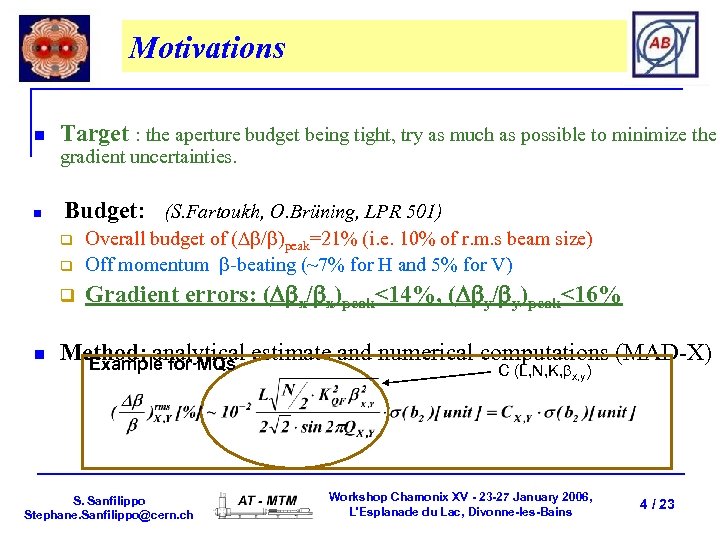
Motivations n Target : the aperture budget being tight, try as much as possible to minimize the gradient uncertainties. n Budget: (S. Fartoukh, O. Brüning, LPR 501) q Overall budget of (Db/b)peak=21% (i. e. 10% of r. m. s beam size) Off momentum b-beating (~7% for H and 5% for V) q Gradient errors: (Dbx/bx)peak<14%, (Dby/by)peak<16% q n Method: analytical estimate and numerical computations (MAD-X) Example for MQs S. Sanfilippo Stephane. Sanfilippo@cern. ch C (L, N, K, bx, y) Workshop Chamonix XV - 23 -27 January 2006, L'Esplanade du Lac, Divonne-les-Bains 4 / 23
Sources of gradient errors n n “Static” error sources : q Knowledge of the transfer function (uncertainty, random) of the quadrupoles (MQ, MQM, MQY, MQX, MQW, MQTL). q Systematic and random of b 2 in dipoles (MB). q Precision of the power converters. q Transfer function dependence on the magnetic field history. q Mismatch of the MQT’s when performing a tune shift DQ~ ± 0. 1. q Feed-downs from lattice and spool-piece sextupoles. “Dynamic” error sources : q Variation of MQ’s transfer functions during the decay, snap-back. q PC tracking errors on B 2(MQ)/B 1(MB). q Chromaticity correction during the decay/snap-back. S. Sanfilippo Stephane. Sanfilippo@cern. ch Workshop Chamonix XV - 23 -27 January 2006, L'Esplanade du Lac, Divonne-les-Bains 5 / 23
Break-down of uncertainties in the transfer function (static) n Quadrupoles measured at cold. q q n Quadrupoles measured at warm (or partially at cold). q q q n Precision of the measurement system (resolution, reproducibility, calibration uncertainty). Uncertainty on the cold magnet state (history dependence). Precision of the measurement system (resolution, reproducibility, calibration uncertainty). Uncertainty on the magnet state (history dependence). Precision of the warm-to-cold correlation and uncertainty on the extrapolation. Quadrupoles powered in series: q Spread of the transfer function due to manufacturing tolerances. S. Sanfilippo Stephane. Sanfilippo@cern. ch Workshop Chamonix XV - 23 -27 January 2006, L'Esplanade du Lac, Divonne-les-Bains 6 / 23
Break-down of the errors coming from the measurement systems n Resolution: Smallest variation that the system can measure. n For all the systems used resolution is better ( not discussed in the following) that 1 unit. n Reproducibility: Random coming from 10 consecutive measurements under the same conditions. n Uncertainty: Absolute accuracy of the system. n n Errors coming from the calibration of the systems. The systematic part is removed using cross-calibration between systems. All measurement errors are supposed to be normally distributed. The uncertainty and the reproducibility will be given at 1 s. S. Sanfilippo Stephane. Sanfilippo@cern. ch Workshop Chamonix XV - 23 -27 January 2006, L'Esplanade du Lac, Divonne-les-Bains 7 / 23
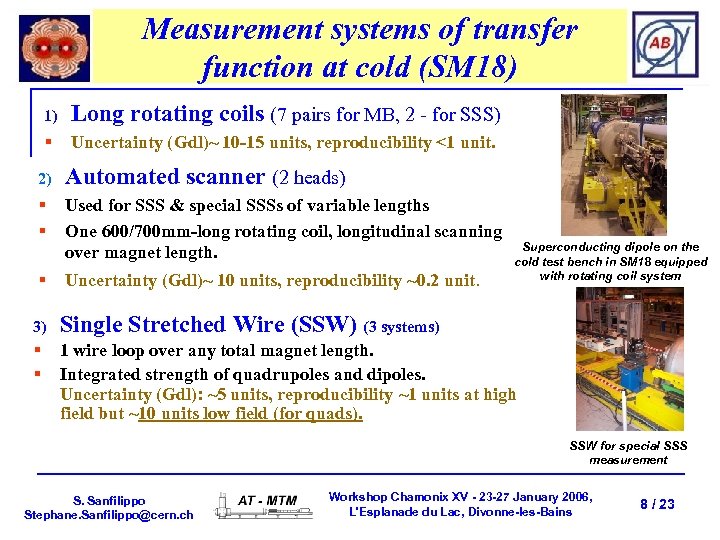
Measurement systems of transfer function at cold (SM 18) 1) Long rotating coils (7 pairs for MB, 2 - for SSS) § Uncertainty (Gdl)~ 10 -15 units, reproducibility <1 unit. 2) Automated scanner (2 heads) § § Used for SSS & special SSSs of variable lengths One 600/700 mm-long rotating coil, longitudinal scanning over magnet length. § Uncertainty (Gdl)~ 10 units, reproducibility ~0. 2 unit. Superconducting dipole on the cold test bench in SM 18 equipped with rotating coil system 3) Single Stretched Wire (SSW) (3 systems) § § 1 wire loop over any total magnet length. Integrated strength of quadrupoles and dipoles. Uncertainty (Gdl): ~5 units, reproducibility ~1 units at high field but ~10 units low field (for quads). SSW for special SSS measurement S. Sanfilippo Stephane. Sanfilippo@cern. ch Workshop Chamonix XV - 23 -27 January 2006, L'Esplanade du Lac, Divonne-les-Bains 8 / 23
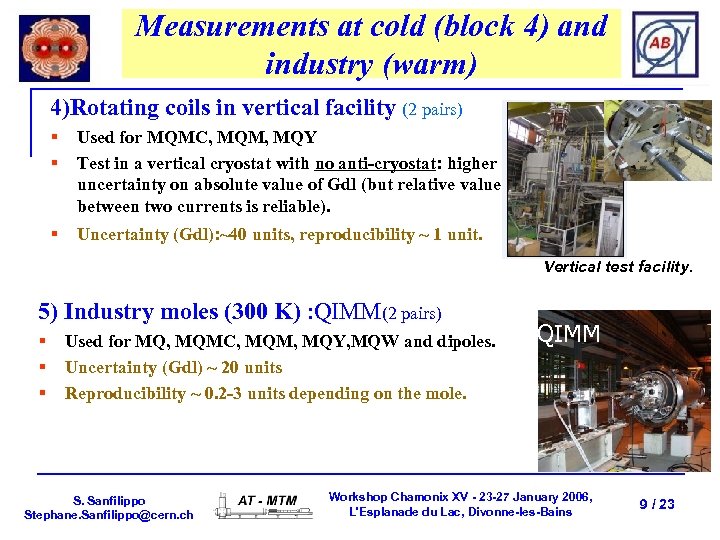
Measurements at cold (block 4) and industry (warm) 4)Rotating coils in vertical facility (2 pairs) § § Used for MQMC, MQM, MQY Test in a vertical cryostat with no anti-cryostat: higher uncertainty on absolute value of Gdl (but relative value between two currents is reliable). § Uncertainty (Gdl): ~40 units, reproducibility ~ 1 unit. Vertical test facility. 5) Industry moles (300 K) : QIMM(2 pairs) § § § Used for MQ, MQMC, MQM, MQY, MQW and dipoles. Uncertainty (Gdl) ~ 20 units Reproducibility ~ 0. 2 -3 units depending on the mole. S. Sanfilippo Stephane. Sanfilippo@cern. ch QIMM Workshop Chamonix XV - 23 -27 January 2006, L'Esplanade du Lac, Divonne-les-Bains 9 / 23
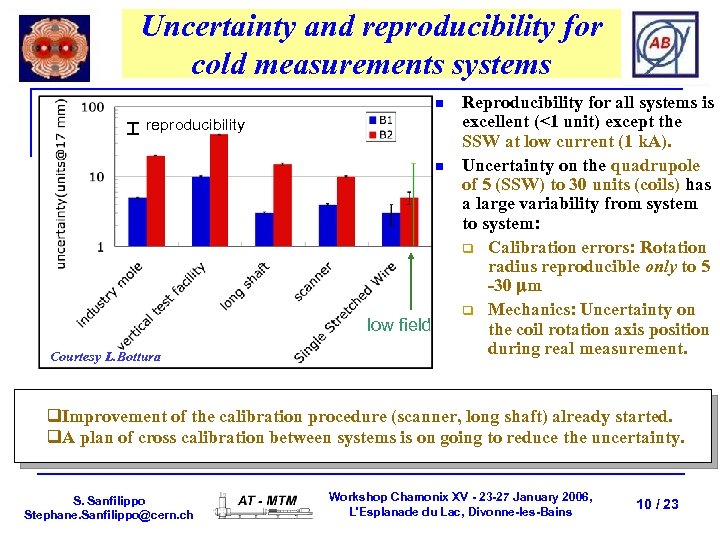
Uncertainty and reproducibility for cold measurements systems n reproducibility n low field Courtesy L. Bottura Reproducibility for all systems is excellent (<1 unit) except the SSW at low current (1 k. A). Uncertainty on the quadrupole of 5 (SSW) to 30 units (coils) has a large variability from system to system: q Calibration errors: Rotation radius reproducible only to 5 -30 mm q Mechanics: Uncertainty on the coil rotation axis position during real measurement. q. Improvement of the calibration procedure (scanner, long shaft) already started. q. A plan of cross calibration between systems is on going to reduce the uncertainty. S. Sanfilippo Stephane. Sanfilippo@cern. ch Workshop Chamonix XV - 23 -27 January 2006, L'Esplanade du Lac, Divonne-les-Bains 10 / 23
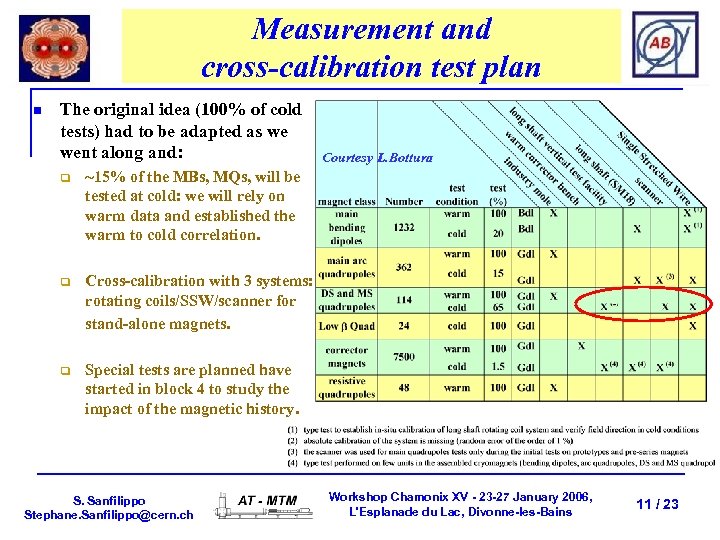
Measurement and cross-calibration test plan n The original idea (100% of cold tests) had to be adapted as we went along and: q ~15% of the MBs, MQs, will be tested at cold: we will rely on warm data and established the warm to cold correlation. q Cross-calibration with 3 systems: rotating coils/SSW/scanner for stand-alone magnets. q Courtesy L. Bottura Special tests are planned have started in block 4 to study the impact of the magnetic history. S. Sanfilippo Stephane. Sanfilippo@cern. ch Workshop Chamonix XV - 23 -27 January 2006, L'Esplanade du Lac, Divonne-les-Bains 11 / 23
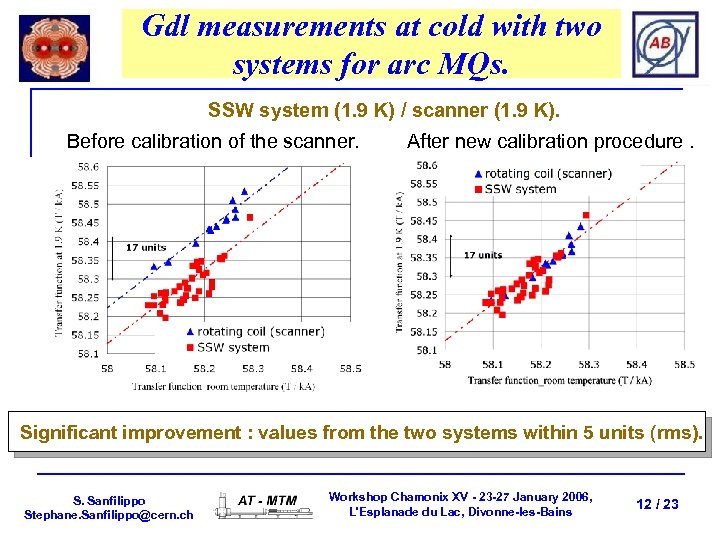
Gdl measurements at cold with two systems for arc MQs. SSW system (1. 9 K) / scanner (1. 9 K). Before calibration of the scanner. After new calibration procedure. Significant improvement : values from the two systems within 5 units (rms). S. Sanfilippo Stephane. Sanfilippo@cern. ch Workshop Chamonix XV - 23 -27 January 2006, L'Esplanade du Lac, Divonne-les-Bains 12 / 23
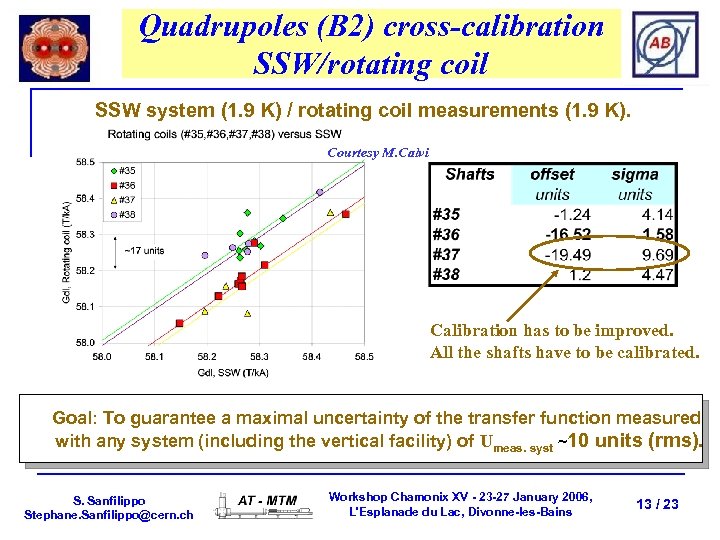
Quadrupoles (B 2) cross-calibration SSW/rotating coil SSW system (1. 9 K) / rotating coil measurements (1. 9 K). Courtesy M. Calvi Calibration has to be improved. All the shafts have to be calibrated. Goal: To guarantee a maximal uncertainty of the transfer function measured with any system (including the vertical facility) of Umeas. syst ~10 units (rms). S. Sanfilippo Stephane. Sanfilippo@cern. ch Workshop Chamonix XV - 23 -27 January 2006, L'Esplanade du Lac, Divonne-les-Bains 13 / 23
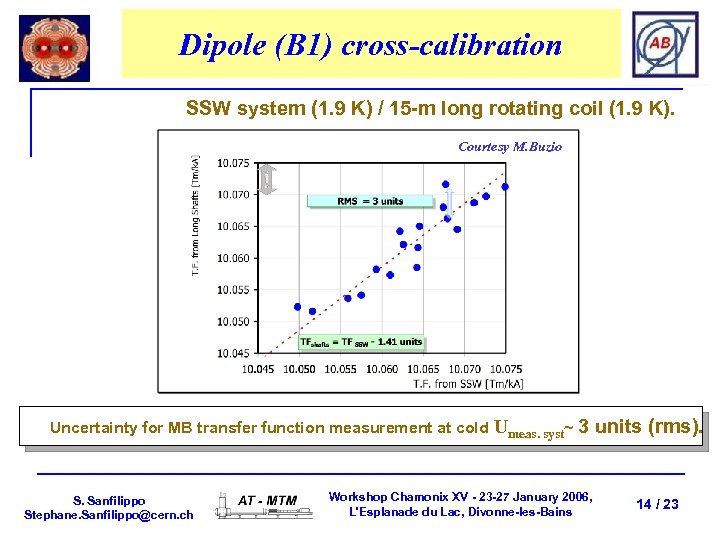
Dipole (B 1) cross-calibration SSW system (1. 9 K) / 15 -m long rotating coil (1. 9 K). Courtesy M. Buzio Uncertainty for MB transfer function measurement at cold S. Sanfilippo Stephane. Sanfilippo@cern. ch Umeas. syst~ 3 units (rms). Workshop Chamonix XV - 23 -27 January 2006, L'Esplanade du Lac, Divonne-les-Bains 14 / 23
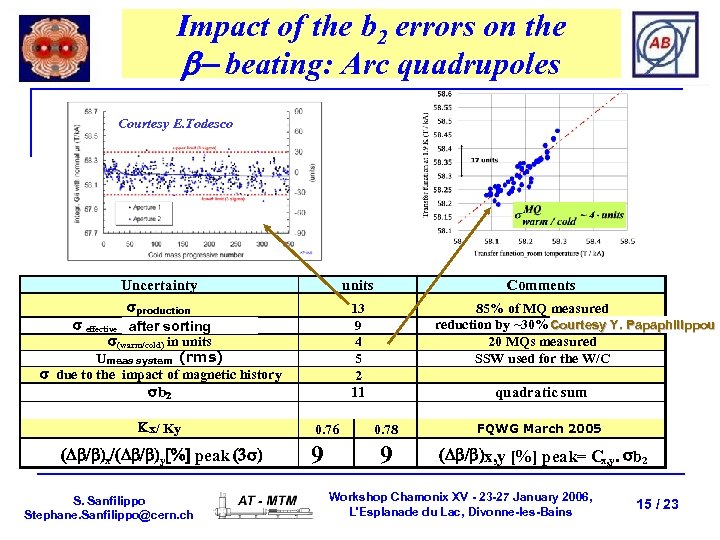
Impact of the b 2 errors on the b- beating: Arc quadrupoles Courtesy E. Todesco Uncertainty units sproduction s effective after (2 n+1)p pairing after sorting s(warm/cold) in units Umeas system (rms) s due to the impact of magnetic history 13 9 4 5 2 sb 2 Kx/ Ky (Db/b)x/(Db/b)y[%] peak (3 s) S. Sanfilippo Stephane. Sanfilippo@cern. ch Comments 85% of MQ measured (Y. Papaphilippou) reduction by ~30% Courtesy Y. Papaphilippou 20 MQs measured SSW used for the W/C 11 0. 76 9 quadratic sum 0. 78 9 FQWG March 2005 (Db/b)x, y [%] peak= Cx, y. sb 2 Workshop Chamonix XV - 23 -27 January 2006, L'Esplanade du Lac, Divonne-les-Bains 15 / 23
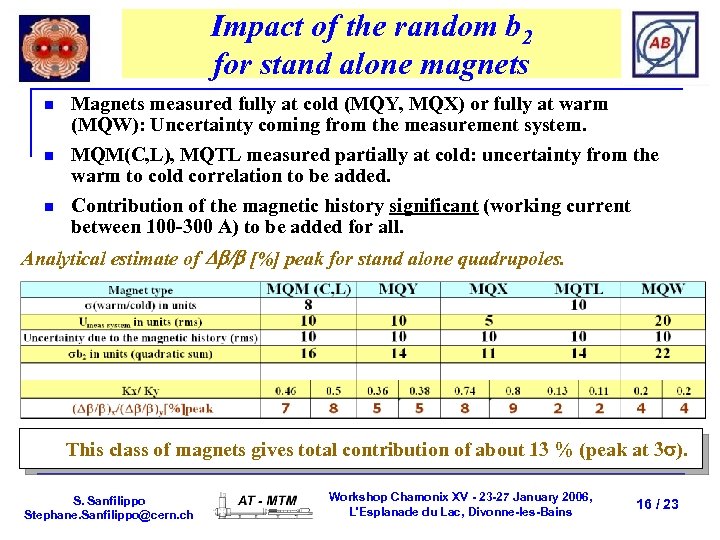
Impact of the random b 2 for stand alone magnets n n n Magnets measured fully at cold (MQY, MQX) or fully at warm (MQW): Uncertainty coming from the measurement system. MQM(C, L), MQTL measured partially at cold: uncertainty from the warm to cold correlation to be added. Contribution of the magnetic history significant (working current between 100 -300 A) to be added for all. Analytical estimate of Db/b [%] peak for stand alone quadrupoles. This class of magnets gives total contribution of about 13 % (peak at 3 s). S. Sanfilippo Stephane. Sanfilippo@cern. ch Workshop Chamonix XV - 23 -27 January 2006, L'Esplanade du Lac, Divonne-les-Bains 16 / 23
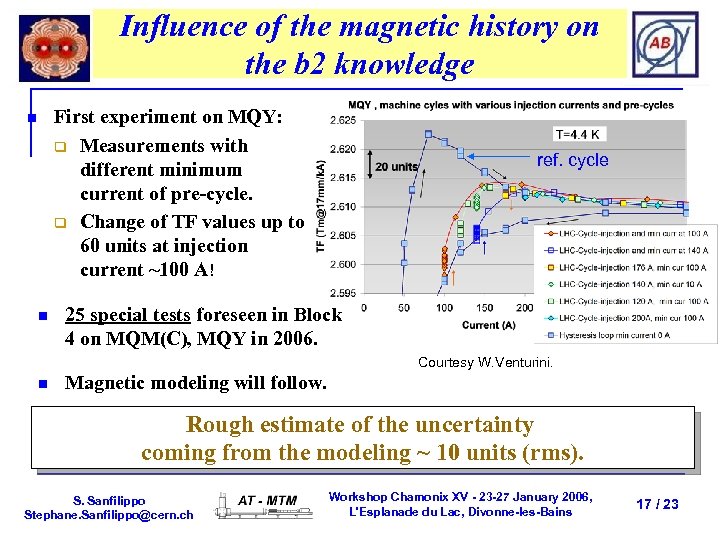
Influence of the magnetic history on the b 2 knowledge First experiment on MQY: q Measurements with different minimum current of pre-cycle. q Change of TF values up to 60 units at injection current ~100 A! n n ref. cycle 25 special tests foreseen in Block 4 on MQM(C), MQY in 2006. Courtesy W. Venturini. n Magnetic modeling will follow. Rough estimate of the uncertainty coming from the modeling ~ 10 units (rms). S. Sanfilippo Stephane. Sanfilippo@cern. ch Workshop Chamonix XV - 23 -27 January 2006, L'Esplanade du Lac, Divonne-les-Bains 17 / 23
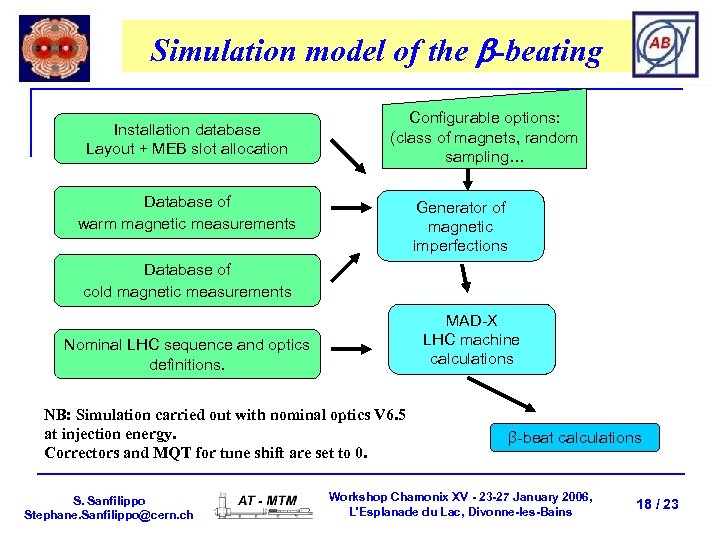
Simulation model of the b-beating Installation database Layout + MEB slot allocation Configurable options: (class of magnets, random sampling… Database of warm magnetic measurements Generator of magnetic imperfections Database of cold magnetic measurements MAD-X LHC machine calculations Nominal LHC sequence and optics definitions. NB: Simulation carried out with nominal optics V 6. 5 at injection energy. Correctors and MQT for tune shift are set to 0. S. Sanfilippo Stephane. Sanfilippo@cern. ch β-beat calculations Workshop Chamonix XV - 23 -27 January 2006, L'Esplanade du Lac, Divonne-les-Bains 18 / 23
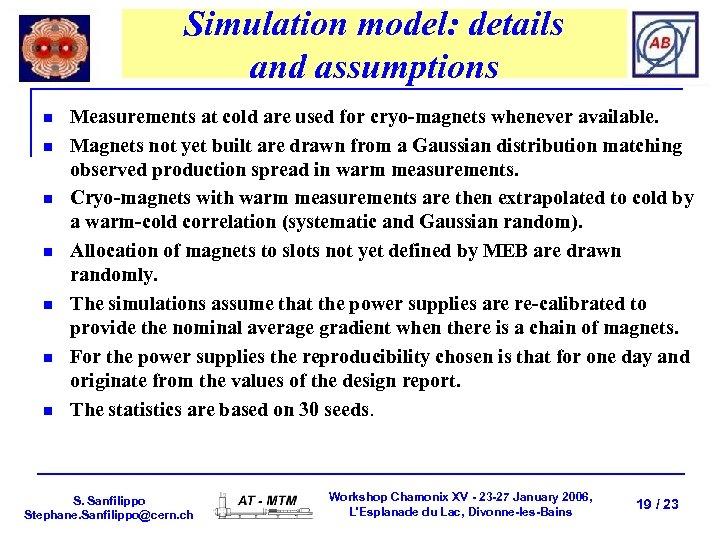
Simulation model: details and assumptions n n n n Measurements at cold are used for cryo-magnets whenever available. Magnets not yet built are drawn from a Gaussian distribution matching observed production spread in warm measurements. Cryo-magnets with warm measurements are then extrapolated to cold by a warm-cold correlation (systematic and Gaussian random). Allocation of magnets to slots not yet defined by MEB are drawn randomly. The simulations assume that the power supplies are re-calibrated to provide the nominal average gradient when there is a chain of magnets. For the power supplies the reproducibility chosen is that for one day and originate from the values of the design report. The statistics are based on 30 seeds. S. Sanfilippo Stephane. Sanfilippo@cern. ch Workshop Chamonix XV - 23 -27 January 2006, L'Esplanade du Lac, Divonne-les-Bains 19 / 23
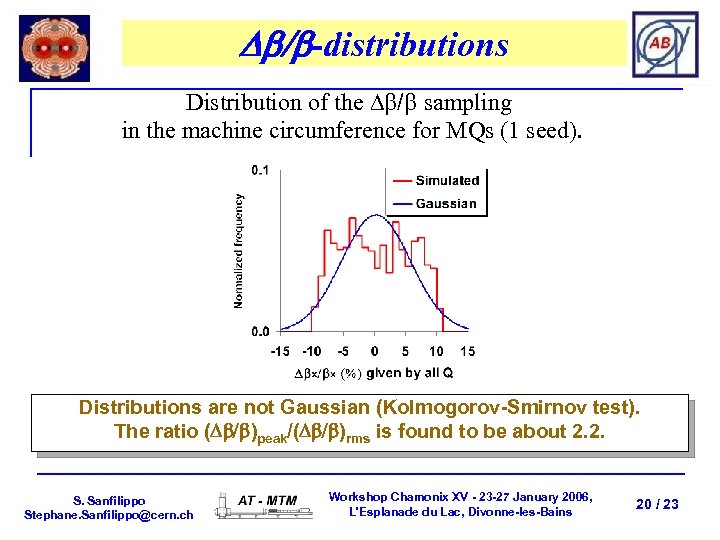
Db/b-distributions Distribution of the Db/b sampling in the machine circumference for MQs (1 seed). Distributions are not Gaussian (Kolmogorov-Smirnov test). The ratio (Db/b)peak/(Db/b)rms is found to be about 2. 2. S. Sanfilippo Stephane. Sanfilippo@cern. ch Workshop Chamonix XV - 23 -27 January 2006, L'Esplanade du Lac, Divonne-les-Bains 20 / 23
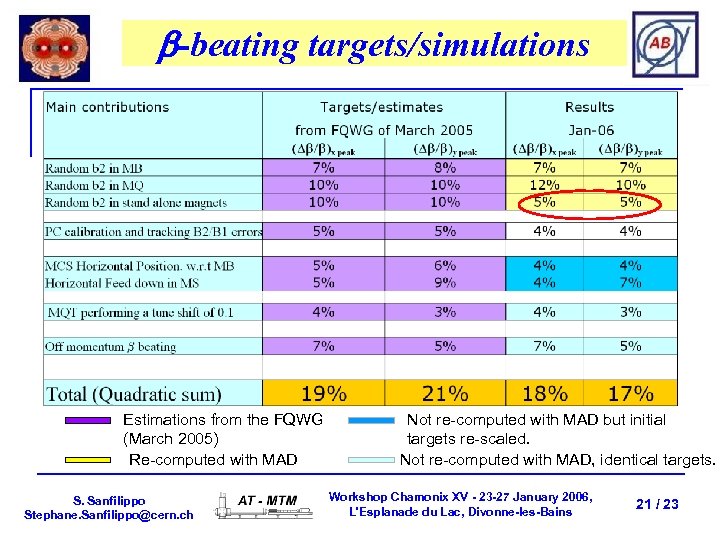
b-beating targets/simulations Estimations from the FQWG (March 2005) Re-computed with MAD S. Sanfilippo Stephane. Sanfilippo@cern. ch Not re-computed with MAD but initial targets re-scaled. Not re-computed with MAD, identical targets. Workshop Chamonix XV - 23 -27 January 2006, L'Esplanade du Lac, Divonne-les-Bains 21 / 23
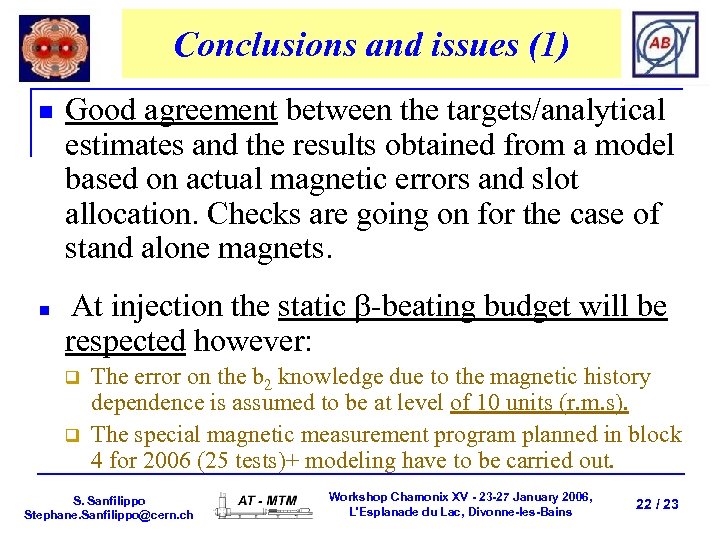
Conclusions and issues (1) n n Good agreement between the targets/analytical estimates and the results obtained from a model based on actual magnetic errors and slot allocation. Checks are going on for the case of stand alone magnets. At injection the static b-beating budget will be respected however: q q The error on the b 2 knowledge due to the magnetic history dependence is assumed to be at level of 10 units (r. m. s). The special magnetic measurement program planned in block 4 for 2006 (25 tests)+ modeling have to be carried out. S. Sanfilippo Stephane. Sanfilippo@cern. ch Workshop Chamonix XV - 23 -27 January 2006, L'Esplanade du Lac, Divonne-les-Bains 22 / 23
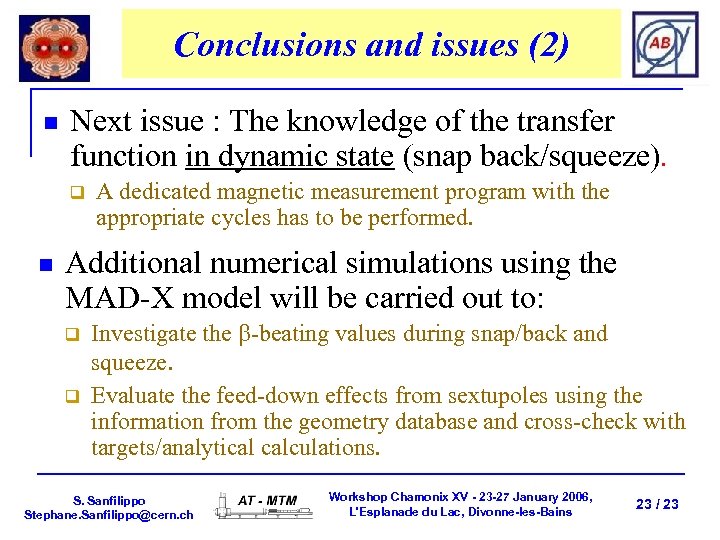
Conclusions and issues (2) n Next issue : The knowledge of the transfer function in dynamic state (snap back/squeeze). q n A dedicated magnetic measurement program with the appropriate cycles has to be performed. Additional numerical simulations using the MAD-X model will be carried out to: q q Investigate the b-beating values during snap/back and squeeze. Evaluate the feed-down effects from sextupoles using the information from the geometry database and cross-check with targets/analytical calculations. S. Sanfilippo Stephane. Sanfilippo@cern. ch Workshop Chamonix XV - 23 -27 January 2006, L'Esplanade du Lac, Divonne-les-Bains 23 / 23
Скачать презентацию Transfer Function of the Quadrupoles And Expected b-Beating
c52373ea990bd36c0615333240b029e1.ppt