


 Скачать презентацию Transcending the Three R s A Survey of Current
765fe85e5c6d1ed6f8c15c5314d3dcb9.ppt
- Количество слайдов: 39
 Transcending the Three R’s A Survey of Current K-12 Practices in Teaching and Assessing 21 st Century Skills and College/Career Readiness CCSSO NCSA June 28, 2012
 Session Background l Increased emphasis on 21 st century skills l l l Districts are struggling l l l Multiple 21 st century skills frameworks Common Core State Standards, Race to the Top Which 21 st century skills? What do they look like? How can you teach them? How can you assess them? Early implementers and pockets of innovation
 Participants l l l Martin Creel, Montgomery County Public Schools Jeff Barker, Gwinnett County Public Schools Christa Macomber, Monona Grove School District Juan D’Brot, West Virginia Department of Ed Tim Magner, P 21
 Montgomery County Public Schools, MD Martin Creel Director of Enriched and Innovative Programs
 Why MCPS Curriculum 2. 0? In 2001 MCPS launched a rigorous new curriculum. As we gathered feedback from parents, teachers, and students we began hearing some of the same themes – More science! More social studies! More art, music, and physical education! More time! (mainly from teachers) http: //www. youtube. com/watch? v=Hx. JHI-j. CMD 4
 Why MCPS Curriculum 2. 0? Many students have excelled in reading and math since 2001. We noticed that students who had the most success in advanced reading and math had certain characteristics as students – Successful students are critical thinkers. Successful students are creative. Successful students know how to learn.
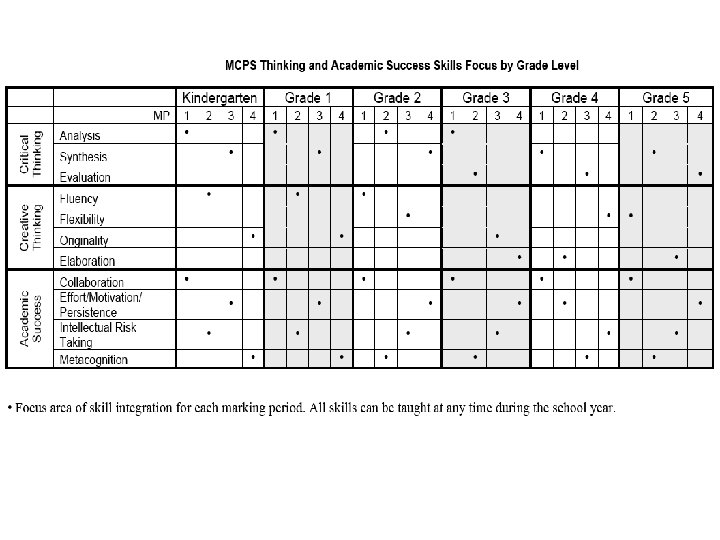
 What is MCPS Curriculum 2. 0? ü New Internationally-driven standards in math, reading, and writing. ü Renewed focus on teaching the whole child. ü Integrates thinking, reasoning, and creativity for a lifetime of learning.
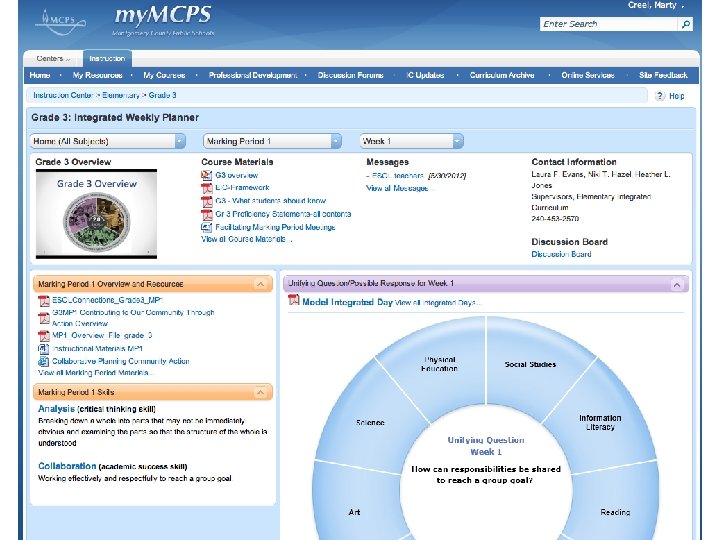
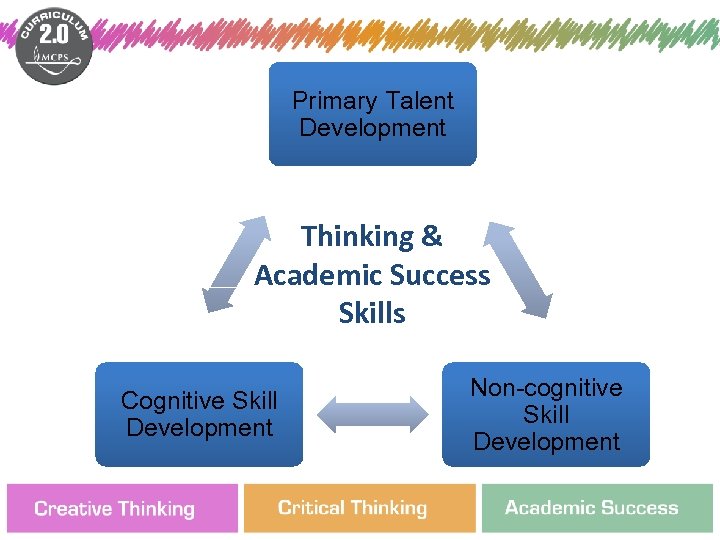 Primary Talent Development Thinking & Academic Success Skills Cognitive Skill Development Non-cognitive Skill Development
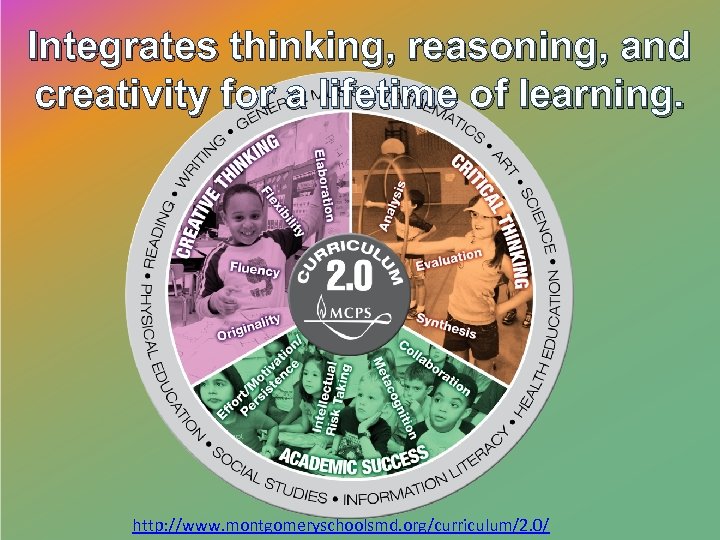 Integrates thinking, reasoning, and creativity for a lifetime of learning. http: //www. montgomeryschoolsmd. org/curriculum/2. 0/
 Gwinnett County Public Schools, GA Jeff Barker Executive Director of Accountability and Assessment
 Gwinnett County Public Schools (GCPS) l l Assessment Audit Reorganization l l l Defined 21 st century skills l l Specialization Curriculum Specialists Curriculum Assessment Instruction Focus on the Student l What, Why and How
 Gwinnett County Public Schools (GCPS) l Instituted an interim assessment program l Rigorous Test Development Process l Variety of items § § § l Item Writing § § l l l Multiple choice Performance Gateway writing Webb’s Depth of Knowledge Universal Design Simulation Automated Scoring Data Analysis at distractor level
 Gwinnett County Public Schools (GCPS) l Next Steps l l Improving and enhancing the classroom assessment program Expand partnerships and collaboration with Ga. DOE, Pearson and other districts. Research and explore opportunities for extending assessments for special populations including ELL students. Implement stream-line learning management system
 Monona Grove School District, WI Christa Macomber Data and Assessment Coordinator
![Organizational Profile Monona Grove School District Environment: § 3000 Students [4 K-12] § 500+](https://present5.com/presentation/765fe85e5c6d1ed6f8c15c5314d3dcb9/image-18.jpg "Organizational Profile Monona Grove School District Environment: § 3000 Students [4 K-12] § 500+") Organizational Profile Monona Grove School District Environment: § 3000 Students [4 K-12] § 500+ Staff-members Relationships § Two Communities (Monona and Cottage Grove) § Business community § Community Services § Higher Education § Leadership Amongst Local and State-wide School Districts (e. g. RTi, College & Career Readiness, Data-Driven Decisionmaking)
Organizational Profile Monona Grove School District Environment: § 3000 Students [4 K-12] § 500+ Staff-members Relationships § Two Communities (Monona and Cottage Grove) § Business community § Community Services § Higher Education § Leadership Amongst Local and State-wide School Districts (e. g. RTi, College & Career Readiness, Data-Driven Decisionmaking)
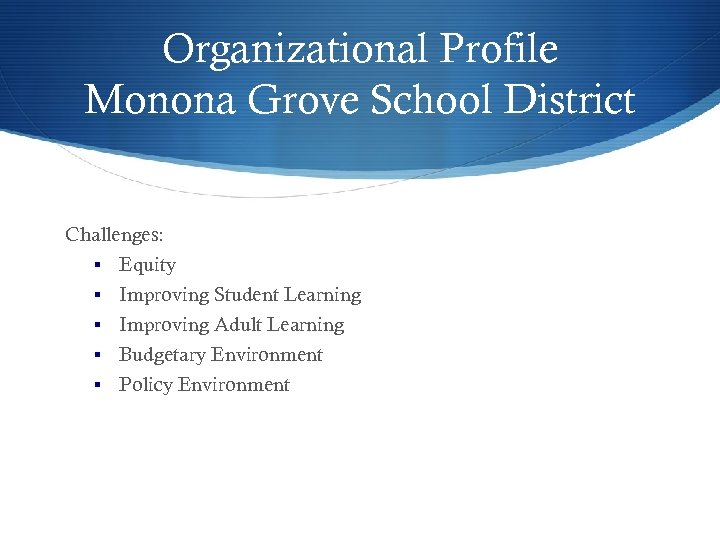 Organizational Profile Monona Grove School District Challenges: § Equity § Improving Student Learning § Improving Adult Learning § Budgetary Environment § Policy Environment
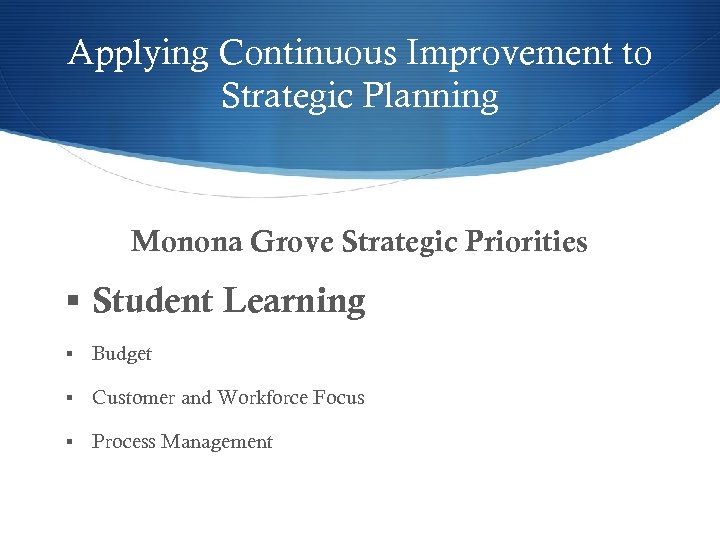 Applying Continuous Improvement to Strategic Planning Monona Grove Strategic Priorities § Student Learning § Budget § Customer and Workforce Focus § Process Management
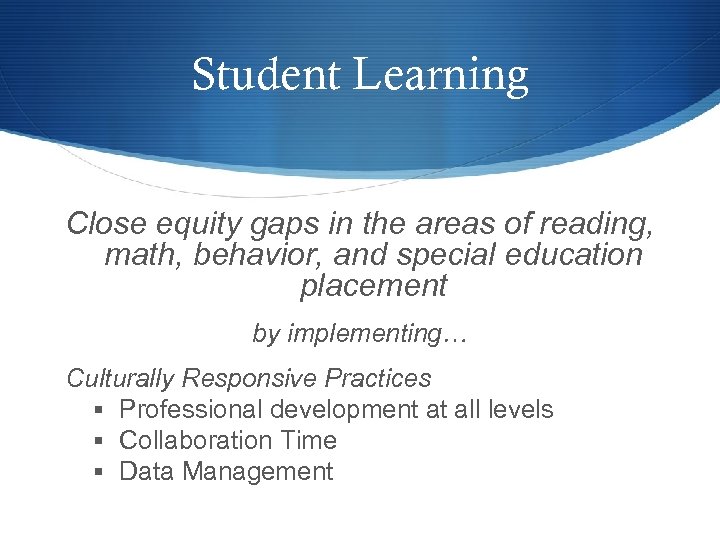 Student Learning Close equity gaps in the areas of reading, math, behavior, and special education placement by implementing… Culturally Responsive Practices § Professional development at all levels § Collaboration Time § Data Management
 Student Learning Close equity gaps in the areas of reading, math, behavior, and special education placement by implementing… Positive Behavior Interventions and Supports (PBIS) § § § Universal K-8 Prevention Curriculum (Tier 1) Interventions (Tier 2 and Tier 3) PBIS Coaches Training and Collaboration Data Management (SWIS)
 Student Learning Increase student achievement in literacy and math by… Implementing a Professional Learning Community framework that supports collaborative work on meeting strategic goals § Professional Collaboration Time § § Common Assessments (Formative and Summative) Data management systems Data Analysis and Support (District, Building and Classroom) Ongoing Professional Development
 Student Learning Increase student achievement in literacy and math by… Differentiating instruction using standards-based assessments. § Curriculum alignment for College and Career Readiness (4 K- 12) § § Wisconsin Model Academic Standards (all subject areas) § Common Core State Standards (K-12, English Language Arts and Math) Interventions (Tiers 1, 2, 3) Professional development Research-based instructional practices and materials
 Critical Components § Research-based practices and resources to promote College and Career Readiness for all students § Time for professional collaboration and learning § Data and Assessment System § Technology to promote: § Student access to worldwide resources on demand § Continuous learning for staff § Efficient and effective operations § Continuous Improvement process
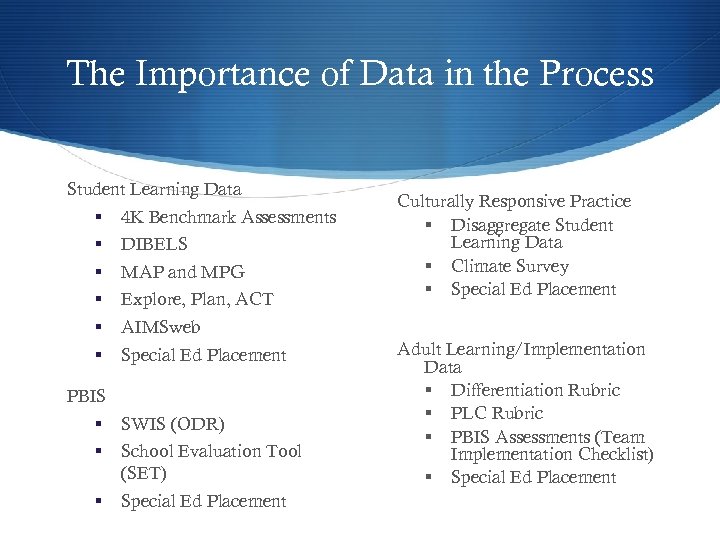 The Importance of Data in the Process Student Learning Data § 4 K Benchmark Assessments § DIBELS § MAP and MPG § Explore, Plan, ACT § AIMSweb § Special Ed Placement Culturally Responsive Practice § Disaggregate Student Learning Data § Climate Survey § Special Ed Placement PBIS § SWIS (ODR) § School Evaluation Tool (SET) § Special Ed Placement Adult Learning/Implementation Data § Differentiation Rubric § PLC Rubric § PBIS Assessments (Team Implementation Checklist) § Special Ed Placement
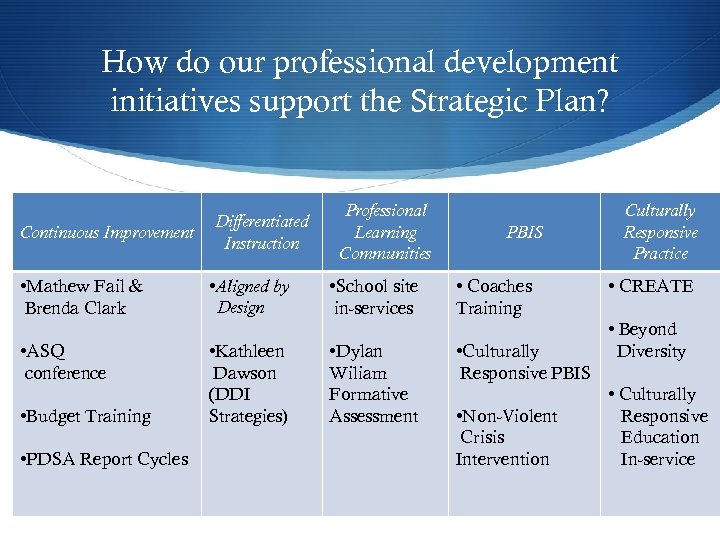 How do our professional development initiatives support the Strategic Plan? Continuous Improvement • Mathew Fail & Brenda Clark • ASQ conference • Budget Training • PDSA Report Cycles Differentiated Instruction • Aligned by Design • Kathleen Dawson (DDI Strategies) Professional Learning Communities • School site in-services • Dylan Wiliam Formative Assessment PBIS • Coaches Training • Culturally Responsive PBIS • Non-Violent Crisis Intervention Culturally Responsive Practice • CREATE • Beyond Diversity • Culturally Responsive Education In-service
 West Virginia Department of Education Juan D’Brot Executive Director Office of Assessment and Accountability
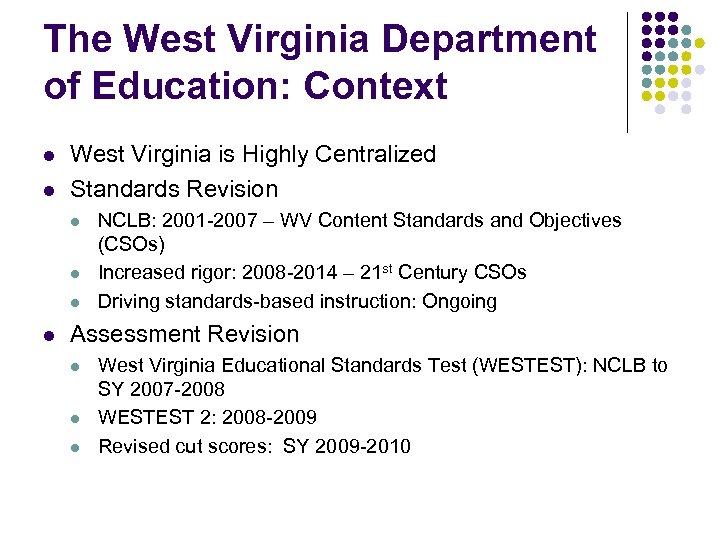 The West Virginia Department of Education: Context l l West Virginia is Highly Centralized Standards Revision l l NCLB: 2001 -2007 – WV Content Standards and Objectives (CSOs) Increased rigor: 2008 -2014 – 21 st Century CSOs Driving standards-based instruction: Ongoing Assessment Revision l l l West Virginia Educational Standards Test (WESTEST): NCLB to SY 2007 -2008 WESTEST 2: 2008 -2009 Revised cut scores: SY 2009 -2010
 The West Virginia Department of Education: Context l Recall transitioning to Evidence-Centered Design-like Development l WESTEST 1 Basic Skills, low DOK, Insufficient objective sampling WESTEST 2 l Higher DOKs, much stricter item development considerations (see harder), too many objectives, but an attempt to link evidence-based arguments about student across objectives (educator-driven). l l Objective Based Sampling in the Core Content: l l Still objective-based (or standard) assessment and reporting A loose proxy-measure on the cognitive processes of students
 West Virginia Department of Education: Framework l WESTEST 2 development was informed by P 21’s Framework l l l Critical Thinking Problem Solving Communication Collaboration Creativity Innovation
 West Virginia Department of Education: Framework l Lack of evidence beyond selected response in Math, Science and Social Studies l l Minor evidence in ELA performance tasks 21 st Century Instruction l l l Project based learning Performance tasks Anecdotal evidence in need of review
 West Virginia Department of Education: Assessment l Edvation’s assistance in gathering evidence (tech. Steps) l l l How do we compile evidence? Initially for compliance with technology literacy at 8 th grade Began with conversations around P 21’s Framework Let to a rubric-based performance assessment Used to engage students in inquiry-based technology literacy activities
 West Virginia Department of Education: Assessment l Edvation’s assistance in gathering evidence (tech. Steps) l Used to engage students in inquiry-based technology literacy activities l l Moving beyond anecdote Targeting a revised set of 21 st century skills: § § § Creativity and Innovation; Critical Thinking and Problem Solving; Collaboration and Teamwork; Life and Career Skills; and Information Literacy and Research
 West Virginia Department of Education: Opportunities l The transition to a Personalized Learning Landscape (to support the use of noncognitive measures) l l l Student ownership of the learning process Enhancing student motivation and engagement Visualizations of learning progressions Portfolio-based evidence model Targeting specifically things outside the domain of math, ELA, science, social studies Any funders in the room?
 West Virginia Department of Education: Opportunities l How? l Concerted design, piloting, validation, and implementation of l Student self-assessments § § l Objective measures § § § l Self-reports validity concerns Forced choice Situational judgment tests Implicit associations Conditional reasoning Interviews or other-ratings
 West Virginia Department of Education: Challenges l Non Cognitive Measures l Pricey? l l l Development Validation Implementation Fidelity Not the traditional focus A different kind of buy-in
 West Virginia Department of Education: Challenges l Accountability l l l 21 st century skills are in the public vernacular Reframing the problem-space within and beyond K-12 In the future of accountability? Threat to continuous improvement and engagement Maintain a dialogue around purpose
 Partnership for 21 st Century Skills Tim Magner Executive Director