 Скачать презентацию Transcending Modularity through Flexible Formative Feedback Sheffield Hallam
00188fd55bbdbb523aa39a1bf1622532.ppt
- Количество слайдов: 33



Transcending Modularity through Flexible Formative Feedback Sheffield Hallam University: Learning and Teaching Conference 2014
Contents • Intro to the F 3 project • Main themes: • Transitions • Student-staff interactions around feedback • Use of feedback • Join the dots: Learning across modules • Feedback Framework: Discussion and suggestions for practice 18/03/2018 © The University of Sheffield
The ‘F 3’ Project Context, methodology, aims
Intro to the F 3 Project • HEA-funded 18 -month research project (ongoing) • Cross-faculty, developed by academic and professional services team • Student-led consultation (year-long) • Expectations (Autumn semester, level 1) • Experiences (Spring semester, all levels) • Co-production of outputs to facilitate and support the delivery and use of feedback 18/03/2018 © The University of Sheffield
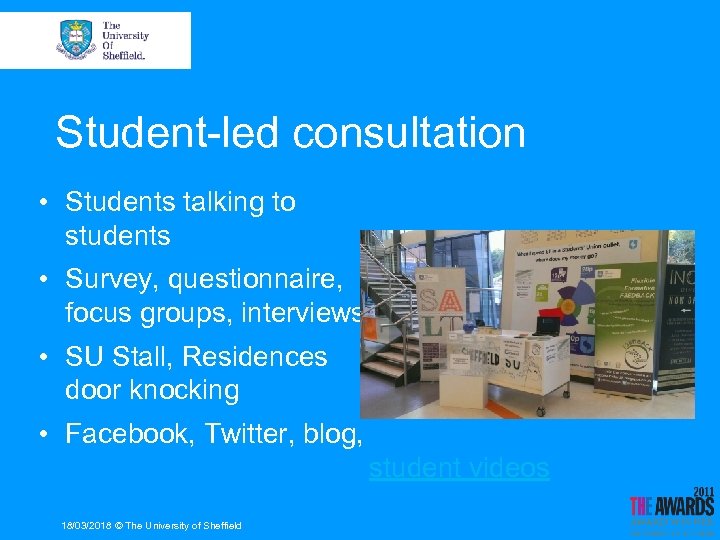
Student-led consultation • Students talking to students • Survey, questionnaire, focus groups, interviews • SU Stall, Residences door knocking • Facebook, Twitter, blog, student videos 18/03/2018 © The University of Sheffield
Student-led philosophy • Traditional focus on method, medium, speed, regularity, quantity and quality • Institutional principles for feedback (after Nicol and Macfarlane, Dick, 2006) 18/03/2018 © The University of Sheffield
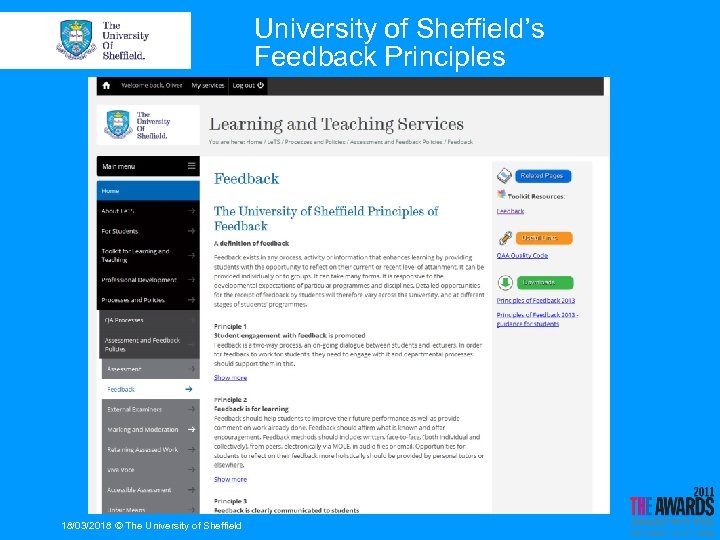
University of Sheffield’s Feedback Principles 18/03/2018 © The University of Sheffield
Student-led philosophy • Traditional focus on method, medium, speed, regularity, quantity and quality • Institutional principles for feedback (after Nicol and Macfarlane, Dick, 2006) • F 3 project transfers the focus to the end user; • What the student expects from feedback • What the student thinks they are getting • What the student does with feedback ‘Feedback should be provided in such a way that students act on it and change their future studying. ’ (Gibbs, 2010) 18/03/2018 © The University of Sheffield
Main themes: Transitions: Mind the gap!
Transitions Proposition statement: Level one students would benefit from a greater level of support and information (feedforward) regarding expectations of assessment and feedback at university. 18/03/2018 © The University of Sheffield
Transitions 80% of level one students surveyed (n=288) expressed negative expectations of university feedback in comparison with their experiences at school. The key issues identified included; • the level of detail of feedback received • the frequency of feedback interactions • the relative lack of individual feedback • the relative lack of one-to-one feedback 18/03/2018 © The University of Sheffield
Transitions • ‘At school, feedback is available more frequently and on a more personal level. University feedback is more formal. ’ (Computer Science, level 1) • ‘It seems to be them telling us to note given feedback, that everything they do is a form of feedback, and not a lot of individualised, what I'd term 'proper', feedback. ’ (BMS, level 1) • ‘So much is your responsibility now. You have to figure out feedback your lecturer says for yourself based on notes on your essays’. (Geography, level 1) • ‘[feedback] isn't presented to you as obviously - you have to seek it out. At school it is almost forced onto you. ’ (Engineering, level 1) 18/03/2018 © The University of Sheffield
Main themes: Student-staff interactions around feedback
Student-Staff Interactions Proposition statement: Transparent and accessible processes and are needed to support students in making the most of opportunities for personal one-to-one interactions with tutors around assessment and feedback. 18/03/2018 © The University of Sheffield
Student-Staff Interactions Only 25% of all students surveyed (n=701) acknowledge that they have met with a tutor (module or personal) to discuss feedback. Reasons cited include; • tutors perceived to be intimidating or unapproachable • concerns over tutor workloads • personal tutors’ lack of specialist knowledge • lack of awareness of availability/office hours (i. e ‘I haven’t been given the opportunity’) • perceived role of personal tutor as provider of pastoral care rather than academic advice 18/03/2018 © The University of Sheffield
Student-Staff Interactions • ‘Sometimes the comments on essays can be far too basic and talking to tutors clears up issues. ’ (Sociological Studies, level 1) • ‘It is extremely useful as it enables you to take stock of the feedback and put it into perspective by explaining it to someone else. Tutors can also help you to know how to act on the feedback given. ’ (Chemistry, level 4) • ‘I went to visit a tutor in her office hours after getting my assignment back from a January submission. This was really nice as I realised how much I miss face-to-face interaction with tutors at university, and how useful it is to be able to have a conversation with someone about my work. ’ (English, level 2) • ‘It more or less saved my degree. The feedback gave me a stepping stone to discuss direction with my supervisor. ’ (Materials Science, PGR) 18/03/2018 © The University of Sheffield
Main themes Using feedback: What happens next?
Using Feedback Proposition statement: Practical and action-oriented feedback is valued by students as a way to facilitate learning both within and across modules. 18/03/2018 © The University of Sheffield
Using Feedback 37% of students surveyed (n=701) keep or file their feedback, although many of those students conceded that they rarely refer back to it. Some of the main challenges of using feedback can be summarised as follows: • Difficult to read (handwritten only) • Difficult to understand – specialist terminology, jargon, etc. • Narrow focus (within a module) • Vague or non-specific comments (‘critical thinking’, ‘close reading’, etc) • Non-standardised feedback methods • Limited availability of electronic feedback 18/03/2018 © The University of Sheffield
Using Feedback • ‘I write it down, but mostly cannot take anything from it, especially from exam scripts because it tends to be very vague and not helpful for the future. ’ (BMS, level 3) • ‘I try to extract the useful bit, that is, specifically what to do to improve for next time: so, what I did wrong, how it was wrong, and how to do it right. ’ (Aerospace, level 4) • ‘I read it to see what it says, but generally don't do much beyond that as my module is over and I will be tested on a totally different area. ’ (English, PGT) • ‘I usually file it away. I would like to think I act upon it but usually I do not. ’ (Medicine, level 3) • ‘When we receive group feedback it is usually difficult to transfer and apply into other areas of work. ’ (Architecture, level 1) 18/03/2018 © The University of Sheffield
Join the dots Learning across modules and levels
![Feedback across modules and levels ‘Resource constraints [have] led to a reduction in the](https://present5.com/presentation/00188fd55bbdbb523aa39a1bf1622532/image-22.jpg "Feedback across modules and levels ‘Resource constraints [have] led to a reduction in the")
Feedback across modules and levels ‘Resource constraints [have] led to a reduction in the frequency of assignments, in the quantity and quality of feedback and in the timeliness of this feedback. Modularisation and semesterisation have tended to shorten courses and reduced the timescale within which it is possible to set assignments and provide feedback. […] At the same time the diversity of students has increased enormously so that previous assumptions of the level of sophistication of knowledge background, study skills, conception of learning or conception of knowledge of students are now likely to be very wide of the mark. ’ (Gibbs and Simpson, 2004) 18/03/2018 © The University of Sheffield
Feedback across modules and levels • Common thread of student responses relates to the difficulty in applying and comparing feedback across modules and levels • Tension between module-specific content and learnerspecific action within feedback • Feedback as a developmental process that encourages a transition towards self-regulated learning • Reframing feedback as an important aspect of professional development 18/03/2018 © The University of Sheffield
Advice from current students • ‘Take note of the improvements that are suggested and implement these changes as soon as you can to demonstrate to your lecturers your ability to grow as a learner. (Oncology, level 2)’ • ‘Just bear in mind that the people providing it are not perfect, and are often opinionated, just like any normal person. (Chemistry, level 3)’ • ‘Feedback is a supplement to independent learning, it is not meant to completely dictate your education or the work you produce. (Geography, level 3)’ • ‘You might be tempted to skip straight to the mark at the end, but make sure you understand why you got that mark. Did you do everything that was within your ability and if not, why? Try to be self-critical as well as receiving criticism from your tutors. (Chemistry, level 4)’ 18/03/2018 © The University of Sheffield
Feedback Framework: Discussion and suggestions for practice
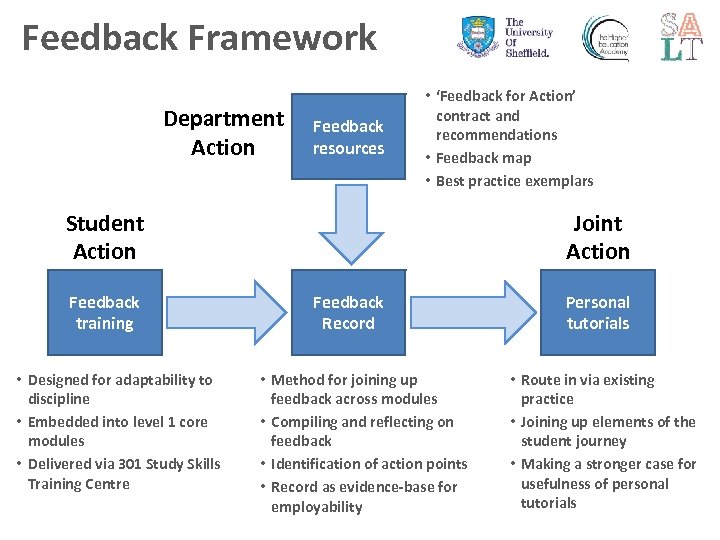
Feedback Framework Department Action Feedback resources • ‘Feedback for Action’ contract and recommendations • Feedback map • Best practice exemplars Student Action Feedback training • Designed for adaptability to discipline • Embedded into level 1 core modules • Delivered via 301 Study Skills Training Centre Joint Action Feedback Record • Method for joining up feedback across modules • Compiling and reflecting on feedback • Identification of action points • Record as evidence-base for employability Personal tutorials • Route in via existing practice • Joining up elements of the student journey • Making a stronger case for usefulness of personal tutorials
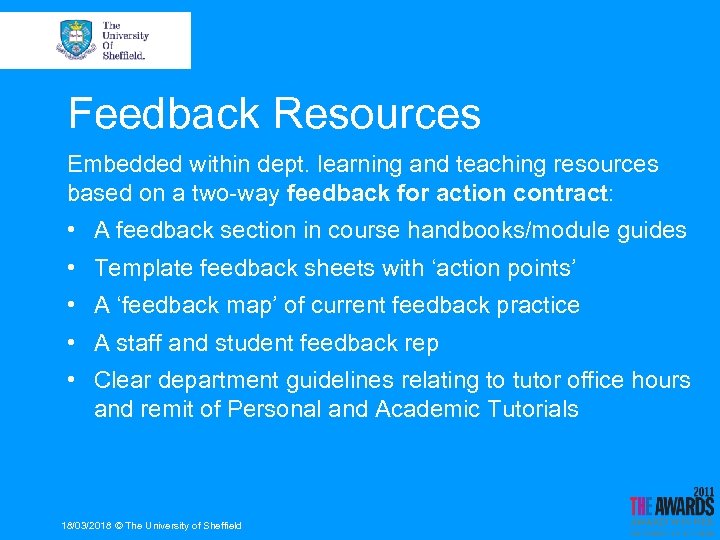
Feedback Resources Embedded within dept. learning and teaching resources based on a two-way feedback for action contract: • A feedback section in course handbooks/module guides • Template feedback sheets with ‘action points’ • A ‘feedback map’ of current feedback practice • A staff and student feedback rep • Clear department guidelines relating to tutor office hours and remit of Personal and Academic Tutorials 18/03/2018 © The University of Sheffield
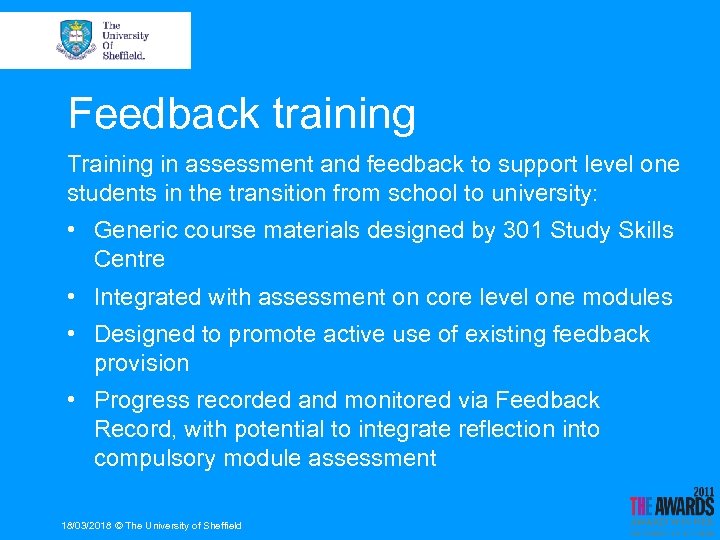
Feedback training Training in assessment and feedback to support level one students in the transition from school to university: • Generic course materials designed by 301 Study Skills Centre • Integrated with assessment on core level one modules • Designed to promote active use of existing feedback provision • Progress recorded and monitored via Feedback Record, with potential to integrate reflection into compulsory module assessment 18/03/2018 © The University of Sheffield
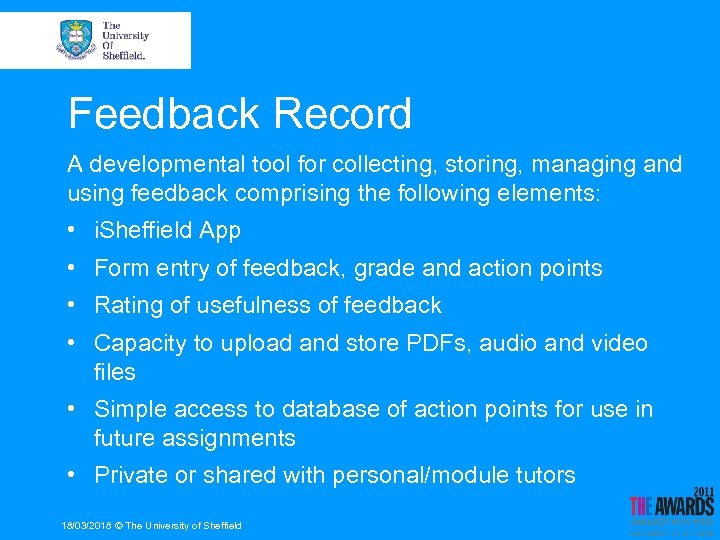
Feedback Record A developmental tool for collecting, storing, managing and using feedback comprising the following elements: • i. Sheffield App • Form entry of feedback, grade and action points • Rating of usefulness of feedback • Capacity to upload and store PDFs, audio and video files • Simple access to database of action points for use in future assignments • Private or shared with personal/module tutors 18/03/2018 © The University of Sheffield
Personal Tutorials Feedback shared with personal tutor as a basis for informed discussion of academic progress around generic learning goals. • Embedding use of feedback into a compulsory element of the student journey • Personal tutor and student to identify agreed action points to be recorded and followed up in subsequent meetings • Creating an evidence base for development as a selfregulated learner 18/03/2018 © The University of Sheffield
Further information: • For more student tips and further information on the F 3 Project, see: F 3 EDBACKfor. US. blogspot. co. uk • If you have any questions, or would like to hear more, please contact Oli Johnson: o. johnson@sheffield. ac. uk 18/03/2018 © The University of Sheffield
References • Barnett, Ronald (2000), Realizing the University in an Age of Supercomplexity, Teaching for a Supercomplex World, (Mc. Graw-Hill International), p. 153 -165. • Buckridge, Margaret and Ross Guest (2007), ‘A conversation about pedagogical responses to increased diversity in university classrooms’, Higher Education Research & Development, Volume 26, Issue 2 • Carless, David (2006), ‘Differing perceptions in the feedback process’, Studies in Higher Education, Vol. 31, No. 2, April 2006, pp. 219– 233 • Gibbs, G. , & Simpson (2004), C. , Does your assessment support your students’ learning? London: Centre for Higher Education Practice, Open University. • Higgins, Richard, Peter Hartley & Alan Skelton (2002), ‘The Conscientious Consumer: Reconsidering the role of assessment feedback in student learning’, Studies in Higher Education, 27 (1), 53 – 64 • Nicol, David J. and Debra Macfarlane, Dick (2006), ‘Formative assessment and self regulated learning: a model and seven principles of good feedback practice’, Studies in Higher Education, 31: 2, 199 -218 • Wingate, U. (2006), ‘Doing away with “study skills”’, Teaching in Higher Education. 11 (4), 457 -469. 18/03/2018 © The University of Sheffield
To Discover And Understand.
Скачать презентацию Transcending Modularity through Flexible Formative Feedback Sheffield Hallam
00188fd55bbdbb523aa39a1bf1622532.ppt