Скачать презентацию Transcendentalism What is Transcendentalism Transcendentalism was
cf06d45a15ff4d8832066adeef679b8c.ppt
- Количество слайдов: 41
 Transcendentalism
 What is Transcendentalism? • Transcendentalism was a literary movement that flourished during the middle 19 th Century (1836 – 1860). • It began as a rebellion against traditionally held beliefs by the English Church that God superseded the individual.
 What does “transcendentalism” mean? • There is an ideal spiritual state which “transcends” the physical and empirical. • A loose collection of eclectic ideas about literature, philosophy, religion, social reform, and the general state of American culture. • Transcendentalism had different meanings for each person involved in the movement.
 Where did it come from? • Ralph Waldo Emerson gave German philosopher Immanuel Kant credit for popularizing the term “transcendentalism. ” • It began as a reform movement in the Unitarian church. • It is not a religion—more accurately, it is a philosophy or form of spirituality. • It centered around Boston and Concord, MA. in the mid-1800’s. • Emerson first expressed his philosophy of transcendentalism in his essay Nature.
 What did Transcendentalists believe? The intuitive faculty, instead of the rational or sensical, became the means for a conscious union of the individual psyche (known in Sanskrit as Atman) with the world psyche also known as the Oversoul, life-force, prime mover and G-d (known in Sanskrit as Brahma).
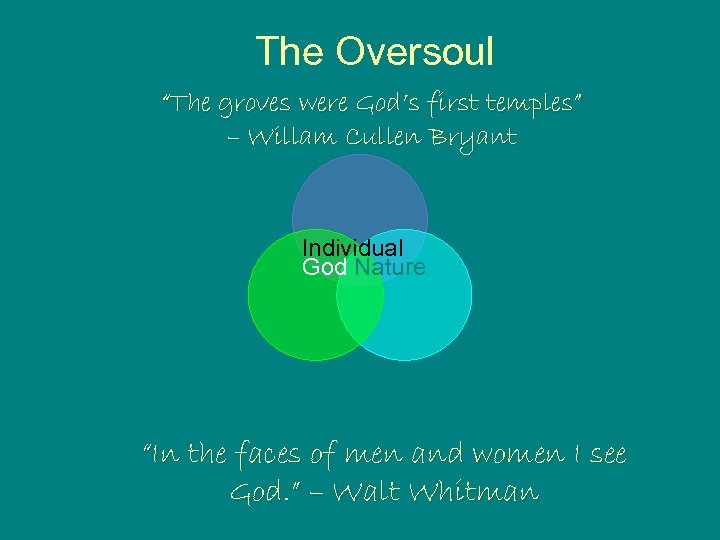 The Oversoul “The groves were God’s first temples” – Willam Cullen Bryant Individual God Nature “In the faces of men and women I see God. ” – Walt Whitman
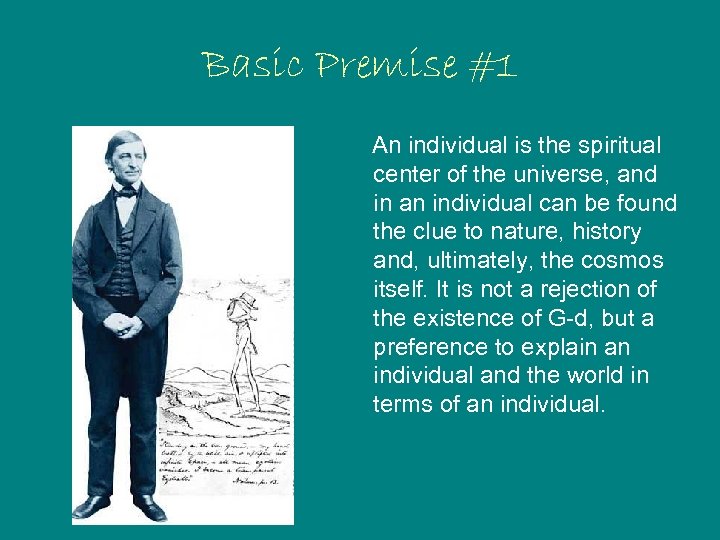 Basic Premise #1 An individual is the spiritual center of the universe, and in an individual can be found the clue to nature, history and, ultimately, the cosmos itself. It is not a rejection of the existence of G-d, but a preference to explain an individual and the world in terms of an individual.
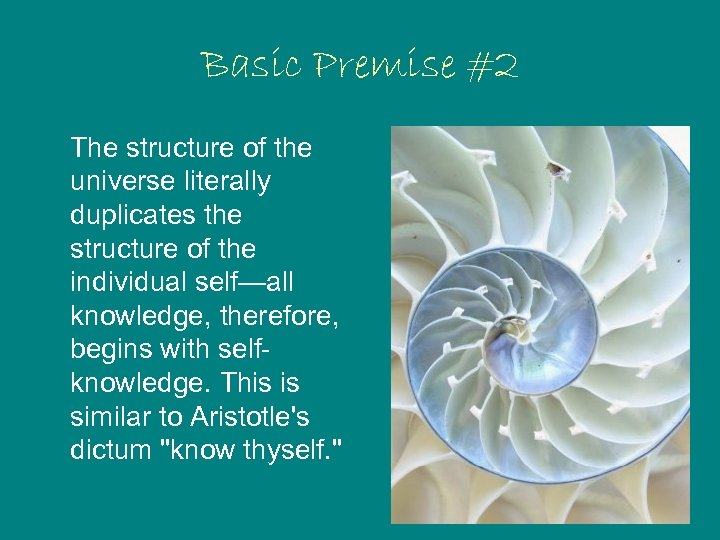 Basic Premise #2 The structure of the universe literally duplicates the structure of the individual self—all knowledge, therefore, begins with selfknowledge. This is similar to Aristotle's dictum "know thyself. "
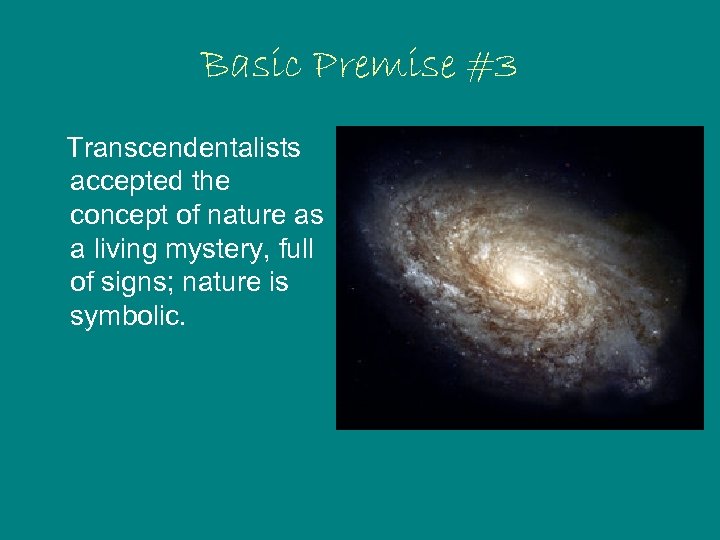 Basic Premise #3 Transcendentalists accepted the concept of nature as a living mystery, full of signs; nature is symbolic.
 Basic Premise #4 The belief that individual virtue and happiness depend upon self-realization —this depends upon the reconciliation of two universal psychological tendencies: 1. The desire to embrace the whole world— to know and become one with the world. 2. The desire to withdraw, remain unique and separate—an egotistical existence.
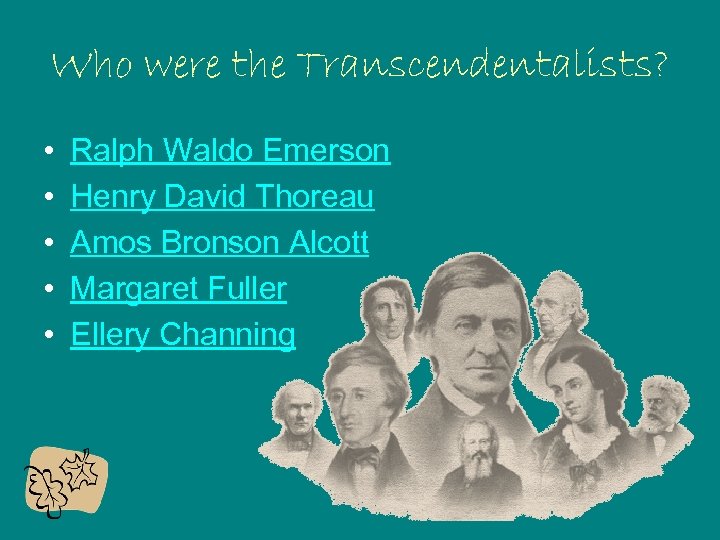 Who were the Transcendentalists? • • • Ralph Waldo Emerson Henry David Thoreau Amos Bronson Alcott Margaret Fuller Ellery Channing
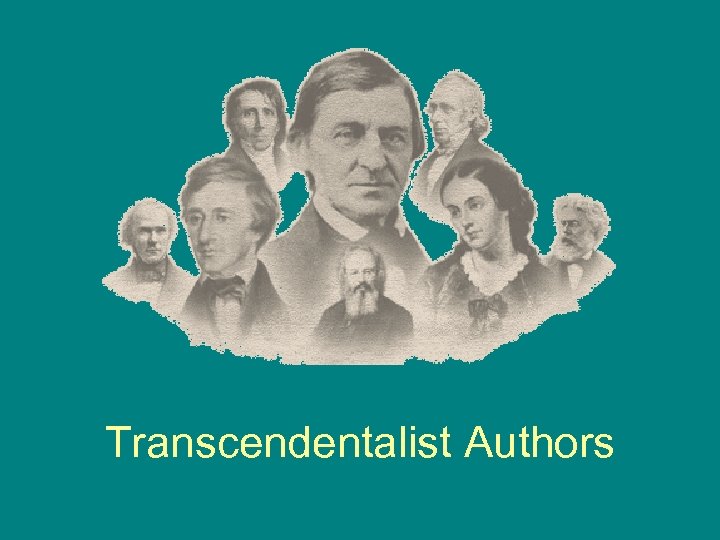 Transcendentalist Authors
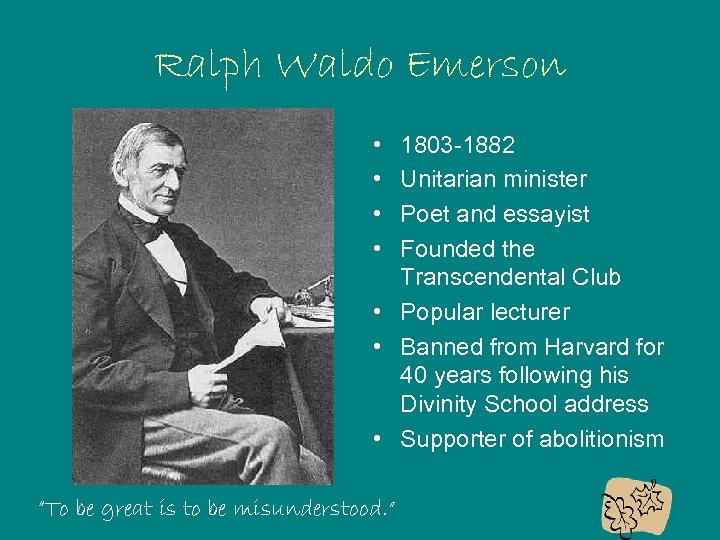 Ralph Waldo Emerson • • 1803 -1882 Unitarian minister Poet and essayist Founded the Transcendental Club • Popular lecturer • Banned from Harvard for 40 years following his Divinity School address • Supporter of abolitionism “To be great is to be misunderstood. ”
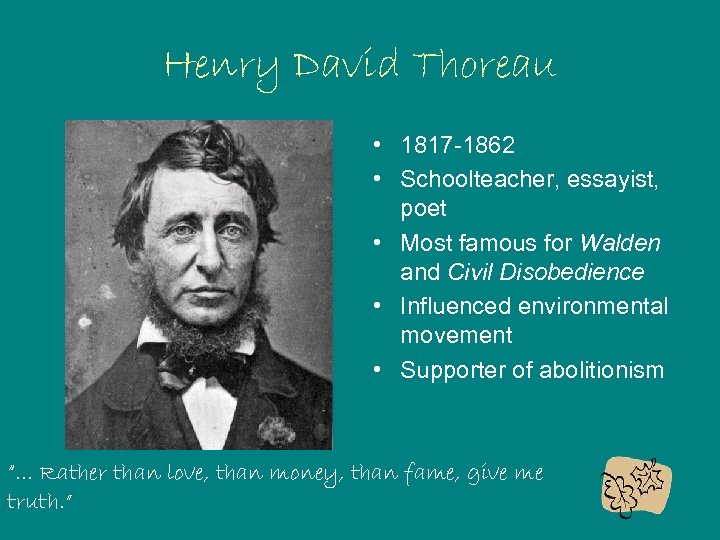 Henry David Thoreau • 1817 -1862 • Schoolteacher, essayist, poet • Most famous for Walden and Civil Disobedience • Influenced environmental movement • Supporter of abolitionism “. . . Rather than love, than money, than fame, give me truth. ”
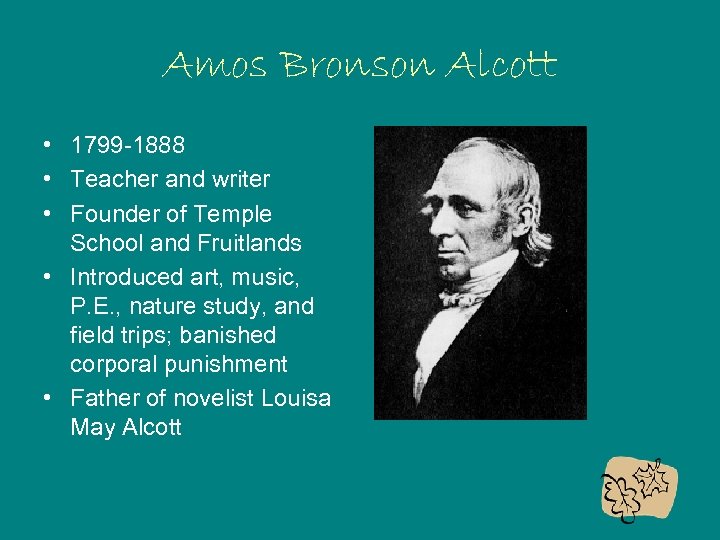 Amos Bronson Alcott • 1799 -1888 • Teacher and writer • Founder of Temple School and Fruitlands • Introduced art, music, P. E. , nature study, and field trips; banished corporal punishment • Father of novelist Louisa May Alcott
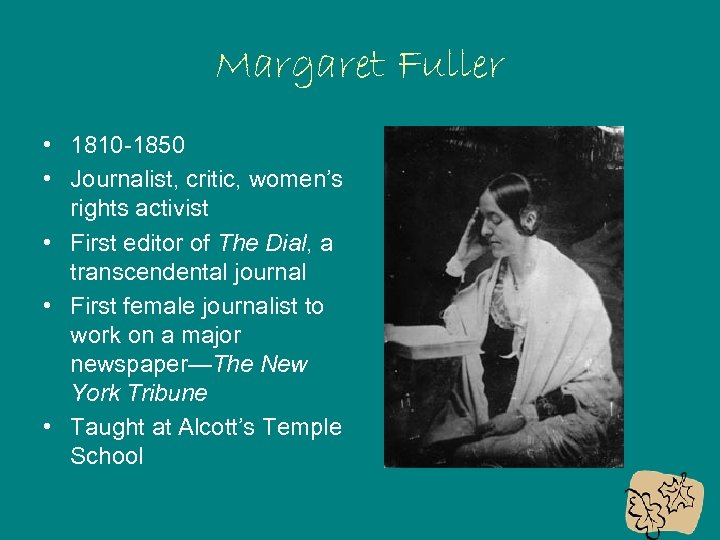 Margaret Fuller • 1810 -1850 • Journalist, critic, women’s rights activist • First editor of The Dial, a transcendental journal • First female journalist to work on a major newspaper—The New York Tribune • Taught at Alcott’s Temple School
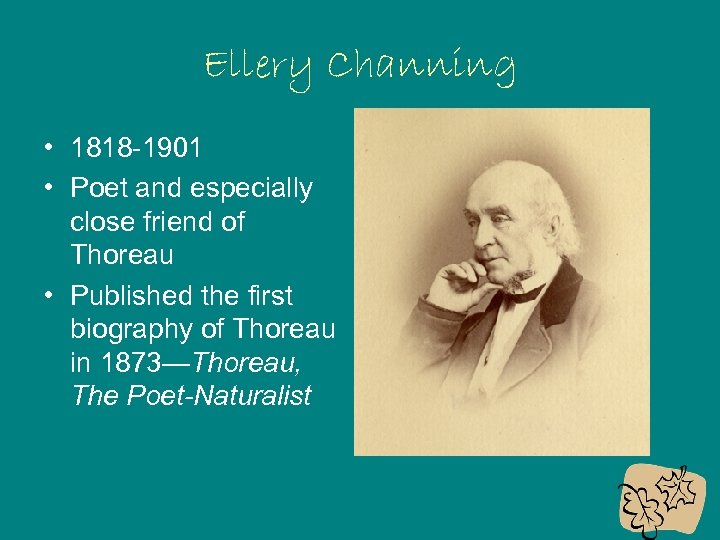 Ellery Channing • 1818 -1901 • Poet and especially close friend of Thoreau • Published the first biography of Thoreau in 1873—Thoreau, The Poet-Naturalist
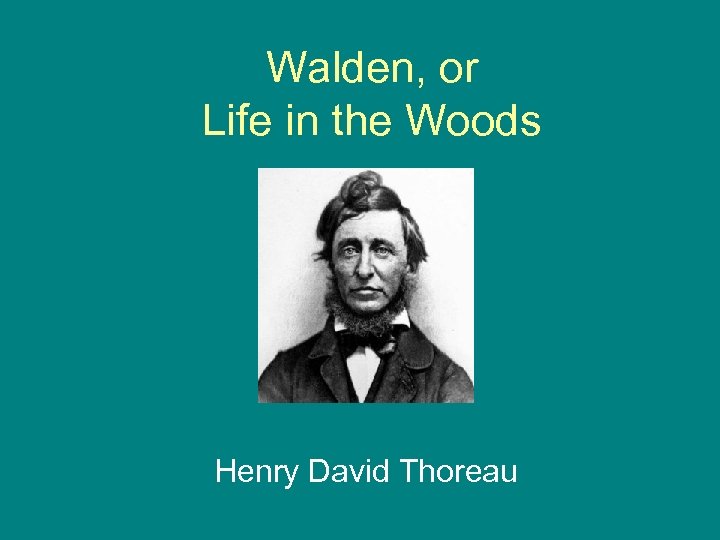 Walden, or Life in the Woods Henry David Thoreau
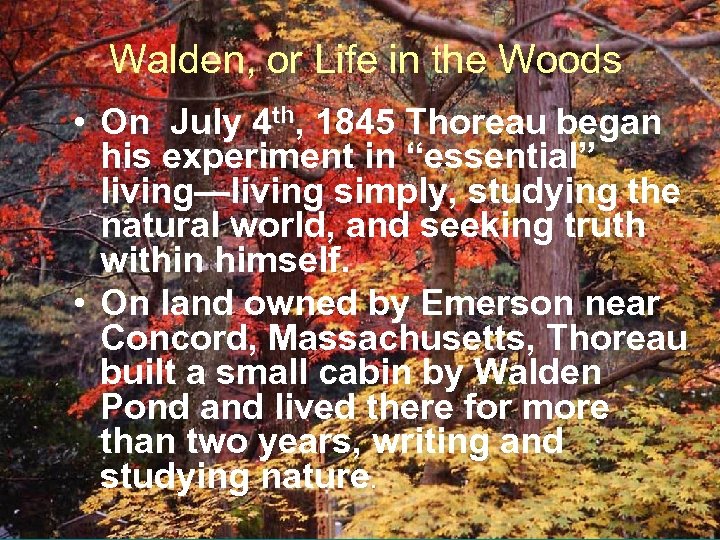 Walden, or Life in the Woods • On July 4 th, 1845 Thoreau began his experiment in “essential” living—living simply, studying the natural world, and seeking truth within himself. • On land owned by Emerson near Concord, Massachusetts, Thoreau built a small cabin by Walden Pond and lived there for more than two years, writing and studying nature.
 “I went to the woods because I wished to live deliberately, to front only the essential facts of life, and see if I could not learn what it had to teach, and not, when I came to die, discover that I had not lived. ”
 “Simplicity, simplicity! I say, let your affairs be as two or three, and not a hundred or a thousand. ”
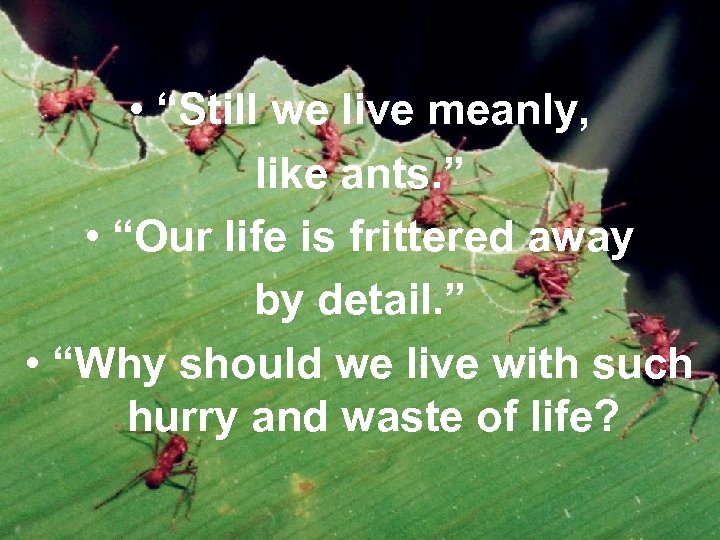 • “Still we live meanly, like ants. ” • “Our life is frittered away by detail. ” • “Why should we live with such hurry and waste of life?
 Ants Marching – Dave Matthews Band • “He wakes up in the morning/Does his teeth, bite to eat and he’s rolling/Never changes a thing/The week ends, the week begins” • “Take these chances/Place them in a box until a quieter time/Lights down, you up and die”
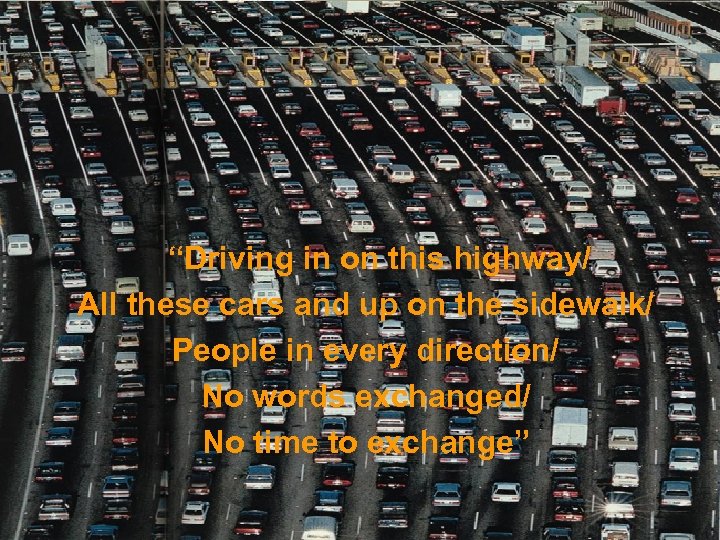 “Driving in on this highway/ All these cars and up on the sidewalk/ People in every direction/ No words exchanged/ No time to exchange”
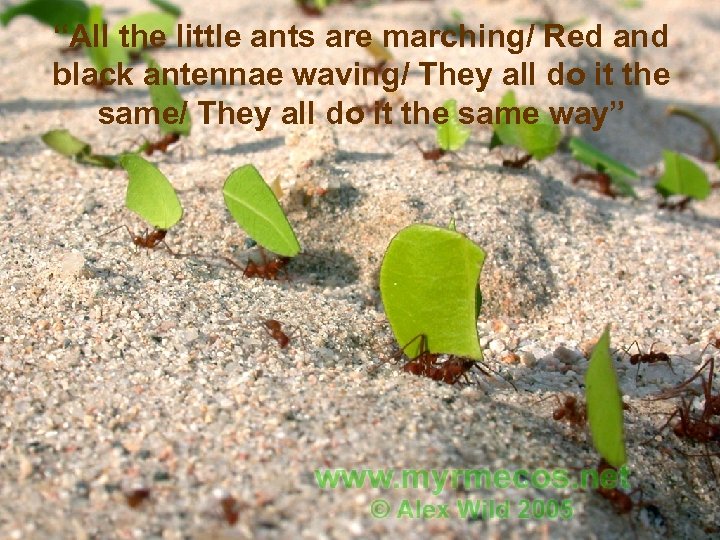 “All the little ants are marching/ Red and black antennae waving/ They all do it the same way”
 Walden (continued)
 “Heaven is under our feet as well as over our heads. ”
 “It is remarkable how easily and insensibly we fall into a particular route, and make a beaten track for ourselves. I had not lived there a week before my feet wore a path from my door to the pond-side; and though it is five or six years since I trod it, it is still quite distinct. ”
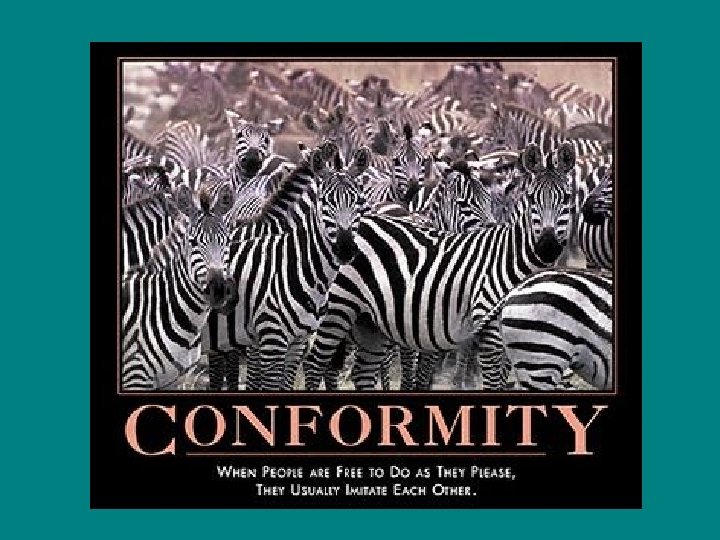
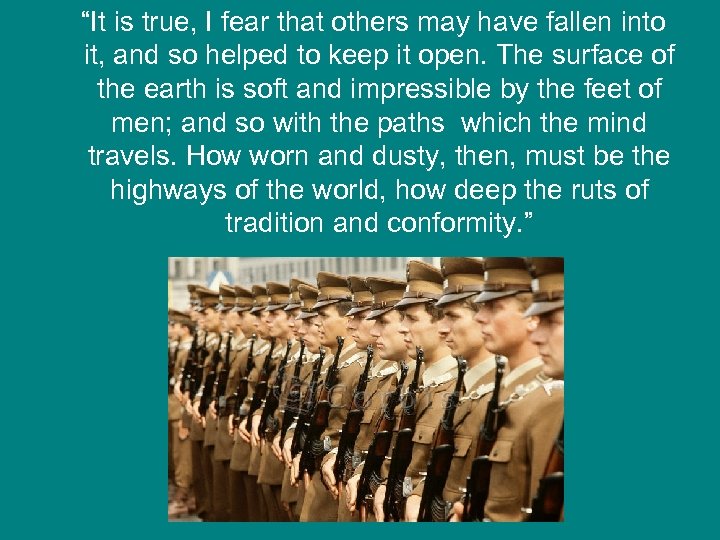 “It is true, I fear that others may have fallen into it, and so helped to keep it open. The surface of the earth is soft and impressible by the feet of men; and so with the paths which the mind travels. How worn and dusty, then, must be the highways of the world, how deep the ruts of tradition and conformity. ”
 “I learned this, at least, by my experiment; that if one advances confidently in the direction of his dreams, and endeavors to live the life which he has imagined, he will meet with a success unexpected in common hours. ”
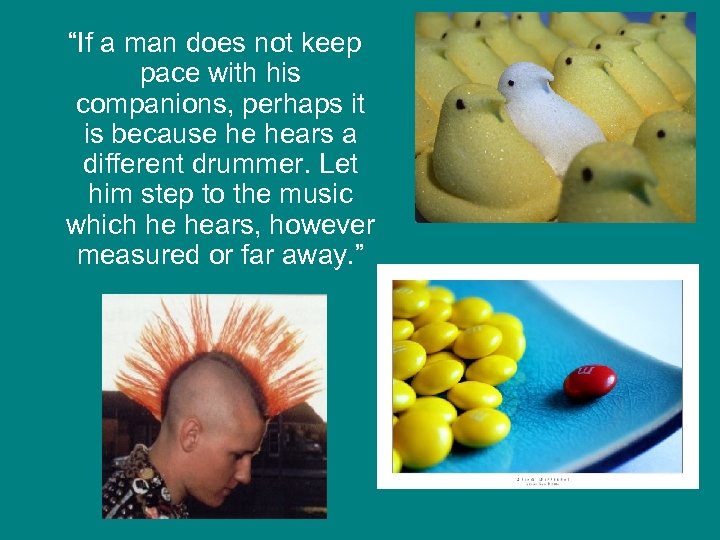 “If a man does not keep pace with his companions, perhaps it is because he hears a different drummer. Let him step to the music which he hears, however measured or far away. ”
 • “However mean your life is, meet it and live it; do not shun it and call it hard names. It is not so bad as you are. ” • “The fault-finder will find faults even in paradise. Love your life, poor as it is. You may perhaps have some pleasant, thrilling, glorious hours, even in a poorhouse. ”
 “Superfluous wealth can buy superfluities only. Money is not required to buy one necessary of the soul. ”
 “Civil Disobedience” Henry David Thoreau
 “Civil Disobedience” • Thoreau’s essay urging passive, nonviolent resistance to governmental policies to which an individual is morally opposed
 “Civil Disobedience” • “That government is best which governs least…That government is best which governs not at all. ” • “I ask for, not at once no government, but at once a better government. ” • “I cannot for an instant recognize that political organization as my government which is the slave’s government also. ”
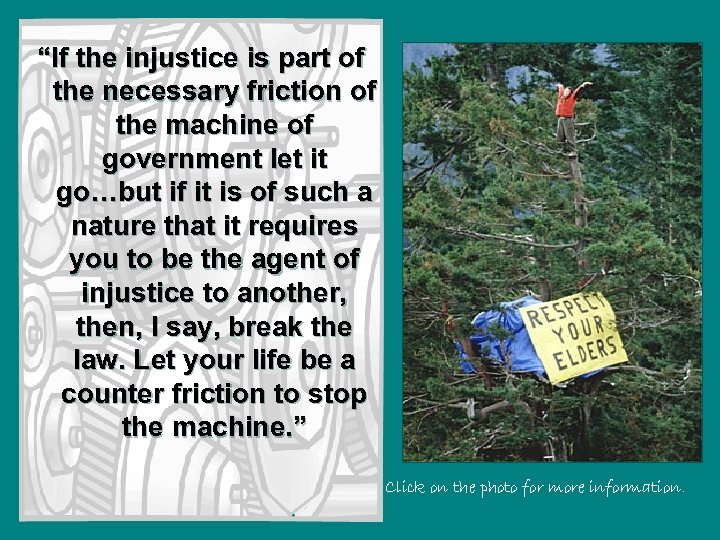 “If the injustice is part of the necessary friction of the machine of government let it go…but if it is of such a nature that it requires you to be the agent of injustice to another, then, I say, break the law. Let your life be a counter friction to stop the machine. ” Click on the photo for more information.

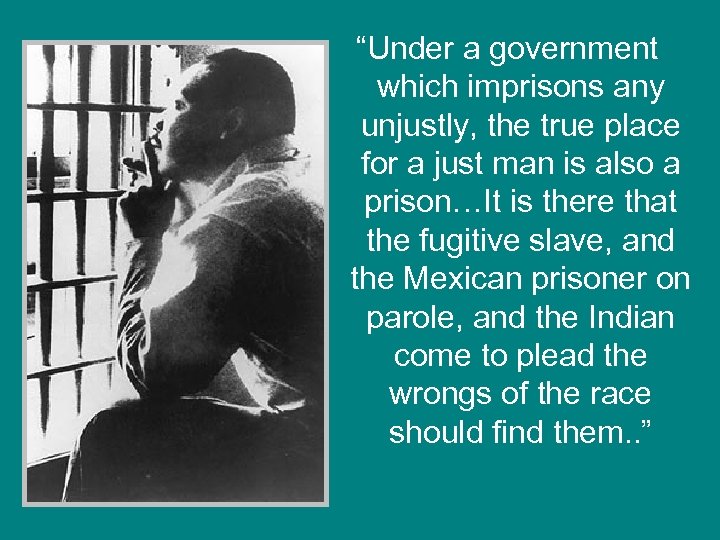 “Under a government which imprisons any unjustly, the true place for a just man is also a prison…It is there that the fugitive slave, and the Mexican prisoner on parole, and the Indian come to plead the wrongs of the race should find them. . ”