


 Скачать презентацию Transceiver Performance What s new in the last year
cd9595fdc6f83b1c8d9bd09252246713.ppt
- Количество слайдов: 50
 Transceiver Performance What’s new in the last year? Rob Sherwood NCØB Lots of options for your dollars. Sherwood Engineering
 • What is important in a contest environment? • Good Dynamic Range to hear weak signals in the presence of near-by strong signals. • You need a better receiver for CW than for SSB. • Be a good neighbor: i. e. Have a clean signal. • Transmitters continue to be a mixed bag.
 What Parameter is Most Important for a CW Contester? • Close-in Dynamic Range (DR 3) • (We have to know the noise floor to calculate Dynamic Range)
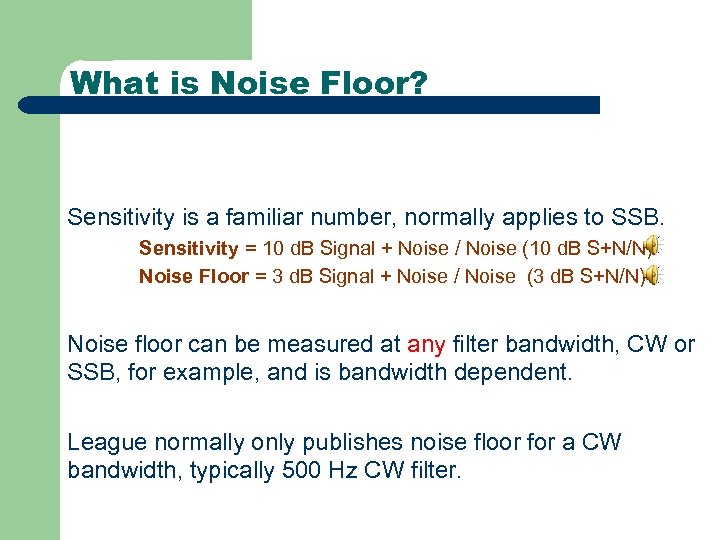 What is Noise Floor? Sensitivity is a familiar number, normally applies to SSB. Sensitivity = 10 d. B Signal + Noise / Noise (10 d. B S+N/N) Noise Floor = 3 d. B Signal + Noise / Noise (3 d. B S+N/N) Noise floor can be measured at any filter bandwidth, CW or SSB, for example, and is bandwidth dependent. League normally only publishes noise floor for a CW bandwidth, typically 500 Hz CW filter.
 Noise Floor – Rarely an Issue on HF l l l On 20 meters and below, atmospheric, galactic and man-made noise predominates. On 15 meters, in a quiet rural location, the receiver is still rarely the limit. Example: NC 0 B, 5 element yagi at 70 feet, 270 feet of 7/8 th inch hardline, antenna pointed in the quietest direction (30 degrees) at 4 PM on 2/28/2010. Receiver sensitivity, no preamp, 2. 4 k. Hz = 0. 5 u. V Receiver sensitivity, w/ preamp, 2. 4 k. Hz = 0. 2 u. V Receiver noise floor, w/ preamp, 500 Hz = -135 d. Bm
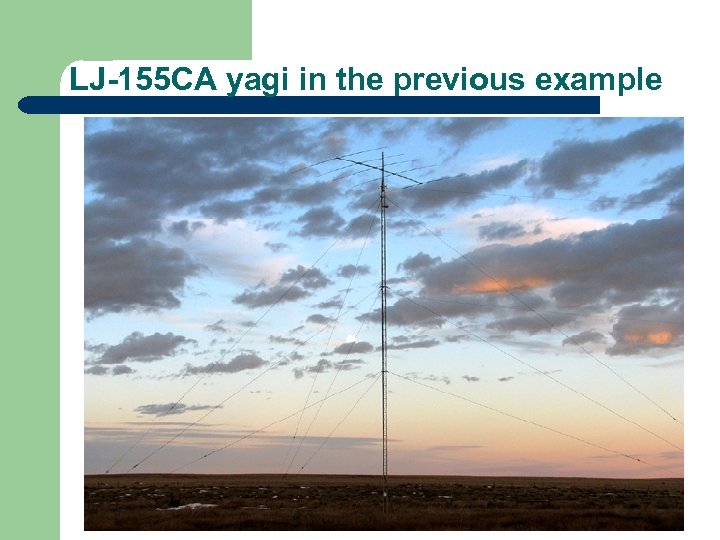 LJ-155 CA yagi in the previous example
 A simple test with only a analog meter l l Most hams don’t own a calibrated signal generator. How do you evaluate your receiver? Measure the noise gain when you connect your antenna. All you need is an analog meter with a d. B scale, hooked up to your speaker.
 Measure the noise gain l l Disconnect your antenna and set the volume so your d. B meter reads -10 d. B. (Put a dummy load on the rig, but it will likely make no difference. ) Connect the antenna and see how many d. B the noise goes up when tuned to a dead spot on the band. Do this with Preamp OFF and ON
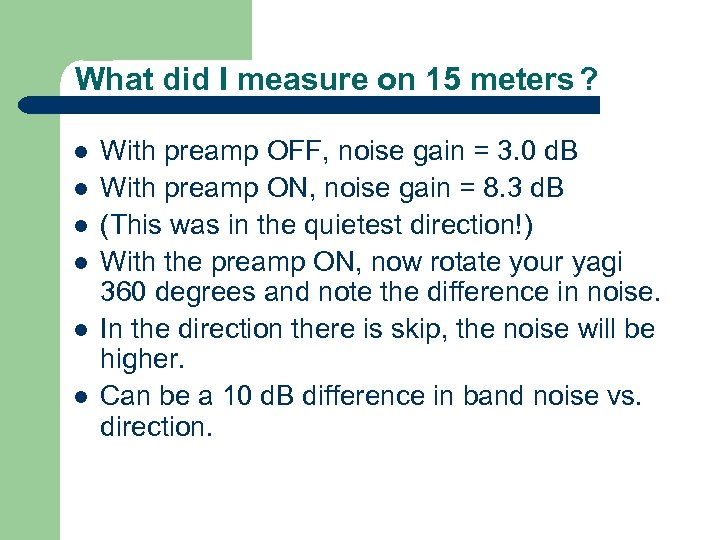 What did I measure on 15 meters ? l l l With preamp OFF, noise gain = 3. 0 d. B With preamp ON, noise gain = 8. 3 d. B (This was in the quietest direction!) With the preamp ON, now rotate your yagi 360 degrees and note the difference in noise. In the direction there is skip, the noise will be higher. Can be a 10 d. B difference in band noise vs. direction.
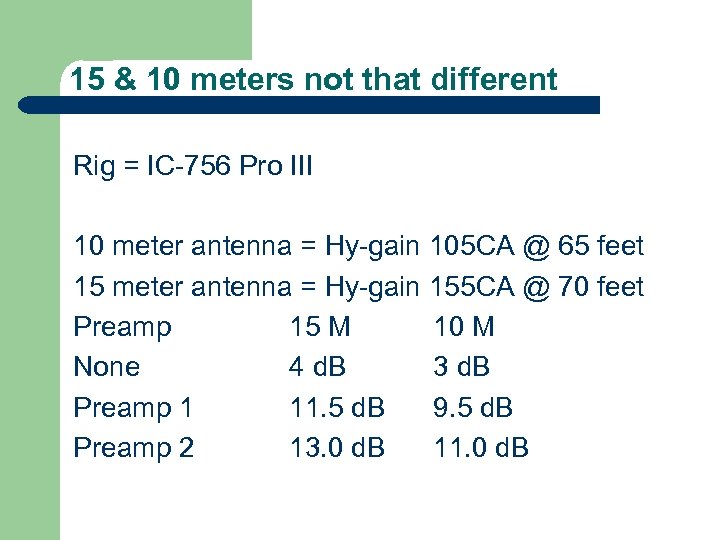 15 & 10 meters not that different Rig = IC-756 Pro III 10 meter antenna = Hy-gain 105 CA @ 65 feet 15 meter antenna = Hy-gain 155 CA @ 70 feet Preamp 15 M 10 M None 4 d. B 3 d. B Preamp 1 11. 5 d. B 9. 5 d. B Preamp 2 13. 0 d. B 11. 0 d. B
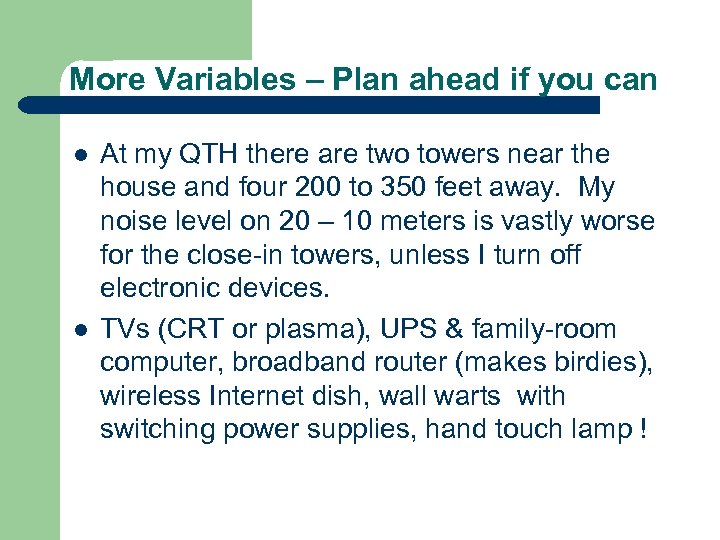 More Variables – Plan ahead if you can l l At my QTH there are two towers near the house and four 200 to 350 feet away. My noise level on 20 – 10 meters is vastly worse for the close-in towers, unless I turn off electronic devices. TVs (CRT or plasma), UPS & family-room computer, broadband router (makes birdies), wireless Internet dish, wall warts with switching power supplies, hand touch lamp !
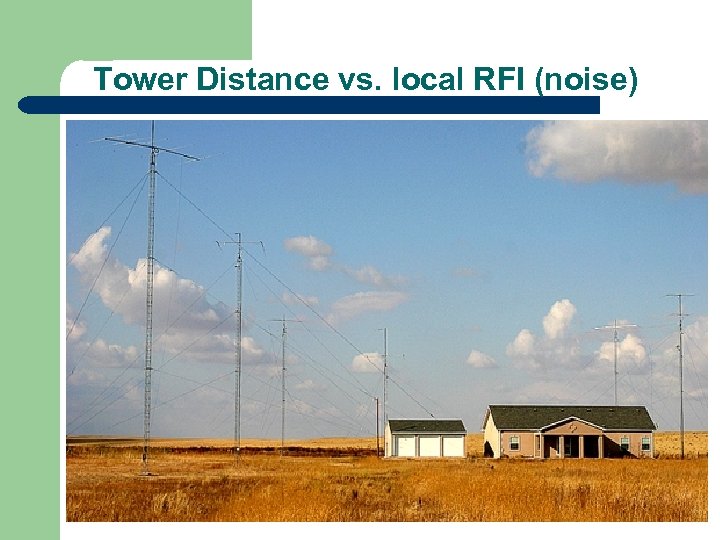 Tower Distance vs. local RFI (noise)
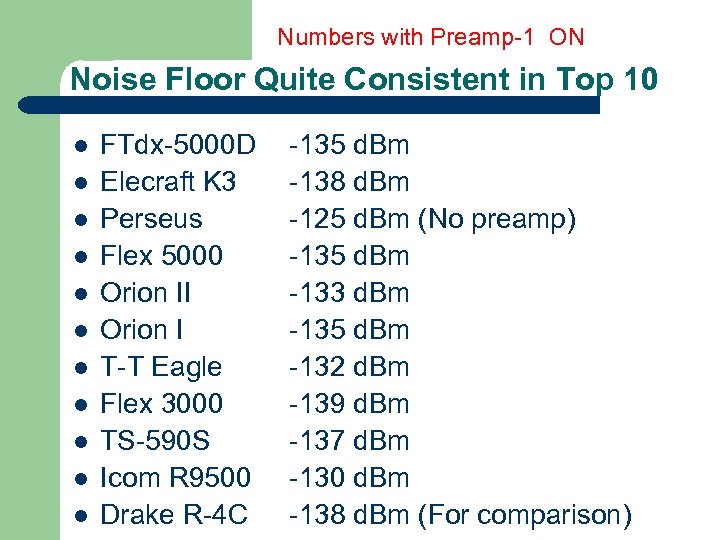 Numbers with Preamp-1 ON Noise Floor Quite Consistent in Top 10 l l l FTdx-5000 D Elecraft K 3 Perseus Flex 5000 Orion II Orion I T-T Eagle Flex 3000 TS-590 S Icom R 9500 Drake R-4 C -135 d. Bm -138 d. Bm -125 d. Bm (No preamp) -135 d. Bm -133 d. Bm -135 d. Bm -132 d. Bm -139 d. Bm -137 d. Bm -130 d. Bm -138 d. Bm (For comparison)
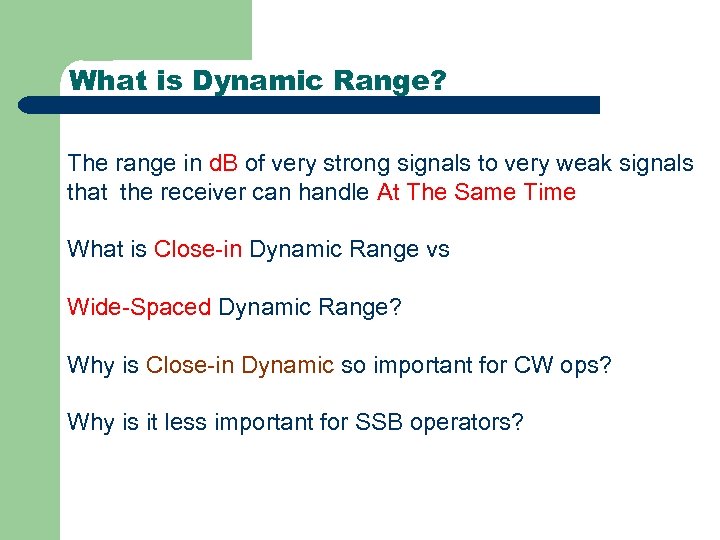 What is Dynamic Range? The range in d. B of very strong signals to very weak signals that the receiver can handle At The Same Time What is Close-in Dynamic Range vs Wide-Spaced Dynamic Range? Why is Close-in Dynamic so important for CW ops? Why is it less important for SSB operators?
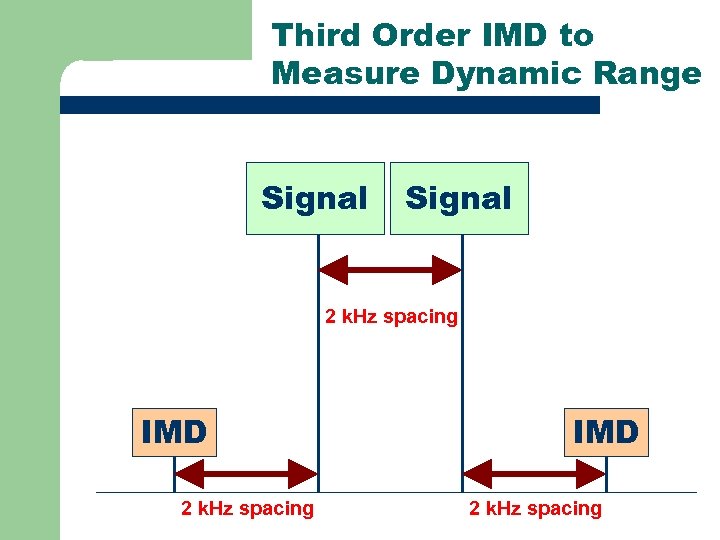 Third Order IMD to Measure Dynamic Range Signal 2 k. Hz spacing IMD 2 k. Hz spacing
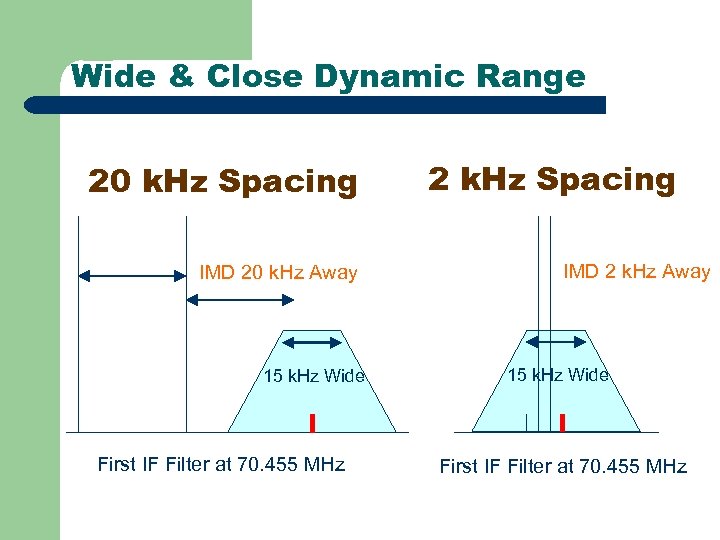 Wide & Close Dynamic Range 20 k. Hz Spacing IMD 20 k. Hz Away 15 k. Hz Wide First IF Filter at 70. 455 MHz 2 k. Hz Spacing IMD 2 k. Hz Away 15 k. Hz Wide First IF Filter at 70. 455 MHz
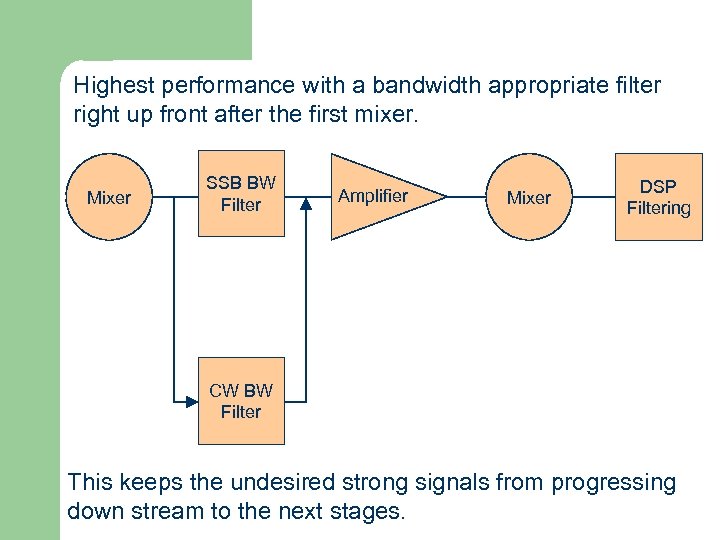 Highest performance with a bandwidth appropriate filter right up front after the first mixer. Mixer SSB BW Filter Amplifier Mixer DSP Filtering CW BW Filter This keeps the undesired strong signals from progressing down stream to the next stages.
 What has changed in last 8 years? l l Ten-Tec started the change in 2003 with the Orion, the first radio to drop “up-conversion” and go back to a low first IF. Elecraft followed, and now Yaesu and Kenwood in 2010. Only Icom has of yet not offered a “downconversion” radio If the TS-590 S is a big seller, will Kenwood follow on with a larger and more expensive model?
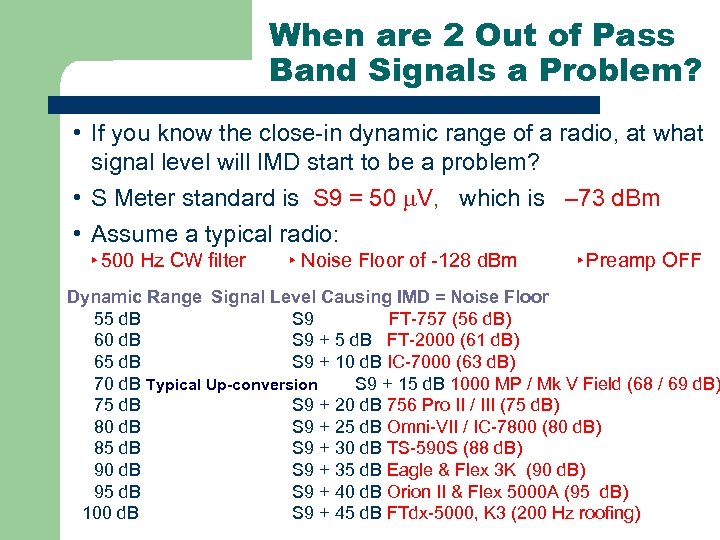 When are 2 Out of Pass Band Signals a Problem? • If you know the close-in dynamic range of a radio, at what signal level will IMD start to be a problem? • S Meter standard is S 9 = 50 V, which is – 73 d. Bm • Assume a typical radio: 500 Hz CW filter Noise Floor of -128 d. Bm Preamp OFF Dynamic Range Signal Level Causing IMD = Noise Floor 55 d. B S 9 FT-757 (56 d. B) 60 d. B S 9 + 5 d. B FT-2000 (61 d. B) 65 d. B S 9 + 10 d. B IC-7000 (63 d. B) 70 d. B Typical Up-conversion S 9 + 15 d. B 1000 MP / Mk V Field (68 / 69 d. B) 75 d. B S 9 + 20 d. B 756 Pro II / III (75 d. B) 80 d. B S 9 + 25 d. B Omni-VII / IC-7800 (80 d. B) 85 d. B S 9 + 30 d. B TS-590 S (88 d. B) 90 d. B S 9 + 35 d. B Eagle & Flex 3 K (90 d. B) 95 d. B S 9 + 40 d. B Orion II & Flex 5000 A (95 d. B) 100 d. B S 9 + 45 d. B FTdx-5000, K 3 (200 Hz roofing)
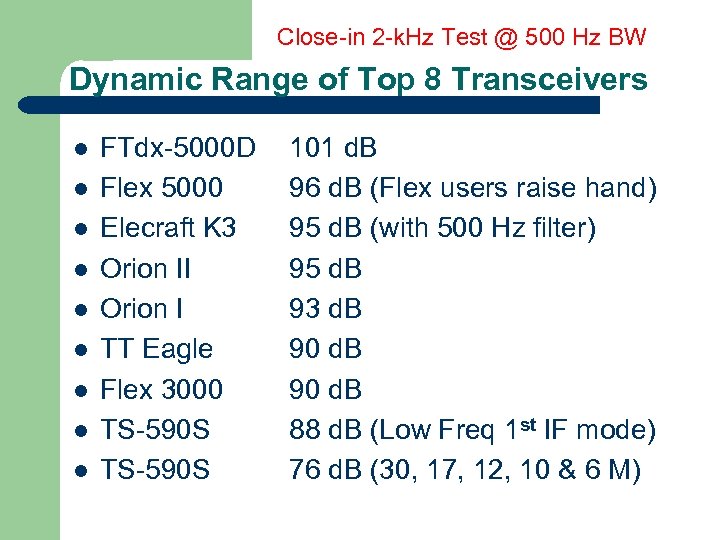 Close-in 2 -k. Hz Test @ 500 Hz BW Dynamic Range of Top 8 Transceivers l l l l l FTdx-5000 D Flex 5000 Elecraft K 3 Orion II Orion I TT Eagle Flex 3000 TS-590 S 101 d. B 96 d. B (Flex users raise hand) 95 d. B (with 500 Hz filter) 95 d. B 93 d. B 90 d. B 88 d. B (Low Freq 1 st IF mode) 76 d. B (30, 17, 12, 10 & 6 M)
 How did the new rigs perform on CW? l l l I used the FTdx-5000, TS-590 S and Eagle in the 160 m. ARRL, Stew Perry & CQ contests. Switched between the Kenwood and the Ten. Tec during the CQ contest. Overload was never an issue. All could crank down the DSP filter to 100 Hz or narrower. Ran most of the contest at 200 Hz BW Definitely needed 50 to 100 Hz BW
 Narrow DSP Filters Come Through l l l In all three contests working CE 1/K 7 CA required the narrowest bandwidths to copy through the pile-up, since he was not working split. Thank goodness the DXpeditions work split, so you can hear when the DX comes back to you. You can imagine what it is like at the DX location: total pandemonium for days!
 The DR 3 “window” is not fixed The dynamic range of a radio is the same with an attenuator ON or OFF. If on a noisy band, attenuate the noise and all signals to make better use of the dynamic range, and reduce the chance of overload. If band noise goes from S 6 to S 2 by turning on the attenuator, you have lost nothing, yet your radio is being stressed much less.
 Let’s now look at the transmitters l l l I am now testing transmitters with white noise feeding the microphone, in addition to a twotone test. The effect of IMD products (splatter) are more obvious with noise. Think of it as a 1000 tone test, more approximating real voice.
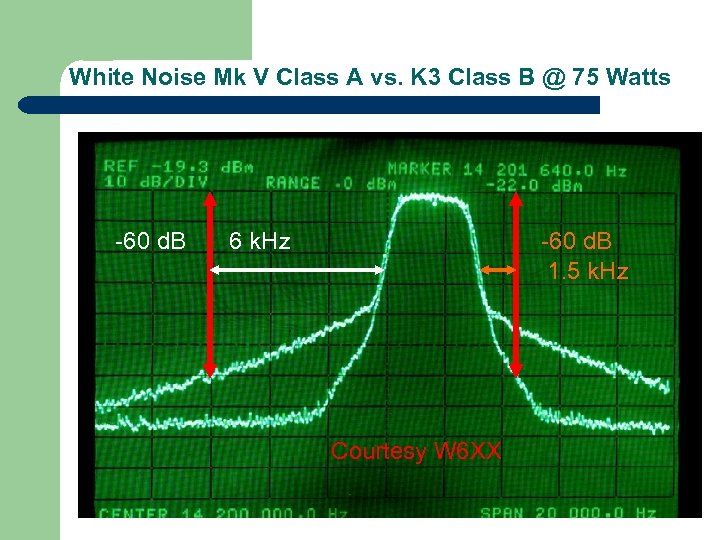 White Noise Mk V Class A vs. K 3 Class B @ 75 Watts -60 d. B 6 k. Hz -60 d. B 1. 5 k. Hz Courtesy W 6 XX
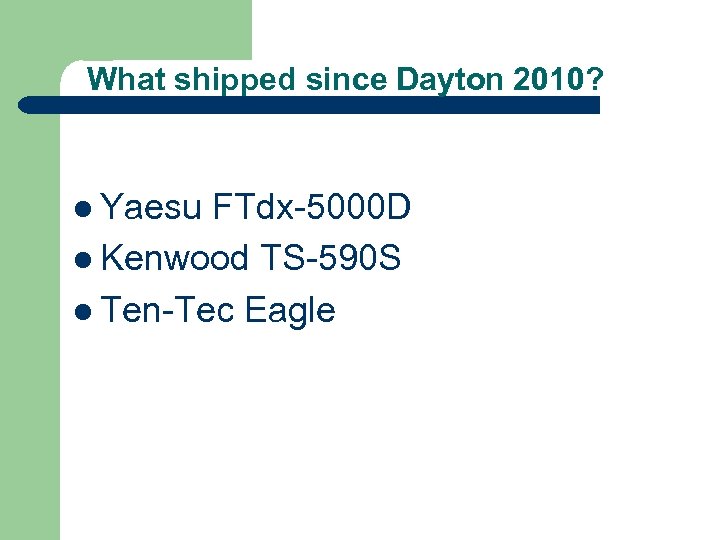 What shipped since Dayton 2010? l Yaesu FTdx-5000 D l Kenwood TS-590 S l Ten-Tec Eagle
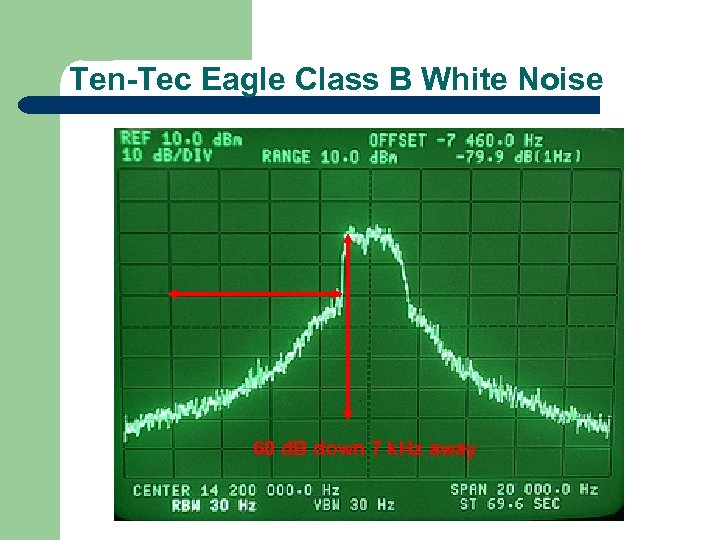 Ten-Tec Eagle Class B White Noise 60 d. B down 7 k. Hz away
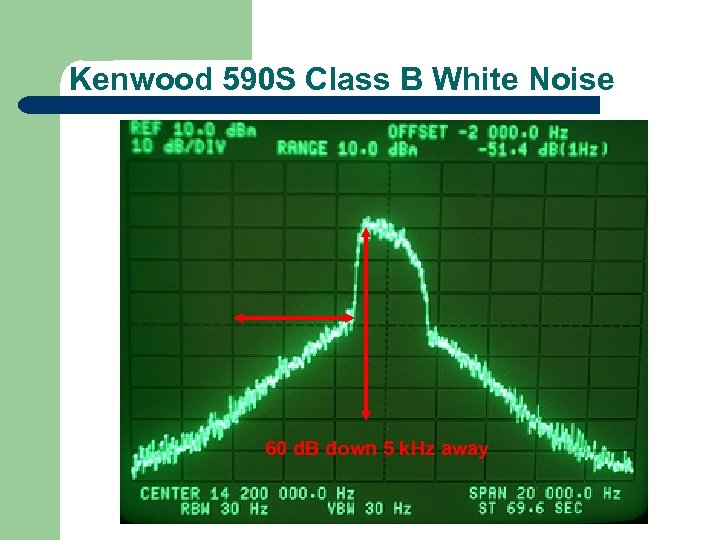 Kenwood 590 S Class B White Noise 60 d. B down 5 k. Hz away
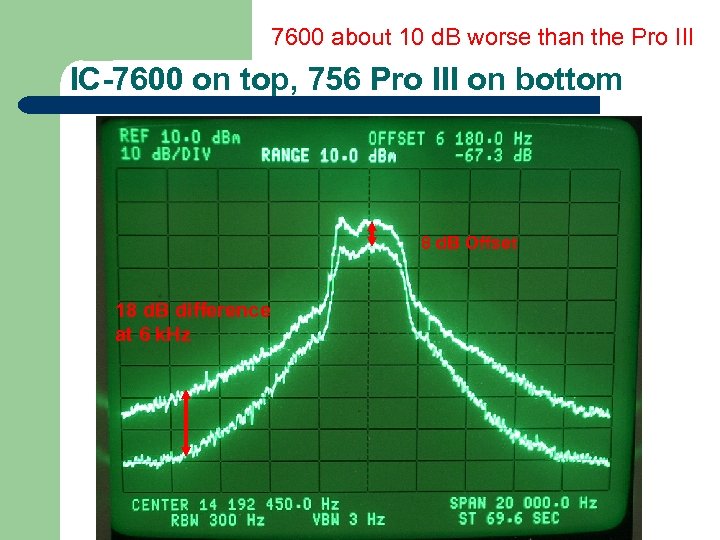 7600 about 10 d. B worse than the Pro III IC-7600 on top, 756 Pro III on bottom 8 d. B Offset 18 d. B difference at 6 k. Hz
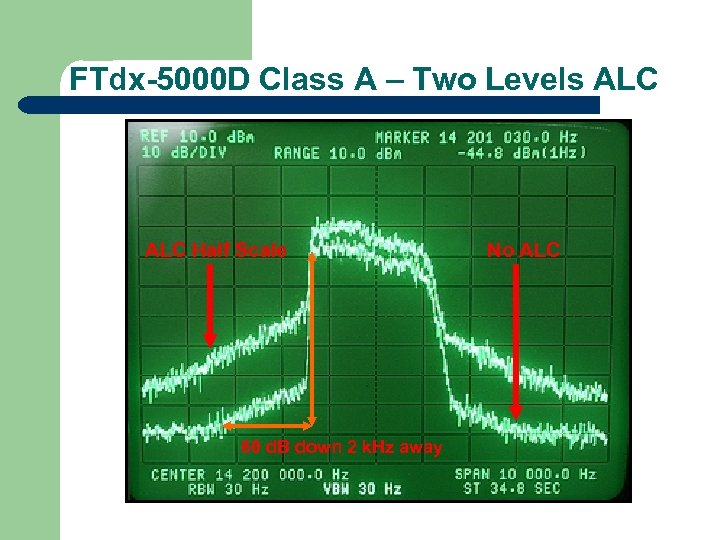 FTdx-5000 D Class A – Two Levels ALC Half Scale 60 d. B down 2 k. Hz away No ALC
 What’s wrong with the FTdx-5000 D? l l Decades ago Collins clearly stated that an ALC circuit should have a SLOW time constant (decay). ALC should just be a slow leveling circuit. Speech processing should be done way before the PA and the ALC. This issue can be fixed, either in hardware or in firmware, but I don’t know which it is.
 Ham breaks into my 20 meter QSO l l l When some breaks in to comment on your signal, what is your first thought? “I must be splattering” With the 5000 D in Class A, and NO ALC, the ham broke in to say I had the cleanest signal he had ever seen on the air with his K 3 and his P 3 bandscope.
 What Could Contests Be Like? l l What would CQ WW or ARRL DX be like if everyone had a signal this clean? Yet some hams don’t want a clean signal. They want “elbow room”. This goes back to Contest Ethics from this morning!
 Back to CW signals We have seen how width of an SSB signal & its IMD products affects how close you can operate to another station. How does CW compare? How close can we work to a strong adjacent CW signal?
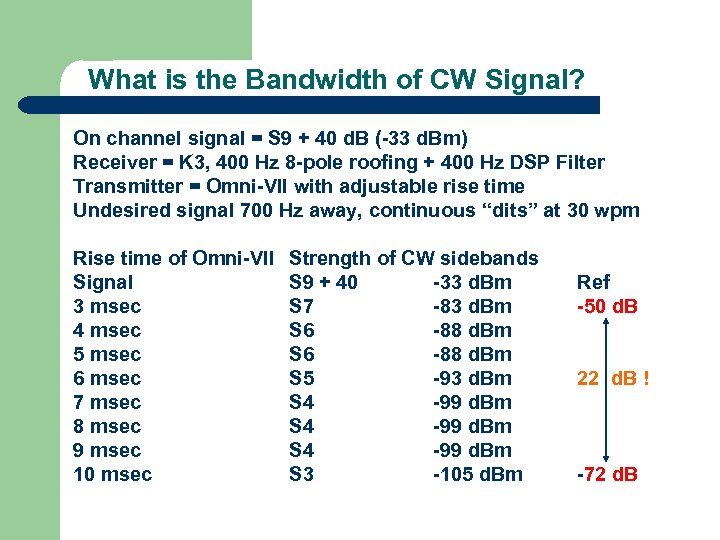 What is the Bandwidth of CW Signal? On channel signal = S 9 + 40 d. B (-33 d. Bm) Receiver = K 3, 400 Hz 8 -pole roofing + 400 Hz DSP Filter Transmitter = Omni-VII with adjustable rise time Undesired signal 700 Hz away, continuous “dits” at 30 wpm Rise time of Omni-VII Signal 3 msec 4 msec 5 msec 6 msec 7 msec 8 msec 9 msec 10 msec Strength of CW sidebands S 9 + 40 -33 d. Bm S 7 -83 d. Bm S 6 -88 d. Bm S 5 -93 d. Bm S 4 -99 d. Bm S 3 -105 d. Bm Ref -50 d. B 22 d. B ! -72 d. B
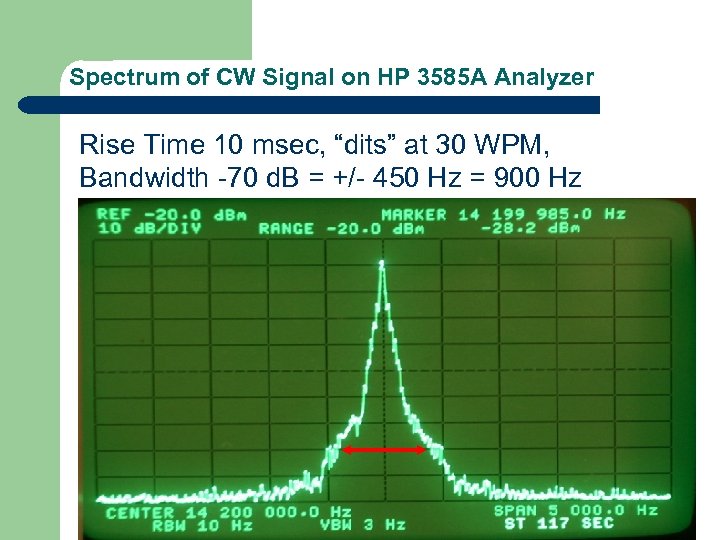 Spectrum of CW Signal on HP 3585 A Analyzer Rise Time 10 msec, “dits” at 30 WPM, Bandwidth -70 d. B = +/- 450 Hz = 900 Hz
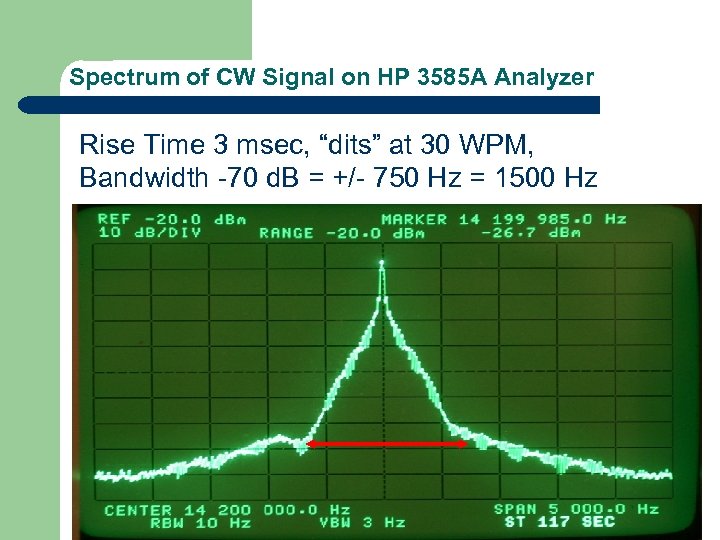 Spectrum of CW Signal on HP 3585 A Analyzer Rise Time 3 msec, “dits” at 30 WPM, Bandwidth -70 d. B = +/- 750 Hz = 1500 Hz
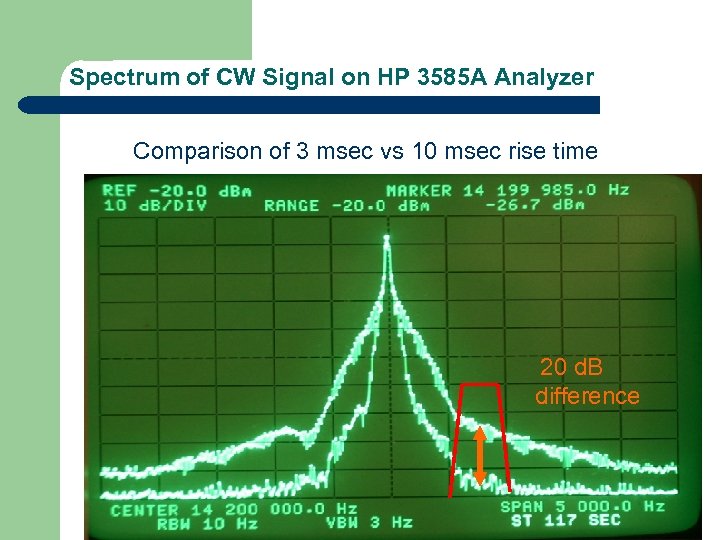 Spectrum of CW Signal on HP 3585 A Analyzer Comparison of 3 msec vs 10 msec rise time 20 d. B difference
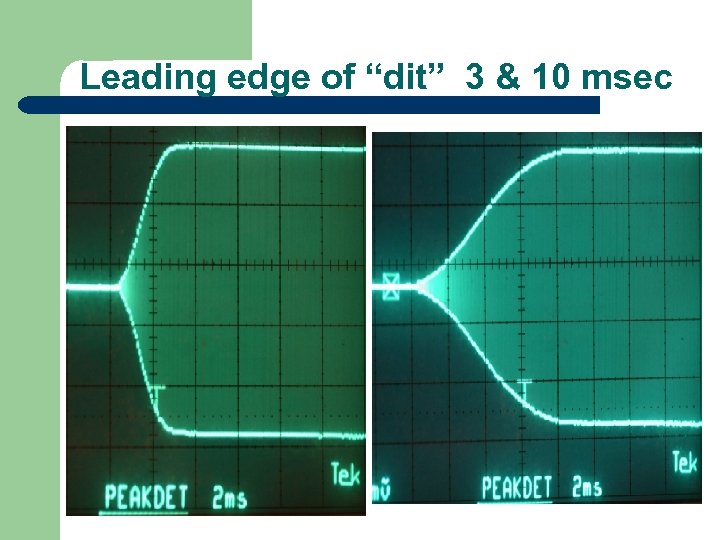 Leading edge of “dit” 3 & 10 msec
 Just the Facts On SSB you want DR 3 = 70 d. B, or more. On CW you want DR 3 = 80 d. B, or more. This is most economically accomplished with low IF (5 to 9 MHz) selectable crystal roofing filters. It is much more difficult to deliver 80 d. B or higher DR 3 with the more common Up-Conversion design. Transmitted bandwidth of the interfering signal is often the limit, not the receiver.
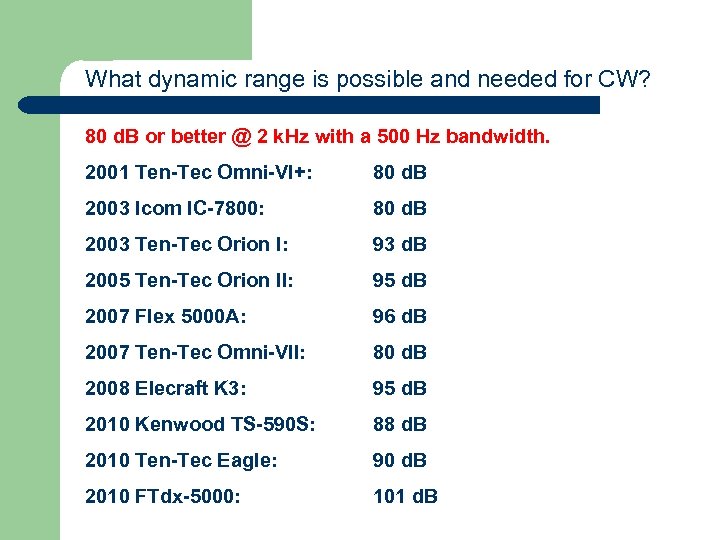 What dynamic range is possible and needed for CW? 80 d. B or better @ 2 k. Hz with a 500 Hz bandwidth. 2001 Ten-Tec Omni-VI+: 80 d. B 2003 Icom IC-7800: 80 d. B 2003 Ten-Tec Orion I: 93 d. B 2005 Ten-Tec Orion II: 95 d. B 2007 Flex 5000 A: 96 d. B 2007 Ten-Tec Omni-VII: 80 d. B 2008 Elecraft K 3: 95 d. B 2010 Kenwood TS-590 S: 88 d. B 2010 Ten-Tec Eagle: 90 d. B 2010 FTdx-5000: 101 d. B
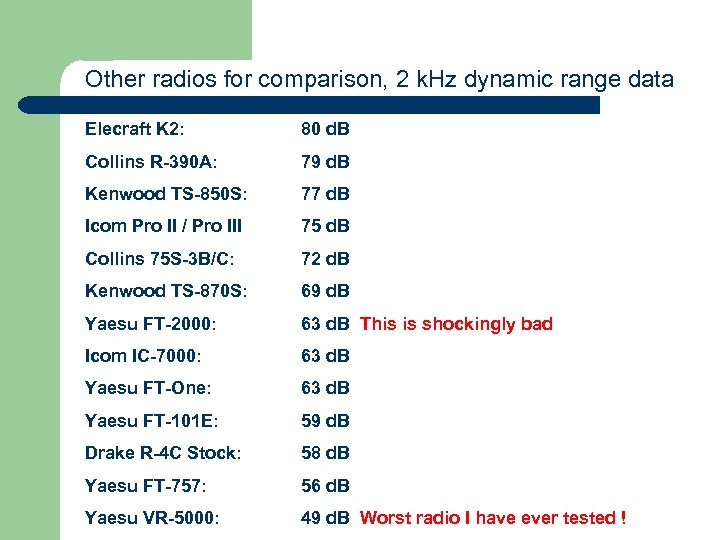 Other radios for comparison, 2 k. Hz dynamic range data Elecraft K 2: 80 d. B Collins R-390 A: 79 d. B Kenwood TS-850 S: 77 d. B Icom Pro II / Pro III 75 d. B Collins 75 S-3 B/C: 72 d. B Kenwood TS-870 S: 69 d. B Yaesu FT-2000: 63 d. B This is shockingly bad Icom IC-7000: 63 d. B Yaesu FT-One: 63 d. B Yaesu FT-101 E: 59 d. B Drake R-4 C Stock: 58 d. B Yaesu FT-757: 56 d. B Yaesu VR-5000: 49 d. B Worst radio I have ever tested !
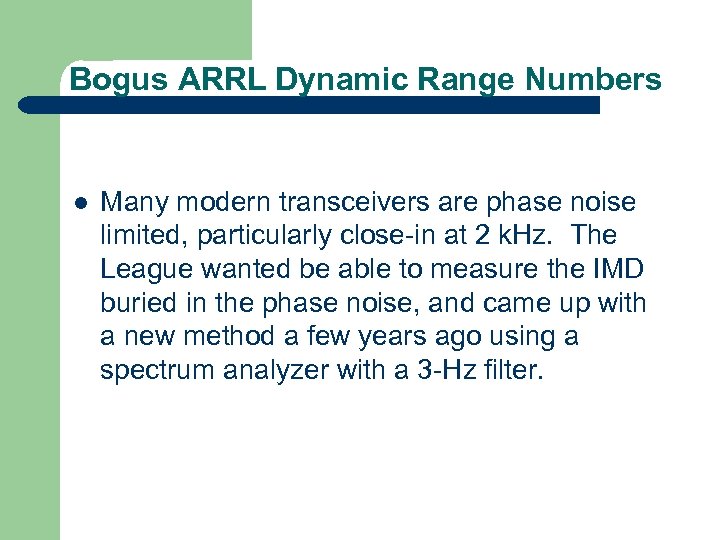 Bogus ARRL Dynamic Range Numbers l Many modern transceivers are phase noise limited, particularly close-in at 2 k. Hz. The League wanted be able to measure the IMD buried in the phase noise, and came up with a new method a few years ago using a spectrum analyzer with a 3 -Hz filter.
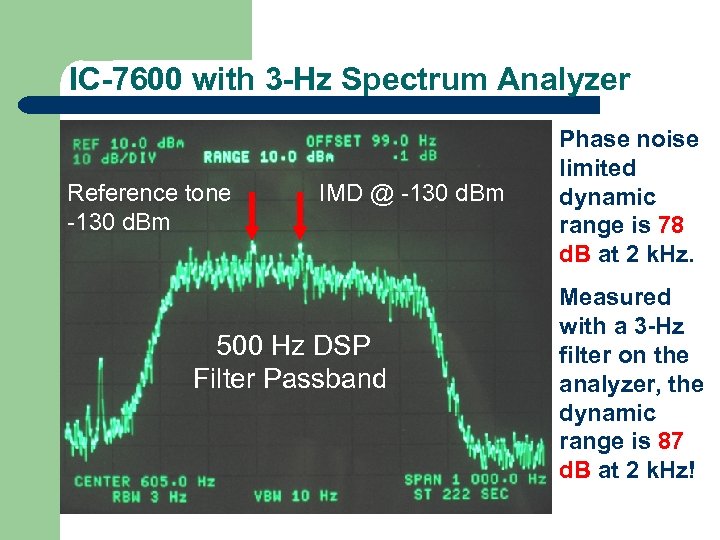 IC-7600 with 3 -Hz Spectrum Analyzer Reference tone -130 d. Bm IMD @ -130 d. Bm 500 Hz DSP Filter Passband Phase noise limited dynamic range is 78 d. B at 2 k. Hz. Measured with a 3 -Hz filter on the analyzer, the dynamic range is 87 d. B at 2 k. Hz!
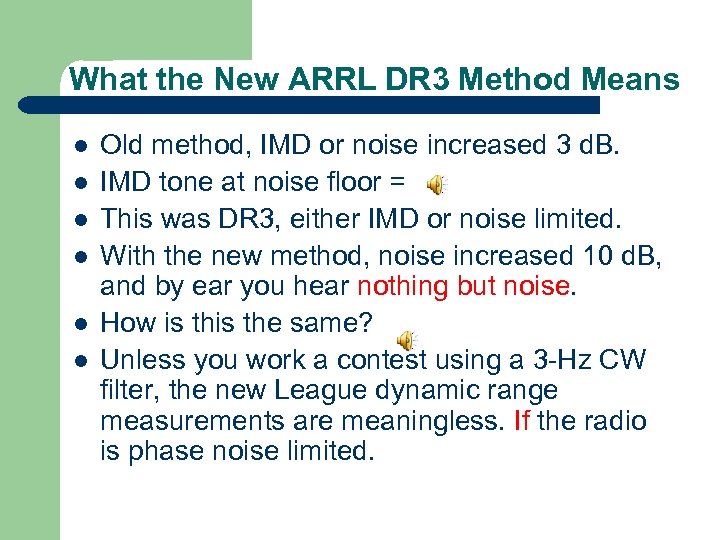 What the New ARRL DR 3 Method Means l l l Old method, IMD or noise increased 3 d. B. IMD tone at noise floor = This was DR 3, either IMD or noise limited. With the new method, noise increased 10 d. B, and by ear you hear nothing but noise. How is the same? Unless you work a contest using a 3 -Hz CW filter, the new League dynamic range measurements are meaningless. If the radio is phase noise limited.
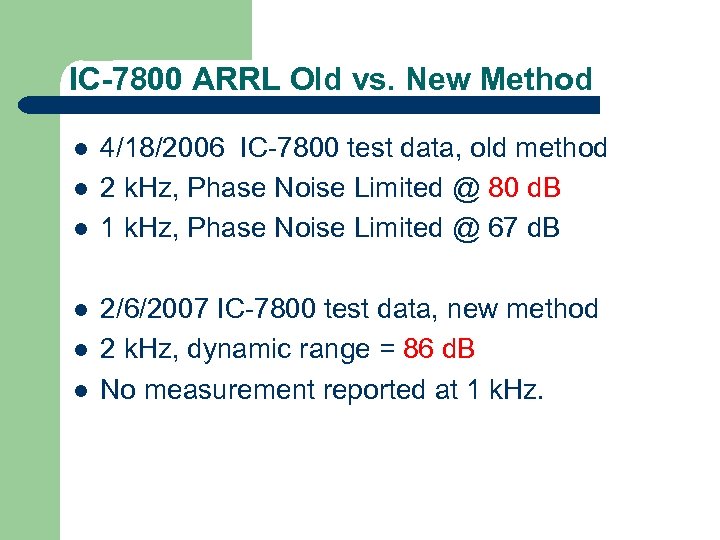 IC-7800 ARRL Old vs. New Method l l l 4/18/2006 IC-7800 test data, old method 2 k. Hz, Phase Noise Limited @ 80 d. B 1 k. Hz, Phase Noise Limited @ 67 d. B 2/6/2007 IC-7800 test data, new method 2 k. Hz, dynamic range = 86 d. B No measurement reported at 1 k. Hz.
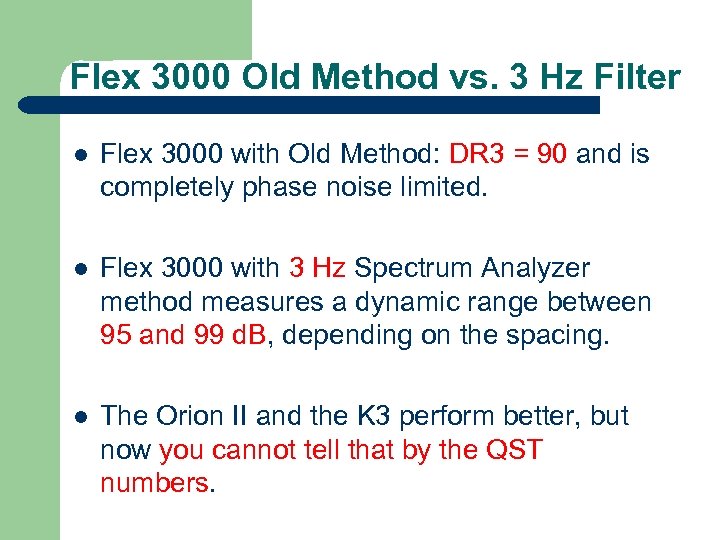 Flex 3000 Old Method vs. 3 Hz Filter l Flex 3000 with Old Method: DR 3 = 90 and is completely phase noise limited. l Flex 3000 with 3 Hz Spectrum Analyzer method measures a dynamic range between 95 and 99 d. B, depending on the spacing. l The Orion II and the K 3 perform better, but now you cannot tell that by the QST numbers.
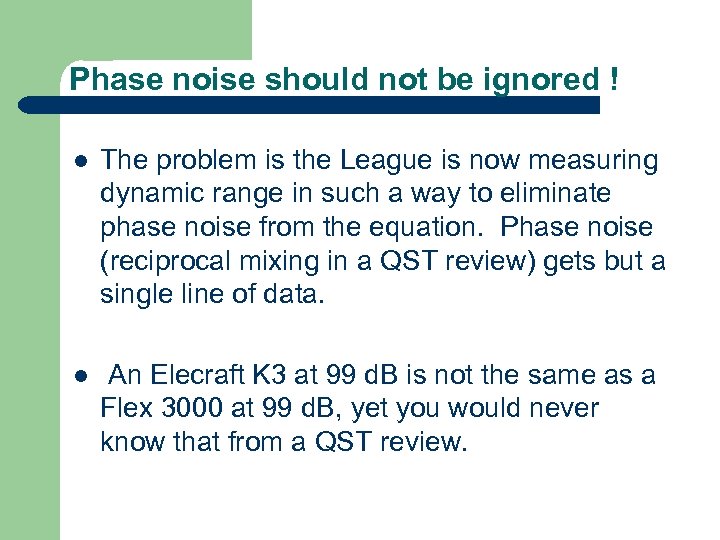 Phase noise should not be ignored ! l The problem is the League is now measuring dynamic range in such a way to eliminate phase noise from the equation. Phase noise (reciprocal mixing in a QST review) gets but a single line of data. l An Elecraft K 3 at 99 d. B is not the same as a Flex 3000 at 99 d. B, yet you would never know that from a QST review.
 Question: How good is good enough? High Dynamic Range Receiver (DR 3). Minimum 70 d. B for SSB & 80 d. B for CW If the “real” DR 3 > 90 d. B, your receiver is fine. Differences of a few d. B are NOT significant. Sensitivity 15 meters and below, preamp ON: 0. 2 u. V Noise floor 15 meters and below, preamp ON: -135 d. Bm Receiver testing needs to approximate the real world.
 Sherwood Engineering http: //www. sherwood-engineering. com http: //www. NC 0 B. com