


 Скачать презентацию Transactions Costs of Market Exchange Introduction Using
912859031a18e1daee9686d0bbf08cd0.ppt
- Количество слайдов: 23
 Transactions Costs of Market Exchange
 Introduction Using the market is costly Imposes limits on the use of the market Transactions costs arise because of n n n mutual interdependence between upstream and downstream units inability to write complete contracts incentives to cheat on the contract w request a higher price if demand unexpectedly increases w demand a lower price if the contract is to be renewed w cheat on quality to increase profit margins
 Contracts Consider arms-length contracts n n no guarantee of renewal essentially short-term Important issues n n incompleteness creation of relationship-specific assets All transactions rely on some form of contract n n facilitates sequential trading protects individuals from opportunistic behavior
 Contractual incompleteness A complete contract eliminates opportunistic behavior What does completeness require? n n n identify all contingencies, the actions to be taken in each case and agree outcomes agreed forms of performance measurement enforceable: observable and subject to rule of law
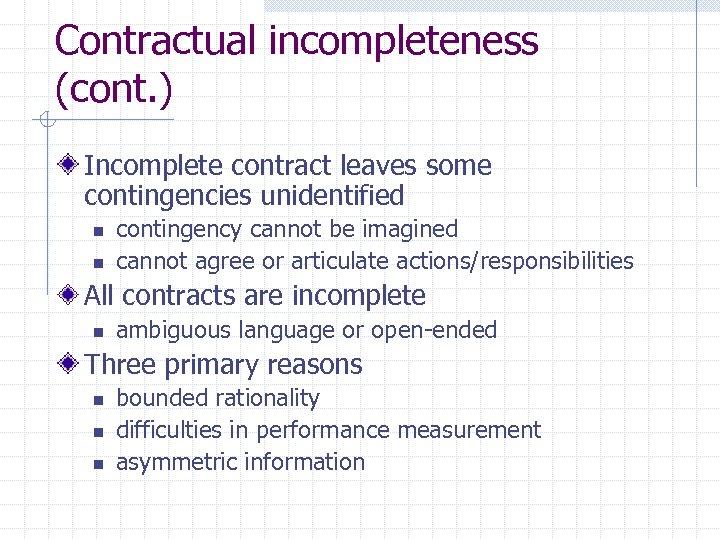 Contractual incompleteness (cont. ) Incomplete contract leaves some contingencies unidentified n n contingency cannot be imagined cannot agree or articulate actions/responsibilities All contracts are incomplete n ambiguous language or open-ended Three primary reasons n n n bounded rationality difficulties in performance measurement asymmetric information
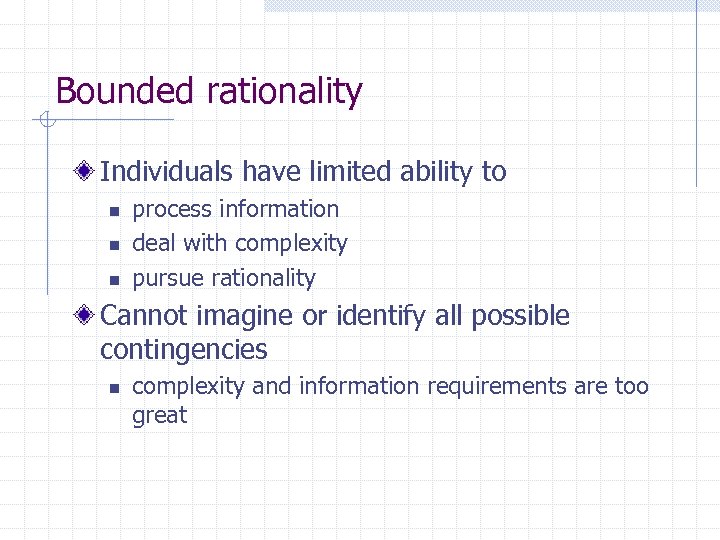 Bounded rationality Individuals have limited ability to n n n process information deal with complexity pursue rationality Cannot imagine or identify all possible contingencies n complexity and information requirements are too great
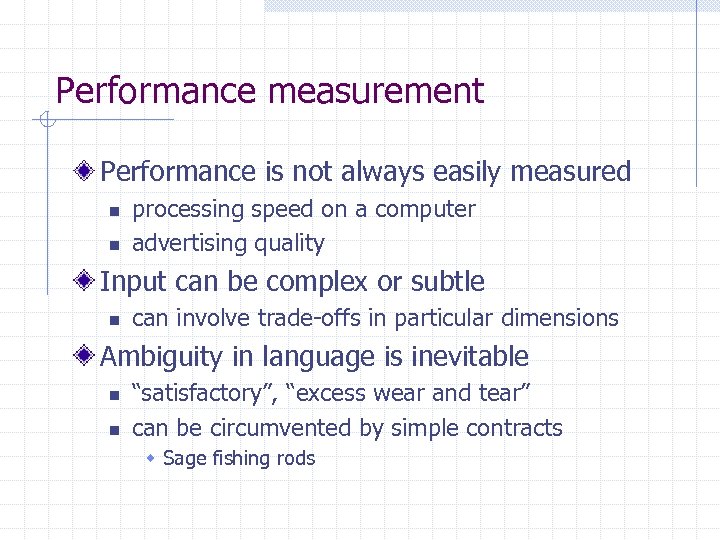 Performance measurement Performance is not always easily measured n n processing speed on a computer advertising quality Input can be complex or subtle n can involve trade-offs in particular dimensions Ambiguity in language is inevitable n n “satisfactory”, “excess wear and tear” can be circumvented by simple contracts w Sage fishing rods
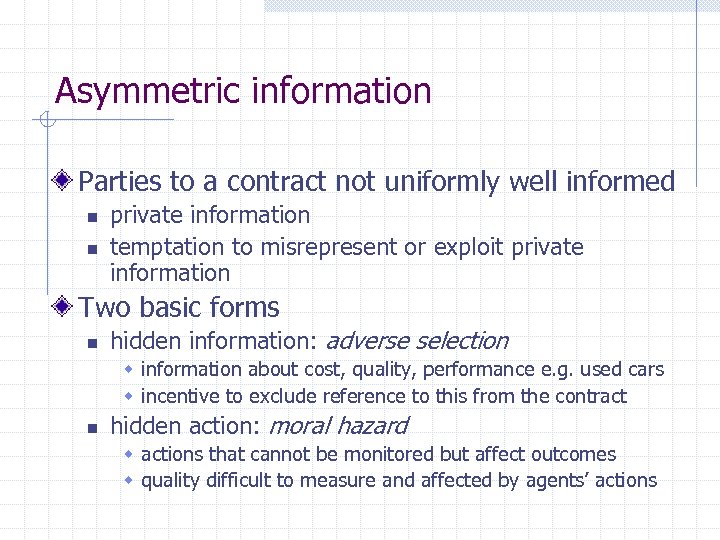 Asymmetric information Parties to a contract not uniformly well informed n n private information temptation to misrepresent or exploit private information Two basic forms n hidden information: adverse selection w information about cost, quality, performance e. g. used cars w incentive to exclude reference to this from the contract n hidden action: moral hazard w actions that cannot be monitored but affect outcomes w quality difficult to measure and affected by agents’ actions
 Asymmetric information (cont. ) If quality cannot be measured and attention to quality cannot be monitored: skimp on quality If quality is measurable but affected by n n buyer’s actions (installation) random factors Buyer has incentive to take less care if this is unobserved n car hire? Cannot contract on unobservable information/actions
 Contract law Underpins all contracts and recognizes incompleteness: establishes general rules But n n n ambiguous and subject to interpretation invoked by litigation: costly and loss of trust has implications for reputation and future contracts w litigation-prone undermines reputation
 Transactions with Relationship. Specific Assets A relationship-specific asset is created by an investment intended to support a specific activity Transforms the relationship between the parties n n n ex ante: competitive bidding ex post: bilateral bargaining “fundamental transformation”: change from “large numbers” bidding to “small numbers” bargaining
 Asset specificity At least four forms n site specificity w assets located side-by-side to increase efficiency n physical asset specificity w physical characteristics specifically tailored to the transaction n dedicated assets w investment in plant and equipment to satisfy a particular buyer n human asset specificity w individuals acquire skills, know-how specific to a particular relationship
 Rents and quasi-rents Quasi-rent arises as a result of a relationshipspecific investment. An example:
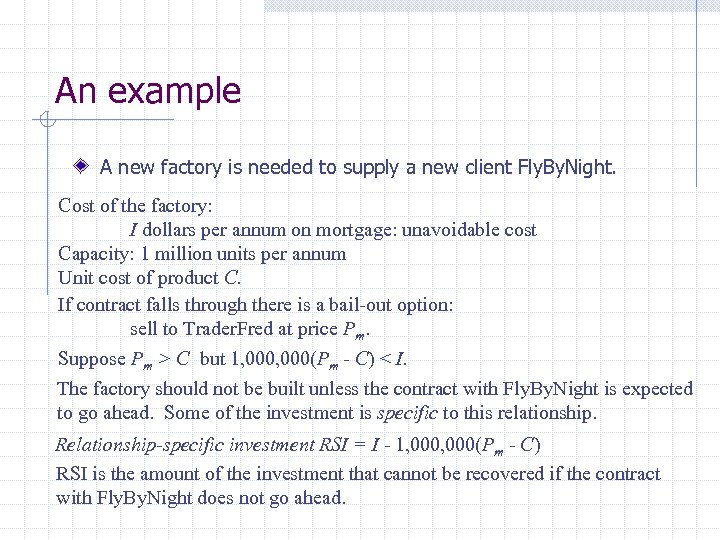 An example A new factory is needed to supply a new client Fly. By. Night. Cost of the factory: I dollars per annum on mortgage: unavoidable cost Capacity: 1 million units per annum Unit cost of product C. If contract falls through there is a bail-out option: sell to Trader. Fred at price Pm. Suppose Pm > C but 1, 000(Pm - C) < I. The factory should not be built unless the contract with Fly. By. Night is expected to go ahead. Some of the investment is specific to this relationship. Relationship-specific investment RSI = I - 1, 000(Pm - C) RSI is the amount of the investment that cannot be recovered if the contract with Fly. By. Night does not go ahead.
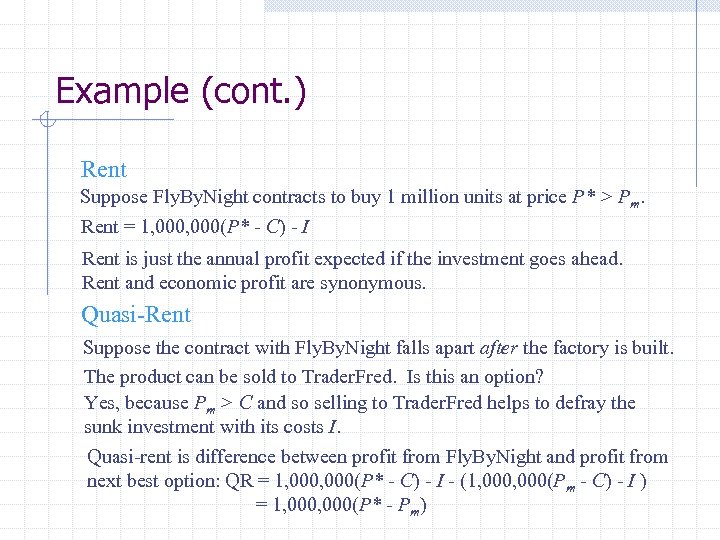 Example (cont. ) Rent Suppose Fly. By. Night contracts to buy 1 million units at price P* > Pm. Rent = 1, 000(P* - C) - I Rent is just the annual profit expected if the investment goes ahead. Rent and economic profit are synonymous. Quasi-Rent Suppose the contract with Fly. By. Night falls apart after the factory is built. The product can be sold to Trader. Fred. Is this an option? Yes, because Pm > C and so selling to Trader. Fred helps to defray the sunk investment with its costs I. Quasi-rent is difference between profit from Fly. By. Night and profit from next best option: QR = 1, 000(P* - C) - I - (1, 000(Pm - C) - I ) = 1, 000(P* - Pm)
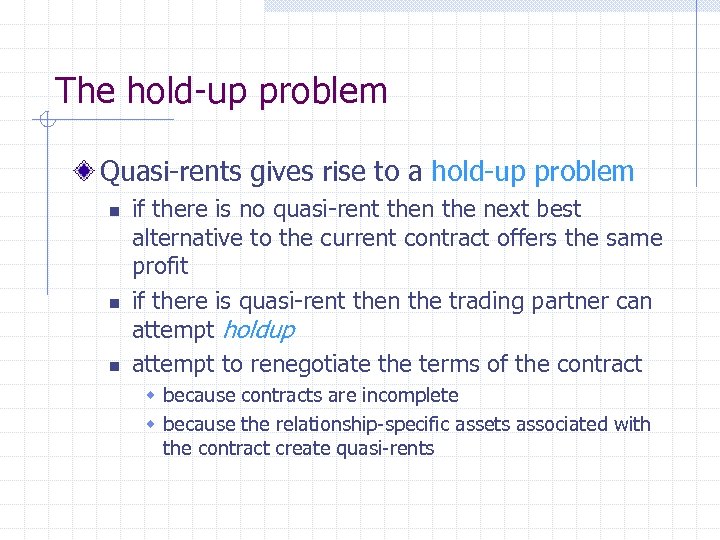 The hold-up problem Quasi-rents gives rise to a hold-up problem n n n if there is no quasi-rent then the next best alternative to the current contract offers the same profit if there is quasi-rent then the trading partner can attempt holdup attempt to renegotiate the terms of the contract w because contracts are incomplete w because the relationship-specific assets associated with the contract create quasi-rents
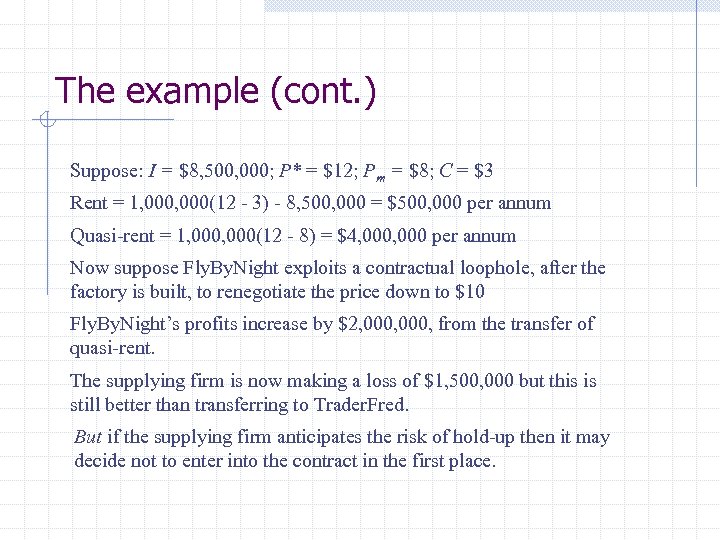 The example (cont. ) Suppose: I = $8, 500, 000; P* = $12; Pm = $8; C = $3 Rent = 1, 000(12 - 3) - 8, 500, 000 = $500, 000 per annum Quasi-rent = 1, 000(12 - 8) = $4, 000 per annum Now suppose Fly. By. Night exploits a contractual loophole, after the factory is built, to renegotiate the price down to $10 Fly. By. Night’s profits increase by $2, 000, from the transfer of quasi-rent. The supplying firm is now making a loss of $1, 500, 000 but this is still better than transferring to Trader. Fred. But if the supplying firm anticipates the risk of hold-up then it may decide not to enter into the contract in the first place.
 The hold-up problem and transactions costs Holdup creates transactions costs n contract negotiation and renegotiations w initial negotiations will be time consuming w remaining possibility of renegotiations with associated costs and delay n investment to improve ex post bargaining position w acquire a stand-by facility w second source n distrust w costly negotiation; underinvestment in the relationship n reduced investment w valuable exchange may not arise
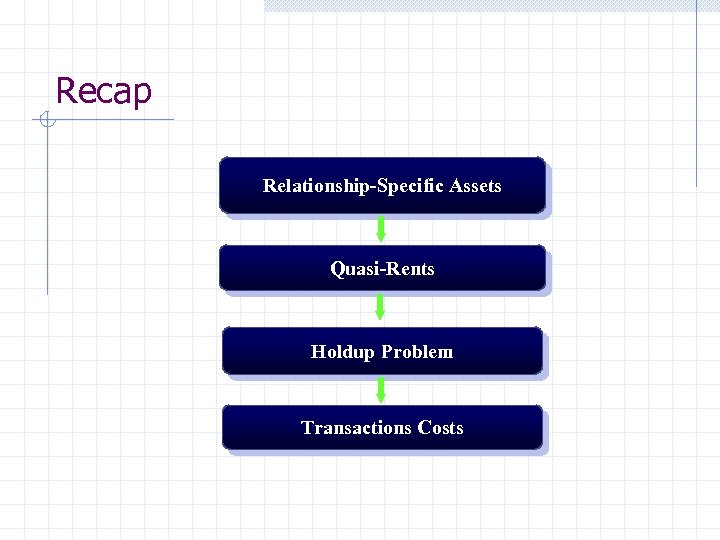 Recap Relationship-Specific Assets Quasi-Rents Holdup Problem Transactions Costs
 Transactions Costs and Vertical Integration Vertical integration (VI) is an alternative to market contracts Why should VI reduce the holdup problem? n n n differences in governance repeated relationship organizational influences
 Differences in governance Powerful and flexible systems exist inside firms to resolve disputes Less formal contracting and more formal authority n n management fiat formal lines of control Information is more extensive since it is internal n reduces problems of bounded rationality and hidden information
 Repeated relationship Vertical relationship involves trading parties in a repeated relationship n less incentive for opportunistic behavior w know that the relationship will continue n more incentive to make relationship-specific investment w temptation to holdup is reduced But not the only possibility: n long-term contracting can achieve the same benefits
 Organizational influences Common purpose across divisions Creation of corporate culture n n teamwork information sharing Competition between divisions still exists n n adversarial relationships competition for advancement Senior management needs to balance competition and cooperation between divisions