


 Скачать презентацию Transactions Costs and Trading Zhiwu Chen Yale School
b6e93b8867aa12ec28857a2b7fa129c5.ppt
- Количество слайдов: 51
 Transactions Costs and Trading Zhiwu Chen, Yale School of Management Note: This presentation is mostly adapted from the slides prepared by Ian Domowitz, Managing Director of ITG, for his talk at Yale on Oct. 1, 2003. His work is gratefully acknowldged. Best Execution ITG Inc. , Member NASD, SIPC 91603 -82599 © 2003 ITG Inc. , All Rights Reserved, Not to be reproduced without permission
 Successful Implementation Strategies Portfolio Management Risk analysis Ø Optimization Ø Fair value pricing Ø Pre-Trade Analysis Trade Blotter Post-Trade Analysis Performance vs. benchmarks Ø Sorted and organized Ø Trading cost Ø Risk analysis Ø Optimal horizon Ø Trade data Ø Organization Ø Trading Access to all liquidity sources Ø Logical participation trading strategies Ø © 2003 ITG Inc. All Rights Reserved, Not to be reproduced without permission 2
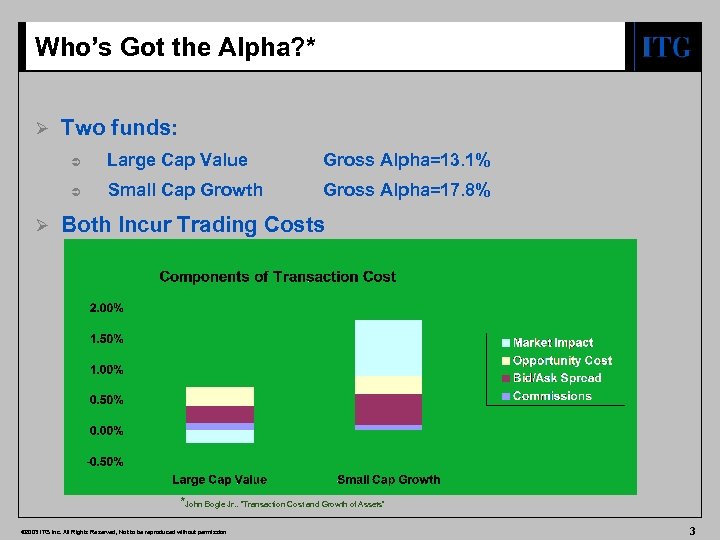 Who’s Got the Alpha? * Ø Two funds: Ü Gross Alpha=13. 1% Ü Ø Large Cap Value Small Cap Growth Gross Alpha=17. 8% Both Incur Trading Costs *John Bogle Jr. . “Transaction Cost and Growth of Assets” © 2003 ITG Inc. All Rights Reserved, Not to be reproduced without permission 3
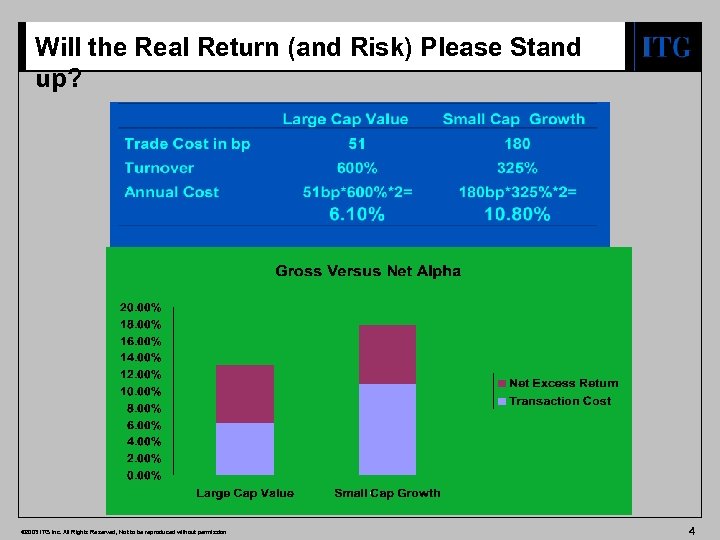 Will the Real Return (and Risk) Please Stand up? © 2003 ITG Inc. All Rights Reserved, Not to be reproduced without permission 4
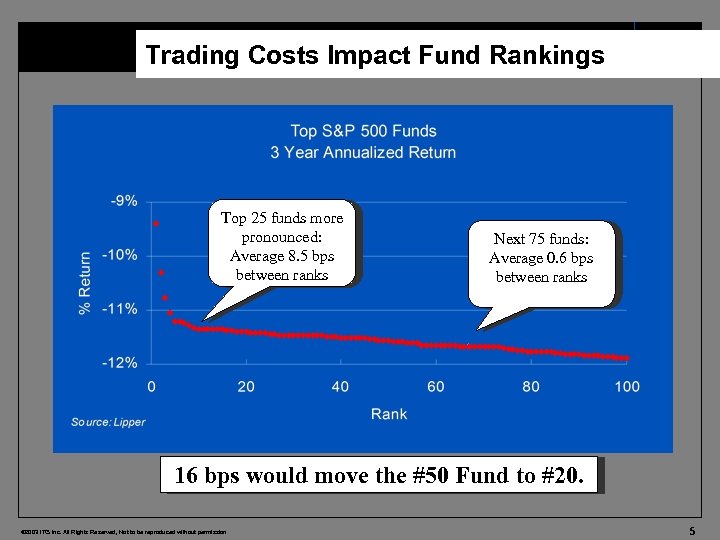 Trading Costs Impact Fund Rankings Top 25 funds more pronounced: Average 8. 5 bps between ranks Next 75 funds: Average 0. 6 bps between ranks 16 bps would move the #50 Fund to #20. © 2003 ITG Inc. All Rights Reserved, Not to be reproduced without permission 5
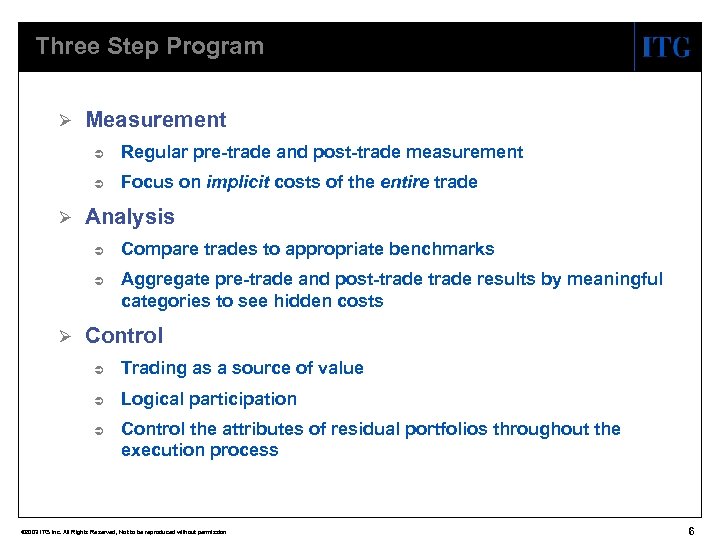 Three Step Program Ø Measurement Ü Ü Ø Regular pre-trade and post-trade measurement Focus on implicit costs of the entire trade Analysis Ü Ü Ø Compare trades to appropriate benchmarks Aggregate pre-trade and post-trade results by meaningful categories to see hidden costs Control Ü Trading as a source of value Ü Logical participation Ü Control the attributes of residual portfolios throughout the execution process © 2003 ITG Inc. All Rights Reserved, Not to be reproduced without permission 6
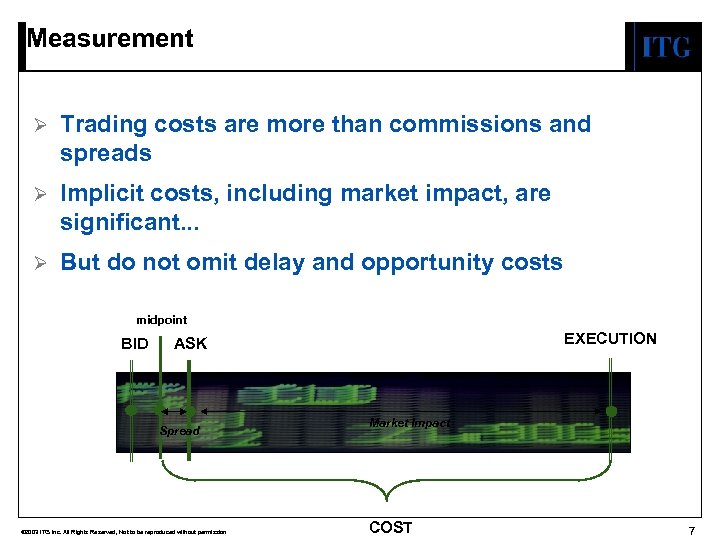 Measurement Ø Trading costs are more than commissions and spreads Ø Implicit costs, including market impact, are significant. . . Ø But do not omit delay and opportunity costs midpoint BID EXECUTION ASK Spread © 2003 ITG Inc. All Rights Reserved, Not to be reproduced without permission Market Impact COST 7
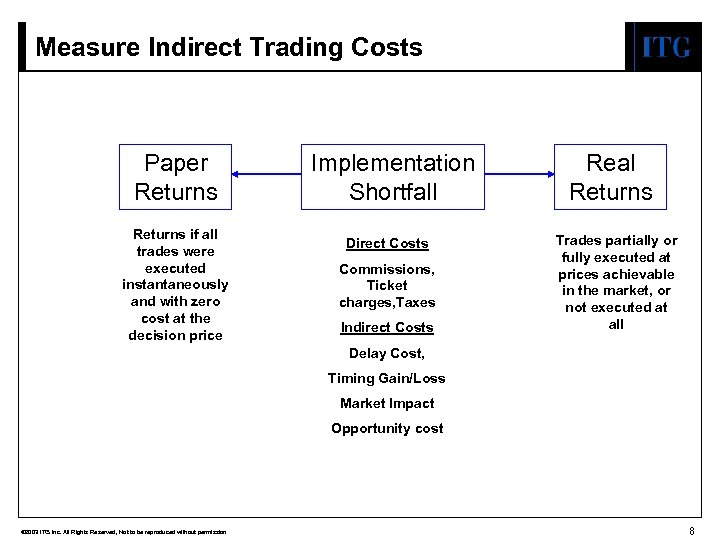 Measure Indirect Trading Costs Paper Returns if all trades were executed instantaneously and with zero cost at the decision price Implementation Shortfall Direct Costs Commissions, Ticket charges, Taxes Indirect Costs Real Returns Trades partially or fully executed at prices achievable in the market, or not executed at all Delay Cost, Timing Gain/Loss Market Impact Opportunity cost © 2003 ITG Inc. All Rights Reserved, Not to be reproduced without permission 8
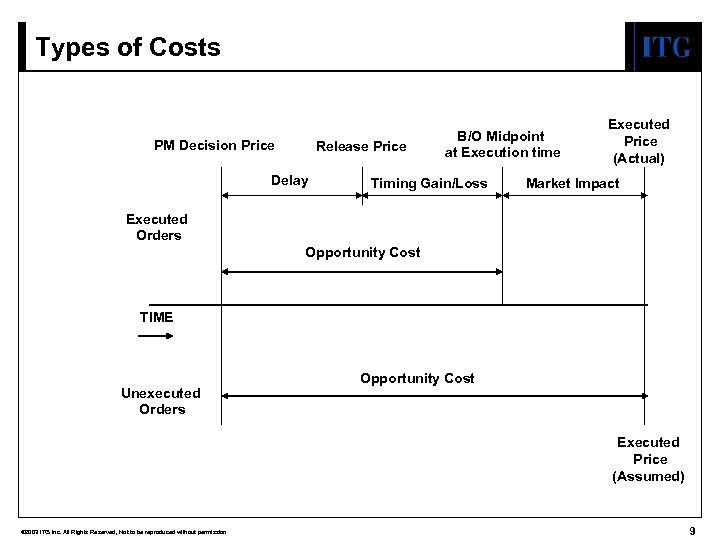 Types of Costs PM Decision Price Release Price Delay B/O Midpoint at Execution time Timing Gain/Loss Executed Price (Actual) Market Impact Executed Orders Opportunity Cost TIME Unexecuted Orders Opportunity Cost Executed Price (Assumed) © 2003 ITG Inc. All Rights Reserved, Not to be reproduced without permission 9
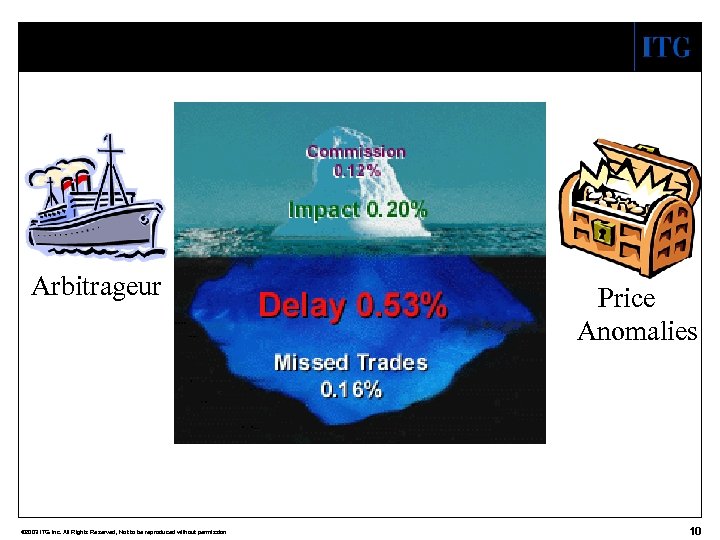 Arbitrageur © 2003 ITG Inc. All Rights Reserved, Not to be reproduced without permission Price Anomalies 10
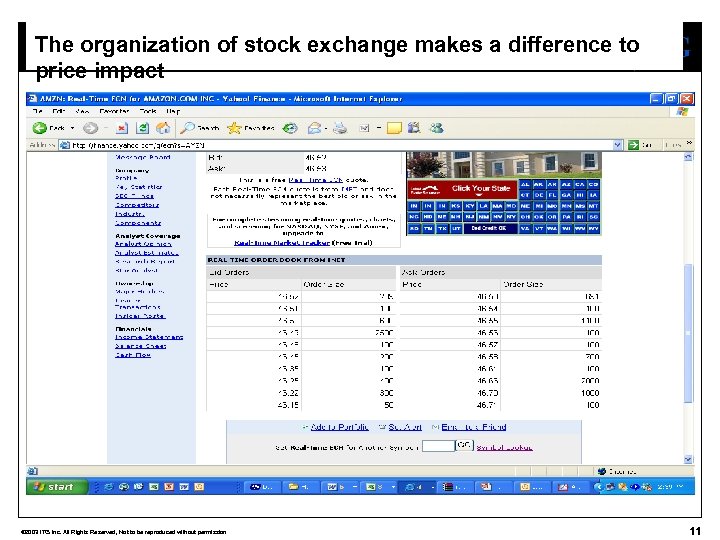 The organization of stock exchange makes a difference to price impact © 2003 ITG Inc. All Rights Reserved, Not to be reproduced without permission 11
 On Benchmarks Ø So many choices, so much confusion Ø What benchmarks to use? Ü Miscommunication between traders and portfolio managers symptomatic of benchmark issues Ü Traders may perform well versus VWAP benchmark Ü . . . but portfolio managers are dissatisfied Ü Pursuing a VWAP benchmark encourages traders to parcel out their trades over several days, missing the opportunity to obtain alpha © 2003 ITG Inc. All Rights Reserved, Not to be reproduced without permission 12
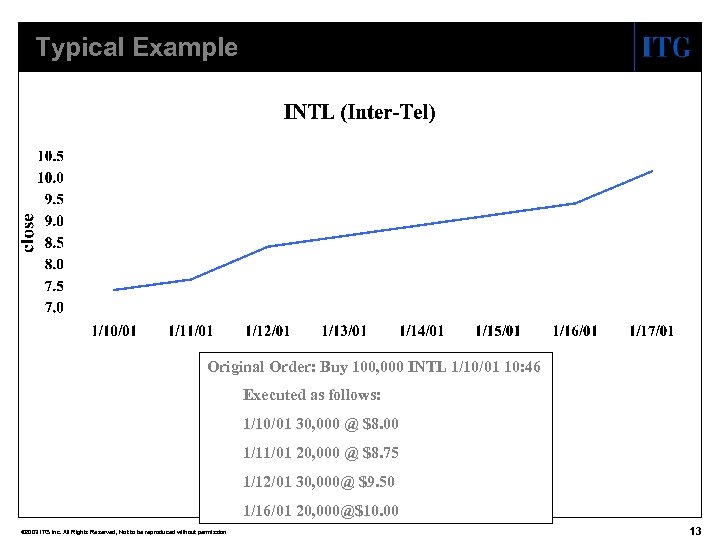 Typical Example Original Order: Buy 100, 000 INTL 1/10/01 10: 46 Executed as follows: 1/10/01 30, 000 @ $8. 00 1/11/01 20, 000 @ $8. 75 1/12/01 30, 000@ $9. 50 1/16/01 20, 000@$10. 00 © 2003 ITG Inc. All Rights Reserved, Not to be reproduced without permission 13
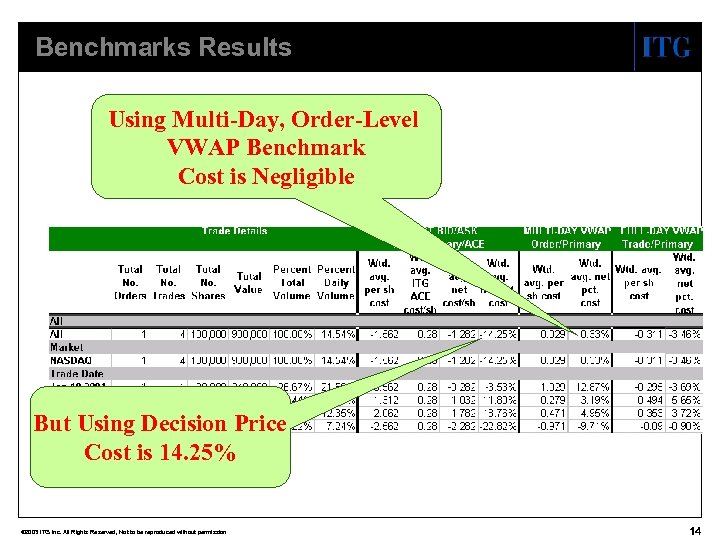 Benchmarks Results Using Multi-Day, Order-Level VWAP Benchmark Cost is Negligible But Using Decision Price Cost is 14. 25% © 2003 ITG Inc. All Rights Reserved, Not to be reproduced without permission 14
 A Study in Timing: an example Ø The head trader believes costs are too high for relatively liquid stocks Ø Goal: identify the cost drivers Ø The trade order management system has time stamps for: Ü When the order was released by the PM to the desk Ü When the desk released the order to the broker Ü When the broker executed the trade © 2003 ITG Inc. All Rights Reserved, Not to be reproduced without permission 15
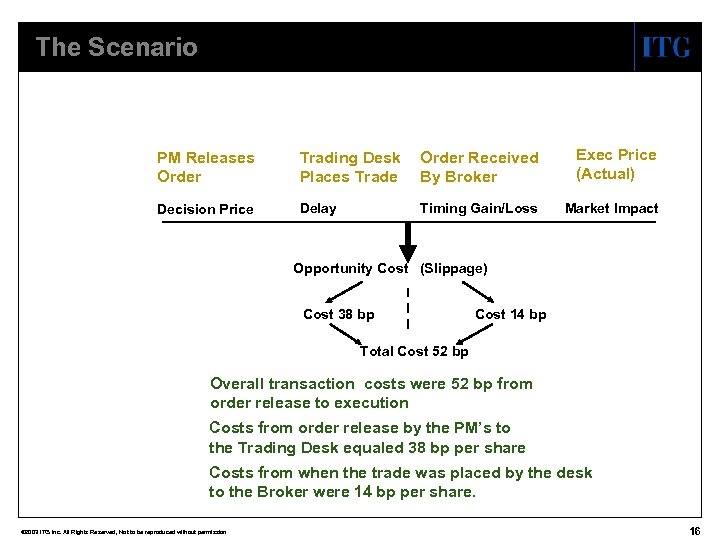 The Scenario PM Releases Order Trading Desk Places Trade Order Received By Broker Exec Price (Actual) Decision Price Delay Timing Gain/Loss Market Impact Opportunity Cost (Slippage) Cost 38 bp Cost 14 bp Total Cost 52 bp Overall transaction costs were 52 bp from order release to execution Costs from order release by the PM’s to the Trading Desk equaled 38 bp per share Costs from when the trade was placed by the desk to the Broker were 14 bp per share. © 2003 ITG Inc. All Rights Reserved, Not to be reproduced without permission 16
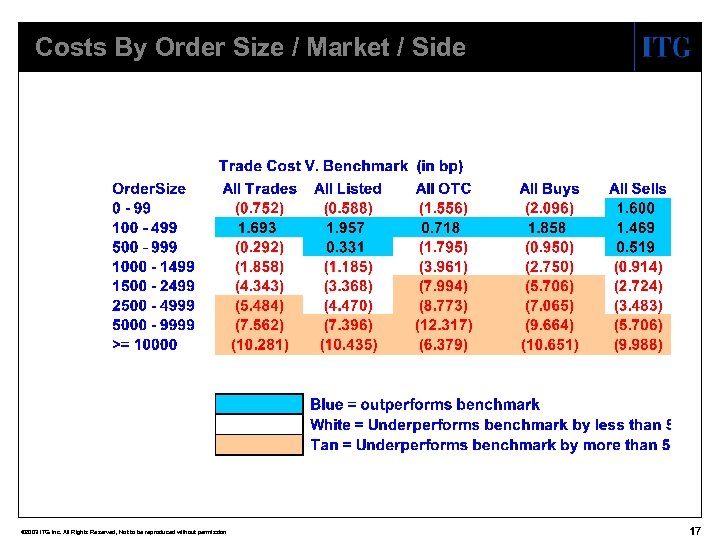 Costs By Order Size / Market / Side © 2003 ITG Inc. All Rights Reserved, Not to be reproduced without permission 17
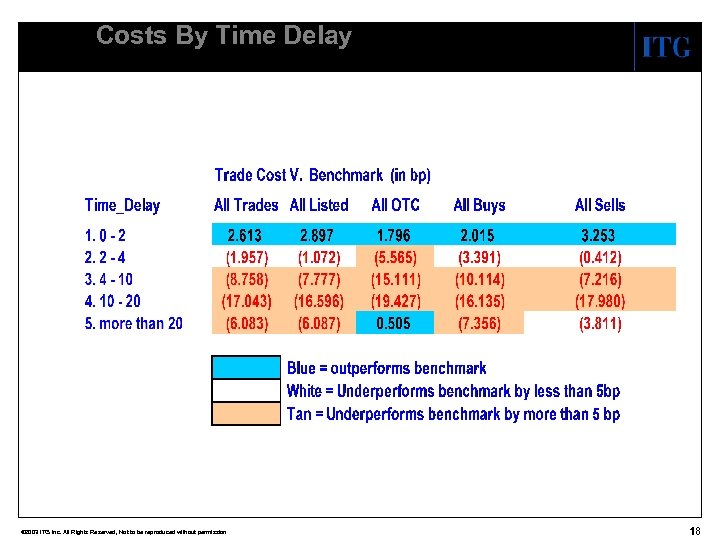 Costs By Time Delay © 2003 ITG Inc. All Rights Reserved, Not to be reproduced without permission 18
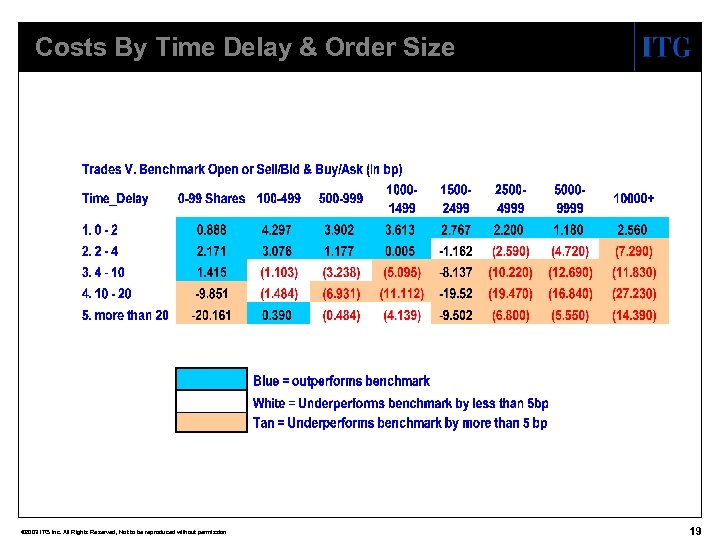 Costs By Time Delay & Order Size © 2003 ITG Inc. All Rights Reserved, Not to be reproduced without permission 19
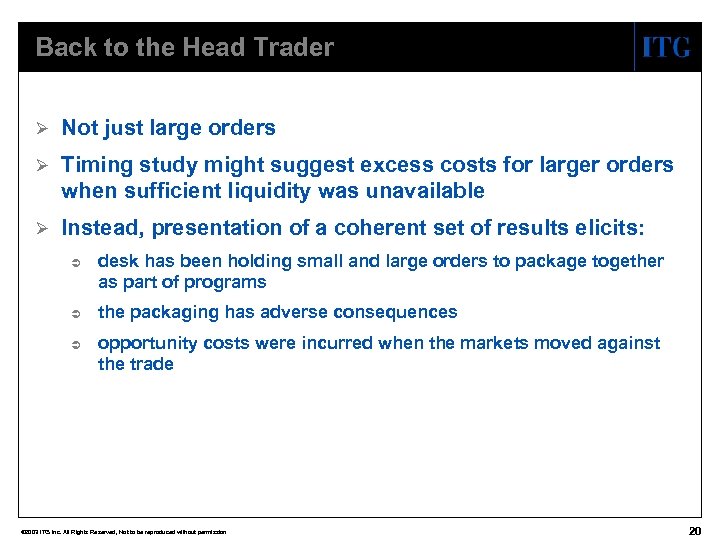 Back to the Head Trader Ø Not just large orders Ø Timing study might suggest excess costs for larger orders when sufficient liquidity was unavailable Ø Instead, presentation of a coherent set of results elicits: Ü Ü Ü desk has been holding small and large orders to package together as part of programs the packaging has adverse consequences opportunity costs were incurred when the markets moved against the trade © 2003 ITG Inc. All Rights Reserved, Not to be reproduced without permission 20
 Analysis Ø Building a narrative Ø Aggregate pre-trade and post-trade results by meaningful categories to see hidden costs © 2003 ITG Inc. All Rights Reserved, Not to be reproduced without permission 21
 Periodic Reviews Add Value Ø Head of Trading performs periodic post-trade analysis to detect trends and refine investment style Ü Ø Classify by market, sector, etc. Post-trade analysis indicates mediocre trading performance Ü Costs are 135 basis points overall, relative to an order-level, midpoint benchmark © 2003 ITG Inc. All Rights Reserved, Not to be reproduced without permission 22
 Outcome Ø Improve trading strategy and performance by synchronizing PM and trader goals Ü Ü Ø Use implementation shortfall as the trader’s benchmark Incorporate this benchmark in the PM’s stock selection process Traders incented to obtain target price close to target price of the PM Ü Ü Traders may be willing to pay up in some cases to get the trade done PM’s are more aware of the liquidity characteristics of their trades and potential costs © 2003 ITG Inc. All Rights Reserved, Not to be reproduced without permission 23
 Delay Costs: consider an example Ø Trader is concerned that his firm’s DOT executions are too costly Ø DOT flow is routed through one major broker Ü From the time the trade was released to the desk to the time of execution, costs averaged 35 basis points (buy-ask, sell-bid) Ü Ü Ø In dollar terms, this was about 9. 5 cents Given the volume of DOT orders, this represents a significant cost Should the broker be fired? © 2003 ITG Inc. All Rights Reserved, Not to be reproduced without permission 24
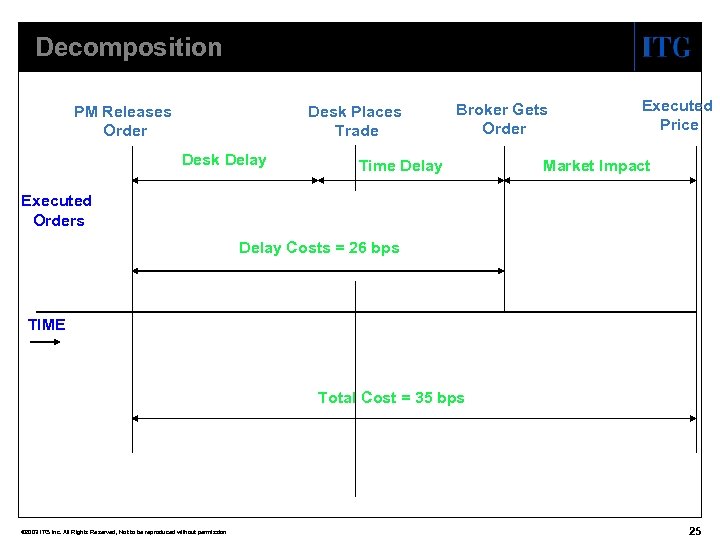 Decomposition PM Releases Order Desk Places Trade Desk Delay Broker Gets Order Time Delay Executed Price Market Impact Executed Orders Delay Costs = 26 bps TIME Total Cost = 35 bps © 2003 ITG Inc. All Rights Reserved, Not to be reproduced without permission 25
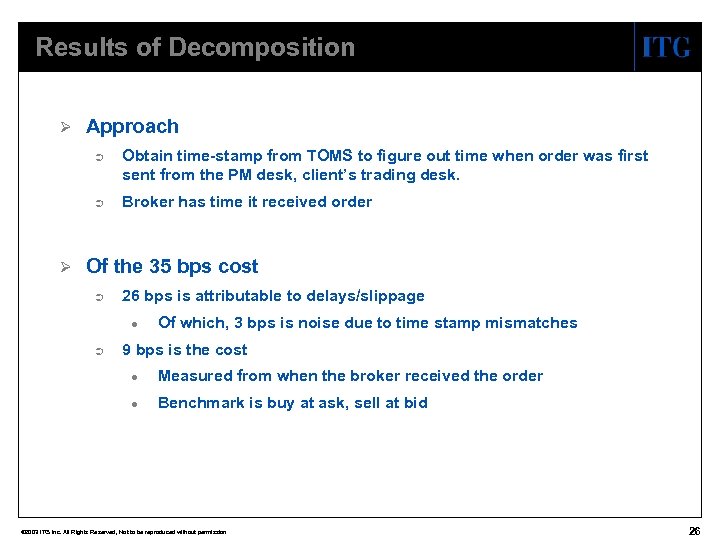 Results of Decomposition Ø Approach Ü Ü Ø Obtain time-stamp from TOMS to figure out time when order was first sent from the PM desk, client’s trading desk. Broker has time it received order Of the 35 bps cost Ü 26 bps is attributable to delays/slippage l Ü Of which, 3 bps is noise due to time stamp mismatches 9 bps is the cost l Measured from when the broker received the order l Benchmark is buy at ask, sell at bid © 2003 ITG Inc. All Rights Reserved, Not to be reproduced without permission 26
 “ 9 bps is still too high!” Ø Maybe Ø Further analysis finds that some trades are sent prior to the open Ø Cost computation uses previous quotes, which might be considered to be misleading © 2003 ITG Inc. All Rights Reserved, Not to be reproduced without permission 27
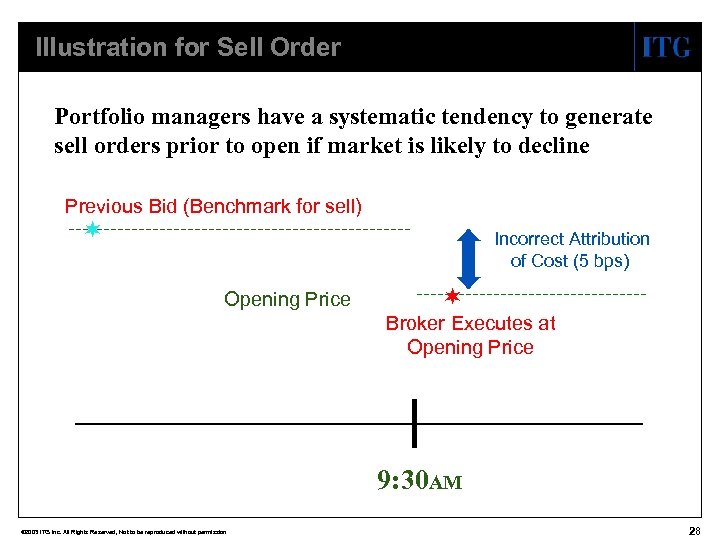 Illustration for Sell Order Portfolio managers have a systematic tendency to generate sell orders prior to open if market is likely to decline Previous Bid (Benchmark for sell) Incorrect Attribution of Cost (5 bps) Opening Price Broker Executes at Opening Price 9: 30 AM © 2003 ITG Inc. All Rights Reserved, Not to be reproduced without permission 28
 Resolution Ø For orders received pre-open, use opening price as benchmark; otherwise buy at ask, sell at bid Ø Results: Broker cost falls to 4 bps Ø Outcome Ü No change in broker Ü Methodology adopted to measure other brokers Ü Approach to creating program trades reviewed © 2003 ITG Inc. All Rights Reserved, Not to be reproduced without permission 29
 Now, what can you do to control price impact costs? Ø The real name of the game Ø Identify means of reducing price impacts Ø Example: liquidity monitoring possibilities Ü Larger sizes in an environment characterized by more trades Ü Larger sizes with smaller spreads © 2003 ITG Inc. All Rights Reserved, Not to be reproduced without permission 30
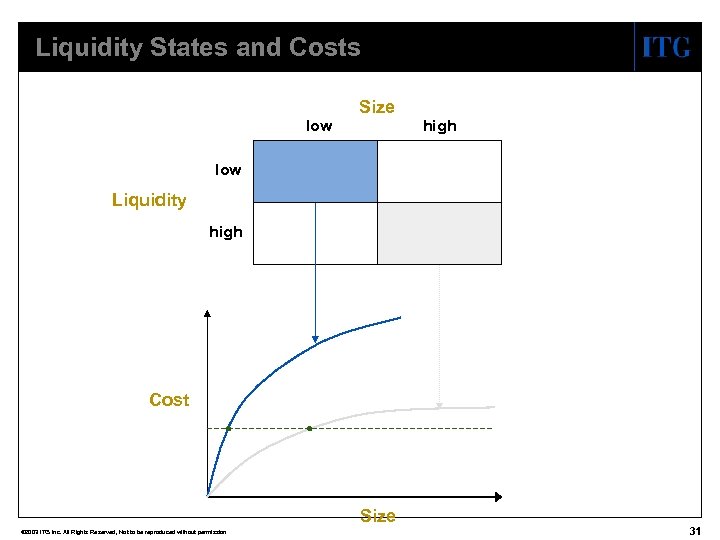 Liquidity States and Costs low Size high low Liquidity high Cost Size © 2003 ITG Inc. All Rights Reserved, Not to be reproduced without permission 31
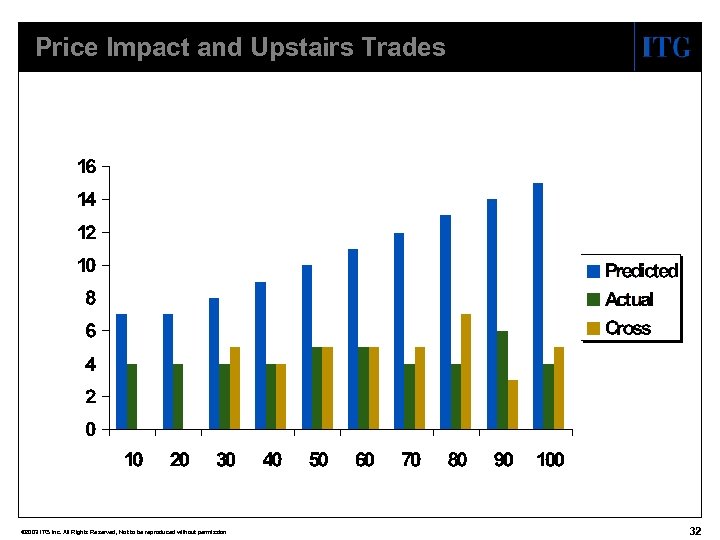 Price Impact and Upstairs Trades © 2003 ITG Inc. All Rights Reserved, Not to be reproduced without permission 32
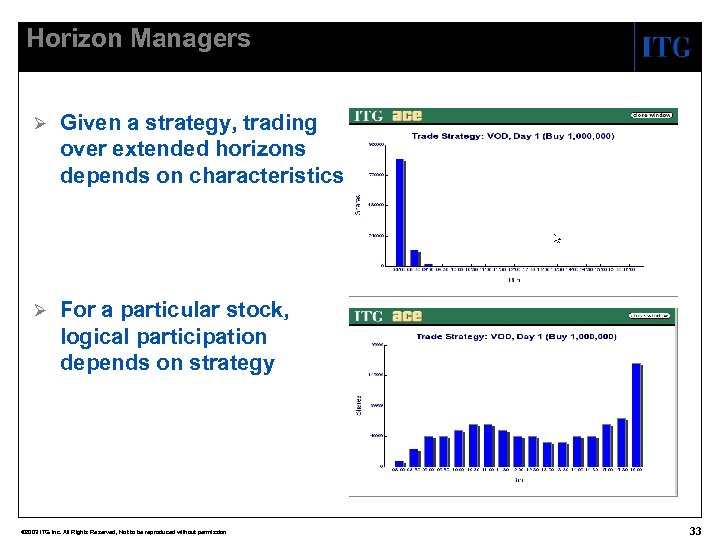 Horizon Managers Ø Given a strategy, trading over extended horizons depends on characteristics Ø For a particular stock, logical participation depends on strategy © 2003 ITG Inc. All Rights Reserved, Not to be reproduced without permission 33
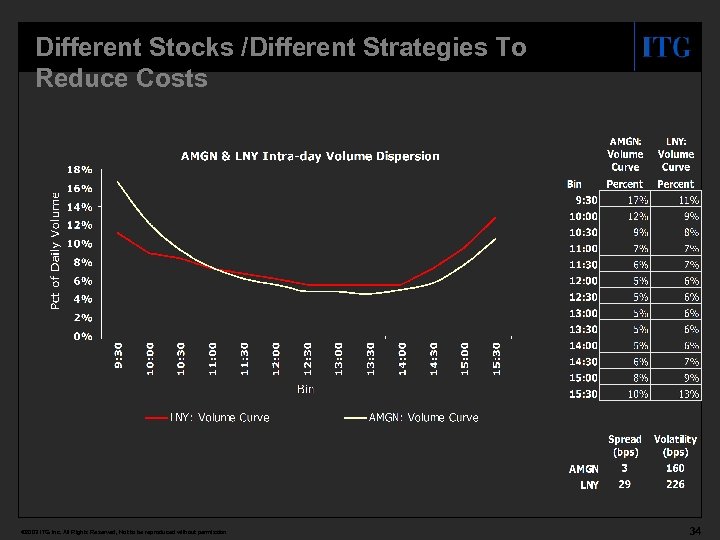 Different Stocks /Different Strategies To Reduce Costs © 2003 ITG Inc. All Rights Reserved, Not to be reproduced without permission 34
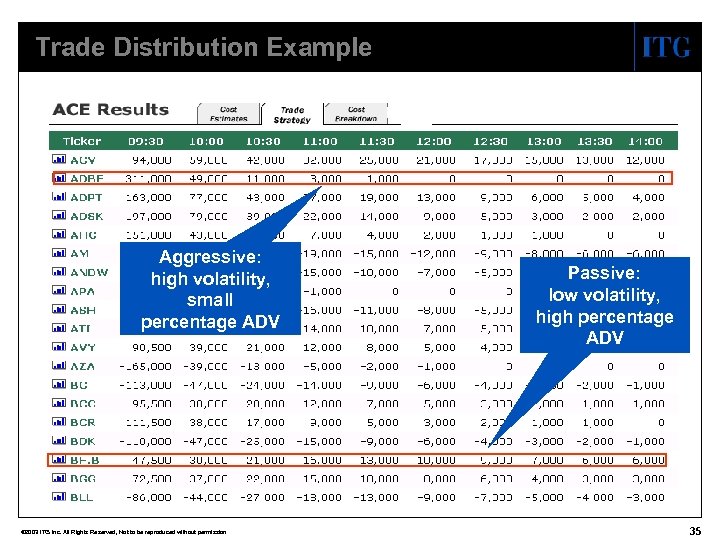 Trade Distribution Example Aggressive: high volatility, small percentage ADV © 2003 ITG Inc. All Rights Reserved, Not to be reproduced without permission Passive: low volatility, high percentage ADV 35
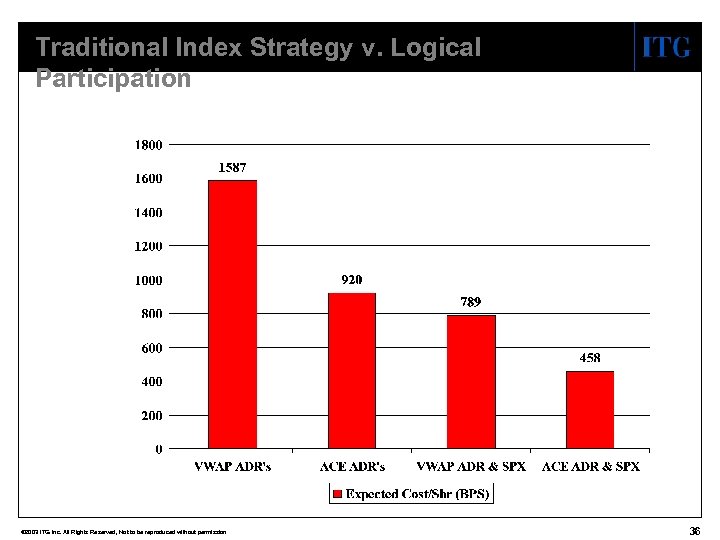 Traditional Index Strategy v. Logical Participation © 2003 ITG Inc. All Rights Reserved, Not to be reproduced without permission 36
 Another way to manage costs: trading over Longer Horizons Ø Two objectives Ü Ü Ø match the desired trading distribution/benchmark closely obtain favorable execution prices Objectives achieved by Ü Ü Placing and correcting limit orders to maximize opportunities to earn the spread Sending marketable orders as necessary to keep on schedule Ø Design for large trade sizes in portfolio trading applications Ø Next generation VWAP © 2003 ITG Inc. All Rights Reserved, Not to be reproduced without permission 37
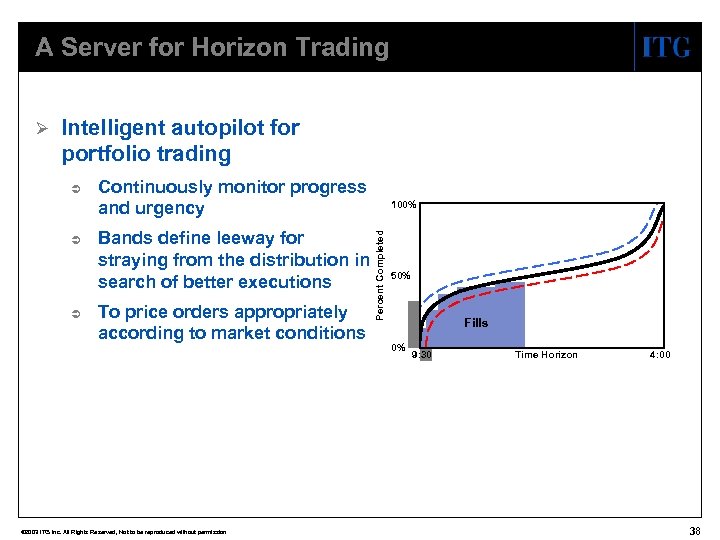 A Server for Horizon Trading Intelligent autopilot for portfolio trading Ü Ü Ü Continuously monitor progress and urgency Bands define leeway for straying from the distribution in search of better executions To price orders appropriately according to market conditions © 2003 ITG Inc. All Rights Reserved, Not to be reproduced without permission 100% Percent Completed Ø 50% Fills 0% 9: 30 Time Horizon 4: 00 38
 Pitfalls in Pegging and Discretion Strategies Ø Typical pegging algorithm errors Ü Ü Ø contribute to momentum by instantaneously adjusting price to match all quote changes pegged orders typically leave an obvious information trail Typical discretion order type errors Ü Ü excess time and effort required to make informed discretion range judgements constancy of discretion range over life of order, although aggressiveness should be a function of urgency, which may change © 2003 ITG Inc. All Rights Reserved, Not to be reproduced without permission 39
 Pegging and Discretion Revisited Ø Enhanced pegging Ü Ü Ü Ø peg an order loosely to the inside market react conditionally, determining whether each quote change merits an order price correction randomize and blend in with the crowd Dynamic discretion Ü Ü Ü automatically choose appropriate discretion range for each order independently continuously adjust range over life of order, recalculating the trigger price that demands liquidity Adjust based on market conditions © 2003 ITG Inc. All Rights Reserved, Not to be reproduced without permission 40
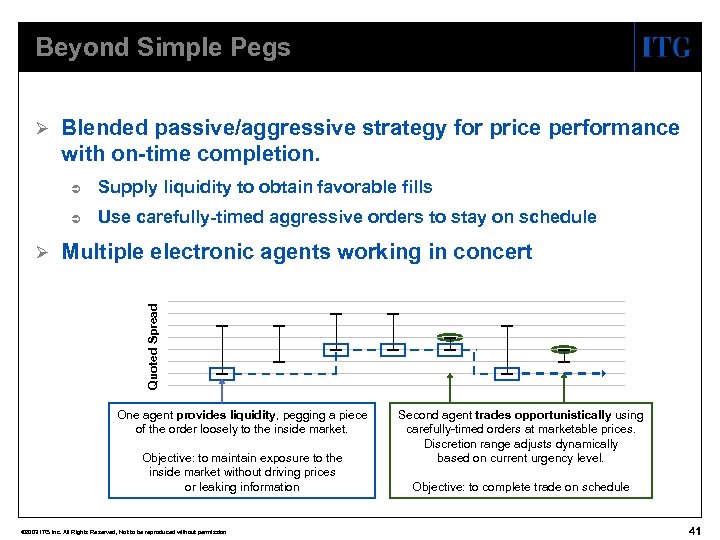 Beyond Simple Pegs Ø Blended passive/aggressive strategy for price performance with on-time completion. Ü Ü Use carefully-timed aggressive orders to stay on schedule Multiple electronic agents working in concert Quoted Spread Ø Supply liquidity to obtain favorable fills One agent provides liquidity, pegging a piece of the order loosely to the inside market. Objective: to maintain exposure to the inside market without driving prices or leaking information © 2003 ITG Inc. All Rights Reserved, Not to be reproduced without permission Second agent trades opportunistically using carefully-timed orders at marketable prices. Discretion range adjusts dynamically based on current urgency level. Objective: to complete trade on schedule 41
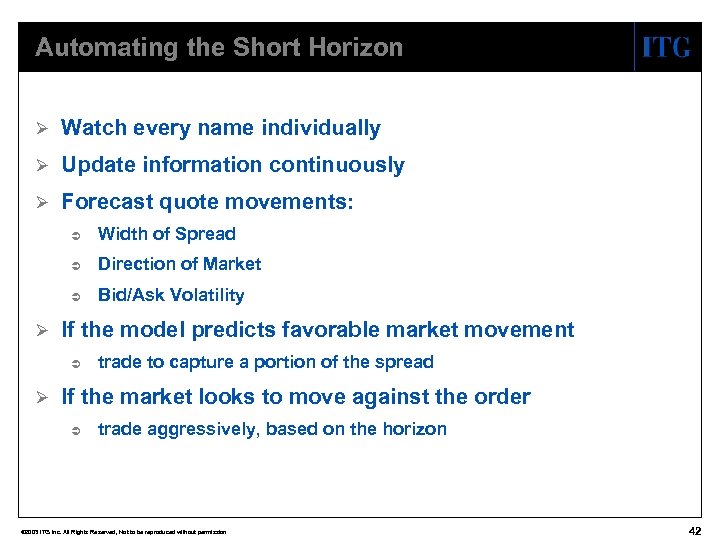 Automating the Short Horizon Ø Watch every name individually Ø Update information continuously Ø Forecast quote movements: Ü Ü Direction of Market Ü Ø Width of Spread Bid/Ask Volatility If the model predicts favorable market movement Ü Ø trade to capture a portion of the spread If the market looks to move against the order Ü trade aggressively, based on the horizon © 2003 ITG Inc. All Rights Reserved, Not to be reproduced without permission 42
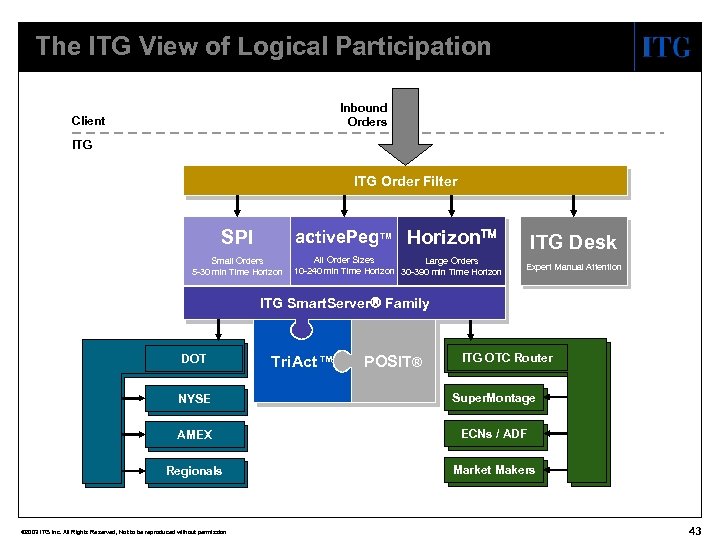 The ITG View of Logical Participation Inbound Orders Client ITG Order Filter SPI active. Peg™ Horizon Small Orders 5 -30 min Time Horizon All Order Sizes Large Orders 10 -240 min Time Horizon 30 -390 min Time Horizon ITG Desk Expert Manual Attention ITG Smart. Server Family DOT Tri. Act™ POSIT® ITG OTC Router NYSE Super. Montage AMEX ECNs / ADF Regionals Market Makers © 2003 ITG Inc. All Rights Reserved, Not to be reproduced without permission 43
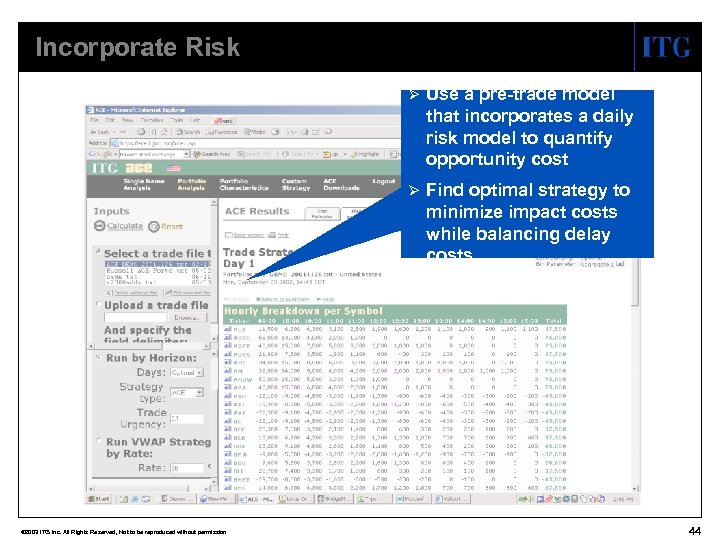 Incorporate Risk Ø Ø © 2003 ITG Inc. All Rights Reserved, Not to be reproduced without permission Use a pre-trade model that incorporates a daily risk model to quantify opportunity cost Find optimal strategy to minimize impact costs while balancing delay costs 44
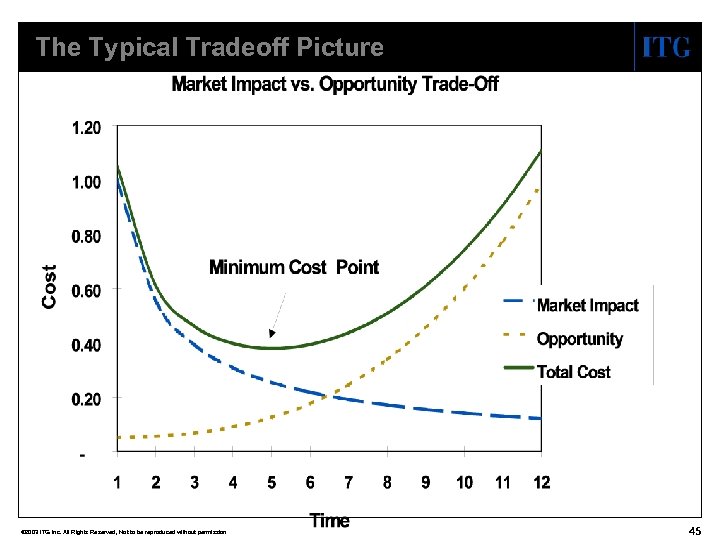 The Typical Tradeoff Picture © 2003 ITG Inc. All Rights Reserved, Not to be reproduced without permission 45
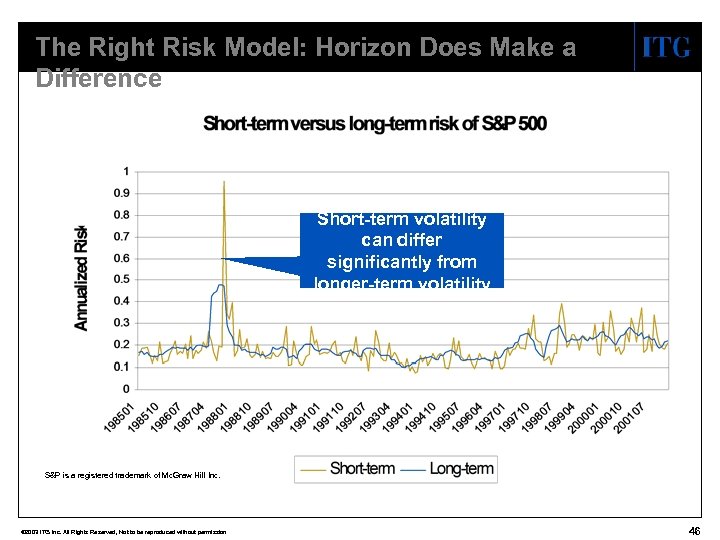 The Right Risk Model: Horizon Does Make a Difference Short-term volatility can differ significantly from longer-term volatility S&P is a registered trademark of Mc. Graw Hill Inc. © 2003 ITG Inc. All Rights Reserved, Not to be reproduced without permission 46
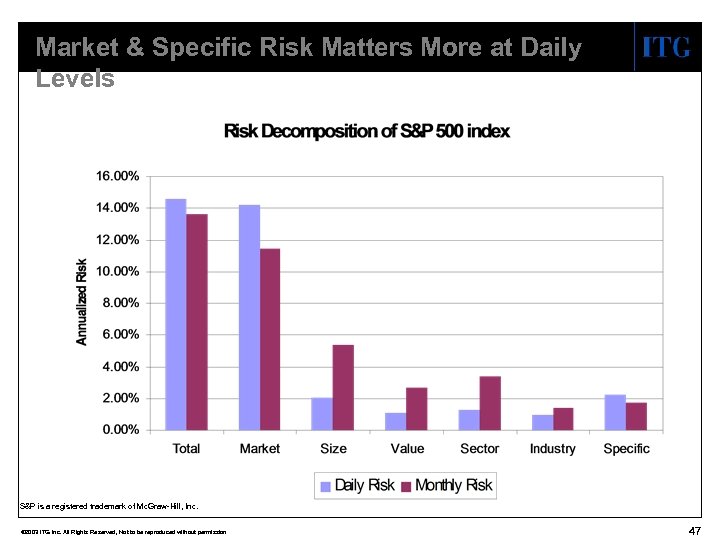 Market & Specific Risk Matters More at Daily Levels S&P is a registered trademark of Mc. Graw-Hill, Inc. © 2003 ITG Inc. All Rights Reserved, Not to be reproduced without permission 47
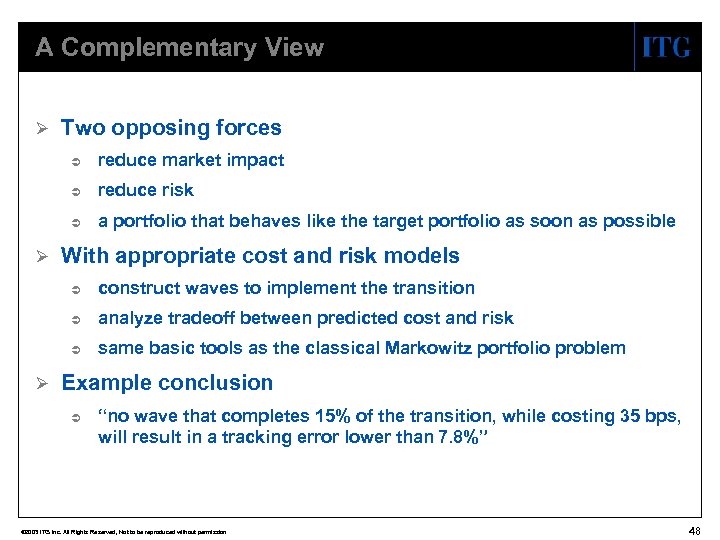 A Complementary View Ø Two opposing forces Ü Ü reduce risk Ü Ø reduce market impact a portfolio that behaves like the target portfolio as soon as possible With appropriate cost and risk models Ü Ü analyze tradeoff between predicted cost and risk Ü Ø construct waves to implement the transition same basic tools as the classical Markowitz portfolio problem Example conclusion Ü “no wave that completes 15% of the transition, while costing 35 bps, will result in a tracking error lower than 7. 8%” © 2003 ITG Inc. All Rights Reserved, Not to be reproduced without permission 48
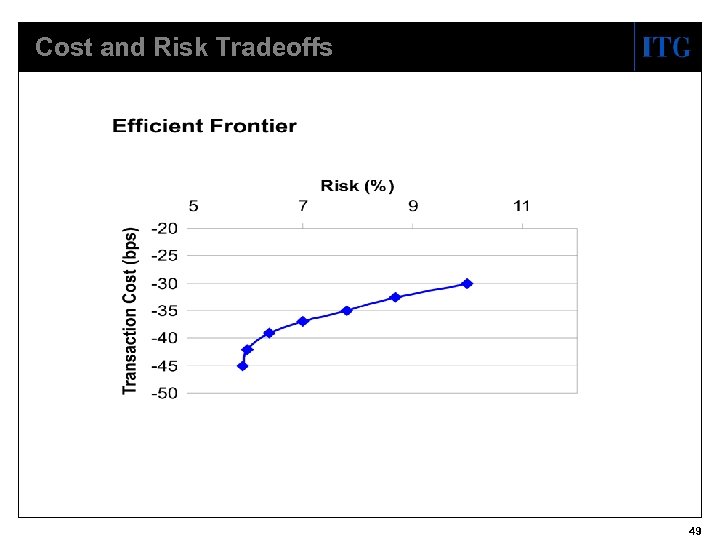 Cost and Risk Tradeoffs 49
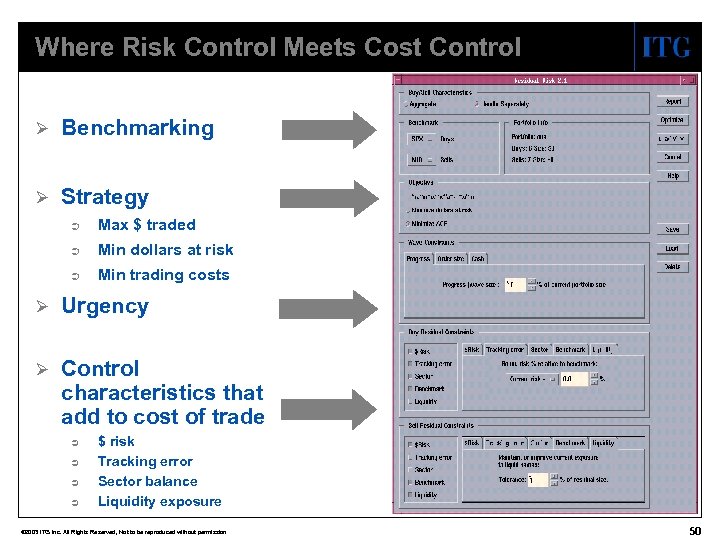 Where Risk Control Meets Cost Control Ø Benchmarking Ø Strategy Ü Max $ traded Ü Min dollars at risk Ü Min trading costs Ø Urgency Ø Control characteristics that add to cost of trade Ü Ü $ risk Tracking error Sector balance Liquidity exposure © 2003 ITG Inc. All Rights Reserved, Not to be reproduced without permission 50
 Example Ø This approach was recently used in a $1. 2 billion two-sided transition portfolio with 403 names Ü Ü Ü Original portfolio has aggregate tracking error of 3. 5% Transition instructions permitted the list to be traded in “waves” subject to constraints Analysis shows can trade a 25% “wave” of $307 MM that cuts risk to 2. 7% Trade 81 of the 403 names This wave improves liquidity of residual positions; order size drops from 18. 7% to 14. 7% of average daily volume Successive application yields the optimal transition strategy © 2003 ITG Inc. All Rights Reserved, Not to be reproduced without permission 51