 Скачать презентацию Trans-European healthcare support network for Europe s mobile citizens
631a144a9d0e5ac26ca15dbcec730e39.ppt
- Количество слайдов: 22



Trans-European healthcare support network for Europe’s mobile citizens The Business Case for pan-European Healthcare Support Dr. Karl A. Stroetmann with Alexander Dobrev, Jörg Artmann, Dr. Veli Stroetmann empirica Gesellschaft für Kommunikations- und Technologieforschung mb. H, Bonn, Germany and Hans-Willi Schemken, Heike Au AOK Rheinland-Hamburg, Düsseldorf, Germany 2 nd Conference on European Cooperation in the Health Sector 22. 02. 2008, Basel, Switzerland 1
Contents 1. Responding to user needs 2. The beginnings: cross border health care 3. The business case: servicing clients wherever they are in Europe 4. A socio-economic impact assessment of the service 5. Outlook: Developing the business case further and expanding the service AEBR Basel, Feb. 22, 2008 2
1. Mobility of European citizens: responding to user needs n Travelling abroad has become a natural part of life for many, if not most European citizens n Growing demand for healthcare services abroad: In border areas like, e. g. , Belgium, Netherlands, Germany (10 s of thousands patients annually) In holiday areas and beyond: about 400 million visits to other European countries in 2006 (vacation; work; study; retirement) n Experience from 15 years of services to meet this demand: Citizens do not travel abroad for treatment, if good quality services are available at home Citizens do not go on holidays just to obtain treatment abroad BUT Citizens want to be sure to be treated properly in case of illness when in another Union Member State AEBR Basel, Feb. 22, 2008 3
Current demand for healthcare abroad: available evidence n Commission staff working paper (SEC 2003/900) In Austria, the number of patients voluntarily travelling abroad each year to receive care: 58, 000 Belgium accepted 14, 000 patients from other Member States in 2000 – in particular from the Netherlands, Luxembourg, and Italy France treated 436, 000 persons under the E-111 and E 112 forms in 2001, giving rise to claims totalling € 300 m In Italy and Luxembourg, annual requests for treatment abroad (E 112) exceed 10. 000 AEBR Basel, Feb. 22, 2008 4
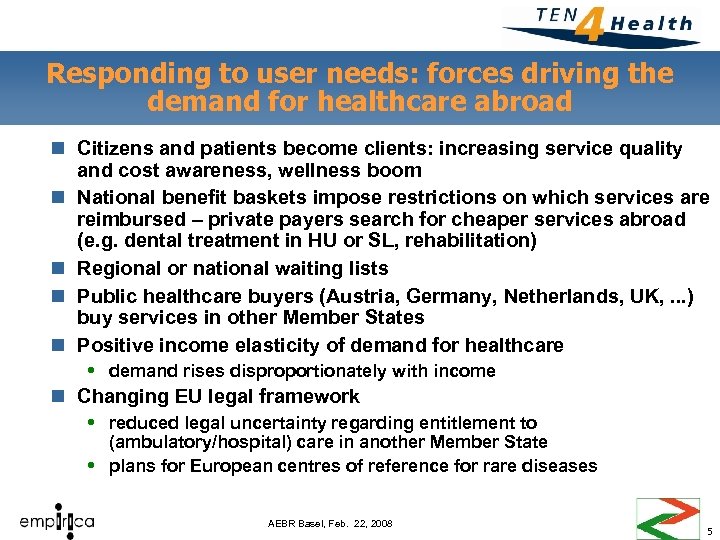
Responding to user needs: forces driving the demand for healthcare abroad n Citizens and patients become clients: increasing service quality and cost awareness, wellness boom n National benefit baskets impose restrictions on which services are reimbursed – private payers search for cheaper services abroad (e. g. dental treatment in HU or SL, rehabilitation) n Regional or national waiting lists n Public healthcare buyers (Austria, Germany, Netherlands, UK, . . . ) buy services in other Member States n Positive income elasticity of demand for healthcare demand rises disproportionately with income n Changing EU legal framework reduced legal uncertainty regarding entitlement to (ambulatory/hospital) care in another Member State plans for European centres of reference for rare diseases AEBR Basel, Feb. 22, 2008 5
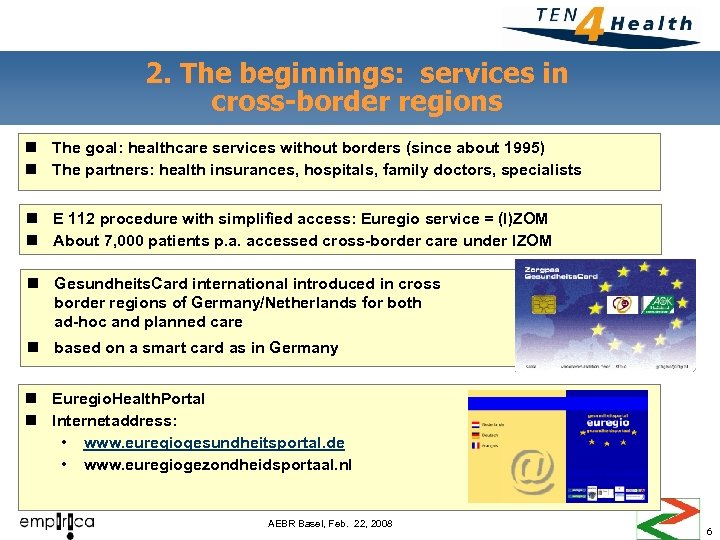
2. The beginnings: services in cross-border regions n The goal: healthcare services without borders (since about 1995) n The partners: health insurances, hospitals, family doctors, specialists n E 112 procedure with simplified access: Euregio service = (I)ZOM n About 7, 000 patients p. a. accessed cross-border care under IZOM n Gesundheits. Card international introduced in cross border regions of Germany/Netherlands for both ad-hoc and planned care n based on a smart card as in Germany n Euregio. Health. Portal n Internetaddress: • www. euregiogesundheitsportal. de • www. euregiogezondheidsportaal. nl AEBR Basel, Feb. 22, 2008 6
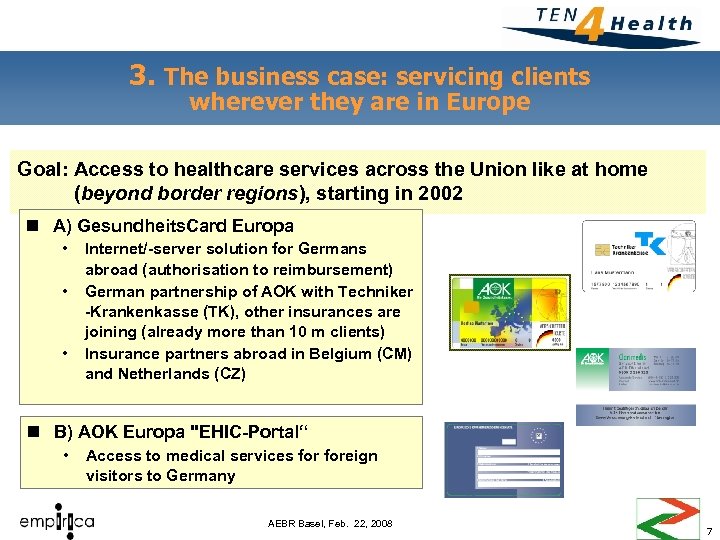
3. The business case: servicing clients wherever they are in Europe Goal: Access to healthcare services across the Union like at home (beyond border regions), starting in 2002 n A) Gesundheits. Card Europa • • • Internet/-server solution for Germans abroad (authorisation to reimbursement) German partnership of AOK with Techniker -Krankenkasse (TK), other insurances are joining (already more than 10 m clients) Insurance partners abroad in Belgium (CM) and Netherlands (CZ) n B) AOK Europa "EHIC-Portal“ • Access to medical services foreign visitors to Germany AEBR Basel, Feb. 22, 2008 7
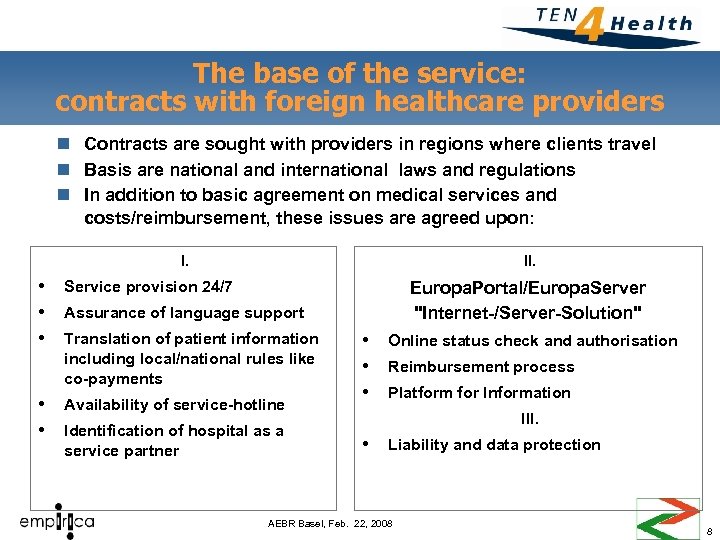
The base of the service: contracts with foreign healthcare providers n Contracts are sought with providers in regions where clients travel n Basis are national and international laws and regulations n In addition to basic agreement on medical services and costs/reimbursement, these issues are agreed upon: I. II. Service provision 24/7 Europa. Portal/Europa. Server "Internet-/Server-Solution" Assurance of language support Translation of patient information including local/national rules like co-payments Availability of service-hotline Identification of hospital as a service partner Online status check and authorisation Reimbursement process Platform for Information III. Liability and data protection AEBR Basel, Feb. 22, 2008 8
Gesundheits. Card "Europa" – The administrative process Assuring service provision: n Citizen presents Health. Card "Europa" at a partner hospital n Verification via a firewall protected data repository Health insurance number (input: hospital administration) and birth date (input by the patient, as his PIN) n Immediate online confirmation and authorisation via Internet connection Reimbursement process: n Partner hospital submits claims to national health insurance (e. g. in NL und B = “virtual AOK” represented by a national [public] health insurance partners CZ and CM) Alternatively: n reimbursement process directly with AOK/TK (e. g. Austria and Italy) n Exchange of administrative data with AOK/TK via a Web-based solution AEBR Basel, Feb. 22, 2008 9
Experience so far supports the business case n High acceptance by citizens because assured quality services when suddenly in need while abroad very limited financial burden (e. g. only standard co-payments in Member State where service is delivered) n Highly motivated partner hospitals deliver excellent health services 100% acceptance of AOK issued insurance cards – GCE/EHIC – by hospitals fast and reliable interoperable electronic reimbursement process fast payment n Competitive advantage for public health insurance company vastly reduced need to reimburse advance cash payments of patients happy customers AEBR Basel, Feb. 22, 2008 10
4. A socio-economic impact assessment of the service: the approach n An economic perspective Benefits and costs – BC Analysis All stakeholders considered n Three analysis periods: Planning and development Implementation Routine operation n Only first level impacts AEBR Basel, Feb. 22, 2008 11
Estimating benefits & costs n According to stakeholders: Citizens Healthcare providers and their organisations (HPO) Third party payers n Benefits - improvement of: Quality: five factors Access: spatial, social inclusion, other barriers Overall economic efficiency n Costs: Investment (planning, implementation) Change management Sustained operation AEBR Basel, Feb. 22, 2008 12
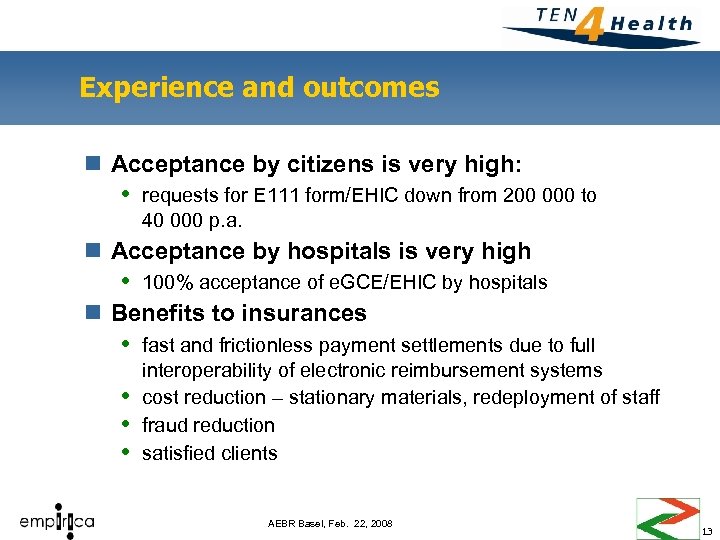
Experience and outcomes n Acceptance by citizens is very high: requests for E 111 form/EHIC down from 200 000 to 40 000 p. a. n Acceptance by hospitals is very high 100% acceptance of e. GCE/EHIC by hospitals n Benefits to insurances fast and frictionless payment settlements due to full interoperability of electronic reimbursement systems cost reduction – stationary materials, redeployment of staff fraud reduction satisfied clients AEBR Basel, Feb. 22, 2008 13
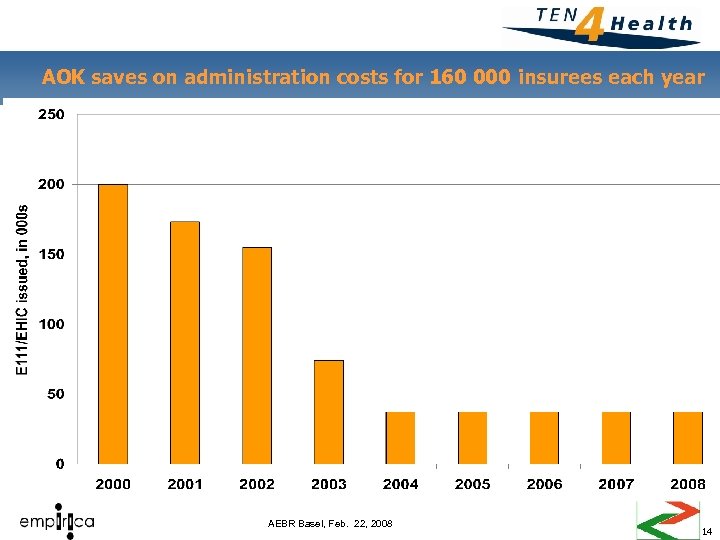
AOK saves on administration costs for 160 000 insurees each year AEBR Basel, Feb. 22, 2008 14
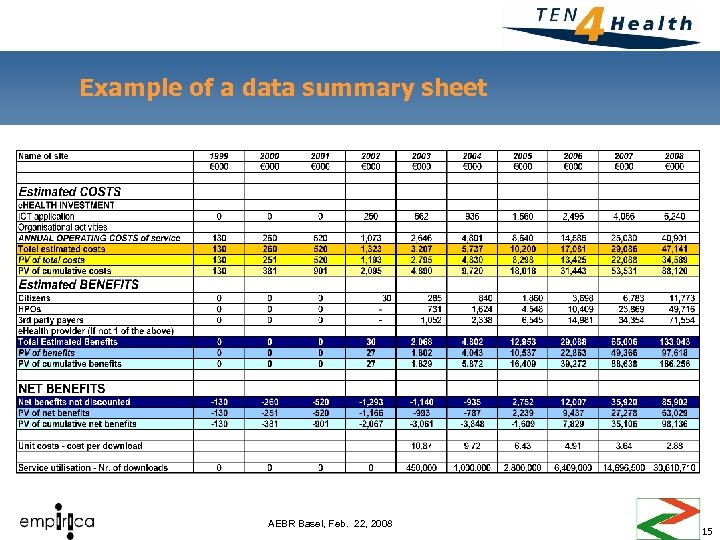
Example of a data summary sheet AEBR Basel, Feb. 22, 2008 15
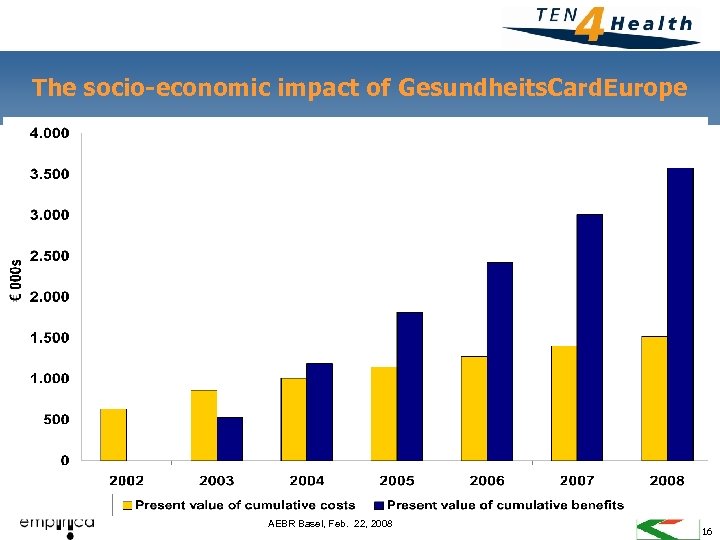
The socio-economic impact of Gesundheits. Card. Europe AEBR Basel, Feb. 22, 2008 16
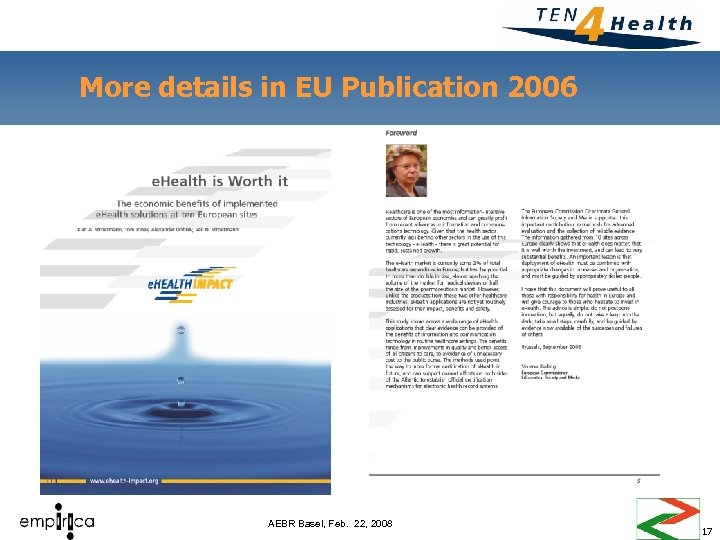
More details in EU Publication 2006 AEBR Basel, Feb. 22, 2008 17
5. Outlook: Developing the business case further and expanding the service n Supported by the e. TEN Programme of the European Commission: Market Validation project n Proposal very well evaluated (First place out of more than 100) n Duration: June 2007 – May 2009 n Systematic assessment and validation of current services and work processes n Improvement and extension to Italy Austria Czech Republic other countries will follow n Piloting application with direct web-services exchange via the Dutch Vecozo system n Piloting use of EHIC n Development of a Business and Deployment Plan AEBR Basel, Feb. 22, 2008 18
Forecasting future demand: who? n Mobile workers a currently underdeveloped market n Mobile citizens members of the age groups between 25 and 44 are the dominant travellers share of older tourists increasing n Residential tourists wealthy elderly owning houses abroad, „snow birds“, retirement villages n Wellness and healthcare tourists depending on development of national benefit baskets and price differences (e. g. dental treatment, rehabilitation) n Difficult to find reliable data AEBR Basel, Feb. 22, 2008 19
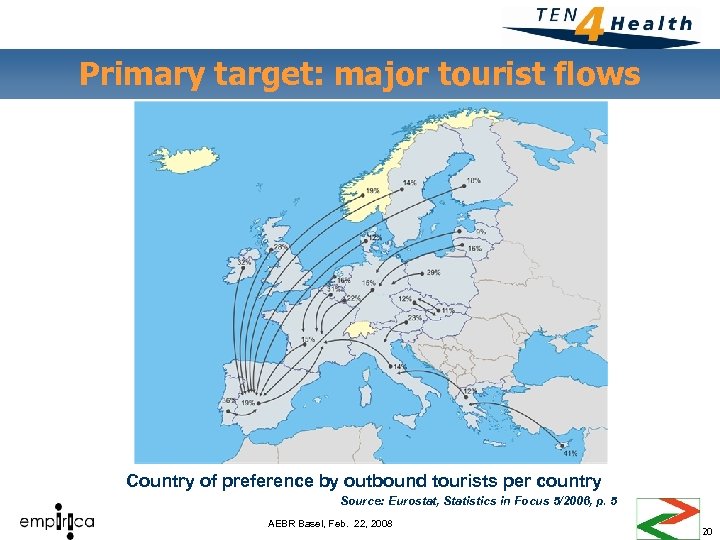
Primary target: major tourist flows Country of preference by outbound tourists per country Source: Eurostat, Statistics in Focus 5/2006, p. 5 AEBR Basel, Feb. 22, 2008 20
Forecasting future demand: how many? The potential demand is very high and expected to grow: n 21 million supplemental health insurance policies for travel abroad were sold in Germany in 2006 (i. e. 1 for every 4 th citizen – 25%) n In 2004: more than 417 m trips lasting five days (four nights) or more were undertaken by European citizens of which approximately 180 million abroad (Eurostat 2006) n If only 3% of these potential clients are in actual need of medical care (figures from AOK), then there are n more than 5 m foreign patient clients across Europe AEBR Basel, Feb. 22, 2008 21
Thank you for your attention ! For further information: AOK Rheinland – die Gesundheitskasse Kasernenstraße 61 D-40213 Düsseldorf, Germany www. aokrheinland. de Heike (dot) Au (at) rh (dot) aok (dot) de empirica Communication and Technology Research Oxfordstraße 2 D-53111 Bonn, Germany www. empirica. com www. ten 4 health. eu ten 4 health (at) empirica (dot) com AEBR Basel, Feb. 22, 2008 22
Скачать презентацию Trans-European healthcare support network for Europe s mobile citizens
631a144a9d0e5ac26ca15dbcec730e39.ppt