


 Скачать презентацию Training on Trial The Urgent Need to Meet
ed9fd60d8c57ac4fdbdea0ad24a4f729.ppt
- Количество слайдов: 25
 Training on Trial: The Urgent Need to Meet the Needs of the Business Jim Kirkpatrick , Ph. D Wendy Kayser Kirkpatrick © 2009, all rights reserved.
 These slides are provided as a courtesy to those who have attended one of our classes or presentations. These are for internal use within your organization only; all rights reserved. We thank you in advance for respecting our intellectual property and refraining from duplicating, distributing, selling, or otherwise using this presentation in whole or part for your own profit or promotion. The following marks are the property of Kirkpatrick Partners, LLC : The Kirkpatrick Business Partnership Model. SM, KBPMSM, Return on Expectations. SM, ROESM, and Chain of Evidence. SM © 2009, all rights reserved.
 The future of training “Training directors might be well advised to take the initiative and evaluate their programs before the day of reckoning arrives” - From Techniques for Evaluating Training Programs, by Don Kirkpatrick - ASTD Journal, November, 1959 © 2009, all rights reserved.
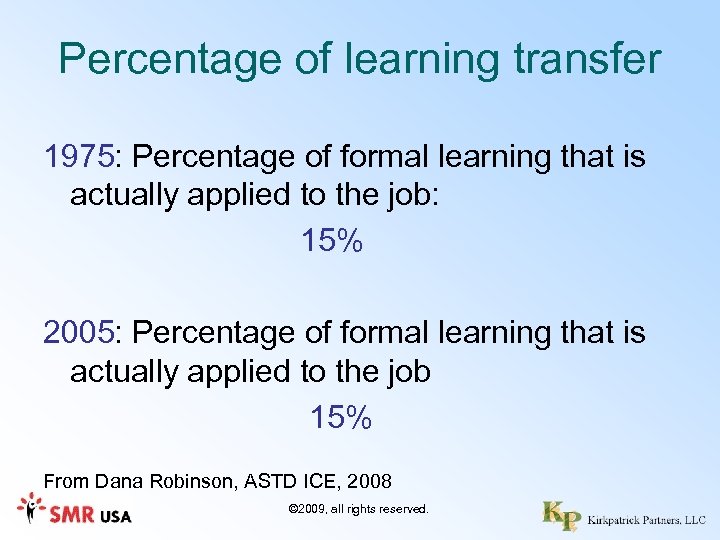 Percentage of learning transfer 1975: Percentage of formal learning that is actually applied to the job: 15% 2005: Percentage of formal learning that is actually applied to the job 15% From Dana Robinson, ASTD ICE, 2008 © 2009, all rights reserved.
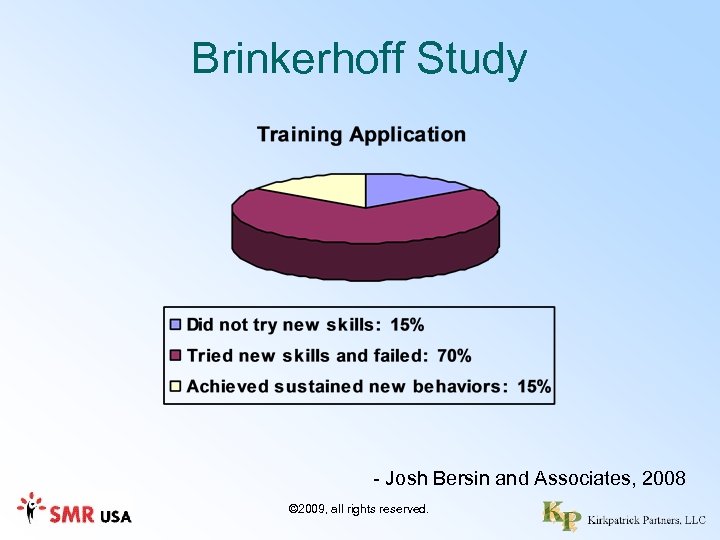 Brinkerhoff Study - Josh Bersin and Associates, 2008 © 2009, all rights reserved.
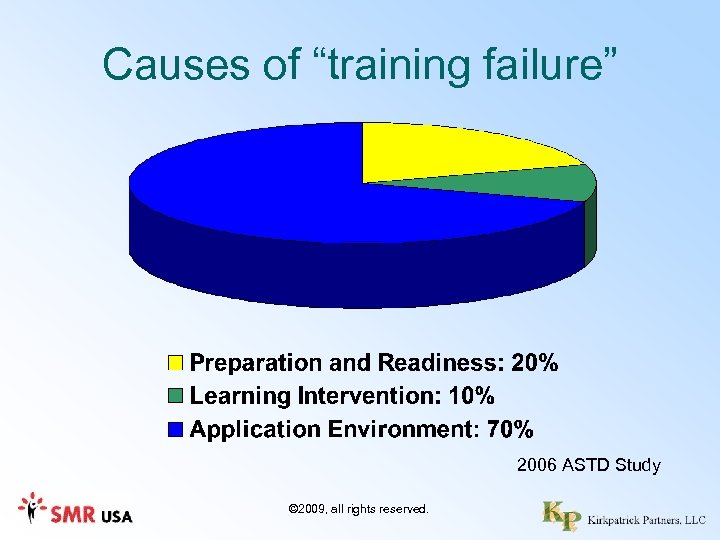 Causes of “training failure” 2006 ASTD Study © 2009, all rights reserved.
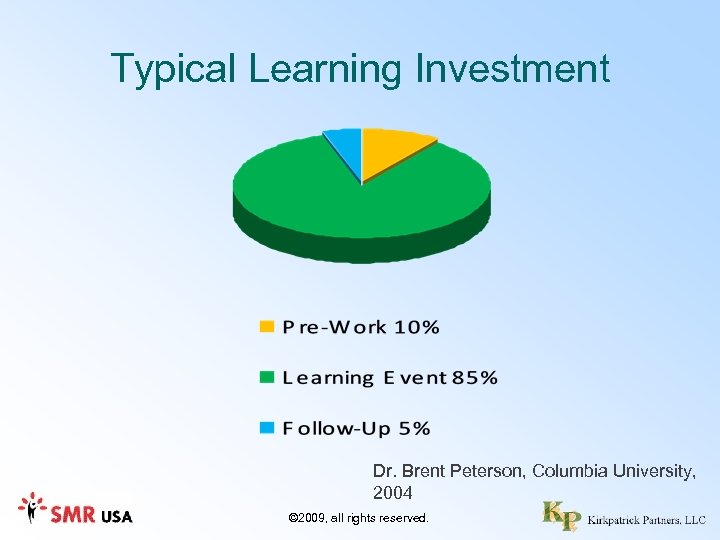 Typical Learning Investment Dr. Brent Peterson, Columbia University, 2004 © 2009, all rights reserved.
 “What is your job here at the hotel? ” “I am a window washer. ” © 2009, all rights reserved.
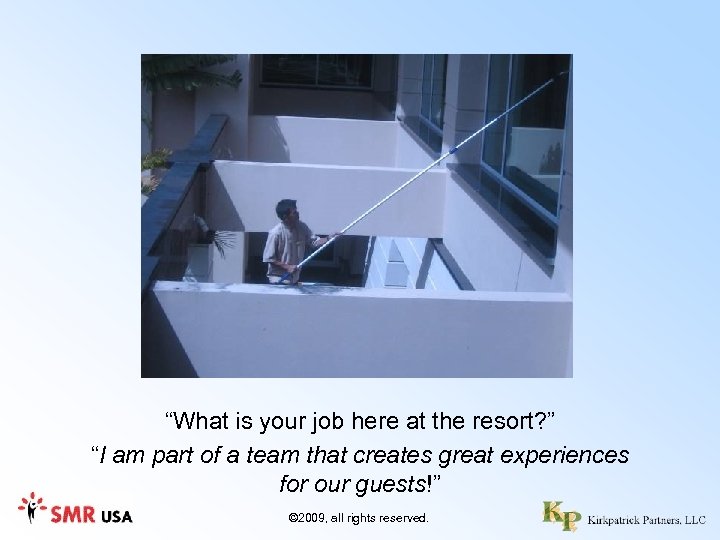 “What is your job here at the resort? ” “I am part of a team that creates great experiences for our guests!” © 2009, all rights reserved.
 © 2009, all rights reserved.
 What will we have to do to be found “not guilty”? We need to extend our role beyond the traditional definitions of learning. • • • Our expertise Our involvement Our influence Our impact Our value © 2009, all rights reserved.
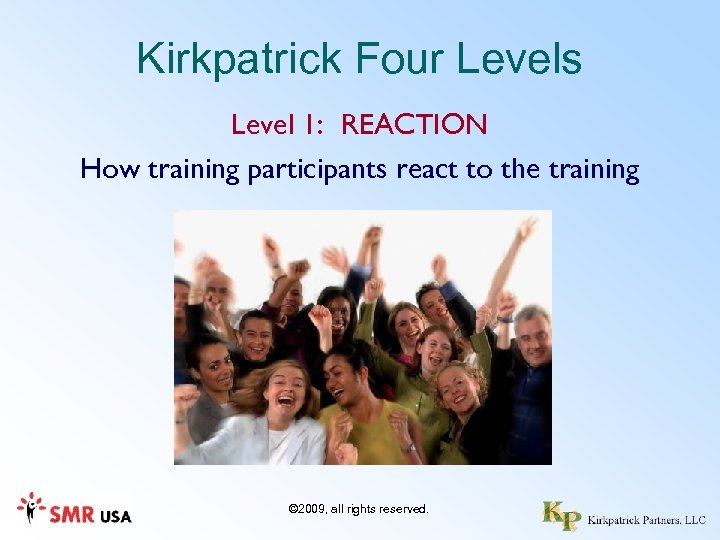 Kirkpatrick Four Levels Level 1: REACTION How training participants react to the training © 2009, all rights reserved.
 Kirkpatrick Four Levels Level 2: LEARNING To what degree participants acquire intended knowledge, skills, and attitudes based on participation in learning event © 2009, all rights reserved.
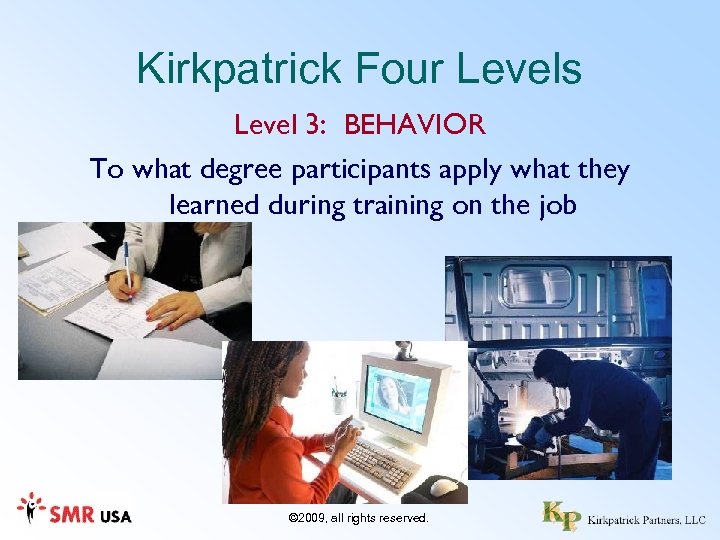 Kirkpatrick Four Levels Level 3: BEHAVIOR To what degree participants apply what they learned during training on the job © 2009, all rights reserved.
 Kirkpatrick Four Levels Level 4: RESULTS The final outcomes that occur as a result of the training © 2009, all rights reserved.
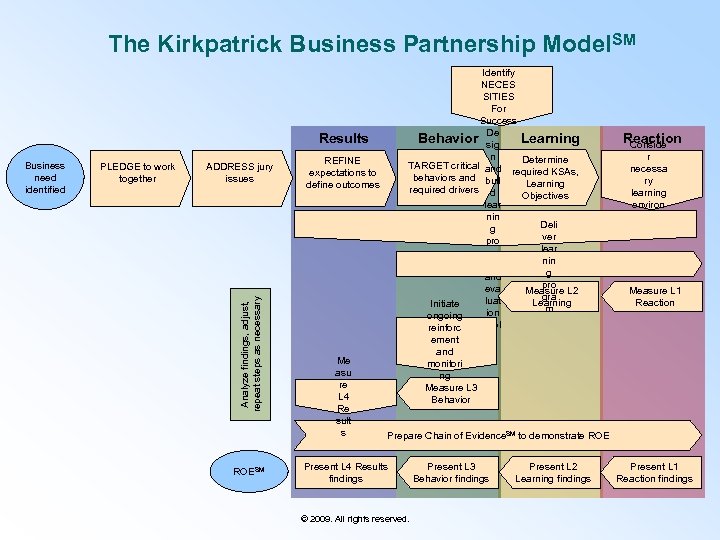 The Kirkpatrick Business Partnership Model. SM Identify NECES SITIES For Success De Behavior sig Learning n Determine TARGET critical and required KSAs, behaviors and buil Learning required drivers d Objectives lear nin Deli g ver pro lear gra nin m g and pro eva Measure L 2 gra luat Learning Initiate m ion ongoing tool reinforc s ement and monitori ng Measure L 3 Behavior Results PLEDGE to work together ADDRESS jury issues Analyze findings, adjust, repeat steps as necessary Business need identified ROESM REFINE expectations to define outcomes Me asu re L 4 Re sult s Reaction Conside r necessa ry learning environ ment Measure L 1 Reaction Prepare Chain of Evidence. SM to demonstrate ROE Present L 4 Results findings © 2009. All rights reserved. Present L 3 Behavior findings Present L 2 Learning findings Present L 1 Reaction findings
 Kirkpatrick Four Level Evaluation major principles 1. 2. 3. 4. 5. The end is the beginning ROESM is the ultimate indicator of value Business partnership is key Value must be created first Demonstrate value through a compelling Chain of Evidence. SM © 2009, all rights reserved.
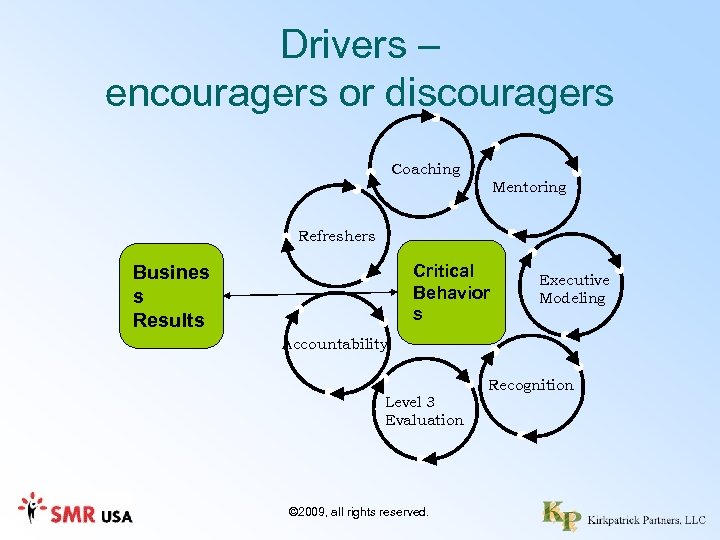 Drivers – encouragers or discouragers Coaching Mentoring Refreshers Critical Behavior s Busines s Results Executive Modeling Accountability Recognition Level 3 Evaluation © 2009, all rights reserved.
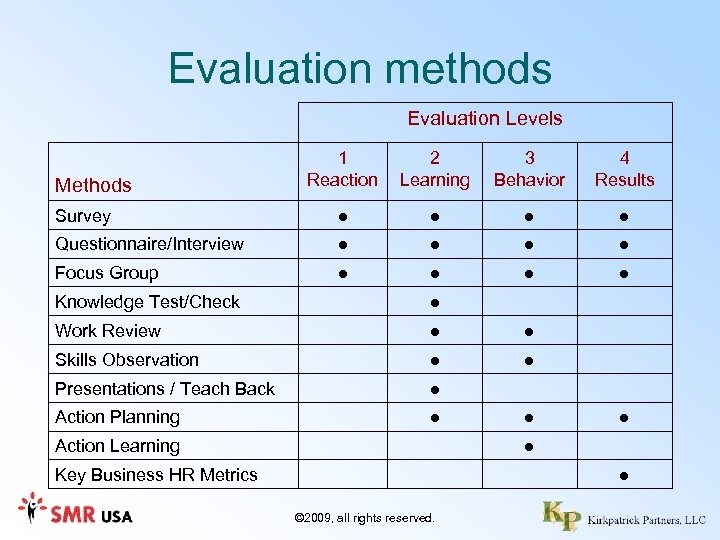 Evaluation methods Evaluation Levels 1 Reaction 2 Learning 3 Behavior 4 Results Survey ● ● Questionnaire/Interview ● ● Focus Group ● ● Methods Knowledge Test/Check ● Work Review ● ● Skills Observation ● ● Presentations / Teach Back ● Action Planning ● Action Learning ● ● ● Key Business HR Metrics ● © 2009, all rights reserved.
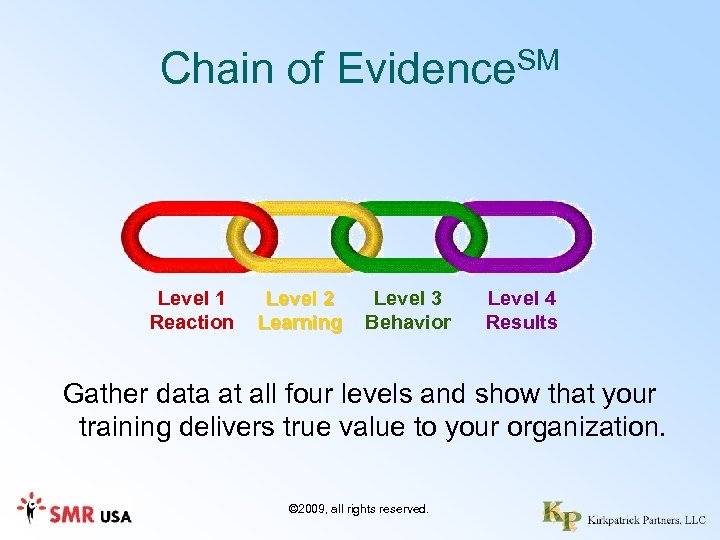 Chain of Evidence. SM Level 1 Reaction Level 2 Learning Level 3 Behavior Level 4 Results Gather data at all four levels and show that your training delivers true value to your organization. © 2009, all rights reserved.
 Four Practical Ways to Increase Training Effectiveness and Lower Costs 1. Show them the data 2. Conduct an impact study and showcase it 3. Review your training curriculum 4. Redeploy your resources to create leverage © 2009, all rights reserved.
 More Information and Support • We offer the following resources to organizations who want to ensure training provides true business value: – Consulting – Impact studies – In-house 2 -day certification program • We also offer: – 2 -day certification program public sessions – Books, articles, and white papers © 2009, all rights reserved.
 Seminar Hosting • Interested in hosting a Kirkpatrick seminar? – Hosting organizations receive free seats in the seminar (in exchange for providing a venue and marketing support) – For full details, please contact Jim or Wendy © 2009, all rights reserved.
 Contact • Jim Kirkpatrick www. smr-usa. com jim. kirkpatrick@smr-usa. com (317) 402 -3882 • Wendy Kirkpatrick www. kirkpatrickpartners. com wendy. kirkpatrick@kirkpatrickpartners. com (314) 961 -4848 © 2009, all rights reserved.
 References • Kirkpatrick, D. L. and J. D. Evaluating Training Programs, 3 rd Ed. , Berrett-Koehler Publ. , Inc. San Francisco, CA, 2006 • Kirkpatrick, D. L. and J. D. Transferring Learning to Behavior, Berrett-Koehler Publ. , San Francisco, CA, 2005 • Kirkpatrick, D. L. and J. D. Implementing the Four Levels, Berrett-Koehler Publ. , San Francisco, CA, 2007 • Kirkpatrick, J. K. , and W. K. Kirkpatrick Then and Now: A Strong Foundation For the Future, Kirkpatrick Publishing, St. Louis, MO, 2009 • Kirkpatrick, J. K. , and W. K. Training on Trial, AMACOM, New York, 2010 © 2009, all rights reserved.