


 Скачать презентацию Training of police officers in Sweden -the development
ecc41ca00315b949b5005ea92365ad5d.ppt
- Количество слайдов: 24
 Training of police officers in Sweden -the development of interview behaviour Professor Ann-Christin Cederborg Department of Child and Youth Studies, Stockholm University, Sweden
 New area in Swedish police training • In 2007 the National Swedish Police Board assigned the police academy in Stockholm to develop a training program for police officers • Professor Ann-Christin Cederborg has been responsible for six different courses during fall 2007 spring 2010 together with detective superintendent Birgitta Engberg. 2010 Ann-Christin Cederborg
 Reason for this bid • Police officers in Sweden have been criticized by judges, prosecutors, psychologists and social workers for their undeveloped interview practice with children. • Previous research findings mostly from Sweden but also from studies of forensic interviewing in other countries may also have influenced the government’s ambition to financially support interview training of police officers. • Police officers have also asked for further training in how to interview children 2010 Ann-Christin Cederborg
 Previous findings • Police officers seldom use open questions when interviewing alleged child witnesses. • Instead they to a large extent use option posing and suggestive questions • Even previously trained police officers in Sweden relied heavily on option posing and suggestive questions 2010 Ann-Christin Cederborg
 The need of a ”new” training program • The training program should enhance the quality of information provided by young victims. • The new Swedish training program was inspired by NICHD protocol where the police officers are trained to structurally ask as many invitations as possible through out the interview • and the PEACE model specifically in terms of how to evaluate performances 2010 Ann-Christin Cederborg
 The training is number two out of a three step program • Step one and two are university based courses. • The first course is mainly focused on crime, law, basic knowledge in developmental psychology and power relations discussed from a sociological perspective. • The police officers are introduced to open questioning in investigative interviewing of children at the end of this course. • Police officers attending course number two, which is specifically focused on interview practices with children, are supposed to have general knowledge about recommended practices in how to interview children. 2010 Ann-Christin Cederborg
 Investigative interviewing of child witnesses • The second step is focused on investigative interviewing both theoretically and practically. 2010 Ann-Christin Cederborg
 Participation • Both in the first and second course the police officers have to participate three full days each month during a period of half a year at the police academy • Between courses they are supposed to read prescribed literature, books and articles in order to manage their homework 2010 Ann-Christin Cederborg
 The third step • It is a “check up” course where staff from the Police Academy updates police officers about recent research findings and give feedback and supervision on interviews performed by the attending police officers. • Police officers can attend this course a year after they have finished the second interview course and it proceeds intensively during one week. 2010 Ann-Christin Cederborg
 This study • This evaluation is about the second course where the police officers are specifically focused on interviewing child witnesses. • It is a study of how police officers developed their interview capacity in five different courses during fall 2007 -fall 2009. 2010 Ann-Christin Cederborg
 Teaching • It is interdisciplinary in terms of developmental psychology, investigative interviewing and law • Most lectures are about research findings and international recommendations in how to accomplish best possible interview practice. 2010 Ann-Christin Cederborg
 Training • The police officers are given continues supervision and feedback on simulated as well as actual forensic interviews. • The simulated interviews involve role play where they act as either a police officer or an alleged child witness • Police officers write three different papers related to litterateur and previous given lectures. • The feed back on at least three different interviews with child witnesses involves codes for question types, structure and comments on how they can change their question style according to recommended open questions. • Feedback on words used in relation to the children’s age and possible diagnose is also given 2010 Ann-Christin Cederborg
 The development of police officers • They are checked at least three times during the course. • They send one initital interview before they start the course, one in the middle of the course and one at the end of the course. • The second and third interview should be evaluated by each police officer and attached to the interview sent in. • The quality of the last interview is the base unit for the final assessment of the police officers achievement. • If they do not reach an acceptable standard they do not pass the course. Then they have to produce further investigative interviews until they can show an acceptable structure of an interview and are able to use invitations and avoid contaminating question types. 2010 Ann-Christin Cederborg
 Data • Between September 2007 and December 2009, 86 police officers have passed the course “Investigative interviewing with children” • When evaluating the police officers results we used their first coded interview as a baseline because it was performed before the course started. • We compared the results with their last performed interview • Sixty nine police officers were approved a certificate after coding their third interview, 17 police officers had to perform four interviews and three police officers made five interviews before they passed the course 2010 Ann-Christin Cederborg
 Coding of question types and structure • The coding of question types and structure from 3 courses performed between 2007 -2008 was made by me. I was a reliable coder by training through staff at National Institute of Child Health and Human Development (NICHD), NIH, Bethesda, USA. • During fall 2008 Birgitta Engberg was trained in how to code question types and structure in investigative interviews. In January 2009, when inter-reliability was 95%, Engberg became the main coder of the remaining two courses in investigative interviewing. • Research assistant Djaildes Lima da Silva Nises calculated the results from all the 172 interviews and senior lecturer Charlotte Alm made all the statistics by using SPSS and Analysis of Variance (ANOVA). 2010 Ann-Christin Cederborg
 Data • Because of ethical reasons we did not have access to data from the preliminary investigations • We did not compare with age because we do not know the ages of 117 out of the 172 involved children, neither possible diagnosis and circumstances surrounding each case • From the transcribed interviews we could recognise possible perpetrator, type of crime, gender of the child and the police officer 2010 Ann-Christin Cederborg
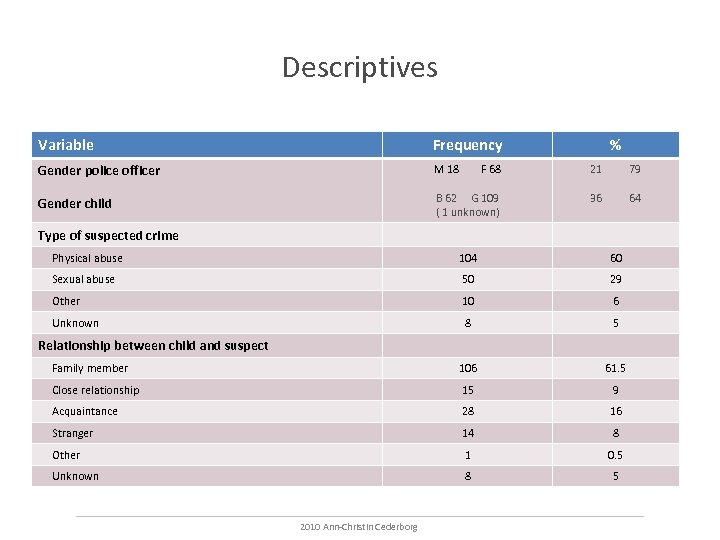 Descriptives Variable Frequency % Gender police officer M 18 F 68 21 79 Gender child B 62 G 109 ( 1 unknown) 36 64 Type of suspected crime Physical abuse 104 60 Sexual abuse 50 29 Other 10 6 Unknown 8 5 Family member 106 61. 5 Close relationship 15 9 Acquaintance 28 16 Stranger 14 8 Other 1 0. 5 Unknown 8 5 Relationship between child and suspect 2010 Ann-Christin Cederborg
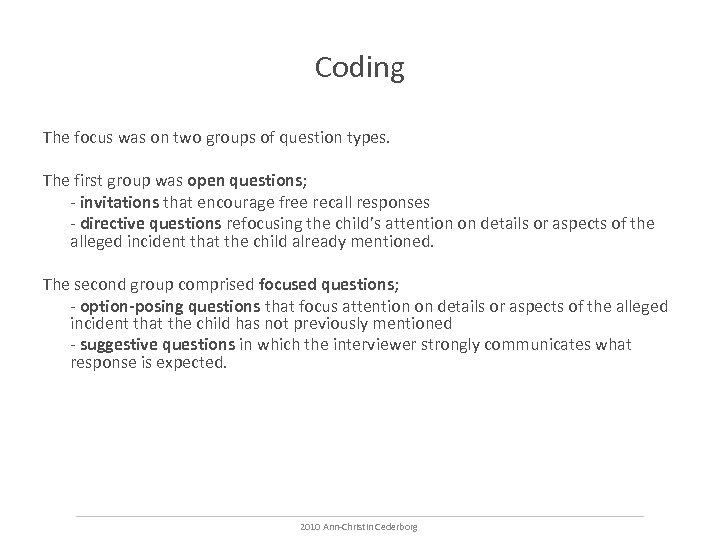 Coding The focus was on two groups of question types. The first group was open questions; - invitations that encourage free recall responses - directive questions refocusing the child’s attention on details or aspects of the alleged incident that the child already mentioned. The second group comprised focused questions; - option-posing questions that focus attention on details or aspects of the alleged incident that the child has not previously mentioned - suggestive questions in which the interviewer strongly communicates what response is expected. 2010 Ann-Christin Cederborg
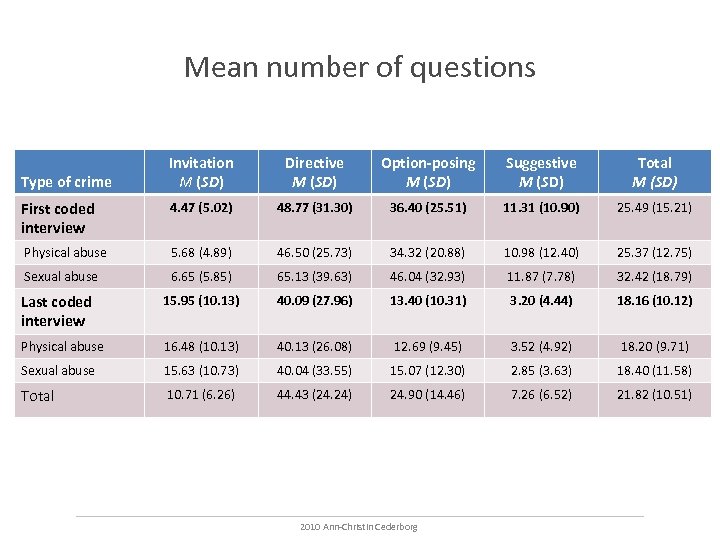 Mean number of questions Invitation M (SD) Directive M (SD) Option-posing M (SD) Suggestive M (SD) Total M (SD) First coded interview 4. 47 (5. 02) 48. 77 (31. 30) 36. 40 (25. 51) 11. 31 (10. 90) 25. 49 (15. 21) Physical abuse 5. 68 (4. 89) 46. 50 (25. 73) 34. 32 (20. 88) 10. 98 (12. 40) 25. 37 (12. 75) Sexual abuse 6. 65 (5. 85) 65. 13 (39. 63) 46. 04 (32. 93) 11. 87 (7. 78) 32. 42 (18. 79) Last coded interview 15. 95 (10. 13) 40. 09 (27. 96) 13. 40 (10. 31) 3. 20 (4. 44) 18. 16 (10. 12) Physical abuse 16. 48 (10. 13) 40. 13 (26. 08) 12. 69 (9. 45) 3. 52 (4. 92) 18. 20 (9. 71) Sexual abuse 15. 63 (10. 73) 40. 04 (33. 55) 15. 07 (12. 30) 2. 85 (3. 63) 18. 40 (11. 58) Total 10. 71 (6. 26) 44. 43 (24. 24) 24. 90 (14. 46) 7. 26 (6. 52) 21. 82 (10. 51) Type of crime 2010 Ann-Christin Cederborg
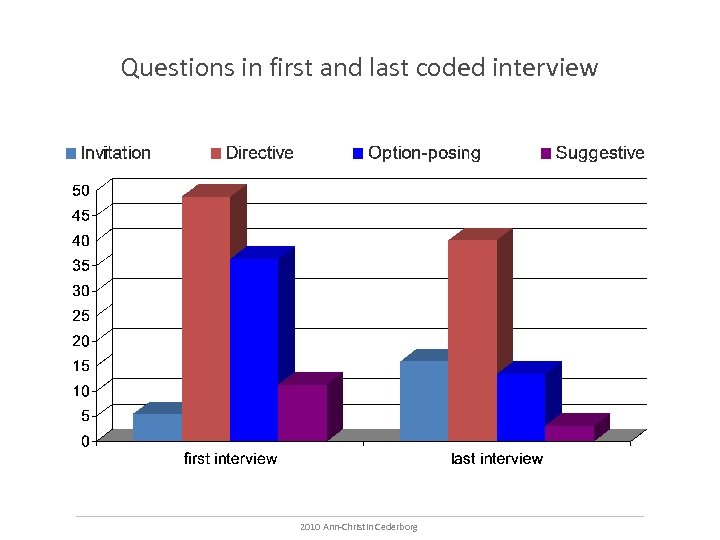 Questions in first and last coded interview 2010 Ann-Christin Cederborg
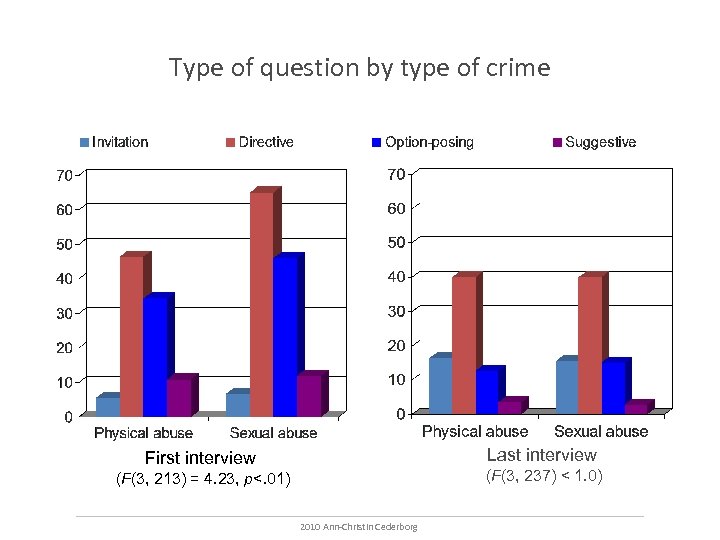 Type of question by type of crime Last interview First interview (F(3, 237) < 1. 0) (F(3, 213) = 4. 23, p<. 01) 2010 Ann-Christin Cederborg
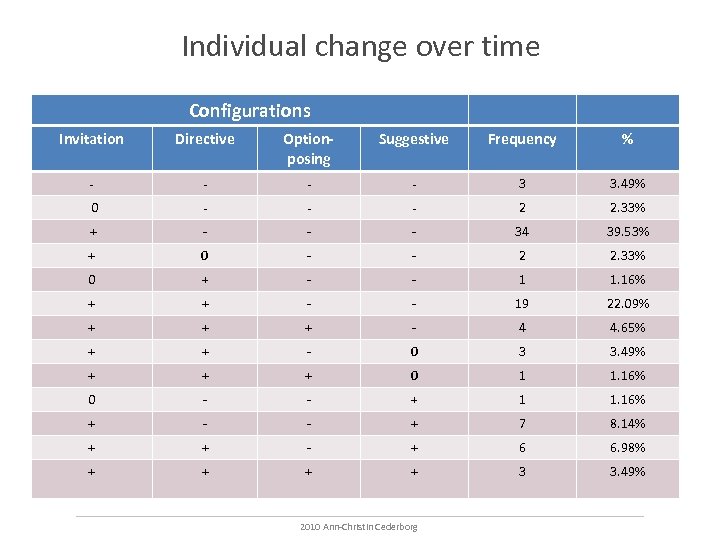 Individual change over time Configurations Invitation Directive Optionposing Suggestive Frequency % - - 3 3. 49% 0 - - - 2 2. 33% + - - - 34 39. 53% + 0 - - 2 2. 33% 0 + - - 1 1. 16% + + - - 19 22. 09% + + + - 4 4. 65% + + - 0 3 3. 49% + + + 0 1 1. 16% 0 - - + 1 1. 16% + - - + 7 8. 14% + + - + 6 6. 98% + + 3 3. 49% 2010 Ann-Christin Cederborg
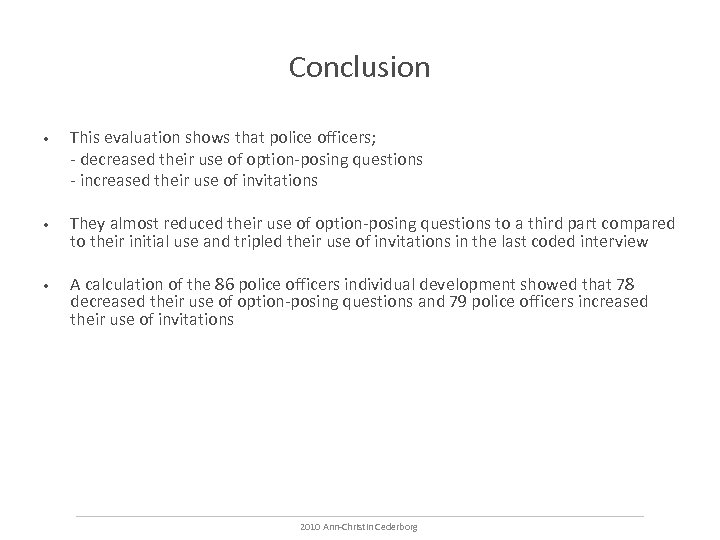 Conclusion • This evaluation shows that police officers; - decreased their use of option-posing questions - increased their use of invitations • They almost reduced their use of option-posing questions to a third part compared to their initial use and tripled their use of invitations in the last coded interview • A calculation of the 86 police officers individual development showed that 78 decreased their use of option-posing questions and 79 police officers increased their use of invitations 2010 Ann-Christin Cederborg
 Acknowledgment The authors are grateful to Birgitta Engberg for her work in the initial phase of the data collection procedure and the police officers who so generously provided their interviews for the analysis of this study. 2010 Ann-Christin Cederborg