


 Скачать презентацию TRAINING IN SURGERY IN GREECE George N Zografos
bf6eeb78f1255f3e8afdd135e51dc6f7.ppt
- Количество слайдов: 36
 TRAINING IN SURGERY IN GREECE George N Zografos Consultant Surgeon, Athens General Hospital General Secretary Hellenic Surgical Association National Delegate, UEMS Division of General Surgery
 STATISTICAL DATA • Panhellenic Medical Association • Panhellenic Association NHS Nursing staff • Greek Statistics Authority ( statistics. gr)
 • 64. 003 Doctors ( 38. 508 male, 25. 495 female) • 2. 208 Surgeons • 1125 Surgeons in Athens - Peireus • 1. 143 Members of the Hellenic Surgical Society
 NATIONAL HEALTH SYSTEM • • • 15. 407 3. 161 845 2. 183 1846 31. 567 Doctors Consultants Chairman Staff Grade A Staff Grade B Nursing staff
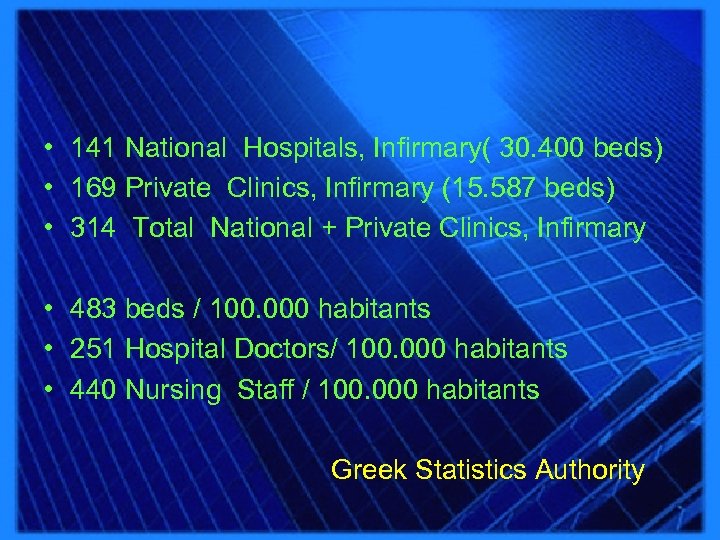 • 141 National Hospitals, Infirmary( 30. 400 beds) • 169 Private Clinics, Infirmary (15. 587 beds) • 314 Total National + Private Clinics, Infirmary • 483 beds / 100. 000 habitants • 251 Hospital Doctors/ 100. 000 habitants • 440 Nursing Staff / 100. 000 habitants Greek Statistics Authority
 CENTRAL STATE CONTROL OF SURGICAL TRAINING • Ministry of Health • Central Committee of Health ( KESY)
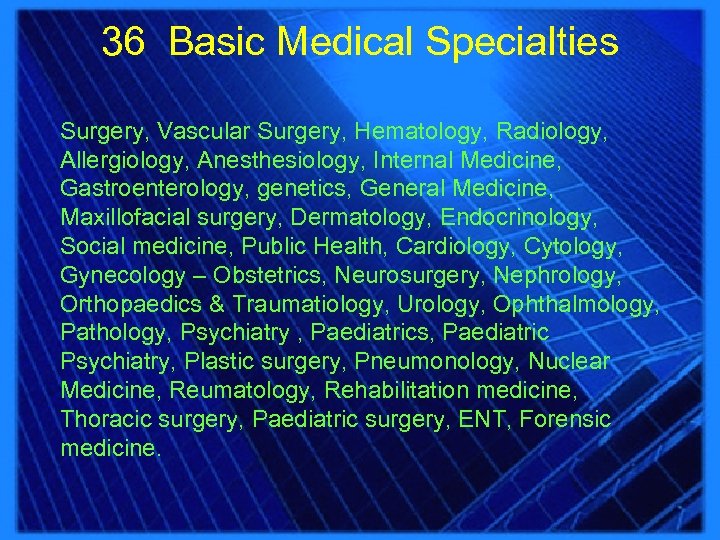 36 Basic Medical Specialties Surgery, Vascular Surgery, Hematology, Radiology, Allergiology, Anesthesiology, Internal Medicine, Gastroenterology, genetics, General Medicine, Maxillofacial surgery, Dermatology, Endocrinology, Social medicine, Public Health, Cardiology, Cytology, Gynecology – Obstetrics, Neurosurgery, Nephrology, Orthopaedics & Traumatiology, Urology, Ophthalmology, Pathology, Psychiatry , Paediatrics, Paediatric Psychiatry, Plastic surgery, Pneumonology, Nuclear Medicine, Reumatology, Rehabilitation medicine, Thoracic surgery, Paediatric surgery, ENT, Forensic medicine.
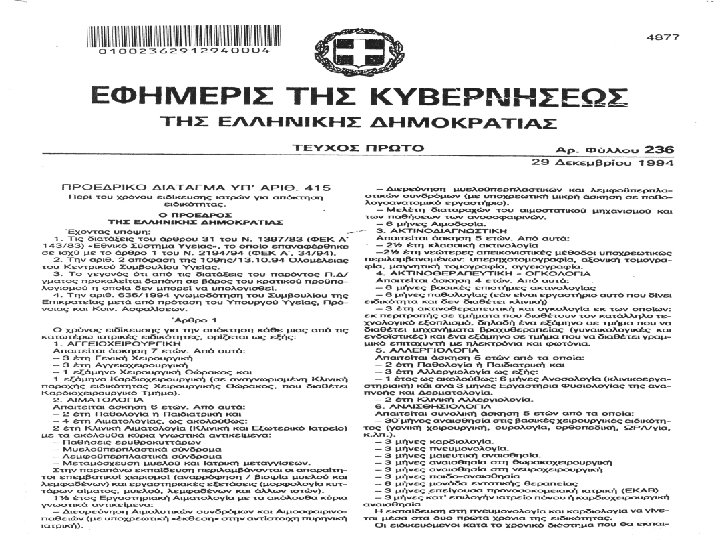
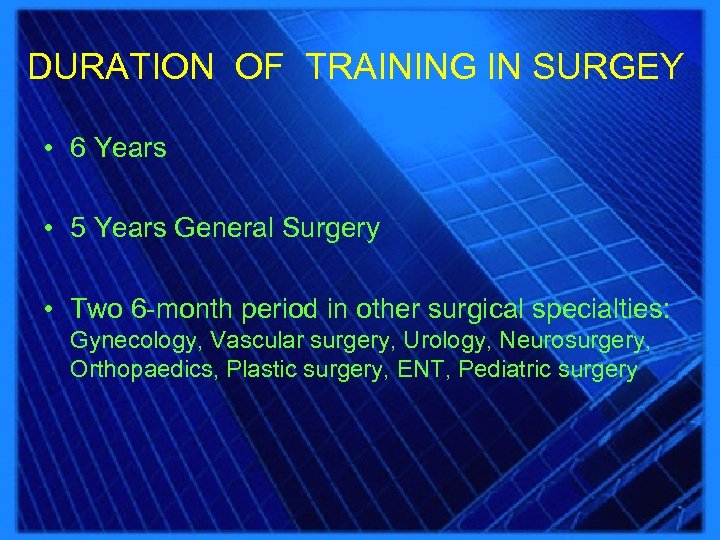 DURATION OF TRAINING IN SURGEY • 6 Years • 5 Years General Surgery • Two 6 -month period in other surgical specialties: Gynecology, Vascular surgery, Urology, Neurosurgery, Orthopaedics, Plastic surgery, ENT, Pediatric surgery
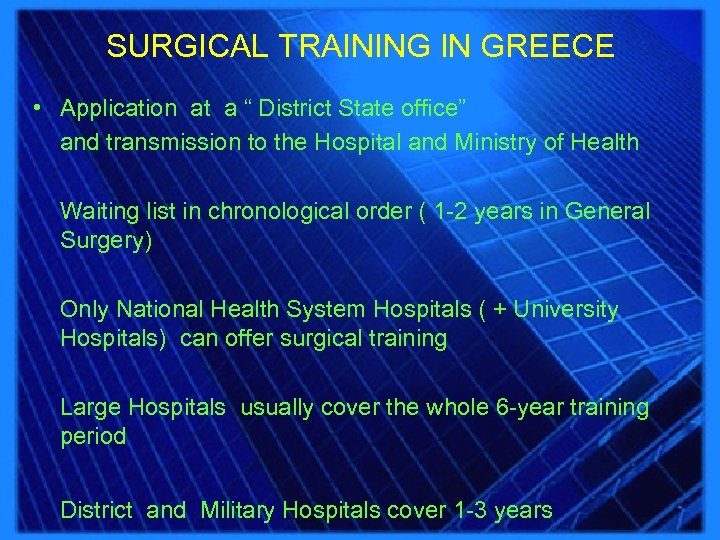 SURGICAL TRAINING IN GREECE • Application at a “ District State office” and transmission to the Hospital and Ministry of Health Waiting list in chronological order ( 1 -2 years in General Surgery) Only National Health System Hospitals ( + University Hospitals) can offer surgical training Large Hospitals usually cover the whole 6 -year training period District and Military Hospitals cover 1 -3 years
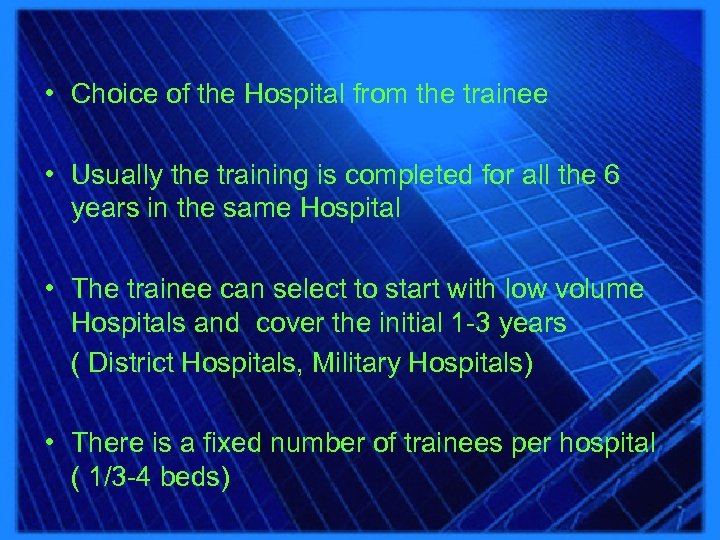 • Choice of the Hospital from the trainee • Usually the training is completed for all the 6 years in the same Hospital • The trainee can select to start with low volume Hospitals and cover the initial 1 -3 years ( District Hospitals, Military Hospitals) • There is a fixed number of trainees per hospital ( 1/3 -4 beds)
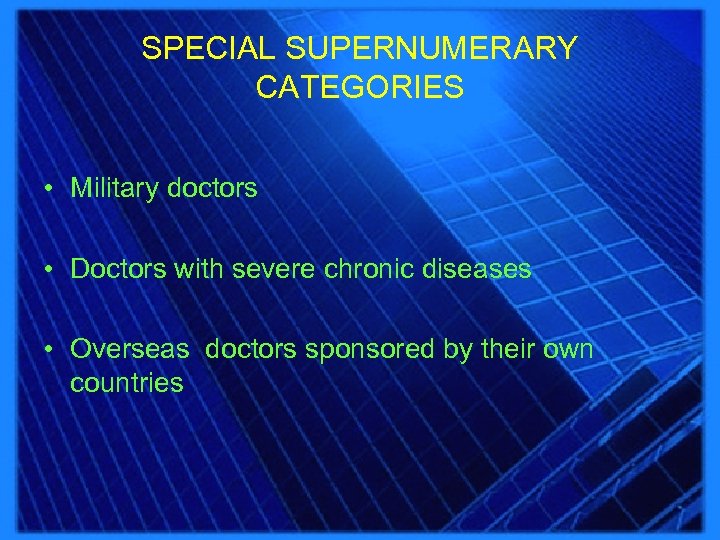 SPECIAL SUPERNUMERARY CATEGORIES • Military doctors • Doctors with severe chronic diseases • Overseas doctors sponsored by their own countries
 DURING THE TRAINING • • • A Number of surgical procedures ( perform/assist) Spectrum of procedures Surgical research, Medical thesis Visiting clinician overseas Postgraduate courses • Chairman/ Staff surgeons of the Department of Surgery • Chairman sign a testimonial in order to apply for the exam
 DURING THE TRAINING Hands on courses , Congresses, Meetings, Medical knowledge courses Hellenic Surgical Society, Other smaller societies (Endocrine, breast, colon, HPB etc) International societies University Departments National Health System Departments Private Clinics Departments Support from Pharmaceutic/ medical supplies companies
 FINAL CENTRAL EXAM • Three Examiners ( 1 from the University, 2 from the NHS - determined by Ministry of Health) • MCQs & Oral exam the following day • Success rate 70 -80 % • Possibility up to 3 attempts • Further failure repeat 6 months training in another hospital and new final exam
 SPECIAL ISSUES IN SURGICAL TRAINING IN GREECE • Full Training Hospitals are not of equal volume and spectrum • Departments within Hospitals or same Hospital are not equal and the level of training varies • Absence of national principles/guidelines for training • Rotation of trainees is not legislated • Medical research is not encouraged in all Hospitals • Log book kept on volunteer basis • Failed trainees can not be removed
 SPECIAL ISSUES IN SURGICAL TRAINING IN GREECE • There is no Hospital/ Department evaluation (quality control) • There is no surgical trainee evaluation • There are no criteria for selection of trainees at the stage of program entrance • Endoscopy is not included in the surgical training • A number of high quality trainees do not wait at the list of the Ministry of Health and enter residency programs abroad ( U. K, USA, Germany, Sweden, France, Switzerland)
 SPECIAL ISSUES IN SURGICAL TRAINING IN GREECE • Several attempts to establish panhellenic entrance exams to commence specialty training • Severe reaction from Athens Medical Association and student unions - syndicalism • Repeat hesitation from the Governements to establish criteria for training commencement and transfer competence/responsibilities to the Hellenic Surgical Society
 THE ROLE OF EUROPEAN AND US HOSPITALS • Significant number of young surgeons/trainees go overseas after the final exam or during the training ( UK, USA, Germany, France) • To enrich surgical training of Greek doctors • During – After basic training
 • There is no official involvement of the Hellenic Surgical Society in the surgical training and exams in Greece
 PROPOSALS OF THE HELLENIC SURGICAL SOCIETY
 SUBJECT OF TRAINING • Theoretical backround and practical training of the resident on basic rules of surgical science and diagnosis & treatment of several diseases, malformations, trauma of human organs as well as the technique of various surgical procedures
 CONTENT OF GENERAL SURGERY • • • Oesophagus Stomach Small bowel, Large bowel, Anus Head & Neck, Endocrine surgery Thorax, Vascular Liver, Biliary tract, Pancreas, Spleen Breast Uterus, ovaries, kidney Abdominal wall Skin, soft tissue
 TRAINING INCLUDES PROCEDURES ON: • • Retroperitoneum, pelvis Various diseases of other organs Trauma Laparoscopic/Robotic surgery
 • Selection criteria for entering the residency program in Surgery • Panhellenic exams / chronological list
 • Training program in Surgery only in eligible Hospitals • Responsible for trainees tutor in cooperation with the chairman of the Department • Training classified as basic and advanced, 3 years each • Number of procedures: 400 -750 ( minor, moderate, major) as a surgeon • Double the number for 1 st/2 nd assistance
 BASIC ADVANCED • Medical knowledge • Minor, moderate procedures • Major procedures • Basic laparoscopic procedures • Advanced laparoscopic procedures
 • Responsible for trainees at least at the level of staff grade A, or associate professor • In cooperation with the team evaluation of the trainee every year a) medical knowledge- multiple choice questions b) skill evaluation c) attitude d) communication with the medical – nursing staff
 LOG BOOK • Subject of training per year • Number, spectrum, category of surgical procedures ( dates, initials, Hospital number, exact operation)
 REPORT AT THE END OF THE BASIC 3 YEARS • Conducted by chairman/tutor • Training centres • Scoring at the annual evaluation • Number, spectrum of procedures • Obligatory participation at the postgraduate courses of the Hellenic Surgical Society • Total score Entrance to the exam
 REPORT –EXAM AT THE END OF THE ADVANCED 3 YEARS • Conducted by chairman/tutor • Training centre • Scoring at the annual evaluation • Number, spectrum of procedures • Obligatory participation at the postgraduate courses of the Hellenic Surgical Society • Total score Entrance to the exam
 FINAL EXAM • Multiple choice questions ( 150 -200) • Short written elucidation on current knowledge, topics, clinical scenario, innovation • Oral exam
 Committee of examiners • 3 Surgeons • Professor/Chairman NHS, Assoc. Professor/ Consultant Surgeon • The list of examiners is proposed exclusively by the Hellenic Surgical Society vs The society decides for 1 of the 3 examiners • The Board changes synthesis every 2 years • Exam centre are large hospitals with significant number of trainees
 TRAINING CENTRES - ELIGIBILITY • General, or University or Prefecture* Hospitals • Fully equiped laboratories • Departmnent of Orthopaedics, Urology, Gynecology, ENT, Ophthalmology, Endoscopy Unit • Intensive care Unit • Admit emergencies • 100 -150 surgical procedures under G. A. per trainee ( including surgical oncology) • Systematic training program *administrative area/county
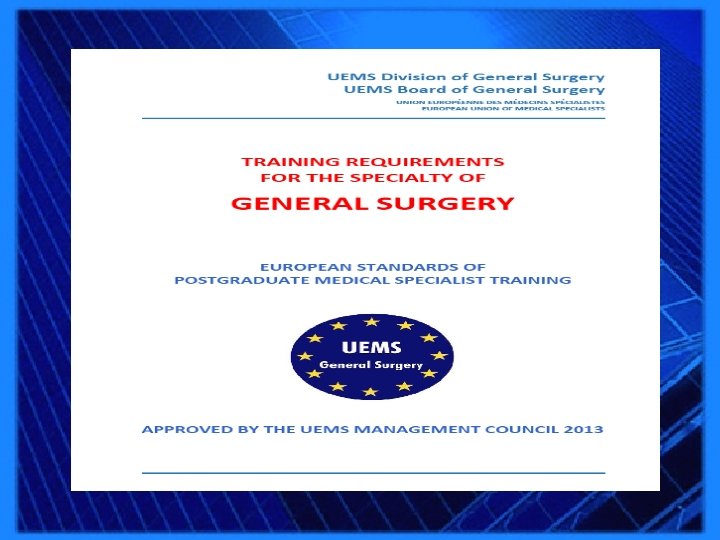
 CONTRIBUTION OF THE HELLENIC SURGICAL SOCIETY • To improve standards of surgical training in Greece • Achieve homogeneity of training in General Surgery in Europe