


 Скачать презентацию Training Delivery Part Two Copyright 2011 Mc
0e2ac6753889c4bde95d21d80a569b82.ppt
- Количество слайдов: 106
 Training Delivery Part Two . Copyright 2011 Mc. Graw-Hill Australia Pty Ltd PPTs to accompany Vocational Training and Assessment by Hill, Hill and Perlitz 2– 1
 The adult learning environment Elements: 1. Understanding the adult learner 2. Learning styles 3. Barriers to learning 4. Health and safety in the learning environment 5. Communication . Copyright 2011 Mc. Graw-Hill Australia Pty Ltd PPTs to accompany Vocational Training and Assessment by Hill, Hill and Perlitz 2– 2
 Adult learners • Expect to be respected, safe and find learning rewarding • Will use all of their senses to learn • Relate new information to existing knowledge or experiences • Need to practice new skills and apply new knowledge . Copyright 2011 Mc. Graw-Hill Australia Pty Ltd PPTs to accompany Vocational Training and Assessment by Hill, Hill and Perlitz 2– 3
 Adult learners (cont. ) • Remember best the first and last things in a learning session • Need feedback to determine their own effectiveness • Need to be actively involved in the learning process • Need time to integrate information that challenges their beliefs . Copyright 2011 Mc. Graw-Hill Australia Pty Ltd PPTs to accompany Vocational Training and Assessment by Hill, Hill and Perlitz 2– 4
 Motivations • Adults bring their own motivation, but can be externally motivated as well • Motivations can include (to name a few): • • • . Money Prestige or self-esteem Lifestyle Better job/position More employable. Copyright 2011 Mc. Graw-Hill Australia Pty Ltd PPTs to accompany Vocational Training and Assessment by Hill, Hill and Perlitz 2– 5
 Learning styles/characteristics • • • . Styles can include: Auditory Visual Kinaesthetic Left/right brain Global/analytical • Characteristics can include: • Theorist • Activist/pragmatist • Social • Reflective (solitary) Copyright 2011 Mc. Graw-Hill Australia Pty Ltd PPTs to accompany Vocational Training and Assessment by Hill, Hill and Perlitz 2– 6
 Characteristics of a target learner group • People already in the workforce • School graduates • Those who have very specific needs • Those needing only a refresher • Apprentices or trainees • Individuals learning new skills . • Unemployed people wishing to improve their employability skills • Learners from other countries • Individuals or groups who need to meet licensing or other regulatory requirements Copyright 2011 Mc. Graw-Hill Australia Pty Ltd PPTs to accompany Vocational Training and Assessment by Hill, Hill and Perlitz 2– 7
 Identifying their characteristics • • • . Course enrolment forms Employer-provided information Interviews with stakeholders (employers, learners) Training records Records or reports of previous courses conducted Copyright 2011 Mc. Graw-Hill Australia Pty Ltd PPTs to accompany Vocational Training and Assessment by Hill, Hill and Perlitz 2– 8
 How adults learn – current theories • • . Cognitive learning theory Andragogy Pedagogy Information processing Behavioural learning theory Constructivist theory Situational Copyright 2011 Mc. Graw-Hill Australia Pty Ltd PPTs to accompany Vocational Training and Assessment by Hill, Hill and Perlitz 2– 9
 Barriers to learning Internal factors may include: • literacy and numeracy (read, write and count) • education level • motivation. . Copyright 2011 Mc. Graw-Hill Australia Pty Ltd PPTs to accompany Vocational Training and Assessment by Hill, Hill and Perlitz 2– 10
 Barriers to learning External factors may include: • • • . environment safety (absence of fear) physical comfort physical health and wellbeing emotional and psychological health communication Copyright 2011 Mc. Graw-Hill Australia Pty Ltd PPTs to accompany Vocational Training and Assessment by Hill, Hill and Perlitz 2– 11
 Diversity • Diversity can encompass differences in: • • • . ability age belief systems/values culture expertise/experience working styles gender interests interpersonal style • • • language mental ability past experiences physical characteristics politics race religion sexual orientation thinking and learning styles Copyright 2011 Mc. Graw-Hill Australia Pty Ltd PPTs to accompany Vocational Training and Assessment by Hill, Hill and Perlitz 2– 12
 Anti-discrimination legislation • • • . Age Discrimination Act 2004 Australian Human Rights Commission Act 1986 Disability Discrimination Act 1992 Racial Discrimination Act 1975 Sex Discrimination Act 1984 Copyright 2011 Mc. Graw-Hill Australia Pty Ltd PPTs to accompany Vocational Training and Assessment by Hill, Hill and Perlitz 2– 13
 Reasonable adjustment A measure or action taken to assist a student from a diverse background or with a physical or learning disability to participate in your session on the same basis as other learners. . Copyright 2011 Mc. Graw-Hill Australia Pty Ltd PPTs to accompany Vocational Training and Assessment by Hill, Hill and Perlitz 2– 14
 Considerations • The learner’s disability • The learner’s wishes or requirements • The effect of the adjustment upon the learner, including on their ability to achieve learning outcomes, participate in courses or programs and achieve learning independence . Copyright 2011 Mc. Graw-Hill Australia Pty Ltd PPTs to accompany Vocational Training and Assessment by Hill, Hill and Perlitz 2– 15
 Considerations (cont. ) • The effect of the proposed adjustment on other learners or stakeholders in the learning program. • The costs of making the adjustment • The benefits of making the changes or adjustment. . Copyright 2011 Mc. Graw-Hill Australia Pty Ltd PPTs to accompany Vocational Training and Assessment by Hill, Hill and Perlitz 2– 16
 Communication Verbal • Sounds (speech, radio, telephone, song) Non-verbal • Sight (print, pictures, video, gesture, expressions) • Touch (pleasure, pain) • Smell (good/bad odour) • Taste (bitter, sweet, sour etc. ) . Copyright 2011 Mc. Graw-Hill Australia Pty Ltd PPTs to accompany Vocational Training and Assessment by Hill, Hill and Perlitz 2– 17
 Verbal communication • Use appropriate tone, pitch, volume, rhythm, speed and intensity • Make clear and definitive presentations of options or advice • Avoid jargon or acronyms (except where the entire audience should be aware of their meaning) • Be open and warm (see non-verbal also) • Enunciate and pronounce your words clearly . Copyright 2011 Mc. Graw-Hill Australia Pty Ltd PPTs to accompany Vocational Training and Assessment by Hill, Hill and Perlitz 2– 18
 Verbal communication (cont. ) • Avoid using ambiguous words or phrases • Listen attentively • Invite learners to paraphrase advice or instructions to confirm understanding (to paraphrase is to ‘put into your own words’) • Ensure language, literacy and numeracy (LLN) used is appropriate to the learners’ needs. . Copyright 2011 Mc. Graw-Hill Australia Pty Ltd PPTs to accompany Vocational Training and Assessment by Hill, Hill and Perlitz 2– 19
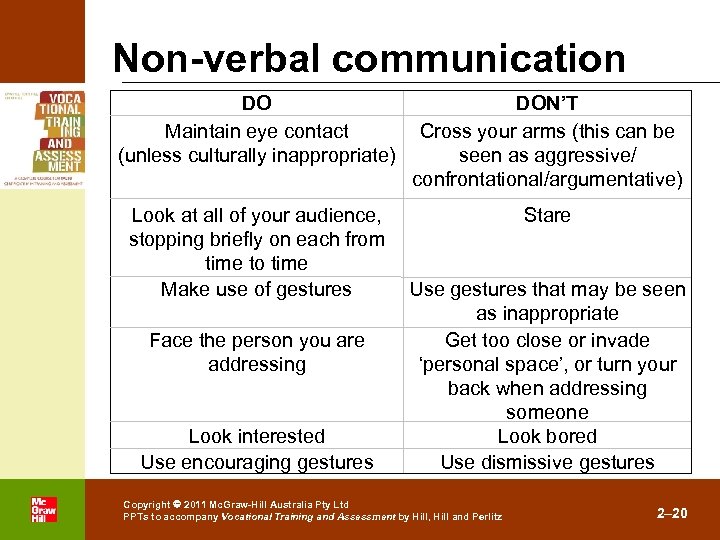 Non-verbal communication DO Maintain eye contact (unless culturally inappropriate) DON’T Cross your arms (this can be seen as aggressive/ confrontational/argumentative) Look at all of your audience, Stare stopping briefly on each from time to time Make use of gestures Use gestures that may be seen as inappropriate Face the person you are Get too close or invade addressing ‘personal space’, or turn your back when addressing someone Look interested Look bored Use encouraging gestures Use dismissive gestures . Copyright 2011 Mc. Graw-Hill Australia Pty Ltd PPTs to accompany Vocational Training and Assessment by Hill, Hill and Perlitz 2– 20
 Listening skills Active listening • Attending • Questioning • Encouraging • Paraphrasing • Summarising . Copyright 2011 Mc. Graw-Hill Australia Pty Ltd PPTs to accompany Vocational Training and Assessment by Hill, Hill and Perlitz 2– 21
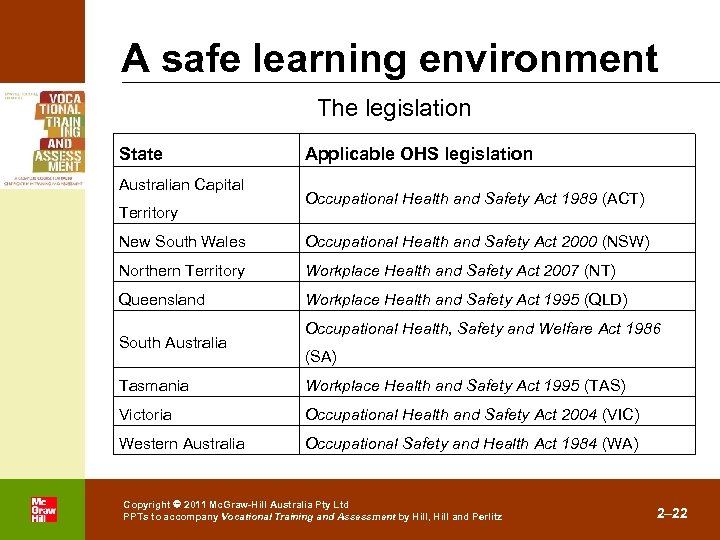 A safe learning environment The legislation State Australian Capital Territory Applicable OHS legislation Occupational Health and Safety Act 1989 (ACT) New South Wales Occupational Health and Safety Act 2000 (NSW) Northern Territory Workplace Health and Safety Act 2007 (NT) Queensland Workplace Health and Safety Act 1995 (QLD) South Australia Occupational Health, Safety and Welfare Act 1986 (SA) Tasmania Victoria Occupational Health and Safety Act 2004 (VIC) Western Australia . Workplace Health and Safety Act 1995 (TAS) Occupational Safety and Health Act 1984 (WA) Copyright 2011 Mc. Graw-Hill Australia Pty Ltd PPTs to accompany Vocational Training and Assessment by Hill, Hill and Perlitz 2– 22
 Hazard A situation in which exists the capacity to cause damage, loss or injury. . Copyright 2011 Mc. Graw-Hill Australia Pty Ltd PPTs to accompany Vocational Training and Assessment by Hill, Hill and Perlitz 2– 23
 Risk The combination of the likelihood that a hazard will actually result in an accident or incident and the consequences of that result, often expressed as the product of the two. . Copyright 2011 Mc. Graw-Hill Australia Pty Ltd PPTs to accompany Vocational Training and Assessment by Hill, Hill and Perlitz 2– 24
 Identifying hazards Hazards can be grouped into six broad areas: • Physical • Chemical • Biological and Environmental • Mechanical/electrical • Psychological . Copyright 2011 Mc. Graw-Hill Australia Pty Ltd PPTs to accompany Vocational Training and Assessment by Hill, Hill and Perlitz 2– 25
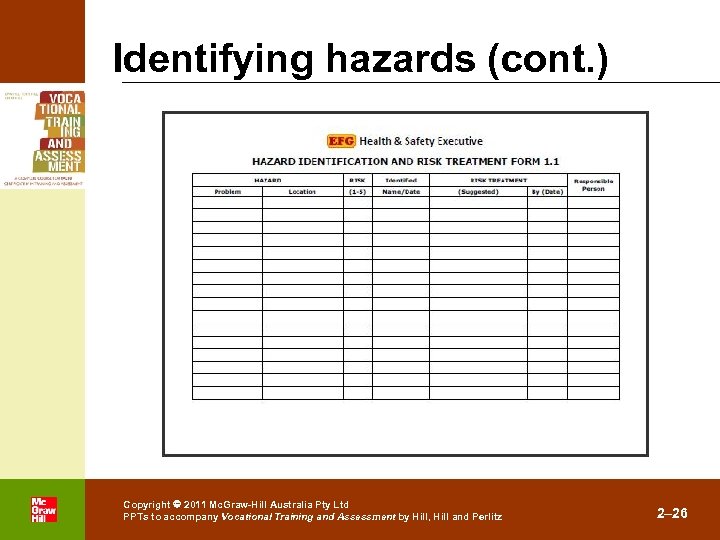 Identifying hazards (cont. ) . Copyright 2011 Mc. Graw-Hill Australia Pty Ltd PPTs to accompany Vocational Training and Assessment by Hill, Hill and Perlitz 2– 26
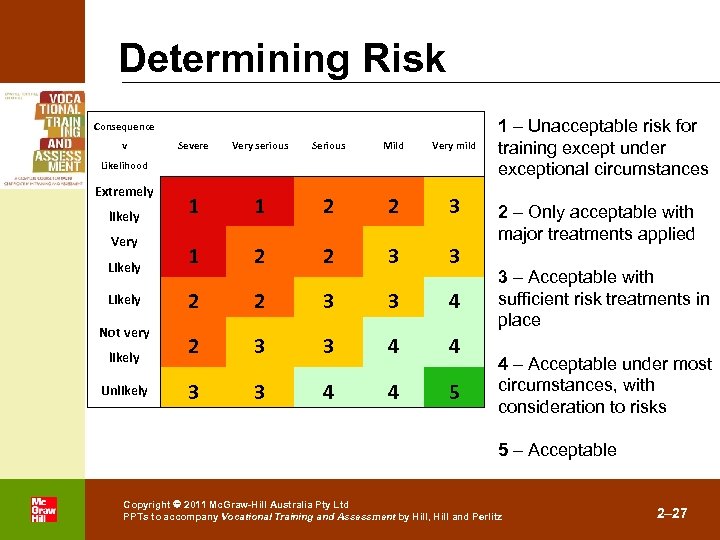 Determining Risk Consequence v Severe Very serious Serious Mild Very mild 1 1 2 2 3 Likely 1 2 2 3 3 Likely 2 2 3 3 4 likely 2 3 3 4 4 Unlikely 3 3 4 4 5 Likelihood Extremely likely Very Not very 1 – Unacceptable risk for training except under exceptional circumstances 2 – Only acceptable with major treatments applied 3 – Acceptable with sufficient risk treatments in place 4 – Acceptable under most circumstances, with consideration to risks 5 – Acceptable . Copyright 2011 Mc. Graw-Hill Australia Pty Ltd PPTs to accompany Vocational Training and Assessment by Hill, Hill and Perlitz 2– 27
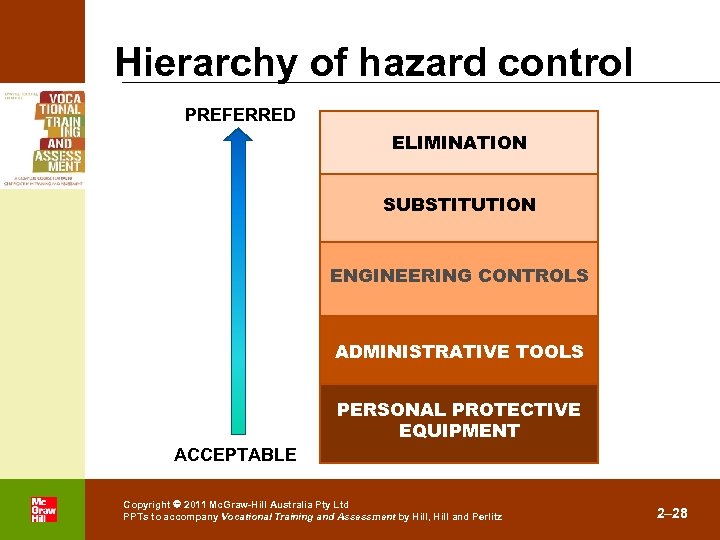 Hierarchy of hazard control PREFERRED ELIMINATION SUBSTITUTION ENGINEERING CONTROLS ADMINISTRATIVE TOOLS PERSONAL PROTECTIVE EQUIPMENT ACCEPTABLE . Copyright 2011 Mc. Graw-Hill Australia Pty Ltd PPTs to accompany Vocational Training and Assessment by Hill, Hill and Perlitz 2– 28
 Other sources of information Information about existing hazards can be garnered from: • risk or hazard registers • hazard or incident reports • risk assessments • emergency procedures • induction training materials • equipment operating manuals • workplace OHS staff. . Copyright 2011 Mc. Graw-Hill Australia Pty Ltd PPTs to accompany Vocational Training and Assessment by Hill, Hill and Perlitz 2– 29
 TAEDEL 401 A Plan, organise and deliver group-based learning Elements: 1. Interpret learning environment and delivery requirements 2. Prepare session plans 3. Prepare resources for delivery 4. Deliver and facilitate training sessions 5. Support and monitor learning . Copyright 2011 Mc. Graw-Hill Australia Pty Ltd PPTs to accompany Vocational Training and Assessment by Hill, Hill and Perlitz 2– 30
 Learning programs can provide the following: • benchmarks (competencies, standards or codes) to be achieved for the learning program: • • . learning outcomes content overview resources (materials and activities) modes and methods of delivery the number/duration of training sessions and timelines OHS issues for delivery assessment points assessment methods and tools. Copyright 2011 Mc. Graw-Hill Australia Pty Ltd PPTs to accompany Vocational Training and Assessment by Hill, Hill and Perlitz 2– 31
 Identifying learner needs Group and individual needs can be identified from: • enrolment information, such as enrolment forms and student information sheets • employee or personnel records (confidentiality protected) • results of task analyses and organisational training needs analyses • outcomes of Recognition of Current Competencies or Recognition of Prior Learning assessments • communication with individual learners. . Copyright 2011 Mc. Graw-Hill Australia Pty Ltd PPTs to accompany Vocational Training and Assessment by Hill, Hill and Perlitz 2– 32
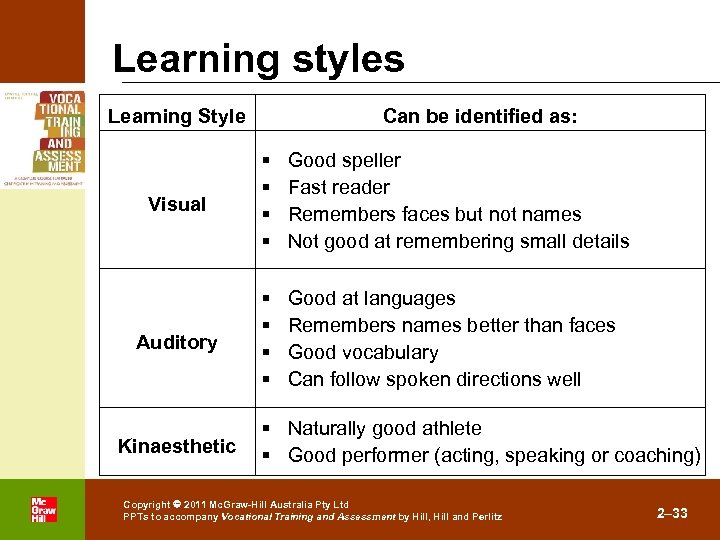 Learning styles Learning Style Can be identified as: Visual Good speller Fast reader Remembers faces but not names Not good at remembering small details Auditory Good at languages Remembers names better than faces Good vocabulary Can follow spoken directions well Kinaesthetic . Naturally good athlete Good performer (acting, speaking or coaching) Copyright 2011 Mc. Graw-Hill Australia Pty Ltd PPTs to accompany Vocational Training and Assessment by Hill, Hill and Perlitz 2– 33
 Risks to delivery Restriction, constraints or risks to delivery can include: • Access restrictions (to training environment) • Cost restrictions • Time restrictions . Copyright 2011 Mc. Graw-Hill Australia Pty Ltd PPTs to accompany Vocational Training and Assessment by Hill, Hill and Perlitz 2– 34
 Understanding your group Tuckman’s stages of group development: • Forming • Storming • Norming • Performing • Adjourning. . Copyright 2011 Mc. Graw-Hill Australia Pty Ltd PPTs to accompany Vocational Training and Assessment by Hill, Hill and Perlitz 2– 35
 Prepare session plans The FIVE ‘P’s of training sessions: Proper Preparation Prevents Poor Performance . Copyright 2011 Mc. Graw-Hill Australia Pty Ltd PPTs to accompany Vocational Training and Assessment by Hill, Hill and Perlitz 2– 36
 Preparing the plan As a minimum, a session plan will include: • an outline of objectives or content to be addressed • a plan of delivery methods and learning activities to be used • timelines/duration for each learning activity • the formative assessment points/opportunities • what learning materials, aides and other resources are required . Copyright 2011 Mc. Graw-Hill Australia Pty Ltd PPTs to accompany Vocational Training and Assessment by Hill, Hill and Perlitz 2– 37
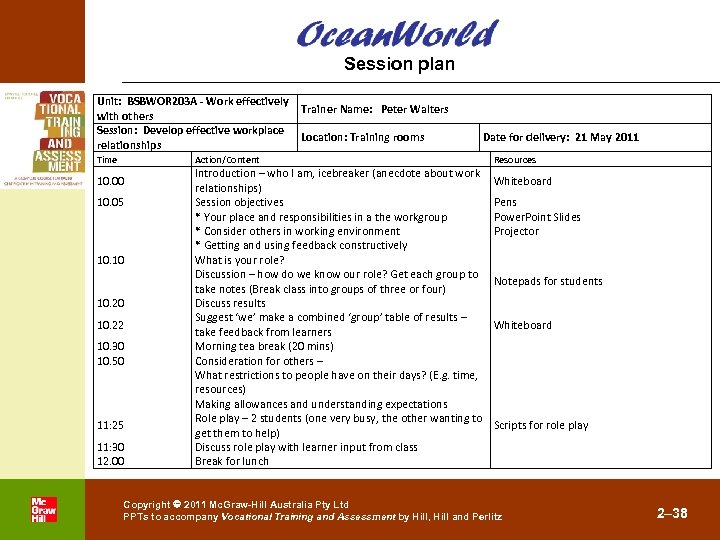 Session plan Unit: BSBWOR 203 A - Work effectively with others Session: Develop effective workplace relationships Time Location: Training rooms Action/Content 10. 00 10. 05 10. 10 10. 22 10. 30 10. 50 11: 25 11: 30 12. 00 . Trainer Name: Peter Walters Introduction – who I am, icebreaker (anecdote about work relationships) Session objectives * Your place and responsibilities in a the workgroup * Consider others in working environment * Getting and using feedback constructively What is your role? Discussion – how do we know our role? Get each group to take notes (Break class into groups of three or four) Discuss results Suggest ‘we’ make a combined ‘group’ table of results – take feedback from learners Morning tea break (20 mins) Consideration for others – What restrictions to people have on their days? (E. g. time, resources) Making allowances and understanding expectations Role play – 2 students (one very busy, the other wanting to get them to help) Discuss role play with learner input from class Break for lunch Date for delivery: 21 May 2011 Resources Whiteboard Pens Power. Point Slides Projector Notepads for students Whiteboard Scripts for role play Copyright 2011 Mc. Graw-Hill Australia Pty Ltd PPTs to accompany Vocational Training and Assessment by Hill, Hill and Perlitz 2– 38
 Steps for preparation There are seven steps in preparing your session plan: • List the objectives of your training session • Order your information in a logical sequence • Determine the content based on the objectives • Identify training aids or learning resources required for each segment • Summarise key points (objectives) and add linkages to next session(s) where required. • Test your plan by conducting a ‘dry run’ (with timings) • Review and revise your plan as required. . Copyright 2011 Mc. Graw-Hill Australia Pty Ltd PPTs to accompany Vocational Training and Assessment by Hill, Hill and Perlitz 2– 39
 Audio-visual resources Audio-visual presentation aids can include: • advertising copy • audio grabs • direct marketing copy • individual or team presentations • verbal presentation • public relations copy • scripts • storyboards • video • visuals (samples). Copyright 2011 Mc. Graw-Hill Australia Pty Ltd PPTs to accompany Vocational Training and Assessment by Hill, Hill and Perlitz 2– 40
 Presentation skills • Synthesising information and ideas • Overhead and digital ‘slide shows’ • Using computer presentation applications, software and hardware • Communication skills • Maintaining awareness of diversity in the group • Encouraging and dealing appropriately with questions . Copyright 2011 Mc. Graw-Hill Australia Pty Ltd PPTs to accompany Vocational Training and Assessment by Hill, Hill and Perlitz 2– 41
 Presentation skills (cont. ) • Demonstrating enthusiasm for the topic • Summarising key points • Making direct eye contact to create direct pathway between learners and self (remember cultural sensitivities) • Demonstrating confidence • Supporting learners to enable progress from simple to more complex tasks and concepts. . Copyright 2011 Mc. Graw-Hill Australia Pty Ltd PPTs to accompany Vocational Training and Assessment by Hill, Hill and Perlitz 2– 42
 Five step skills instruction Step 1: Demonstrate the skill Step 2: Demonstrate with instruction Step 3: Demonstrate step-by-step, with learners following Step 4: Learners practice Step 5: Learner demonstrates the skill . Copyright 2011 Mc. Graw-Hill Australia Pty Ltd PPTs to accompany Vocational Training and Assessment by Hill, Hill and Perlitz 2– 43
 Facilitation methods • • Demonstration/modelling Instruction Presentations/lectures Guided facilitation of individual and group learning activities/group work/case studies • Initiating and facilitating group discussions • Brainstorming activities . Copyright 2011 Mc. Graw-Hill Australia Pty Ltd PPTs to accompany Vocational Training and Assessment by Hill, Hill and Perlitz 2– 44
 Facilitation methods (cont. ) • • • Providing and guiding practice opportunities Enabling and supporting effective learner participation Tutoring Project-based Individual facilitation techniques - coaching/ mentoring • Blended learning (combinations of styles). . Copyright 2011 Mc. Graw-Hill Australia Pty Ltd PPTs to accompany Vocational Training and Assessment by Hill, Hill and Perlitz 2– 45
 Group management The trainer or facilitator must be able to: • ensure that every individual has an opportunity for participation and input • maintain group cohesion • encourage rapport between group members • manage group dynamics • observe and interpret behaviour that puts others at risk • facilitate discussion and group interaction. . Copyright 2011 Mc. Graw-Hill Australia Pty Ltd PPTs to accompany Vocational Training and Assessment by Hill, Hill and Perlitz 2– 46
 Questioning Questions can: • manage class behaviour • determine learners’ knowledge to aid in modifying session plan • arouse curiosity and stimulate interest • clarify and emphasise key concepts • stimulate discussion among learners • develop or sharpen learners’ problem-solving ability • motivate student to search for new information • stimulate and encourage learners to think at higher levels. . Copyright 2011 Mc. Graw-Hill Australia Pty Ltd PPTs to accompany Vocational Training and Assessment by Hill, Hill and Perlitz 2– 47
 Question types Closed – a question that requires only a simple yes or no answer, or directs the learner to only one possible correct answer. Open – a question requiring a more considered, structured answer of at least a few words or sentences. Rhetorical – not so much a question for the learner to answer, but a dramatic pause to regain focus and attention, and stimulate thinking. . Copyright 2011 Mc. Graw-Hill Australia Pty Ltd PPTs to accompany Vocational Training and Assessment by Hill, Hill and Perlitz 2– 48
 Question styles Direct: Aimed at an individual, this technique allows the trainer total control over the group, and doesn’t allow anyone to relax as the question may be to them. Indirect: This question is aimed at everyone in the class, but only seeks one answerer. Redirection: Encourages deeper thinking and attention. By taking the answer of one student and throwing it to another, with ‘Why? ’ or ‘Does that sound right to you? ’ Discussion: This type of question also seeks input from the whole learner group and promotes participation. . Copyright 2011 Mc. Graw-Hill Australia Pty Ltd PPTs to accompany Vocational Training and Assessment by Hill, Hill and Perlitz 2– 49
 Inappropriate behaviour can include: • verbal or physical abuse or bullying • inappropriate use of language or gestures • insensitive verbal or physical behaviour towards other learners or the trainer/facilitator, including cultural, racial, disability or gender-based insensitivities • dominant or overbearing behaviour • other disruptive behaviour • non-compliance with, or disregard for, safety rules or instructions. . Copyright 2011 Mc. Graw-Hill Australia Pty Ltd PPTs to accompany Vocational Training and Assessment by Hill, Hill and Perlitz 2– 50
 Behaviour mediation • • • . Identify critical points/concerns Talk through the issues with all parties Identify options for change Identify misunderstandings and discuss issues Manage discussions and provide an independent perspective Move parties past sticking points Present possible solutions to manage issues Ensure equitable outcomes for all parties concerned Provide face-saving options Obtain agreement (verbal or written) as necessary. Copyright 2011 Mc. Graw-Hill Australia Pty Ltd PPTs to accompany Vocational Training and Assessment by Hill, Hill and Perlitz 2– 51
 Record keeping It is important that accurate records are maintained in accordance with organisational policy, as learner records: • are used by government for statistics-gathering purposes • can be linked to government funding • are used as a quality training indicator • provide feedback to the learner or client organisation • form part of personnel records for employers • may be required to meet legislative requirements. . Copyright 2011 Mc. Graw-Hill Australia Pty Ltd PPTs to accompany Vocational Training and Assessment by Hill, Hill and Perlitz 2– 52
 Record keeping (cont. ) Records that may be required to be maintained can include: • training and delivery plans • observations of learner behaviour • records of discussions, • notes on conflict resolution meetings or interviews or inappropriate behaviour • records of student sessions payments • learner work samples • attendance sheets • records of adjustments for • OHS documentation learner needs • learner evaluation sheets • trainer notes for personal or • results of informal professional development assessment or training critique. . Copyright 2011 Mc. Graw-Hill Australia Pty Ltd PPTs to accompany Vocational Training and Assessment by Hill, Hill and Perlitz 2– 53
 TAEDEL 402 A Plan, organise and facilitate learning in the workplace Elements: 1. Establish effective work environment for learning 2. Develop a work-based learning pathway 3. Establish the learning-facilitation relationship 4. Implement work-based learning pathway 5. Maintain and develop the learning/facilitation relationship 6. Close and evaluate the learning/facilitation relationship 7. Monitor and review the effectiveness of workbased learning pathway. . Copyright 2011 Mc. Graw-Hill Australia Pty Ltd PPTs to accompany Vocational Training and Assessment by Hill, Hill and Perlitz 2– 54
 Why train in the workplace? The benefits of work-based training can include: • employee remains available and productive to the employer • provides professional development of employees for the employer for minimal disruption/cost • learners learn on the equipment they will use for the actual task • employers do not need to back-fill positions • learners engage in real-time activities and events • learners can relate new functions and skills to their existing task knowledge and experience . Copyright 2011 Mc. Graw-Hill Australia Pty Ltd PPTs to accompany Vocational Training and Assessment by Hill, Hill and Perlitz 2– 55
 Why train in the workplace? (cont. ) • support for learners through work colleagues and supervisors/ managers • introduction of new technology • new product/service • new organisational direction/workplace change • new position or job roles • compliance or regulatory requirements • addressing identified skills gap/deficit • OHS requirements • quality improvements • need for competency achievement • part of traineeship/apprenticeship . Copyright 2011 Mc. Graw-Hill Australia Pty Ltd PPTs to accompany Vocational Training and Assessment by Hill, Hill and Perlitz 2– 56
 SMART goals When developing goals for work-based training, you must concentrate on developing goals that are SMART: • Specific • Measurable • Achievable • Realistic • Timely. . Copyright 2011 Mc. Graw-Hill Australia Pty Ltd PPTs to accompany Vocational Training and Assessment by Hill, Hill and Perlitz 2– 57
 Scope Understanding the scope of the training is as important as understanding the objectives. It provides you with a framework of limitations and guides the requirements of the training. Without a clearly defined scope the training can get sidetracked and even lose sight of objectives, particularly in the mind of the trainee. . Copyright 2011 Mc. Graw-Hill Australia Pty Ltd PPTs to accompany Vocational Training and Assessment by Hill, Hill and Perlitz 2– 58
 Constraints • • • . Work schedules Work timelines Work performance expectations Work organisation/organisational change Work models/multi-skilling Work structures and systems Operational/organisational guidelines OHS guidelines, systems and safeguards Work demarcations and industrial relations concerns English language, literacy and numeracy (LLN) requirements. Copyright 2011 Mc. Graw-Hill Australia Pty Ltd PPTs to accompany Vocational Training and Assessment by Hill, Hill and Perlitz 2– 59
 Workplace safety Learning in the workplace can present several health and safety issues. Trainers must be aware of: • OHS legal obligations • workplace OHS policies and procedures • work practices, routines and proposed changes to ensure they do not pose a risk to the learner and others. . Copyright 2011 Mc. Graw-Hill Australia Pty Ltd PPTs to accompany Vocational Training and Assessment by Hill, Hill and Perlitz 2– 60
 Learning pathways The pathway may be any of the following: • Coaching/mentoring • On-the-job training (OJT) • On-site training (off-the-job) • Recognition of prior learning (RPL) • Combinations of the above. . Copyright 2011 Mc. Graw-Hill Australia Pty Ltd PPTs to accompany Vocational Training and Assessment by Hill, Hill and Perlitz 2– 61
 Learning pathways – Cont’d A simple learning pathway can consist of five steps: 1. Identifying specific goals for work-based learning 2. Identifying job tasks or activities to be included in the learning process 3. Appropriate sequencing of job tasks/activities to reflect learner’s incremental development 4. Direct guidance and modelling from experienced coworkers and experts 5. Opportunities for learner practice. . Copyright 2011 Mc. Graw-Hill Australia Pty Ltd PPTs to accompany Vocational Training and Assessment by Hill, Hill and Perlitz 2– 62
 Integrating external training Some external learning that may need to be integrated can include: • Specific equipment training (by manufacturer, the learner’s organisation or an external training provider) • Product training (as above) • Computer training • Skills training (e. g. management, sales, customer support) • Health and safety (OHS) or emergency training. . Copyright 2011 Mc. Graw-Hill Australia Pty Ltd PPTs to accompany Vocational Training and Assessment by Hill, Hill and Perlitz 2– 63
 Learning agreement When the pathway is negotiated, you will need to obtain agreement from: • workplace supervisor/frontline manager • training/human resources/industrial relations manager • trainer/facilitator/assessor • learner • training and/or assessment organisation personnel • group training company personnel or external training organisation. . Copyright 2011 Mc. Graw-Hill Australia Pty Ltd PPTs to accompany Vocational Training and Assessment by Hill, Hill and Perlitz 2– 64
 Learning context Barriers to learning for the individual in the workplace can include: • contextual issues, such as: • physical accessibility • environment (noise, light, distraction) • access to learning resources • • . language, literacy and numeracy needs specific needs employment status past learning experiences work roles level of maturity culture. Copyright 2011 Mc. Graw-Hill Australia Pty Ltd PPTs to accompany Vocational Training and Assessment by Hill, Hill and Perlitz 2– 65
 Building the relationship • Be open and honest • Listen – use active listening techniques and responses • Ask questions to confirm feelings, intentions or actions – don’t make assumptions • Be empathetic • Avoid jargon unless it is appropriate • Employ appropriate body language • Use clear, unambiguous language • Avoid emotive language and contentious or divisive topics • Value every learner’s input • Select media types that suit learning styles. . Copyright 2011 Mc. Graw-Hill Australia Pty Ltd PPTs to accompany Vocational Training and Assessment by Hill, Hill and Perlitz 2– 66
 Facilitation techniques There are several techniques we can use, which can include: • Discovery learning • Action learning • Cooperative learning • Projects or assignments • Mentoring • Coaching • Work diaries, log books or journals. . Copyright 2011 Mc. Graw-Hill Australia Pty Ltd PPTs to accompany Vocational Training and Assessment by Hill, Hill and Perlitz 2– 67
 Individual learning plan An individual learning plan may contain: • participant details • goals and expected outcomes • delivery styles & techniques • duration of the program • a schedule of contact sessions • resources required • activities to be completed • monitoring, assessment and evaluation outline • any additional support to be provided • OHS considerations • contingency arrangements. . Copyright 2011 Mc. Graw-Hill Australia Pty Ltd PPTs to accompany Vocational Training and Assessment by Hill, Hill and Perlitz 2– 68
 Health and safety considerations • Identifying who to contact in an emergency • Identifying evacuation wardens and your role in an emergency • Knowledge of evacuation assembly points • Reporting requirements for incidents • General record keeping requirements • Attendance records • Roles or responsibilities of others in the learning environment • Duty of care. . Copyright 2011 Mc. Graw-Hill Australia Pty Ltd PPTs to accompany Vocational Training and Assessment by Hill, Hill and Perlitz 2– 69
 Monitoring supervision By monitoring the supervisory arrangements applied, and ensuring they are appropriate to the learner’s level of development toward achievement of their goals, you can intervene before learning is derailed. . Copyright 2011 Mc. Graw-Hill Australia Pty Ltd PPTs to accompany Vocational Training and Assessment by Hill, Hill and Perlitz 2– 70
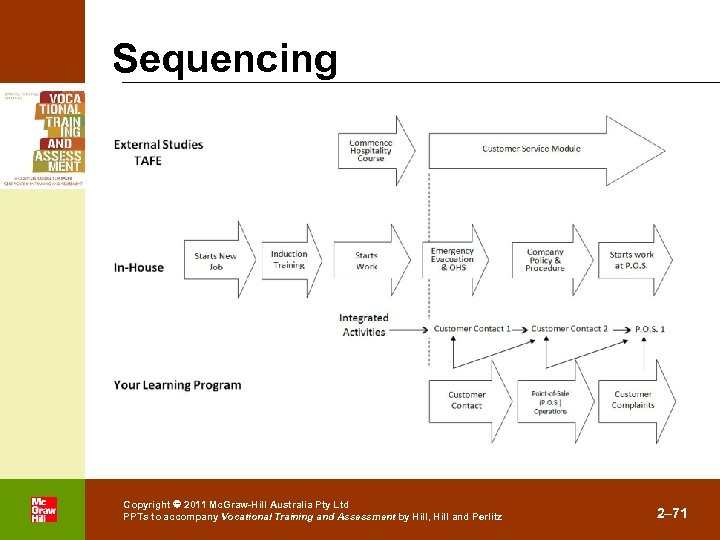 Sequencing . Copyright 2011 Mc. Graw-Hill Australia Pty Ltd PPTs to accompany Vocational Training and Assessment by Hill, Hill and Perlitz 2– 71
 Encouraging self-management Encourage the learner to take control of their own learning and development and to foster an enjoyment of learning. Include the learner in planning of the activities, encourage their input and make adjustments to accommodate their needs. . Copyright 2011 Mc. Graw-Hill Australia Pty Ltd PPTs to accompany Vocational Training and Assessment by Hill, Hill and Perlitz 2– 72
 Transferring knowledge You must find means that are appropriate to your learner’s; • • • . level of knowledge, ability, level of authority and work context Copyright 2011 Mc. Graw-Hill Australia Pty Ltd PPTs to accompany Vocational Training and Assessment by Hill, Hill and Perlitz 2– 73
 Preparing for the session • • . Planning for each meeting/session Being organised for each meeting/session Reflecting on outcomes of previous meeting/session Being punctual Identifying 'where we are' at the start Appearing relaxed and confident Enabling learner to identify his/her perspective Providing a relaxing, non-threatening environment. Copyright 2011 Mc. Graw-Hill Australia Pty Ltd PPTs to accompany Vocational Training and Assessment by Hill, Hill and Perlitz 2– 74
 Preparing for the session (cont. ) Also: • Confirming venue • Confirming learner attendance • Confirming equipment is available (machinery, office equipment, computer workstations etc. ) • Contacting manager/supervisor to confirm session • Confirming any guests or visitors • Training and assessment plan or individual learning plan • Confirming other resources. . Copyright 2011 Mc. Graw-Hill Australia Pty Ltd PPTs to accompany Vocational Training and Assessment by Hill, Hill and Perlitz 2– 75
 Structured learning Direction, guidance and mutual discussion – examples of structured learning activities include: • role-plays • written exercises • demonstrations • practice opportunities • role modelling • projects • readings • research • video/audio analysis • a learning journal. . Copyright 2011 Mc. Graw-Hill Australia Pty Ltd PPTs to accompany Vocational Training and Assessment by Hill, Hill and Perlitz 2– 76
 Maintaining learner momentum Momentum is measured as a product of speed and mass. In training, learner momentum is the energy and speed built up when training is running smoothly and the learner is happily progressing towards the goal. Momentum slows or stops where the learner is stumped by a concept or skill that may seem beyond them. . Copyright 2011 Mc. Graw-Hill Australia Pty Ltd PPTs to accompany Vocational Training and Assessment by Hill, Hill and Perlitz 2– 77
 Signs of losing momentum • • • . Introverted or exhibiting diversionary behaviour Easily distracted Poor organisational skills in learning activities Reluctant to undertake new activities Dependent on you (or colleagues) to lead them through activities Work slowly or work too quickly, and generally inaccurately Find excuses to miss sessions, such as illness, appointments or urgent meetings Lack of motivation Lose self-esteem or see themselves as never being able to achieve the goals. Copyright 2011 Mc. Graw-Hill Australia Pty Ltd PPTs to accompany Vocational Training and Assessment by Hill, Hill and Perlitz 2– 78
 Ethical behaviour can be seen as demonstrating: • integrity (adhering to a moral/ethical code, incorruptible, scrupulous, trustworthy) • privacy and confidentiality of the session • following organisational policies • knowing your own limitations • having a range of other intervention referrals ready when needed • honesty in all actions and dealings • fairness to others. . Copyright 2011 Mc. Graw-Hill Australia Pty Ltd PPTs to accompany Vocational Training and Assessment by Hill, Hill and Perlitz 2– 79
 Monitoring results We monitor learner progress and results to ensure the goals and outcomes expected by all participants and stakeholders are being met. . Copyright 2011 Mc. Graw-Hill Australia Pty Ltd PPTs to accompany Vocational Training and Assessment by Hill, Hill and Perlitz 2– 80
 Closure involves providing everyone involved in a relationship, professional or otherwise, the feeling that the end has come so as not to maintain the unrealistic expectation of a continuation of that relationship. . Copyright 2011 Mc. Graw-Hill Australia Pty Ltd PPTs to accompany Vocational Training and Assessment by Hill, Hill and Perlitz 2– 81
 Evaluating Evaluation of the relationship is conducted to: • find out what works and what doesn’t work in the relationship • provide the other person’s view on how things went • encourage and promote trainer/facilitator professional development. . Copyright 2011 Mc. Graw-Hill Australia Pty Ltd PPTs to accompany Vocational Training and Assessment by Hill, Hill and Perlitz 2– 82
 Using feedback Evaluation can be garnered from learner feedback. User feedback can be derived from: • interview • formal discussion • informal discussion • written questionnaire. . Copyright 2011 Mc. Graw-Hill Australia Pty Ltd PPTs to accompany Vocational Training and Assessment by Hill, Hill and Perlitz 2– 83
 Maintaining records • Many trades, industries and professional bodies require records of self improvement and professional development as part of quality management systems. • Professional registration as a nurse or accountant, licensing as a contractor or builder, or membership of a professional body may require self-evaluation as part of maintaining registration or membership at a personal and/or organisational level. . Copyright 2011 Mc. Graw-Hill Australia Pty Ltd PPTs to accompany Vocational Training and Assessment by Hill, Hill and Perlitz 2– 84
 Program evaluation When evaluating a program, we are looking to answer questions such as: • Did the program achieve its objectives? • What worked? What didn’t work? • Were the objectives attained in a timely manner? • Were resources (time, personnel and materials) allocated effectively? • Were there sufficient resources? • Is the work-based learning pathway the best option? • How did the leaner’s workplace view the program? • What can we improve upon for the next program? . Copyright 2011 Mc. Graw-Hill Australia Pty Ltd PPTs to accompany Vocational Training and Assessment by Hill, Hill and Perlitz 2– 85
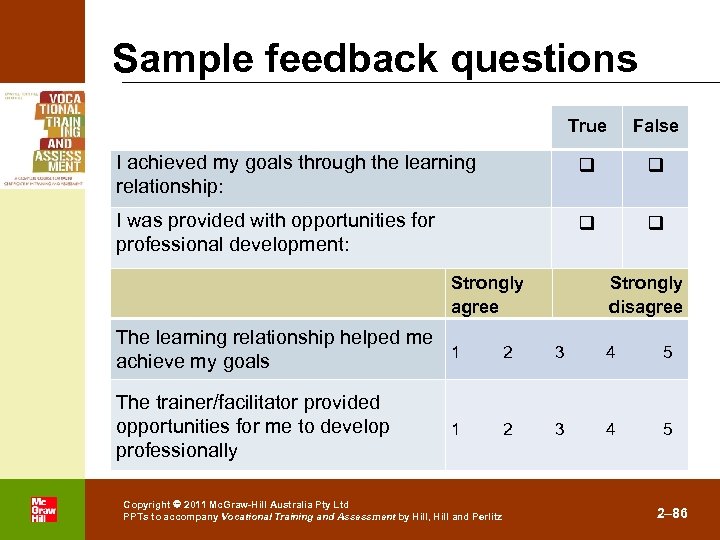 Sample feedback questions True False I achieved my goals through the learning relationship: I was provided with opportunities for professional development: Strongly agree Strongly disagree The learning relationship helped me 1 2 3 4 5 achieve my goals The trainer/facilitator provided opportunities for me to develop professionally . 1 2 3 4 5 Copyright 2011 Mc. Graw-Hill Australia Pty Ltd PPTs to accompany Vocational Training and Assessment by Hill, Hill and Perlitz 2– 86
 TAEDEL 403 A Coordinate and facilitate distance-based learning Elements: 1. Prepare for distance-based learning 2. Manage distance-based learners 3. Monitor learner progress 4. Review distance-based learning process . Copyright 2011 Mc. Graw-Hill Australia Pty Ltd PPTs to accompany Vocational Training and Assessment by Hill, Hill and Perlitz 2– 87
 What is distance-based learning? • Distance-based learning opens up vocational education to a whole range of learners that traditional residential (attendance-based) courses and work-based training cannot reach. • Distance-based learning includes anyone who studies or undertakes learning ‘off-campus’. . Copyright 2011 Mc. Graw-Hill Australia Pty Ltd PPTs to accompany Vocational Training and Assessment by Hill, Hill and Perlitz 2– 88
 Learner characteristics Characteristics that must be considered can include: • language, literacy and numeracy requirements • specific needs • employment status • past learning experiences • level of maturity • culture and/or language diversity • level of formal schooling in Australia or overseas • length of time as a resident in Australia. . Copyright 2011 Mc. Graw-Hill Australia Pty Ltd PPTs to accompany Vocational Training and Assessment by Hill, Hill and Perlitz 2– 89
 Selecting/modifying resources Factors to consider in determining suitability for distance learning include: • available communication media – written: email, instant messaging (IM), mail, fax, SMS – oral: telephone, teleconferencing – face-to-face contact: personal attendance, video conferencing (e. g. Skype) • cost of producing new format materials • cost of modifying existing resources or transferring content to new technologies/formats • suitability of chosen format to learner’s context. . Copyright 2011 Mc. Graw-Hill Australia Pty Ltd PPTs to accompany Vocational Training and Assessment by Hill, Hill and Perlitz 2– 90
 Distance-delivery management plan Similar in many ways to an individual learning plan, it may contain: • learning outcomes • sequence, packaging, timing and distribution requirements for learning resources and materials • timelines for completing outcomes and activities • formative assessment requirements • expectations of the learner(s) • instructions to the learner(s) • list of other learners. . Copyright 2011 Mc. Graw-Hill Australia Pty Ltd PPTs to accompany Vocational Training and Assessment by Hill, Hill and Perlitz 2– 91
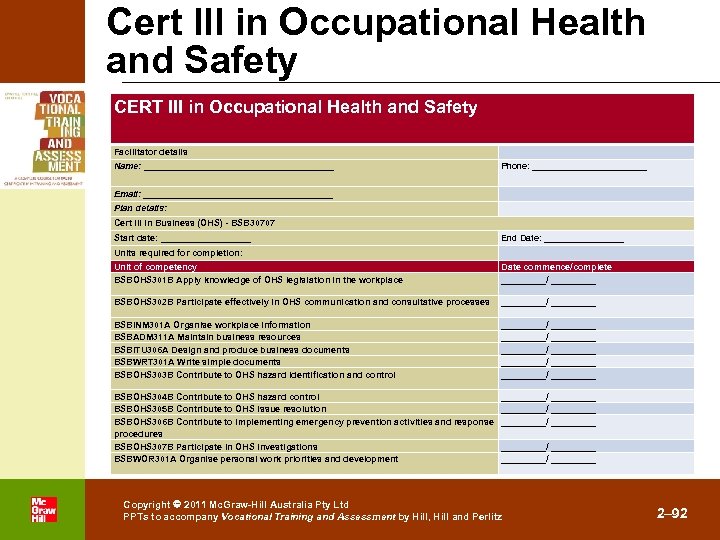 Cert III in Occupational Health and Safety CERT III in Occupational Health and Safety Facilitator details Name: ___________________ Phone: ____________ Email: ___________________ Plan details: Cert III in Business (OHS) - BSB 30707 Start date: _________ Unit of competency BSBOHS 301 B Apply knowledge of OHS legislation in the workplace Date commence/complete _____/ _____ BSBOHS 302 B Participate effectively in OHS communication and consultative processes _____/ _____ BSBINM 301 A Organise workplace information BSBADM 311 A Maintain business resources BSBITU 306 A Design and produce business documents BSBWRT 301 A Write simple documents BSBOHS 303 B Contribute to OHS hazard identification and control _________/ _________ _____/ _____ BSBOHS 304 B Contribute to OHS hazard control BSBOHS 305 B Contribute to OHS issue resolution BSBOHS 306 B Contribute to implementing emergency prevention activities and response procedures BSBOHS 307 B Participate in OHS investigations BSBWOR 301 A Organise personal work priorities and development . End Date: ________ Units required for completion: _________/ _________ _____/ _____ Copyright 2011 Mc. Graw-Hill Australia Pty Ltd PPTs to accompany Vocational Training and Assessment by Hill, Hill and Perlitz 2– 92
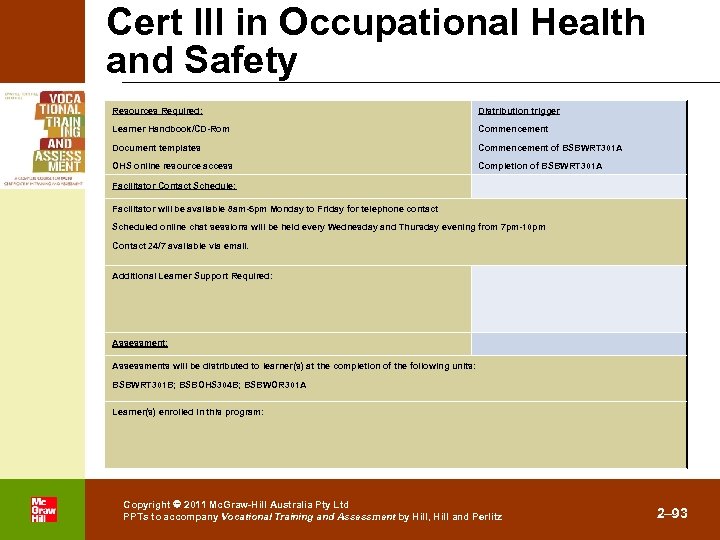 Cert III in Occupational Health and Safety Resources Required: Distribution trigger Learner Handbook/CD-Rom Commencement Document templates Commencement of BSBWRT 301 A OHS online resource access Completion of BSBWRT 301 A Facilitator Contact Schedule: Facilitator will be available 8 am-5 pm Monday to Friday for telephone contact Scheduled online chat sessions will be held every Wednesday and Thursday evening from 7 pm-10 pm Contact 24/7 available via email. Additional Learner Support Required: Assessment: Assessments will be distributed to learner(s) at the completion of the following units: BSBWRT 301 B; BSBOHS 304 B; BSBWOR 301 A Learner(s) enrolled in this program: . Copyright 2011 Mc. Graw-Hill Australia Pty Ltd PPTs to accompany Vocational Training and Assessment by Hill, Hill and Perlitz 2– 93
 Maintaining contact Support mechanisms that may be in place to facilitate student contact can include: • contact numbers for help or guidance • email or phone tutoring • workplace mentoring by supervisors or managers • learning partners • contact numbers of other learners • equipment needs • disability and support needs. . Copyright 2011 Mc. Graw-Hill Australia Pty Ltd PPTs to accompany Vocational Training and Assessment by Hill, Hill and Perlitz 2– 94
 Starting direct Direct contact in the distance learning environment can include contact by: • face-to-face meeting • telephone • video-phone (including Vo. IP video-systems such as Skype) • video conferencing. . Copyright 2011 Mc. Graw-Hill Australia Pty Ltd PPTs to accompany Vocational Training and Assessment by Hill, Hill and Perlitz 2– 95
 Monitoring progress Distance learners’ progress must be monitored and documented to ensure the learners are able to attain their learning goals. Monitoring of distance-based learners’ progress can be achieved by: • direct contact • indirect contact • formal or informal assessment • documents/tasks completed or submitted. . Copyright 2011 Mc. Graw-Hill Australia Pty Ltd PPTs to accompany Vocational Training and Assessment by Hill, Hill and Perlitz 2– 96
 Maintain enthusiasm Some techniques that we can use for maintaining motivation in our distance learners may include: • providing constructive/supportive feedback • regular guidance • motivational activities. . Copyright 2011 Mc. Graw-Hill Australia Pty Ltd PPTs to accompany Vocational Training and Assessment by Hill, Hill and Perlitz 2– 97
 Seek feedback and review Appropriate feedback may include: • learner feedback via survey or discussion, which may include: – face-to-face session – telephone interview – questionnaire • feedback from colleagues • feedback from external stakeholders or parties • self-reflection. . Copyright 2011 Mc. Graw-Hill Australia Pty Ltd PPTs to accompany Vocational Training and Assessment by Hill, Hill and Perlitz 2– 98
 TAEDEL 404 A Mentor in the workplace Elements: 1. Develop a mentoring plan 2. Facilitate the mentoring relationship 3. Monitor the mentoring relationship 4. Evaluate the effectiveness of mentoring. . Copyright 2011 Mc. Graw-Hill Australia Pty Ltd PPTs to accompany Vocational Training and Assessment by Hill, Hill and Perlitz 2– 99
 What is ‘mentoring’? Mentoring is a different approach to learning that encompasses a personal developmental relationship in which a more experienced or knowledgeable person helps a less experienced or knowledgeable person to grow and develop in their work role. . Copyright 2011 Mc. Graw-Hill Australia Pty Ltd PPTs to accompany Vocational Training and Assessment by Hill, Hill and Perlitz 2– 100
 Setting the rules Some ground rules that can be applied may include: • Relationship is voluntary • Partners not in the same chain of command • Supervisors of both mentoring partners must approve • Mentor’s guidance and counsel does not supersede that of the supervisor in work-related matters • Mentoring partners to receive training • A mentoring agreement. . Copyright 2011 Mc. Graw-Hill Australia Pty Ltd PPTs to accompany Vocational Training and Assessment by Hill, Hill and Perlitz 2– 101
 Mentoring agreement A mentoring agreement or contract may include: • explicit expectations of both parties and any wider purpose • well-defined objectives • issues that may constrain achievement of the objectives • clear statement of what the mentor will and will not do • goals set by the organisation • expected timeframe/time commitments • meeting arrangements – face-to-face, distance, email. . Copyright 2011 Mc. Graw-Hill Australia Pty Ltd PPTs to accompany Vocational Training and Assessment by Hill, Hill and Perlitz 2– 102
 Growing the relationship 1. Positive thinking 2. Attainable goals 3. Increasing responsibility 4. Promoting self-improvement 5. Building trust. . Copyright 2011 Mc. Graw-Hill Australia Pty Ltd PPTs to accompany Vocational Training and Assessment by Hill, Hill and Perlitz 2– 103
 Seven steps to problem solving 1. Identify the problem 2. Explore the problem and identify causes 3. Set goals 4. Investigate the alternatives 5. Select a possible solution 6. Implement a possible solution 7. Evaluate. . Copyright 2011 Mc. Graw-Hill Australia Pty Ltd PPTs to accompany Vocational Training and Assessment by Hill, Hill and Perlitz 2– 104
 Dispute resolution Some techniques that can be used for resolving differences may include: • finding a mutually beneficial solution • self-disclosure • inviting discussion • providing explanations • accessing assistance. . Copyright 2011 Mc. Graw-Hill Australia Pty Ltd PPTs to accompany Vocational Training and Assessment by Hill, Hill and Perlitz 2– 105
 The changing relationship The five phases of the mentoring relationship: • Building rapport • Setting direction • Progression • Winding up/winding down • Moving on. . Copyright 2011 Mc. Graw-Hill Australia Pty Ltd PPTs to accompany Vocational Training and Assessment by Hill, Hill and Perlitz 2– 106