 Скачать презентацию Train the Trainer Supporting Employees with Military Background
b4d00ffe8a19a9d4d2742f6c798d2ac8.ppt
- Количество слайдов: 28



Train the Trainer: Supporting Employees with Military Background n n Dawn Marie Klug, LPC, CEAP Renee’ Evans, Ph. D, LPC 1
Goal Participants will gain an overall understanding about the importance of retaining employees with military backgrounds once they are hired and how to train and consult with supervisors to support this effort. 2
Objectives n n To gain a better understanding about the need to focus on employees with military backgrounds To better prepare EA professionals to provide consultations on the impact of military culture and the deployment cycle on the workforce To enable EA Professionals to provide consultation and address performance issues and workplace conflicts that may arise in regards to employees with military background To offer a 30 -45 minute presentation template to present to workplace leaders on effective management of employees with military backgrounds. 3
The United States Armed Forces n n n An all Volunteer Force Active Duty Component (AD) - Air Force, Army, Coast Guard*, Marine Corp, and Navy Reserve Component (RC) - Air Force Reserve, Army Reserve, Coast Guard Reserve*, Marine Reserve, Navy Reserve, Air National Guard, Army National Guard 2. 1 million service members have served in Iraq and Afghanistan * Coast Guard is part of the Department of Homeland Security not the Department of Defense 4
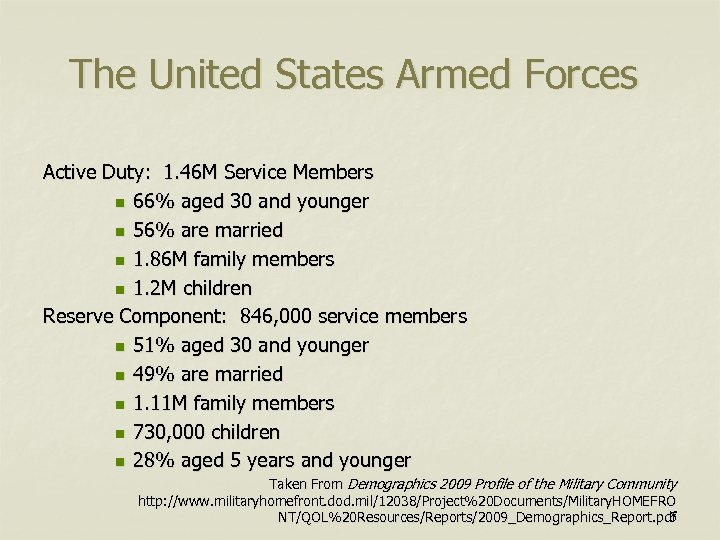
The United States Armed Forces Active Duty: 1. 46 M Service Members n 66% aged 30 and younger n 56% are married n 1. 86 M family members n 1. 2 M children Reserve Component: 846, 000 service members n 51% aged 30 and younger n 49% are married n 1. 11 M family members n 730, 000 children n 28% aged 5 years and younger Taken From Demographics 2009 Profile of the Military Community http: //www. militaryhomefront. dod. mil/12038/Project%20 Documents/Military. HOMEFRO 5 NT/QOL%20 Resources/Reports/2009_Demographics_Report. pdf
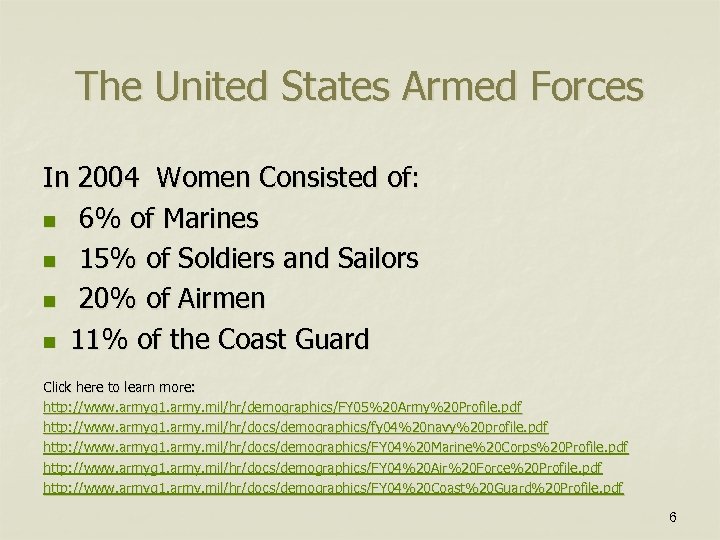
The United States Armed Forces In 2004 Women Consisted of: n 6% of Marines n 15% of Soldiers and Sailors n 20% of Airmen n 11% of the Coast Guard Click here to learn more: http: //www. armyg 1. army. mil/hr/demographics/FY 05%20 Army%20 Profile. pdf http: //www. armyg 1. army. mil/hr/docs/demographics/fy 04%20 navy%20 profile. pdf http: //www. armyg 1. army. mil/hr/docs/demographics/FY 04%20 Marine%20 Corps%20 Profile. pdf http: //www. armyg 1. army. mil/hr/docs/demographics/FY 04%20 Air%20 Force%20 Profile. pdf http: //www. armyg 1. army. mil/hr/docs/demographics/FY 04%20 Coast%20 Guard%20 Profile. pdf 6
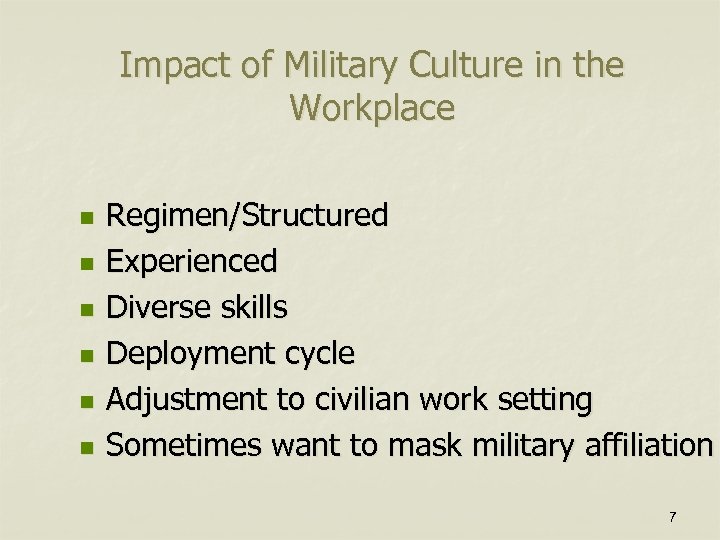
Impact of Military Culture in the Workplace n n n Regimen/Structured Experienced Diverse skills Deployment cycle Adjustment to civilian work setting Sometimes want to mask military affiliation 7
Seek First to Understand… n n As with all diversity issues, valuing and not just tolerating people of diverse backgrounds is an essential skill for managers and Human Resources As an EA professional, having an understanding of, and appreciation for the experiences of someone from a military background will help in serving the client company 8
There is a Need to Focus on this Population of Employees Workplace Issues: n “More and more employees are hindered from doing their jobs productively by personal problems, and industry is realizing that it is not only humanitarian but cost-effective to take more responsibility than it has in the past for helping employees solve these problems” (Masi, 1984, p. 5). As a result, “today’s HR professionals are faced with more issues than were faced 10 years ago” (Hale, Evans, & Hodiak, 2008) when addressing employees’ issues. 9
There is a Need to Focus on this Population of Employees Workplace Issues: According to the Prohofsky (2005), “On any given workday, an estimated one million people are absent from work due to stress. n n 8% of employees say that they feel stress on the job. The number of employees who call in sick due to stress has tripled in the last four years. Each year, an estimated 20 million lost work days are attributable to employee depression and mental health is a major reason for absence”. . 10
There is a Need to Focus on this Population of Employees Workplace Issues: n n n There is no reason to not believe that these employee concerns do not include service members and veterans who have reintegrated back into the workplace due to service-related issues that has also contributed to the above issues. HR professionals and other members of management must address these issues in order to improve retention of employees with military backgrounds which in turn will increase employee motivation, and reduce turnover. The EAP is the key resource for addressing these issues in order to meet the needs of the client employee and the client company 11
Employment Issues of Veterans n n n Unemployment Rate for Veterans has been higher than the general population at 8. 3% in June 2012, the highest in 2012 was May 12. 7% There has been tremendous effort to promote the benefits of hiring veterans in the workplace to assist both employers and job seekers from military backgrounds. “USERRA protects civilian job rights and benefits for veterans and members of the active and Reserve components of the U. S. armed forces. USERRA provides that returning service-members must be promptly reemployed in the same position that they would have attained had they not been absent for military service, with the same seniority, status and pay, as well as other rights and benefits determined by seniority” (Uniformed Services Employment and Reemployment Rights Act (USERRA)) http: //www. dol. gov/vets/programs/userra/ 12
Considerations When Preparing to Train Your Supervisors n n n Understand that all supervisors may not understand military culture and may not know anyone serving in the military As a result, these supervisors may not have an awareness about the importance of being considerate of, and working with employees with military backgrounds Understand that supervisors may or may not be aware of their company policy around supporting employees with military backgrounds Understand that some companies may or may not have policies around supporting employees with military backgrounds 13 n
Considerations When Preparing to Train Your Supervisors n n n Understand that the best way to help managers understand how to support employees with military backgrounds may be through the company’s diversity policy (if they have one). Be aware that some supervisors may have biases and stereotypes about employees with military. How do you plan to address this if it occurs? Understand that supervisors may not understand why this is an important topic and how supporting employees with military backgrounds might directly impact employee productivity, morale, motivation, attendance, and the bottom line. So, may need explain this to them. 14
Considerations When Preparing to Train Your Supervisors n n It will be important to speak in the supervisors’ language. Therefore, may need to address productivity, workplace performance issues, individual performance issues, loss of time, etc. Want to come across as supportive and not accusatory of supervisors. 15
How does Retention Fit into This? n n n This is a diversity issue; Employers who do not have a formal policy related to recruiting veterans may focus on the need to have a diverse workforce. EAP can play a vital role in helping employers to retain and support employees with military backgrounds May assist with understanding policy and procedures that support employees with military background 16
How does Retention Fit into This? n n n Losing employees directly impacts a company’s bottom line When employees feel valued and supported, this directly impacts employee morale, motivation, absenteeism, and productivity positively This is the case for all employees 17
Helping Managers Understand their Policies and Procedures n n Understand that supervisors may not be aware the Uniformed Services Employment and Reemployment Rights Act (USERRA)); Therefore, will need encourage them to contact Human Resources within their organization whenever USERRA may apply. http: //www. dol. gov/vets/programs/userra/ Questions to ask a manager: n Does your organization have a policy on giving priority or preference to employees with military backgrounds? n Does your organization work with local or national groups to recruit employees with military backgrounds? n Have you talked with Human Resources about any potential ADA or USERRA concerns? 18
Helping Managers Understand the Law: ADA n n Understanding and supporting employees based on this policy speaks to the value of the employee in the workplace. Veterans with Disabilities are protected under ADA and USERRA n Employers may not make hiring decisions based on real disabilities or assumptions about disabilities or medical conditions n Employers may ask if applicant is disabled veteran to determine eligibility for affirmative action USERRA “requires employers to go further than the ADA by making reasonable efforts to assist a veteran who is returning to employment to become qualified for a job whether or not the veteran has a serviceconnected disability. ” (http: //www. eeoc. gov/eeoc/publications/ada_veterans_employers. cfm ) Human Resources should always be included if there is a concern about ADA or accommodations are being considered. 19
Real Life Scenario A n n A manager contacts the EAP for consultation and reports the following issue: An employee who works in a cubicle and has been on two tours in Iraq, is described as being “jumpy” when approached by other employees in his workspace. He has also been slower to complete work and is less accurate than he was before active duty in the military. When his manager asks him if he is comfortable in his workspace he reports to her that he feels as though people are “sneaking up on me” and he is having difficulty focusing on his tasks. What consultation do you provide to the supervisor? 20
Real Life Scenario B n n A manager contacts the EAP for consultation and reports the following issue: An employee who has been deployed twice in the last year and has been gone from work for more than 6 months returns to work and his first day returning requests a vacation so he can spend time with his family. The supervisor knows that the other employees are anxious for this employee to return because they have been covering his assignments and overtime while he was gone. What consultation do you provide to the supervisor? 21
Real Life Scenario C n n A manager calls you with a concern because she just met with an employee related to a first time warning that her job performance is suffering, missing deadlines and poorer quality work. The manager stated that the employee responded by telling her that she just can’t focus because she worrying about her daughter who is deployed in the military. The manager stated that she was so worried about the employee she did not continue the disciplinary action, and now she wonders if she did the right thing. What consultation do you provide to the manager?
Real Life Scenario D n n A manager contacts the EAP for consultation and reports the following issue: an employee just came to her with a copy of an email from a co-worker with a military background. The co-worker has signed the email “V/R” and has used some language or jargon that the employee doesn’t understand. The employee complained that “she always talks so strange and is so ridged, it makes me uncomfortable. ” The manager admits to you that she has the same experience of this employee and that she has wondered what V/R means but was uncomfortable asking. What consultation do you provide to the manager? 23
We Must Continue to Educate Ourselves n n n As with all workplace diversity issues, EA Professionals need to continue to educate ourselves and expand our understanding as the workplace evolves. It is vital that you continue to learn about employees with a military background. Citizen Soldier Support Program and AHEC http: //www. aheconnect. com/citizensoldier/ Center for Deployment Psychology http: //deploymentpsych. org/training/online-courses 24
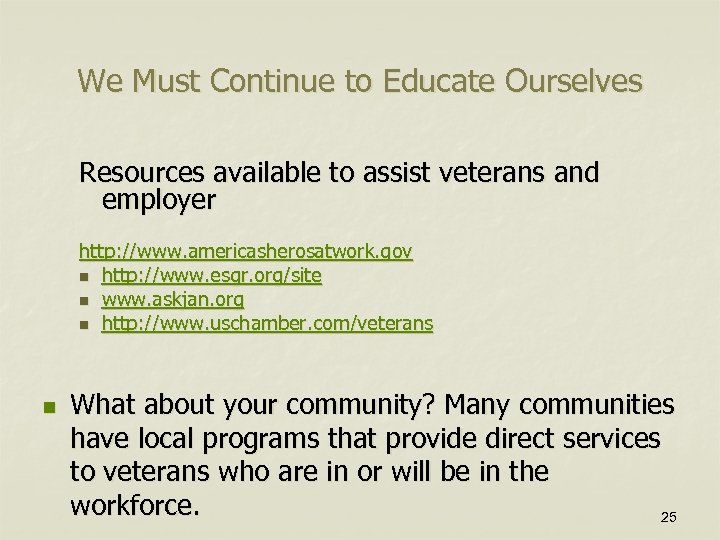
We Must Continue to Educate Ourselves Resources available to assist veterans and employer http: //www. americasherosatwork. gov n http: //www. esgr. org/site n www. askjan. org n http: //www. uschamber. com/veterans n What about your community? Many communities have local programs that provide direct services to veterans who are in or will be in the workforce. 25
Wrapping Up n n Other questions/Comments Thank you!! Dawn M. Klug, MS/LPC/CEAP Director of Operations, EAN dawn@eannc. com Renee’ Evans, Ph. D/LPC Licensed Professional Counselor and Consultant revans 6@bellsouth. net 26
n n n n n n n n References D. A. Masi (1984). Designing employee assistance programs. New York: American Management Associations. Pg 5. D. A. Masi (1984). Hale, J. , Evans, R. , & Hodiak, E. G. (Fall/Winter, 2008). Levering value in your employee assistance programs. North Carolina HR Review , 11 -12. Prohofsky, J. (Summer, 2005). Bridging the gap: Communicating employee assistance to your CEO. EAP Digest, 16 -18. Prohofsky, J. (Summer, 2005). Bridging the gap: Communicating employee assistance to your CEO. Mansfield, A. , Kaufman, J. , Marshall, S, Gaynes, B. , Morrissey, J. & Engel, C. (2010). Deployment and the use of mental health services among U. S. army wives. The New England Journal of Medicine, 362(2), 101 -109. Eaton K. M. Hoge, C. W. , Messer, S. C. , Whitt, A. A. , Cabrera, O. A. , Mc. Gurk, D. , Cox, A. & Castro, C. A. (2008). Prevalence of mental health problems, treatment need, and barriers to care among primary care-seeking spouses of military service members involved in Iraq and Afghanistan deployments. Military Medicine, 173(11), 1051. Evans, R. , & Meed, J. T. (2012). Managing transitions: The role of the EA provider in facilitating a military friendly workplace. University of North Carolina Citizen Soldier Program, The North Carolina. Employee Assistance Professional Association, & The North Carolina Area Health Education Centers. Gorman, L. A. , Blow, A. J. , Ames, B. D. & Reed, P. L. (2011). National guard families after combat: Mental health, use of mental health services, and perceived treatment barriers. Psychiatric Services (Washington, D. C. ), 62(1), 28 -34. Office of the Deputy Under Secretary of Defense (Military Community and Family Policy). 2010 Demographics Report, pg 1 -5 http: //www. militaryhomefront. dod. mil//12038/Project%20 Documents/Military. HOMEFRONT/Reports/2010_Demographics_Report. pdf Office of the Deputy Under Secretary of Defense (Military Community and Family Policy). 2010 Demographics Report, pg vii http: //www. militaryhomefront. dod. mil//12038/Project%20 Documents/Military. HOMEFRONT/Reports/2010_Demographics_Report. pdf Kudler, H; Dekle, J. ; Meed, J. ; Pfledderer, K. & Pfledderer, L. TTIWW: Understanding Military Family Issues. Greensboro AHEC Online course In production. Kudler, H. Military Family Issues training series. North Carolina AHEC system. November 2010 -June 2011. Kudler, H. Deployment Cycle Support Process- (DCS) Redeployment Stage http: //www. armyg 1. army. mil/dcs/redeployment. asp accessed 9/30/2012 12. Do. D Deployment Health Clinical Center, Enhanced Post-Deployment Health Assessment (PDHA) Process DD Form 2796). http: //www. pdhealth. mil/dcs/dd_form_2796. asp accessed 8/22/2012 13. U. S. Senate Committee on Veterans Affairs. “Press Release: Senator Murray’s Landmark Veterans Employment Bill Passes Senate. ” http: //veterans. senate. gov/press-releases. cfm? action =release. display&release_id =c 41 a 192 f-d 9 a 1 -412 e-8464 -c 30821 ff 5165 accessed 9/30/2012 13 a. OSD Guidance on Revised q 21 U. S. Department of Veterans Affairs. “Understanding Traumatic Brain Injury > Definition and Background” ( http: //www. polytrauma. va. gov/understanding-tbi/definition -and-background. asp) accessed March 7 th 2012. National Center for Telehealth & Technology (T 2) “Anger. ” Afterdeployment. org http: //afterdeployment. org/topics-anger, accessed Nov 30 2011” 15 a. NCPTSD (2007) “Anger and Trauma”. National Center for PTSD website. http: //www. ptsd. va. gov/public/pages/anger-and-trauma. asp Accessed March 27, 2012 Siratt, D. , Ozanian, A, Traenkner, B. Epidemiology and Prevention of Substance Use and Disorders in the Military Medicine 2012; 177: 21 -28 Nelson J. P. , Pederson, L. L & Lewis, J. Tobacco use in the Army: Illuminating patterns, practices, and options for treatment. Military Medicine 2009; 174: 164 -169 Siratt, D. , Ozanian, A, Traenkner, B. Epidemiology and Prevention of Substance Use and Disorders in the Military Medicine 2012; 177: 21 -28 Wong, K. “Rising Suicides Stump Military Leaders ” ABC News. September 27 th 2011 http: //abcnews. go. com/US/rising-suicides-stump-militaryleaders/story? id=14578134#. Tt. Z-lv. L 09 n. U, accessed 11/ 11 /2011. Kaufmann, K “The importantance of military families” New York Times, Nov 20 th 2011 http: //www. nytimes. com/roomfordebate/2011/11/20/how-can-we-preventmilitary-suicides/suicide-prevention-efforts-must-integrate-military-families “ Partners of Veterans with PTSD: Common Problems”http: //www. ptsd. va. gov/public/pages/partners-of-vets. asp, accessed Nov 30 th 2011 National Center for PTSD (NCPTSD) “Intimate Partner Violence” http: //www. ptsd. va. gov/public/pages/domestic-violence. asp Accessed March 7, 2012. Mc. Carroll. J. , Ursano, R. J. ; Liu, X. , Newby, J. H. ; Norwood, A. E. ; Fullerton, C. S. (2010)“Deployment and the Probability of Spousal Aggression by U. S. Army Soldiers” . Military Medicine. Vol 175 (5) p 352 -356 http: //www. ptsd. va. gov/public/pages/military-sexual-trauma-general. asp, accessed Nov 30 th 2011 27
Reference Continued n n n n n n Gibbs, D. ; Martin, S. ; Kupper, L. ; Johnson, R (2007)“Child Maltreatment in Enlisted Soldiers’ Families During Combat-Related Deployments. ” 2007. JAMA. Vol 298 (5) 528535. Warner, C. H. (2009). Psychological effects of deployments on military families. Psychiatric Annals, 39 (2), 56. Clinical Psychology Review 30 (2010) 595– 607 28 a. GAO (2009) “Army Needs to Reevaluate its Approach to Training and Mobilizing Reserve Component Forces” U. S. Government Accountability Office. http: //www. gao. gov/products/GAO-09 -720, accessed 11/28/11 GAO (2007). “Military Personnel : Additional Actions Needed to Improve Oversight of Reserve Employment Issues. http: //www. gao. gov/new. items/d 07259. pdf Accessed 11/28/11 IOM (Institute of Medicine). 2010. Returning Home from Iraq and Afghanistan: Preliminary Assessment of Readjustment Needs of Veterans, Service Members, and Their Families. Washington, DC: The National Academies Press. Brunson, J. G. 2010“MH/SA Issues & Technology: Assisting Combat Veterans with Hearing Loss”. Presented at the Governors Focus on Returning Veterans, Raleigh N. C. (2011). FOCUS (Families Overcoming Under Stress). A collaboration of BUMED & UCLA Semel Institute. Presentation for AHEC Military Family Issues March 28 th 2011 Presented by Linda Havens. (2011). FOCUS (Families Overcoming Under Stress). A collaboration of BUMED & UCLA Semel Institute. Presentation for AHEC Military Family Issues March 28 th 2011, Presented by Linda Havens. (2011) FOCUS (Families Overcoming Under Stress). A collaboration of BUMED & UCLA Semel Institute. Presentation for AHEC Military Family Issues March 28 th 2011 Presented by Linda Havens. . (2011). FOCUS (Families Overcoming Under Stress). A collaboration of BUMED & UCLA Semel Institute. Presentation for AHEC Military Family Issues March 28 th 2011 Presented by Linda Havens. Jones, J. (2011) “ Rate of Homeless Female Veterans rises Near Fort Brag” NPR. http: //www. npr. org/2011/09/15/140490523/rate-of-homeless-female-vets-rises-in-fayetteville -n-c Accesed March 27, 2012 ADDITIONAL REFERENCE Aamodt, M. G. (2004). Applied industrial/organizational psychology (4 th ed. ). Australia: Thomas/Wadsworth. Aamodt, M. G. (2004). Hale, J. , Evans, R. , & Hodiak, E. G. (Fall/Winter, 2008). Levering value in your employee assistance programs. North Carolina HR Review , 11 -12. D. A. Masi (1984). Designing employee assistance programs. New York: American Management Associations. D. A. Masi (1984). Myers, D. W. (1984). Establishing and building employee assistance programs. Connecticut: Quorum Books. Oher, J. M. (1999). The employee assistance handbook. New York: John Wiley & Sons, Inc. Oher, J. M. (1999). Prohofsky, J. (Summer, 2005). Bridging the gap: Communicating employee assistance to your CEO. EAP Digest, 16 -18. Prohofsky, J. (Summer, 2005). Bridging the gap: Communicating employee assistance to your CEO.
Скачать презентацию Train the Trainer Supporting Employees with Military Background
b4d00ffe8a19a9d4d2742f6c798d2ac8.ppt