



 Train
Train
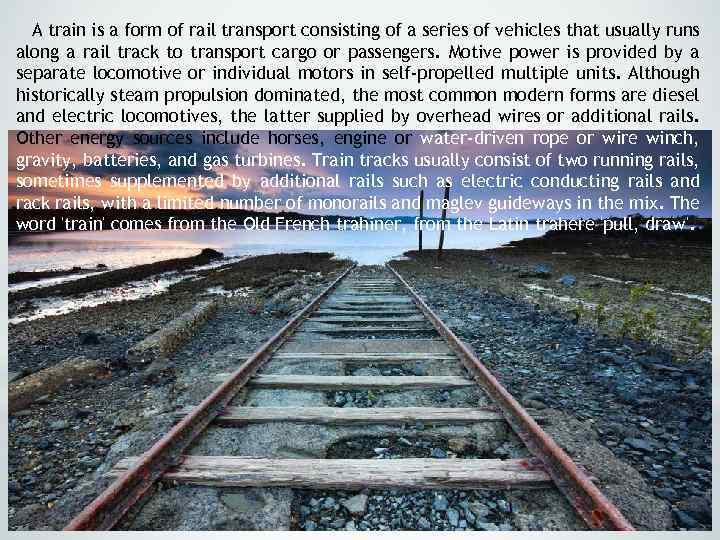 A train is a form of rail transport consisting of a series of vehicles that usually runs along a rail track to transport cargo or passengers. Motive power is provided by a separate locomotive or individual motors in self-propelled multiple units. Although historically steam propulsion dominated, the most common modern forms are diesel and electric locomotives, the latter supplied by overhead wires or additional rails. Other energy sources include horses, engine or water-driven rope or wire winch, gravity, batteries, and gas turbines. Train tracks usually consist of two running rails, sometimes supplemented by additional rails such as electric conducting rails and rack rails, with a limited number of monorails and maglev guideways in the mix. The word 'train' comes from the Old French trahiner, from the Latin trahere 'pull, draw'.
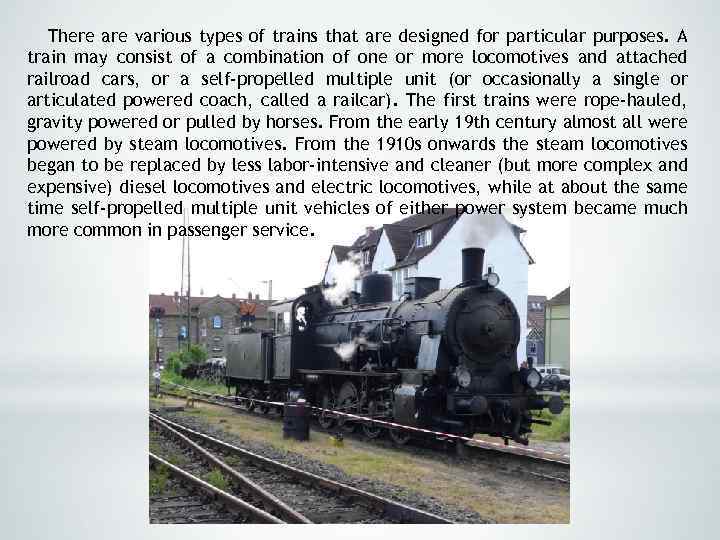 There are various types of trains that are designed for particular purposes. A train may consist of a combination of one or more locomotives and attached railroad cars, or a self-propelled multiple unit (or occasionally a single or articulated powered coach, called a railcar). The first trains were rope-hauled, gravity powered or pulled by horses. From the early 19 th century almost all were powered by steam locomotives. From the 1910 s onwards the steam locomotives began to be replaced by less labor-intensive and cleaner (but more complex and expensive) diesel locomotives and electric locomotives, while at about the same time self-propelled multiple unit vehicles of either power system became much more common in passenger service.
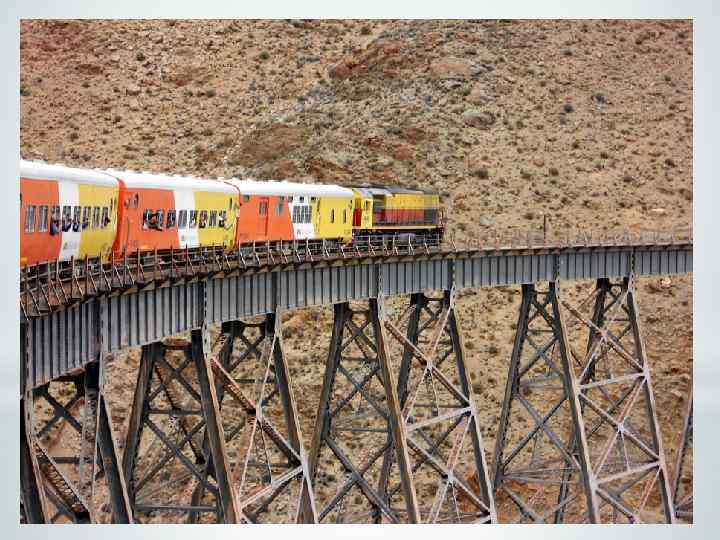
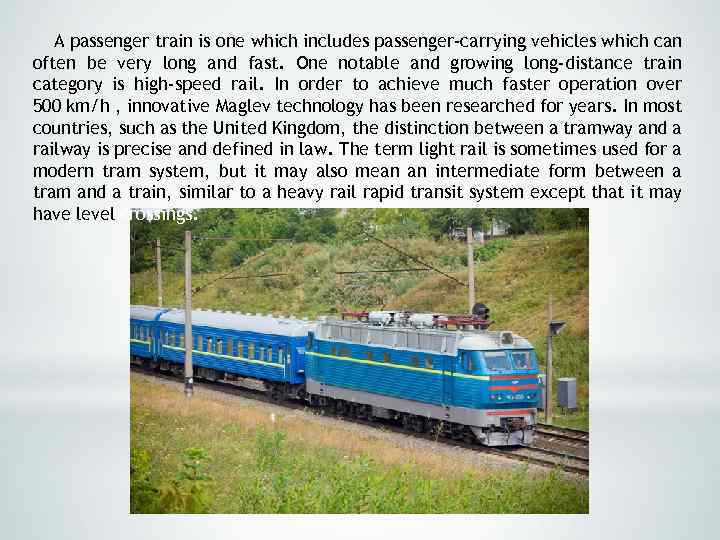 A passenger train is one which includes passenger-carrying vehicles which can often be very long and fast. One notable and growing long-distance train category is high-speed rail. In order to achieve much faster operation over 500 km/h , innovative Maglev technology has been researched for years. In most countries, such as the United Kingdom, the distinction between a tramway and a railway is precise and defined in law. The term light rail is sometimes used for a modern tram system, but it may also mean an intermediate form between a tram and a train, similar to a heavy rail rapid transit system except that it may have level crossings.
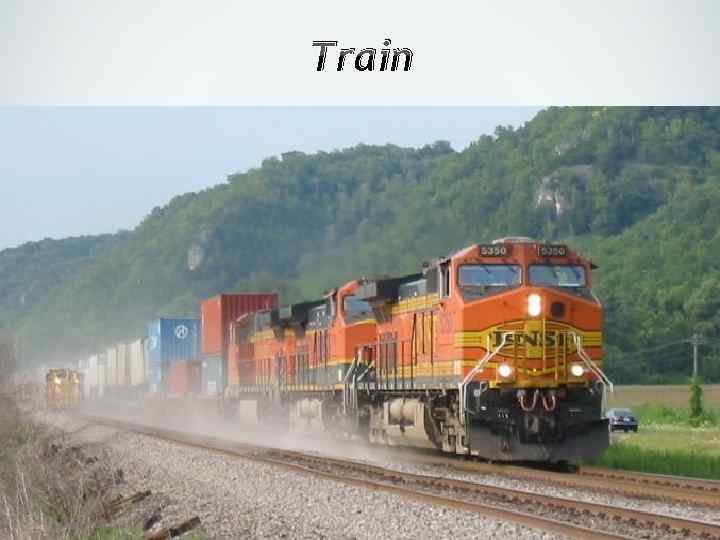
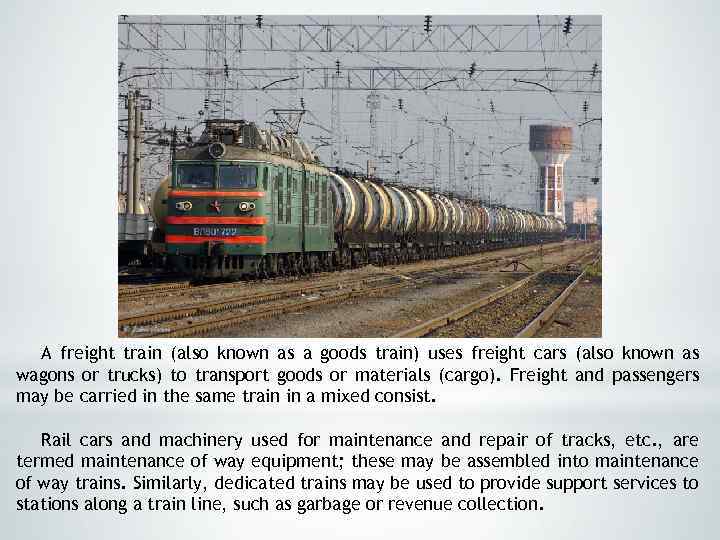 A freight train (also known as a goods train) uses freight cars (also known as wagons or trucks) to transport goods or materials (cargo). Freight and passengers may be carried in the same train in a mixed consist. Rail cars and machinery used for maintenance and repair of tracks, etc. , are termed maintenance of way equipment; these may be assembled into maintenance of way trains. Similarly, dedicated trains may be used to provide support services to stations along a train line, such as garbage or revenue collection.
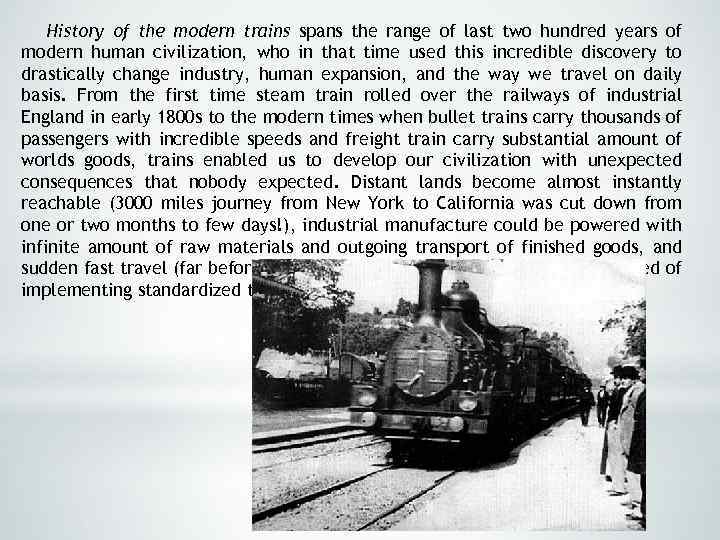 History of the modern trains spans the range of last two hundred years of modern human civilization, who in that time used this incredible discovery to drastically change industry, human expansion, and the way we travel on daily basis. From the first time steam train rolled over the railways of industrial England in early 1800 s to the modern times when bullet trains carry thousands of passengers with incredible speeds and freight train carry substantial amount of worlds goods, trains enabled us to develop our civilization with unexpected consequences that nobody expected. Distant lands become almost instantly reachable (3000 miles journey from New York to California was cut down from one or two months to few days!), industrial manufacture could be powered with infinite amount of raw materials and outgoing transport of finished goods, and sudden fast travel (far before first airplanes were discovered) caused the need of implementing standardized time zones across entire world.
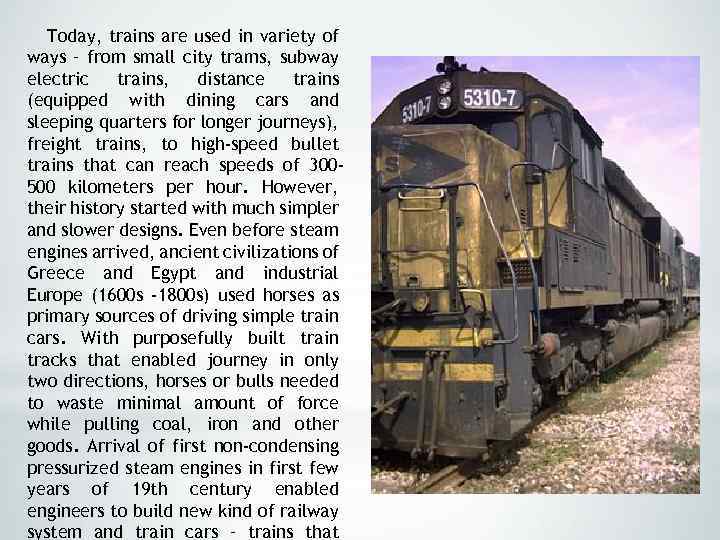 Today, trains are used in variety of ways – from small city trams, subway electric trains, distance trains (equipped with dining cars and sleeping quarters for longer journeys), freight trains, to high-speed bullet trains that can reach speeds of 300500 kilometers per hour. However, their history started with much simpler and slower designs. Even before steam engines arrived, ancient civilizations of Greece and Egypt and industrial Europe (1600 s -1800 s) used horses as primary sources of driving simple train cars. With purposefully built train tracks that enabled journey in only two directions, horses or bulls needed to waste minimal amount of force while pulling coal, iron and other goods. Arrival of first non-condensing pressurized steam engines in first few years of 19 th century enabled engineers to build new kind of railway system and train cars – trains that