


 Скачать презентацию Trade strategies for growth development Inward
37b79c2560010f30ade0902130b45c28.ppt
- Количество слайдов: 45
 Trade strategies for growth & development
 Inward vs outward-oriented International trade strategies in LDCs have formed the basis of growth & development strategies, so one can hardly consider one without considering the other. To start industrialization, LDCs have two options: 1. Discourage IMPORTS whilst developing substitutes → import substitution / inward oriented strategies. 2. Encourage EXPORTS to pay for needed imports → export-led growth / outward oriented strategies.
 Four periods • 1950 -60 s: Import substitution with strong government intervention • 1960 s-1970 s: Export-led with strong government intervention • 1980 s-1990 s: Export-led with market liberalization (Washington consensus) • Late 1990 s-2000: Export-led with selective government intervention (New Development consensus)
 Import substitution (1950 s-1960 s) • Also known as import-substituting industrialisation • Definition: growth and trade strategy where a country begins to manufacture simple consumer goods oriented towards the domestic market in order to promote the domestic industry. It depends on protective measures that will prevent entry of imports that compete with domestic producers.
 Rationale 1. Independence (from colonizers) seen as 2. opportunity to modernize. Instead of continuing to export commodities to and import manufactures from DCs: shut out manufactured imports from DCs and start producing those goods domestically. Historical experience of DCs, which used import subs strategies in their initial phases of development.
 3. Export pessimism in the 50 s-60 s caused 4. 5. by ↓Px and deterioration in balance of payments plus expectation of long term deterioration of To. T. Avoiding Bo. P problems through curtailment of imports. Infant industry argument.
 Import-substitution policies and consequences 1. High protection of dom firms, inefficiency and resource misallocation. Lack of competition→ high costs + inefficiencies + high prices paid by consumers. 2. Overvalued exchange rates, making imports of capital goods cheaper and X more expensive.
 Negative effects: • Capital-intensive methods→ urban UE + growth of informal sector • X in agricultural sector more difficult →worsen rural poverty 3. Excessive gov intervention, leading to misallocation of resources and inefficiencies in production.
 4. Neglect of agriculture → ↑need for food 5. imports Deterioration of Bo. P and debt position due to: a) ↑need for M of cap equipment and intermediate goods b) ↑need for food imports c) Outward flow of financial capital caused by repatriation of profits by MNCs and wealthy elites seeking safety for their financial investments
 6. Encouragement of cap-intensive 7. production methods, but no effort to ↑ access to credit or support users of labour-intensive technologies. Negative impacts on employment and income distribution.
 8. Limited possiblities for growth over the 9. longer term on the basis of import-subs, due to inefficiencies of production and misallocation of resources. For example, many firms enjoying protection never became efficient. More room for corruption favoured by strong government intervention (payments of bribes to gov officials in order to secure particular policies).
 • Problems with import-substitution became apparent in the 60 s: – India, Egypt reacted by ↑protection for cap goods imports and other intermediate goods in order to allevaite Bo. P problems. – Others (Brazil, Israel, Mexico, Singapore, South korea, Taiwan, Southern European countries) moved towards export promotion.
 Export promotion (1960 s-1970 s) • Export-led growth strategy: a growth and trade strategy where a country attempts to achieve economic growth by expanding its exports. Based on strong government intervention. • It is an outward-oriented strategy since it looks outward towards foreign markets and provides stronger links between the domestic and global economies.
 • Strong gov intervention necessary to help countries develop a strong manuf sector oriented towards exports. • Most LDCs that turned to export promotion had began their industrialization with import-substitution. The stronger export industries were in many cases the ones that had received protection.
 • China, Hong Kong (more market-oriented), Indonesia, Japan, Malaysia, Singapore, South Korea, Taiwan, Thailand = Newly Industrializing Economies (NIEs) or Asian Tigers. All of them pursued export promotion of manufactured goods strongly supported by gov intervention and industrial policies.
 Interventionist policies 1. State ownership and control of financial 2. 3. institutions, in order to provide subsidized credit to the industries being promoted. Targeting of industries for export. Industrial policies to support export industries: investment grants, production subsidies to export industries, tax exemptions, export subsidies. . .
 4. Some (selective) protection of domestic industries. 5. Requirements on MNCs in order to 6. maximize benefits of FDI: promotion of R&D, transfer of targeted technologies into the domestic economy, training of dom workers, use of local inputs. Large public investments in key areas: education and skills, R&D, transport and communications infrastructure.
 7. Incentives for R&D by private sector for high tech products. To encourage development of domestic skill levels and technology appropriate to local conditions. These policies resulted in successful export performance and the achievement of very high economic growth rates. Since the 1950 s, NIESs have been the fastest growing economies in the developing world.
 The Success of the Asian Tigers 1. Expansion into foreign markets. 2. Benefits of diversification. 3. Major investments in human capital. 4. Appropriate technologies. 5. Increased employment (from the use of labour-intensive technologies). 6. Export earnings avoided balnce of payments problems.
 1980 s-1990 s: Export-led with Market Liberalization: Washington Consensus • Early 80 s: 1. Poor econ and export performance in many LDCs and high indebtedness 2. Shift in thinking about econ growth and development inspired by neoclassical model, which stressed importance of limiting gov intervention and allowing private sector to operate in a competitive free-market environment. Outward orientation based on free-trade.
 • Main policies recommended: 1. 2. 3. 4. 5. Trade liberalisation No restrictions to new FDI by MNCs Sound fiscal policy (no excessive borrowing) Tax reform Changing priorities of gov spending towards health, education, infrastructure 6. Interest rate liberalization 7. Market-determined exchange rates 8. Privatization 9. Deregulation 10. Securing property rights
 • Rationale: reliance on market forces and free trade maximizes efficiency, domestic and global allocation of resources and economic growth. • LDCs that have adopted these policies include Argentina, Brazil, China, Chile, India, Kenya, Sri Lanka, Tanzania, Turkey. They began a process of ↓gov intervention in the market.
 • Strong influence of the World Bank and the IMF, which lent these countries funds on the condition of reorienting their economies towards freer trade and freer market.
 Impacts of economic and trade liberalization 1. Limited benefits for export growth and diversification: • Countries lost export shares in world markets, especially in Africa • LDCs did not succeed in diversifying their production into manufacturing. Countries that performed best were those that had already developed significant export sectors.
 Causes of these negative impacts: a. Protectionist policies by DCs b. Growing reliance on free market policies 2. Limited impacts on economic growth • No hard evidence suggesting that a greater outward orientation based on freer trade during 80 s, 90 s has been responsible for more rapid econ growth.
 • Great variability in performance. • Some economists see no link between • econ growth and trade liberalization. Some countries better able to benefit from freer trade. Low income countries perform the worst→ ↑inequalities between rich and poor.
 3. Increasing income inequalities and poverty within LDCs. World Bank study reveals that the correlation between trade liberalization and income growth is – Negative among the 40% poorest of the population – Positive among the higher income groups So it helps the rich get richer and the poor get poorer. Reason: econ and trade liberalization give rise to winners and losers.
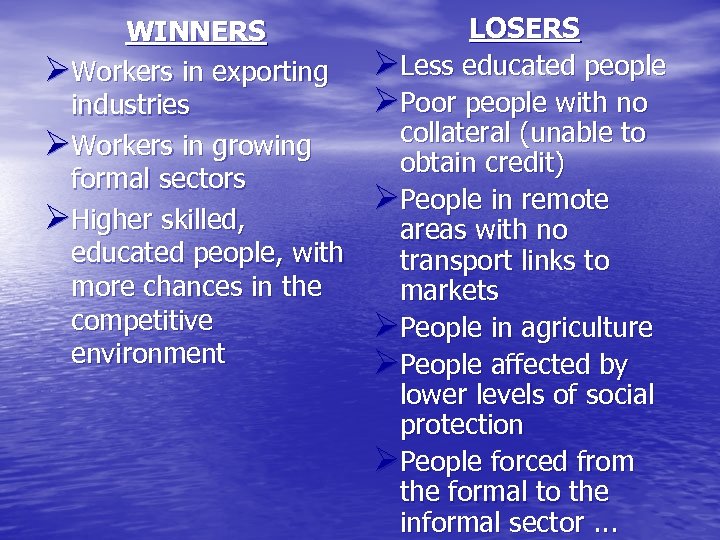 WINNERS ØWorkers in exporting industries ØWorkers in growing formal sectors ØHigher skilled, educated people, with more chances in the competitive environment LOSERS ØLess educated people ØPoor people with no collateral (unable to obtain credit) ØPeople in remote areas with no transport links to markets ØPeople in agriculture ØPeople affected by lower levels of social protection ØPeople forced from the formal to the informal sector. . .
 • According to int’al trade theory, free trade originates overall gains that are likely to be greater than the overall losses. However, in the real world this rarely occurs, with the result that some people are worse off due to freer trade and freer markets. • Late 1990 s: the Washington consensus was called into question even by the Chief economist of the World bank, Joseph Stiglitz.
 Late 1990 s-2000 s: Export-led growth strategies with selective gov intervention: The New Development Consensus • Gov. ’s role in LDCs should be complemented (not substituted) by markets. • Governments must support education, health and infrastructure development, as well as R&D for both industry and agriculture.
 • Gov should pursue policies that promote income equality and poverty alleviation. • Gov must provide regulatory framework for markets to work efficiently: regulation of financial system and regulatory framework for competition (to avoid development of private monopolies. • Market-supporting institutions (tax systems, property rights, banking & credit. . . ) should be promotes.
 • DCs must assist econ development by ↑foreign aid and providing increased access to their markets by LDCs. • Due to their special circumstances, LDCs should receive special treatment by int’al trade agreements regarding removal of their protectionist measures.
 Remark: • Unlike the strongly interventionist supplyside policies pursued by the Asian tigers, that focused on direct support and protection against competition, the New Dev Consensus favours the establishment of institutions and conditions that assist firms to do well in a competitive market environment.
 Support for: – R&D in targeted areas – Vocational training and education – Small firms – Development of infrastructure
 • Justification for industrial policies: numerous kinds of market failures that may prevent countries/markets from: – Setting up the needed private firms – Undertaking the necessary R&D – Innovating – Importing appropriate technologies
 Evaluation of Inward and Outward-oriented strategies • Benefits: those of international free trade – Increased dom. production and consumtion due to specialization – Economies of scale – Greater variety and quality of g+s – Allows countries to acquire needed resources – Flow of new ideas and technology – Increased X + more efficiency = Larger growth rates
 • Obstacles a) If countries specialize in production & export of primary commodities: – Unstable export revenues due to price volatility. – Deteriorating To. T for exporters of primary commodities over long periods of time (due to low YED for these exports, among other) – Rich country protection of their farmers may limit access to rich country markets and cause price ↓ of protected commodities.
 b) If countries specialize in production and X of manufactured goods: Protectionist policies imposed by DCs: – Prevent access to the large and rich markets – Discourage diversification of LDC into manufacturing and higher VA activities (tariff escalation, admin and technical barriers)
 Can LDCs imitate the trade and growth strategies of the Asian Tigers? 1. The Asian Tigers faced lower trade barriers on their X of manufactures to DCs. Some trade barriers were increased during the 1980 s, after the entry of East Asian exports into DCs markets. This was in order to protect • domestic producers against low cost competing goods and • their workers against losing their jobs due to entry of low cost imports
 2. The Asian Tigers’ outward orientation was export promotion with strong gov intervention, whereas countries in the 80 s opened to international trade on the basis of marketbased policies. Interventionist supply-side policies played a key role in the development of manufacturing and higher VA production. LDCs that opened up to int’al trade in the context of market-based policies could not rely on government support for their export industries.
 Concluding remarks 1. An outward oriented trade strategy is superior to an inward-oriented one. 2. Significant advantages in an outwardoriented strategy based on diversification of Xs into manufacturing and higher VA activities. 3. DC protectionism is a major obstacle.
 Role of the WTO
 Bilateral and regional preferential trade agreements (FTAs)
 Diversification
 Capital liberalisation