


 Скачать презентацию Trade Remedies and Tariff Overhang at the WTO
7ca97ddfed66628889170b3e2ac88d95.ppt
- Количество слайдов: 25
 Trade Remedies and “Tariff Overhang” at the WTO Marc L. Busch, Georgetown Krzysztof J. Pelc, Princeton and Mc. Gill
 Summary • With nearly all tariffs bound under WTO obligation, Members use other protectionism • The most popular protectionist tools are so-called trade remedies: ADs, CVDs, and safeguards • But in fact, many countries have tariff overhang, and this influences their use of trade remedies
 Trade Rules and Flexibility • WTO builds in flexibility, allowing Members to temporarily abrogate obligations in hard times. • Trade remedies serve this purpose, but Members can also exploit tariff overhang, which averages 18% • Each of these measures entails different costs and benefits to the user, and to the institution
 Why Trade Remedies? • There is evidence that flexibility allows Members to make deeper commitments to liberalization • Trade remedies may also lower the barriers to joining trade institutions, increasing membership • This is because ADs, CVDs and safeguards help ease the political cost of adjusting to free trade
 Yet Flexibility Comes at a Cost • Trade remedies create uncertainty and thus can reduce international commerce • The easier it is to use trade remedies, the more likely they are to be abused • Trade remedies may thus simply substitute for tariff liberalization: law of constant protection
 How do Trade Remedies Work? • AD: Tariff applied to imported products thought to be priced lower than fair market value • CVD: Tariff levied to offset a perceived subsidy by a foreign government • Safeguard: Duty on import that has experienced an unexpected surge, causing injury domestically
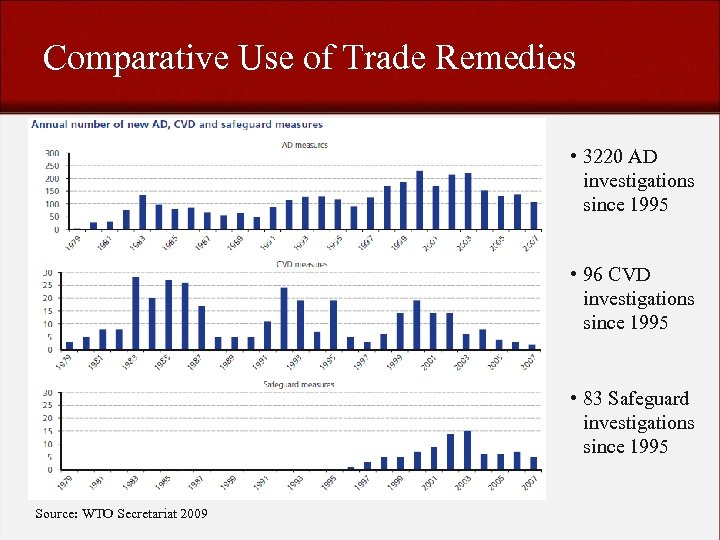 Comparative Use of Trade Remedies • 3220 AD investigations since 1995 • 96 CVD investigations since 1995 • 83 Safeguard investigations since 1995 Source: WTO Secretariat 2009
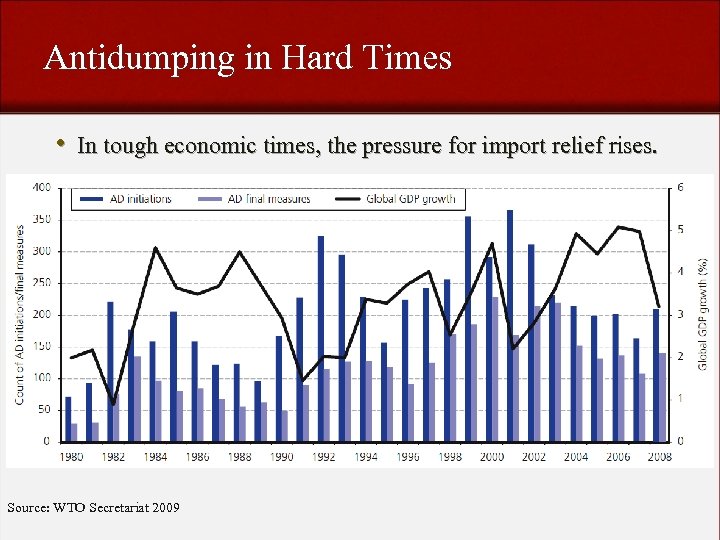 Antidumping in Hard Times • In tough economic times, the pressure for import relief rises. Source: WTO Secretariat 2009
 Antidumping • The most used trade remedy is antidumping: targeted, easily extendable, no stringent criteria • Mostly used by developing countries (two thirds of AD measures): India is by far the top user. • Also sparks greatest number of WTO complaints: 60 since 1995, vs. 20 on CVD, 34 on safeguards
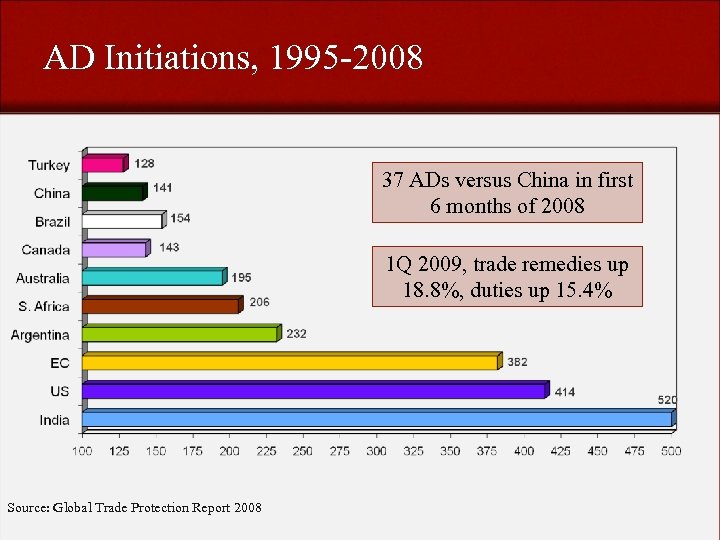 AD Initiations, 1995 -2008 37 ADs versus China in first 6 months of 2008 1 Q 2009, trade remedies up 18. 8%, duties up 15. 4% Source: Global Trade Protection Report 2008
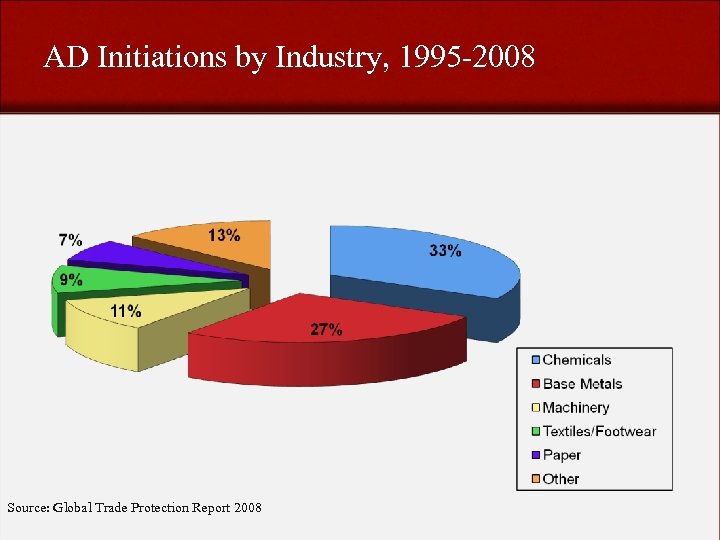 AD Initiations by Industry, 1995 -2008 Source: Global Trade Protection Report 2008
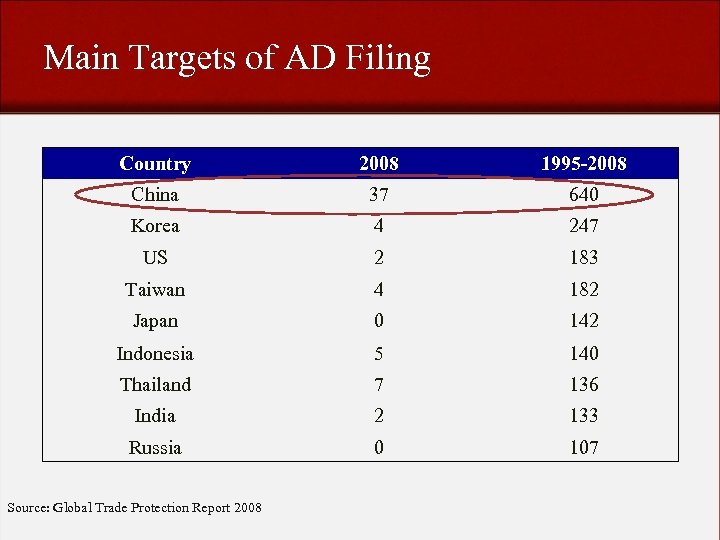 Main Targets of AD Filing Country 2008 1995 -2008 China 37 640 Korea 4 247 US 2 183 Taiwan 4 182 Japan 0 142 Indonesia 5 140 Thailand 7 136 India 2 133 Russia 0 107 Source: Global Trade Protection Report 2008
 Countervailing Duties • Like AD, countervailing duties offset perceived “unfair” measures • Used by developed countries (86% of measures) against developing countries (61% of targets) • The amount of the duty is limited to the amount of the alleged subsidy
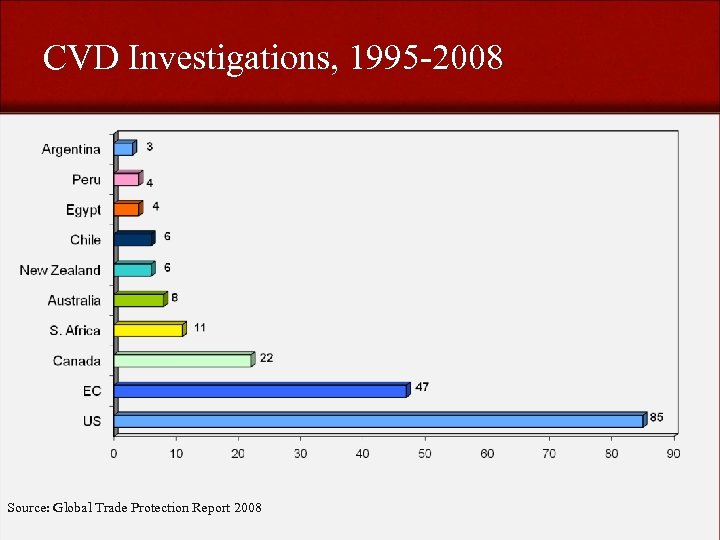 CVD Investigations, 1995 -2008 Source: Global Trade Protection Report 2008
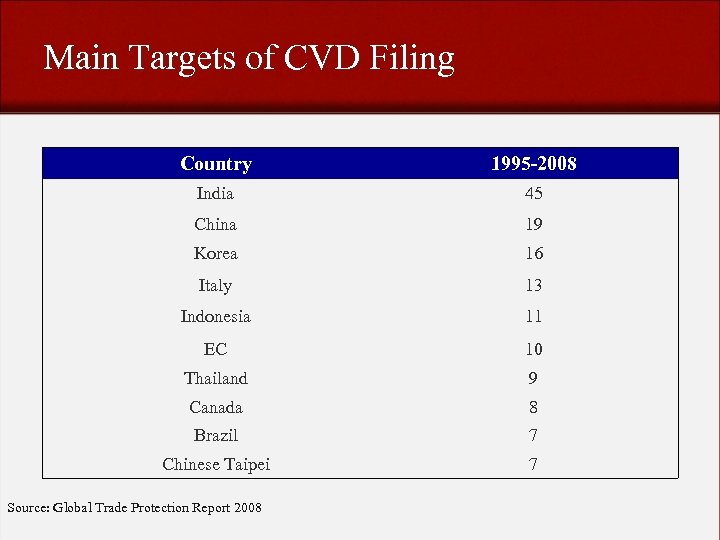 Main Targets of CVD Filing Country 1995 -2008 India 45 China 19 Korea 16 Italy 13 Indonesia 11 EC 10 Thailand 9 Canada 8 Brazil 7 Chinese Taipei 7 Source: Global Trade Protection Report 2008
 Safeguards • Contingent on import increase, injury, and “unforeseen developments” • Most frequent users are developing countries (representing 89% of measures) • Not targeted at a specific country, as opposed to either an AD or CVD
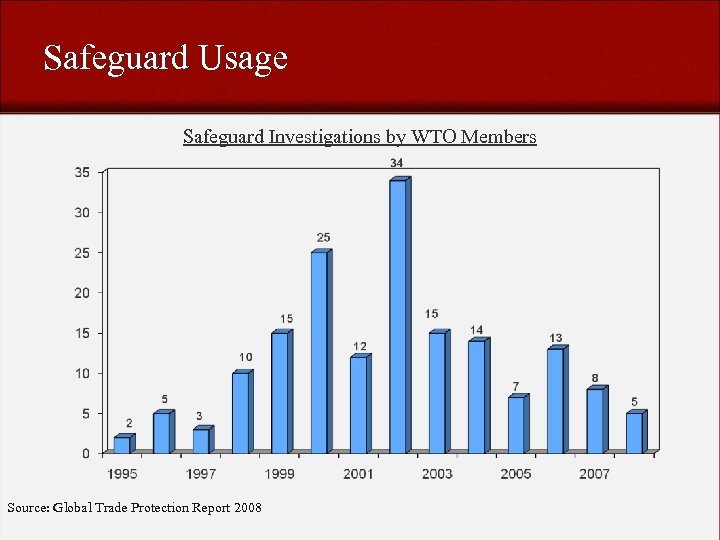 Safeguard Usage Safeguard Investigations by WTO Members Source: Global Trade Protection Report 2008
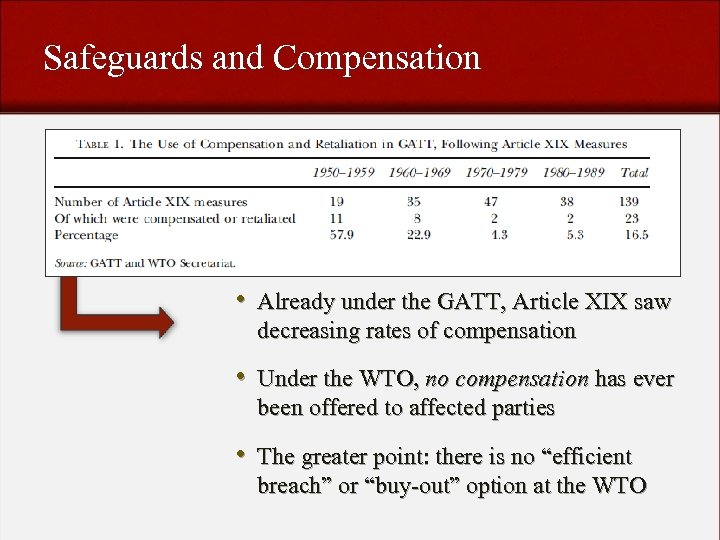 Safeguards and Compensation • Already under the GATT, Article XIX saw decreasing rates of compensation • Under the WTO, no compensation has ever been offered to affected parties • The greater point: there is no “efficient breach” or “buy-out” option at the WTO
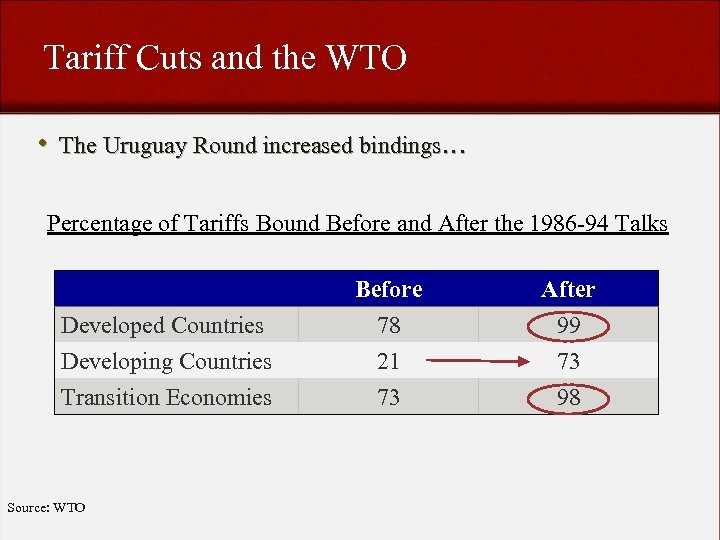 Tariff Cuts and the WTO • The Uruguay Round increased bindings… Percentage of Tariffs Bound Before and After the 1986 -94 Talks Developed Countries Developing Countries Transition Economies Source: WTO Before 78 21 73 After 99 73 98
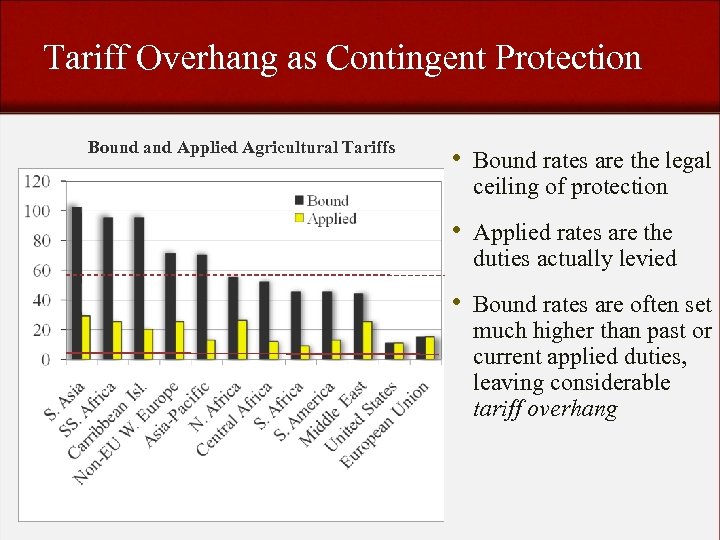 Tariff Overhang as Contingent Protection Bound and Applied Agricultural Tariffs • Bound rates are the legal ceiling of protection • Applied rates are the duties actually levied • Bound rates are often set much higher than past or current applied duties, leaving considerable tariff overhang
 Tariff Overhang and Unpredictability • Exploiting tariff overhang is cheap, since there is no legal check • This ease of use leads to unpredictability, which acts as a tax on trade • Increasing overhang on a product by one standard deviation decreases imports by 18%, on average
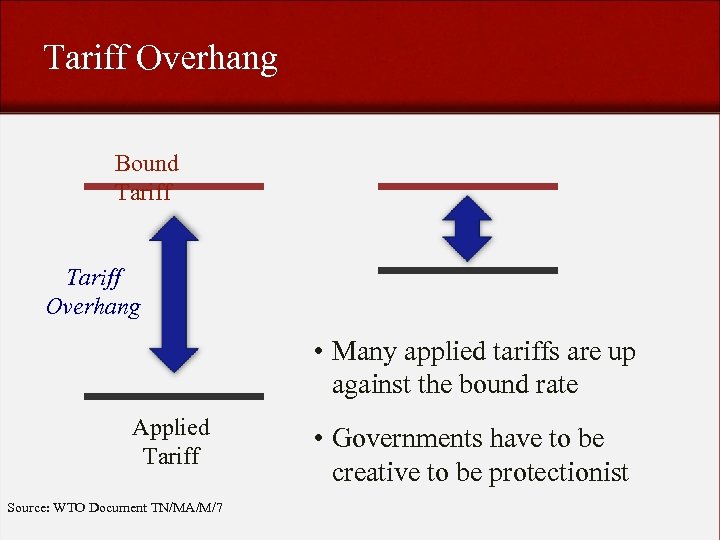 Tariff Overhang Bound Tariff Overhang • Many applied tariffs are up against the bound rate Applied Tariff Source: WTO Document TN/MA/M/7 • Governments have to be creative to be protectionist
 Tariff Binding and Trade Remedies • Once a binding on a product takes effect, it is more likely to be targeted for trade remedies • Past that binding point, the amount of tariff overhang influences use of trade remedies • Thus, tariff overhang and trade remedies are inextricably linked
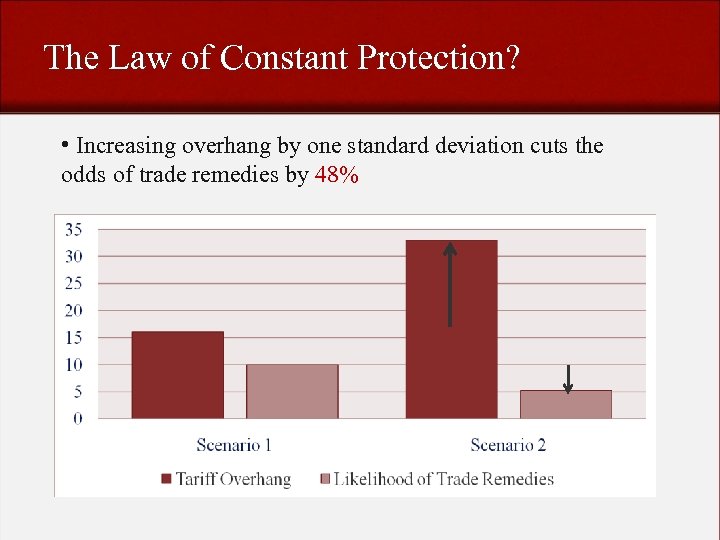 The Law of Constant Protection? • Increasing overhang by one standard deviation cuts the odds of trade remedies by 48%
 Conclusion • Some built in flexibility is a necessary element of trade agreements • Reliance on flexibility increases in tough times, or in reaction to increased commitments • Trade remedies limit unpredictability through legal checks; tariff overhang does not • The inability to use one type of flexibility may increase reliance on other devices