 Скачать презентацию Trade-offs in High-Performance Numerical Library Design Lois Curfman
6b255207f33d3c032825c9d194fe15dc.ppt
- Количество слайдов: 47



Trade-offs in High-Performance Numerical Library Design Lois Curfman Mc. Innes Mathematics and Computer Science Division Argonne National Laboratory The Conference on High Speed Computing April 22 -25, 2002 Salishan Lodge, Gleneden Beach, Oregon 1
Outline • Motivation – Complex, multi-physics, multi-scale applications – Distributed, multi-level memory hierarchies • High-Performance Scientific Components – What are components? – Common Component Architecture (CCA) – Center for Component Technology for Terascale Simulation Software (CCTTSS) • Parallel Components for PDEs and Optimization – Approach – Performance • Ongoing Challenges 2
Collaborators • Co-developers of PETSc – Satish Balay, Kris Buschelman, Bill Gropp, Dinesh Kaushik, Matt Knepley, Barry Smith, Hong Zhang • Co-developers of TAO – Steve Benson, Jorge Moré, Jason Sarich • CCA/CCTTSS collaborators – Include ANL, Indiana Univ. , LANL, LLNL, ORNL, PNNL, SNL, Univ. of Utah, etc. – Led by Rob Armstrong (SNL) – Special thanks to L. Freitag and B. Norris 3
Acknowledgements • U. S. Department of Energy – Office of Science – Core funding in the MCS Division of Argonne through the Mathematical, Information, and Computational Science (MICS) program – Advanced Computational Testing and Simulation (ACTS) toolkit – Scientific Discovery through Advanced Computing (Sci. DAC) program • National Science Foundation – Multi-Model Multi-Domain Computational Methods in Aerodynamics and Acoustics 4
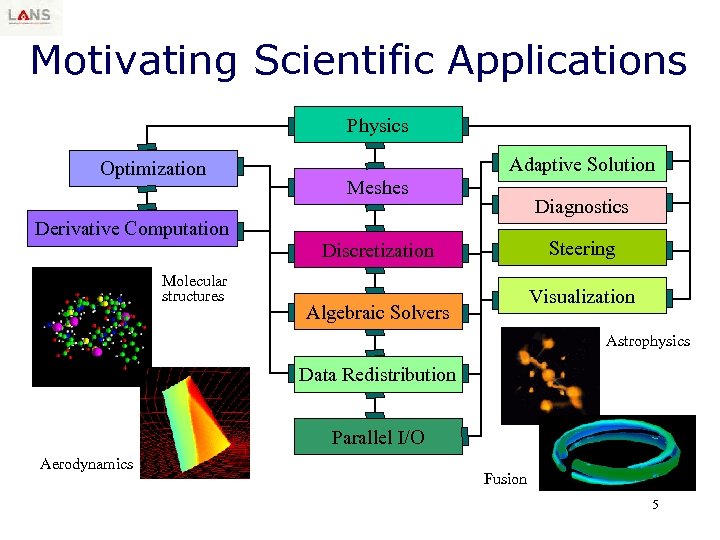
Motivating Scientific Applications Physics Optimization Derivative Computation Molecular structures Adaptive Solution Meshes Diagnostics Steering Discretization Visualization Algebraic Solvers Astrophysics Data Redistribution Parallel I/O Aerodynamics Fusion 5
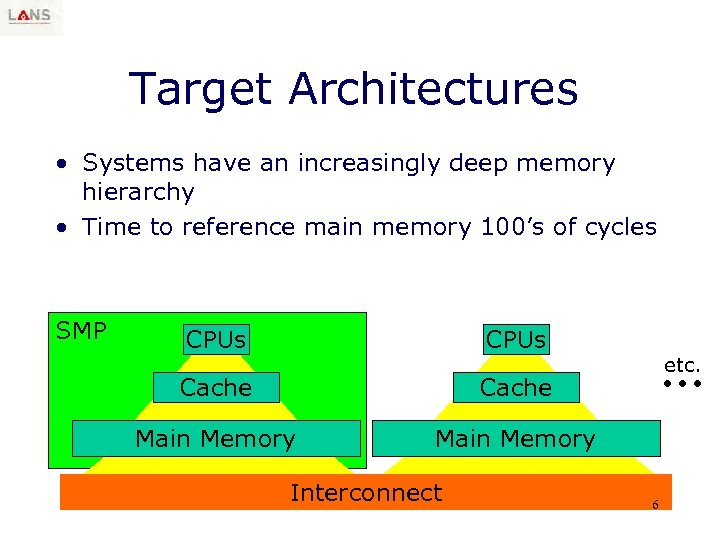
Target Architectures • Systems have an increasingly deep memory hierarchy • Time to reference main memory 100’s of cycles SMP CPUs Cache Main Memory Interconnect . . . etc. 6
Challenges • Community Perspective – Life-cycle costs of applications are increasing • Require the combined use of software developed by different groups • Difficult to leverage expert knowledge and advances in subfields • Difficult to obtain portable performance • Individual Scientist Perspective – Too much energy focused on too many details • Little time to think about modeling, physics, mathematics • Fear of bad performance without custom code • Even when code reuse is possible, it is far too difficult • Our Perspective – How to manage complexity? • Numerical software tools that work together • New algorithms (e. g. , interactive/dynamic techniques, algorithm composition) • Multi-model, multi-physics simulations 7
Outline • Motivation – Complex, multi-physics, multi-scale applications – Distributed, multi-level memory hierarchies • High-Performance Scientific Components – What are components? – Common Component Architecture (CCA) – Center for Component Technology for Terascale Simulation Software (CCTTSS) • Parallel Components for PDEs and Optimization – Approach – Performance • Ongoing Challenges 8
Why Use Components? X Hero programmer producing single-purpose, monolithic, tightly-coupled parallel codes • Promote software reuse – “The best software is code you don’t have to write. ” [Steve Jobs] • Reuse, through cost amortization, allows – thoroughly tested code – highly optimized code – developer team specialization • Also reuse of skills, practice, and design [Thanks to Craig Rasmussen (LANL) for the base of this slide. ] 9
What are differences between objects and components? • More similar than different – Object: a software black box – Component: object + • OO techniques are useful for building individual components by relatively small teams; component technologies facilitate sharing of code developed by different groups by addressing issues in – Language interoperability • Via interface definition language (IDL) – Well-defined abstract interfaces • Enable “plug-and-play” – Dynamic composability • Components can discover information about their environment (e. g. , interface discovery) from framework and connected components • Can easily convert from an object orientation to a component orientation – Automatic tools can help with conversion (ongoing work by C. Rasmussen and M. Sottile, LANL) • For more info: C. Szyperski, Component Software: Beyond Object. Oriented Programming, ACM Press, New York, 1998 10
CCA History and Participants • 1998: CCA Forum originated – Participation from researchers who were exploring one-to-one software interfacing in the DOE ACTS Toolkit program – Open to everyone interested in HPC components – See http: //www. cca-forum. org – Active CCA Forum participants include • ANL - Lori Freitag, Kate Keahey, Jay Larson, Lois Mc. Innes, Boyana Norris • Indiana Univ. - Randall Bramley, Dennis Gannon • LANL - Craig Rasmussen, Matt Sotille • LLNL - Scott Kohn, Gary Kumfert, Tom Epperly • ORNL - David Bernholdt, Jim Kohl • PNNL - Jarek Nieplocha, Theresa Windus • SNL - Rob Armstrong, Ben Allan, Curt Janssen, Jaideep Ray • Univ. of Utah - Steve Parker • And others as well … • 2001: Center for Component Technology for Terascale Simulation Software (CCTTSS) founded – Support from the DOE Sci. DAC Initiative – CCTTSS team is a subset of the CCA Forum – Leader: Rob Armstrong (SNL) – See http: //www. cca-forum. org/ccttss 11
CCTTSS Multi-Pronged Approach CCTTSS Leader: Rob Armstrong (SNL) • HPC component specification and framework – coordinator Scott Kohn (LLNL) – Unified reference framework implementation targeting both SPMD and distributed environments – Tools for language interoperability via a Scientific Interface Definition Language (SIDL) • Suite of scientific components – Mc. Innes (ANL) coordinator Lois Curfman – Linear and nonlinear algebra, optimization, mesh management, scientific data, visualization, steering, fault tolerance, scientific application domains, etc. • Parallel data redistribution – coordinator Jim Kohl (ORNL) – Model coupling, visualization • Applications integration – coordinator David Bernholdt (ORNL) – General outreach to the scientific community – Close feedback loop for users/developers of CCA technology – Collaborate with climate and chemistry applications domains as well as other groups 12
Requirements for a High-Performance Component Architecture • Simple/Flexible – to adopt – to understand – to use • Support a composition mechanism that does not impede high-performance component interactions • Permit the SPMD paradigm in component form • Meant to live with and rely on other commodity component frameworks to provide services. . . – e. g. , Java. Beans, CORBA, … 13
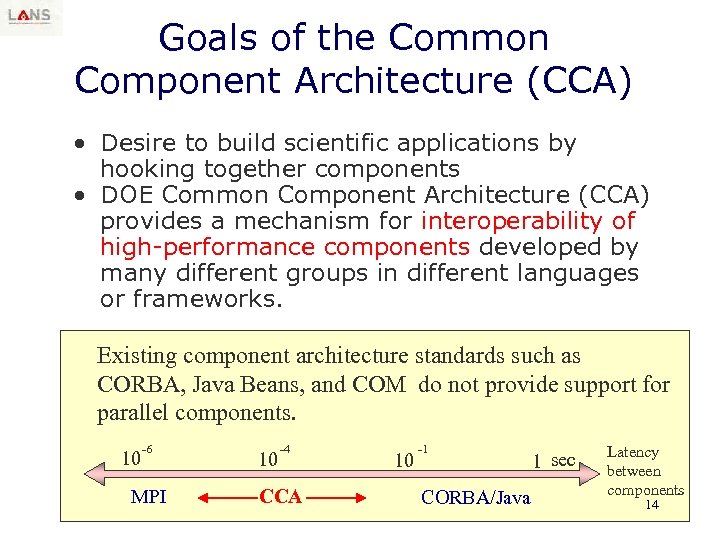
Goals of the Common Component Architecture (CCA) • Desire to build scientific applications by hooking together components • DOE Common Component Architecture (CCA) provides a mechanism for interoperability of high-performance components developed by many different groups in different languages or frameworks. Existing component architecture standards such as CORBA, Java Beans, and COM do not provide support for parallel components. 10 -6 MPI 10 -4 CCA 10 -1 CORBA/Java 1 sec Latency between components 14
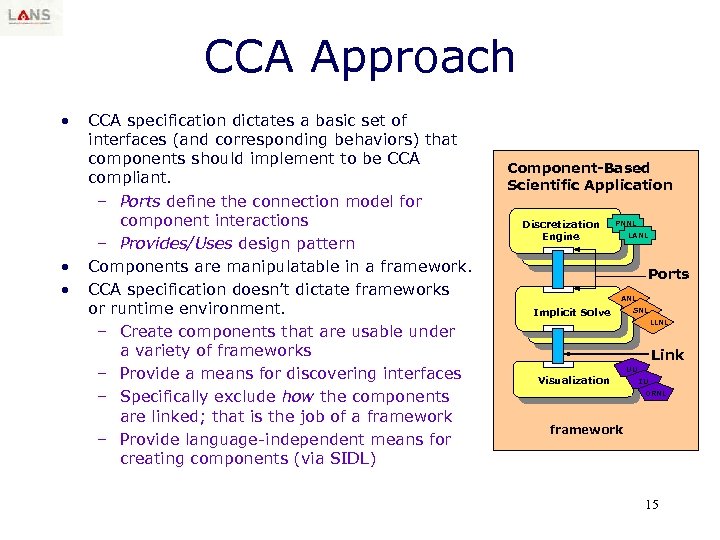
CCA Approach • • • CCA specification dictates a basic set of interfaces (and corresponding behaviors) that components should implement to be CCA compliant. – Ports define the connection model for component interactions – Provides/Uses design pattern Components are manipulatable in a framework. CCA specification doesn’t dictate frameworks or runtime environment. – Create components that are usable under a variety of frameworks – Provide a means for discovering interfaces – Specifically exclude how the components are linked; that is the job of a framework – Provide language-independent means for creating components (via SIDL) Component-Based Scientific Application Discretization Engine PNNL LANL Ports ANL Implicit Solve SNL LLNL Link UU Visualization IU ORNL framework 15
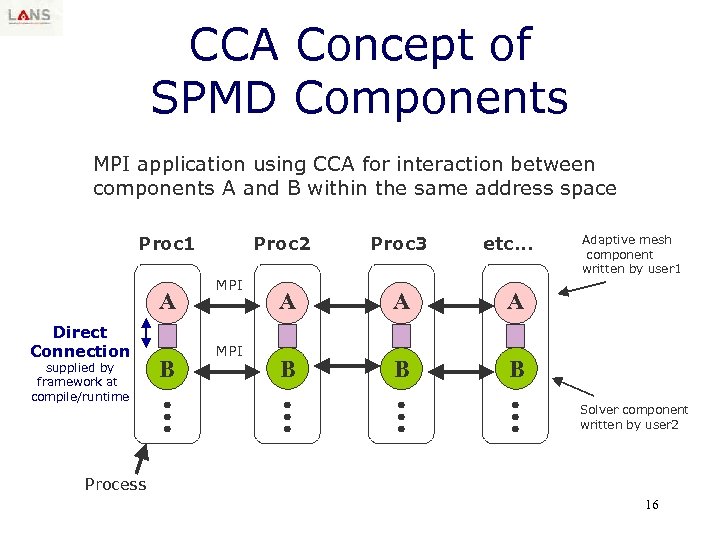
CCA Concept of SPMD Components MPI application using CCA for interaction between components A and B within the same address space Proc 1 A Direct Connection supplied by framework at compile/runtime B Proc 2 MPI Proc 3 etc. . . A A A B B Adaptive mesh component written by user 1 B Solver component written by user 2 Process 16
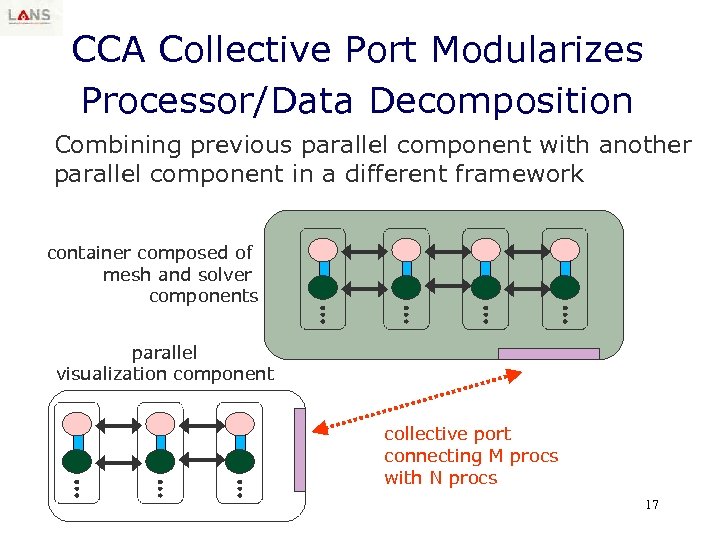
CCA Collective Port Modularizes Processor/Data Decomposition Combining previous parallel component with another parallel component in a different framework container composed of mesh and solver components parallel visualization component collective port connecting M procs with N procs 17
CCA References • Web sites – CCA Forum • http: //www. cca-forum. org – Center for Component Technology for Terascale Simulation Software (CCA Sci. DAC Center) • http: //www. cca-forum. org/ccttss – Sample component software and applications • http: //www. cca-forum. org/cca-sc 01 • Introductory paper – R. Armstrong, D. Gannon, A. Geist, K. Keahey, S. Kohn, L. Mc. Innes, S. Parker, and B. Smolinski, Toward a Common Component Architecture for High-Performance Scientific Computing, Proceedings of the High-Performance Distributed Computing Conference, pp. 115 -124, 1999. 18
More CCA Papers • • B. Norris, S. Balay, S. Benson, L. Freitag, P. Hovland, L. Mc. Innes, and B. Smith, Parallel Components for PDEs and Optimization: Some Issues and Experiences, preprint ANL/MCS-P 932 -0202, February 2002, Parallel Computing (to appear). B. Allan, R. Armstrong, A. Wolfe, J. Ray, D. Bernholdt, and J. Kohl, The CCA Core Specification in a Distributed Memory SPMD Framework, August 2001, Concurrency and Computation: Practice and Experience (to appear). T. Epperly, S. Kohn, and G. Kumfert. Component Technology for High. Performance Scientific Simulation Software, Proceedings of the International Federation for Information Processing’s Working Conference on Software Architectures for Scientific Computing, 2000. S. Parker, A Component-based Architecture for Parallel Multi-Physics PDE Simulations, Proceedings of the 2002 International Conference on Computational Science (to appear). M. Sottile and C. Rasmussen, Automated Component Creation for Legacy C++ and Fortran Codes, Proceedings of the First International IFIP/ACM Working Conference on Component Deployment, June 2002 (submitted). R. Bramley, K. Chiu, S. Diwan, D. Gannon, M. Govindaraju, N. Mukhi, B. Temko, and M. Yechuri, A Component Based Services Architecture for Building Distributed Applications, Proceedings of High Performance Distributed Computing, 2000. K. Keahey, P. Beckman, and J. Ahrens, Ligature: A Component Architecture for High-Performance Applications, International Journal of High. Performance Computing Applications, 2000. 19
Related Work • • N. Furmento, A. Mayer, S. Mc. Gough, S. Newhouse, T. Field, and J. Darlington, Optimization of Component-based Applications within a Grid Environment, Proceedings of SC 2001. C. René, T. Priol, and G. Alléon, Code Coupling Using Parallel CORBA Objects, Proceedings of the International Federation for Information Processing’s Working Conference on Software Architectures for Scientific Computing, 2000. E. de Sturler, J. Hoeflinger, L. Kale, and M. Bhandarkar, A New Approach to Software Integration Frameworks for Multiphysics Simulation Codes, Proceedings of the International Federation for Information Processing’s Working Conference on Software Architectures for Scientific Computing, 2000. R. Sistla, A. Dovi, P. Su, and R. Shanmugasundaram, Aircraft Design Problem Implementation Under the Common Object Request Broker Architecture, Proceedings of the 40 th AIAA/ASME/ASCH/AHS/ASC Structures, Structural Dynamics, and Materials Conference, 1999. 20
Outline • Motivation – Complex, multi-physics, multi-scale applications – Distributed, multi-level memory hierarchies • High-Performance Scientific Components – What are components? – Common Component Architecture (CCA) – Center for Component Technology for Terascale Simulation Software (CCTTSS) • Parallel Components for PDEs and Optimization – Approach – Performance • Ongoing Challenges 21
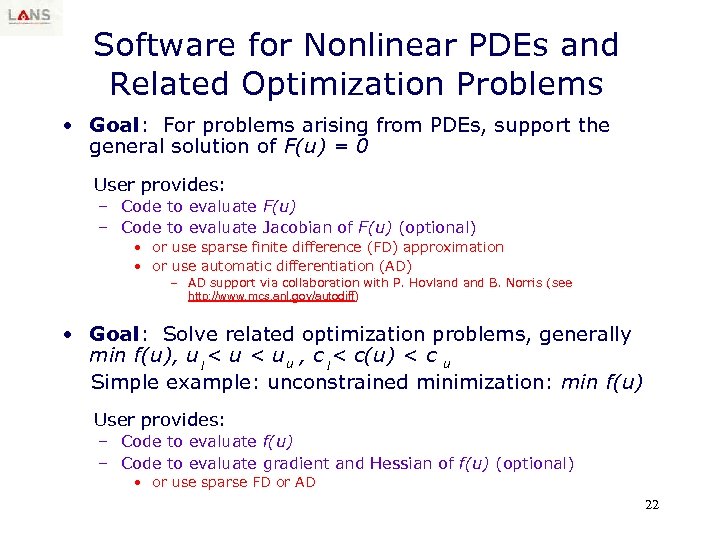
Software for Nonlinear PDEs and Related Optimization Problems • Goal: For problems arising from PDEs, support the general solution of F(u) = 0 User provides: – Code to evaluate F(u) – Code to evaluate Jacobian of F(u) (optional) • or use sparse finite difference (FD) approximation • or use automatic differentiation (AD) – AD support via collaboration with P. Hovland B. Norris (see http: //www. mcs. anl. gov/autodiff) • Goal: Solve related optimization problems, generally min f(u), u l < u u , c l< c(u) < c u Simple example: unconstrained minimization: min f(u) User provides: – Code to evaluate f(u) – Code to evaluate gradient and Hessian of f(u) (optional) • or use sparse FD or AD 22
What are the algorithmic needs of our target applications? • Large-scale, PDE-based applications – multi-rate, multi-scale, multi-component • Need – Fully or semi-implicit solvers – Multi-level algorithms – Support for adaptivity – Support for user-defined customizations (e. g. , physics-informed preconditioners, transfer operators, and smoothers) Reference: Salishan presentation by D. Keyes 23
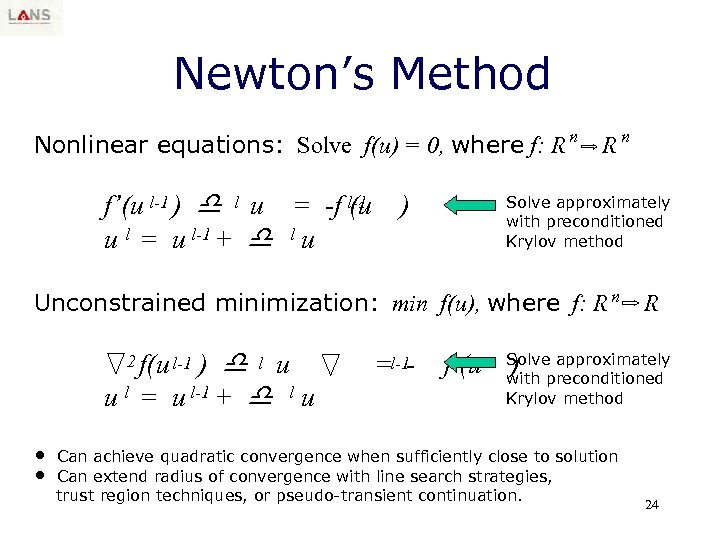
Newton’s Method Nonlinear equations: Solve f(u) = 0, where f: R n f’(u l-1 ) d l u = -f l-1 (u u l = u l-1 + d l u ) Solve approximately with preconditioned Krylov method Unconstrained minimization: min f(u), where f: R n ) dl u u l = u l-1 + d l u 2 f(u l-1 • • =l-1 - f (u R ) Solve approximately with preconditioned Krylov method Can achieve quadratic convergence when sufficiently close to solution Can extend radius of convergence with line search strategies, trust region techniques, or pseudo-transient continuation. 24
Interface Issues • How to hide complexity, yet allow customization and access to a range of algorithmic options? • How to achieve portable performance? • How to interface among external tools? – including multiple libraries developed by different groups that provide similar functionality (e. g. , linear algebra software) • Criteria for evaluation of success – efficiency (both per node performance and scalability) – usability – extensibility 25
Two-Phased Approach • Phase 1 – Develop parallel, object-oriented numerical libraries • OO techniques are quite effective for development with a moderate sized team • Provide foundation of algorithms, data structures, implementations • Phase 2 – Develop CCA-compliant component interfaces • Leverage existing code • Provide a more effective means for managing interactions among code developed by different groups 26
Parallel Numerical Libraries: PETSc and TAO • PETSc: Portable, Extensible Toolkit for Scientific Computation – S. Balay, K. Buschelman, B. Gropp, D. Kaushik, M. Knepley, L. C. Mc. Innes, B. Smith, H. Zhang – http: //www. mcs. anl. gov/petsc – Targets the parallel solution of large-scale PDE-based applications – Begun in 1991, now over 8, 500 downloads since 1995 • TAO: Toolkit for Advanced Optimization – – • S. Benson, L. C. Mc. Innes, J. Moré, J. Sarich http: //www. mcs. anl. gov/tao Targets the solution of large-scale optimization problems Begun in 1997 as part of DOE ACTS Toolkit Both are freely available and supported research toolkits – Hyperlinked documentation, many examples – Usable from Fortran 77/90, C, and C++ • Both are portable to any parallel system supporting MPI, including – Tightly coupled systems • Cray T 3 E, SGI Origin, IBM SP, HP 9000, Sun Enterprise – Loosely coupled systems, e. g. , networks of workstations • Compaq, HP, IBM, SGI, Sun • PCs running Linux or Windows 27
Some Related Work in Numerical Libraries (Not an exhaustive list) • Krylov methods and preconditioners – – (for large, sparse problems) Trilinos – Heroux et al. http: //www. cs. sandia. gov/Trilinos Parpre – Eijkhout and Chan http: //www. cs. utk. edu/~eijkhout/parpre. html Hypre – Cleary et al. http: //www. llnl. gov/casc/hypre SPARSKIT, etc. – Saad www. cs. umn. edu/~saad • Nonlinear solvers – KINSOL – Hindmarsh http: //www. llnl. gov/casc/PVODE – NITSol – Walker and Pernice • Optimization software – Hilbert Class Library - Gockenback, Petro, and Symes http: //www. trip. caam. rice. edu/txt/hcldoc/html – – OPT++ - Meza http: //csmr. ca. sandia. gov/projects/opt++. html DAKOTA - Eldred et al. http: //endo. sandia. gov/DAKOTA COOOL - Deng and Gouivera http: //coool. mines. edu Veltisto - Biros and Ghattas http: //www. cs. nyu. edu/~biros/veltisto 28
Programming Model • Goals – Portable, runs everywhere – Performance – Scalable parallelism • Approach – Distributed memory, “shared-nothing” • Requires only a compiler (single node or processor) • Access to data on remote machines through MPI – Can still exploit “compiler discovered” parallelism on each node (e. g. , SMP) – Hide within parallel objects the details of the communication – User orchestrates communication at a higher abstract level than message passing 29
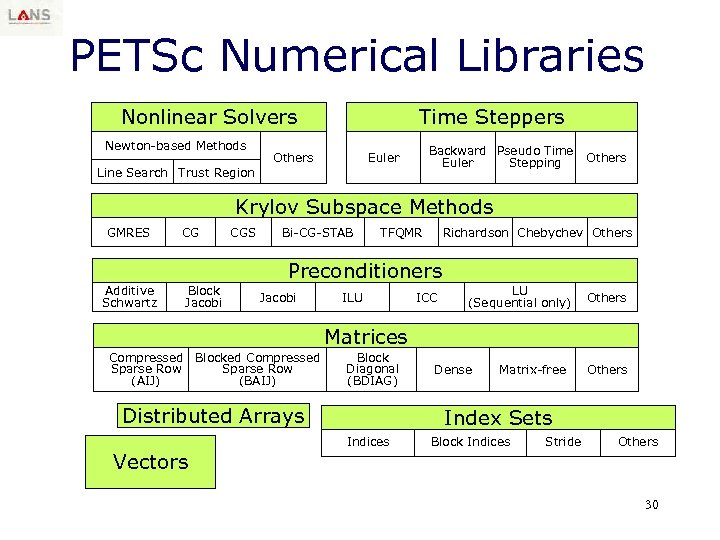
PETSc Numerical Libraries Nonlinear Solvers Newton-based Methods Line Search Trust Region Time Steppers Others Backward Pseudo Time Euler Stepping Euler Others Krylov Subspace Methods GMRES CG CGS Bi-CG-STAB TFQMR Richardson Chebychev Others Preconditioners Additive Schwartz Block Jacobi ILU ICC LU (Sequential only) Others Matrices Compressed Sparse Row (AIJ) Blocked Compressed Sparse Row (BAIJ) Block Diagonal (BDIAG) Distributed Arrays Dense Matrix-free Others Index Sets Indices Block Indices Stride Others Vectors 30
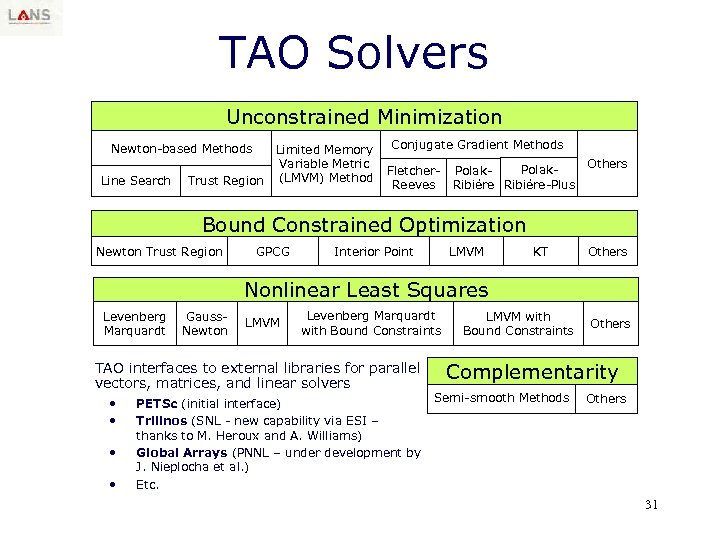
TAO Solvers Unconstrained Minimization Newton-based Methods Line Search Limited Memory Variable Metric (LMVM) Method Trust Region Conjugate Gradient Methods Fletcher. Reeves Polak. Ribiére-Plus Others Bound Constrained Optimization Newton Trust Region GPCG Interior Point LMVM KT Others Nonlinear Least Squares Levenberg Marquardt Gauss. Newton LMVM Levenberg Marquardt with Bound Constraints TAO interfaces to external libraries for parallel vectors, matrices, and linear solvers • • PETSc (initial interface) Trilinos (SNL - new capability via ESI – thanks to M. Heroux and A. Williams) Global Arrays (PNNL – under development by J. Nieplocha et al. ) Etc. LMVM with Bound Constraints Others Complementarity Semi-smooth Methods Others 31
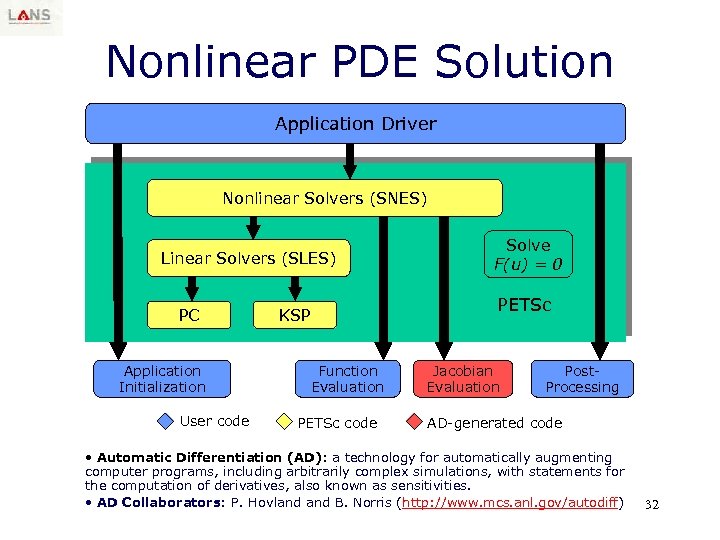
Nonlinear PDE Solution Application Driver Nonlinear Solvers (SNES) Linear Solvers (SLES) PC Application Initialization User code Solve F(u) = 0 PETSc KSP Function Evaluation PETSc code Jacobian Evaluation Post. Processing AD-generated code • Automatic Differentiation (AD): a technology for automatically augmenting computer programs, including arbitrarily complex simulations, with statements for the computation of derivatives, also known as sensitivities. • AD Collaborators: P. Hovland B. Norris (http: //www. mcs. anl. gov/autodiff) 32
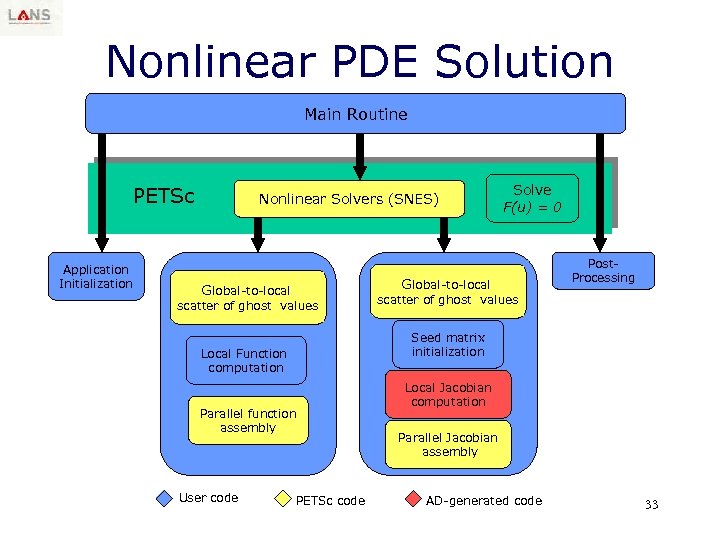
Nonlinear PDE Solution Main Routine PETSc Application Initialization Nonlinear Solvers (SNES) Global-to-local scatter of ghost values Post. Processing scatter of ghost values Seed matrix initialization Local Function computation Parallel function assembly User code Solve F(u) = 0 PETSc code Local Jacobian computation Parallel Jacobian assembly AD-generated code 33
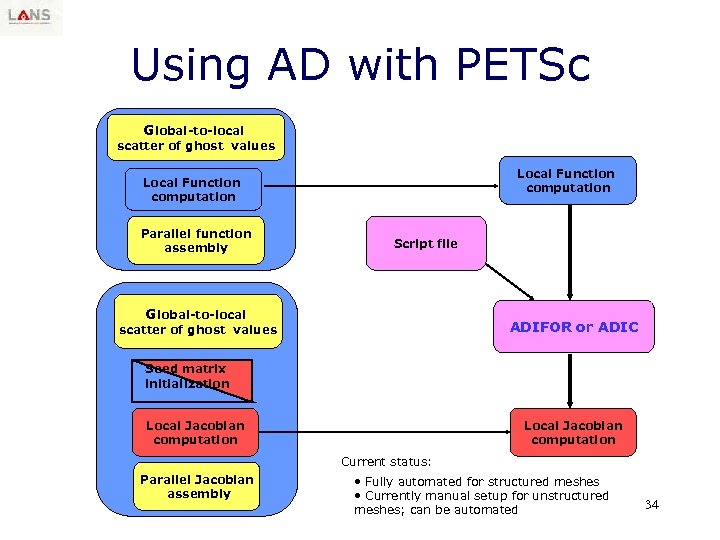
Using AD with PETSc Global-to-local scatter of ghost values Local Function computation Parallel function assembly Script file Global-to-local ADIFOR or ADIC scatter of ghost values Seed matrix initialization Local Jacobian computation Current status: Parallel Jacobian assembly • Fully automated for structured meshes • Currently manual setup for unstructured meshes; can be automated 34
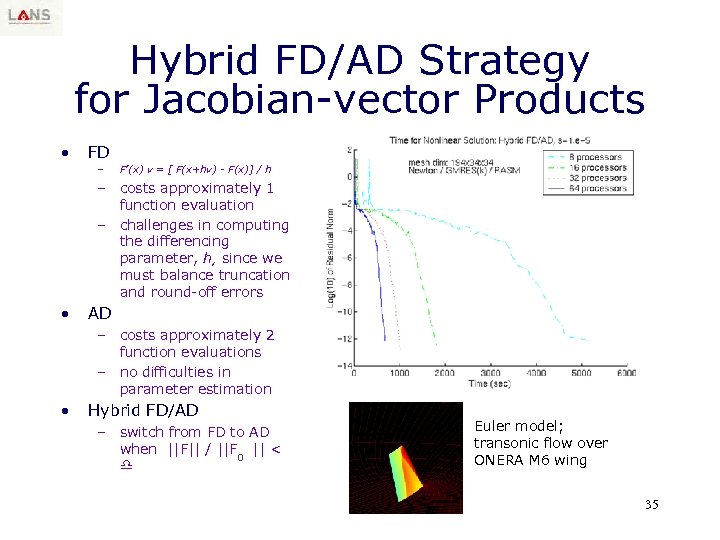
Hybrid FD/AD Strategy for Jacobian-vector Products • FD – F’(x) v = [ F(x+hv) - F(x)] / h – costs approximately 1 function evaluation – challenges in computing the differencing parameter, h, since we must balance truncation and round-off errors • AD – costs approximately 2 function evaluations – no difficulties in parameter estimation • Hybrid FD/AD – switch from FD to AD when ||F|| / ||F || < 0 d Euler model; transonic flow over ONERA M 6 wing 35
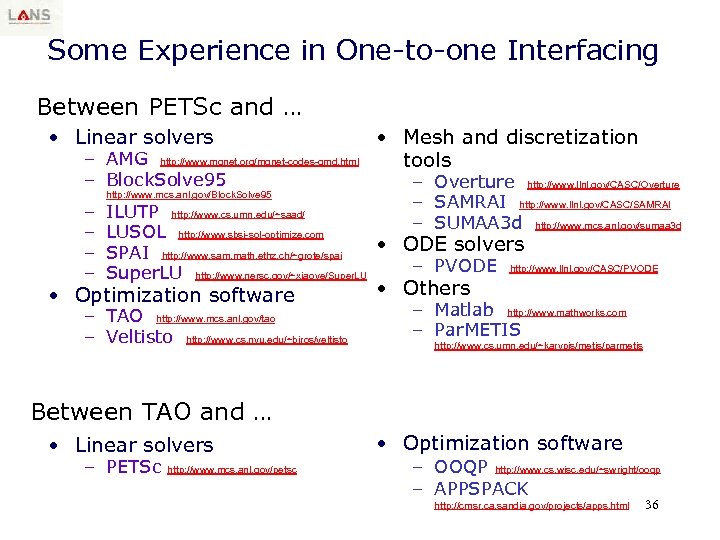
Some Experience in One-to-one Interfacing Between PETSc and … • Linear solvers – AMG http: //www. mgnet. org/mgnet-codes-gmd. html – Block. Solve 95 – – http: //www. mcs. anl. gov/Block. Solve 95 • Mesh and discretization tools – Overture http: //www. llnl. gov/CASC/Overture – SAMRAI http: //www. llnl. gov/CASC/SAMRAI – SUMAA 3 d http: //www. mcs. anl. gov/sumaa 3 d ILUTP http: //www. cs. umn. edu/~saad/ LUSOL http: //www. sbsi-sol-optimize. com • ODE solvers SPAI http: //www. sam. math. ethz. ch/~grote/spai – PVODE http: //www. llnl. gov/CASC/PVODE Super. LU http: //www. nersc. gov/~xiaoye/Super. LU • Optimization software – TAO http: //www. mcs. anl. gov/tao – Veltisto http: //www. cs. nyu. edu/~biros/veltisto • Others – Matlab http: //www. mathworks. com – Par. METIS http: //www. cs. umn. edu/~karypis/metis/parmetis Between TAO and … • Linear solvers – PETSc http: //www. mcs. anl. gov/petsc • Optimization software – OOQP http: //www. cs. wisc. edu/~swright/ooqp – APPSPACK http: //cmsr. ca. sandia. gov/projects/apps. html 36
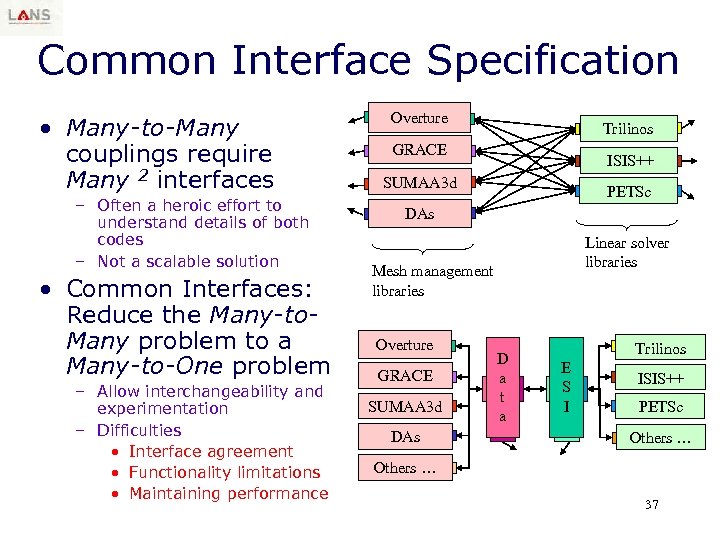
Common Interface Specification • Many-to-Many couplings require Many 2 interfaces – Often a heroic effort to understand details of both codes – Not a scalable solution • Common Interfaces: Reduce the Many-to. Many problem to a Many-to-One problem – Allow interchangeability and experimentation – Difficulties • Interface agreement • Functionality limitations • Maintaining performance Overture Trilinos GRACE ISIS++ SUMAA 3 d PETSc DAs Linear solver libraries Mesh management libraries Overture GRACE SUMAA 3 d DAs D a t a Trilinos E S I ISIS++ PETSc Others … 37
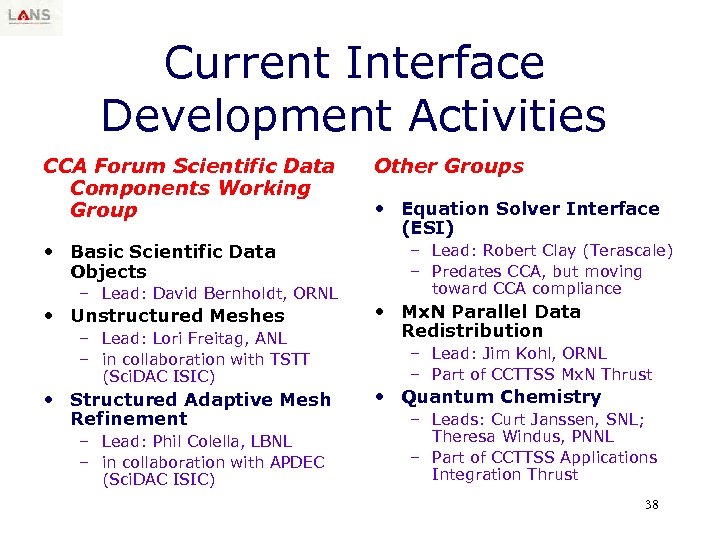
Current Interface Development Activities CCA Forum Scientific Data Components Working Group • Basic Scientific Data Objects – Lead: David Bernholdt, ORNL • Unstructured Meshes – Lead: Lori Freitag, ANL – in collaboration with TSTT (Sci. DAC ISIC) • Structured Adaptive Mesh Refinement – Lead: Phil Colella, LBNL – in collaboration with APDEC (Sci. DAC ISIC) Other Groups • Equation Solver Interface (ESI) – Lead: Robert Clay (Terascale) – Predates CCA, but moving toward CCA compliance • Mx. N Parallel Data Redistribution – Lead: Jim Kohl, ORNL – Part of CCTTSS Mx. N Thrust • Quantum Chemistry – Leads: Curt Janssen, SNL; Theresa Windus, PNNL – Part of CCTTSS Applications Integration Thrust 38
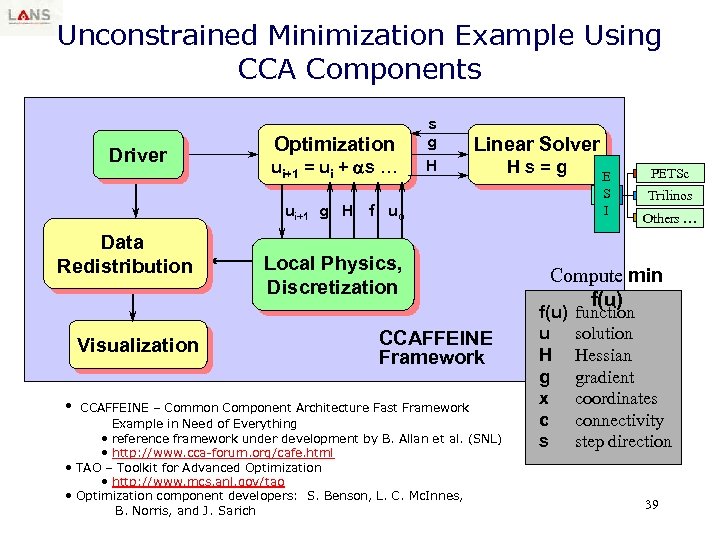
Unconstrained Minimization Example Using CCA Components Driver Optimization ui+1 = ui + as … s g H Linear Solver Hs=g ui+1 g H f uo Data Redistribution Visualization • Local Physics, Discretization CCAFFEINE Framework CCAFFEINE – Common Component Architecture Fast Framework Example in Need of Everything • reference framework under development by B. Allan et al. (SNL) • http: //www. cca-forum. org/cafe. html • TAO – Toolkit for Advanced Optimization • http: //www. mcs. anl. gov/tao • Optimization component developers: S. Benson, L. C. Mc. Innes, B. Norris, and J. Sarich E S I PETSc Trilinos Others … Compute min f(u) u H g x c s function solution Hessian gradient coordinates connectivity step direction 39
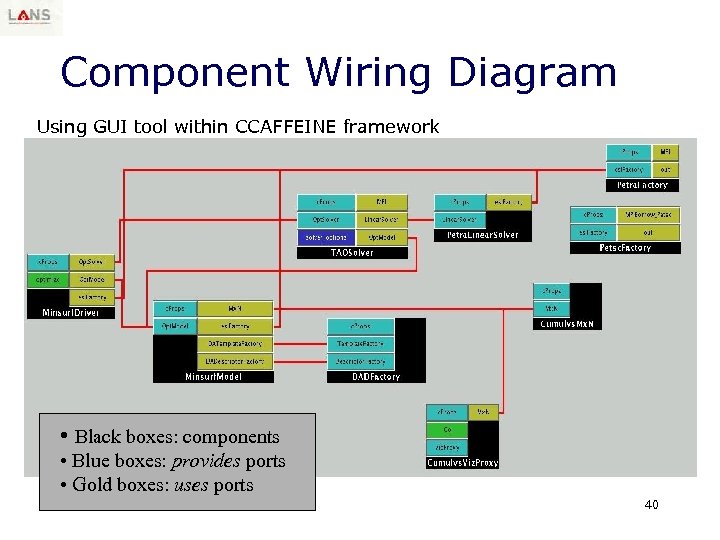
Component Wiring Diagram Using GUI tool within CCAFFEINE framework • Black boxes: components • Blue boxes: provides ports • Gold boxes: uses ports 40
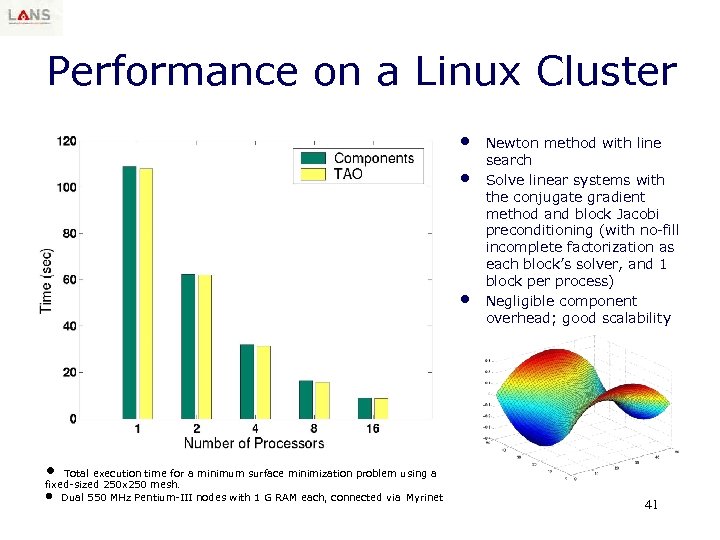
Performance on a Linux Cluster • • • Newton method with line search Solve linear systems with the conjugate gradient method and block Jacobi preconditioning (with no-fill incomplete factorization as each block’s solver, and 1 block per process) Negligible component overhead; good scalability • Total execution time for a minimum surface minimization problem using a fixed-sized 250 x 250 mesh. Dual 550 MHz Pentium-III nodes with 1 G RAM each, connected via Myrinet • 41
CCA Compliance in TAO • Paradigm shift; both TAO and the application become components – Each is required to provide a default constructor and to implement the CCA component interface • contains one method: “set. Services” to register ports – All interactions between components use ports • Application provides a “go” port and uses “tao. Solver” port • TAO provides a “tao. Solver” port – There is no “main” routine • Status – TAO-1. 4, released April 2002, includes CCA component interfaces – Ongoing work with T. Windus (PNNL) and C. Janssen (SNL) on CCA-based chemistry applications that involve optimization 42
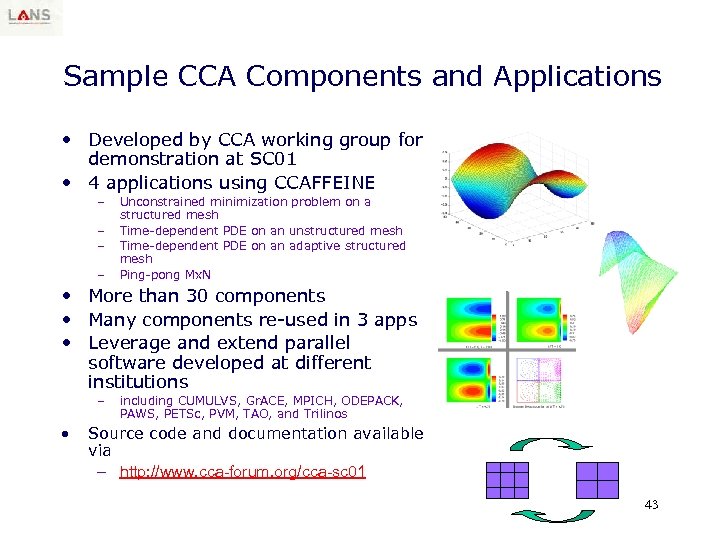
Sample CCA Components and Applications • Developed by CCA working group for demonstration at SC 01 • 4 applications using CCAFFEINE – – Unconstrained minimization problem on a structured mesh Time-dependent PDE on an unstructured mesh Time-dependent PDE on an adaptive structured mesh Ping-pong Mx. N • More than 30 components • Many components re-used in 3 apps • Leverage and extend parallel software developed at different institutions – • including CUMULVS, Gr. ACE, MPICH, ODEPACK, PAWS, PETSc, PVM, TAO, and Trilinos Source code and documentation available via – http: //www. cca-forum. org/cca-sc 01 43
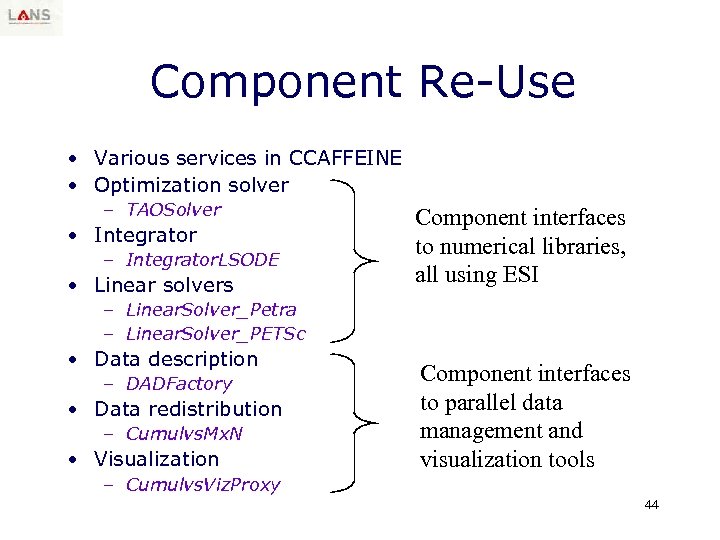
Component Re-Use • Various services in CCAFFEINE • Optimization solver – TAOSolver • Integrator – Integrator. LSODE • Linear solvers Component interfaces to numerical libraries, all using ESI – Linear. Solver_Petra – Linear. Solver_PETSc • Data description – DADFactory • Data redistribution – Cumulvs. Mx. N • Visualization – Cumulvs. Viz. Proxy Component interfaces to parallel data management and visualization tools 44
Summary • Object-oriented techniques have been effective in enabling individual libraries for high-performance numerics to explore of trade-offs in – Algorithms, data structures, data distribution, etc. • The CCA Forum is developing component technology specifically targeted at high-performance scientific simulations – Addressing issues in language interoperability, dynamic composability, abstract interfaces, parallel data redistribution, etc. – Aiming to enable the exploration of trade-offs in the broader context of multi-disciplinary simulations that require the combined use of software developed by different groups • We have a solid start through an interdisciplinary, multiinstitution team – Open to everyone interested in high-performance scientific components (see http: //www. cca-forum. org for info on joining the CCA mailing list) • Lots of research challenges remain! 45
One Challenge: Interfaces are central • The CCA Forum participants do not pretend to be experts in all phases of computation, but rather just to be developing a standard way to exchange component capabilities. • Medium of exchange: interfaces – Need experts in various areas to define sets of domain-specific abstract interfaces • scientific application domains, meshes, discretization, nonlinear solvers, optimization, visualization, etc. This means you! • Developing common interfaces is difficult – Technical challenges – Social challenges Many, many additional research issues remain. 46
More Information CCA: http: //www. cca-forum. org PETSc: http: //www. mcs. anl. gov/petsc TAO: http: //www. mcs. anl. gov/tao 47
Скачать презентацию Trade-offs in High-Performance Numerical Library Design Lois Curfman
6b255207f33d3c032825c9d194fe15dc.ppt