


 Скачать презентацию TRADE-MARKS University of Toronto IP 298 HS Cynthia
207907ce6be17c52017bd1a3dcfd9648.ppt
- Количество слайдов: 38
 TRADE-MARKS University of Toronto IP 298 HS Cynthia Mason – cmason@ogilvyrenault. com – 416. 216. 4841 March 17, 2005 2481 -0304 © Cynthia Mason, 2005
 Outline • Trade-mark Searching • Procedure for Trade-mark Registration • Registrable Trade-marks 2
 Trade-mark Searching § Types of trade-mark searches § Opinions 3
 Types of Trade-mark Searches § Locate Search • Trade-marks Office register • Identical trade-marks 4
 Types of Trade-mark Searches • Registrability Search § Trade-marks Office register § Similar or confusing trade-marks • Phonetic equivalents • Visually similar marks • Marks in similar channels of trade 5
 Types of Trade-mark Searches § Availability Searches • Trade-marks Office register • Common law sources • Business names • Trade directories • Magazine and newspaper articles • Internet • Specialty sources – pharmaceutical indices, catalogues 6
 After the Search • Opinion § Limitations of search • Follow up investigation • File trade-mark application 7
 Procedure for Registering Trade-marks • Application • Examination • Approval/Advertisement • Allowance • Registration 8
 Application • Trade-marks Act, RSC 1985, c. T-13 § Section 30 – Contents of Application • Trade-marks Regulations (1996), SOR/96 -195 § Sections 24 to 29 – Formalities § Sections 30 to 33 - Amendments 9
 Application 1. Applicant’s Name and Address • • Partnership • Joint venture • Corporation • 10 Individual Association
 Application 2. Trade-mark § § Designs § Patterns on 3 D objects § Shapes of wares or packaging (distinguishing guise) § Certification mark § 11 Words Official mark
 Application 3. Wares or Services • • 12 Specific and ordinary commercial terms Amendments
 Application 4. Basis for Application § Use in Canada § Making Known in Canada § Foreign Application or Registration and Use § Proposed Use in Canada 13
 Application 5. Priority Claim § Foreign application filing date 6. Entitlement Claim 7. Representative for Service in Canada 8. Filing Fee 14
 Examination • Formal requirements • Description of wares and services – Act, s. 30(a) • Foreign registration certificate – Act, s. 31(1) • Drawing – Regulations, ss, 27 and 28 • Translation and Transliteration – Regulations, s. 29 • Registrability • Entitlement to registration 15
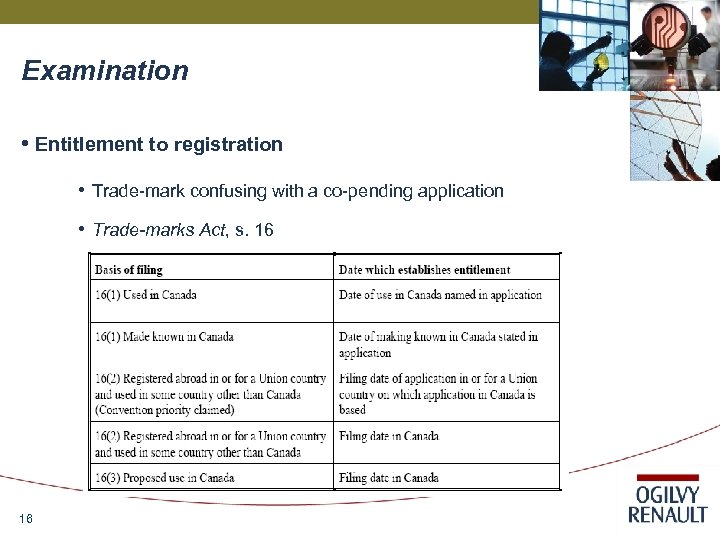 Examination • Entitlement to registration • Trade-mark confusing with a co-pending application • Trade-marks Act, s. 16 16
 Approval/Advertisement • Trade-marks Journal • Amendments • Opposition § Trade-marks Act, s. 38 § Trade-marks Regulations, ss. 35 to 47 17
 Allowance/Registration • Declaration of Use in Canada • Fee • Continued use § Trade-marks Act, s. 45 • Renewal 18
 Registrable Trade-marks § Names or Surnames § Clearly descriptive or deceptively misdescriptive § Confusing with registered trade-mark § Prohibited marks § Distinguishing guises 19
 Registrable Trade-marks Names and Surnames § Trade-marks Act, s, 12(1)(a) – primarily merely the name or surname of an individual who is living or has died within preceding 30 years. § Rationale • Fairness • Inability of names and surnames to distinguish 20
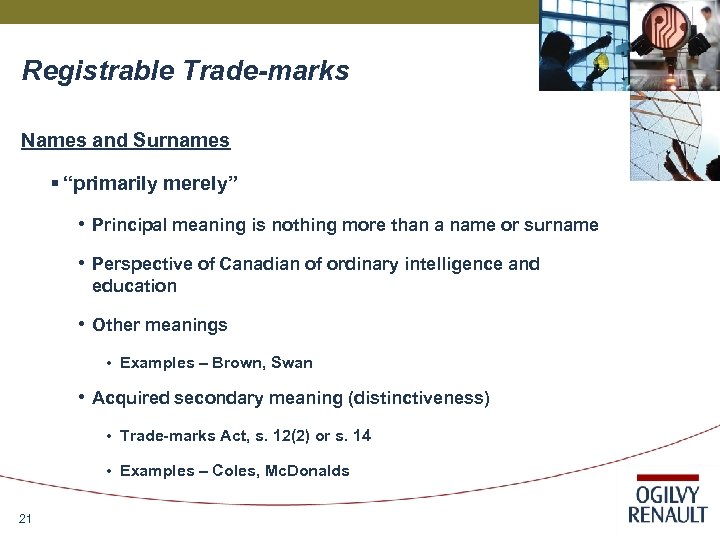 Registrable Trade-marks Names and Surnames § “primarily merely” • Principal meaning is nothing more than a name or surname • Perspective of Canadian of ordinary intelligence and education • Other meanings • Examples – Brown, Swan • Acquired secondary meaning (distinctiveness) • Trade-marks Act, s. 12(2) or s. 14 • Examples – Coles, Mc. Donalds 21
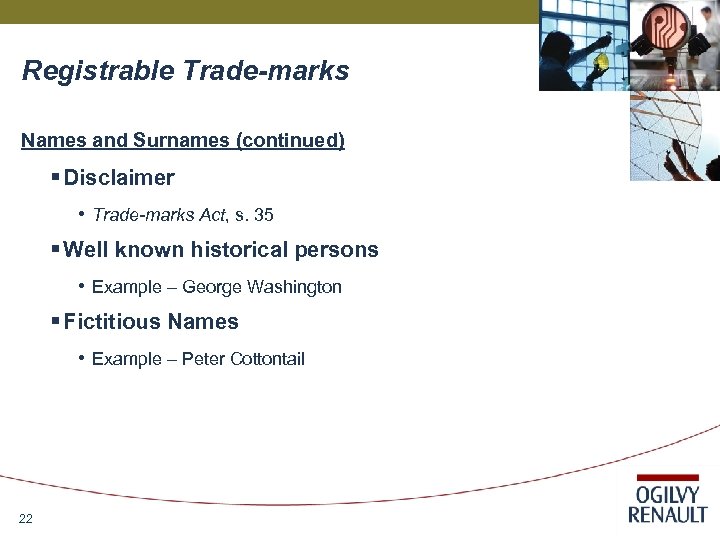 Registrable Trade-marks Names and Surnames (continued) § Disclaimer • Trade-marks Act, s. 35 § Well known historical persons • Example – George Washington § Fictitious Names • Example – Peter Cottontail 22
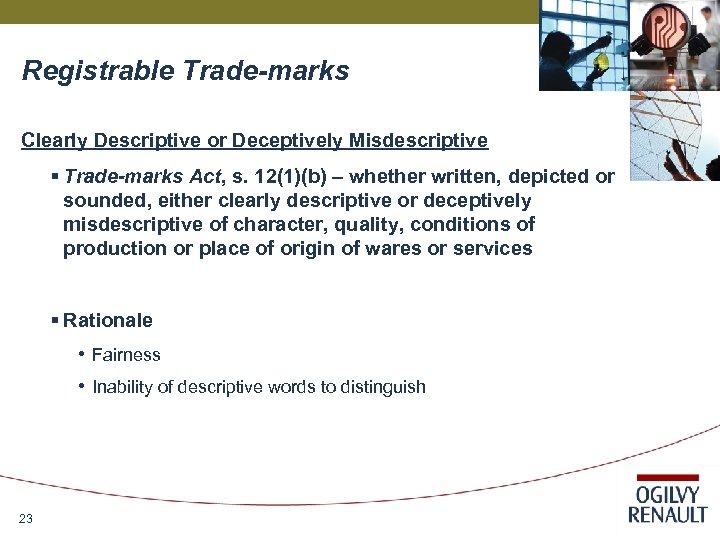 Registrable Trade-marks Clearly Descriptive or Deceptively Misdescriptive § Trade-marks Act, s. 12(1)(b) – whether written, depicted or sounded, either clearly descriptive or deceptively misdescriptive of character, quality, conditions of production or place of origin of wares or services § Rationale • Fairness • Inability of descriptive words to distinguish 23
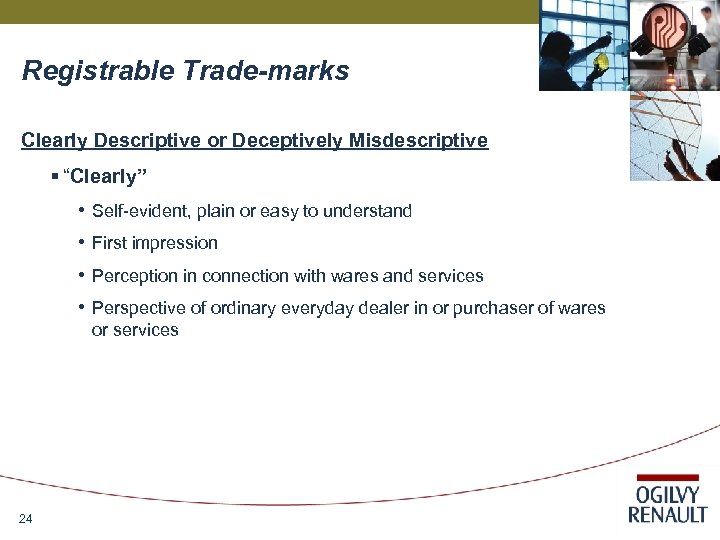 Registrable Trade-marks Clearly Descriptive or Deceptively Misdescriptive § “Clearly” • Self-evident, plain or easy to understand • First impression • Perception in connection with wares and services • Perspective of ordinary everyday dealer in or purchaser of wares or services 24
 Registrable Trade-marks Clearly Descriptive or Deceptively Misdescriptive § Character • Feature, trait, function or result • Examples – KOOL ONE (beer), BRIGHTS CHILLABLE RED (wine), THE GOOD SLICE (cheese) § Quality • Laudatory epithets • Examples – BEST BUY, SUPER SCRABBLE 25
 Registrable Trade-marks Clearly Descriptive or Deceptively Misdescriptive § Conditions of production or persons employed in production • Examples – KILNCRAFT (wares), KREBS ENGINEERS § Place of Origin • TORONTO LIFE (magazines), SWISS FORMULA (lotions) 26
 Registrable Trade-marks Clearly Descriptive or Deceptively Misdescriptive § Whether depicted, written or sounded • Descriptive designs • Descriptive word/design composite marks • Best Canadian Motor Inns Ltd. v. Best Western International, Inc. , 2004 FC 135. 27
 Registrable Trade-marks Clearly Descriptive or Deceptively Misdescriptive § Deceptively misdescriptive • Marks that would deceive consumers into making false buying decisions • Examples – SHAMMI (gloves with no chamois), LIVER DINNER (cat food) 28
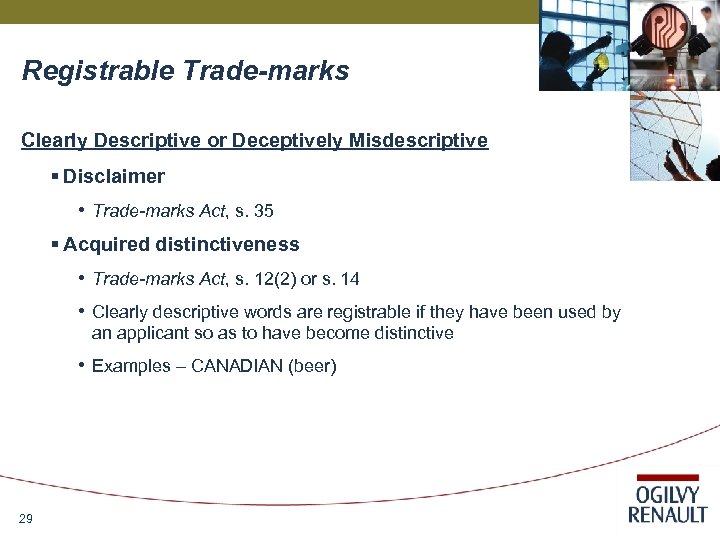 Registrable Trade-marks Clearly Descriptive or Deceptively Misdescriptive § Disclaimer • Trade-marks Act, s. 35 § Acquired distinctiveness • Trade-marks Act, s. 12(2) or s. 14 • Clearly descriptive words are registrable if they have been used by an applicant so as to have become distinctive • Examples – CANADIAN (beer) 29
 Registrable Trade-marks Confusing with Registered Trade-mark • Trade-marks Act, s. 12(1)(d) • Confusion • Trade-marks Act, s. 6(2) • Use of trade-marks in same area would be likely to lead to the inference that they have the same origin 30
 Registrable Trade-marks Confusing with Registered Trade-mark • Trade-marks Act, s. 6(5) • Factors to consider in determining confusion • “all the surrounding circumstances” including • Inherent distinctiveness and extent to which marks known • Length of time in use • Nature of wares or services • Nature of trade • Degree of resemblance in appearance, sound or ideas suggested • Other circumstances 31
 Registrable Trade-marks Prohibited Marks • Trade-marks Act, ss. 12(1)(e), 9 and 10 • Marks consisting of or so nearly resembling as to be likely to be mistaken for § Royal crests, arms, etc. § Government arms, crests, flags, RCMP § Red Cross, United Nations, other international symbols § Scandalous, obscene or immoral words or designs § Matter falsely suggesting connection with individual, portraits and signatures § Official marks 32
 Registrable Trade-marks Prohibited Marks • Official marks § Trade-marks Act, s. 9(1)(n) § Badges, crests, emblems or marks adopted and used by Canadian Forces, any university, or any “public authority” § “Public authority” • Subject to significant degree of government control • Public benefit 33
 Registrable Trade-marks Prohibited Marks • Official marks § Not limited to specific wares and services § Not removable from register § Can be registered and used by others with consent of public authority 34
 Registrable Trade-marks Prohibited Marks § Well known commercial symbols of quality, quantity, value, and place of origin (Trade-marks Act, s. 10) • Examples – XXX (beer), Canadian Champagne § Plant varieties (Trade-marks Act, s. 10. 1) § Geographical indications for wine and spirits (Trade-marks Act, ss. 12(1)(g) and (h)) 35
 Registrable Trade-marks • Distinguishing guises § Trade-marks Act, s. 13 § Registrable only if distinctive and its exclusive use is not likely to unreasonably limit the development of any art or industry § Examples 36
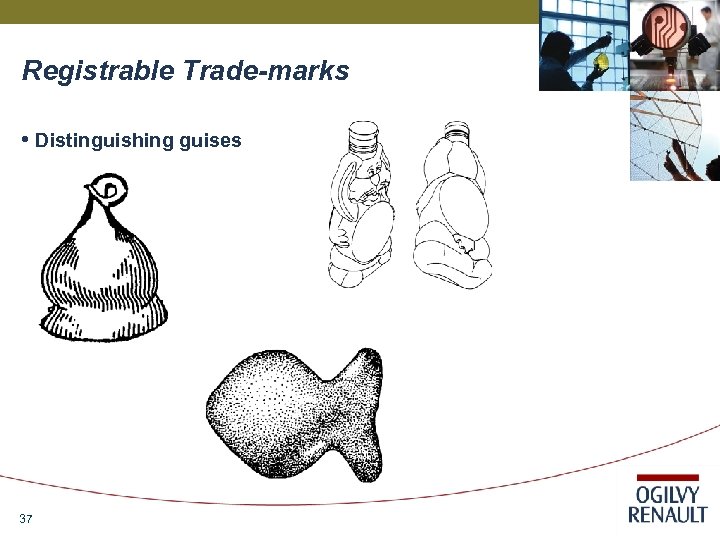 Registrable Trade-marks • Distinguishing guises 37
 TRADE-MARKS University of Toronto IP 298 HS Cynthia Mason – cmason@ogilvyrenault. com – 416. 216. 4841 March 17, 2005 2481 -0304 © Cynthia Mason, 2005