


 Скачать презентацию Trade in telecommunications accounting rate reform Dr
2ac9f18f98b75d27ff2e3a45e8286b16.ppt
- Количество слайдов: 35
 Trade in telecommunications & accounting rate reform Dr Tim Kelly *, Head, Strategy and Policy Unit, International Telecommunication Union, 30 April, 2001 * The views expressed in this presentation are those of the author, and do not necessarily reflect the opinions of the ITU or its membership. Tim Kelly can be contacted at tim. kelly@itu. int.
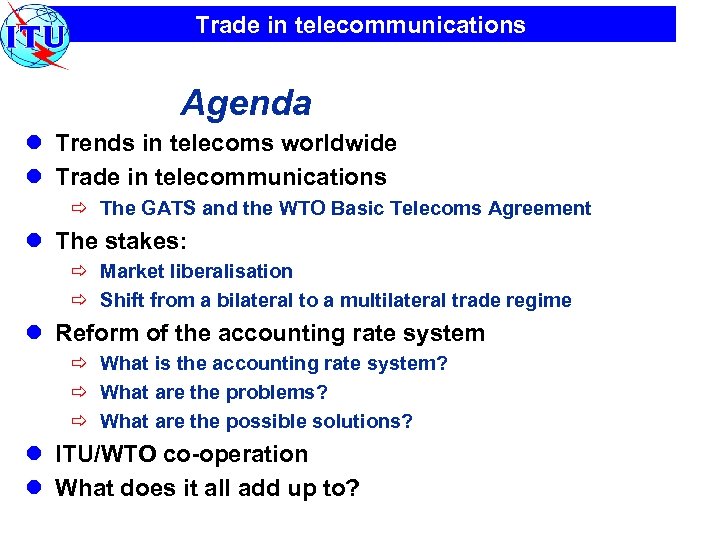 Trade in telecommunications Agenda l Trends in telecoms worldwide l Trade in telecommunications ð The GATS and the WTO Basic Telecoms Agreement l The stakes: ð Market liberalisation ð Shift from a bilateral to a multilateral trade regime l Reform of the accounting rate system ð What is the accounting rate system? ð What are the problems? ð What are the possible solutions? l ITU/WTO co-operation l What does it all add up to?
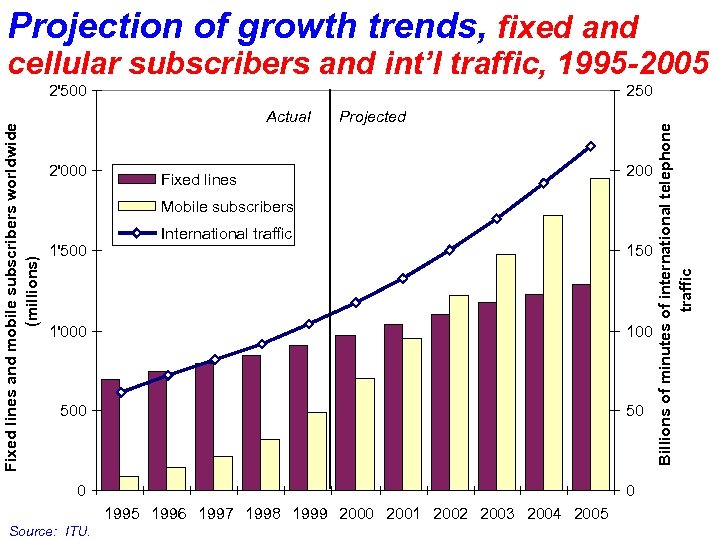 Projection of growth trends, fixed and cellular subscribers and int’l traffic, 1995 -2005 250 Actual 2'000 Projected Fixed lines 200 Mobile subscribers 1'500 International traffic 1'000 100 50 0 0 1995 1996 1997 1998 1999 2000 2001 2002 2003 2004 2005 Source: ITU. 150 Billions of minutes of international telephone traffic Fixed lines and mobile subscribers worldwide (millions) 2'500
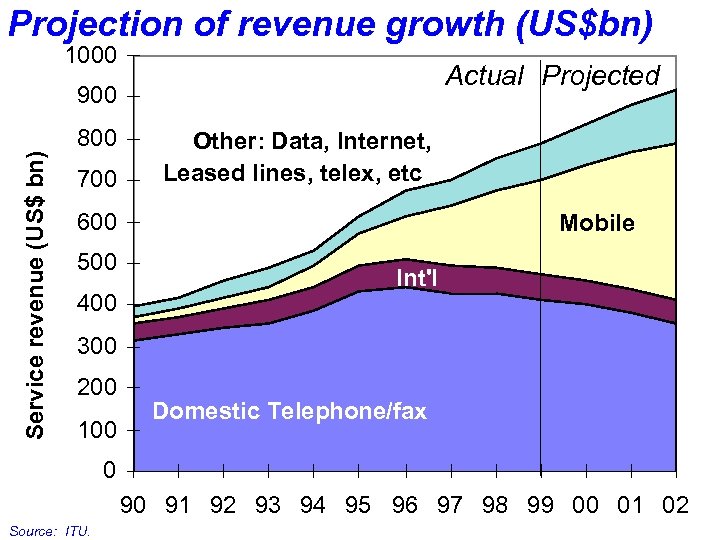 Projection of revenue growth (US$bn) 1000 Actual Projected Service revenue (US$ bn) 900 800 700 Other: Data, Internet, Leased lines, telex, etc 600 500 400 Mobile Int'l 300 200 100 Domestic Telephone/fax 0 90 91 92 93 94 95 96 97 98 99 00 01 02 Source: ITU.
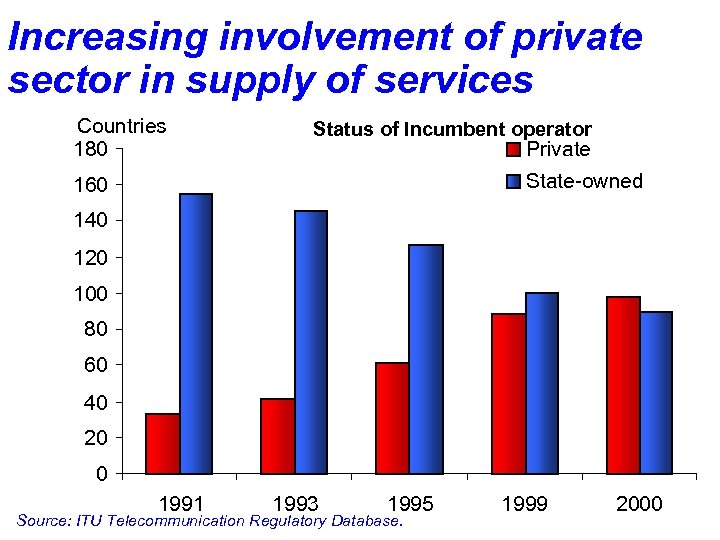 Increasing involvement of private sector in supply of services Countries 180 Status of Incumbent operator Private State-owned 160 140 120 100 80 60 40 20 0 1991 1993 1995 Source: ITU Telecommunication Regulatory Database. 1999 2000
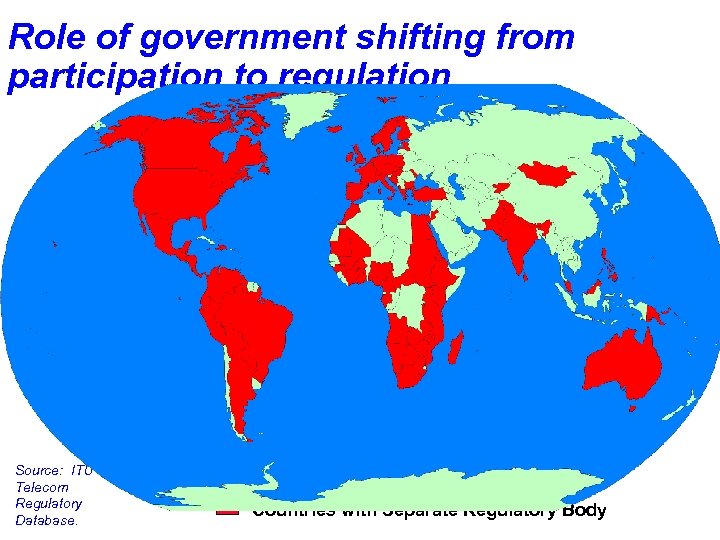 Role of government shifting from participation to regulation Source: ITU Telecom Regulatory Database. Countries with Separate Regulatory Body
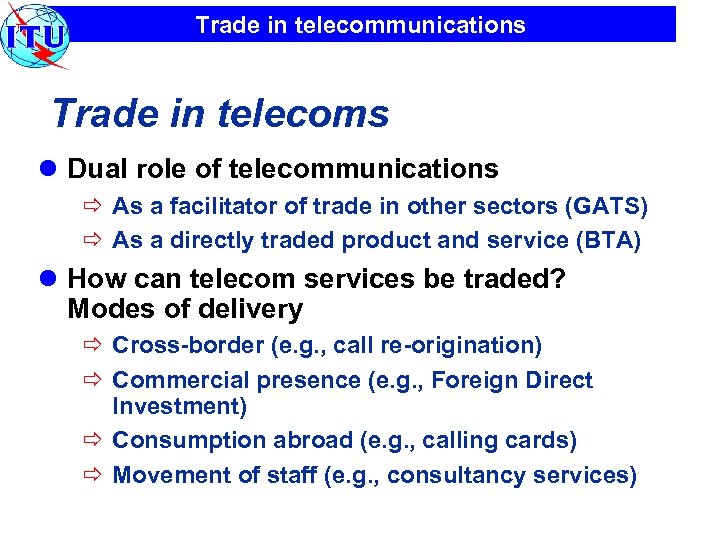 Trade in telecommunications Trade in telecoms l Dual role of telecommunications ð As a facilitator of trade in other sectors (GATS) ð As a directly traded product and service (BTA) l How can telecom services be traded? Modes of delivery ð Cross-border (e. g. , call re-origination) ð Commercial presence (e. g. , Foreign Direct Investment) ð Consumption abroad (e. g. , calling cards) ð Movement of staff (e. g. , consultancy services)
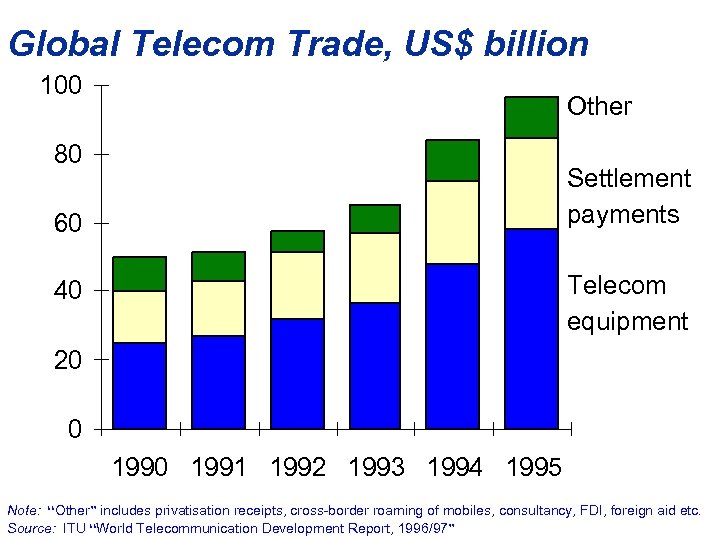 Global Telecom Trade, US$ billion 100 Other 80 Settlement payments 60 Telecom equipment 40 20 0 1991 1992 1993 1994 1995 Note: “Other” includes privatisation receipts, cross-border roaming of mobiles, consultancy, FDI, foreign aid etc. Source: ITU “World Telecommunication Development Report, 1996/97”
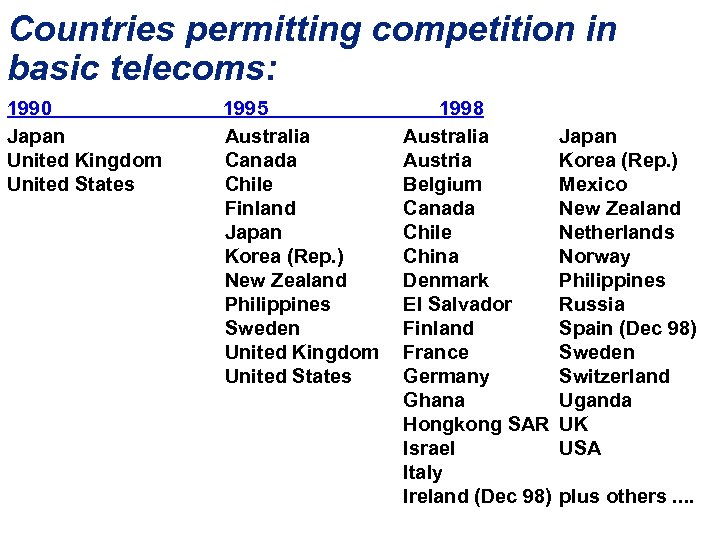 Countries permitting competition in basic telecoms: 1990 Japan United Kingdom United States 1995 Australia Canada Chile Finland Japan Korea (Rep. ) New Zealand Philippines Sweden United Kingdom United States 1998 Australia Austria Belgium Canada Chile China Denmark El Salvador Finland France Germany Ghana Hongkong SAR Israel Italy Ireland (Dec 98) Japan Korea (Rep. ) Mexico New Zealand Netherlands Norway Philippines Russia Spain (Dec 98) Sweden Switzerland Uganda UK USA plus others. .
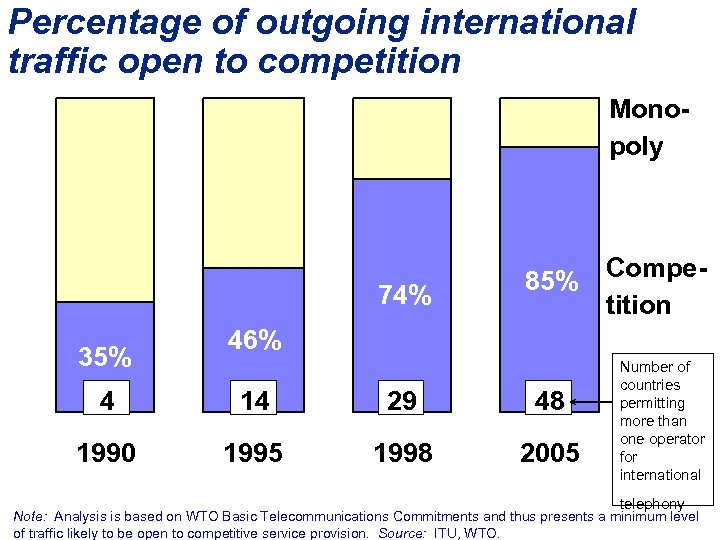 Percentage of outgoing international traffic open to competition Monopoly 74% 35% 85% Competition 46% 4 14 29 48 1990 1995 1998 2005 Number of countries permitting more than one operator for international telephony Note: Analysis is based on WTO Basic Telecommunications Commitments and thus presents a minimum level of traffic likely to be open to competitive service provision. Source: ITU, WTO.
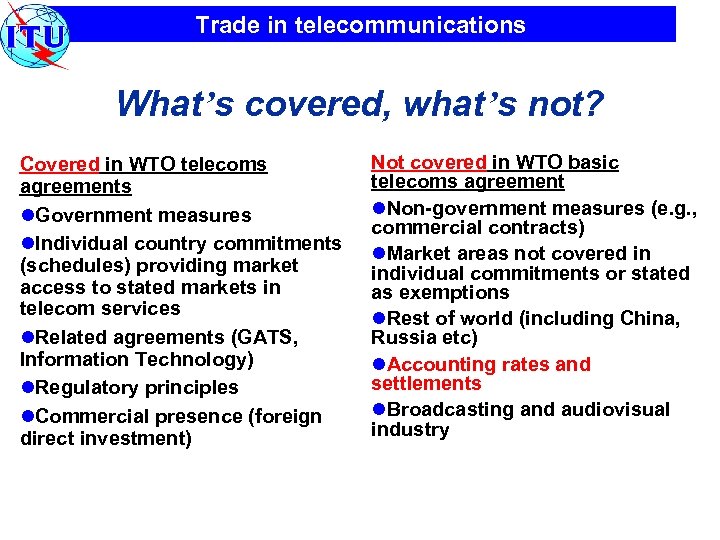 Trade in telecommunications What’s covered, what’s not? Covered in WTO telecoms agreements l. Government measures l. Individual country commitments (schedules) providing market access to stated markets in telecom services l. Related agreements (GATS, Information Technology) l. Regulatory principles l. Commercial presence (foreign direct investment) Not covered in WTO basic telecoms agreement l. Non-government measures (e. g. , commercial contracts) l. Market areas not covered in individual commitments or stated as exemptions l. Rest of world (including China, Russia etc) l. Accounting rates and settlements l. Broadcasting and audiovisual industry
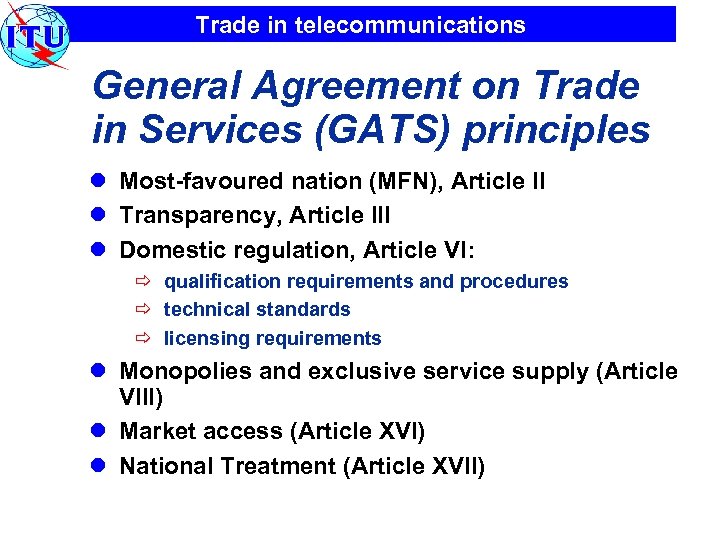 Trade in telecommunications General Agreement on Trade in Services (GATS) principles l Most-favoured nation (MFN), Article II l Transparency, Article III l Domestic regulation, Article VI: ð qualification requirements and procedures ð technical standards ð licensing requirements l Monopolies and exclusive service supply (Article VIII) l Market access (Article XVI) l National Treatment (Article XVII)
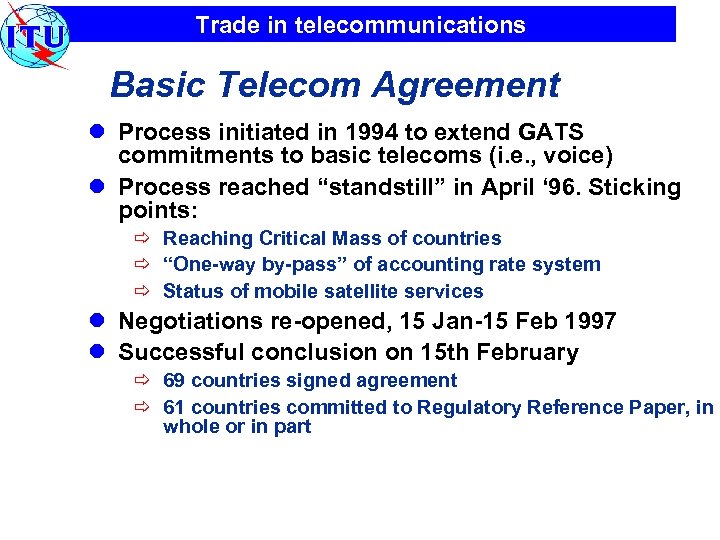 Trade in telecommunications Basic Telecom Agreement l Process initiated in 1994 to extend GATS commitments to basic telecoms (i. e. , voice) l Process reached “standstill” in April ‘ 96. Sticking points: ð Reaching Critical Mass of countries ð “One-way by-pass” of accounting rate system ð Status of mobile satellite services l Negotiations re-opened, 15 Jan-15 Feb 1997 l Successful conclusion on 15 th February ð 69 countries signed agreement ð 61 countries committed to Regulatory Reference Paper, in whole or in part
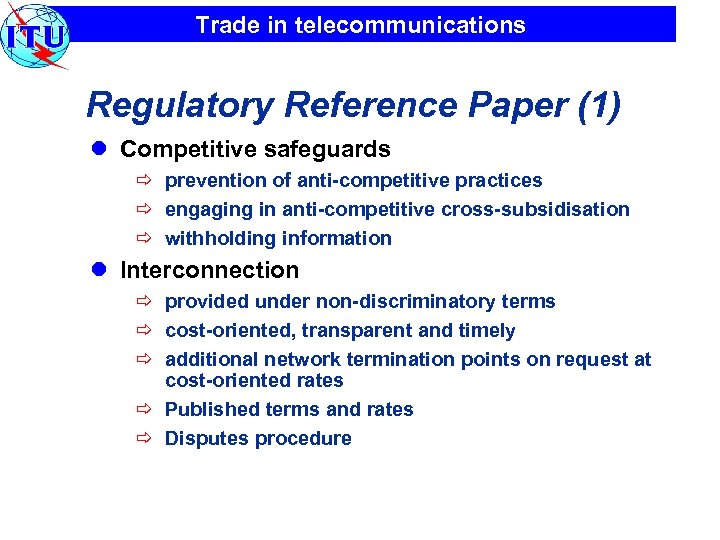 Trade in telecommunications Regulatory Reference Paper (1) l Competitive safeguards ð prevention of anti-competitive practices ð engaging in anti-competitive cross-subsidisation ð withholding information l Interconnection ð provided under non-discriminatory terms ð cost-oriented, transparent and timely ð additional network termination points on request at cost-oriented rates ð Published terms and rates ð Disputes procedure
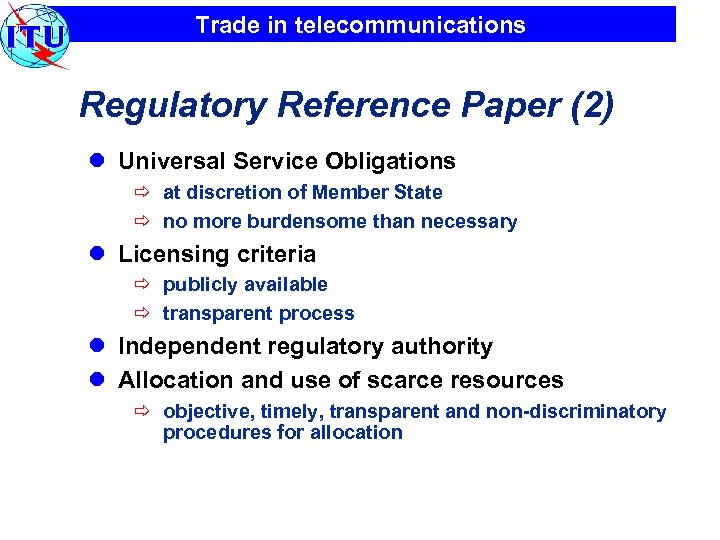 Trade in telecommunications Regulatory Reference Paper (2) l Universal Service Obligations ð at discretion of Member State ð no more burdensome than necessary l Licensing criteria ð publicly available ð transparent process l Independent regulatory authority l Allocation and use of scarce resources ð objective, timely, transparent and non-discriminatory procedures for allocation
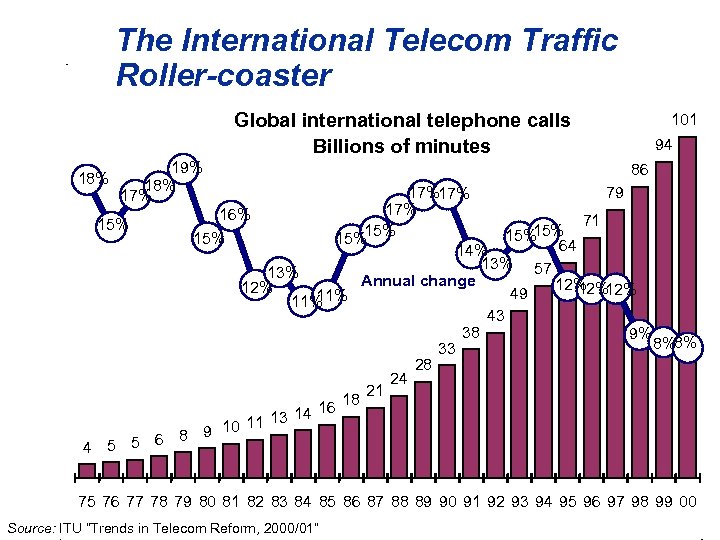 The International Telecom Traffic Roller-coaster Global international telephone calls Billions of minutes 18% 19% 18% 17% 101 94 86 17%17% 79 17% 16% 71 15% 15% 15% 64 14% 13% 57 13% Annual change 12% 12% 49 11% 43 38 9% 8%8% 33 28 24 21 18 14 16 13 10 11 8 9 5 5 6 4 75 76 77 78 79 80 81 82 83 84 85 86 87 88 89 90 91 92 93 94 95 96 97 98 99 00 Source: ITU “Trends in Telecom Reform, 2000/01”
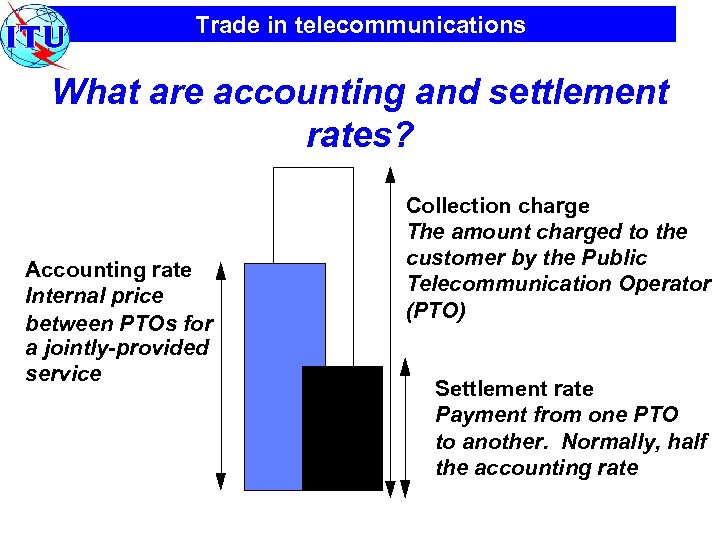 Trade in telecommunications What are accounting and settlement rates? Accounting rate Internal price between PTOs for a jointly-provided service Collection charge The amount charged to the customer by the Public Telecommunication Operator (PTO) Settlement rate Payment from one PTO to another. Normally, half the accounting rate
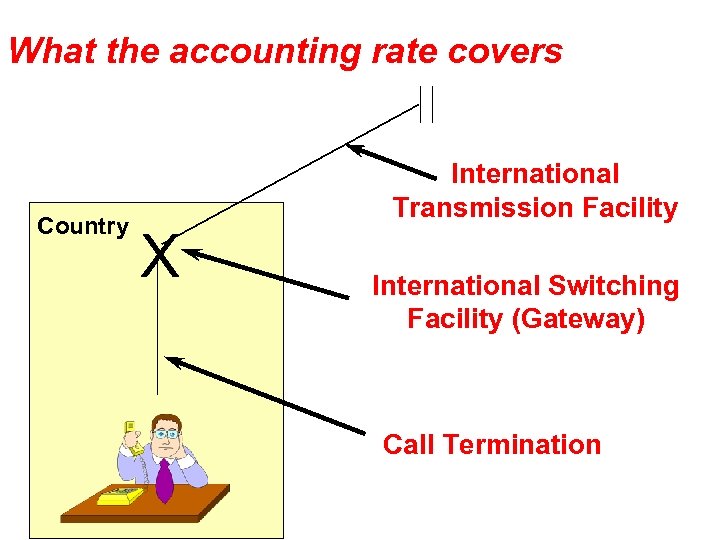 What the accounting rate covers Country International Transmission Facility X International Switching Facility (Gateway) Call Termination
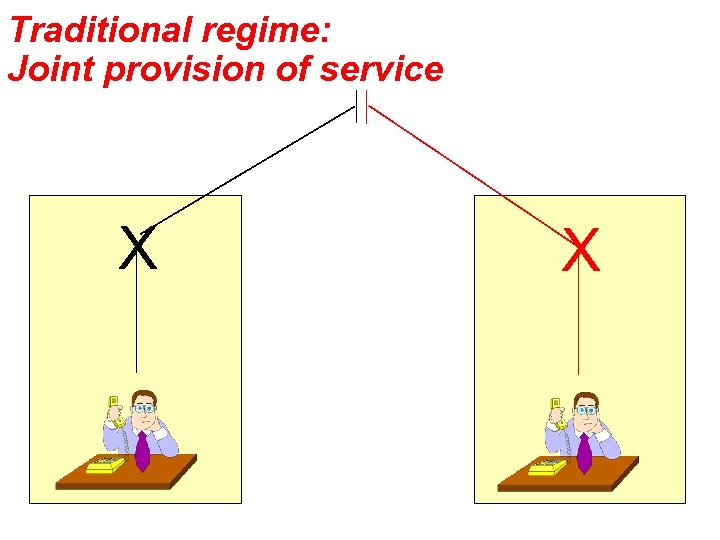 Traditional regime: Joint provision of service X X
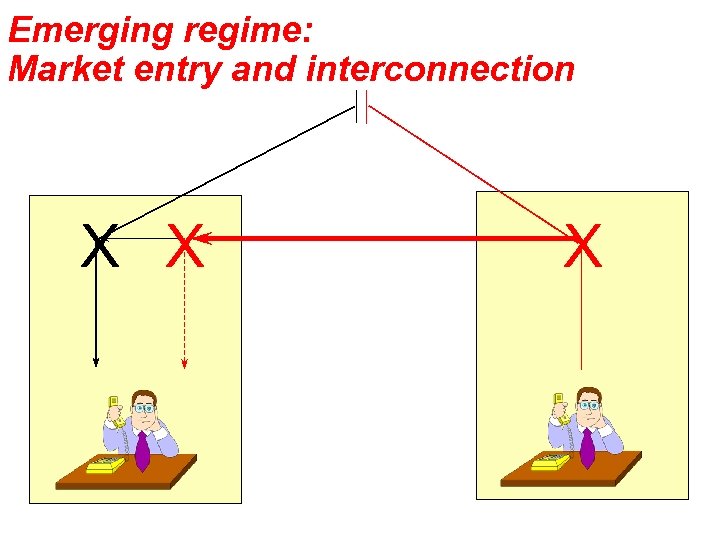 Emerging regime: Market entry and interconnection X X X
 Trade in telecommunications Accounting rate reform l Accounting rates are traditional way of sharing revenues from int’l services ð BUT, creates incentives among recipient countries to sustain rates at high level ð Accounting rate system not well-adapted to competitive market environment ð Large imbalances in traffic and settlement payments l Strong pressure to move towards a costoriented system ð BUT, many developing countries are heavily dependent on net settlement payments ð Transition may be quicker for some than others ð Cost-oriented system may well be asymmetric
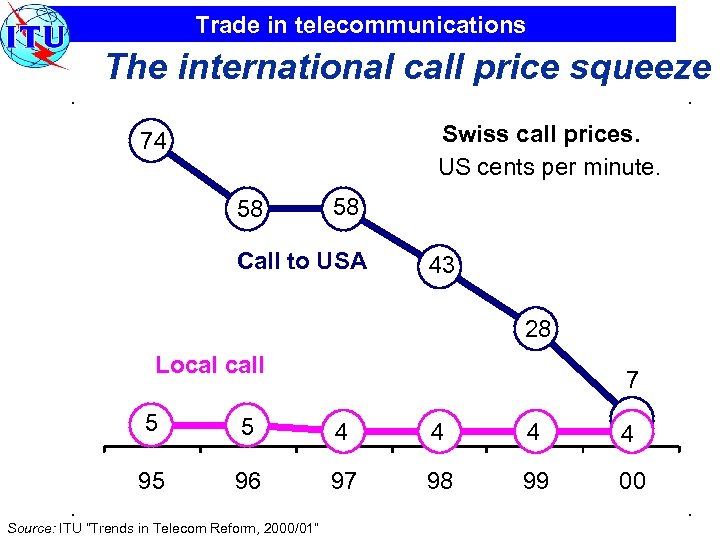 Trade in telecommunications The international call price squeeze Swiss call prices. US cents per minute. 74 58 58 Call to USA 43 28 Local call 7 5 5 4 4 95 96 97 98 99 00 Source: ITU “Trends in Telecom Reform, 2000/01”
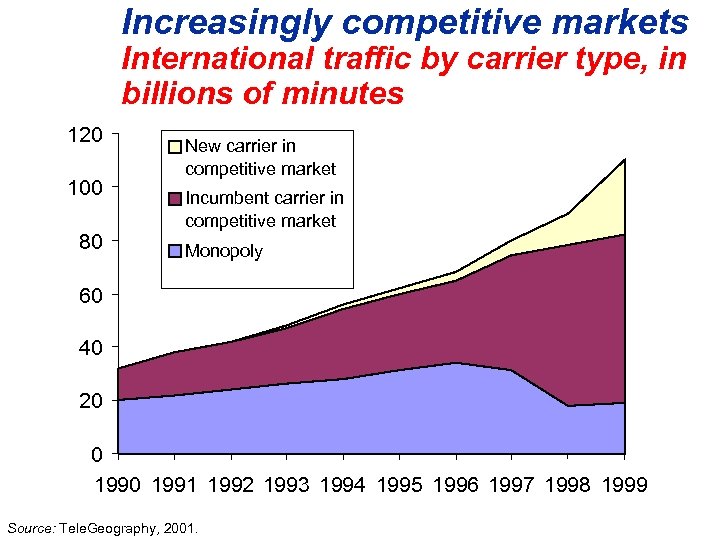 Increasingly competitive markets International traffic by carrier type, in billions of minutes 120 100 80 New carrier in competitive market Incumbent carrier in competitive market Monopoly 60 40 20 0 1991 1992 1993 1994 1995 1996 1997 1998 1999 Source: Tele. Geography, 2001.
 The accounting rate regime unravels l The bilateral accounting rate regime ð More than 100 years old ð Rates negotiated and accounts settled bilaterally ð Worked well in time of monopolies, state control and balanced traffic flows l As market liberalisation increases … ð Price imbalances and traffic imbalances grow ð Net settlements increase, creating incentives for operators receiving more traffic than they send to keep prices high l … pressure for a multilateral agreement grows ð WTO basic telecommunications agreement creates possibility for direct interconnection, but agreement avoids discussing accounting rates
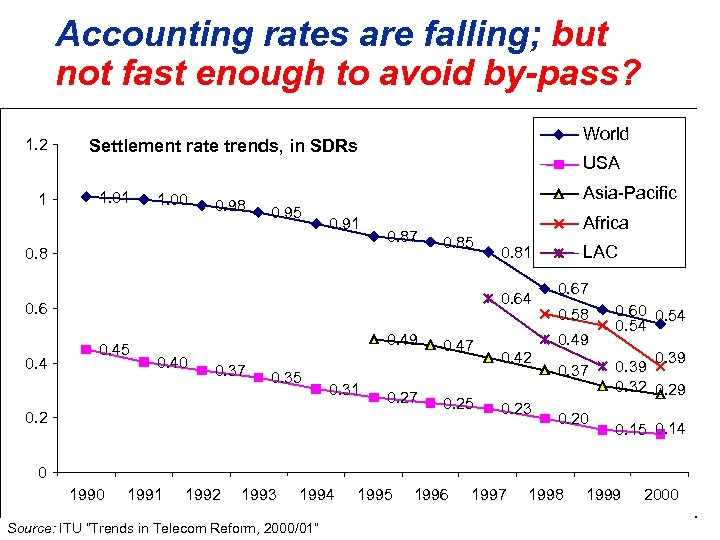 Accounting rates are falling; but not fast enough to avoid by-pass? 1. 2 1 World Settlement rate trends, in SDRs 1. 01 1. 00 0. 98 USA Asia-Pacific 0. 95 0. 91 0. 87 Africa 0. 85 0. 64 0. 6 0. 45 0. 49 0. 40 0. 37 0. 35 0. 31 0. 27 0. 2 0. 47 0. 25 LAC 0. 81 0. 67 0. 58 0. 49 0. 42 0. 23 0. 37 0. 20 0. 60 0. 54 0. 39 0. 32 0. 29 0. 15 0. 14 0 1991 1992 1993 1994 Source: ITU “Trends in Telecom Reform, 2000/01” 1995 1996 1997 1998 1999 2000
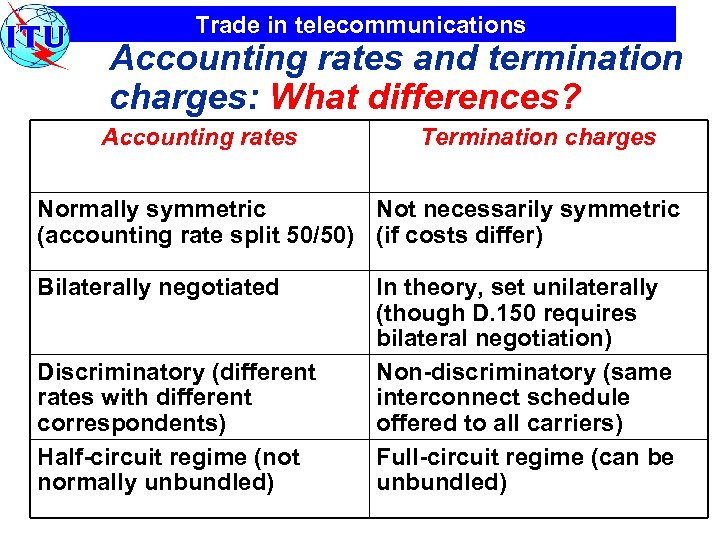 Trade in telecommunications Accounting rates and termination charges: What differences? Accounting rates Termination charges Normally symmetric Not necessarily symmetric (accounting rate split 50/50) (if costs differ) Bilaterally negotiated Discriminatory (different rates with different correspondents) Half-circuit regime (not normally unbundled) In theory, set unilaterally (though D. 150 requires bilateral negotiation) Non-discriminatory (same interconnect schedule offered to all carriers) Full-circuit regime (can be unbundled)
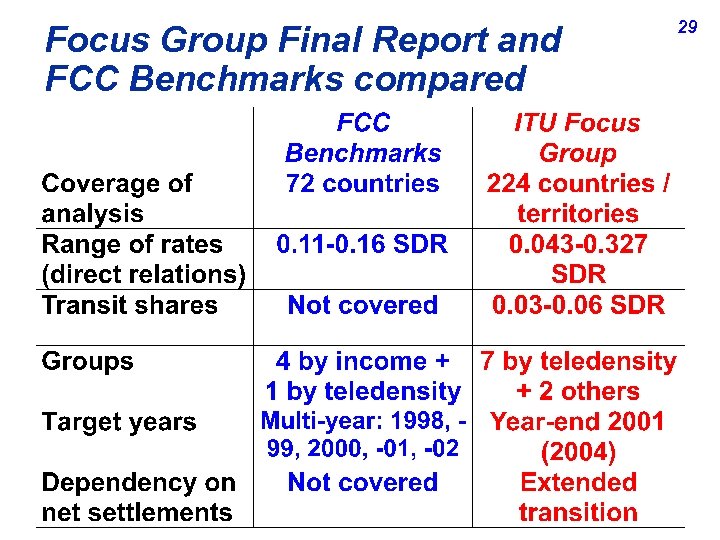
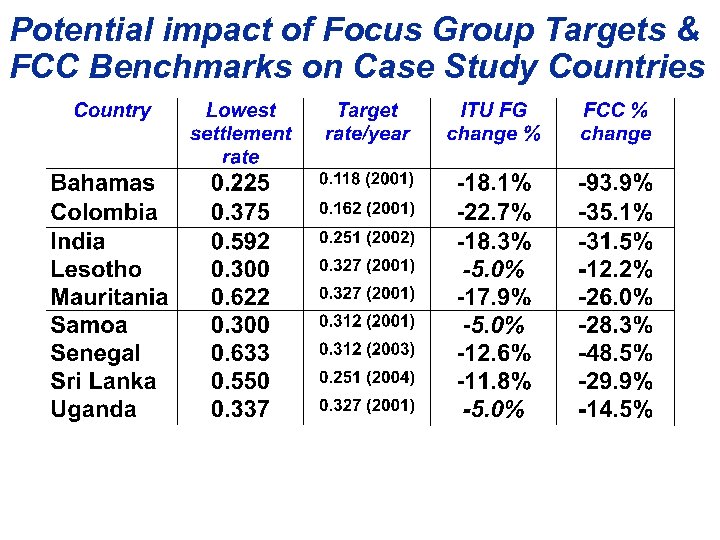
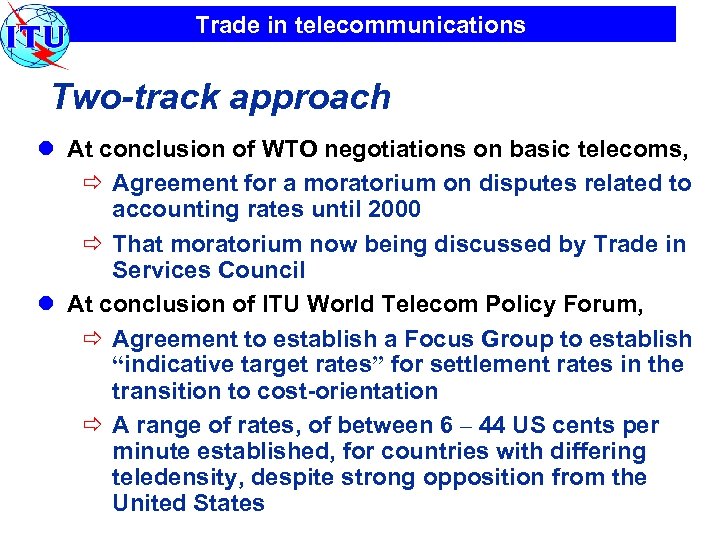 Trade in telecommunications Two-track approach l At conclusion of WTO negotiations on basic telecoms, ð Agreement for a moratorium on disputes related to accounting rates until 2000 ð That moratorium now being discussed by Trade in Services Council l At conclusion of ITU World Telecom Policy Forum, ð Agreement to establish a Focus Group to establish “indicative target rates” for settlement rates in the transition to cost-orientation ð A range of rates, of between 6 – 44 US cents per minute established, for countries with differing teledensity, despite strong opposition from the United States
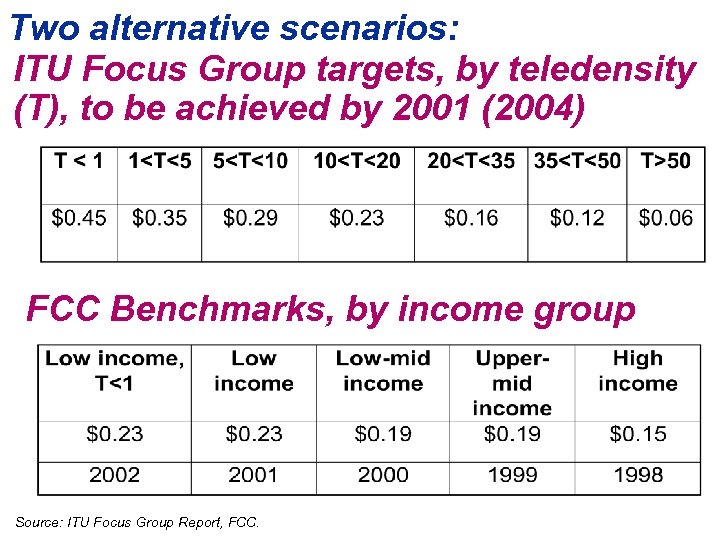 Two alternative scenarios: ITU Focus Group targets, by teledensity (T), to be achieved by 2001 (2004) FCC Benchmarks, by income group Source: ITU Focus Group Report, FCC.
 Focus Group Final Report and FCC Benchmarks compared 29
 Potential impact of Focus Group Targets & FCC Benchmarks on Case Study Countries
 The future (1): Will traffic be “too cheap to meter”? Trans. Atlantic cables, 1983 -2000 Cost per voice path (US$) 10'000 Capacity (voice paths), growing by 64% p. a. 100'000 10'000 1'000 100'000 10'000 10 1'000 Cost per voice path (US$), declining by 41% p. a. 100 10 1 1 TAT-7 TAT-8 TAT-9 TAT-10 T-11 T-12/13 Gemini TAT-14 1983 1988 1991 1992 1993 1995 1998 2000 Source: ITU, Tele. Geography Inc. , FCC. Note: Voice-path numbers assume a compression ratio of 5: 1 to number of circuits. Capacity (voice paths) 100'000
 The future (2): Will IP render PSTN circuits obsolete? International circuit usage 250 200 Public Switched Telephone Network circuits 150 100 Int'l Private Line circuits (Internet) 50 0 1996 1997 Note: Based on usage of circuits between the US and the rest of the world. Source: FCC. 1998
 Trade in telecommunications ITU/WTO Co-operation l Opinion A of 1998 World Telecom Policy Forum Recommends applying the WTO Regulatory Reference Principles in ITU Member States ð ð ð Competitive safeguards Interconnection Universal service Licensing Independent regulators Allocation and use of scarce resources l Co-operation agreement between ITU and WTO considered by ITU Plenipotentiary and WTO Trade in Services Council and signed on 22 Nov. 2000
 International interconnection: Issues for regulators l Transparency: Should regulators require the publication or disclosure of settlement rates and/or interconnection rates? l Intervention: What circumstances might justify intervention in negotiation of accounting rates or establishment of interconnect rates? l Unilateral action: How should regulators respond to possible unilateral action by foreign regulators in setting benchmark rates? l Mobile international connection: Does the development of 3 G services require special attention from regulators?
 Trade in telecommunications What does it all add up to? l Philosophical ð Facilitating the transition to a competitive market environment ð Birth of a global information society ð Telecommunications as a traded service l Practical ð Shift from a revenue-sharing to a cost-oriented regime for international telecommunications ð Market liberalisation now the dominant paradigm ð Efforts to provide a “soft landing” for those countries likely to be hardest hit by changes