 Скачать презентацию Trade Facilitation Benefits to Business Dr Carol Cosgrove-Sacks
14a59cd9ea28b85e229d7e5e170c4d93.ppt
- Количество слайдов: 26




Trade Facilitation: Benefits to Business Dr. Carol Cosgrove-Sacks Director, Trade United Nations Economic Commission for Europe (UNECE) CTIED, 26 May 2005
Trade Facilitation: Benefits to Business Contents 1. Business relevance of trade facilitation 2. What business needs from public service 3. Costs and benefits of trade facilitation 4. Business contribution to trade facilitation 5. Further negotiations 2

Trade Facilitation: Benefits to Business 1. Business relevance of trade facilitation 3
Trade Facilitation: Benefits to Business • Trade liberalization and lower tariffs make non-tariff barriers more costly • Unpredictable and cumbersome procedures and administrative delays cost money 4
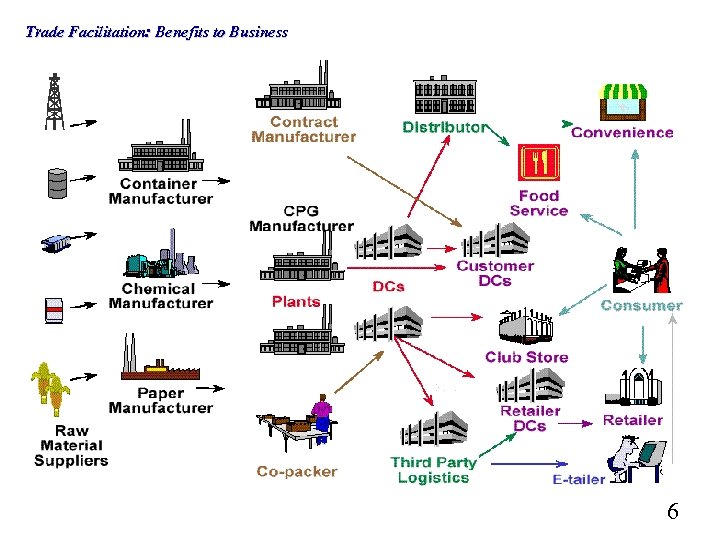
Trade Facilitation: Benefits to Business • International supply chains depend on moving goods and components fast and predictably • Increased reliance on just in time production and delivery makes just in time customs clearance a major issue for business • SMEs suffer most from poor trade facilitation 5
Trade Facilitation: Benefits to Business 6
Trade Facilitation: Benefits to Business • Direct costs: compliance trade-related services • Indirect costs: procedural delays lack of predictability lost business opportunities 7

Trade Facilitation: Benefits to Business 2. What business needs from public service 8
Trade Facilitation: Benefits to Business • Lower trade transaction costs • Faster information flow & more secure trading environment • Efficient and predictable customs procedures • Modernization of customs facilities and automation to support cross-border trade and security • Transparent and robust framework for financial transactions 9
Trade Facilitation: Benefits to Business The average ad valorem equivalent of a 1 -day delay in the transportation of manufactured goods is around 0. 8% (Hummels 2001) 10

Trade Facilitation: Benefits to Business 3. Costs and benefits of trade facilitation 11
Trade Facilitation: Benefits to Business • Cutting costs and reducing delays • Faster Customs clearance and release • Simple commercial framework for both domestic and international trade • Enhanced competitiveness 12
Trade Facilitation: Benefits to Business The world income gains from 1% reduction in trade transaction costs amounts to USD 40 billion, with no losers (OECD 2005) 13
Trade Facilitation: Benefits to Business APEC: 5% of reduction in trade-related transaction costs by 2006 could raise GDP by 0. 9% and lift real consumption significantly above what it would otherwise be. (Foreign Affairs and Trade, Australia, 2002) 14
Trade Facilitation: Benefits to Business Freight and insurance costs as % of total exports (WTO submissions 2005): – 12. 9% for landlocked LDCs – 8. 1% for developing countries – 5. 8% for developed countries – over 50% for some African LDCs – Over 25% for landlocked CIS (UNECE) 15
Trade Facilitation: Benefits to Business • Fraud, illegal payments and poor security at customs in Nigeria are estimated to increase the cost of imports by 45% (World Bank 2004) • Increased efficiency of customs procedures could increase trade flows by 30% in the Russian Federation and 22% in Indonesia (Wilson et al. 2003) 16
Trade Facilitation: Benefits to Business Automation / e-Business saved 1. 5% of the value of imported goods in APEC countries (Foreign Affairs and Trade, Australia, 2002) 17

Trade Facilitation: Benefits to Business 4. Business contribution to Trade Facilitation 18
Trade Facilitation: Benefits to Business • A key partner in trade facilitation for governments • Public Private Partnerships for trade • Source of expertise on trade practices and technology • Useful first-hand experience of problems and solutions 19

Trade Facilitation: Benefits to Business 5. Further negotiations 20
Trade Facilitation: Benefits to Business Trade Facilitation in WTO Negotiations • Art. V: Creating a predictable regime to expedite the movement of goods in transit; special interest to landlocked and transit countries • Art. VIII: Reducing fees and formalities connected with imports and exports procedures and documents • Art. X: Increasing transparency in publication and application of trade laws, regulations and procedures 21
Trade Facilitation: Benefits to Business Issues • Capacity building and technical assistance – needs assessment • Customs cooperation – agreed guidelines • Special and differential treatment for developing countries and Least Developed Countries • Timing 22
Trade Facilitation: Benefits to Business UNECE/CEFACT • Developing and maintaining trade facilitation standards, recommendations and other tools • Vision: “Simple, Transparent and Effective Processes for Global Commerce” • Open to participation from all UN member states and organizations recognized by ECOSOC • Series of Working Groups with over 400 participants from governments and businesses 23
Trade Facilitation: Benefits to Business UNECE/CEFACT standards • Over 30 Trade Facilitation Recommendations, several of which are ISO standards – Recommendation 1: UNLAYOUT KEY Recommendation 4: Trade Facilitation organizations – UN/EDIFACT and related standards and recommendations – Single window (single entry point) 24
Trade Facilitation: Benefits to Business How UNECE/CEFACT could help • e. Documents: paperless trade • Capacity building for trade facilitation • Tools – – – Document alignment Repositories Publications Codes databases Websites 25

Thank you. Carol. Cosgrove-Sacks@unece. org www. unece. org/trade 26
Скачать презентацию Trade Facilitation Benefits to Business Dr Carol Cosgrove-Sacks
14a59cd9ea28b85e229d7e5e170c4d93.ppt