


 Скачать презентацию TR 33 in the Light of the USDark
2e47cef249c3a7eeced4b05b784a7a06.ppt
- Количество слайдов: 11
 TR 33 in the Light of the USDark Energy Task Force Report Thomas Reiprich Danny Hudson Oxana Nenestyan Holger Israel Emmy Noether Research Group Argelander-Institut für Astronomie Universität Bonn http: //www. dark-energy. net
 US-Dark Energy Task Force (DETF) • Established to advise Do. E, NASA, and NSF on future of dark energy research. • Members: Kolb, Albrecht, Bernstein, Cahn, Freedman, Hewitt, Huth, Kamionkowski, Knox, Mather, Staggs, Suntzeff. • US - why care? Useful calculations, trendsetter.
 Introductory Remarks • DE one of most important problems in all physical sciences. • Most critical component of any approach to DE problem is improvement in experimental constraints. • Clear steps can be taken to drive significant progress.
 Four Main Techniques • Baryon Acoustic Oscillations (BAO; new, less affected by astrophysical uncertainties but least statistical power). • Galaxy Cluster (CL) surveys (MF, statistical power to exceed BAO and SN but currently largest systematic uncertainties). • Supernova (SN) surveys (at present most powerful). • Weak Lensing (WL) surveys (new, if systematics under control as currently predicted then most powerful technique). • No primary CMB. GRBs and GW unclear.
 Four Stages • I: Known today. • II: Known after completion of ongoing projects. • III: Currently proposed near term projects. • IV: LST, SKA, JDEM.
 Recommendations • Multiple techniques at every stage, at least one sensitive to growth of structure. • Stage III projects should achieve factor 3 gain over stage II projects. • Stage IV factor 10. • High priority for near term funding for studies of systematic efffects.
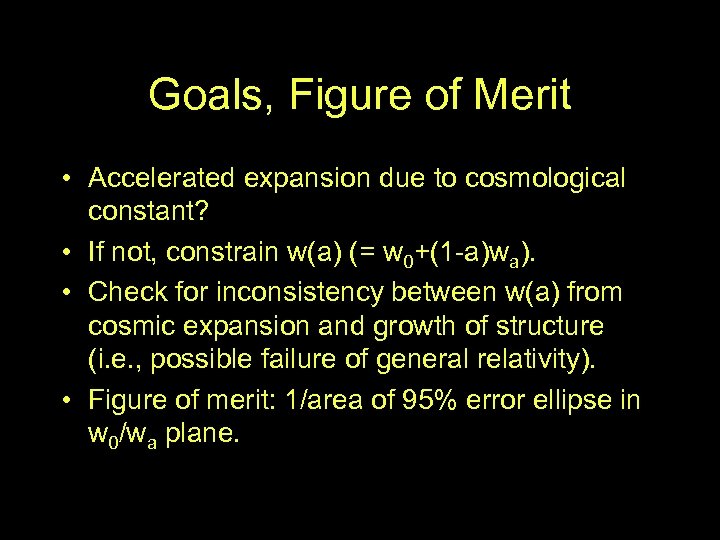 Goals, Figure of Merit • Accelerated expansion due to cosmological constant? • If not, constrain w(a) (= w 0+(1 -a)wa). • Check for inconsistency between w(a) from cosmic expansion and growth of structure (i. e. , possible failure of general relativity). • Figure of merit: 1/area of 95% error ellipse in w 0/wa plane.
 Direct Relation to TR 33 • All observational methods included! – BAO: B 8 – CL: B 4, B 6, B 7 (optical, SZ, X-ray, lensing) – SN: B 3 – WL: B 5
 Direct Relation to TR 33 • “Our inability to forecast systematic error levels reliably is the biggest impediment to judging the future capabilities of the techniques. ” => Use results with care. => Test systematics.
 Direct Relation to TR 33 • TR includes (almost? ) all mentioned primary tests for systematics for all techniques: – BAO: better theoretical understanding of non-linear regime and bias (B 8, C 1). – CL: observational constraints from lensing, SZ, and X-rays on observable-mass relation (B 6, B 7). – SN: detailed observations of nearby SN to study dependence of peak luminosities (and spectra) on observational parameters (B 3). – WL: observational calibration of photo-z technique (also for BAO) and study feasibility of corrections for intrinsic galaxy shapes and PSF (~B 5, B 8? ).
 Direct Relation to TR 33 • Involvement in – JDEM? – LST? – SKA?