


 Скачать презентацию TPC sector alignment Marian Ivanov Outlook o
3a40801bdff106baff6a4b8f4fa6892c.ppt
- Количество слайдов: 33
 TPC sector alignment Marian Ivanov
 Outlook o o o Requirements STAR TPC example Alignment algorithm using tracks – Inner outer sectors n n o Simulation Results Laser system
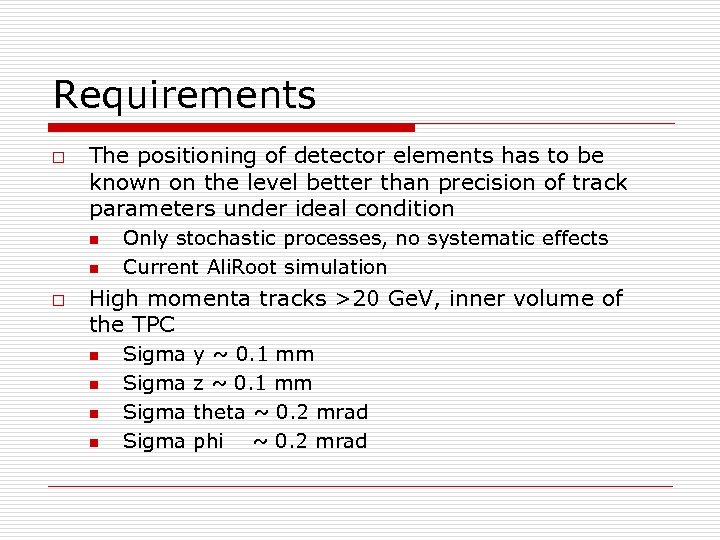 Requirements o The positioning of detector elements has to be known on the level better than precision of track parameters under ideal condition n n o Only stochastic processes, no systematic effects Current Ali. Root simulation High momenta tracks >20 Ge. V, inner volume of the TPC n n Sigma y ~ 0. 1 mm z ~ 0. 1 mm theta ~ 0. 2 mrad phi ~ 0. 2 mrad
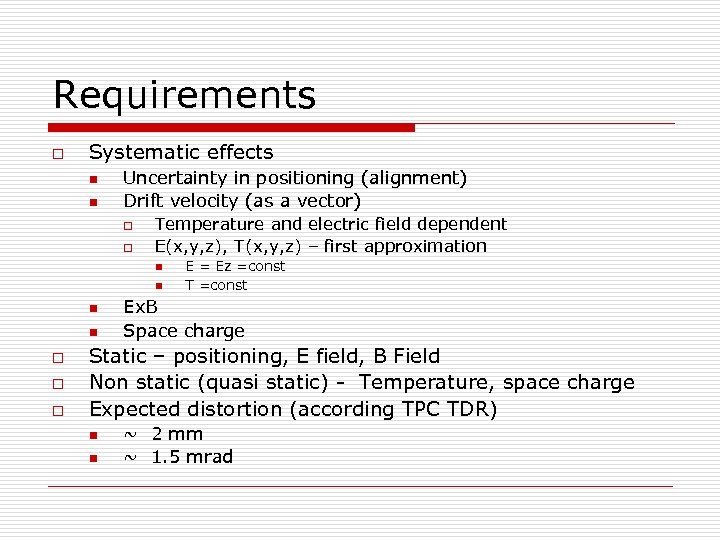 Requirements o Systematic effects n n Uncertainty in positioning (alignment) Drift velocity (as a vector) o o Temperature and electric field dependent E(x, y, z), T(x, y, z) – first approximation n n o o o E = Ez =const T =const Ex. B Space charge Static – positioning, E field, B Field Non static (quasi static) - Temperature, space charge Expected distortion (according TPC TDR) n n ~ 2 mm ~ 1. 5 mrad
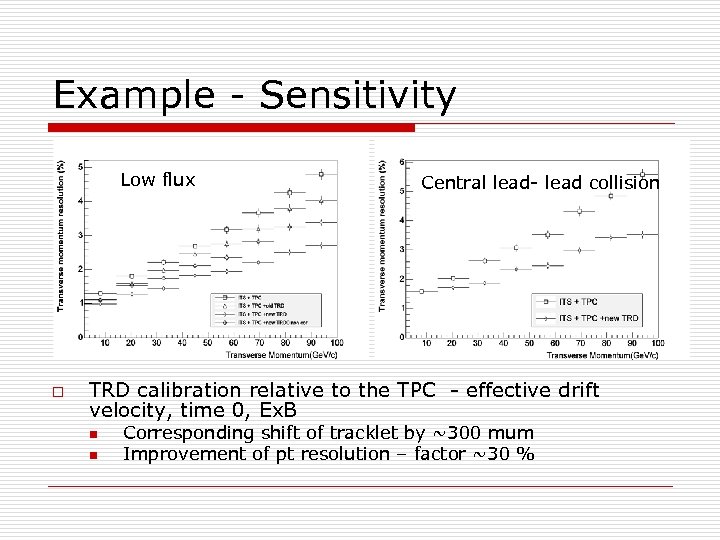 Example - Sensitivity Low flux o Central lead- lead collision TRD calibration relative to the TPC - effective drift velocity, time 0, Ex. B n n Corresponding shift of tracklet by ~300 mum Improvement of pt resolution – factor ~30 %
 STAR - Tracking detectors TPC, SVT, SSD, FTPC, TOF, p. VPD, CTB, RICH Initial positions from survey (or previous year), later fine-tuned with tracking Pedestals taken throughout run-year Gains determined early in the run (and monitored) using pulsers (Initial) drift velocities determined / monitored with lasers Distortions studied in Fast Offline
 STAR TPC Gains needed early in run-year to use online cluster-finder Updated every few months, or when pads/RDOs die Automated updating of drift velocities (and initial T 0) from laser runs Checked / fine-tuned via matching primary vertex Z position using east and west half tracks separately Ideally determined from track-matching to SVT (perpendicular drift), but requires all other calibs to be done already! (principle has been tested)
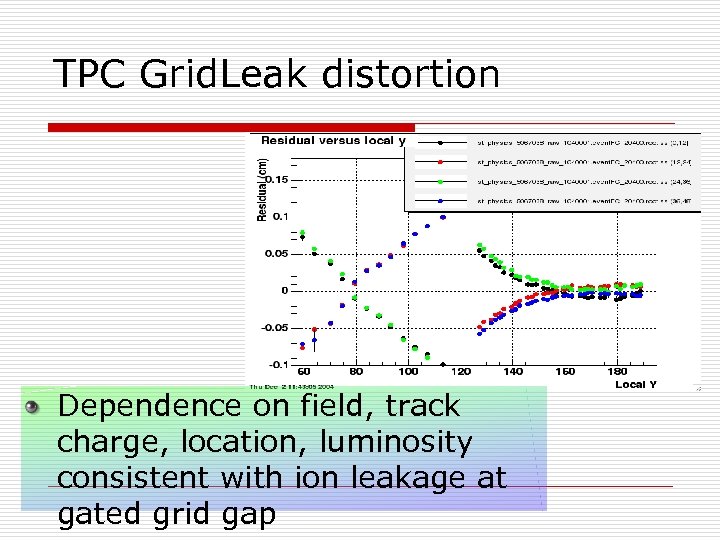 TPC Grid. Leak distortion Dependence on field, track charge, location, luminosity consistent with ion leakage at gated grid gap
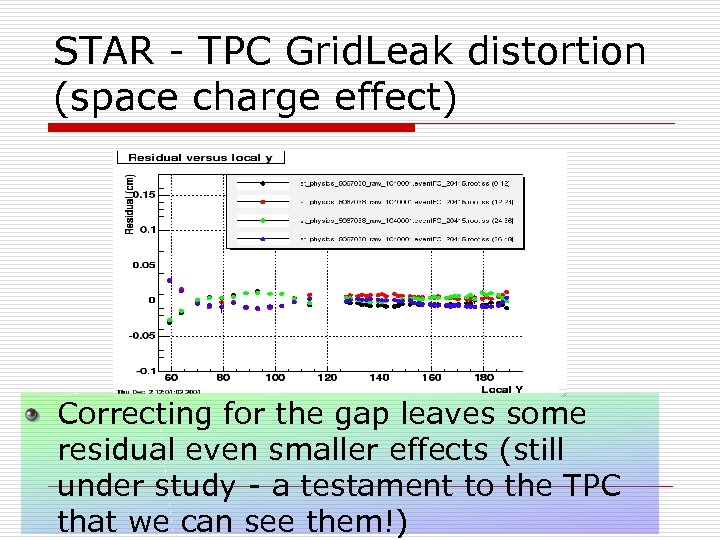 STAR - TPC Grid. Leak distortion (space charge effect) Correcting for the gap leaves some residual even smaller effects (still under study - a testament to the TPC that we can see them!)
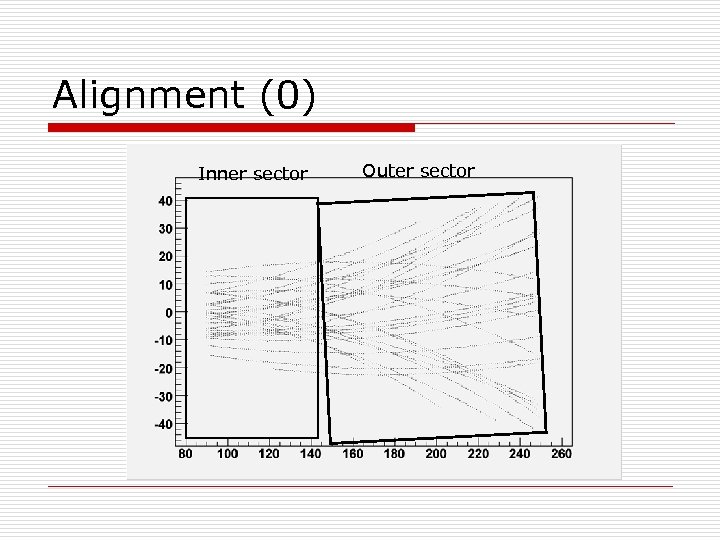
 Simulation o o o Stand alone simulator Ideal helix Pt range >0. 4 Ge. V n Exp(-x/0. 4) distribution Magnetic field 0. 5 T Tracks inside of one sector, inner and outer n o Pads and pad-rows and time bins inside chamber perfectly aligned Outer sector misaligned n Characterize by TGeo. HMatrix
 Motivation o Why to use tracks in the magnetic field for the alignment? n Rotation and translation of the chambers can be affected by the presence of the magnetic field
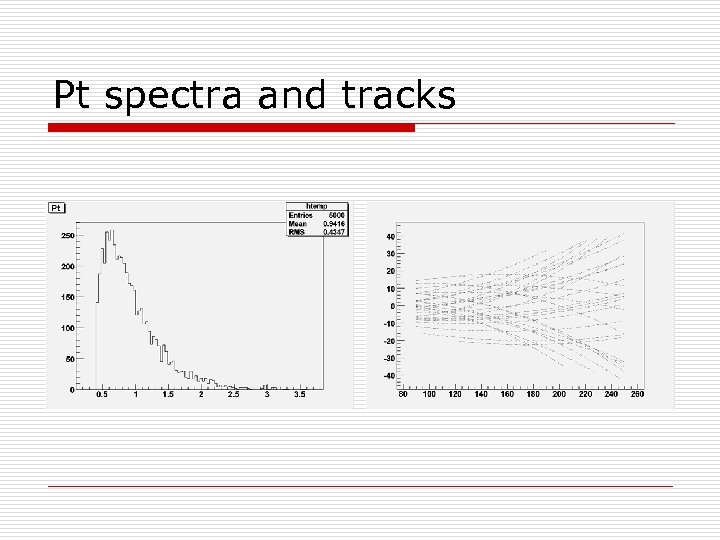 Pt spectra and tracks
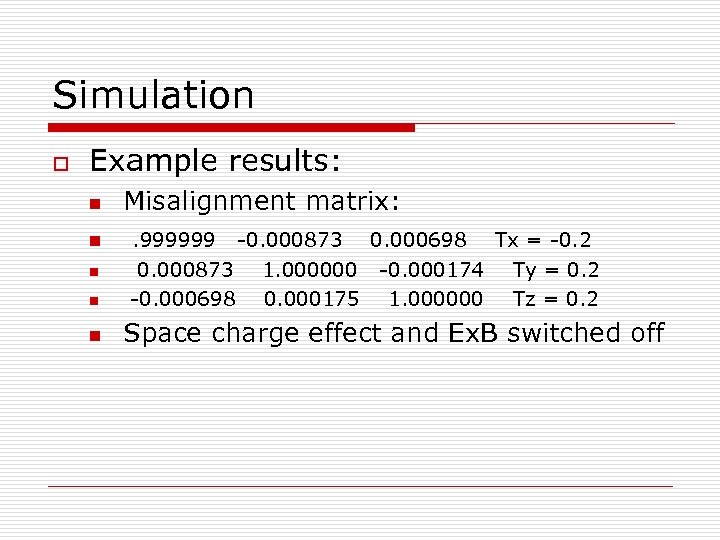 Simulation o Example results: n n n Misalignment matrix: . 999999 0. 000873 -0. 000698 -0. 000873 0. 000698 1. 000000 -0. 000174 0. 000175 1. 000000 Tx = -0. 2 Ty = 0. 2 Tz = 0. 2 Space charge effect and Ex. B switched off
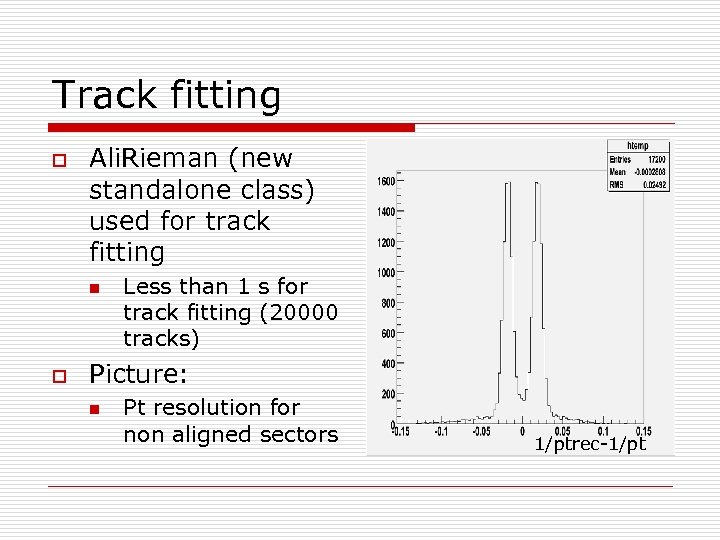 Track fitting o Ali. Rieman (new standalone class) used for track fitting n o Less than 1 s for track fitting (20000 tracks) Picture: n Pt resolution for non aligned sectors 1/ptrec-1/pt
 Alignment (0) Inner sector Outer sector
 Alignment (1) o o o Separate track –fitting in inner and outer sector Parabolic track approximation at the middle reference plane in both chambers Minimization of the chi 2 distance between space point in reference plane of upper chamber and corresponding extrapolation of the inner track n TMinuit used
 Alignment (2) o FCN=1257. 14 FROM MIGRAD STATUS=CONVERGED 132 CALLS 133 TOTAL EDM=2. 42528 e-12 STRATEGY= 1 ERROR MATRIX UNCERTAINTY 0. 0 per cent EXT PARAMETER STEP FIRST NO. NAME VALUE ERROR SIZE DERIVATIVE 1 2 3 4 5 6 rx ry rz sx sy sz 1. 07144 e-02 3. 95478 e-02 4. 82396 e-02 -1. 96256 e-01 2. 05511 e-01 1. 99985 e-01 8. 90503 e-04 1. 99467 e-03 5. 75040 e-03 4. 94420 e-03 1. 60506 e-02 5. 07757 e-03 1. 58139 e-05 6. 68023 e-06 9. 11108 e-06 4. 00290 e-05 2. 49723 e-05 2. 49634 e-05 -2. 35997 e-01 -2. 30862 e+01 1. 29964 e-01 -3. 84583 e+00 7. 85195 e-02 5. 15010 e+00
 Alignment – Covariance matrix o o PARAMETER CORRELATION COEFFICIENTS NO. GLOBAL 1 2 3 4 5 6 1 0. 86752 1. 000 0. 018 -0. 192 -0. 025 0. 266 0. 014 2 0. 99573 0. 018 1. 000 0. 023 -0. 921 -0. 021 0. 971 3 0. 99896 -0. 192 0. 023 1. 000 -0. 005 -0. 996 0. 027 4 0. 97508 -0. 025 -0. 921 -0. 005 1. 000 0. 002 -0. 819 5 0. 99900 0. 266 -0. 021 -0. 996 0. 002 1. 000 -0. 025 6 0. 99065 0. 014 0. 971 0. 027 -0. 819 -0. 025 1. 000
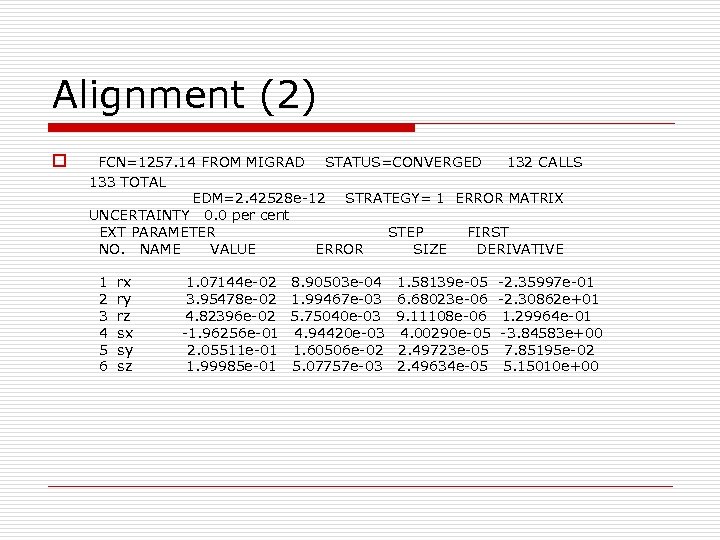
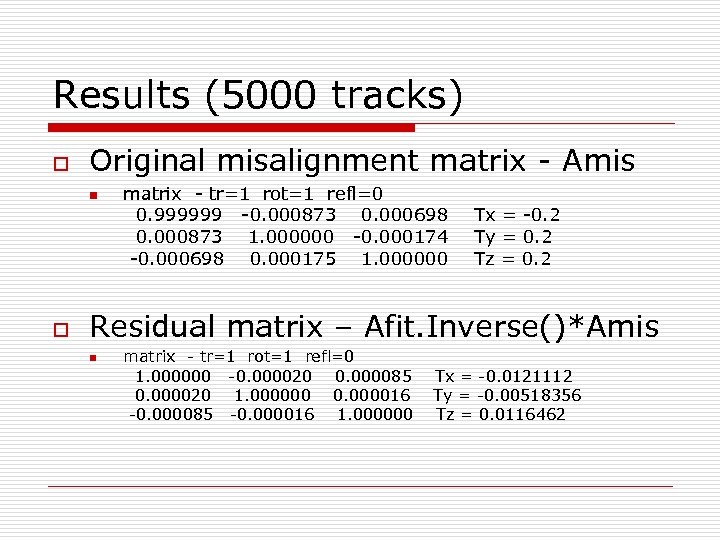 Results (5000 tracks) o Original misalignment matrix - Amis n o matrix - tr=1 rot=1 refl=0 0. 999999 -0. 000873 0. 000698 0. 000873 1. 000000 -0. 000174 -0. 000698 0. 000175 1. 000000 Tx = -0. 2 Ty = 0. 2 Tz = 0. 2 Residual matrix – Afit. Inverse()*Amis n matrix - tr=1 rot=1 refl=0 1. 000000 -0. 000020 0. 000085 0. 000020 1. 000000 0. 000016 -0. 000085 -0. 000016 1. 000000 Tx = -0. 0121112 Ty = -0. 00518356 Tz = 0. 0116462
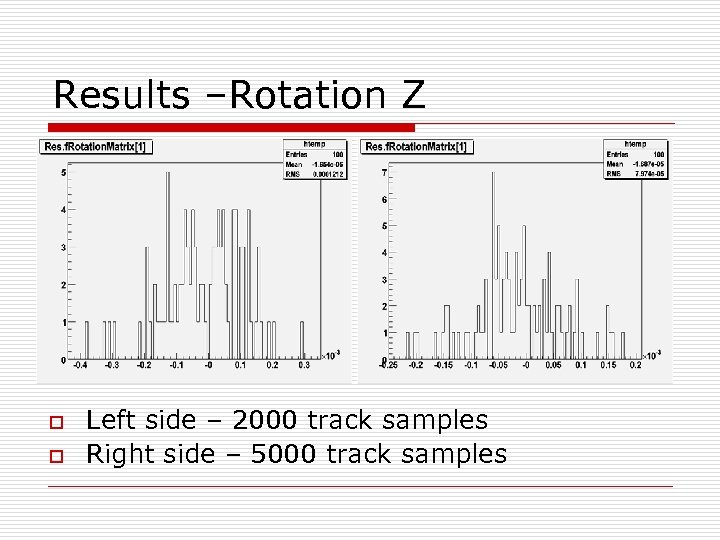 Results –Rotation Z o o Left side – 2000 track samples Right side – 5000 track samples
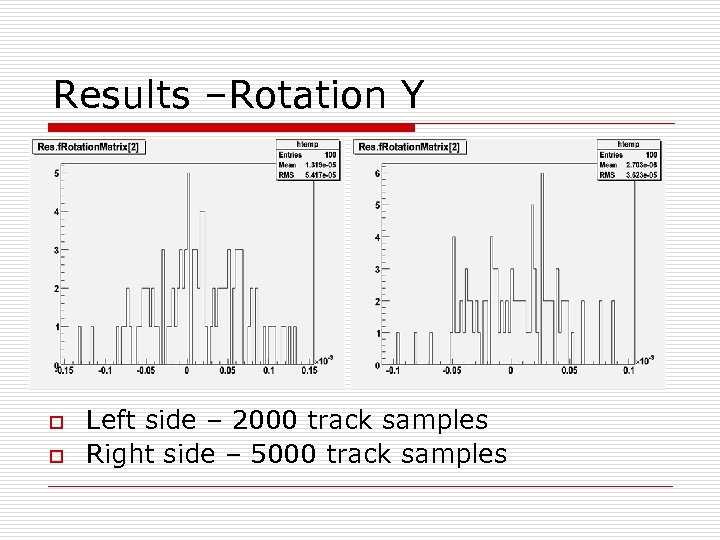 Results –Rotation Y o o Left side – 2000 track samples Right side – 5000 track samples
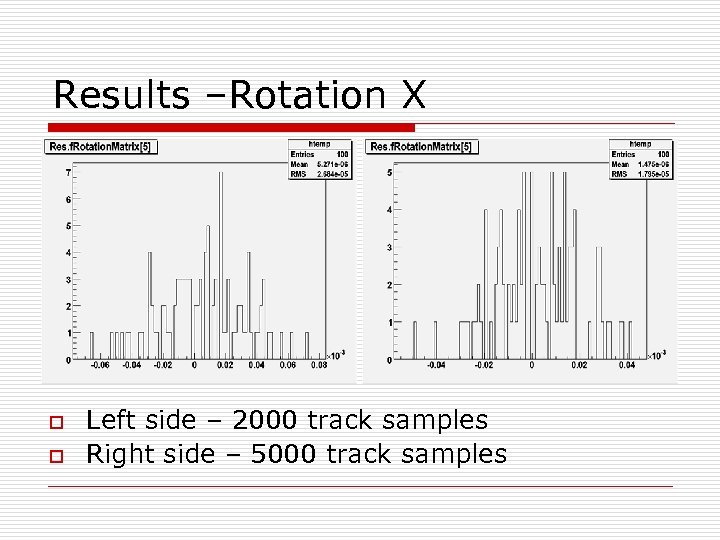 Results –Rotation X o o Left side – 2000 track samples Right side – 5000 track samples
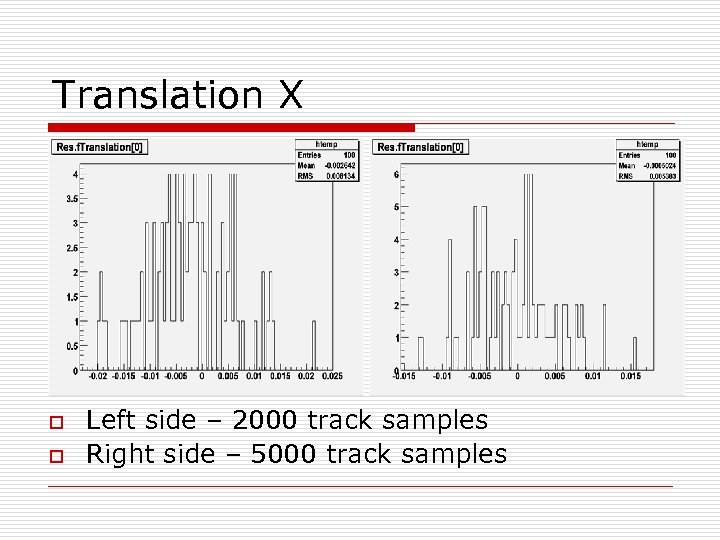 Translation X o o Left side – 2000 track samples Right side – 5000 track samples
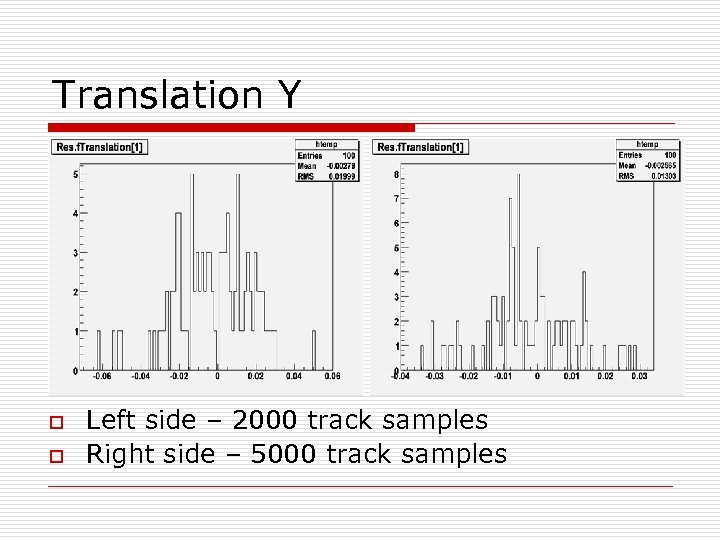 Translation Y o o Left side – 2000 track samples Right side – 5000 track samples
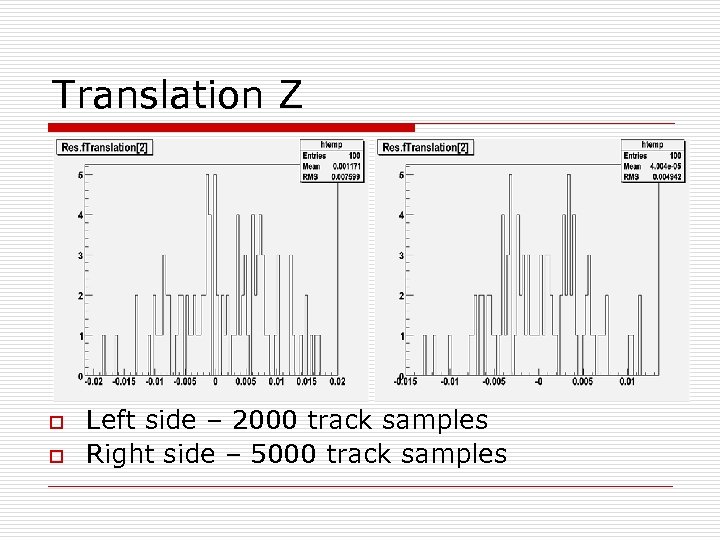 Translation Z o o Left side – 2000 track samples Right side – 5000 track samples
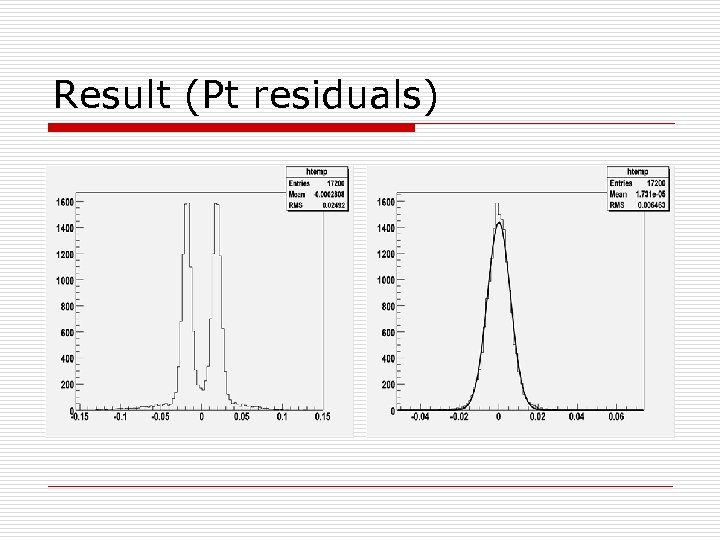 Result (Pt residuals)
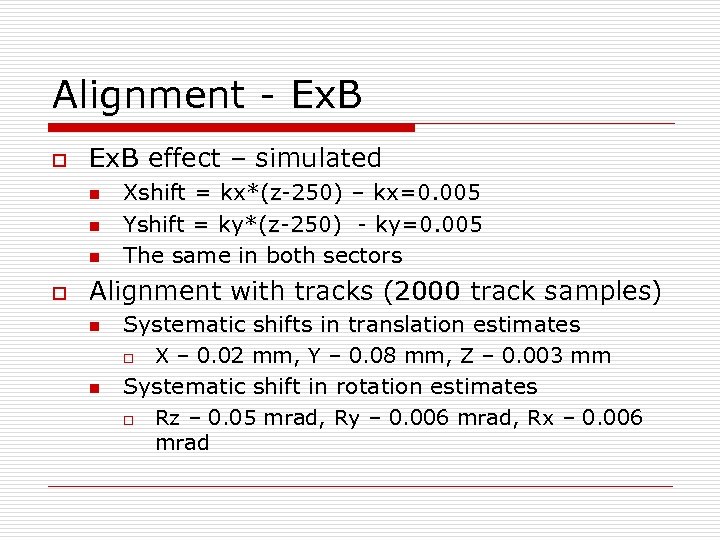 Alignment - Ex. B o Ex. B effect – simulated n n n o Xshift = kx*(z-250) – kx=0. 005 Yshift = ky*(z-250) - ky=0. 005 The same in both sectors Alignment with tracks (2000 track samples) n n Systematic shifts in translation estimates o X – 0. 02 mm, Y – 0. 08 mm, Z – 0. 003 mm Systematic shift in rotation estimates o Rz – 0. 05 mrad, Ry – 0. 006 mrad, Rx – 0. 006 mrad
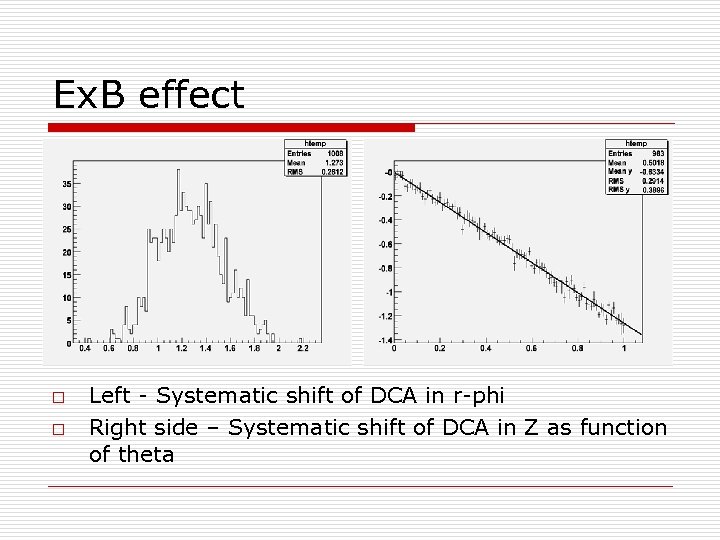 Ex. B effect o o Left - Systematic shift of DCA in r-phi Right side – Systematic shift of DCA in Z as function of theta
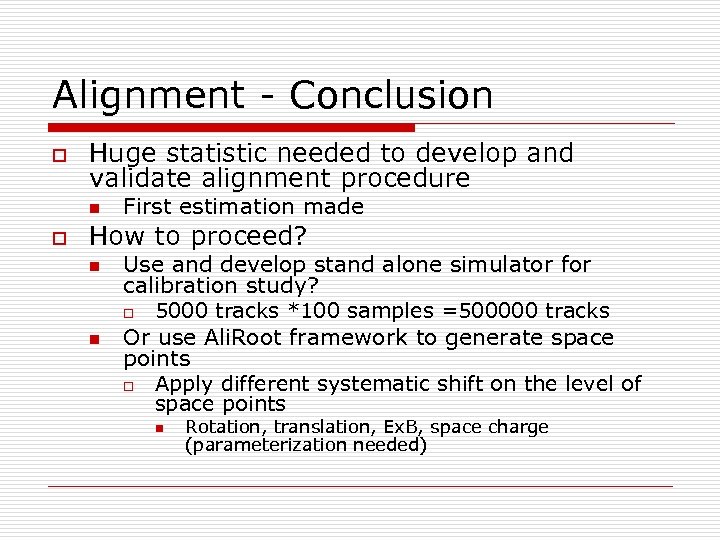 Alignment - Conclusion o Huge statistic needed to develop and validate alignment procedure n o First estimation made How to proceed? n n Use and develop stand alone simulator for calibration study? o 5000 tracks *100 samples =500000 tracks Or use Ali. Root framework to generate space points o Apply different systematic shift on the level of space points n Rotation, translation, Ex. B, space charge (parameterization needed)
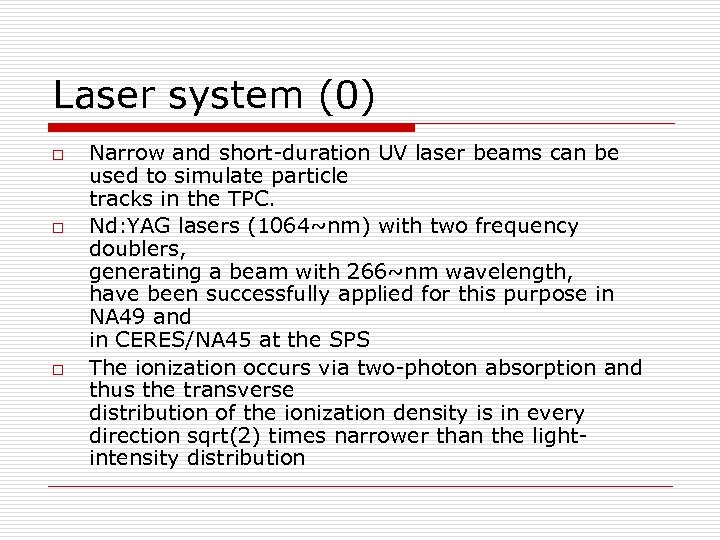 Laser system (0) o o o Narrow and short-duration UV laser beams can be used to simulate particle tracks in the TPC. Nd: YAG lasers (1064~nm) with two frequency doublers, generating a beam with 266~nm wavelength, have been successfully applied for this purpose in NA 49 and in CERES/NA 45 at the SPS The ionization occurs via two-photon absorption and thus the transverse distribution of the ionization density is in every direction sqrt(2) times narrower than the lightintensity distribution
 Laser system (1) o o The aim of the laser calibration system n Measure the response of the TPC to straight tracks at known position. In particular, the laser system should allow the TPC readout electronics and software to be tested, distortions caused by misalignment of the sectors to be measured Temporal and spatial changes of the drift velocity down to 10^-4 to be monitored (0. 25 mm? ) Apparent track distortions due to Ex. B and space-charge effects to be measured, and the transition region between the drift volume and wire chambers to be understood.
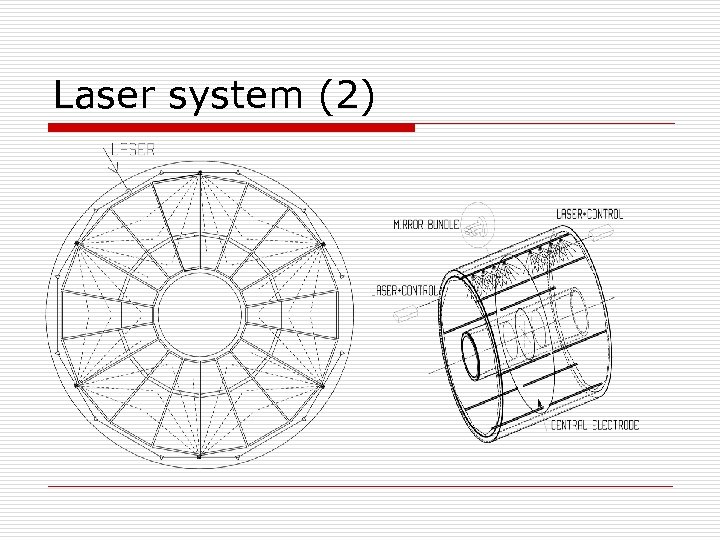 Laser system (2)
 Laser system (3) o 168 beams in each of the TPC halves n o absolute position n n o up to 2 mm at the entrance of the track into the TPC up to 2 cm at its end-point Relative position n n o 6 x 7 x 4 up to 0. 2 mm entrance and 2 mm at the end-point Size n n n Directly after the mirror the beam has a box profile, with a size equal to that of the mirror (1 mm) About 60 --80~cm later the beam acquires a perfect Gaussian shape with diameter ~0. 6 mm (4 sigma) Subsequently, the beam stays Gaussian and its diameter increases to d~=1. 6 mm at 300 cm, which corresponds to a divergence of 0. 5~mr