 Скачать презентацию TOWNSVILLE CITY COUNCIL SUSTAINABLE PURCHASING TRAINING MODULE 1
92225d492bb719dbe26de23315b9e0ad.ppt
- Количество слайдов: 29



TOWNSVILLE CITY COUNCIL SUSTAINABLE PURCHASING TRAINING MODULE 1
1. TRAINING OVERVIEW 2
TRAINING OVERVIEW 1. Introduction to Sustainable Purchasing (SP) 2. SP: What is it & Why practice it? 3. Overview- Good SP Practices 4. SP Principles 5. Including the Environment in Procurement Policies & Planning 6. Writing Specifications 7. Tender Evaluation 8. Make sure you get what you paid for 9. Bringing it all together 3
OBJECTIVES The purpose of this training is to help you: Understand what Sustainable Purchasing (SP) is; Appreciate the reasons to support it; & Be able to apply the Principles of SP in procurement policies & practices, that is, how to do it! 4
SP- WHAT IS IT & WHY DO IT? Sustainability- Triple Bottom Line (TBL) in Public Disclosure. Q: What is Unsustainable? Sound Management Systems include the Environment, as well as WH&S & Quality Systems; Competitive Advantage; Environmentally Responsible Businesses; Image, Grants & Support for Local Business. 5
WHAT IS SP? SP means integrating environmental/health considerations into purchasing decisions. Sustainable Goods & Services (G&S) are those that have a lesser or reduced effect on human health & the environment when compared with competing G&S that serve the same purpose. 6
WHY DO SP? Purchasing G&S that satisfy value for money (V 4$) criteria but also include sustainability; Save $- improving efficiency & reducing costs- landfill charges & on-sell recyclables Better manage environmental risks; To ensure the public image of TCC as a leader in environmental management & a responsible corporate citizen; To provide an example to other businesses, industry & the community in promoting the use of sustainable G&S; 7
BARRIERS/MOTIVATORS Changing behaviours in an organisation not only requires an understanding of the levers that can push the desired changes but also a knowledge of the barriers. If you wish to improve your organisation’s SP performance, it is worthwhile understanding the reason to support it, the barriers against it & finding ways to overcome these barriers (CBSM). 8
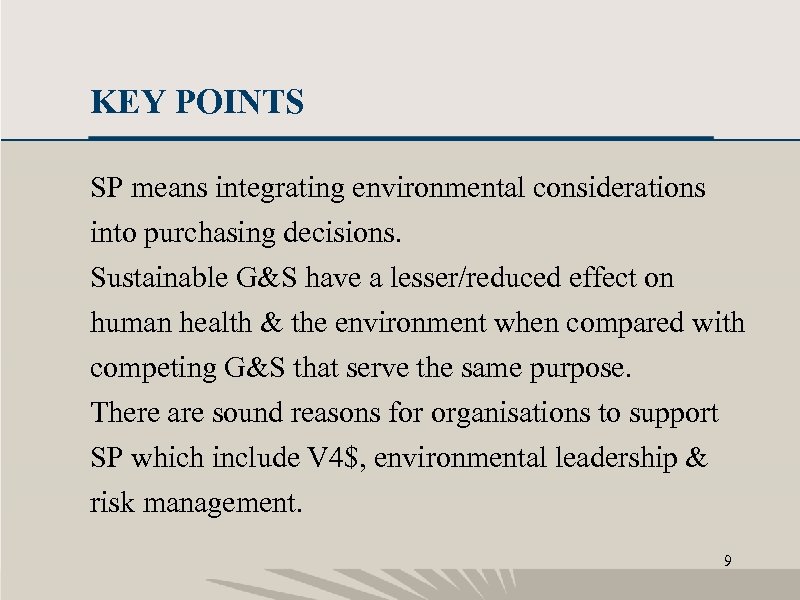
KEY POINTS SP means integrating environmental considerations into purchasing decisions. Sustainable G&S have a lesser/reduced effect on human health & the environment when compared with competing G&S that serve the same purpose. There are sound reasons for organisations to support SP which include V 4$, environmental leadership & risk management. 9
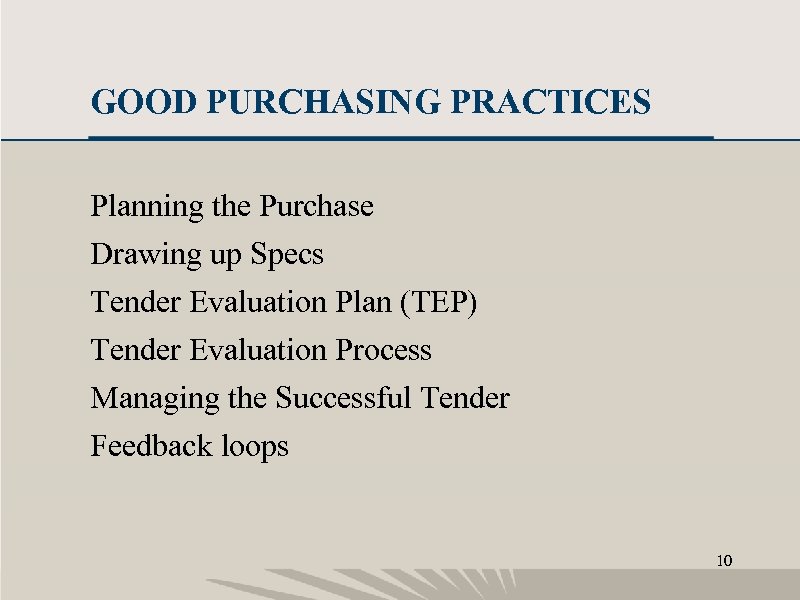
GOOD PURCHASING PRACTICES Planning the Purchase Drawing up Specs Tender Evaluation Plan (TEP) Tender Evaluation Process Managing the Successful Tender Feedback loops 10
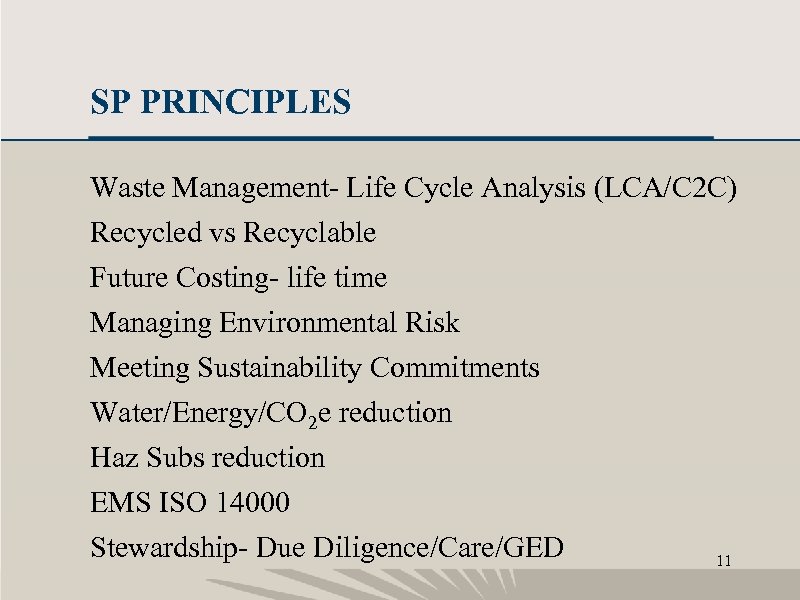
SP PRINCIPLES Waste Management- Life Cycle Analysis (LCA/C 2 C) Recycled vs Recyclable Future Costing- life time Managing Environmental Risk Meeting Sustainability Commitments Water/Energy/CO 2 e reduction Haz Subs reduction EMS ISO 14000 Stewardship- Due Diligence/Care/GED 11
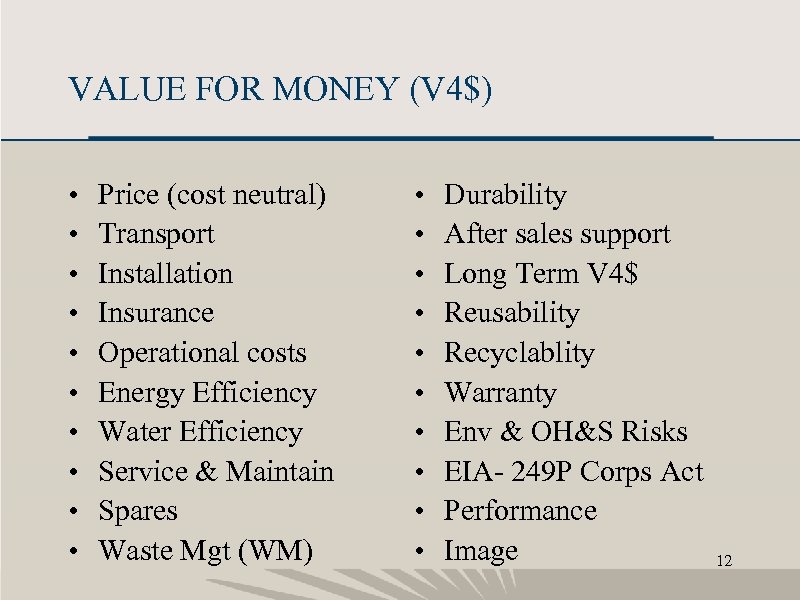
VALUE FOR MONEY (V 4$) • • • Price (cost neutral) Transport Installation Insurance Operational costs Energy Efficiency Water Efficiency Service & Maintain Spares Waste Mgt (WM) • • • Durability After sales support Long Term V 4$ Reusability Recyclablity Warranty Env & OH&S Risks EIA- 249 P Corps Act Performance Image 12
KEY POINTS • WM Principles should guide procurement planning so that strict avoidance of waste is the highest priority & disposal to landfill the least favourable option. • When costs of G&S are compared, it should not only relate to price but to all other costs during use of G&S. • SP as part of Environmental Risk Mgt strategy • SP most effective at front end of procurement process, where relevant policies incorporating sustainable principles direct procurement. 13
ENVIRONMENTAL POLICY • “Environmental Considerations will be taken into account in investment & corporate strategies & in the purchase of G&S” Australian Post Environmental Policy • “The organisation is committed to purchasing G&S that reduce environmental impacts & contributes to the socio-economic development of Brisbane City Council” 14
SP POLICIES & PLANNING • Service Level Agreements (SLA) & Standards of G&S • Specifications • Quantities [Q] (measurable) • Verification (competent person) • Evaluation- Tenders • Re-evaluation • Reporting- feedback 15
TOP DOWN COMMITMENT • • • Purchasing Policy Behavioural/cultural change Change Agents/Champs “Rewards” Contracts Education Promotion Involvement- design & implementation Tools- ecospecifier 16
ENVIRONMENTAL ISSUES • • • Environmental Policy- Corporate/Business Units Information (tools) Current Product Performance Payback timeframe Price Premium- up-front cost Considerations- next sheet 17
Q’s BEFORE PURCHASING • • Is it needed at all? Life-cycle costs? Waste prevention? Toxicity? No virgin material? Sustainable harvest? Recycled/recovered? Reusability? *Greenhouse gases = • Recyclability? • Durability? • Energy Rating? • Water Rating? • Disposal (package)? • Clients Needs? • Alternatives? • CO 2 e*? Equivalent CO 2 18
TARGET G&S- OFFICE: • A 4 • COMS PAPER • TOILET TISSUE • STATIONARY • TECHNOLOGY • SPARE PARTS • LIGHTS ELSEWHERE: • PARKS • CONSTRUCTION • FLEET 19
SUSTAINABLE G&S • • ecospecifier www. ecospecifier. org eco. Buy www. mav. asn. au/buyrecycled AGO www. greenhouse. gov. au www. greenprocurement. org. au/toolbox 20
KEY POINTS • To be most effective, sustainability issues need to be considered in the policy & planning phases of purchasing. • By adopting a proactive stance to the establishment & use of SP policies, an organisation can ensure that SP becomes a reality. • SP will be most successful with top-level management support, as such people have the most power to influence policy frameworks & the general culture of the organisation. • Consider sustainability issues in your procurement planning. Review previous checklist. • Some types of goods such as paper, office equipment, landscaping materials, certain construction materials & rubber/tyre derived products particularly lend themselves to SP considerations 21
ELIMINATING BIAS • Performance verses prescriptive specs. • Obstacles: colour, virgin paper, all-or-none basis, tight response & delivery times. • Over-Reliance on Track Record. • Cost considerations- cheap vs longevity: - Comparison shopping & bulk purchasing - Life-cycle (LCA) costing - Demand management (reduced volumes) - Longer term solutions- economies of scale 22
SUPPLIER CHECKLIST • What is their Environmental Record? • What is the Environmental Impact of their G&S? • What is the Environmental Impact of their production process? • What are whole of life considerations? • What are Environmentally positive features of each G&S? 23
USEFUL ADVICE • • Internal expertise Review Purchasing Policy Review Tender Template Re-develop Specs- biodegradable etc. Statement- greater recycled content preference Use eco-product databases Discussions with like organisations Attend relevant forums 24
KEY POINTS • Specs may result in bias against sustainable G&S if overly prescriptive, reliant on track record or focus on up front costs • Writing performance specs less likely to create bias • When preparing spec based on existing template, check for & amend prejudicial provisions. • Add appropriate provisions to specs to enhance SP 25
TENDER EVALUATION • Sustainable factors must be incorporated in evaluation criteria before the Request for Tender (RFT) is released. Hughes Aircraft Systems International v Airservices Australia [1997] 558 Federal Court of Australia (30 June 1997). • Scoring of tenders against predetermined criteria & application of agreed weightings against scores is generally acceptable (similar to job applications). • All tenderers must be legally compliant. 26
KEY POINTS • There are legal requirements relating to tender evaluation that impact upon SP. Importantly, environmental issues must be incorporated into evaluation criteria before the call for tenders. • Checklists &/or questionnaires can be used to gather & assess environmental information on suppliers & their G&S. These can be stipulated in the requirements for the tenderer in the specification. • Environmental issues need to be appropriately weighed in the tender evaluation process. V 4$ considerations should encompass all the relevant factors rather than simply the cheapest purchase price. 27
GET WHAT YOU PAID FOR • The extent of monitoring of supplier’s performance is determined by the level of risk with the G&S being provided. • Good monitoring of contractor performance progressively identifies, anticipates & facilitates correction of short comings before the relationship is adversely affected. • The suppliers performance must be assessed objectively using techniques & against criteria which are predetermined, clearly understood & agreed by both parties. • Techniques- Contract Management Meetings, Contract Reporting, Expediting, Inspection/Visits, SLA Performance Audits & Financial Monitoring & Review/Audit. 28
KEY POINTS • Standard Contract Management Procedures should be used to ensure compliance with SP components of specs. • Refer Contract Management notes. Developed by DEPT of ENVIRONMENT & CONSERVATION (NSW) & Adapted from MOLINO STEWART PL. presentation. 29
Скачать презентацию TOWNSVILLE CITY COUNCIL SUSTAINABLE PURCHASING TRAINING MODULE 1
92225d492bb719dbe26de23315b9e0ad.ppt