


 Скачать презентацию Towards Universal Access Antiretroviral Drugs for Treating Pregnant
ae0c5bf70e78d41db2b90838260d88d0.ppt
- Количество слайдов: 22
 Towards Universal Access Antiretroviral Drugs for Treating Pregnant Women and Preventing HIV Infection in Infants in Resource-Limited Settings Recommendations for a Public Health Approach BASED ON WHO GUIDELINES Dr. S. K CHATURVEDI Dr. KANUPRIYA CHATURVEDI
 OBJECTIVES: o o To understand the role of antiretroviral in prevention of mother to child transmission of HIV To understand the rationale behind the new guidelines To know about the new WHO guidelines on use of antiretroviral in prevention of mother to child transmission of HIV(PMTCT) To be able to select appropriate interventions for prevention of MTCT of HIV
 Global inequities in the prevention of mother-tochild transmission of HIV • More than 95% of paediatric HIV infection occurs in resource-limited settings • Virtual elimination of HIV infection in infants with MTCT rates <2% in developed countries • Low coverage and uptake in resource-limited settings: • Less than 15% of pregnant women tested for HIV • Less than 10% are offered ARV prophylaxis • Less than 5% of HIV-infected women in need of treatment are offered ART
 Timing of MTCT o o o HIV-1 transmission can occur during intrauterine, intrapartum, and post-partum period. The estimates of timing of vertical transmission differ between breast-feeding and non-breastfeeding population. Various studies have shown that the estimates for intrauterine, intrapartum, and postpartum period as ranging between 23 -30 %, 45 -50%, and 30 -35 % among breast-feeding population The efficiency of MTCT of HIV-2 was reported to be 1. 2% when compared to 24. 7 % of HIV‑ 1 that is almost 20 times lesser than that of HIV-1. . NNRTI’s such as Nevirapine is not effective against reducing the risk of transmission of HIV-2. In breastfeeding populations, up to 44% of the infections can be attributed to breastfeeding, depending on the duration of breastfeeding and through risk factors such as presence of mastitis, breast abscess and other local factors.
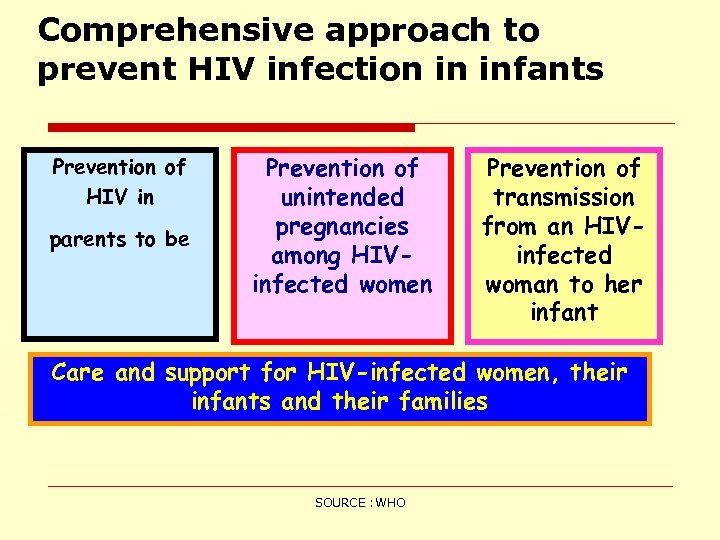 Comprehensive approach to prevent HIV infection in infants Prevention of HIV in parents to be Prevention of unintended pregnancies among HIVinfected women Prevention of transmission from an HIVinfected woman to her infant Care and support for HIV-infected women, their infants and their families SOURCE : WHO
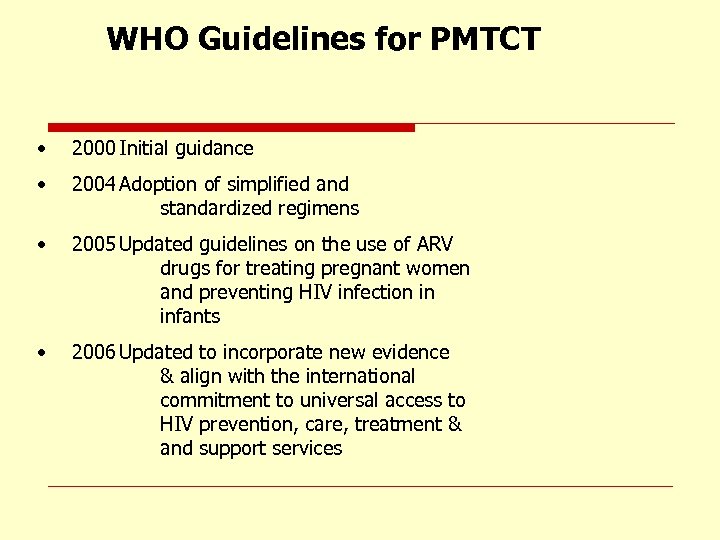 WHO Guidelines for PMTCT • 2000 Initial guidance • 2004 Adoption of simplified and standardized regimens • 2005 Updated guidelines on the use of ARV drugs for treating pregnant women and preventing HIV infection in infants • 2006 Updated to incorporate new evidence & align with the international commitment to universal access to HIV prevention, care, treatment & and support services
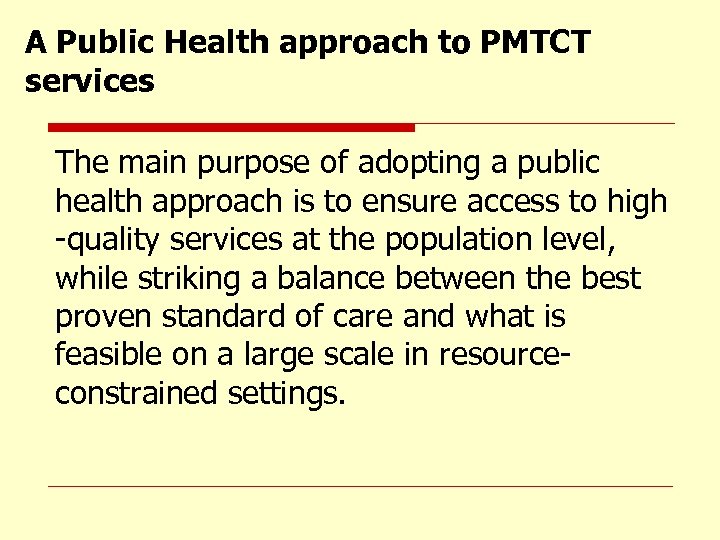 A Public Health approach to PMTCT services The main purpose of adopting a public health approach is to ensure access to high -quality services at the population level, while striking a balance between the best proven standard of care and what is feasible on a large scale in resourceconstrained settings.
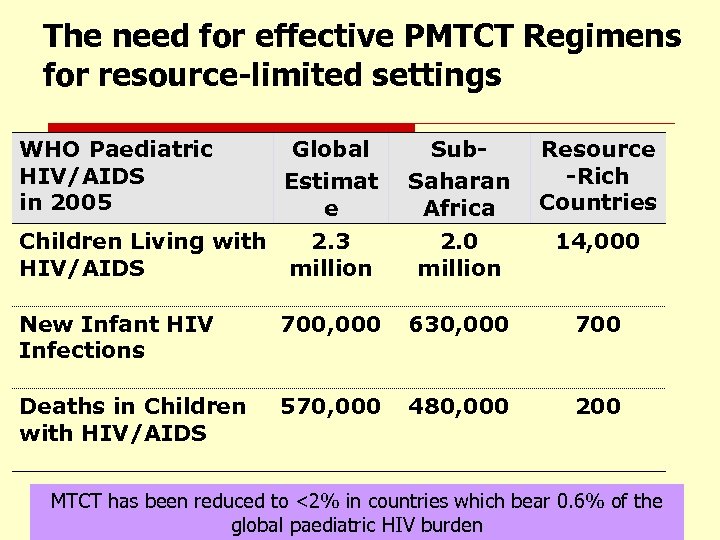 The need for effective PMTCT Regimens for resource-limited settings WHO Paediatric HIV/AIDS in 2005 Global Estimat e Sub. Saharan Africa Resource -Rich Countries Children Living with HIV/AIDS 2. 3 million 2. 0 million 14, 000 New Infant HIV Infections 700, 000 630, 000 700 Deaths in Children with HIV/AIDS 570, 000 480, 000 200 MTCT has been reduced to <2% in countries which bear 0. 6% of the global paediatric HIV burden
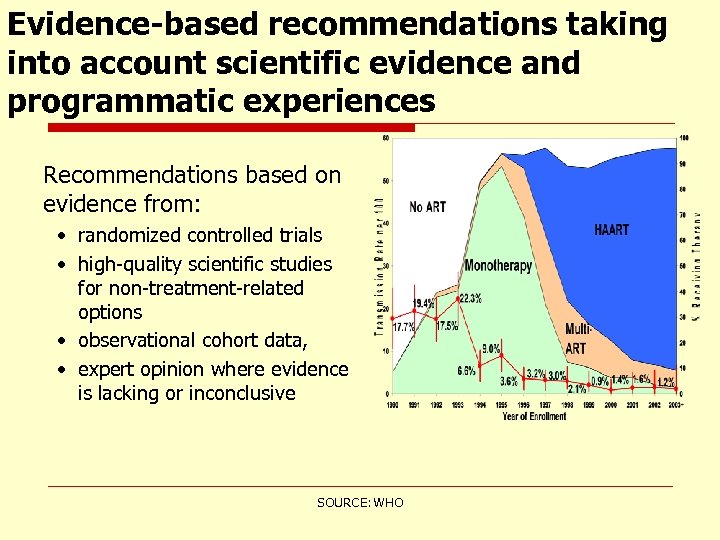 Evidence-based recommendations taking into account scientific evidence and programmatic experiences Recommendations based on evidence from: • randomized controlled trials • high-quality scientific studies for non-treatment-related options • observational cohort data, • expert opinion where evidence is lacking or inconclusive SOURCE: WHO
 Evidence from short course PMTCT studies o o Efficacy of AZT alone or AZT/3 TC regimens decreases with breastfeeding, particularly with prolonged breastfeeding In contrast, efficacy of sd-NVP less affected by breastfeeding A combination regimen of AZT plus sd NVP is more effective than single drug regimens in formula-fed and breastfeeding populations AZT plus sd NVP is equally effective as a more complex regimen of AZT/3 TC + sd NVP and an AP-IPPP regimen of AZT/3 TC
 Evidence from short course PMTCT studies o o Estimated 20 -30% of pregnant women meet WHO criteria for initiating ART for their own health Advanced disease, low CD 4 are associated with higher MTCT, even in women receiving short-course ARV prophylaxis Risk of NVP resistance after sd-NVP, given alone or with other ARVs, significantly higher in women with indication of ART An AZT/3 TC “tail” given at the time of Sd-NVP and for a short time in the postpartum reduces development of NVP resistance
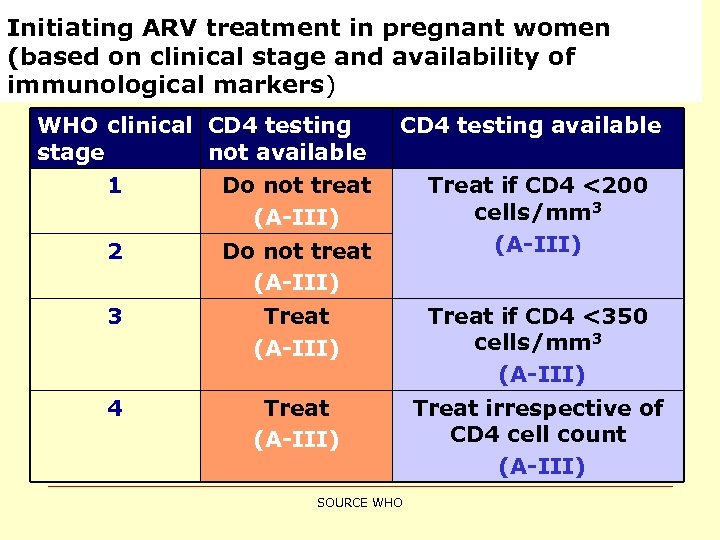 Initiating ARV treatment in pregnant women (based on clinical stage and availability of immunological markers) WHO clinical CD 4 testing stage not available CD 4 testing available 1 Do not treat (A-III) 2 Do not treat (A-III) 3 Treat (A-III) Treat if CD 4 <350 cells/mm 3 (A-III) 4 Treat (A-III) Treat irrespective of CD 4 cell count (A-III) SOURCE WHO Treat if CD 4 <200 cells/mm 3 (A-III)
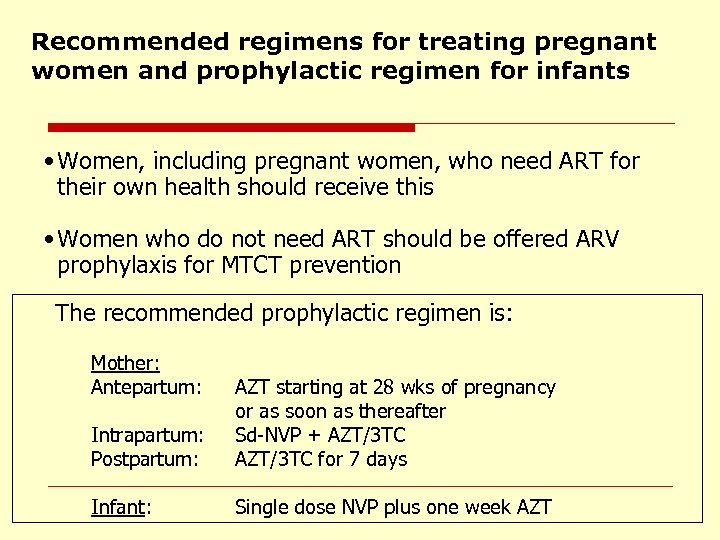 Recommended regimens for treating pregnant women and prophylactic regimen for infants • Women, including pregnant women, who need ART for their own health should receive this • Women who do not need ART should be offered ARV prophylaxis for MTCT prevention The recommended prophylactic regimen is: Mother: Antepartum: Intrapartum: Postpartum: AZT starting at 28 wks of pregnancy or as soon as thereafter Sd-NVP + AZT/3 TC for 7 days Infant: Single dose NVP plus one week AZT
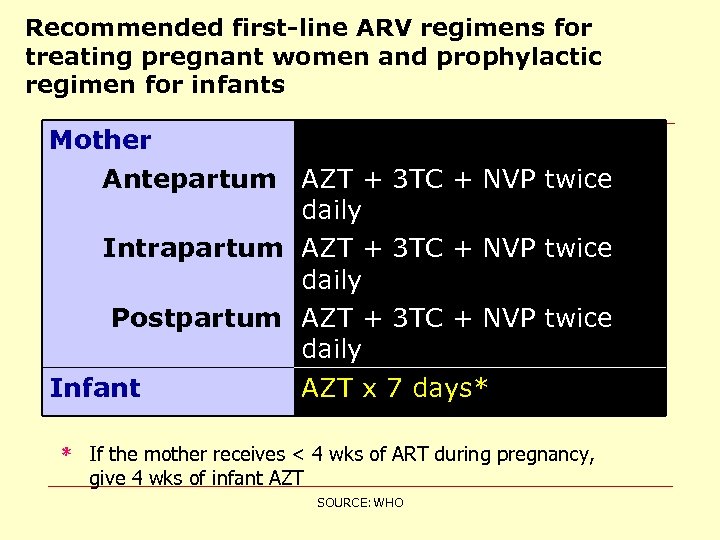 Recommended first-line ARV regimens for treating pregnant women and prophylactic regimen for infants Mother Antepartum AZT + 3 TC + NVP twice daily Intrapartum AZT + 3 TC + NVP twice daily Postpartum AZT + 3 TC + NVP twice daily Infant AZT x 7 days* * If the mother receives < 4 wks of ART during pregnancy, give 4 wks of infant AZT SOURCE: WHO
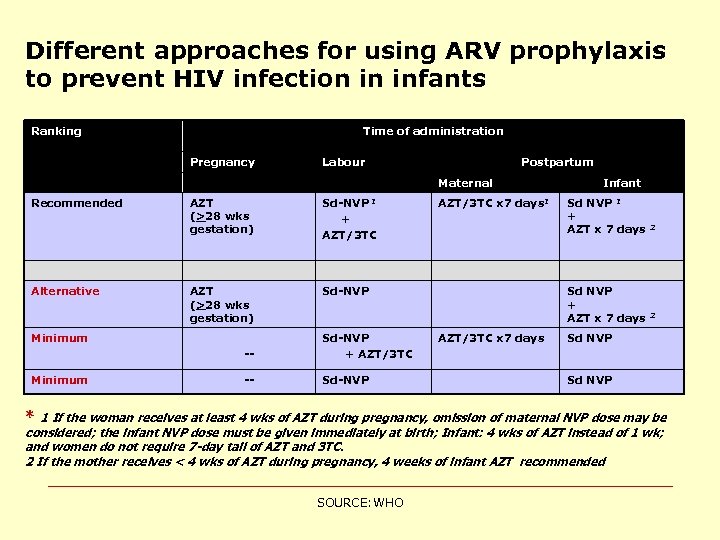 Different approaches for using ARV prophylaxis to prevent HIV infection in infants Ranking Time of administration Pregnancy Labour Postpartum Maternal Recommended Alternative AZT (>28 wks gestation) Sd-NVP 1 + AZT/3 TC AZT (>28 wks gestation) Sd-NVP Minimum -Minimum Sd-NVP + AZT/3 TC -- Sd-NVP * AZT/3 TC x 7 days 1 Infant Sd NVP 1 + AZT x 7 days Sd NVP + AZT x 7 days AZT/3 TC x 7 days 2 2 Sd NVP 1 If the woman receives at least 4 wks of AZT during pregnancy, omission of maternal NVP dose may be considered; the infant NVP dose must be given immediately at birth; Infant: 4 wks of AZT instead of 1 wk; and women do not require 7 -day tail of AZT and 3 TC. 2 If the mother receives < 4 wks of AZT during pregnancy, 4 weeks of infant AZT recommended SOURCE: WHO
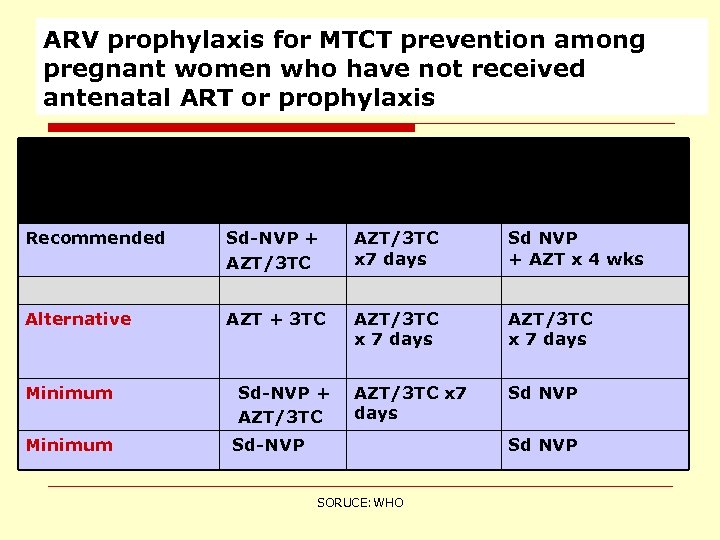 ARV prophylaxis for MTCT prevention among pregnant women who have not received antenatal ART or prophylaxis Ranking Time of administration Labour Postpartum Maternal Infant Recommended Sd-NVP + AZT/3 TC x 7 days Sd NVP + AZT x 4 wks Alternative AZT + 3 TC AZT/3 TC x 7 days Sd NVP Minimum Sd-NVP + AZT/3 TC Sd-NVP Sd NVP SORUCE: WHO
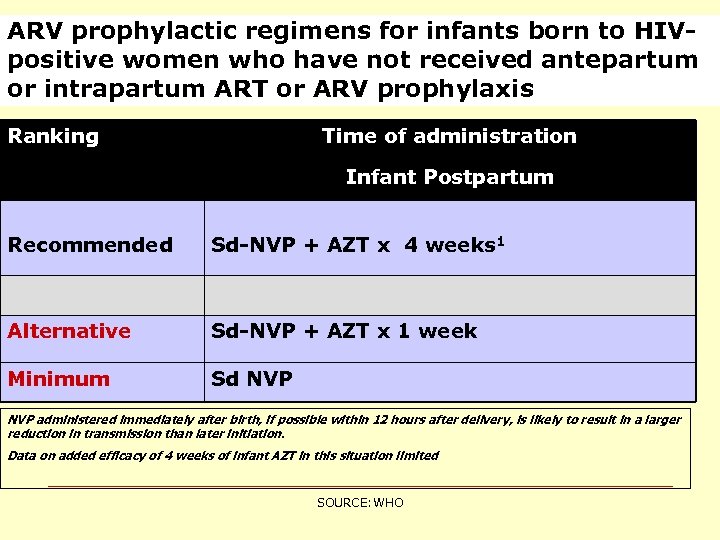 ARV prophylactic regimens for infants born to HIVpositive women who have not received antepartum or intrapartum ART or ARV prophylaxis Ranking Time of administration Infant Postpartum Recommended Sd-NVP + AZT x 4 weeks 1 Alternative Sd-NVP + AZT x 1 week Minimum Sd NVP administered immediately after birth, if possible within 12 hours after delivery, is likely to result in a larger reduction in transmission than later initiation. Data on added efficacy of 4 weeks of infant AZT in this situation limited SOURCE: WHO
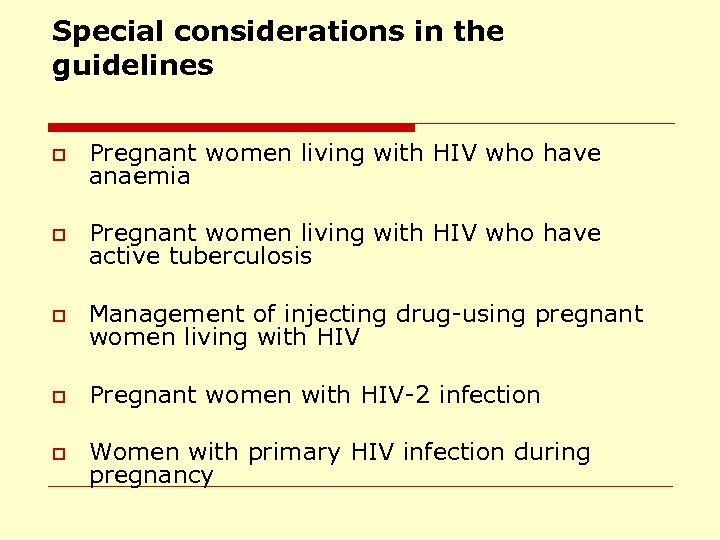 Special considerations in the guidelines o Pregnant women living with HIV who have anaemia o Pregnant women living with HIV who have active tuberculosis o Management of injecting drug-using pregnant women living with HIV o Pregnant women with HIV-2 infection o Women with primary HIV infection during pregnancy
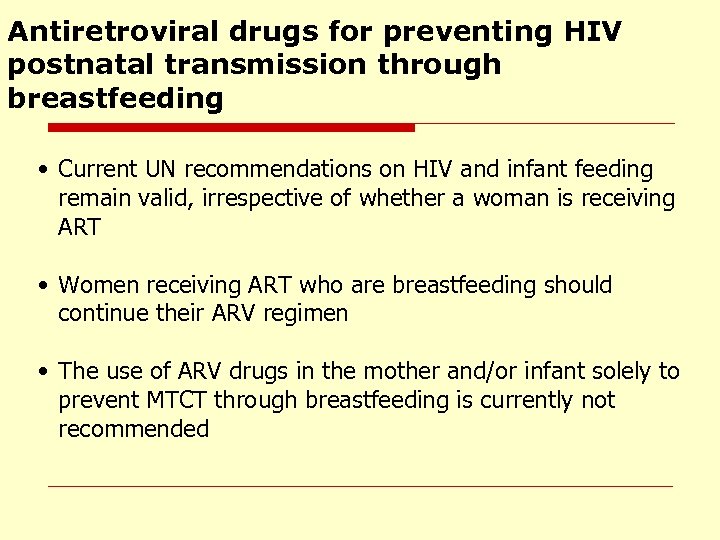 Antiretroviral drugs for preventing HIV postnatal transmission through breastfeeding • Current UN recommendations on HIV and infant feeding remain valid, irrespective of whether a woman is receiving ART • Women receiving ART who are breastfeeding should continue their ARV regimen • The use of ARV drugs in the mother and/or infant solely to prevent MTCT through breastfeeding is currently not recommended
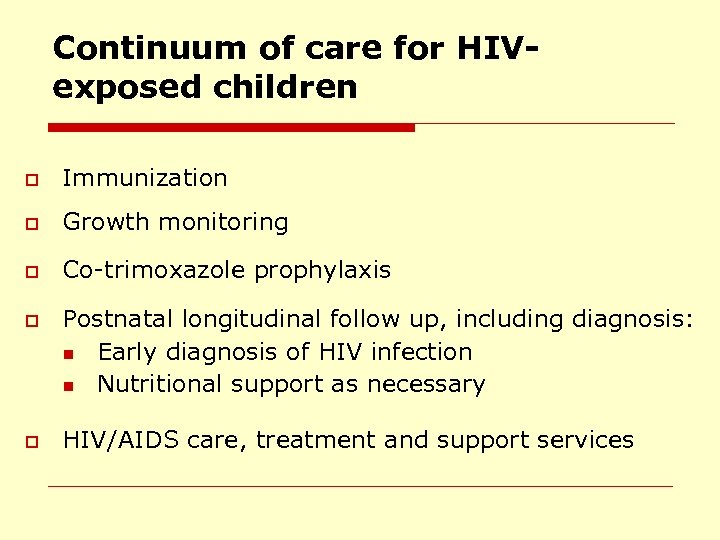 Continuum of care for HIVexposed children o Immunization o Growth monitoring o Co-trimoxazole prophylaxis o o Postnatal longitudinal follow up, including diagnosis: n Early diagnosis of HIV infection n Nutritional support as necessary HIV/AIDS care, treatment and support services
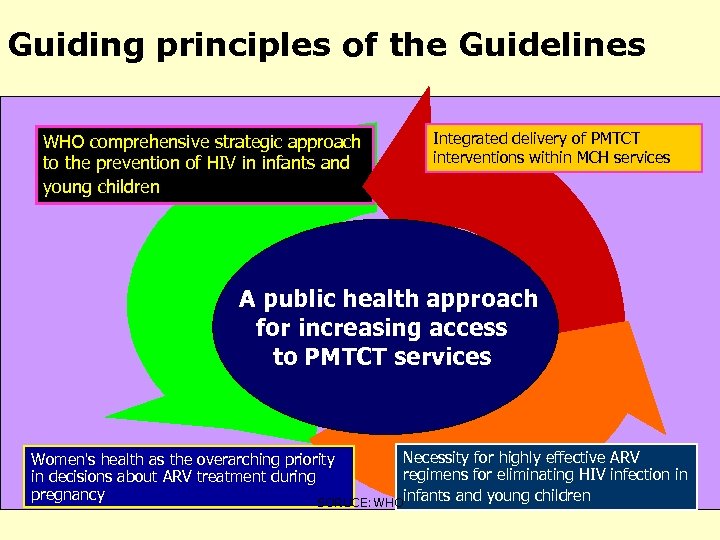 Guiding principles of the Guidelines WHO comprehensive strategic approach to the prevention of HIV in infants and young children Integrated delivery of PMTCT interventions within MCH services A public health approach for increasing access to PMTCT services Necessity for highly effective ARV Women's health as the overarching priority regimens for eliminating HIV infection in in decisions about ARV treatment during pregnancy SORUCE: WHOinfants and young children
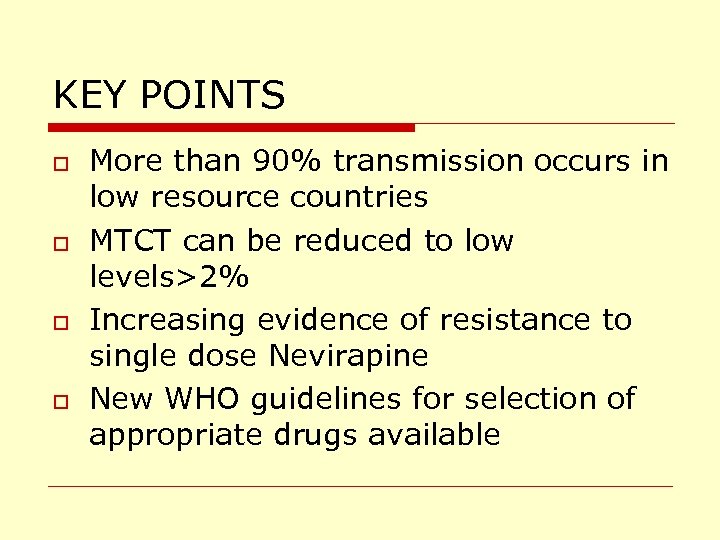 KEY POINTS o o More than 90% transmission occurs in low resource countries MTCT can be reduced to low levels>2% Increasing evidence of resistance to single dose Nevirapine New WHO guidelines for selection of appropriate drugs available