 Скачать презентацию Towards the Self-Annotating Web Philipp Cimiano Siegfried Handschuh
aabf9a0b1ba25ad6c6038967ccc4c549.ppt
- Количество слайдов: 36




Towards the Self-Annotating Web Philipp Cimiano, Siegfried Handschuh, Steffen Staab Presenter: Hieu K Le (most of slides come from Philipp Cimiano) CS 598 CXZ - Spring 2005 - UIUC
Outline q. Introduction q. The Process of PANKOW q. Pattern-based categorization q. Evaluation q. Integration to CREAM q. Related work q. Conclusion
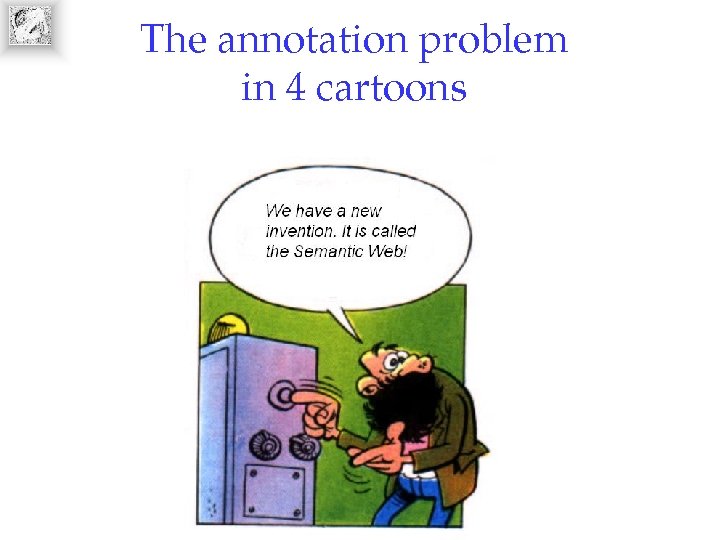
The annotation problem in 4 cartoons
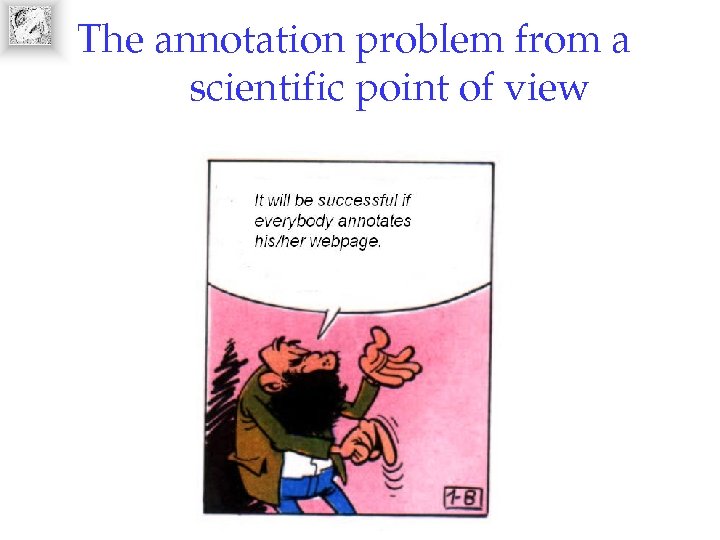
The annotation problem from a scientific point of view
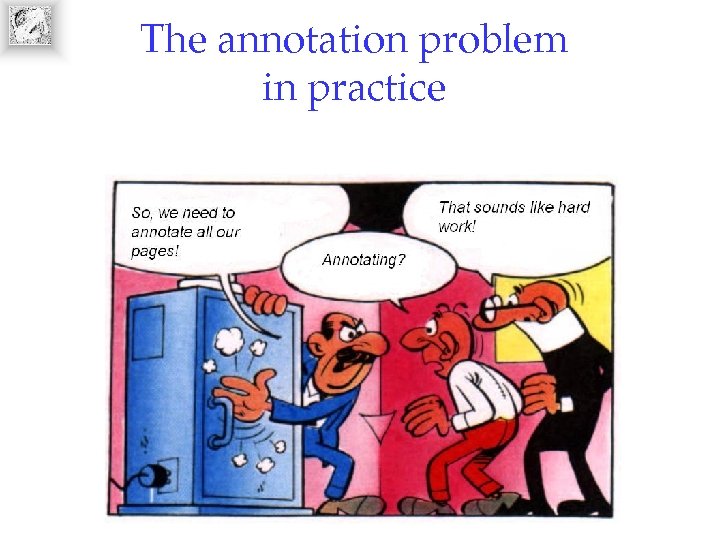
The annotation problem in practice
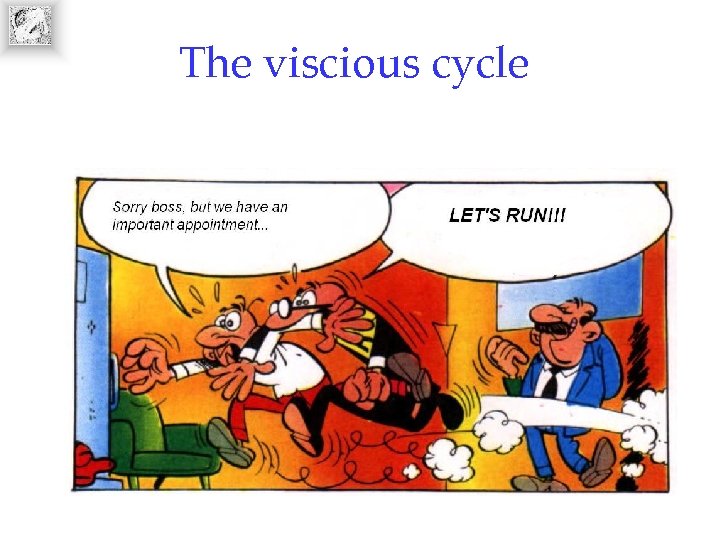
The viscious cycle
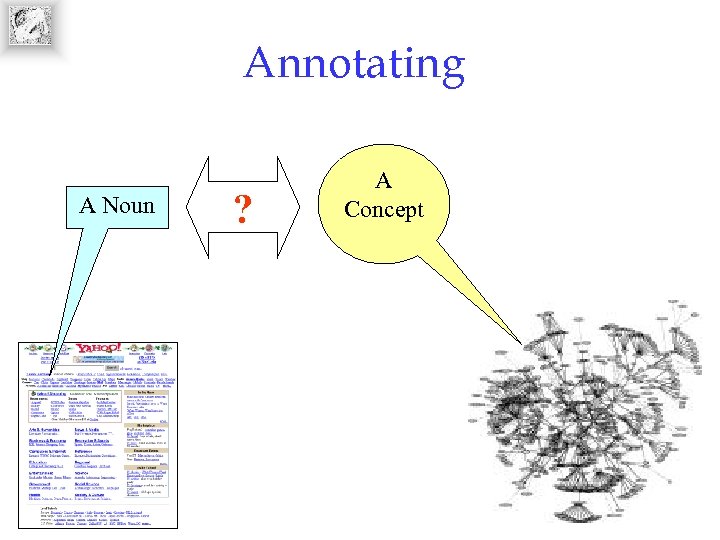
Annotating A Noun ? A Concept
Annotating • To annotate terms in a web page: – Manually defining – Learning of extraction rules Both require lot of labor
A small Quiz • What is “Laska” ? A. A dish B. A city C. A temple D. A mountain The answer is:
A small Quiz • What is “Laska” ? A. A dish B. A city C. A temple D. A mountain The answer is:
A small Quiz • What is “Laska” ? A. A dish B. A city C. A temple D. A mountain The answer is:
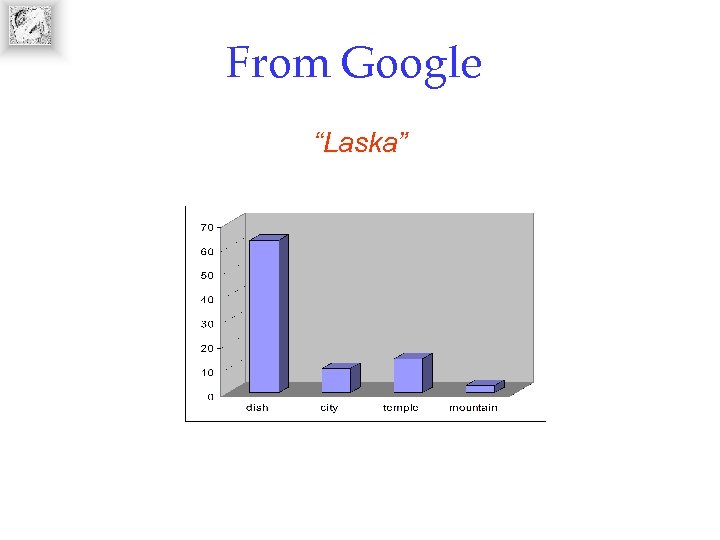
From Google “Laska”
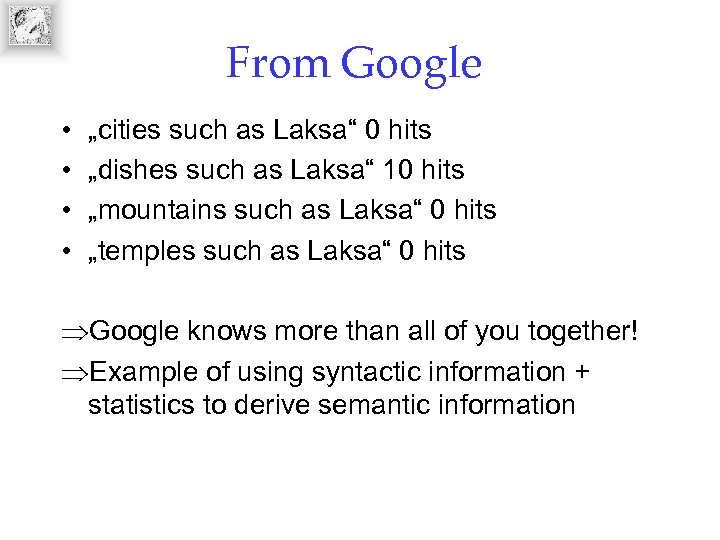
From Google • • „cities such as Laksa“ 0 hits „dishes such as Laksa“ 10 hits „mountains such as Laksa“ 0 hits „temples such as Laksa“ 0 hits ÞGoogle knows more than all of you together! ÞExample of using syntactic information + statistics to derive semantic information
Self-annotating • PANKOW (Pattern-based Annotation through Knowledge On the Web) – Unsupervised – Pattern based – Within a fixed ontology – Involve information of the whole web
The Self-Annotating Web • There is a huge amount of implicit knowledge in the Web • Make use of this implicit knowledge together with statistical information to propose formal annotations and overcome the viscious cycle: semantics ≈ syntax + statistics? • Annotation by maximal statistical evidence
Outline ü Introduction q. The Process of PANKOW q. Pattern-based categorization q. Evaluation q. Integration to CREAM q. Related work q. Conclusion
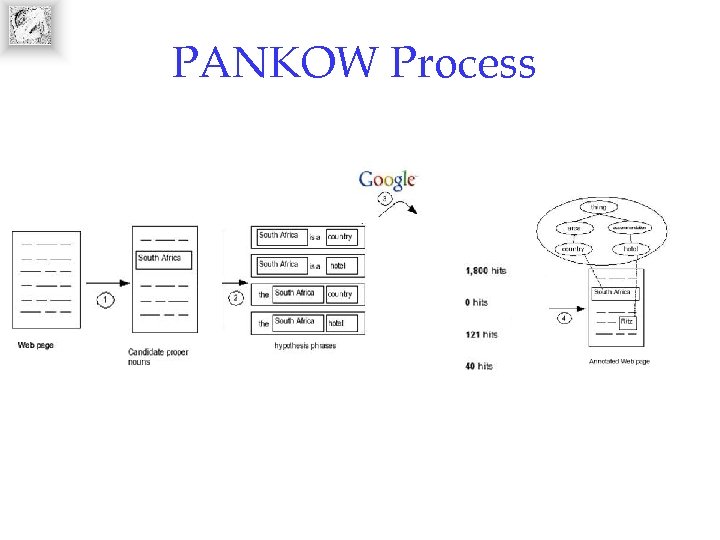
PANKOW Process
Outline ü Introduction ü The Process of PANKOW q. Pattern-based categorization q. Evaluation q. Integration to CREAM q. Related work q. Conclusion
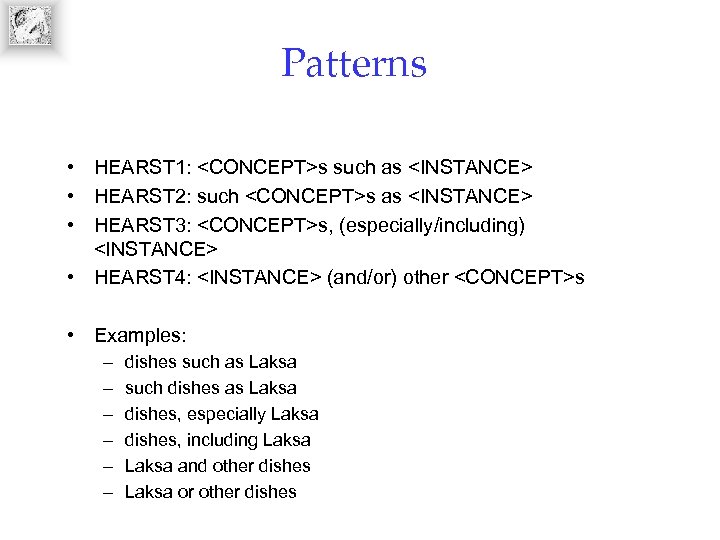
Patterns • HEARST 1: <CONCEPT>s such as <INSTANCE> • HEARST 2: such <CONCEPT>s as <INSTANCE> • HEARST 3: <CONCEPT>s, (especially/including) <INSTANCE> • HEARST 4: <INSTANCE> (and/or) other <CONCEPT>s • Examples: – – – dishes such as Laksa such dishes as Laksa dishes, especially Laksa dishes, including Laksa and other dishes Laksa or other dishes
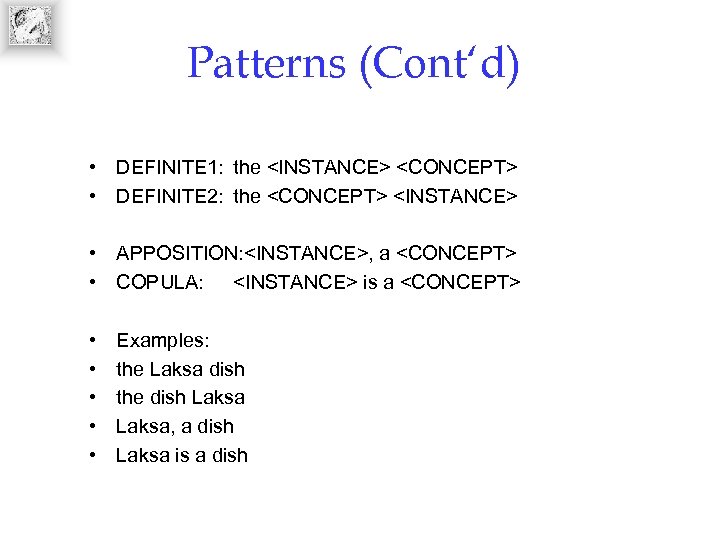
Patterns (Cont‘d) • DEFINITE 1: the <INSTANCE> <CONCEPT> • DEFINITE 2: the <CONCEPT> <INSTANCE> • APPOSITION: <INSTANCE>, a <CONCEPT> • COPULA: <INSTANCE> is a <CONCEPT> • • • Examples: the Laksa dish the dish Laksa, a dish Laksa is a dish
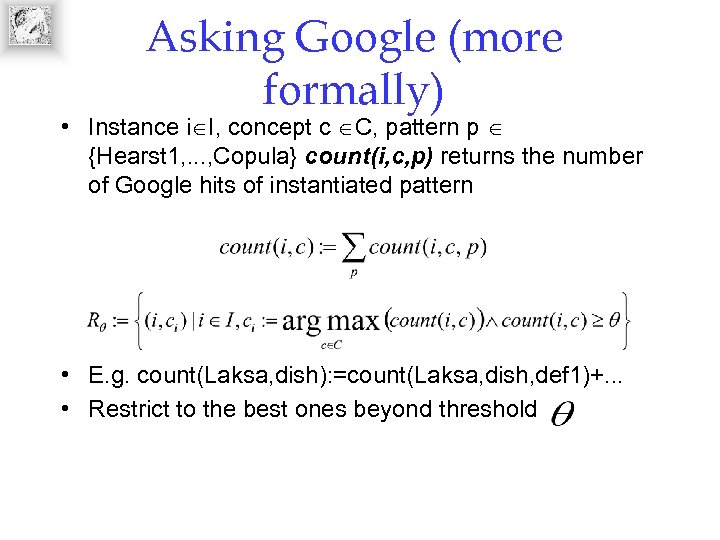
Asking Google (more formally) • Instance i I, concept c C, pattern p {Hearst 1, . . . , Copula} count(i, c, p) returns the number of Google hits of instantiated pattern • E. g. count(Laksa, dish): =count(Laksa, dish, def 1)+. . . • Restrict to the best ones beyond threshold
Outline ü Introduction ü The Process of PANKOW ü Pattern-based categorization q. Evaluation q. Integration to CREAM q. Related work q. Conclusion
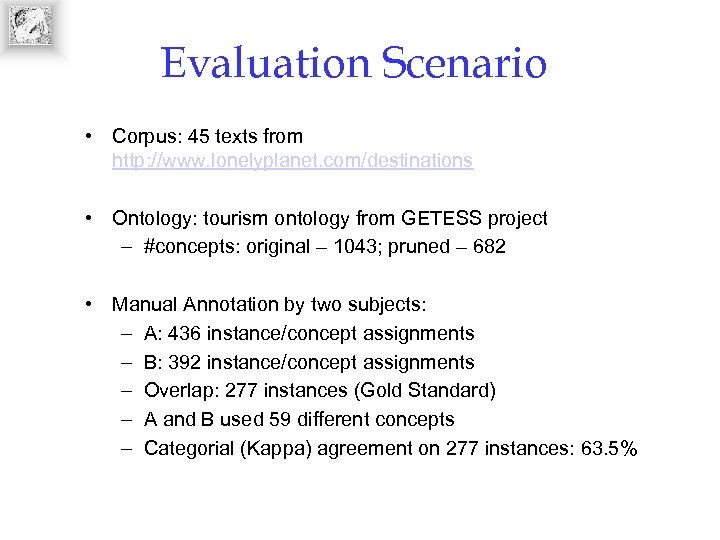
Evaluation Scenario • Corpus: 45 texts from http: //www. lonelyplanet. com/destinations • Ontology: tourism ontology from GETESS project – #concepts: original – 1043; pruned – 682 • Manual Annotation by two subjects: – A: 436 instance/concept assignments – B: 392 instance/concept assignments – Overlap: 277 instances (Gold Standard) – A and B used 59 different concepts – Categorial (Kappa) agreement on 277 instances: 63. 5%
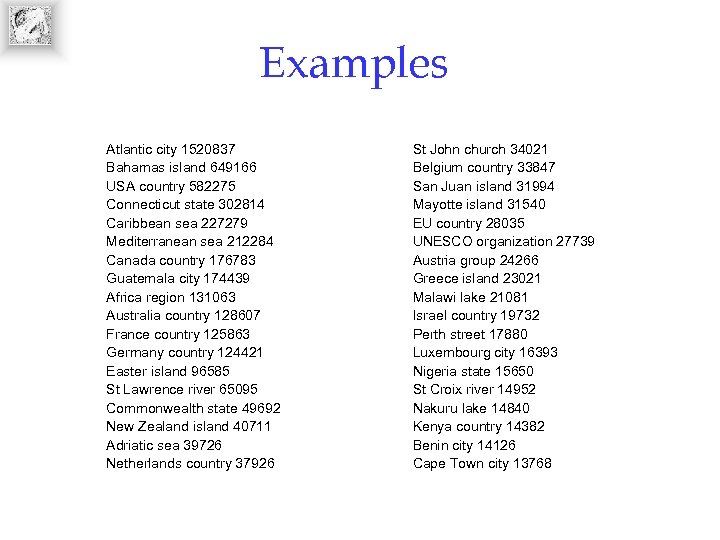
Examples Atlantic city 1520837 Bahamas island 649166 USA country 582275 Connecticut state 302814 Caribbean sea 227279 Mediterranean sea 212284 Canada country 176783 Guatemala city 174439 Africa region 131063 Australia country 128607 France country 125863 Germany country 124421 Easter island 96585 St Lawrence river 65095 Commonwealth state 49692 New Zealand island 40711 Adriatic sea 39726 Netherlands country 37926 St John church 34021 Belgium country 33847 San Juan island 31994 Mayotte island 31540 EU country 28035 UNESCO organization 27739 Austria group 24266 Greece island 23021 Malawi lake 21081 Israel country 19732 Perth street 17880 Luxembourg city 16393 Nigeria state 15650 St Croix river 14952 Nakuru lake 14840 Kenya country 14382 Benin city 14126 Cape Town city 13768
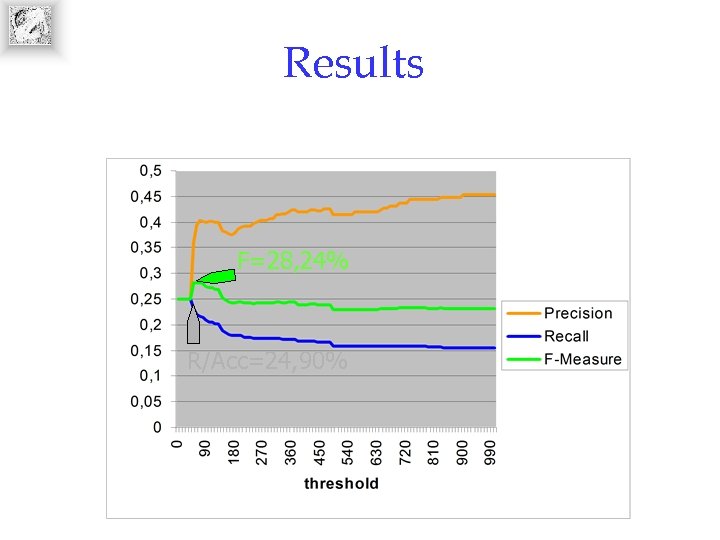
Results F=28, 24% R/Acc=24, 90%
![Comparison System # Preprocessing / Cost Accuracy [MUC-7] 3 Various (? ) >> 90%](https://present5.com/presentation/aabf9a0b1ba25ad6c6038967ccc4c549/image-26.jpg "Comparison System # Preprocessing / Cost Accuracy [MUC-7] 3 Various (? ) >> 90%")
Comparison System # Preprocessing / Cost Accuracy [MUC-7] 3 Various (? ) >> 90% [Fleischman 02] 8 N-gram extraction ($) 70. 4% PANKOW 59 none 24. 9% [Hahn 98] –TH 196 syn. & sem. analysis ($$$) 21% [Hahn 98]-CB 196 syn. & sem. analysis ($$$) 26% [Hahn 98]-CB 196 syn. & sem. analysis ($$$) 31% [Alfonseca 02] 1200 syn. analysis ($$) 17. 39% (strict)
Outline ü Introduction ü The Process of PANKOW ü Pattern-based categorization ü Evaluation q. Integration to CREAM q. Related work q. Conclusion
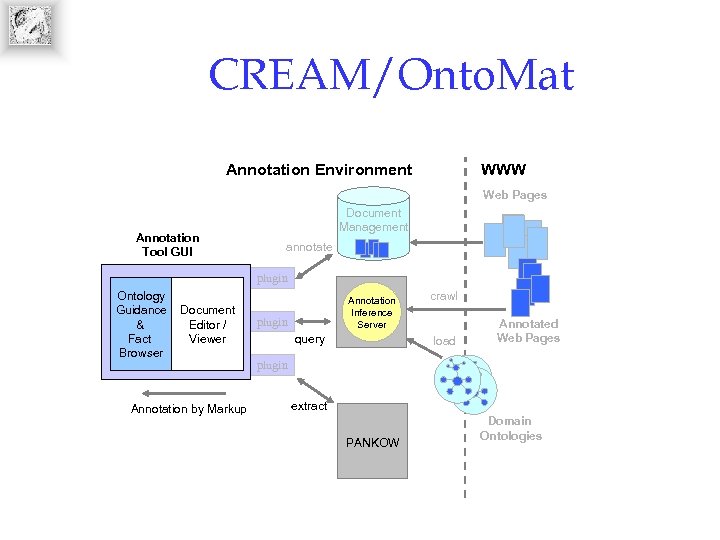
CREAM/Onto. Mat Annotation Environment WWW Web Pages Annotation Tool GUI Document Management annotate plugin Ontology Guidance & Fact Browser Document Editor / Viewer Annotation by Markup Annotation Inference Server plugin query crawl load Annotated Web Pages plugin extract PANKOW Domain Ontologies
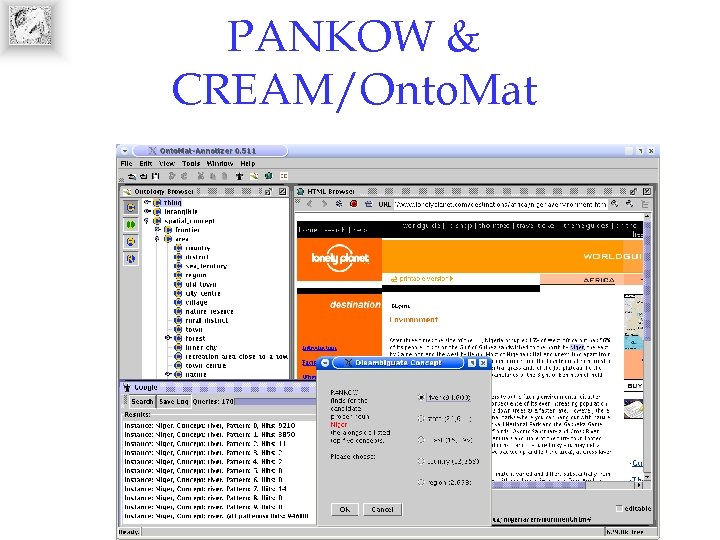
PANKOW & CREAM/Onto. Mat
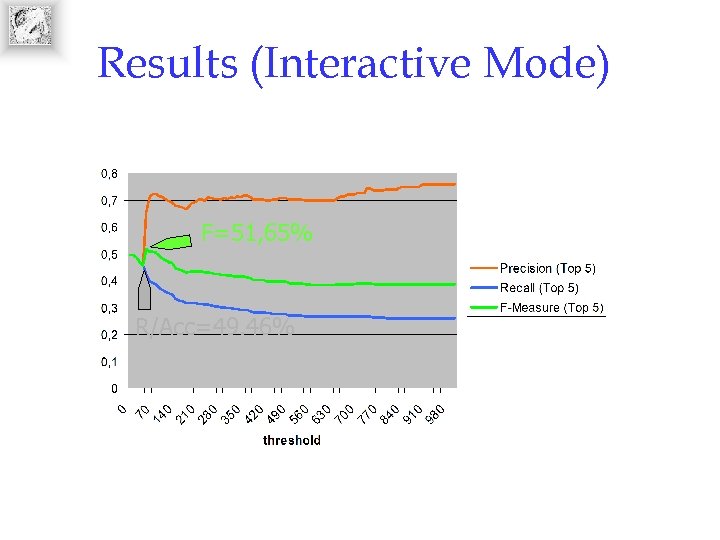
Results (Interactive Mode) F=51, 65% R/Acc=49. 46%
Outline ü Introduction ü The Process of PANKOW ü Pattern-based categorization ü Evaluation ü Integration to CREAM q. Related work q. Conclusion
![Current State-of-the-art • Large-scale IE [Sem. Tag&Seeker@WWW‘ 03] – only disambiguation • Standard IE](https://present5.com/presentation/aabf9a0b1ba25ad6c6038967ccc4c549/image-32.jpg "Current State-of-the-art • Large-scale IE [Sem. Tag&Seeker@WWW‘ 03] – only disambiguation • Standard IE")
Current State-of-the-art • Large-scale IE [Sem. Tag&Seeker@WWW‘ 03] – only disambiguation • Standard IE (MUC) – need of handcrafted rules • ML-based IE (e. g. Amilcare@{Onto. Mat, Mn. M}) – need of hand-annotated training corpus – does not scale to large numbers of concepts – rule induction takes time • Know. It. All (Etzioni et al. WWW‘ 04) – shallow (pattern-matching-based) approach
Outline ü Introduction ü The Process of PANKOW ü Pattern-based categorization ü Evaluation ü Integration to CREAM ü Related work q. Conclusion
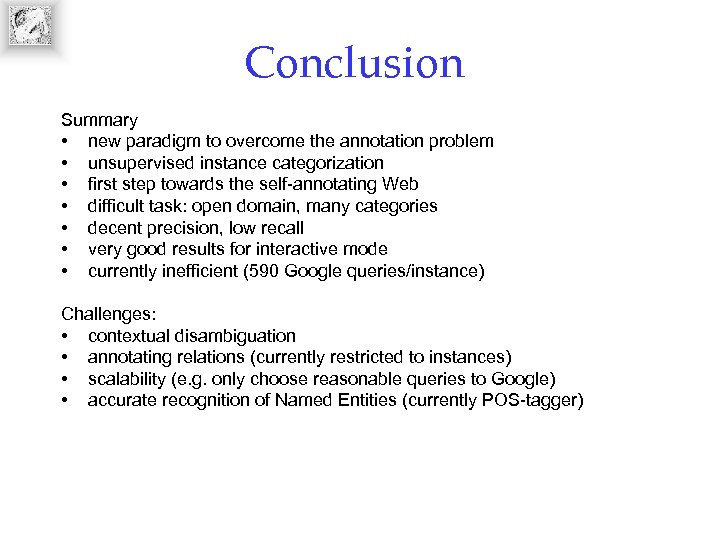
Conclusion Summary • new paradigm to overcome the annotation problem • unsupervised instance categorization • first step towards the self-annotating Web • difficult task: open domain, many categories • decent precision, low recall • very good results for interactive mode • currently inefficient (590 Google queries/instance) Challenges: • contextual disambiguation • annotating relations (currently restricted to instances) • scalability (e. g. only choose reasonable queries to Google) • accurate recognition of Named Entities (currently POS-tagger)
Outline ü Introduction ü The Process of PANKOW ü Pattern-based categorization ü Evaluation ü Integration to CREAM ü Related work ü Conclusion
Thanks to… • Philipp Cimiano (cimiano@aifb. unikarlsruhe. de) for slides • The audience for listening
Скачать презентацию Towards the Self-Annotating Web Philipp Cimiano Siegfried Handschuh
aabf9a0b1ba25ad6c6038967ccc4c549.ppt