


 Скачать презентацию Towards Service Oriented Geoscience SEE Grid and APAC
c3df8d4ccb4874cee09e7231a07f05d5.ppt
- Количество слайдов: 35
 Towards Service Oriented Geoscience SEE Grid and APAC Grid Dr Robert Woodcock Executive Manager, e-Science www. csiro. au
 Outline • Industry drivers • Inefficiencies in “geoscience” modelling workflow • The Solid Earth and Environment Grid • The APAC (Geoscience) Grid • Putting it all together: pmd*CRC Modelling Workflow for Industry problems • Results and what might the future hold? 2
 Australian National Research Priorities Frontier Technologies for Building and Transforming Australian Industries: Stimulating the growth of world-class Australian industries using innovative technologies developed from cutting-edge research Priority Goal 4: Smart information use Improved data management for existing and new business applications and creative applications for digital technologies § ICT applications are providing huge opportunities to deliver new systems, products, business solutions, and to make more efficient use of infrastructure § The ability of organisations to operate virtually and collaborate across huge distances in Australia and internationally hinges on our capabilities in this area 3
 Key points from case studies and support letters • Show the diversity of use cases for the same data type throughout the mining value chain • Show a strong business case for interoperability for management of your data in the external world • Show an even stronger business case for interoperability for internal data management • Show why standards need to be developed by groups working together as part of a community • Highlight the emerging issue that responsibility of data quality becoming a legislative issue 4
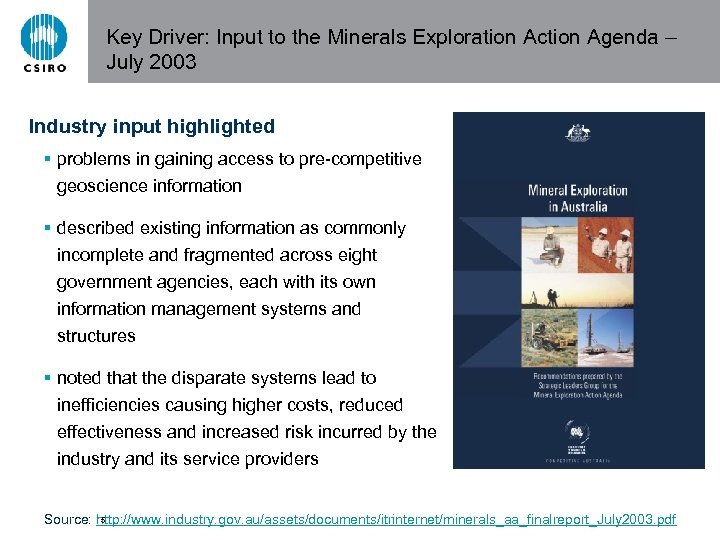 Key Driver: Input to the Minerals Exploration Action Agenda – July 2003 Industry input highlighted § problems in gaining access to pre-competitive geoscience information § described existing information as commonly incomplete and fragmented across eight government agencies, each with its own information management systems and structures § noted that the disparate systems lead to inefficiencies causing higher costs, reduced effectiveness and increased risk incurred by the industry and its service providers 5 Source: http: //www. industry. gov. au/assets/documents/itrinternet/minerals_aa_finalreport_July 2003. pdf
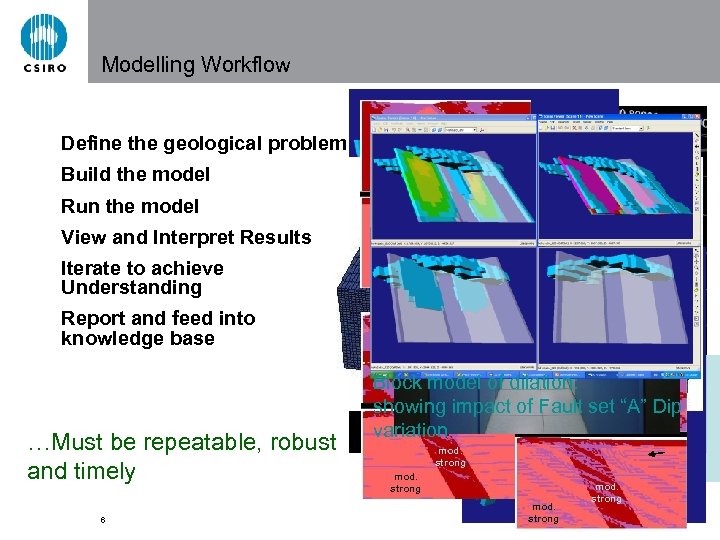 Modelling Workflow Define the geological problem Build the model Run the model strong View and Interpret Results Iterate to achieve Understanding strong Tensile failure very weak Report and feed into knowledge base What is the role of: …Must be repeatable, robust and timely 6 Block model of dilation: • Competency of Fault set showing impact contrasts? “A” Dip variation • Permeability? mod. strong • Pore fluid pressure & flow fields? mod. strong
 Inefficiencies in the Workflow Information is scattered across: § Organisations – company, geological survey, etc § Resources – different hardware and software platforms § Geography – geological surveys in each state and territory (region) in Australia § Can these issues be removed? Cost of data integration is high, in some situations exceeding all other costs • Computational resources: § Different architectures suit different numerical codes better § Are often available but outside your organisations direct control § Are setup in different ways § Cost of adapting an investigators specific toolkit to use multiple sites is often prohibitive 7
 The Solid Earth and Environment Grid Obtaining information… www. csiro. au
 The SEE Grid Community Working together (loosely) to develop a toolkit for interoperability for the Solid Earth and Environmental Sciences § Together… because our information and services need to be shared more easily to achieve our goals § Loosely… because ultimately we are separated by political and economic boundaries § Toolkit… because our World is dynamic and we need tools that can be reconfigured and chained together quickly to answer our questions …in this context we must reduce the barriers to becoming a part of the community 9
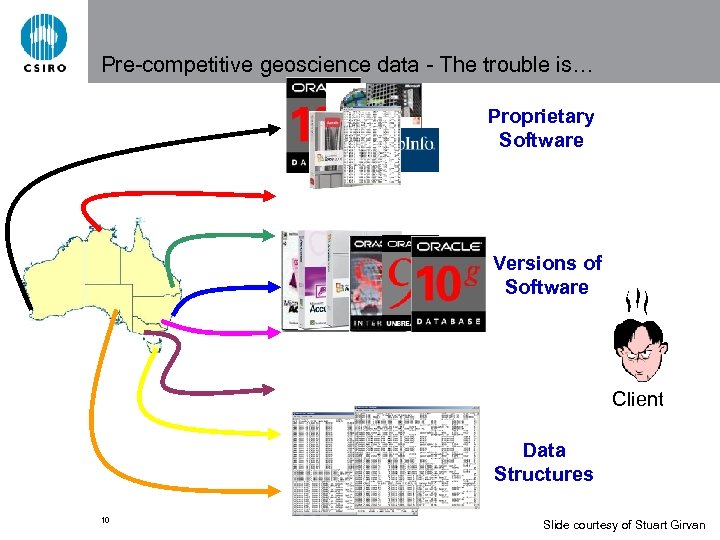 Pre-competitive geoscience data - The trouble is… Proprietary Software Versions of Software Client Data Structures 10 Slide courtesy of Stuart Girvan
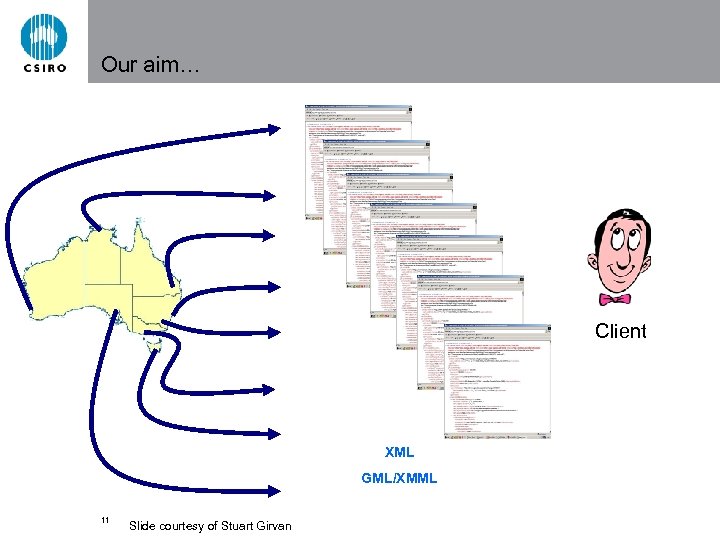 Our aim… Client XML GML/XMML 11 Slide courtesy of Stuart Girvan
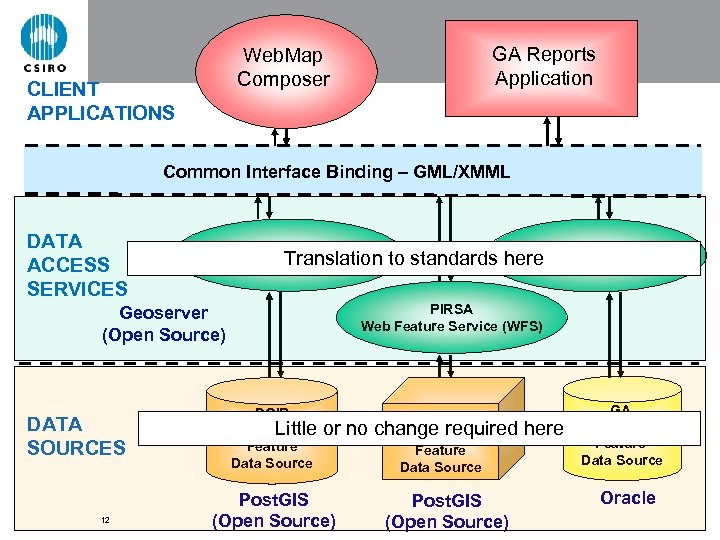 GA Reports Application Web. Map Composer CLIENT APPLICATIONS Common Interface Binding – GML/XMML DATA ACCESS SERVICES DOIR Web Feature Translation Service (WFS) Geoserver (Open Source) DATA SOURCES 12 DOIR Geochemistry or Little Feature Data Source Post. GIS (Open Source) GA to standards here Web Feature Service (WFS) PIRSA Web Feature Service (WFS) no PIRSA change required Geochemistry Feature Data Source Post. GIS (Open Source) here GA Geochemistry Feature Data Source Oracle
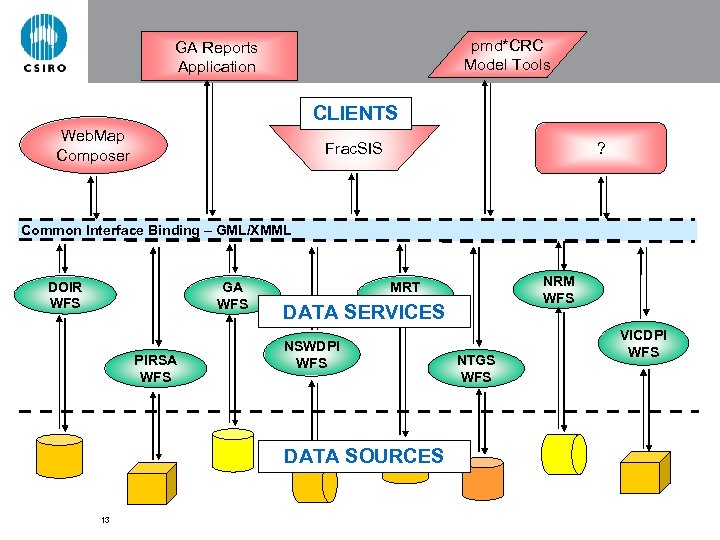 pmd*CRC Model Tools GA Reports Application CLIENTS Web. Map Composer Frac. SIS ? Common Interface Binding – GML/XMML DOIR WFS GA WFS PIRSA WFS DATA SERVICES NSWDPI WFS DATA SOURCES 13 NRM WFS MRT WFS NTGS WFS VICDPI WFS
 The Solid Earth and Environment Grid Information - Implementation and Examples www. csiro. au
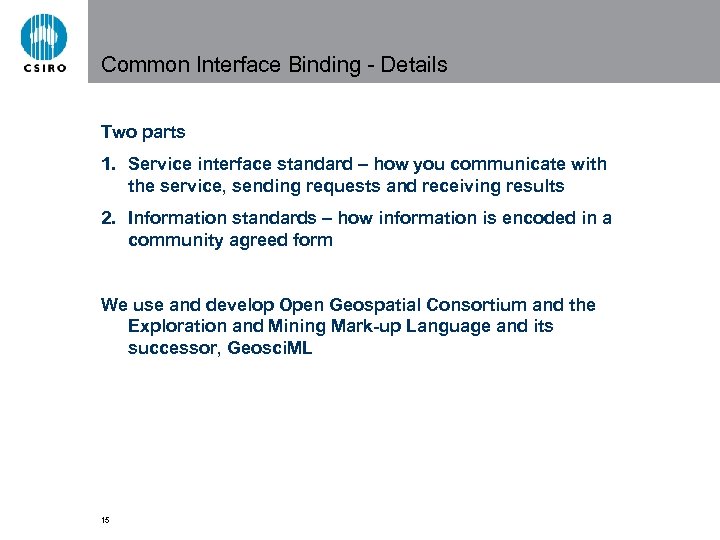 Common Interface Binding - Details Two parts 1. Service interface standard – how you communicate with the service, sending requests and receiving results 2. Information standards – how information is encoded in a community agreed form We use and develop Open Geospatial Consortium and the Exploration and Mining Mark-up Language and its successor, Geosci. ML 15
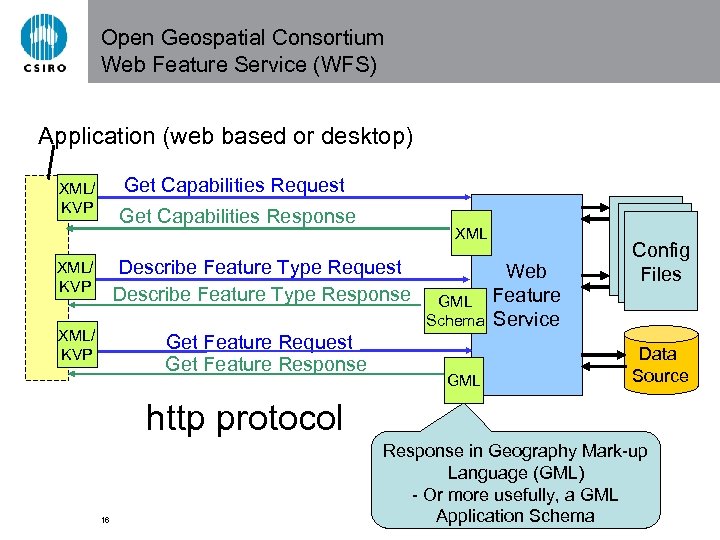 Open Geospatial Consortium Web Feature Service (WFS) Application (web based or desktop) Get Capabilities Request XML/ KVP Get Capabilities Response XML/ KVP Describe Feature Type Request Describe Feature Type Response XML/ KVP Get Feature Request Get Feature Response GML Schema GML Web Feature Service Config Files Data Source http protocol 16 Response in Geography Mark-up Language (GML) - Or more usefully, a GML Application Schema
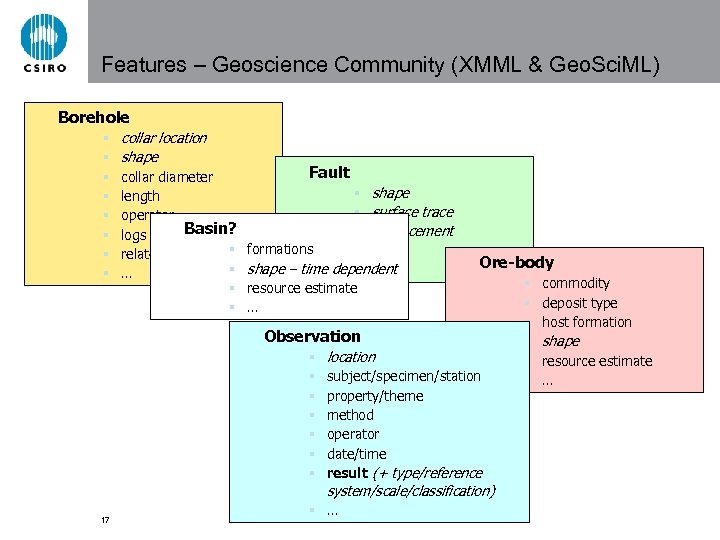 Features – Geoscience Community (XMML & Geo. Sci. ML) Borehole § § § § collar location shape Fault collar diameter § shape length § surface trace operator Basin? § displacement logs § § age related observations formations § shape – time dependent § … … § resource estimate § … Ore-body Observation § § § § 17 location subject/specimen/station property/theme method operator date/time result (+ type/reference system/scale/classification) § … § § § commodity deposit type host formation shape resource estimate …
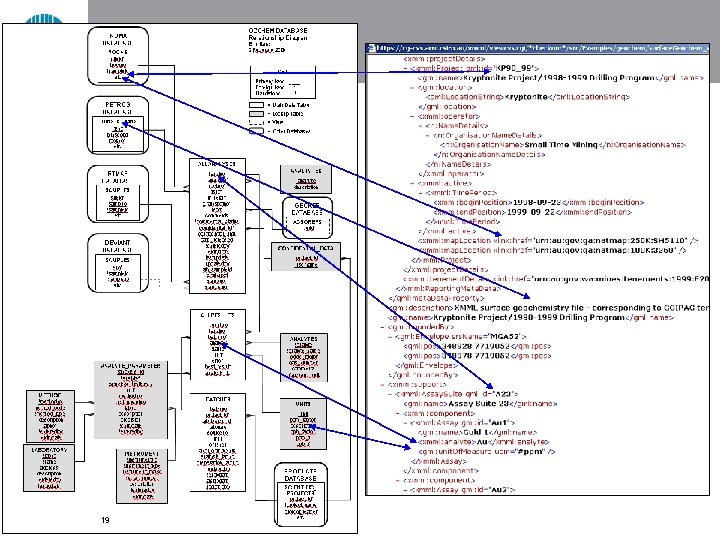
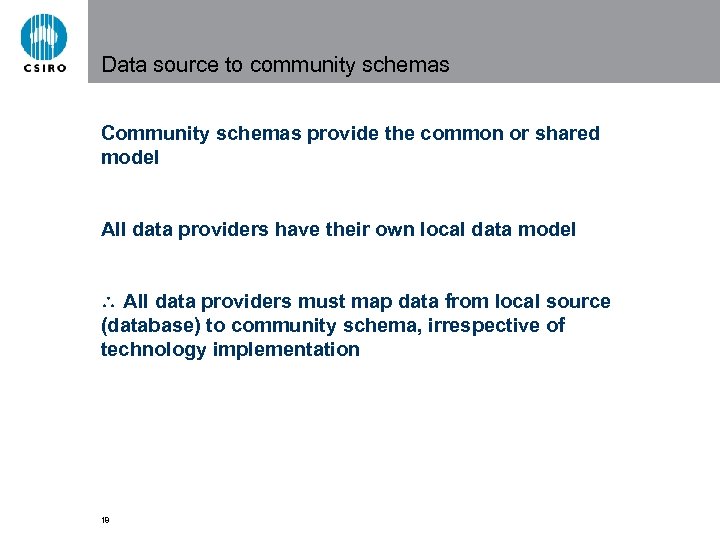 Data source to community schemas Community schemas provide the common or shared model All data providers have their own local data model All data providers must map data from local source (database) to community schema, irrespective of technology implementation 18
 19
19
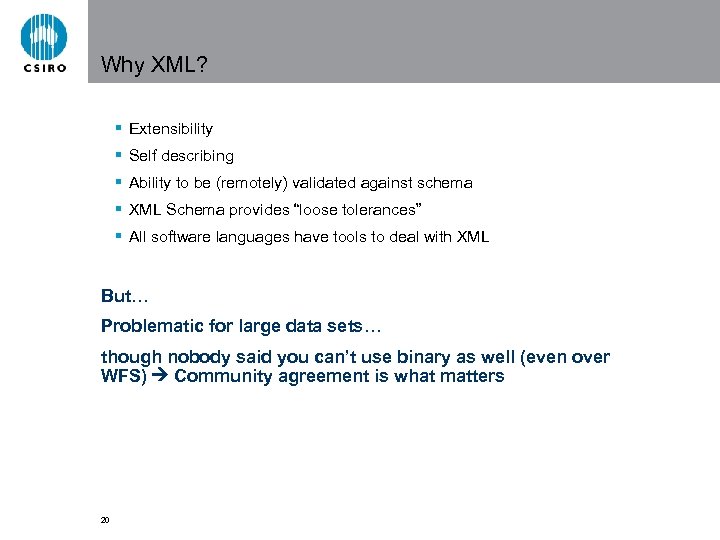 Why XML? § Extensibility § Self describing § Ability to be (remotely) validated against schema § XML Schema provides “loose tolerances” § All software languages have tools to deal with XML But… Problematic for large data sets… though nobody said you can’t use binary as well (even over WFS) Community agreement is what matters 20
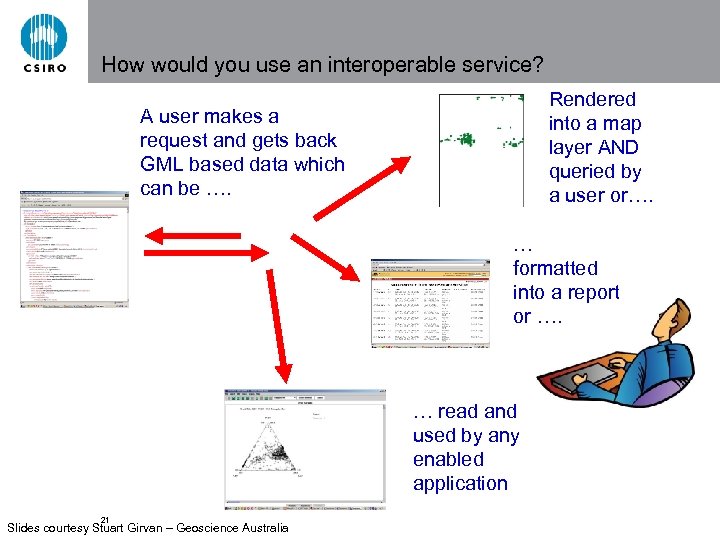 How would you use an interoperable service? Rendered into a map layer AND queried by a user or…. A user makes a request and gets back GML based data which can be …. … formatted into a report or …. … read and used by any enabled application 21 Slides courtesy Stuart Girvan – Geoscience Australia
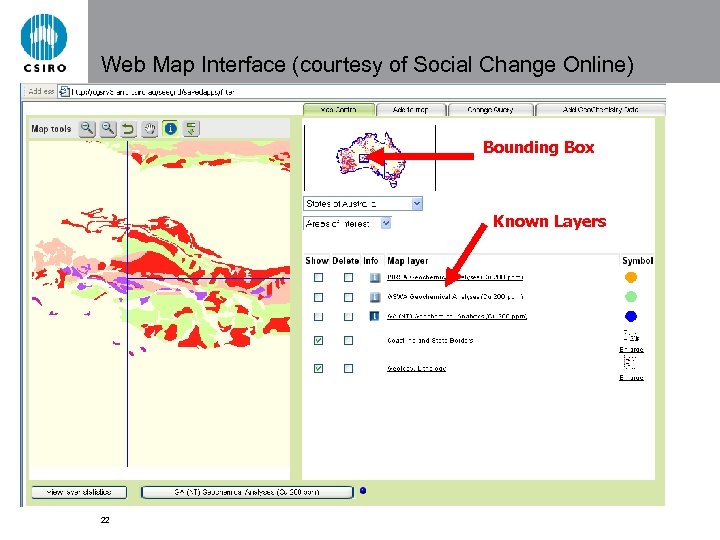 Web Map Interface (courtesy of Social Change Online) Bounding Box Known Layers 22
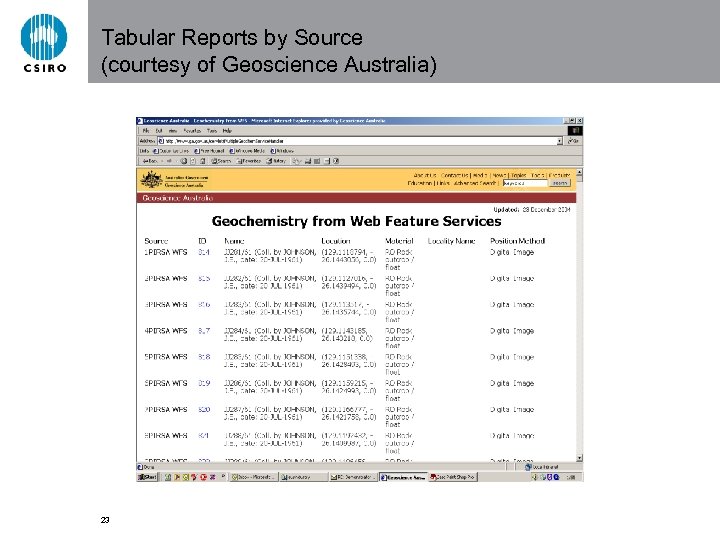 Tabular Reports by Source (courtesy of Geoscience Australia) 23
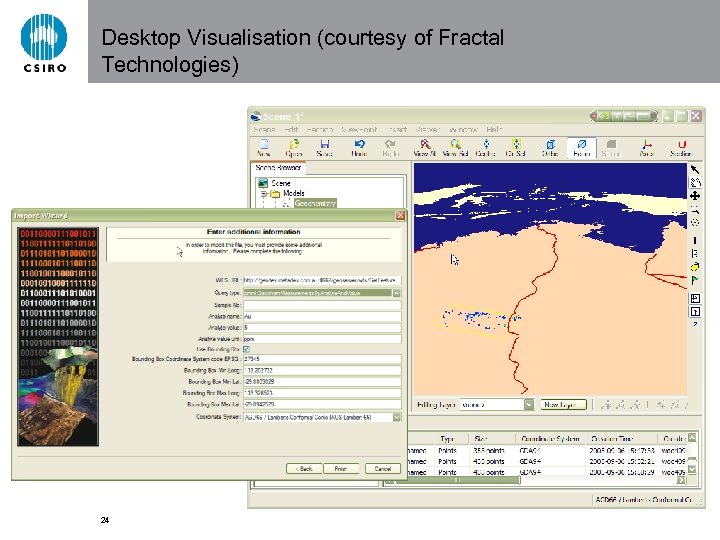 Desktop Visualisation (courtesy of Fractal Technologies) 24
 High Performance Computing in Exploration and Mining www. csiro. au
 Why use simulation and modelling? • Mineral exploration has considerable uncertainty • We use simulation and modelling to analyse an ensemble of possible geological structures and histories that could have produced the observations seen today • The result is reduced uncertainty and some quantification of risk This same approach applies to many fields – hazards, environment, … which is why we formed SEE Grid community 26
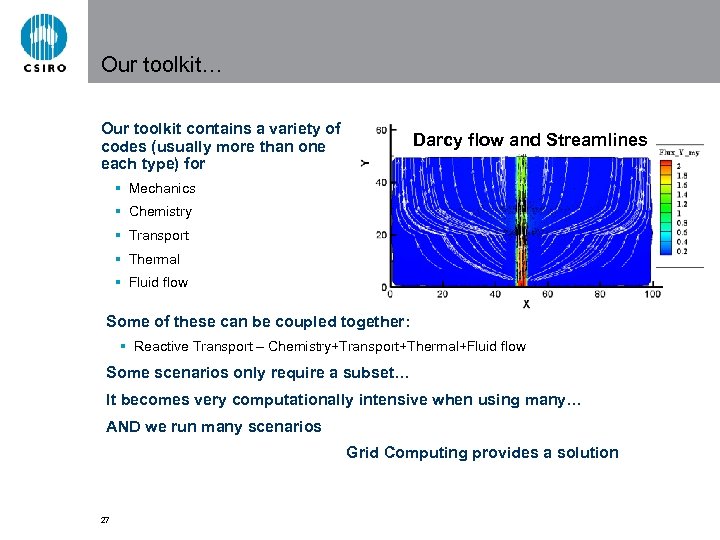 Our toolkit… Our toolkit contains a variety of codes (usually more than one each type) for Darcy flow and Streamlines § Mechanics § Chemistry § Transport § Thermal § Fluid flow Some of these can be coupled together: § Reactive Transport – Chemistry+Transport+Thermal+Fluid flow Some scenarios only require a subset… It becomes very computationally intensive when using many… AND we run many scenarios Grid Computing provides a solution 27
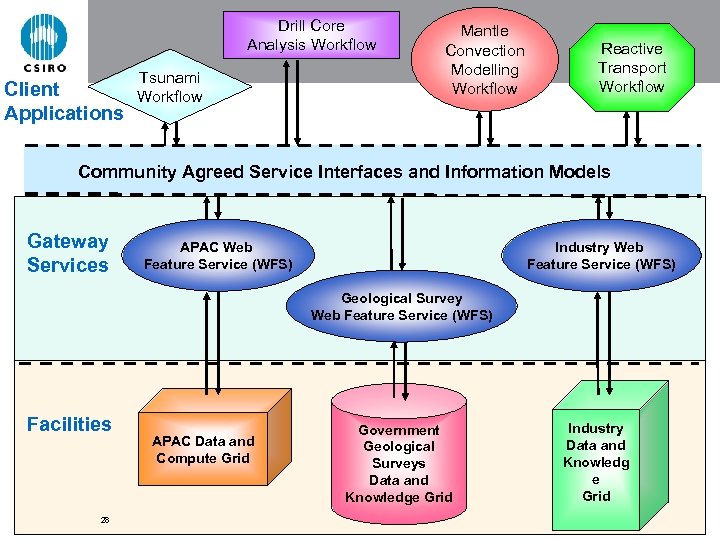 Drill Core Analysis Workflow Client Applications Tsunami Workflow Mantle Convection Modelling Workflow Reactive Transport Workflow Community Agreed Service Interfaces and Information Models Gateway Services APAC Web Feature Service (WFS) Industry Web Feature Service (WFS) Geological Survey Web Feature Service (WFS) Facilities 28 APAC Data and Compute Grid Government Geological Surveys Data and Knowledge Grid Industry Data and Knowledg e Grid
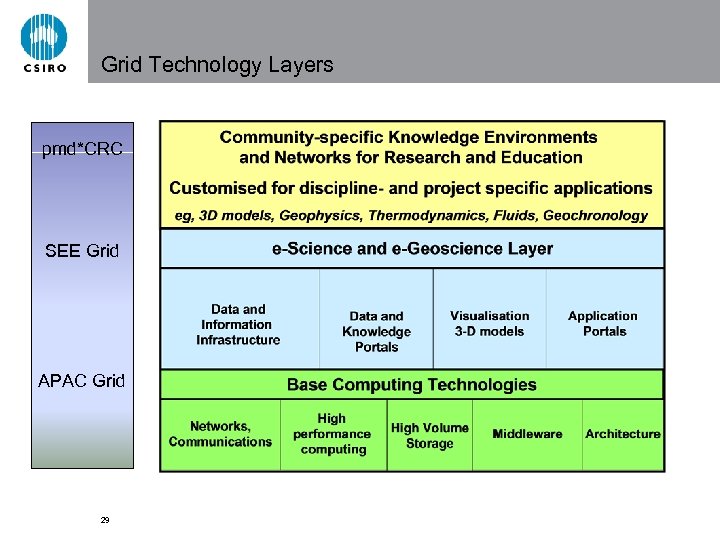 Grid Technology Layers pmd*CRC SEE Grid APAC Grid 29
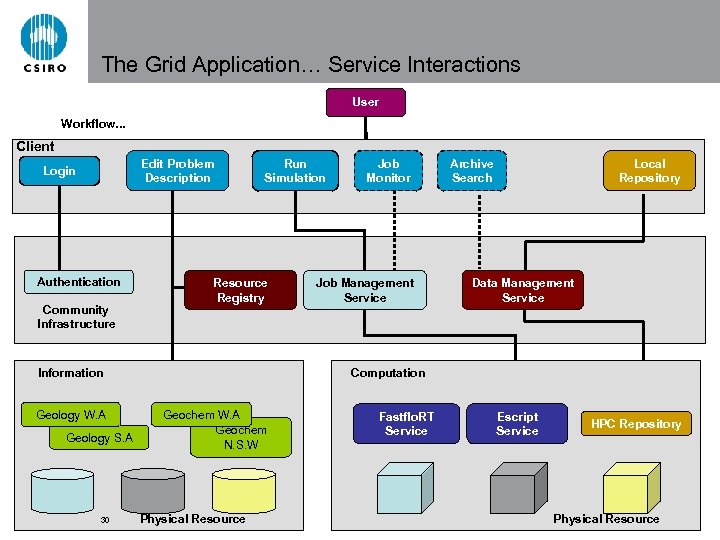 The Grid Application… Service Interactions User Workflow. . . Client Edit Problem Description Login Authentication Community Infrastructure Run Simulation Resource Registry Information Geology W. A Geology S. A 30 Job Monitor Job Management Service Local Repository Archive Search Data Management Service Computation Geochem W. A Geochem N. S. W Physical Resource Fastflo. RT Service Escript Service HPC Repository Physical Resource
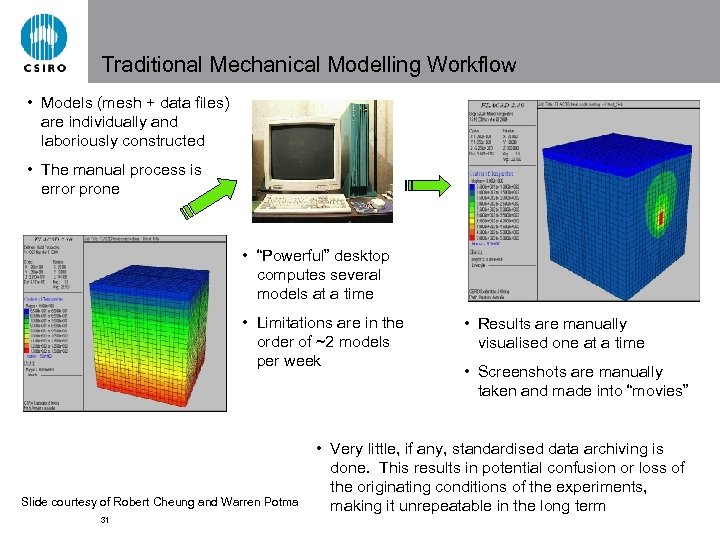 Traditional Mechanical Modelling Workflow • Models (mesh + data files) are individually and laboriously constructed • The manual process is error prone • “Powerful” desktop computes several models at a time • Limitations are in the order of ~2 models per week Slide courtesy of Robert Cheung and Warren Potma 31 • Results are manually visualised one at a time • Screenshots are manually taken and made into “movies” • Very little, if any, standardised data archiving is done. This results in potential confusion or loss of the originating conditions of the experiments, making it unrepeatable in the long term
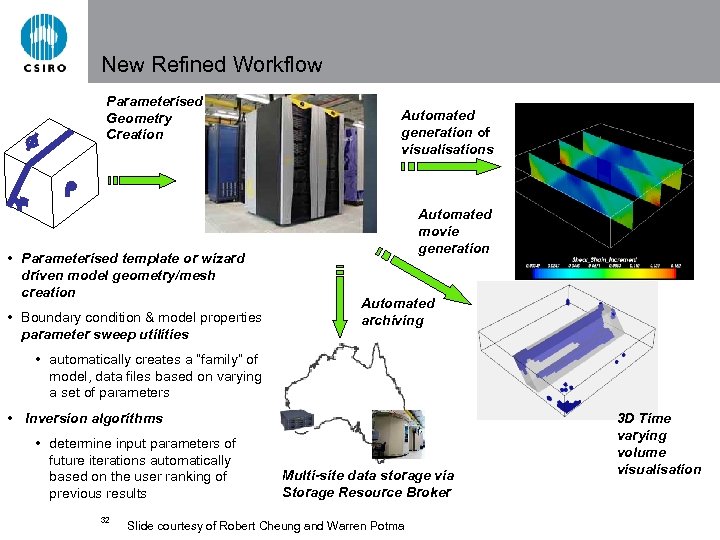 New Refined Workflow Parameterised Geometry Creation • Parameterised template or wizard driven model geometry/mesh creation • Boundary condition & model properties parameter sweep utilities Automated generation of visualisations Automated movie generation Automated archiving • automatically creates a “family” of model, data files based on varying a set of parameters • Inversion algorithms • determine input parameters of future iterations automatically based on the user ranking of previous results 32 Multi-site data storage via Storage Resource Broker Slide courtesy of Robert Cheung and Warren Potma 3 D Time varying volume visualisation
 Results to Date For one Investigator, on one investigation: • 500 Models in 4 months (100 x more!) • Inversion/parameter sweep algorithms – semi-automated model creation; faster, less errors • Automated post-processing/visualisation – all views X all timescale X all models await the investigator automatically • Automated archiving – metadata searchable, more accurate store of experimental conditions, delivered to your store! 33
 Results Major inefficiencies have been removed by: • Integrating the pmd*CRC geoscience modelling workflow with the: • Solid Earth and Environment Grid, and • APAC (Geoscience) Grid Industry response to approach is supportive as evidenced by SEE Grid Roadshow survey results and pmd*CRC applications 34
 Name Dr Robert Woodcock Title Executive Manager, e-Science Phone +61 8 6436 8780 Email Robert. Woodcock@csiro. au Web www. csiro. au www. seegrid. csiro. au Thank You Contact CSIRO Phone Email Web 1300 363 400 +61 3 9545 2176 enquiries@csiro. au www. csiro. au