 Скачать презентацию Towards Outcome-Based Incentives for Grid-Connected Windpower Energy Conclave
7fed163c8f290405cf7bb2ff63068731.ppt
- Количество слайдов: 15



Towards Outcome-Based Incentives for Grid-Connected Windpower Energy Conclave 2006 “Implementing the Integrated Energy Policy” IRADe, New Delhi, 27 th July 2006 Ajay Mathur President Senergy Global Pvt Ltd India Page of 15
Overview Ø IEP stresses need to move away from capital subsidies towards performance incentives, such as Tradeable Tax Rebate Certificates Ø Wind projects have need for high cashflow in early years because debt-service coverage ratio is low; this need is met by cashflow from the currently available accelerated depreciation benefit Ø A TTRC of Rs. 1 per k. Wh, subject to a maximum of Rs. 17 lakhs per MW per year, for the first four years of a project, can provide the same benefit as accelerated depreciation Page 2 of 15
Subsidy should be linked to outcomes IEP, Chapter VII: Policy for Renewable and Non. Conventional Energy 1. Price subsidy should be linked to outcomes. Thus, for example, giving a capital subsidy on wind power plant provides encouragement to set-up a power plant but does not provide additional incentive to generate power… 2. …capital subsidy, however, can be linked to the amount of power actually generated, if it is given in the form of Tradable Tax Rebate Certificates (TTRC)… Page 3 of 15
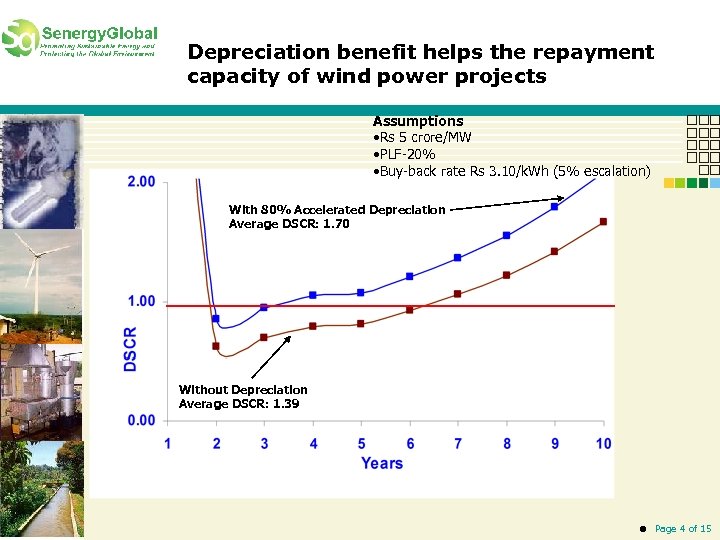
Depreciation benefit helps the repayment capacity of wind power projects Assumptions • Rs 5 crore/MW • PLF-20% • Buy-back rate Rs 3. 10/k. Wh (5% escalation) With 80% Accelerated Depreciation Average DSCR: 1. 70 Without Depreciation Average DSCR: 1. 39 Page 4 of 15
The shift to TTRC : The much required correction The current accelerated depreciation, for installation of wind energy projects, to be supplemented by a system of tax credit certificates of equivalent value, earned through the generation of electricity from these projects. Page 5 of 15
What are. TTRCs ? Ø Rearrangement of existing cash-flow of tax forgone/tax collected by Government of India, from wind energy projects, in order to link with energy generation by using the same discount factor Ø REVENUE NEUTRAL VIS-À-VIS BASE CASE Ø TCCs are tax credit certificates to be given on a unit generation of electricity (much like in US) with a possibility of a transfer to a third party Ø Ensure performance Ø Create a framework for non-recourse project financing Ø Push a way for large sized wind projects (50 MW and above) Ø Culminate into an environment to attract FDI in wind energy projects Ø Lower the cost of generation, and in turn the tariff Page 6 of 15
Advantages of TTRCs Ø Direct Ø Participation of serious energy sector players Ø Encourage higher performance – improving the economics Ø Break investment barrier which is currently linked with tax appetite Ø Indirect Ø Energy diversity/security & environment benefits Ø Higher tax revenues with expanded markets Ø Being generation linked, would put extensive thrust on R&D and improved O&M Ø Push project financing, thereby reduction in Capex Page 7 of 15
The design of Revenue neutrality Ø Current model of accelerated depreciation Ø Tax deferral against a normal depreciation (for P&M) accounted using time value of money (discount rate of 12%) Ø Wind energy projects subsequently generate profit and thereby pay “tax on operations” Ø TTRC is designed for the same revenue neutrality (atleast in designing) so that it is not a burden on the exchequer Page 8 of 15
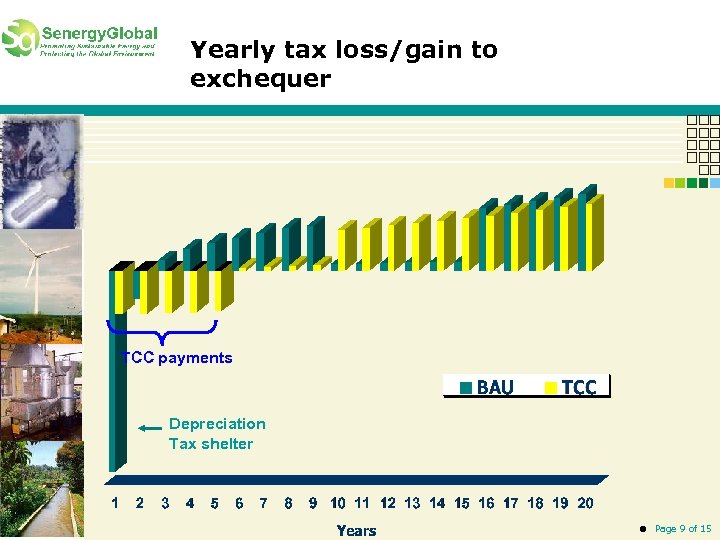
Yearly tax loss/gain to exchequer TCC payments Depreciation Tax shelter Page 9 of 15
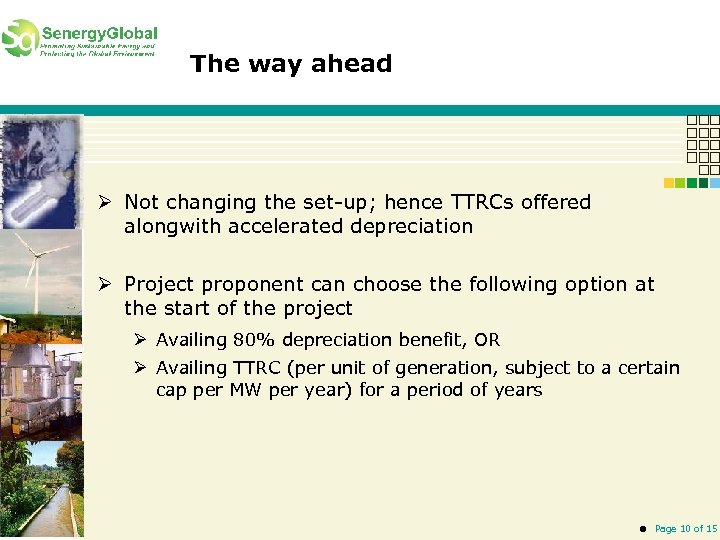
The way ahead Ø Not changing the set-up; hence TTRCs offered alongwith accelerated depreciation Ø Project proponent can choose the following option at the start of the project Ø Availing 80% depreciation benefit, OR Ø Availing TTRC (per unit of generation, subject to a certain cap per MW per year) for a period of years Page 10 of 15
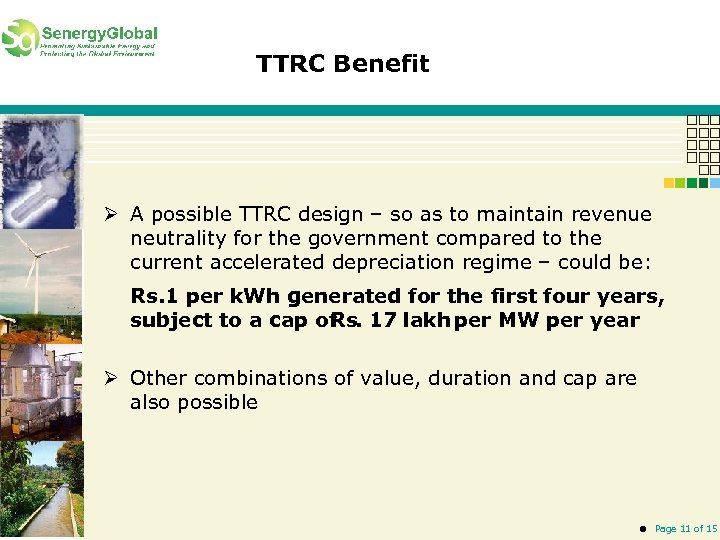
TTRC Benefit Ø A possible TTRC design – so as to maintain revenue neutrality for the government compared to the current accelerated depreciation regime – could be: Rs. 1 per k. Wh generated for the first four years, subject to a cap of Rs. 17 lakh per MW per year Ø Other combinations of value, duration and cap are also possible Page 11 of 15
Plausible implementation framework Page 12 of 15
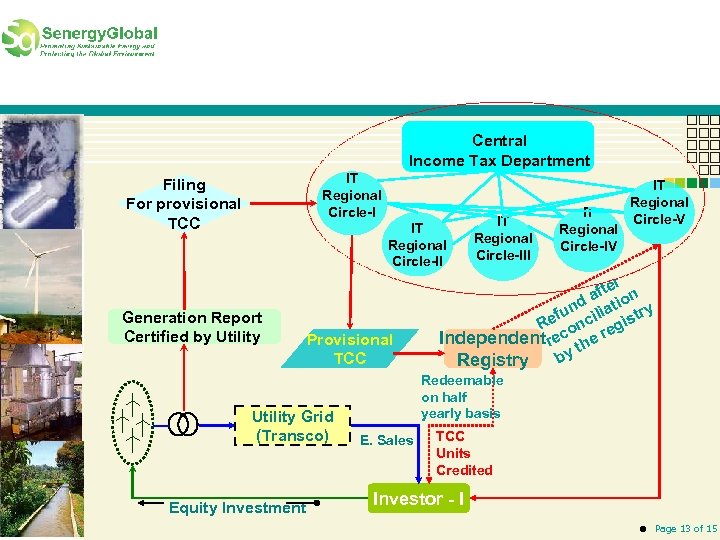
Central Income Tax Department IT Regional Circle-I Filing For provisional TCC IT Regional Circle-II Generation Report Certified by Utility Provisional TCC Utility Grid (Transco) Equity Investment IT Regional Circle-III IT Regional Circle-IV IT Regional Circle-V r fte n a nd liatio try fu i Re onc egis Independent rec the r by Registry Redeemable on half yearly basis E. Sales TCC Units Credited Investor - I Page 13 of 15
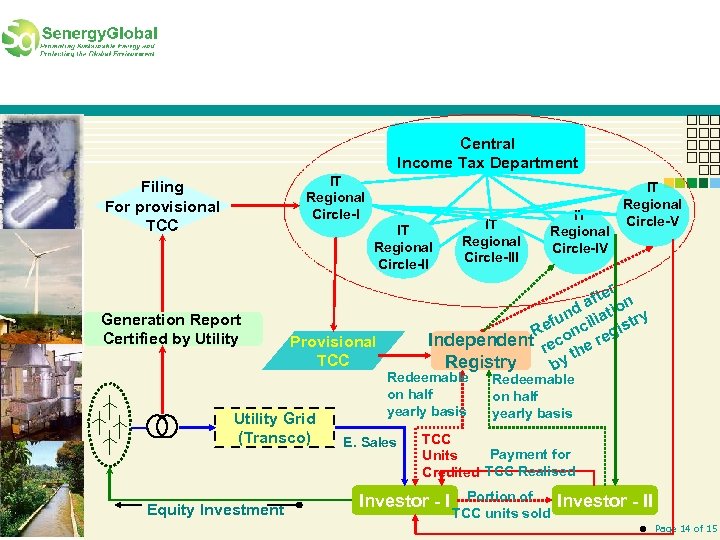
Central Income Tax Department IT Regional Circle-I Filing For provisional TCC IT Regional Circle-II Generation Report Certified by Utility Provisional TCC Utility Grid (Transco) Equity Investment IT Regional Circle-III r fte n a nd liatio try fu i Re onc egis Independent rec e r th Registry by Redeemable on half yearly basis E. Sales IT Regional Circle-IV IT Regional Circle-V Redeemable on half yearly basis TCC Payment for Units Credited TCC Realised Investor - I Portion of TCC units sold Investor - II Page 14 of 15
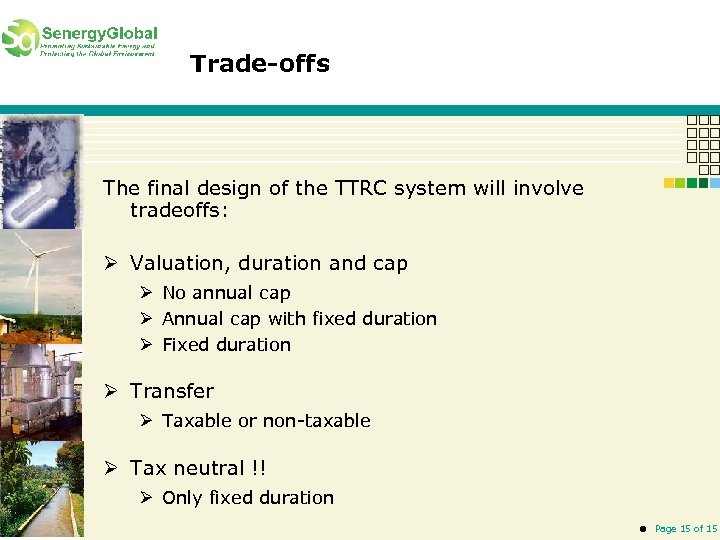
Trade-offs The final design of the TTRC system will involve tradeoffs: Ø Valuation, duration and cap Ø No annual cap Ø Annual cap with fixed duration Ø Fixed duration Ø Transfer Ø Taxable or non-taxable Ø Tax neutral !! Ø Only fixed duration Page 15 of 15
Скачать презентацию Towards Outcome-Based Incentives for Grid-Connected Windpower Energy Conclave
7fed163c8f290405cf7bb2ff63068731.ppt