 Скачать презентацию Towards Junking the PBX Deploying IP Telephony Wenyu
854d5501dadfeb46d1975eea33973797.ppt
- Количество слайдов: 28



Towards Junking the PBX: Deploying IP Telephony Wenyu Jiang, Jonathan Lennox, Henning Schulzrinne and Kundan Singh Columbia University {wenyu, lennox, hgs, kns 10}@cs. columbia. edu We describe our departmental IP telephony installation
Outline • • • Introduction to IP telephony System architecture Call flows System configuration Security Scalability 6/26/2001 Columbia University, Deploying IP Telephony 2
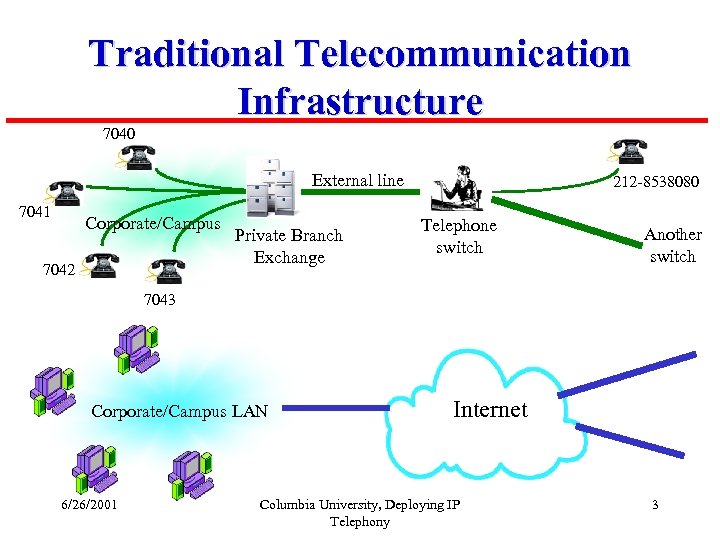
Traditional Telecommunication Infrastructure 7040 External line 7041 Corporate/Campus 7042 Private Branch Exchange 212 -8538080 Telephone switch Another switch 7043 Corporate/Campus LAN 6/26/2001 Internet Columbia University, Deploying IP Telephony 3
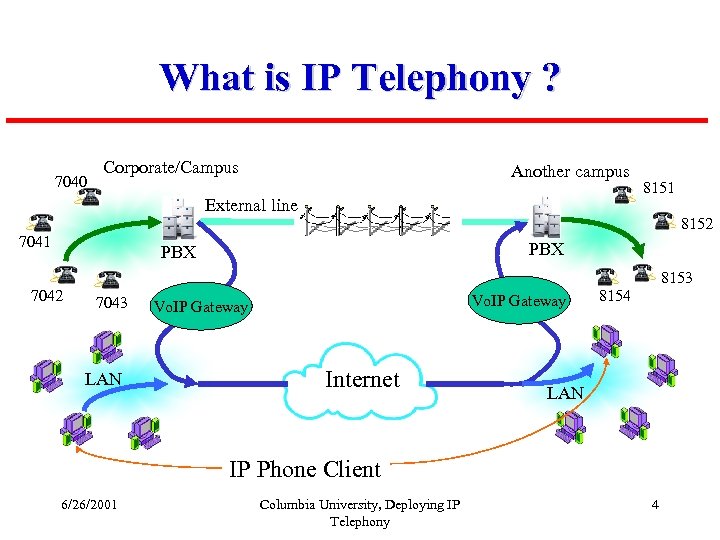
What is IP Telephony ? 7040 Corporate/Campus Another campus External line 7041 8152 PBX 7042 7043 LAN 8151 Vo. IP Gateway Internet 8153 8154 LAN IP Phone Client 6/26/2001 Columbia University, Deploying IP Telephony 4
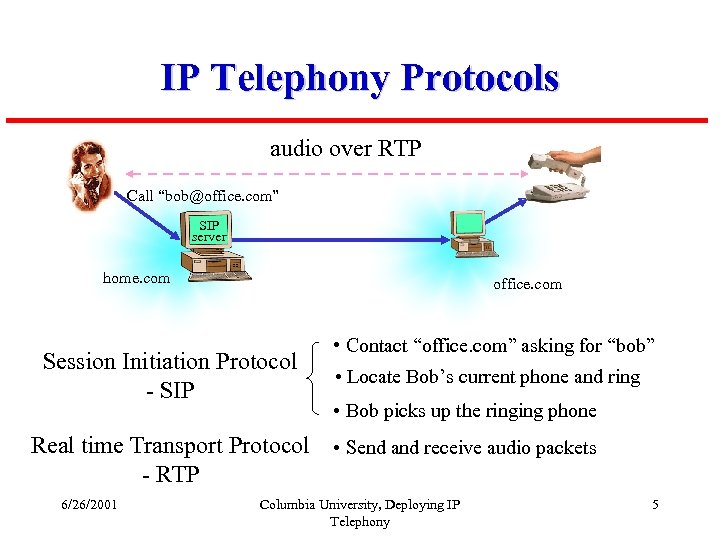
IP Telephony Protocols audio over RTP Call “bob@office. com” SIP server home. com office. com Session Initiation Protocol - SIP • Contact “office. com” asking for “bob” • Locate Bob’s current phone and ring • Bob picks up the ringing phone Real time Transport Protocol • Send and receive audio packets - RTP 6/26/2001 Columbia University, Deploying IP Telephony 5
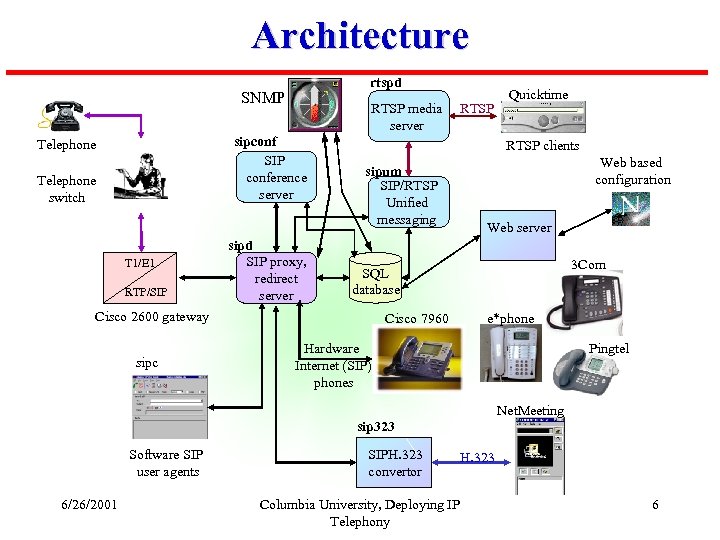
Architecture rtspd SNMP RTSP media server sipconf SIP conference server Telephone switch T 1/E 1 RTP/SIP sipd SIP proxy, redirect server RTSP clients sipum SIP/RTSP Unified messaging Web based configuration Web server 3 Com SQL database Cisco 2600 gateway sipc RTSP Quicktime Cisco 7960 e*phone Hardware Internet (SIP) phones Pingtel Net. Meeting sip 323 Software SIP user agents 6/26/2001 SIPH. 323 convertor Columbia University, Deploying IP Telephony H. 323 6
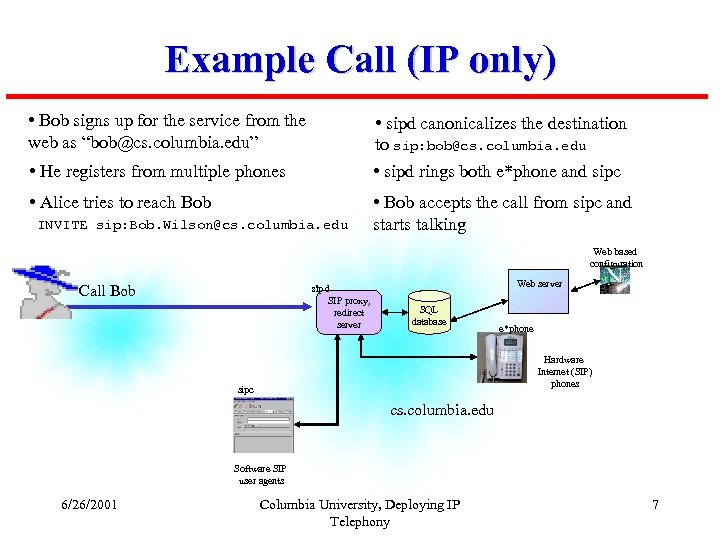
Example Call (IP only) • Bob signs up for the service from the web as “bob@cs. columbia. edu” • sipd canonicalizes the destination to sip: bob@cs. columbia. edu • sipd rings both e*phone and sipc • He registers from multiple phones • Alice tries to reach Bob INVITE sip: Bob. Wilson@cs. columbia. edu • Bob accepts the call from sipc and starts talking Web based configuration Call Bob sipd SIP proxy, redirect server Web server SQL database e*phone Hardware Internet (SIP) phones sipc cs. columbia. edu Software SIP user agents 6/26/2001 Columbia University, Deploying IP Telephony 7
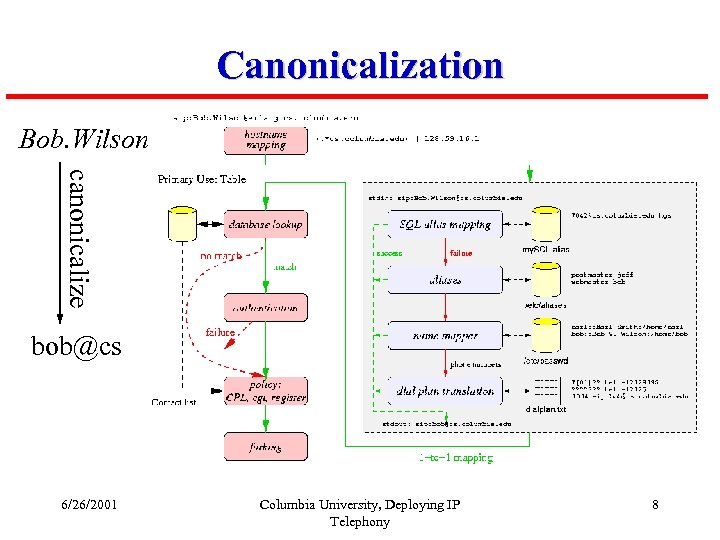
Canonicalization Bob. Wilson canonicalize bob@cs 6/26/2001 Columbia University, Deploying IP Telephony 8
Other Services • Programmable servers – Time-of-day, caller identification – CPL, SIP CGI • Unified messaging – Centralized voice mail – SIP, RTSP • Conferencing – Dial-in bridges; centralized audio mixing – Audio, video and chat 6/26/2001 Columbia University, Deploying IP Telephony 9
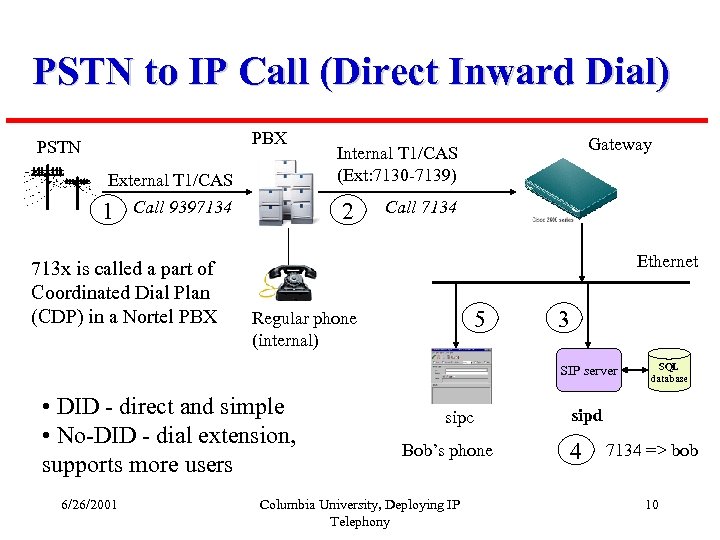
PSTN to IP Call (Direct Inward Dial) PBX PSTN External T 1/CAS 1 Call 9397134 713 x is called a part of Coordinated Dial Plan (CDP) in a Nortel PBX Gateway Internal T 1/CAS (Ext: 7130 -7139) 2 Call 7134 Ethernet 5 Regular phone (internal) 3 SIP server • DID - direct and simple • No-DID - dial extension, supports more users 6/26/2001 sipc Bob’s phone Columbia University, Deploying IP Telephony SQL database sipd 4 7134 => bob 10
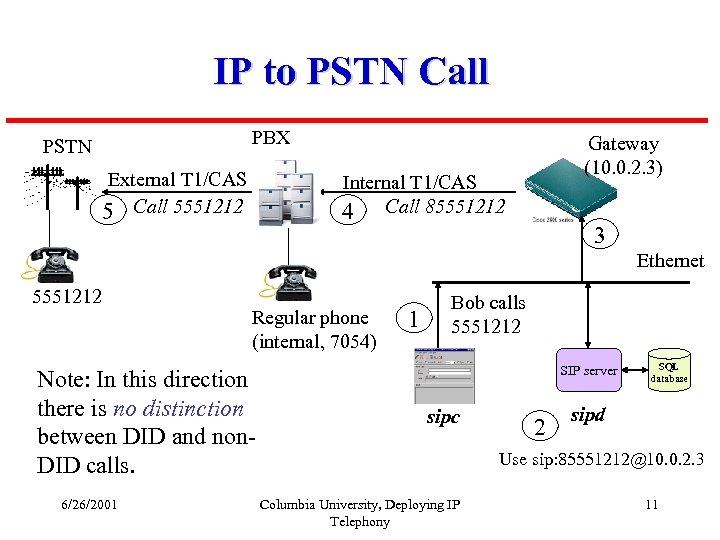
IP to PSTN Call PBX PSTN External T 1/CAS 5 Call 5551212 Gateway (10. 0. 2. 3) Internal T 1/CAS 4 Call 85551212 3 Ethernet 5551212 Regular phone (internal, 7054) Note: In this direction there is no distinction between DID and non. DID calls. 6/26/2001 1 Bob calls 5551212 SIP server sipc 2 SQL database sipd Use sip: 85551212@10. 0. 2. 3 Columbia University, Deploying IP Telephony 11
T 1 Line Configuration (From the PBX Side) • Electrical/physical settings – T 1 type: Channelized, PRI – Characteristics: line coding - AMI, B 8 ZS; framing - D 4, ESF • Trunk type: DID, TIE • Channel type: Data, Voice-only, Data/Voice • Access permissions: adjust NCOS for internal T 1 trunk and CDP routing entry (713 x) 6/26/2001 Columbia University, Deploying IP Telephony 12
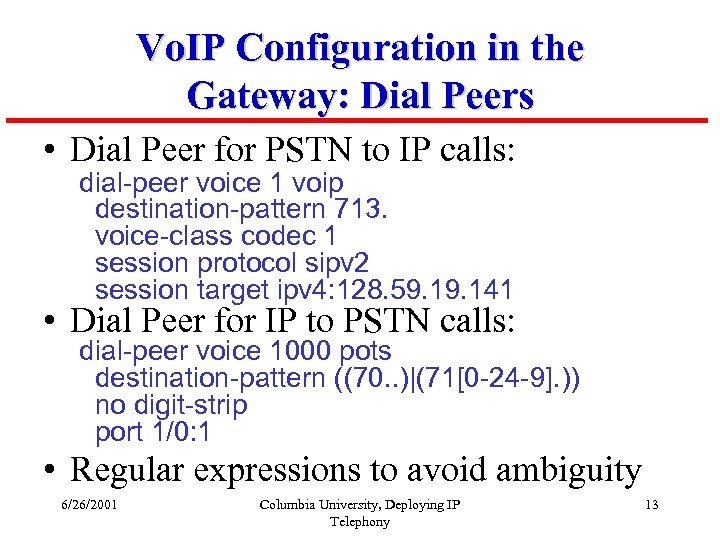
Vo. IP Configuration in the Gateway: Dial Peers • Dial Peer for PSTN to IP calls: dial-peer voice 1 voip destination-pattern 713. voice-class codec 1 session protocol sipv 2 session target ipv 4: 128. 59. 141 • Dial Peer for IP to PSTN calls: dial-peer voice 1000 pots destination-pattern ((70. . )|(71[0 -24 -9]. )) no digit-strip port 1/0: 1 • Regular expressions to avoid ambiguity 6/26/2001 Columbia University, Deploying IP Telephony 13
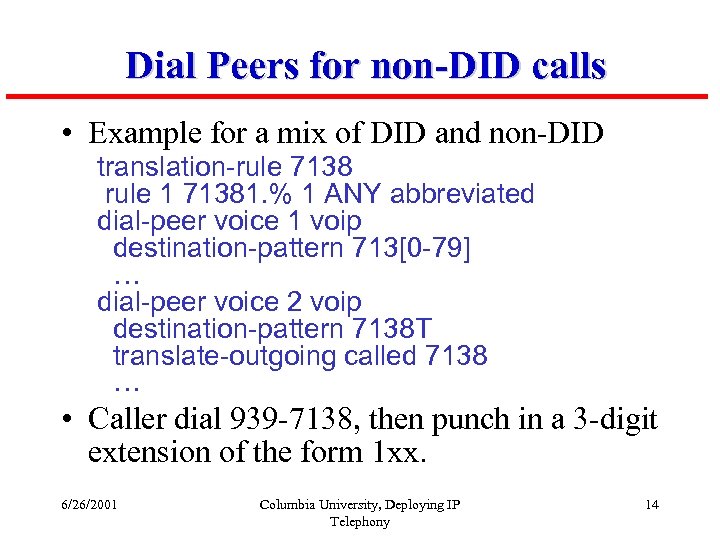
Dial Peers for non-DID calls • Example for a mix of DID and non-DID translation-rule 7138 rule 1 71381. % 1 ANY abbreviated dial-peer voice 1 voip destination-pattern 713[0 -79] … dial-peer voice 2 voip destination-pattern 7138 T translate-outgoing called 7138 … • Caller dial 939 -7138, then punch in a 3 -digit extension of the form 1 xx. 6/26/2001 Columbia University, Deploying IP Telephony 14
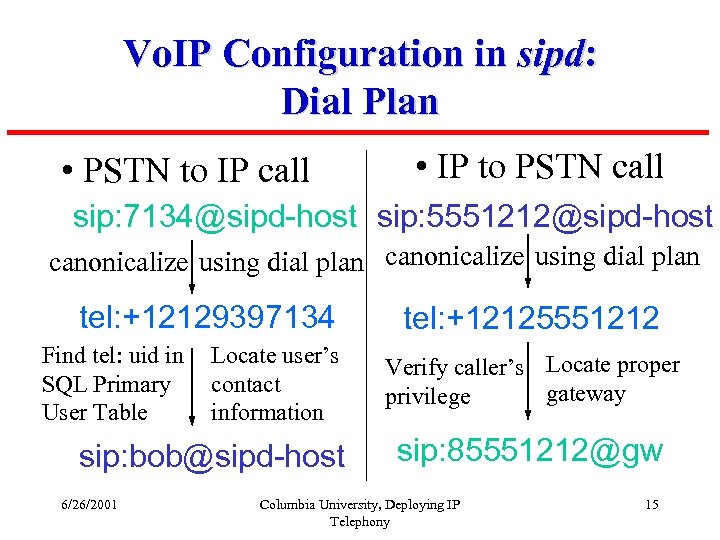
Vo. IP Configuration in sipd: Dial Plan • PSTN to IP call • IP to PSTN call sip: 7134@sipd-host sip: 5551212@sipd-host canonicalize using dial plan tel: +12129397134 Find tel: uid in SQL Primary User Table Locate user’s contact information sip: bob@sipd-host 6/26/2001 tel: +12125551212 Verify caller’s Locate proper gateway privilege sip: 85551212@gw Columbia University, Deploying IP Telephony 15
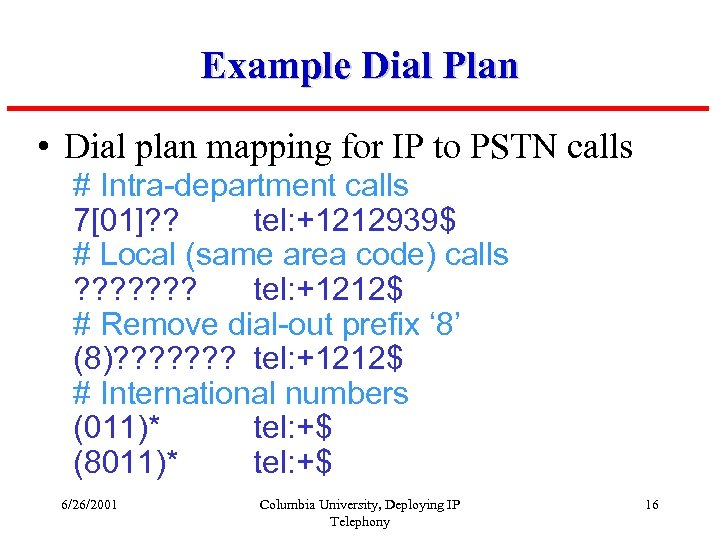
Example Dial Plan • Dial plan mapping for IP to PSTN calls # Intra-department calls 7[01]? ? tel: +1212939$ # Local (same area code) calls ? ? ? ? tel: +1212$ # Remove dial-out prefix ‘ 8’ (8)? ? ? ? tel: +1212$ # International numbers (011)* tel: +$ (8011)* tel: +$ 6/26/2001 Columbia University, Deploying IP Telephony 16
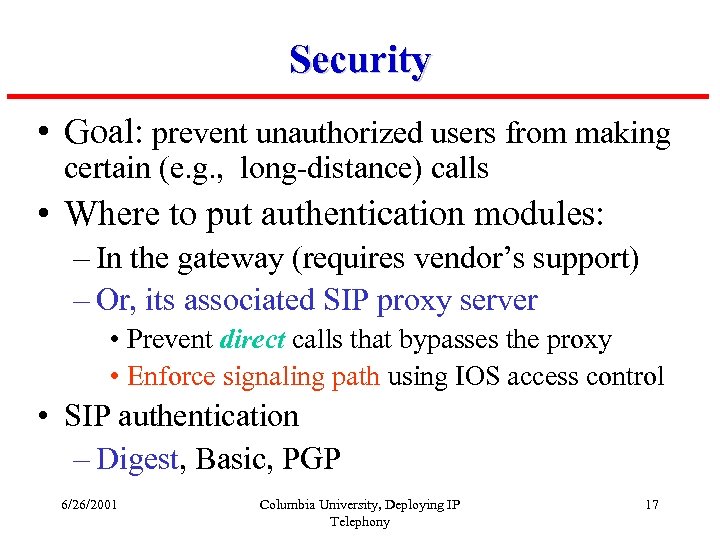
Security • Goal: prevent unauthorized users from making certain (e. g. , long-distance) calls • Where to put authentication modules: – In the gateway (requires vendor’s support) – Or, its associated SIP proxy server • Prevent direct calls that bypasses the proxy • Enforce signaling path using IOS access control • SIP authentication – Digest, Basic, PGP 6/26/2001 Columbia University, Deploying IP Telephony 17
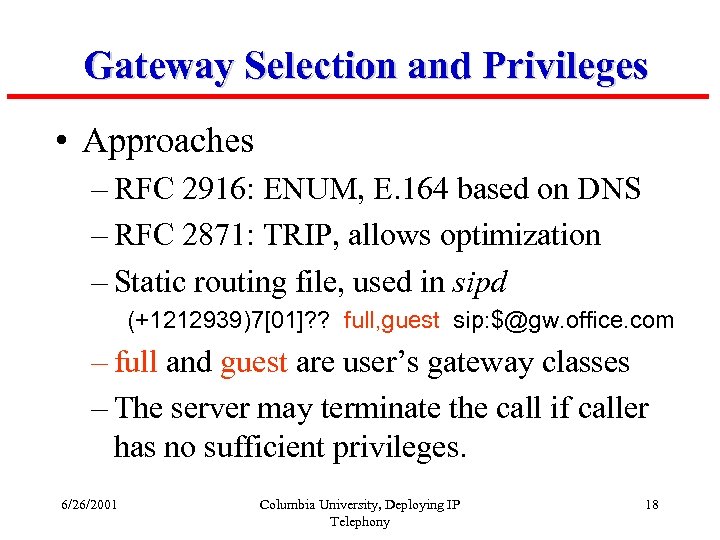
Gateway Selection and Privileges • Approaches – RFC 2916: ENUM, E. 164 based on DNS – RFC 2871: TRIP, allows optimization – Static routing file, used in sipd (+1212939)7[01]? ? full, guest sip: $@gw. office. com – full and guest are user’s gateway classes – The server may terminate the call if caller has no sufficient privileges. 6/26/2001 Columbia University, Deploying IP Telephony 18
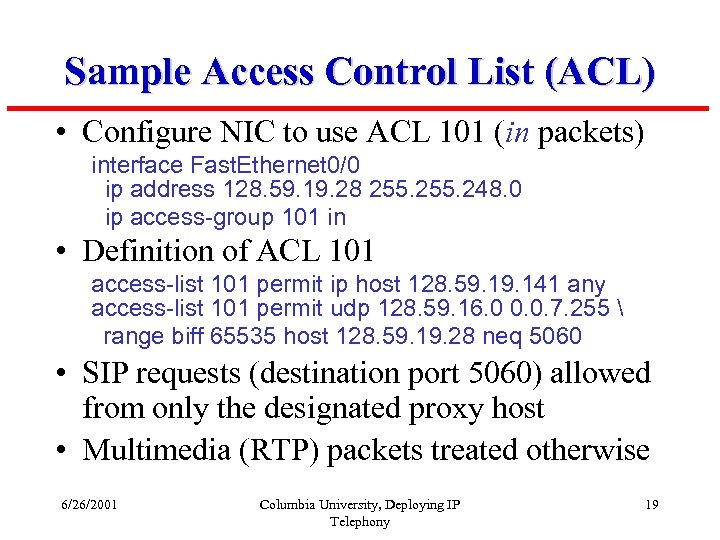
Sample Access Control List (ACL) • Configure NIC to use ACL 101 (in packets) interface Fast. Ethernet 0/0 ip address 128. 59. 19. 28 255. 248. 0 ip access-group 101 in • Definition of ACL 101 access-list 101 permit ip host 128. 59. 141 any access-list 101 permit udp 128. 59. 16. 0 0. 0. 7. 255 range biff 65535 host 128. 59. 19. 28 neq 5060 • SIP requests (destination port 5060) allowed from only the designated proxy host • Multimedia (RTP) packets treated otherwise 6/26/2001 Columbia University, Deploying IP Telephony 19
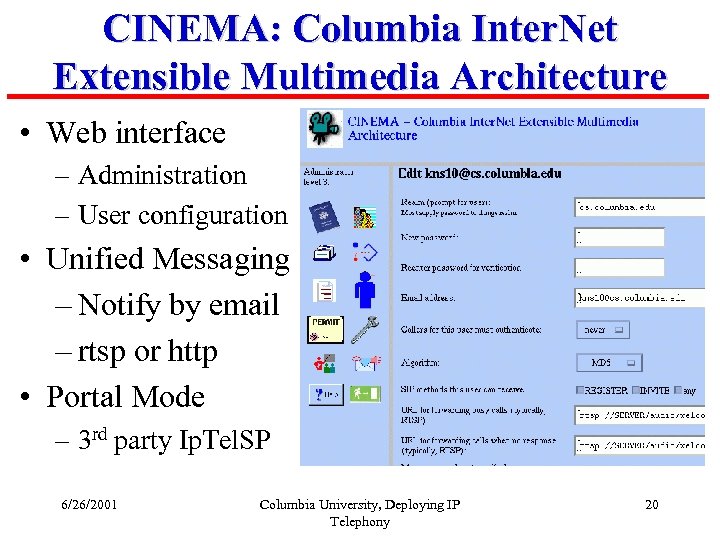
CINEMA: Columbia Inter. Net Extensible Multimedia Architecture • Web interface – Administration – User configuration • Unified Messaging – Notify by email – rtsp or http • Portal Mode – 3 rd party Ip. Tel. SP 6/26/2001 Columbia University, Deploying IP Telephony 20
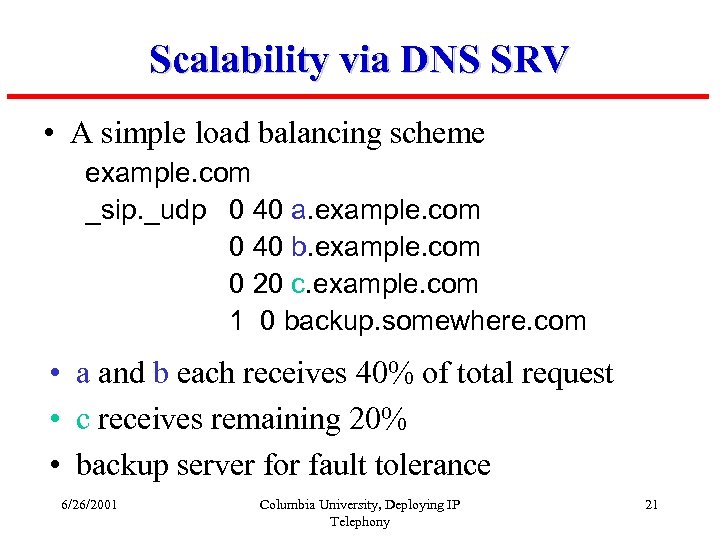
Scalability via DNS SRV • A simple load balancing scheme example. com _sip. _udp 0 40 a. example. com 0 40 b. example. com 0 20 c. example. com 1 0 backup. somewhere. com • a and b each receives 40% of total request • c receives remaining 20% • backup server for fault tolerance 6/26/2001 Columbia University, Deploying IP Telephony 21
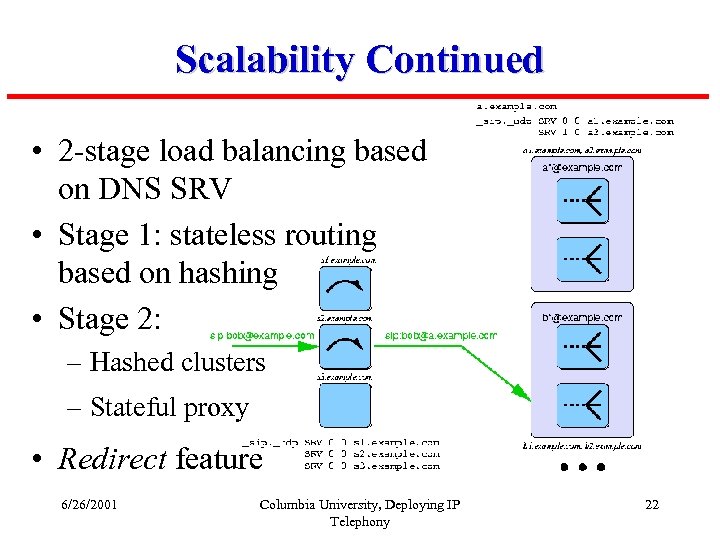
Scalability Continued • 2 -stage load balancing based on DNS SRV • Stage 1: stateless routing based on hashing • Stage 2: – Hashed clusters – Stateful proxy • Redirect feature 6/26/2001 Columbia University, Deploying IP Telephony 22
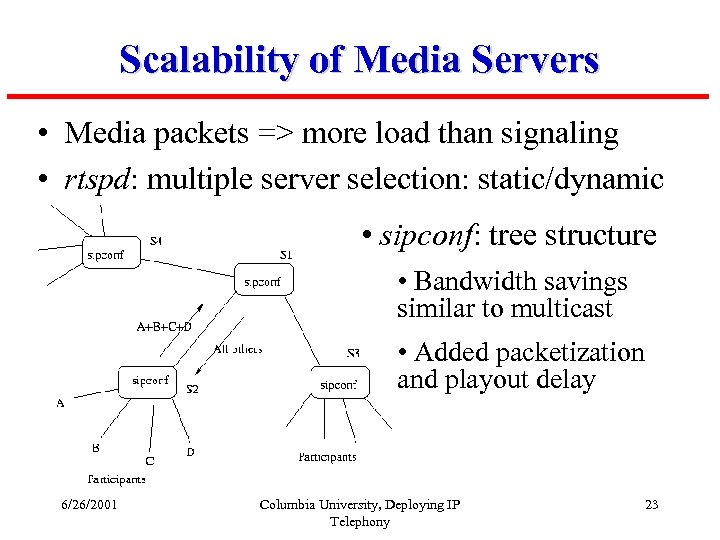
Scalability of Media Servers • Media packets => more load than signaling • rtspd: multiple server selection: static/dynamic • sipconf: tree structure • Bandwidth savings similar to multicast • Added packetization and playout delay 6/26/2001 Columbia University, Deploying IP Telephony 23
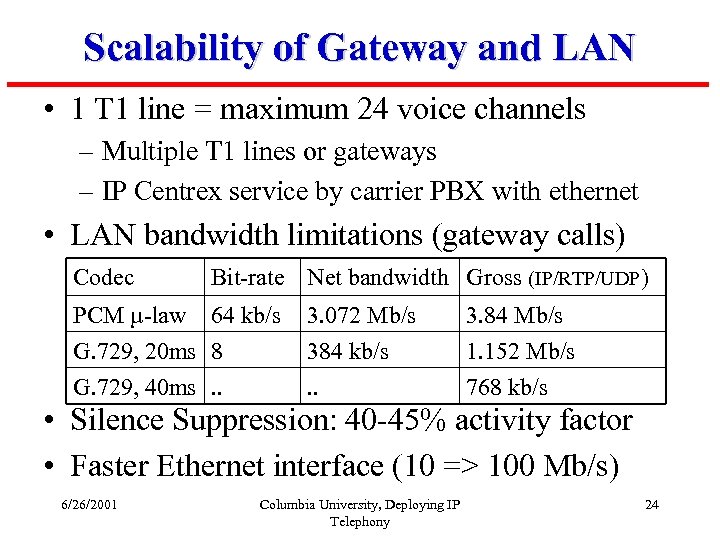
Scalability of Gateway and LAN • 1 T 1 line = maximum 24 voice channels – Multiple T 1 lines or gateways – IP Centrex service by carrier PBX with ethernet • LAN bandwidth limitations (gateway calls) Codec Bit-rate Net bandwidth Gross (IP/RTP/UDP) PCM µ-law 64 kb/s G. 729, 20 ms 8 G. 729, 40 ms. . 3. 072 Mb/s 384 kb/s. . 3. 84 Mb/s 1. 152 Mb/s 768 kb/s • Silence Suppression: 40 -45% activity factor • Faster Ethernet interface (10 => 100 Mb/s) 6/26/2001 Columbia University, Deploying IP Telephony 24
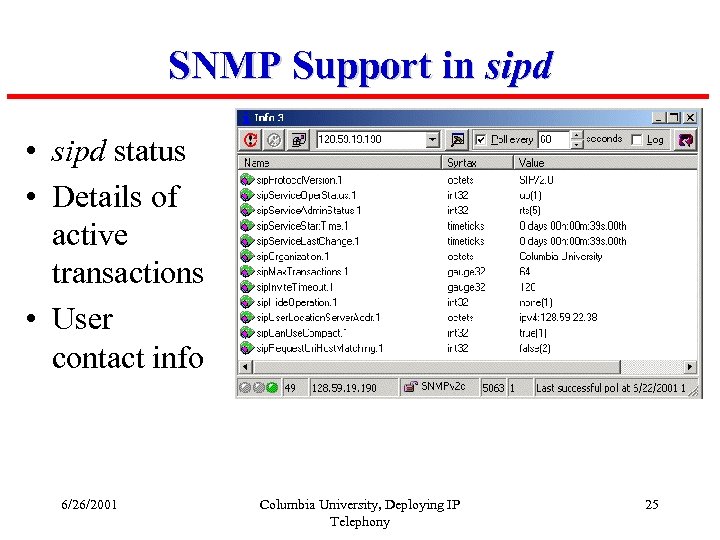
SNMP Support in sipd • sipd status • Details of active transactions • User contact info 6/26/2001 Columbia University, Deploying IP Telephony 25
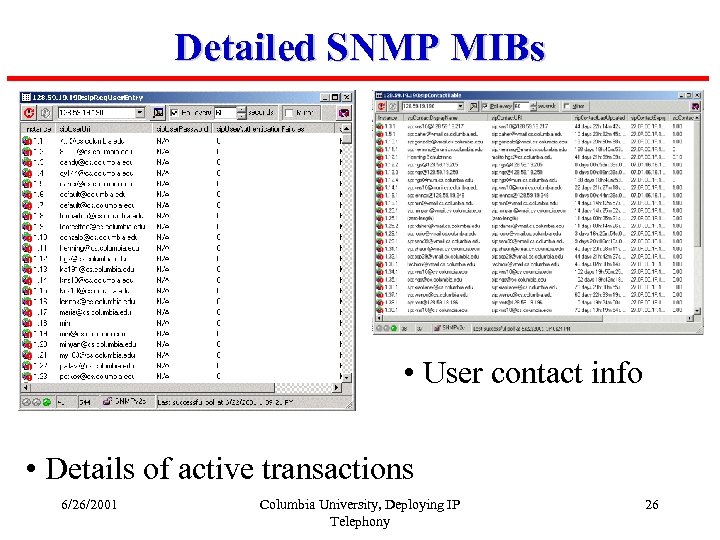
Detailed SNMP MIBs • User contact info • Details of active transactions 6/26/2001 Columbia University, Deploying IP Telephony 26
Future Work • Additional services – PIN numbers for telephone users – Automated, electronic billing – Instant messaging – Voice. XML (e. g. , email access via PSTN) • Performance and scalability: – sipd, rtspd, sipconf – SQL main-memory vs. disk database • Firewall/NAT interoperability • Details of system to appear in Tech Report 6/26/2001 Columbia University, Deploying IP Telephony 27
Conclusion • Initial field test experience with deploying IP telephony in a campus environment • The architecture and installation experience can be used at other organizations • Issues raised for further study: – Service availability/reliability – Quality of Service (Qo. S) – Privacy/encryption – Electronic billing policies 6/26/2001 Columbia University, Deploying IP Telephony 28
Скачать презентацию Towards Junking the PBX Deploying IP Telephony Wenyu
854d5501dadfeb46d1975eea33973797.ppt