 Скачать презентацию Towards Internet of Things Malawi By Emily Khamula
ee8542aee7ea83afe6f4c80eca0820e7.ppt
- Количество слайдов: 18



Towards Internet of Things Malawi By Emily Khamula Lungu Deputy Director –Universal Access MACRA
Presentation outline • • • Introduction Sector Overview Sector performance Policy & Regulatory issues Interventions
Introduction • ICT is an emerging sector in Malawi due to its essential nature in accelerating growth of all other sectors and as an enabler for poverty reduction. • Provision of information can only be done through the use of appropriate technologies from the source to users • Communication of information is ably facilitated by the deployment of information and communication infrastructure that has been developed and established throughout the country. • ICTs is no longer an option but a necessity for any country
Introduction • Malawi Government recognizes that Io. T holds promise for delivering social and economic benefits to its economy. • Growth of smart-phones/mobile services are essential part of how economies globally function and • continue to offer unique opportunities for economic growth in many countries. • Growth in mobile data has changed consumer behaviour • more people continue to depend on mobile data/devices connected to the internet • have made life easier as they have improves peoples lives • Io. T has been facilitated by the dependence of mobile data by the general public and growth and increased usage of smart phones, smart environment and cities etc.
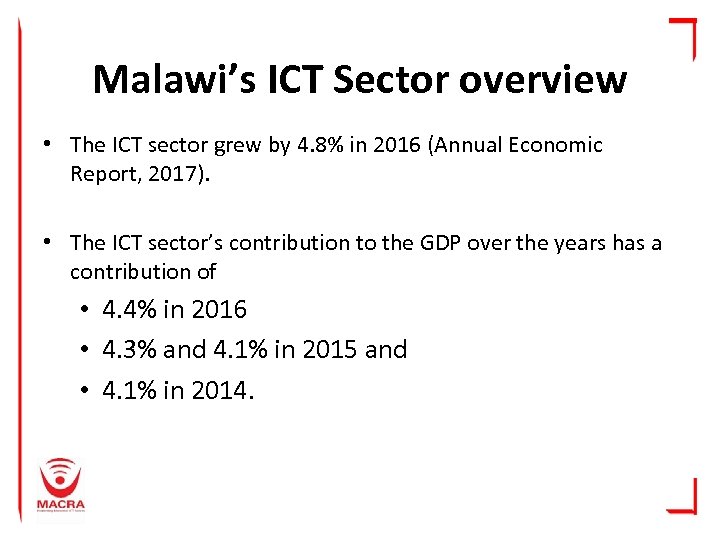
Malawi’s ICT Sector overview • The ICT sector grew by 4. 8% in 2016 (Annual Economic Report, 2017). • The ICT sector’s contribution to the GDP over the years has a contribution of • 4. 4% in 2016 • 4. 3% and 4. 1% in 2015 and • 4. 1% in 2014.
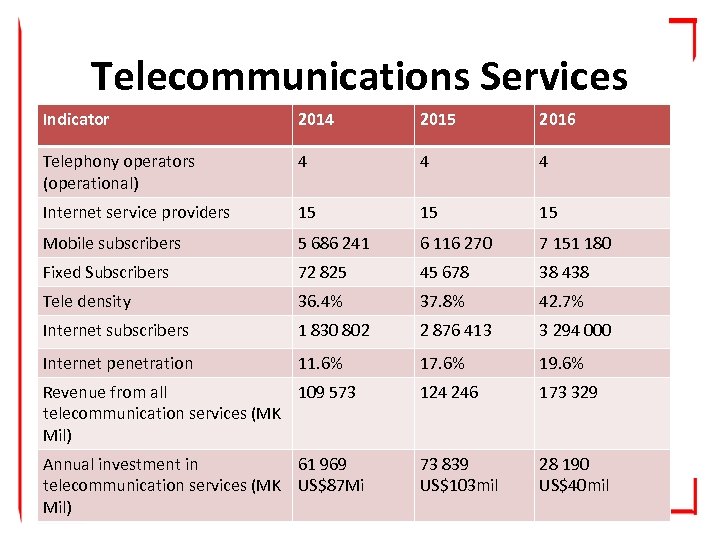
Telecommunications Services Indicator 2014 2015 2016 Telephony operators (operational) 4 4 4 Internet service providers 15 15 15 Mobile subscribers 5 686 241 6 116 270 7 151 180 Fixed Subscribers 72 825 45 678 38 438 Tele density 36. 4% 37. 8% 42. 7% Internet subscribers 1 830 802 2 876 413 3 294 000 Internet penetration 11. 6% 17. 6% 19. 6% Revenue from all 109 573 telecommunication services (MK Mil) 124 246 173 329 Annual investment in 61 969 telecommunication services (MK US$87 Mi Mil) 73 839 US$103 mil 28 190 US$40 mil
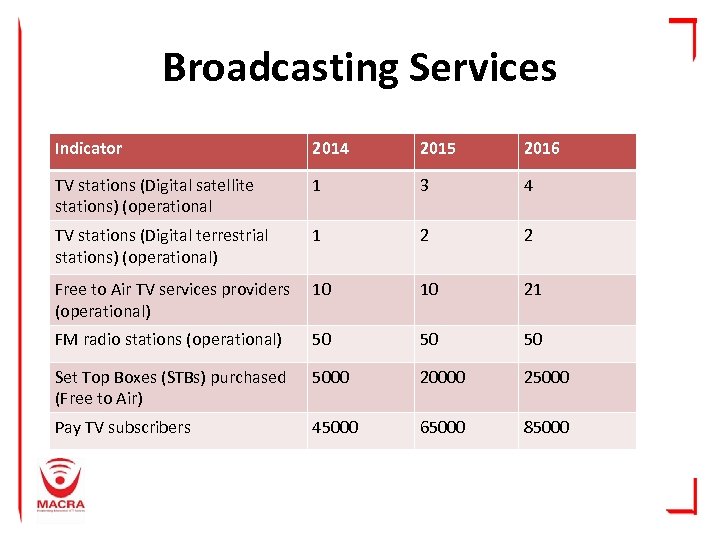
Broadcasting Services Indicator 2014 2015 2016 TV stations (Digital satellite stations) (operational 1 3 4 TV stations (Digital terrestrial stations) (operational) 1 2 2 Free to Air TV services providers (operational) 10 10 21 FM radio stations (operational) 50 50 50 Set Top Boxes (STBs) purchased (Free to Air) 5000 20000 25000 Pay TV subscribers 45000 65000 85000
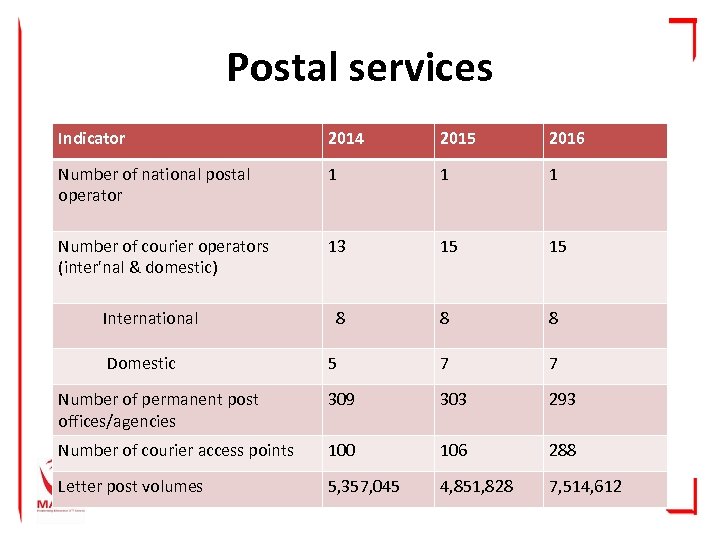
Postal services Indicator 2014 2015 2016 Number of national postal operator 1 1 1 Number of courier operators (inter'nal & domestic) 13 15 15 8 8 8 5 7 7 Number of permanent post offices/agencies 309 303 293 Number of courier access points 100 106 288 Letter post volumes 5, 357, 045 4, 851, 828 7, 514, 612 International Domestic
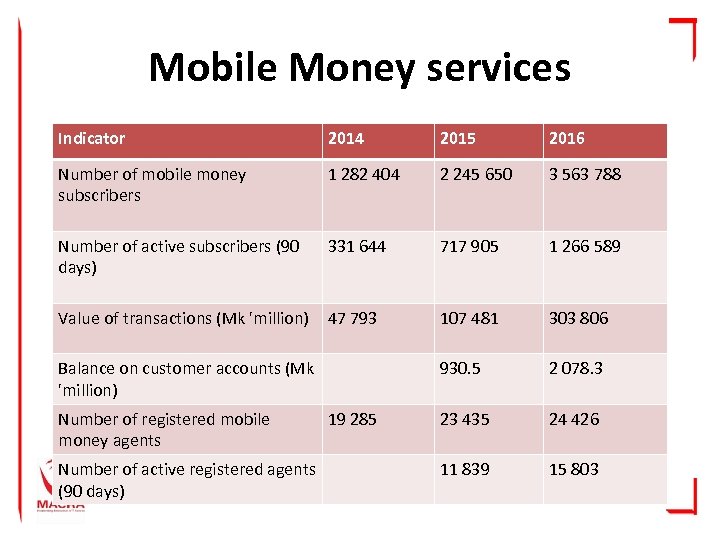
Mobile Money services Indicator 2014 2015 2016 Number of mobile money subscribers 1 282 404 2 245 650 3 563 788 Number of active subscribers (90 days) 331 644 717 905 1 266 589 Value of transactions (Mk 'million) 47 793 107 481 303 806 930. 5 2 078. 3 23 435 24 426 11 839 15 803 Balance on customer accounts (Mk 'million) Number of registered mobile money agents Number of active registered agents (90 days) 19 285
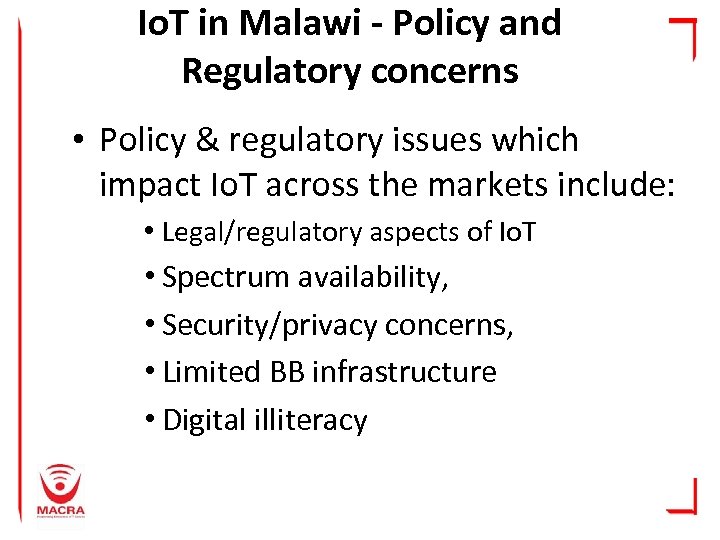
Io. T in Malawi - Policy and Regulatory concerns • Policy & regulatory issues which impact Io. T across the markets include: • Legal/regulatory aspects of Io. T • Spectrum availability, • Security/privacy concerns, • Limited BB infrastructure • Digital illiteracy
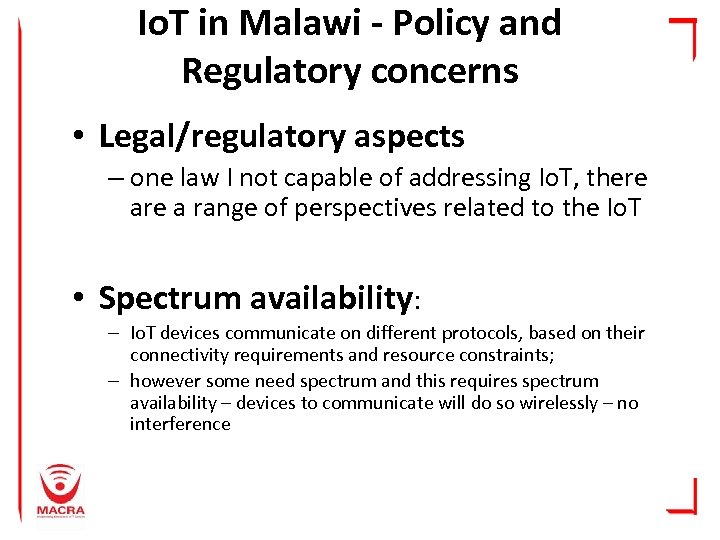
Io. T in Malawi - Policy and Regulatory concerns • Legal/regulatory aspects – one law I not capable of addressing Io. T, there a range of perspectives related to the Io. T • Spectrum availability: – Io. T devices communicate on different protocols, based on their connectivity requirements and resource constraints; – however some need spectrum and this requires spectrum availability – devices to communicate will do so wirelessly – no interference
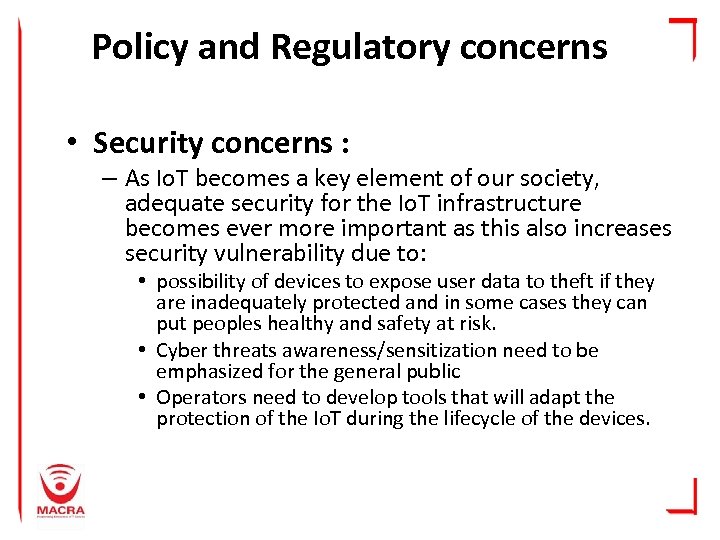
Policy and Regulatory concerns • Security concerns : – As Io. T becomes a key element of our society, adequate security for the Io. T infrastructure becomes ever more important as this also increases security vulnerability due to: • possibility of devices to expose user data to theft if they are inadequately protected and in some cases they can put peoples healthy and safety at risk. • Cyber threats awareness/sensitization need to be emphasized for the general public • Operators need to develop tools that will adapt the protection of the Io. T during the lifecycle of the devices.
Policy and Regulatory concerns • Digital illiteracy (demand side): – A large part of the targeted population is digitally illiterate • Internet is still a limited technology (supply side): – With 19% penetration rate, more inhabitants cannot access the service - universal connectivity is a vital for the uptake of Io. T – National BB Infrastructure is inadequate – • with 3 optical fibre operators and 5, 000 km of fibre, there is still some broadband gaps and last mile is a concern • distribution is still a challenge, this certainly can slow down the Io. T prospectives – Quality of Service by operators (voice and data) is another critical enabler for Io. T
Interventions/Projects 1. Digital Malawi Project • Increase access to affordable, high quality Internet services for govt, businesses, citizens • To improve the Government's capacity to deliver digital public services • Project components a) Digital Ecosystem • more attractive and competitive place to invest and innovate • Legal and Regulatory Reform and Implementation (Enabling Environment); • Regulatory Capacity Building and Institutional Development; • Partnerships for ICT Skills Development, job creation and Innovation.
Interventions/Projects b) Digital Connectivity • encouraging infrastructure development in areas which do not attract investment from the private sector through: • Connecting all public institutions in the country; • Providing innovative broadband access • Connecting higher education institutions to improve caching and local content development. c) Digital Platform and Services • focus on digital transformation for Malawi to deliver an advanced, competitive economy and modern, effective public services for all. • Strengthening Institutional Capacity to Deliver Digital Services; • Sharing Digital Public Services Delivery Platform e. g. Data Center; • Developing Digital Applications and Services.
Interventions/Projects 2) National Fibre Backbone Project • The Project is expected to lay fibre from the northern border district of Chitipa to Nsanje in the south, through Lilongwe, Blantyre and Zomba – mandate to promote UA to BB is strategic • BB Strategy development – Consultant is working on this development 3)Digitizing Post Offices – one stop shop (e-govt services to be accesses in post offices (digital economy creation) 4) Universal access projects - newly created UA Fund • Connect public institutions (health centres, clinics, schools, colleges, libraries) • Community Access Projects enhance post offices and provide connectivity • Broadband infrastructure gaps and BB access gaps • Digital literacy and local content
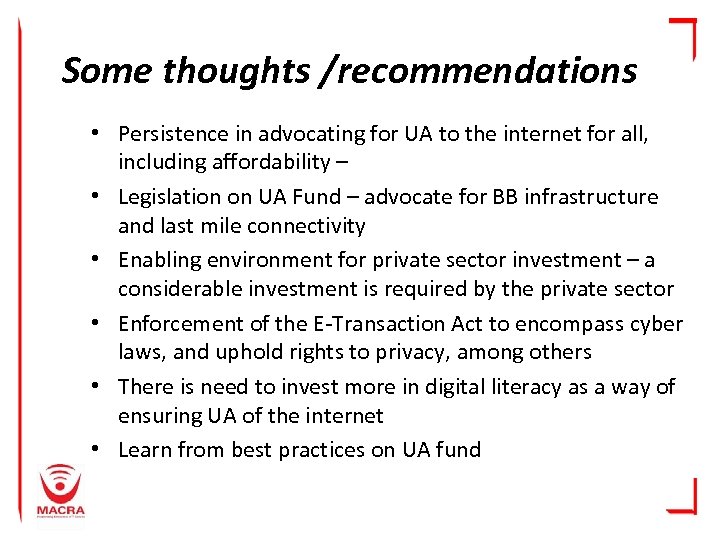
Some thoughts /recommendations • Persistence in advocating for UA to the internet for all, including affordability – • Legislation on UA Fund – advocate for BB infrastructure and last mile connectivity • Enabling environment for private sector investment – a considerable investment is required by the private sector • Enforcement of the E-Transaction Act to encompass cyber laws, and uphold rights to privacy, among others • There is need to invest more in digital literacy as a way of ensuring UA of the internet • Learn from best practices on UA fund

Thank you for your attention
Скачать презентацию Towards Internet of Things Malawi By Emily Khamula
ee8542aee7ea83afe6f4c80eca0820e7.ppt