 Скачать презентацию Towards European-wide Quality and Benchmarking of Open Educational
0702fa1e880fc5efeeb845aea657cf60.ppt
- Количество слайдов: 23



Towards European-wide Quality and Benchmarking of Open Educational Resources C. A. van Dorp & George Ubachs European Association of Distance Teaching Universities (EADTU) Kees-Jan. van. Dorp@EADTU. nl George. Ubachs@EADTU. nl SCOP 2007 ‘Open Educational Resources as an Instrument for achieving Education for All’
Agenda Part – One: Consortium of New Generation OER Consortium introduction Consortium stages Consortium progress Consortium outlook Part – Two: Proliferating Quality and Benchmarking The problem at hand Some results Tool support needed E-xcellence
Consortium introduction Consortium philosophy A new generation open educational resources Stimulate, extend, and expand the use of OER in Europe Provide lifelong learning with a new gateway to university education Widen the participation in higher education in line with the Lisbon agenda Brand lifelong open and flexible learning throughout Europe Share and build on scientific and expert knowledge of OER Consortium aspiration A new generation open educational resources No traditional face-to-face education Didactic model based on distance education Specifically designed, developed for distance learning Courses with intrinsic broad pedagogical coverage Unique pathway: from non-matriculated to matriculated Successive multilingual versioning and localisation Content and registration: a distributed model Content mobility and virtual mobility Strong partnership
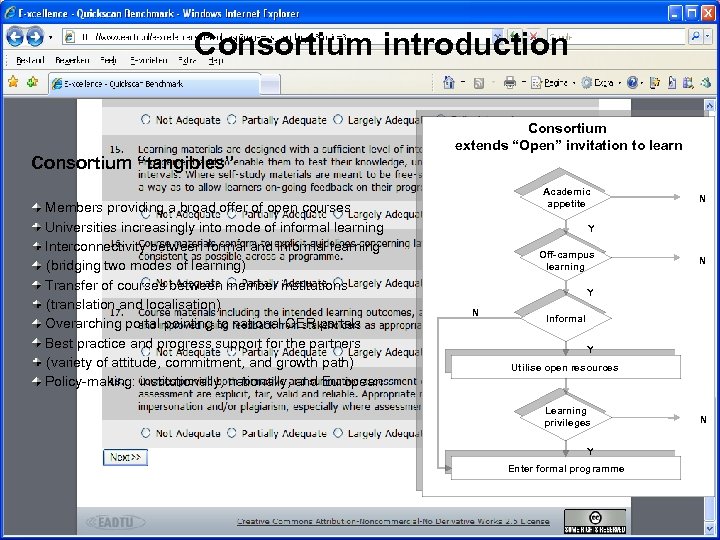
Consortium introduction Consortium “tangibles” Members providing a broad offer of open courses Universities increasingly into mode of informal learning Interconnectivity between formal and informal learning (bridging two modes of learning) Transfer of courses between member institutions (translation and localisation) Overarching portal pointing to national OER portals Best practice and progress support for the partners (variety of attitude, commitment, and growth path) Policy-making: institutionally, nationally, and European Consortium extends “Open” invitation to learn Academic appetite N Y Off-campus learning N Y N Informal Y Utilise open resources Learning privileges Y Enter formal programme N
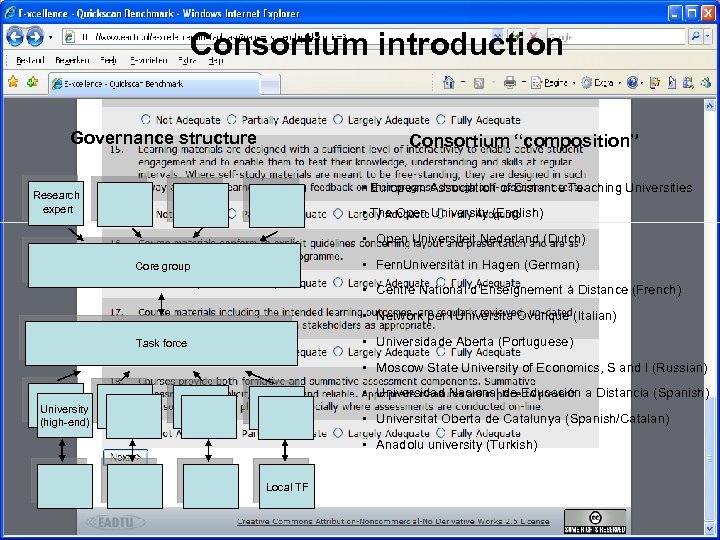
Consortium introduction Governance structure Consortium “composition” • European Association of Distance Teaching Universities Research expert • The Open University (English) • Open Universiteit Nederland (Dutch) • Fern. Universität in Hagen (German) Core group • Centre National d'Enseignement à Distance (French) • Network per l'Universita Ovunque (Italian) • Universidade Aberta (Portuguese) Task force • Moscow State University of Economics, S and I (Russian) Actors University (high-end) • Universidad Nacional de Educación a Distancia (Spanish) Actors • Universitat Oberta de Catalunya (Spanish/Catalan) • Anadolu university (Turkish) Local TF
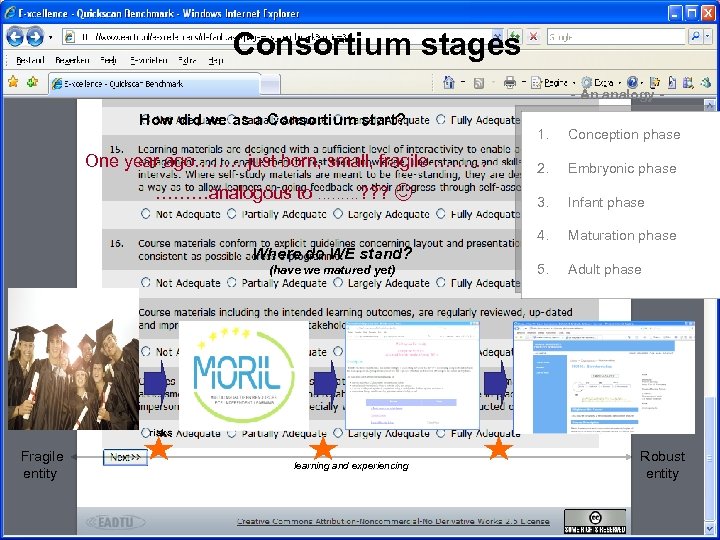
Consortium stages - An analogy - How did we as a Consortium start? ………analogous to ………? ? ? ☺ Where do WE stand? (have we matured yet) Conception phase 2. Embryonic phase 3. Infant phase 4. One year ago………just born, small, fragile ……… 1. Maturation phase 5. Adult phase risks Fragile entity learning and experiencing Robust entity
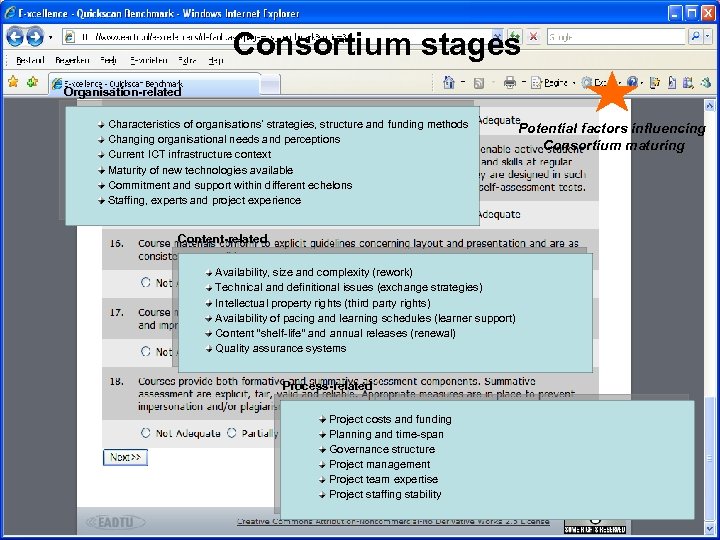
Consortium stages Organisation-related Characteristics of organisations’ strategies, structure and funding methods Changing organisational needs and perceptions Current ICT infrastructure context Maturity of new technologies available Commitment and support within different echelons Staffing, experts and project experience Content-related Availability, size and complexity (rework) Technical and definitional issues (exchange strategies) Intellectual property rights (third party rights) Availability of pacing and learning schedules (learner support) Content “shelf-life” and annual releases (renewal) Quality assurance systems Process-related Project costs and funding Planning and time-span Governance structure Project management Project team expertise Project staffing stability Potential factors influencing Consortium maturing
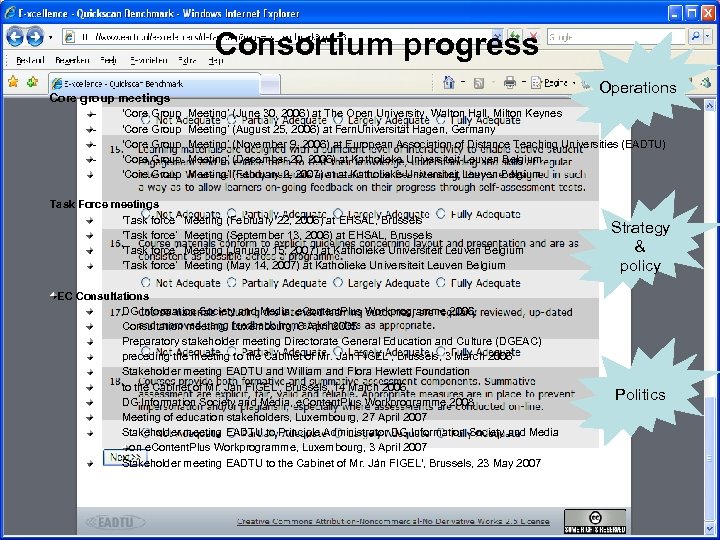
Consortium progress Operations Core group meetings - ‘Core Group ‘Core Group Task Force meetings ‘Task force’ Meeting’ (June 30, 2006) at The Open University, Walton Hall, Milton Keynes Meeting’ (August 25, 2006) at Fern. Universität Hagen, Germany Meeting’ (November 9, 2006) at European Association of Distance Teaching Universities (EADTU) Meeting’ (December 20, 2006) at Katholieke Universiteit Leuven Belgium Meeting’ (February 2, 2007) at at Katholieke Universiteit Leuven Belgium Meeting (February 22, 2006) at EHSAL, Brussels Meeting (September 13, 2006) at EHSAL, Brussels Meeting (January 15, 2007) at Katholieke Universiteit Leuven Belgium Meeting (May 14, 2007) at Katholieke Universiteit Leuven Belgium EC Consultations DG Information Society and Media, e. Content. Plus Workprogramme 2006, Consultation meeting, Luxembourg, 6 April 2005 Preparatory stakeholder meeting Directorate General Education and Culture (DGEAC) preceding the meeting to the Cabinet of Mr. Ján FIGEL', Brussels, 3 March 2006 Stakeholder meeting EADTU and William and Flora Hewlett Foundation to the Cabinet of Mr. Ján FIGEL', Brussels, 14 March 2006 DG Information Society and Media, e. Content. Plus Workprogramme 2008 Meeting of education stakeholders, Luxembourg, 27 April 2007 Stakeholder meeting EADTU to Principle Administrator DG Information Society and Media on e. Content. Plus Workprogramme, Luxembourg, 3 April 2007 Stakeholder meeting EADTU to the Cabinet of Mr. Ján FIGEL', Brussels, 23 May 2007 Strategy & policy Politics
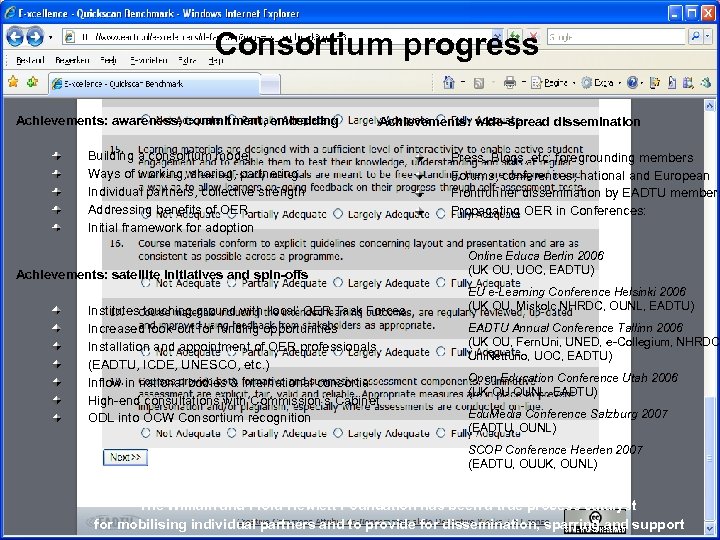
Consortium progress Achievements: awareness, commitment, embedding Achievements: wide-spread dissemination Building a consortium model Ways of working, sharing, partnering Individual partners, collective strength Addressing benefits of OER Initial framework for adoption Achievements: satellite initiatives and spin-offs Institutes touching ground with ‘local’ OER Task Forces Increased look-out for funding opportunities Installation and appointment of OER professionals (EADTU, ICDE, UNESCO, etc. ) Inflow in national bodies & international consortia High-end consultations with Commission’s Cabinet ODL into OCW Consortium recognition Press, Blogs, etc: foregrounding members Forums, conferences, national and European Frontrunner dissemination by EADTU members Propagating OER in Conferences: Online Educa Berlin 2006 (UK OU, UOC, EADTU) EU e-Learning Conference Helsinki 2006 (UK OU, Miskolc NHRDC, OUNL, EADTU) EADTU Annual Conference Tallinn 2006 (UK OU, Fern. Uni, UNED, e-Collegium, NHRDC, Uni. Nettuno, UOC, EADTU) Open Education Conference Utah 2006 (UK OU, OUNL, EADTU) Edu. Media Conference Salzburg 2007 (EADTU, OUNL) SCOP Conference Heerlen 2007 (EADTU, OUUK, OUNL) The William and Flora Hewlett Foundation has been a true process catalyst for mobilising individual partners and to provide for dissemination, sparring and support
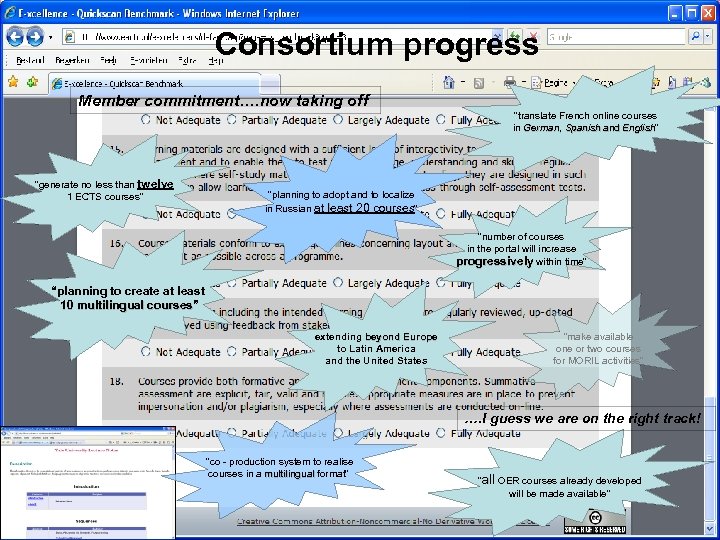
Consortium progress Member commitment…. now taking off “translate French online courses in German, Spanish and English” German, English “generate no less than twelve 1 ECTS courses” “planning to adopt and to localize in Russian at least 20 courses” “number of courses in the portal will increase progressively within time” “planning to create at least 10 multilingual courses” courses extending beyond Europe to Latin America and the United States “make available one or two courses for MORIL activities” …. I guess we are on the right track! “co - production system to realise courses in a multilingual format” “all OER courses already developed will be made available”
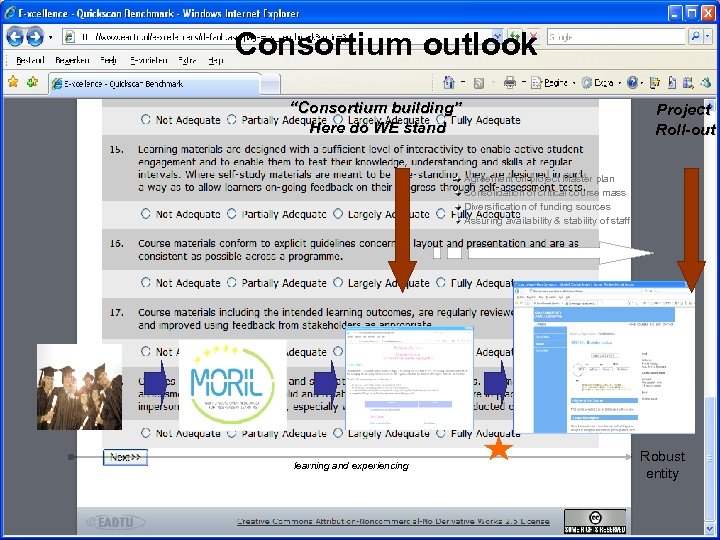
Consortium outlook “Consortium building” Here do WE stand Project Roll-out Agreement on project Master plan Consolidation of critical course mass Diversification of funding sources Assuring availability & stability of staff learning and experiencing Robust entity
Consortium outlook Aren’t we forgetting something? Long term Consortium success depends on the learners’ appreciation Individual quality perceptions and personal course satisfaction The key to retention of your visitors and learners my. Quality
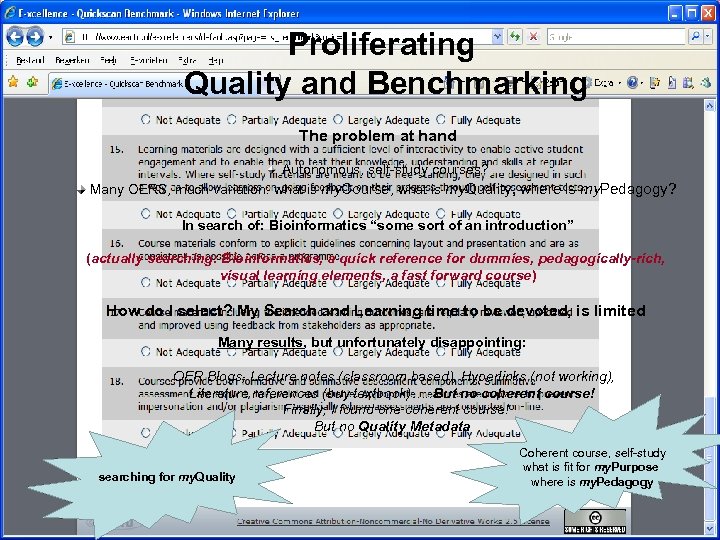
Proliferating Quality and Benchmarking The problem at hand Autonomous, self-study courses? Many OERS, much variation: what is my. Course, what is my. Quality, where is my. Pedagogy? In search of: Bioinformatics “some sort of an introduction” (actually searching: Bioinformatics, a quick reference for dummies, pedagogically-rich, visual learning elements, a fast forward course) How do I select? My Search and Learning time to be devoted, is limited Many results, but unfortunately disappointing: OER Blogs, Lecture notes (classroom based), Hyperlinks (not working), Literature references (buy textbook)…. . But no coherent course! Finally, I found one coherent course! But no Quality Metadata searching for my. Quality Coherent course, self-study what is fit for my. Purpose where is my. Pedagogy
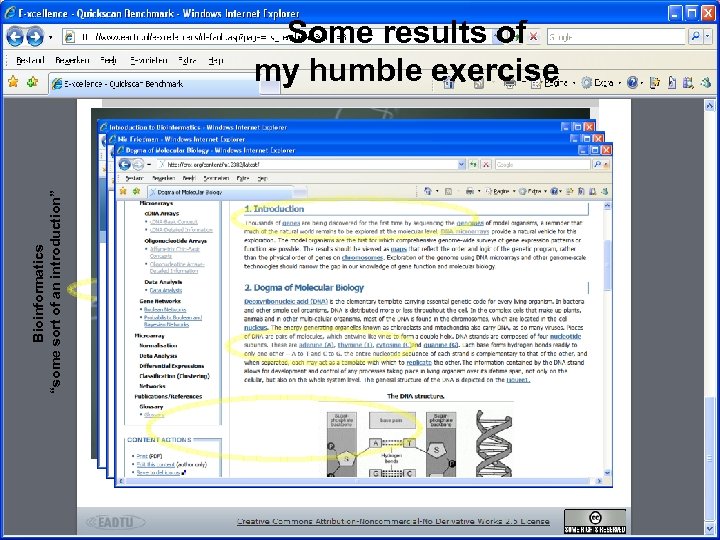
Bioinformatics “some sort of an introduction” Some results of my humble exercise
Tool support needed OER urgently requires tangible and ready-to-deploy quality instruments built upon a European (or Global) platform with national recognition
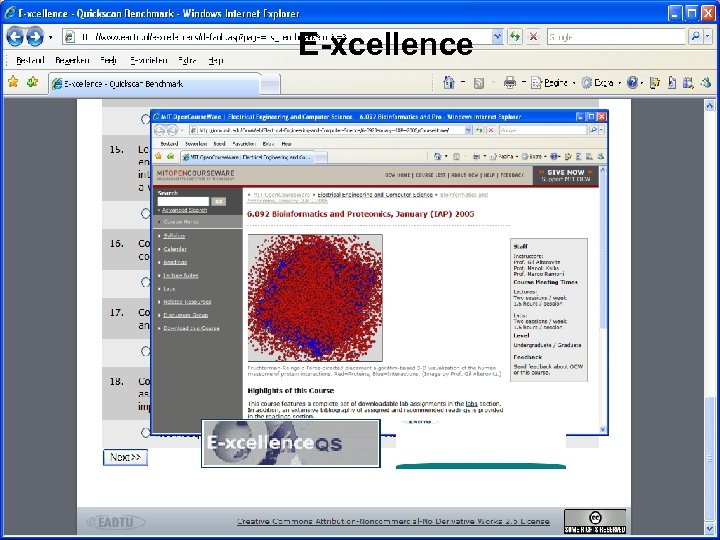
E-xcellence
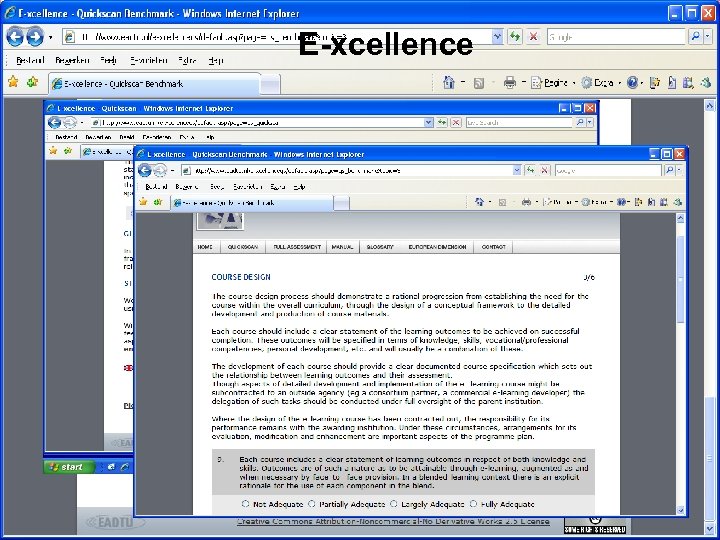
E-xcellence QA in HE and is receiving a lot of attention at institutional, national and European level Still missing: QA specific to e-learning • Criteria based on ease of access • New forms of interaction (students and staff) • Flexibility, personalisation and other pedagogical aspects that are more relevant to e- learning • They express the added value of e-learning to HE Especially, with the leap towards new generation OER
E-xcellence in e-learning is: • Complementary to other national quality assurance systems related more to content, staff and infrastructure • Optimising the learning process and offering assurance to stakeholders that e-learning provision is of high quality E-xcellence has established: • A framework of quality criteria for the development, operation and evaluation of e-learning programmes • An appropriate set of performance indicators, parameters and guidelines by which the quality of e-learning programmes can be measured by assessment • A definition of threshold and excellence level
E-xcellence Set of (33) European benchmarks They cover institutional, pedagogical, technical, ethical and management aspects of elearning organised into the three main categories of : • Management(institutional and programme levels) • Products(curriculum, course design and delivery) • Services(student and staff support) An important aspect of E-xcellence is that it offers a European-wide set of benchmarks, independent of particular institutional or national systems, and with guidance to educational improvement
E-xcellence
E-xcellence
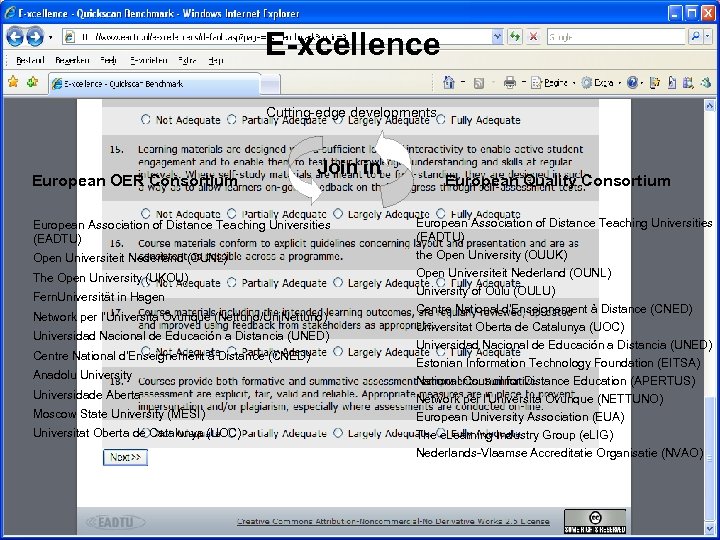
E-xcellence Cutting-edge developments European OER Consortium Join in European Association of Distance Teaching Universities (EADTU) Open Universiteit Nederland (OUNL) The Open University (UKOU) Fern. Universität in Hagen Network per l'Universita Ovunque (Nettuno/Uni. Nettuno) Universidad Nacional de Educación a Distancia (UNED) Centre National d'Enseignement à Distance (CNED) Anadolu University European Quality Consortium European Association of Distance Teaching Universities (EADTU) the Open University (OUUK) Open Universiteit Nederland (OUNL) University of Oulu (OULU) Centre National d'Enseignement à Distance (CNED) Universitat Oberta de Catalunya (UOC) Universidad Nacional de Educación a Distancia (UNED) Estonian Information Technology Foundation (EITSA) National Council for Distance Education (APERTUS) Universidade Aberta Network per l'Universita Ovunque (NETTUNO) Moscow State University (MESI) European University Association (EUA) Universitat Oberta de Catalunya (UOC) The e. Learning Industry Group (e. LIG) Nederlands-Vlaamse Accreditatie Organisatie (NVAO)
Towards European-wide Quality and Benchmarking of Open Educational Resources C. A. van Dorp & George Ubachs Kees-Jan. van. Dorp@EADTU. nl George. Ubachs@EADTU. nl Thank you ! SCOP 2007 ‘Open Educational Resources as an Instrument for achieving Education for All’
Скачать презентацию Towards European-wide Quality and Benchmarking of Open Educational
0702fa1e880fc5efeeb845aea657cf60.ppt