


 Скачать презентацию Towards Data Management for PX Structure Determination Within
2524175d47b677a7f05d609878235f94.ppt
- Количество слайдов: 1
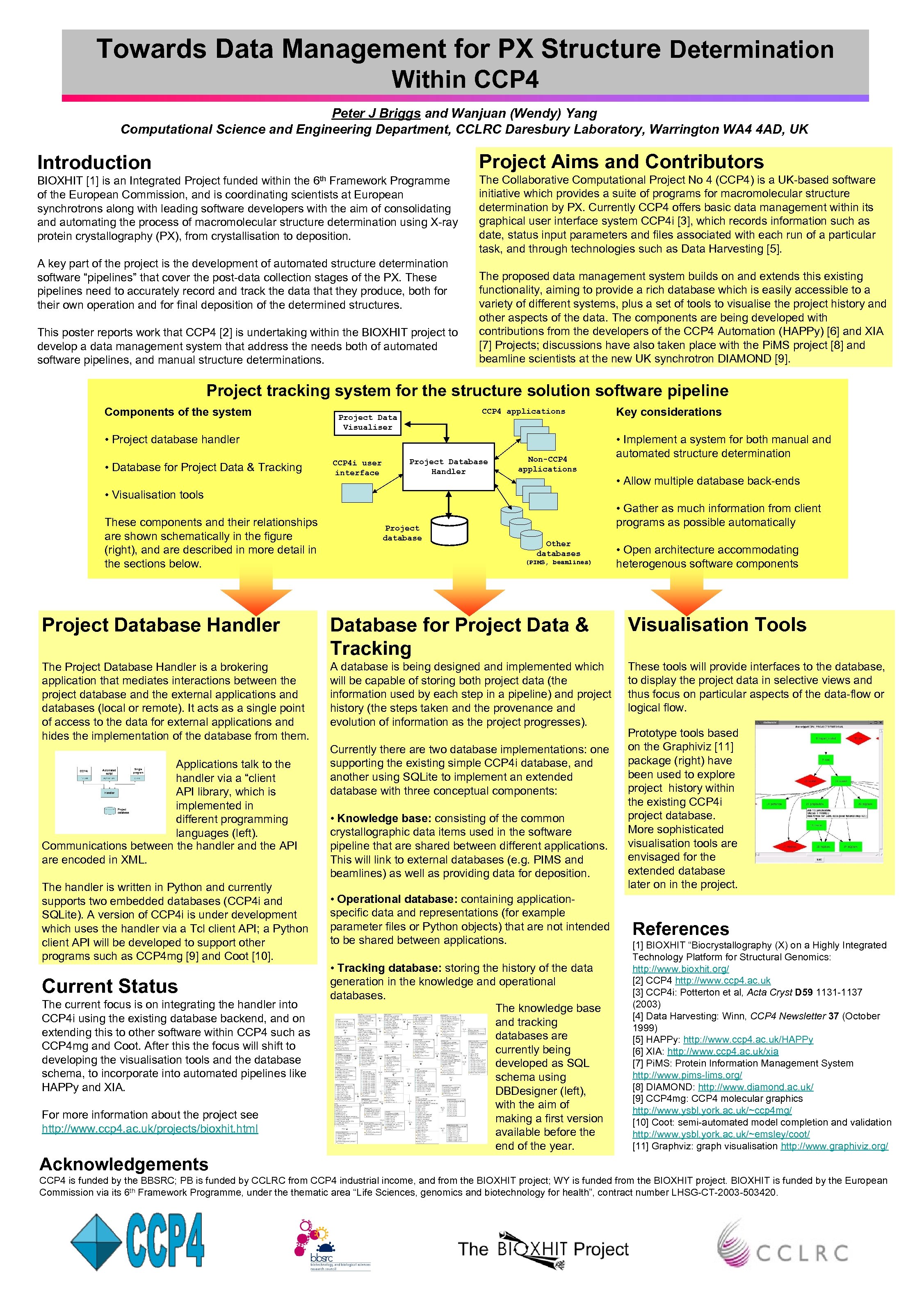 Towards Data Management for PX Structure Determination Within CCP 4 Peter J Briggs and Wanjuan (Wendy) Yang Computational Science and Engineering Department, CCLRC Daresbury Laboratory, Warrington WA 4 4 AD, UK Introduction Project Aims and Contributors BIOXHIT [1] is an Integrated Project funded within the 6 th Framework Programme of the European Commission, and is coordinating scientists at European synchrotrons along with leading software developers with the aim of consolidating and automating the process of macromolecular structure determination using X-ray protein crystallography (PX), from crystallisation to deposition. The Collaborative Computational Project No 4 (CCP 4) is a UK-based software initiative which provides a suite of programs for macromolecular structure determination by PX. Currently CCP 4 offers basic data management within its graphical user interface system CCP 4 i [3], which records information such as date, status input parameters and files associated with each run of a particular task, and through technologies such as Data Harvesting [5]. A key part of the project is the development of automated structure determination software “pipelines” that cover the post-data collection stages of the PX. These pipelines need to accurately record and track the data that they produce, both for their own operation and for final deposition of the determined structures. This poster reports work that CCP 4 [2] is undertaking within the BIOXHIT project to develop a data management system that address the needs both of automated software pipelines, and manual structure determinations. The proposed data management system builds on and extends this existing functionality, aiming to provide a rich database which is easily accessible to a variety of different systems, plus a set of tools to visualise the project history and other aspects of the data. The components are being developed with contributions from the developers of the CCP 4 Automation (HAPPy) [6] and XIA [7] Projects; discussions have also taken place with the Pi. MS project [8] and beamline scientists at the new UK synchrotron DIAMOND [9]. Project tracking system for the structure solution software pipeline Components of the system CCP 4 applications Project Data Visualiser • Project database handler • Database for Project Data & Tracking CCP 4 i user interface Project Database Handler Non-CCP 4 applications Key considerations • Implement a system for both manual and automated structure determination • Allow multiple database back-ends • Visualisation tools These components and their relationships are shown schematically in the figure (right), and are described in more detail in the sections below. Project database • Gather as much information from client programs as possible automatically Other databases (PIMS, beamlines) • Open architecture accommodating heterogenous software components Project Database Handler Database for Project Data & Tracking Visualisation Tools The Project Database Handler is a brokering application that mediates interactions between the project database and the external applications and databases (local or remote). It acts as a single point of access to the data for external applications and hides the implementation of the database from them. A database is being designed and implemented which will be capable of storing both project data (the information used by each step in a pipeline) and project history (the steps taken and the provenance and evolution of information as the project progresses). These tools will provide interfaces to the database, to display the project data in selective views and thus focus on particular aspects of the data-flow or logical flow. Applications talk to the handler via a “client API library, which is implemented in different programming languages (left). Communications between the handler and the API are encoded in XML. The handler is written in Python and currently supports two embedded databases (CCP 4 i and SQLite). A version of CCP 4 i is under development which uses the handler via a Tcl client API; a Python client API will be developed to support other programs such as CCP 4 mg [9] and Coot [10]. Current Status The current focus is on integrating the handler into CCP 4 i using the existing database backend, and on extending this to other software within CCP 4 such as CCP 4 mg and Coot. After this the focus will shift to developing the visualisation tools and the database schema, to incorporate into automated pipelines like HAPPy and XIA. For more information about the project see http: //www. ccp 4. ac. uk/projects/bioxhit. html Currently there are two database implementations: one supporting the existing simple CCP 4 i database, and another using SQLite to implement an extended database with three conceptual components: • Knowledge base: consisting of the common crystallographic data items used in the software pipeline that are shared between different applications. This will link to external databases (e. g. PIMS and beamlines) as well as providing data for deposition. • Operational database: containing applicationspecific data and representations (for example parameter files or Python objects) that are not intended to be shared between applications. • Tracking database: storing the history of the data generation in the knowledge and operational databases. The knowledge base and tracking databases are currently being developed as SQL schema using DBDesigner (left), with the aim of making a first version available before the end of the year. Prototype tools based on the Graphiviz [11] package (right) have been used to explore project history within the existing CCP 4 i project database. More sophisticated visualisation tools are envisaged for the extended database later on in the project. References [1] BIOXHIT “Biocrystallography (X) on a Highly Integrated Technology Platform for Structural Genomics: http: //www. bioxhit. org/ [2] CCP 4 http: //www. ccp 4. ac. uk [3] CCP 4 i: Potterton et al, Acta Cryst D 59 1131 -1137 (2003) [4] Data Harvesting: Winn, CCP 4 Newsletter 37 (October 1999) [5] HAPPy: http: //www. ccp 4. ac. uk/HAPPy [6] XIA: http: //www. ccp 4. ac. uk/xia [7] Pi. MS: Protein Information Management System http: //www. pims-lims. org/ [8] DIAMOND: http: //www. diamond. ac. uk/ [9] CCP 4 mg: CCP 4 molecular graphics http: //www. ysbl. york. ac. uk/~ccp 4 mg/ [10] Coot: semi-automated model completion and validation http: //www. ysbl. york. ac. uk/~emsley/coot/ [11] Graphviz: graph visualisation http: //www. graphiviz. org/ Acknowledgements CCP 4 is funded by the BBSRC; PB is funded by CCLRC from CCP 4 industrial income, and from the BIOXHIT project; WY is funded from the BIOXHIT project. BIOXHIT is funded by the European Commission via its 6 th Framework Programme, under thematic area “Life Sciences, genomics and biotechnology for health”, contract number LHSG-CT-2003 -503420.