 Скачать презентацию Towards a Viable Europa Penetrator A Smith R
d2d99d5af2691697e47e505315c69bb3.ppt
- Количество слайдов: 17



Towards a Viable Europa Penetrator A. Smith, R. Gowen, A. Coates, etc – MSSL/UCL I. Crawford – Birkbeck College London P. Church, R. Scott – Qinetiq Y. Gao, M. Sweeting – Surrey Space Centre/SSTL T. Pike – Imperial College A. Ball – Open University J. Flanagan – Southampton University Jupiter-Europa Cosmic Vision Meeting, London, Nov 23 -24, 2006 MSSL/UCL UK
Contents § § § § Introduction Background A New Start… Science Feasibility Cost Technology developments Summary Jupiter-Europa Cosmic Vision Meeting, London, Nov 23 -24, 2006 MSSL/UCL UK
Introduction § Problem: How to work towards a surface element proposal that has both scientific and technical viability. § Offer potential for unique science and ground truth to complement a Europa orbiter. § Here we consider Penetrator (vs passive impactor, soft lander, etc). § We present some thoughts on technology, payload and cost issues that could be input to an assessment study. Jupiter-Europa Cosmic Vision Meeting, London, Nov 23 -24, 2006 MSSL/UCL UK
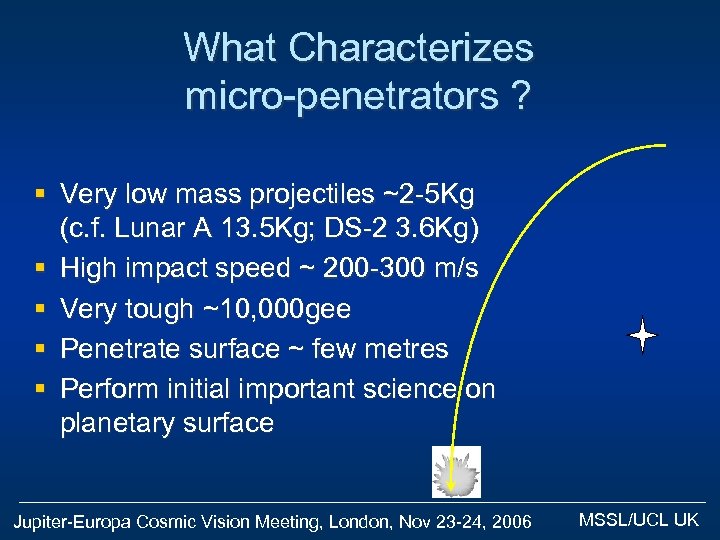
What Characterizes micro-penetrators ? § Very low mass projectiles ~2 -5 Kg (c. f. Lunar A 13. 5 Kg; DS-2 3. 6 Kg) § High impact speed ~ 200 -300 m/s § Very tough ~10, 000 gee § Penetrate surface ~ few metres § Perform initial important science on planetary surface Jupiter-Europa Cosmic Vision Meeting, London, Nov 23 -24, 2006 MSSL/UCL UK
Mullard Space Science Laboratory Hinode Launch 22 -9 -06 § § § Part of University College London 140 Staff In-house mechanical and electrical engineering design, manufacture and test Provided hardware or calibration facilities for 17 instruments on 12 spacecraft currently operating Provided stereo cameras for Beagle-2 Leading Pan. Cam development for EXOMARS Jupiter-Europa Cosmic Vision Meeting, London, Nov 23 -24, 2006 MSSL/UCL UK
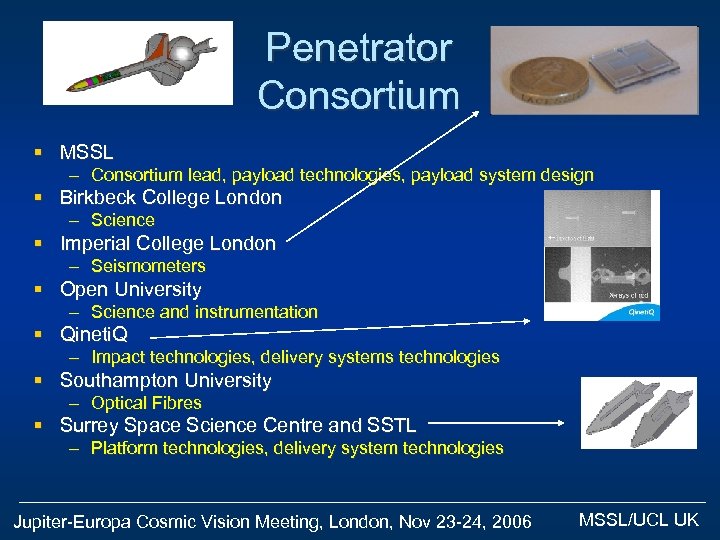
Penetrator Consortium § MSSL – Consortium lead, payload technologies, payload system design § Birkbeck College London – Science § Imperial College London – Seismometers § Open University – Science and instrumentation § Qineti. Q – Impact technologies, delivery systems technologies § Southampton University – Optical Fibres § Surrey Space Science Centre and SSTL – Platform technologies, delivery system technologies Jupiter-Europa Cosmic Vision Meeting, London, Nov 23 -24, 2006 MSSL/UCL UK
A New Start § An initial ESA technical study for a first Europa probe led to conclusion that there would be insufficient mass (~1 Kg) to support a survivable probe, to perform significant science, and that any development costs would be excessive. § A following ESA TRP Empie study, aimed at a second Europa mission, removed the mass limit resulting in a feasible (at a pre. Phase A level), 4 probe (1. 7 Kg each) system which are axially oriented and decelerated with modest mass (20 Kg). § It is not clear that 20 Kg is required for a first mission. For example a 2 probe system around 15 Kg might be feasible if such mass were available. § There is a considerable body of evidence that real probes (well beyond pre-phase A level) impacting around 300 m/s with gee forces well in excess of 10 kgee are survivable. § A pre-cursor Lunar mission (~2010) (which could perform excellent science) would provide timely and cost effective technical developments, thereby reducing necessary Europa developments to a delta level. Jupiter-Europa Cosmic Vision Meeting, London, Nov 23 -24, 2006 MSSL/UCL UK
Europa Penetrator ‘Payload’ Science § Beeping Transmitter - For Earth based VLBI determination of surface ice movement (deformation, seismic vibration) § Micro-Seismometers/tilt-meter - Detection of natural (or impact) seismic activity. - Presence and size of an under ice ocean. - ‘cryo-tectonic’ activity § Accelerometer - Determination of ice characteristics and penetration depth. § Chemical Sensors § Other sensors: Heat flow (melting depth, internal structure), microcamera (descent, surface), magnetometer, radiation monitor, etc. - Presence, extent, concentration of organics (possible life indicators). - Presence, extent and concentration of other chemical species (minerals, chirality, isotopic abundances ? ) => Assess science value, sensitivity, resource requirements, likelihood of success c. f. other surface/orbit alternatives Jupiter-Europa Cosmic Vision Meeting, London, Nov 23 -24, 2006 MSSL/UCL UK
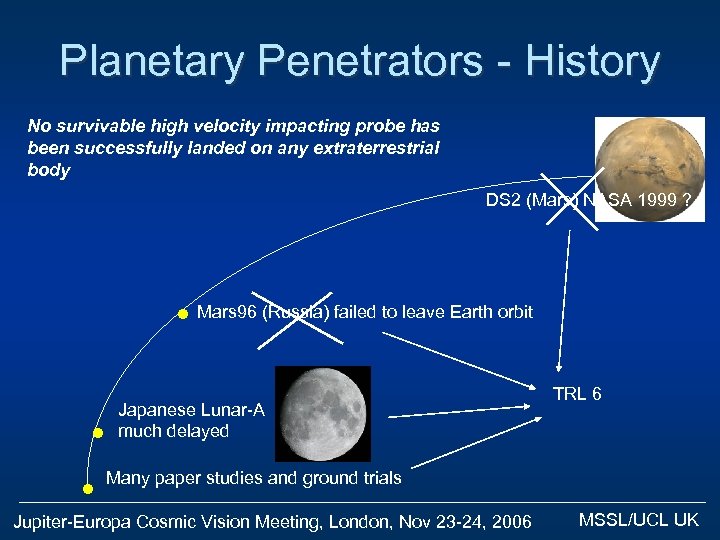
Planetary Penetrators - History No survivable high velocity impacting probe has been successfully landed on any extraterrestrial body DS 2 (Mars) NASA 1999 ? Mars 96 (Russia) failed to leave Earth orbit Japanese Lunar-A much delayed TRL 6 Many paper studies and ground trials Jupiter-Europa Cosmic Vision Meeting, London, Nov 23 -24, 2006 MSSL/UCL UK
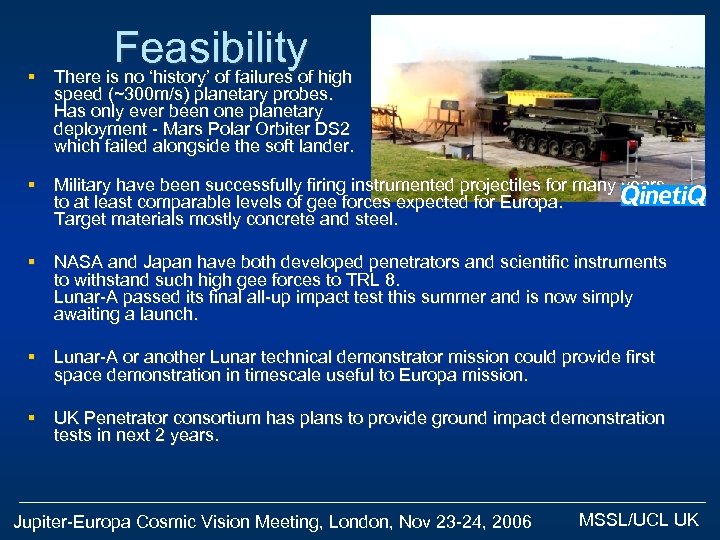
§ Feasibility high There is no ‘history’ of failures of speed (~300 m/s) planetary probes. Has only ever been one planetary deployment - Mars Polar Orbiter DS 2 which failed alongside the soft lander. § Military have been successfully firing instrumented projectiles for many years to at least comparable levels of gee forces expected for Europa. Target materials mostly concrete and steel. § NASA and Japan have both developed penetrators and scientific instruments to withstand such high gee forces to TRL 8. Lunar-A passed its final all-up impact test this summer and is now simply awaiting a launch. § Lunar-A or another Lunar technical demonstrator mission could provide first space demonstration in timescale useful to Europa mission. § UK Penetrator consortium has plans to provide ground impact demonstration tests in next 2 years. Jupiter-Europa Cosmic Vision Meeting, London, Nov 23 -24, 2006 MSSL/UCL UK
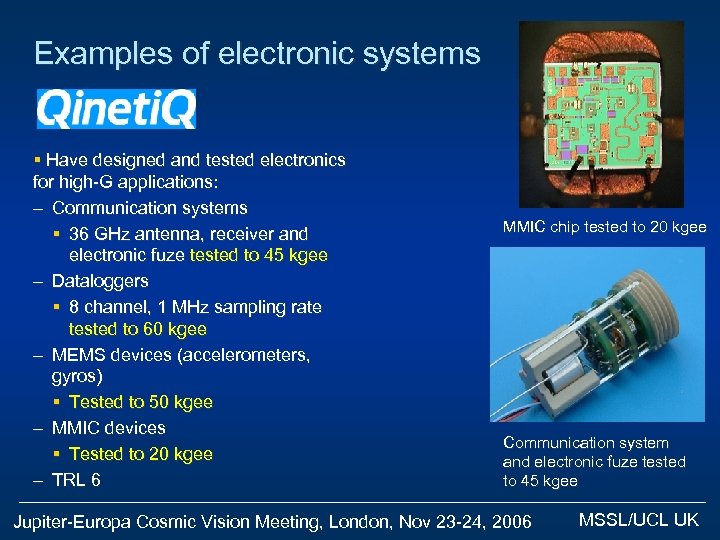
Examples of electronic systems § Have designed and tested electronics for high-G applications: – Communication systems § 36 GHz antenna, receiver and electronic fuze tested to 45 kgee – Dataloggers § 8 channel, 1 MHz sampling rate tested to 60 kgee – MEMS devices (accelerometers, gyros) § Tested to 50 kgee – MMIC devices § Tested to 20 kgee – TRL 6 MMIC chip tested to 20 kgee Communication system and electronic fuze tested to 45 kgee Jupiter-Europa Cosmic Vision Meeting, London, Nov 23 -24, 2006 MSSL/UCL UK
Targetting and Impact Site Issues § Ability to impact at site of optimum scientific interest ? – – § Ability to successfully penetrate rough surface ? – – – § To land anywhere will give a high degree of scientific return – surface composition and structural strength (also useful to follow on mission), seismometer determination of ice depth and event rates. Detection of organic chemicals will still be performed but not optimum. Could optimise impact ellipse zone using existing imagery, or during Europa approach and early orbit camera imagery with autonomous analysis to provide landing coordinates within descent system capabilities. Glancing impact angle could prevent penetration. Study and tests required for expected ice. Could optimise impact ellipse as above, but with criteria for surface flatness/smoothness. Implement small pre-impact explosive to pre-smooth local entry surface. Defense sector has experience of this technology which is reported to be reliable. Disadvantage is possibility of chemical contamination of upper impact site which would complicate chemical sensing analysis. Ability to survive non-perpendicular surface impact ? – – Lunar penetrator mission limits entry to within around 8 of vertical, to limit possibility of probe failure through excess probe sideways stresses. Study required to determine if similar effects likely to exist for Europan ice, and to what degree. Jupiter-Europa Cosmic Vision Meeting, London, Nov 23 -24, 2006 MSSL/UCL UK
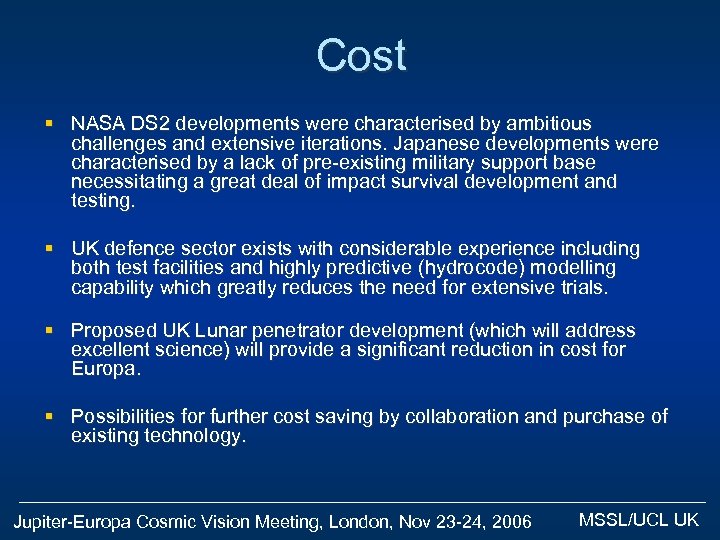
Cost § NASA DS 2 developments were characterised by ambitious challenges and extensive iterations. Japanese developments were characterised by a lack of pre-existing military support base necessitating a great deal of impact survival development and testing. § UK defence sector exists with considerable experience including both test facilities and highly predictive (hydrocode) modelling capability which greatly reduces the need for extensive trials. § Proposed UK Lunar penetrator development (which will address excellent science) will provide a significant reduction in cost for Europa. § Possibilities for further cost saving by collaboration and purchase of existing technology. Jupiter-Europa Cosmic Vision Meeting, London, Nov 23 -24, 2006 MSSL/UCL UK
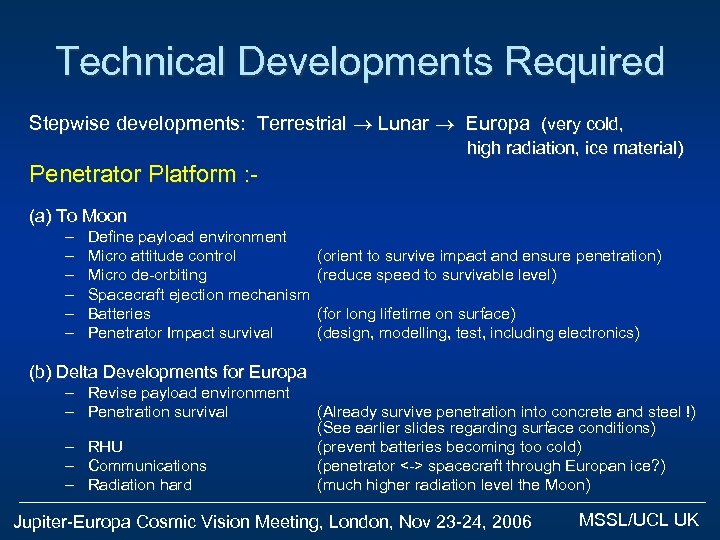
Technical Developments Required Stepwise developments: Terrestrial Lunar Europa (very cold, high radiation, ice material) Penetrator Platform : (a) To Moon – – – Define payload environment Micro attitude control Micro de-orbiting Spacecraft ejection mechanism Batteries Penetrator Impact survival (orient to survive impact and ensure penetration) (reduce speed to survivable level) (for long lifetime on surface) (design, modelling, test, including electronics) (b) Delta Developments for Europa – Revise payload environment – Penetration survival – – – RHU Communications Radiation hard (Already survive penetration into concrete and steel !) (See earlier slides regarding surface conditions) (prevent batteries becoming too cold) (penetrator <-> spacecraft through Europan ice? ) (much higher radiation level the Moon) Jupiter-Europa Cosmic Vision Meeting, London, Nov 23 -24, 2006 MSSL/UCL UK
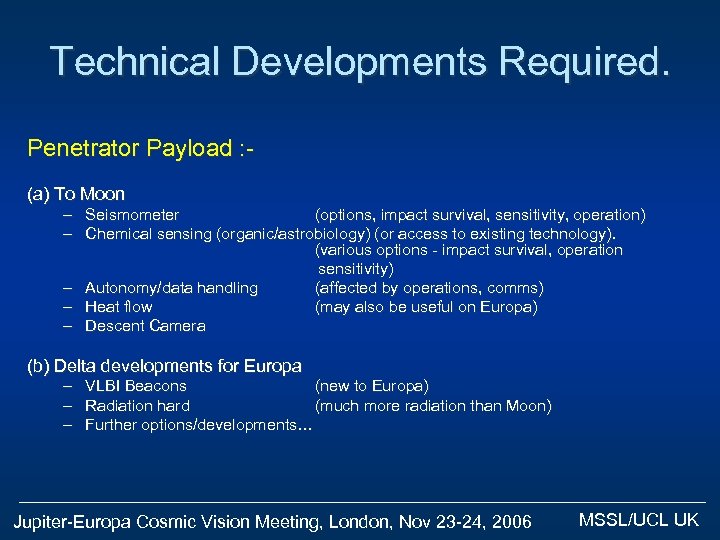
Technical Developments Required. Penetrator Payload : (a) To Moon – Seismometer (options, impact survival, sensitivity, operation) – Chemical sensing (organic/astrobiology) (or access to existing technology). (various options - impact survival, operation sensitivity) – Autonomy/data handling (affected by operations, comms) – Heat flow (may also be useful on Europa) – Descent Camera (b) Delta developments for Europa – – – VLBI Beacons (new to Europa) Radiation hard (much more radiation than Moon) Further options/developments… Jupiter-Europa Cosmic Vision Meeting, London, Nov 23 -24, 2006 MSSL/UCL UK
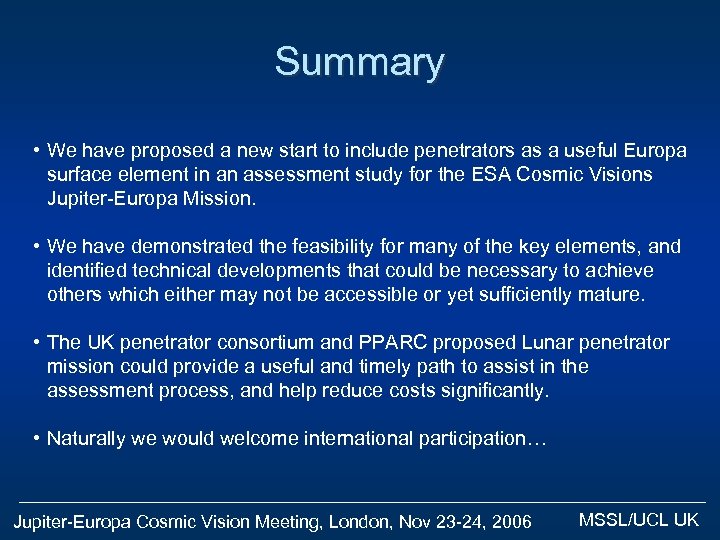
Summary • We have proposed a new start to include penetrators as a useful Europa surface element in an assessment study for the ESA Cosmic Visions Jupiter-Europa Mission. • We have demonstrated the feasibility for many of the key elements, and identified technical developments that could be necessary to achieve others which either may not be accessible or yet sufficiently mature. • The UK penetrator consortium and PPARC proposed Lunar penetrator mission could provide a useful and timely path to assist in the assessment process, and help reduce costs significantly. • Naturally we would welcome international participation… Jupiter-Europa Cosmic Vision Meeting, London, Nov 23 -24, 2006 MSSL/UCL UK
- End - Jupiter-Europa Cosmic Vision Meeting, London, Nov 23 -24, 2006 MSSL/UCL UK
Скачать презентацию Towards a Viable Europa Penetrator A Smith R
d2d99d5af2691697e47e505315c69bb3.ppt