


 Скачать презентацию Towards a Strategic Approach to Organizational Conflict Management
0b7ac72e2a68a0d8a9e48a1de97842eb.ppt
- Количество слайдов: 26
 Towards a Strategic Approach to Organizational Conflict Management Ariel C. Avgar School of Labor and Employment Relations University of Illinois at Urbana-Champaign ACR Workplace Section Teleseminar Monday, August 31, 2015 Page 1/27
 The Strategic Underpinnings of Conflict Management in U. S. Corporations: Evidence from a Survey of Fortune 1000 Companies David B. Lipsky Cornell University Ariel C. Avgar University of Illinois at Urbana-Champaign J. Ryan Lamare Penn State University Page 2/27
 Presentation Road Map q State of organizational conflict management: Evidence from Fortune 1000 firms q Traditional explanations for the rise of sophisticated conflict management practices and systems in organizations q The strategic underpinnings for the adoption of conflict management practices and systems q Summary and conclusions Page 3/27
 Motivation q The dramatic growth in the use of ADR by many U. S. employers, especially major corporations, over the past 40 years v ADR: The use of arbitration, mediation, and other dispute resolution techniques to resolve workplace conflict v Employers began to use ADR as an alternative to litigation and (sometimes) to collective bargaining q The recent emergence of so-called “integrated conflict management systems” in many U. S. organizations q The relative lack of empirical research on the drivers (especially from a strategic standpoint) of these organizational innovations Page 4/27
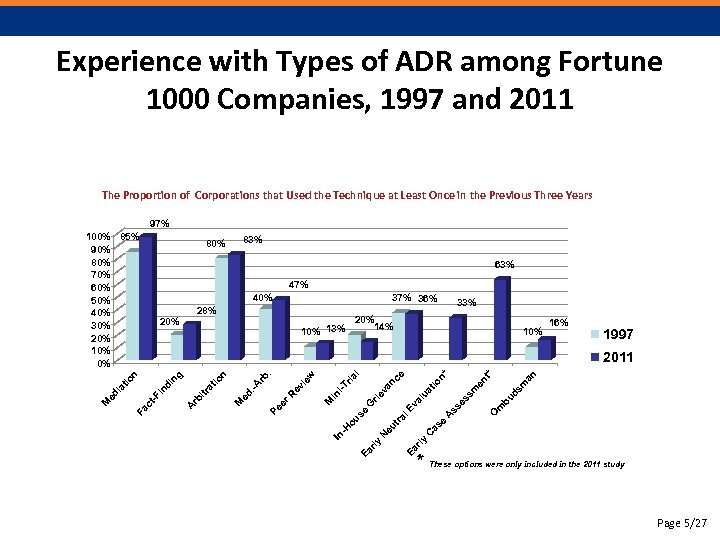 Experience with Types of ADR among Fortune 1000 Companies, 1997 and 2011 The Proportion of Corporations that Used the Technique at Least Once in the Previous Three Years 97% 100% 85% 90% 80% 70% 60% 50% 40% 30% 20% 10% 0% 80% 63% 47% 40% 37% 36% 28% 20% 13% 33% 20% 14% 10% 16% 1997 an t* m en ds bu m as e O ss A al E tr C eu Ea rly N rly Ea es s at lu va rie G se ou -H In m io va nc n* e l ria i-T ev R M in ie w . er Pe M ed . -A rb n io tr rb i A Fa ct -F in at di tio ng n 2011 ia M ed 83% * These options were only included in the 2011 study Page 5/27
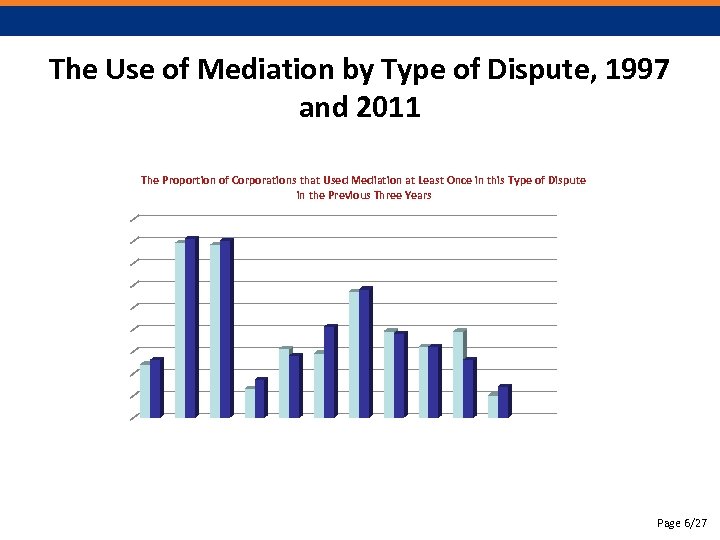 The Use of Mediation by Type of Dispute, 1997 and 2011 The Proportion of Corporations that Used Mediation at Least Once in this Type of Dispute in the Previous Three Years Page 6/27
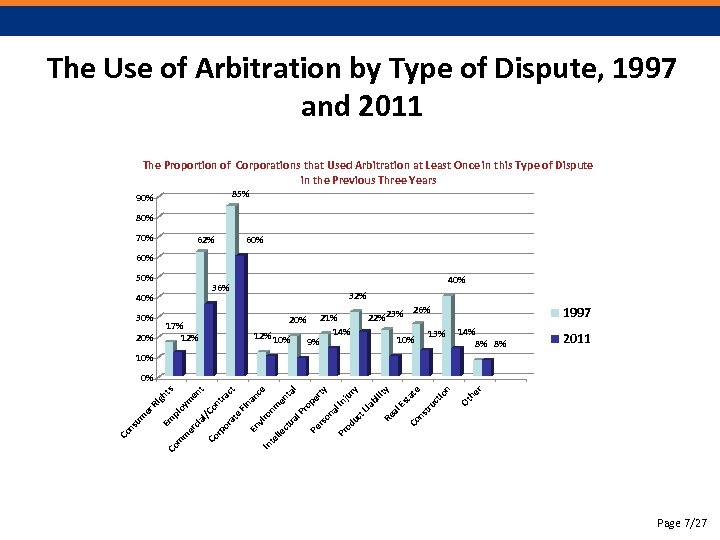 The Use of Arbitration by Type of Dispute, 1997 and 2011 The Proportion of Corporations that Used Arbitration at Least Once in this Type of Dispute in the Previous Three Years 85% 90% 80% 70% 62% 60% 50% 40% 36% 40% 30% 20% 17% 12% 20% 32% 10% 9% 21% 14% 22% 23% 1997 26% 10% 13% 14% 8% 8% 2011 10% he r Ot Co on rp tra or ct at e Fin an En ce vi ro In nm te lle en ct ta ua l l P ro pe Pe rty rs on al In Pr ju od ry uc t L ia bi lit y Re al E st at Co e ns tru ct io n l/C oy m m er cia pl Em Co ns um er R ig ht s en t 0% Page 7/27
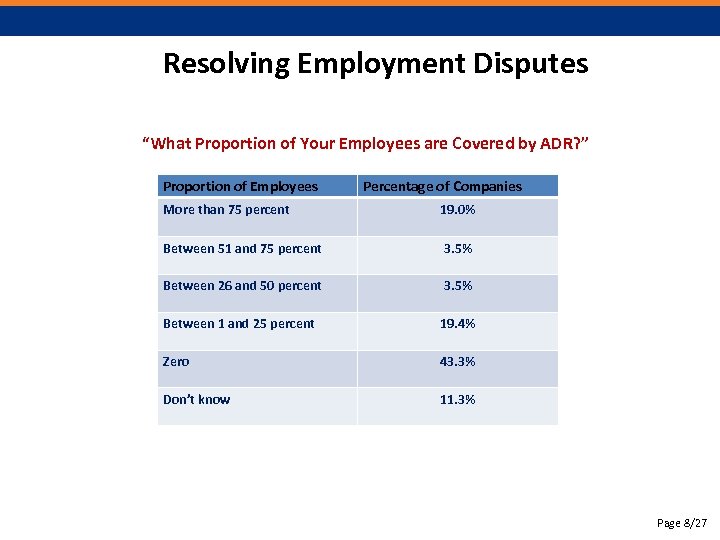 Resolving Employment Disputes “What Proportion of Your Employees are Covered by ADR? ” Proportion of Employees Percentage of Companies More than 75 percent 19. 0% Between 51 and 75 percent 3. 5% Between 26 and 50 percent 3. 5% Between 1 and 25 percent 19. 4% Zero 43. 3% Don’t know 11. 3% Page 8/27
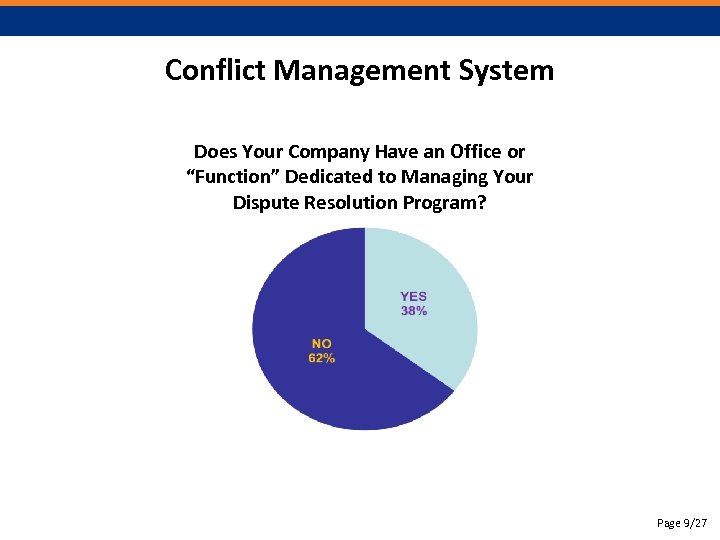 Conflict Management System Does Your Company Have an Office or “Function” Dedicated to Managing Your Dispute Resolution Program? Page 9/27
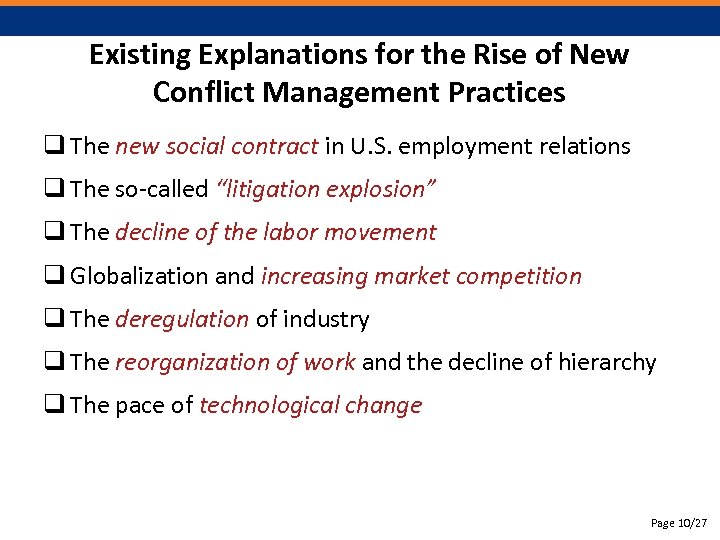 Existing Explanations for the Rise of New Conflict Management Practices q The new social contract in U. S. employment relations q The so-called “litigation explosion” q The decline of the labor movement q Globalization and increasing market competition q The deregulation of industry q The reorganization of work and the decline of hierarchy q The pace of technological change Page 10/27
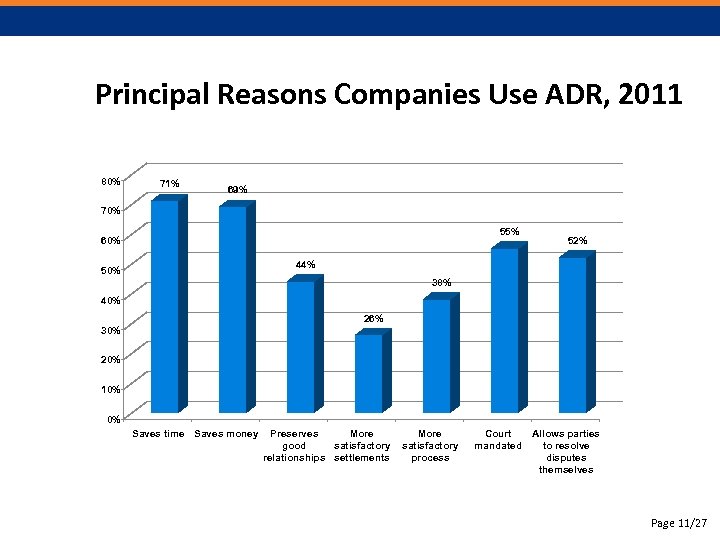 Principal Reasons Companies Use ADR, 2011 80% 71% 69% 70% 55% 60% 52% 44% 50% 38% 40% 26% 30% 20% 10% 0% Saves time Saves money Preserves More good satisfactory relationships settlements More satisfactory process Court mandated Allows parties to resolve disputes themselves Page 11/27
 Strategic Choice and the Study of Organizational Conflict Management q Most of the existing explanations view ADR and CMS as a reactive response to either external or internal pressures q Our study proposes a strategic lens through which to assess ADR and CMS adoption patterns q Firms, according to this argument, are adopting conflict management practices as a function of strategic choice and not as a mere reactive response to organizational and environmental pressures q In doing so, we build on the seminal industrial relations research on the strategic choices managers make in adopting and implementing organizational practices Page 12/27
 Strategic Choice and the Study of Organizational Conflict Management: Two Elements q Strategic Orientation—What are the anticipated benefits delivered to the organization through the adoption of conflict management practices? q Commitment to Conflict Management Practice—Once practices are in place, what proportion of the firm’s employees are afforded access to them? Page 13/27
 Strategic Choice and the Study of Organizational Conflict Management q Three dominant strategic orientations v Seeking gains in efficiency through the use of ADR (efficiency) v Avoiding litigation and reducing associated costs (litigation avoidance) v Retaining management control and improving internal relationships (sustainable resolutions) q Management commitment to ADR v Proportion of the workforce that is covered by ADR practices Page 14/27
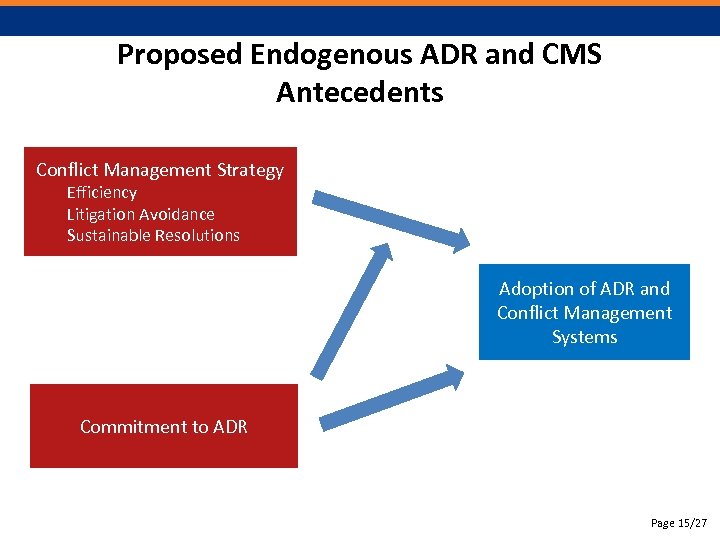 Proposed Endogenous ADR and CMS Antecedents Conflict Management Strategy Efficiency Litigation Avoidance Sustainable Resolutions Adoption of ADR and Conflict Management Systems Commitment to ADR Page 15/27
 Framework for the Study q Cornell conducted the first comprehensive survey of ADR practices used by Fortune 1000 corporations in 1997 q The 1997 survey documented the following results: v The growing use of ADR, especially arbitration and mediation v The corporate preference for interest-based (rather than rightsbased) methods of resolving disputes v The emergence of conflict management systems q Our new survey of the Fortune 1000 was conducted in 201011 v Designed in part to replicate the 1997 survey, and in part to capture new ADR developments adopted over the past 15 years v The new survey was cosponsored by Pepperdine, CPR, and Cornell Page 16/27
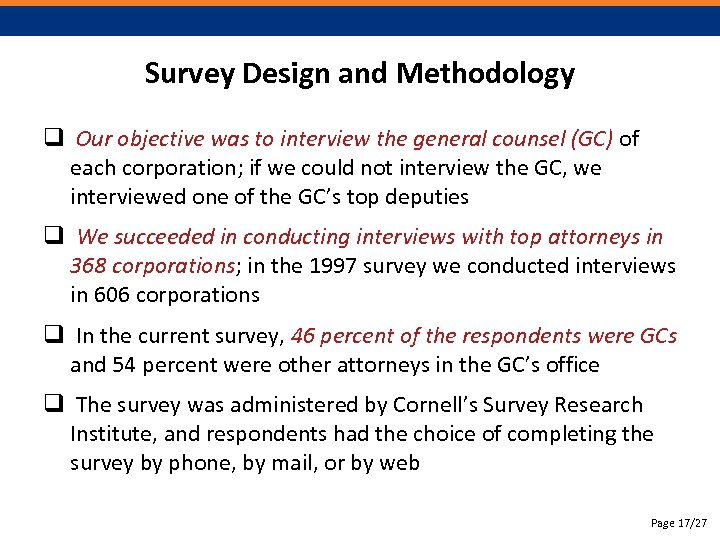 Survey Design and Methodology q Our objective was to interview the general counsel (GC) of each corporation; if we could not interview the GC, we interviewed one of the GC’s top deputies q We succeeded in conducting interviews with top attorneys in 368 corporations; in the 1997 survey we conducted interviews in 606 corporations q In the current survey, 46 percent of the respondents were GCs and 54 percent were other attorneys in the GC’s office q The survey was administered by Cornell’s Survey Research Institute, and respondents had the choice of completing the survey by phone, by mail, or by web Page 17/27
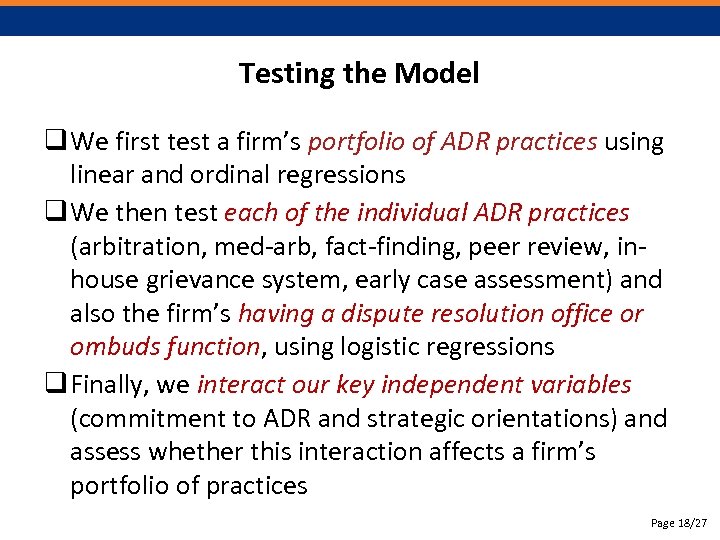 Testing the Model q We first test a firm’s portfolio of ADR practices using linear and ordinal regressions q We then test each of the individual ADR practices (arbitration, med-arb, fact-finding, peer review, inhouse grievance system, early case assessment) and also the firm’s having a dispute resolution office or ombuds function, using logistic regressions q Finally, we interact our key independent variables (commitment to ADR and strategic orientations) and assess whether this interaction affects a firm’s portfolio of practices Page 18/27
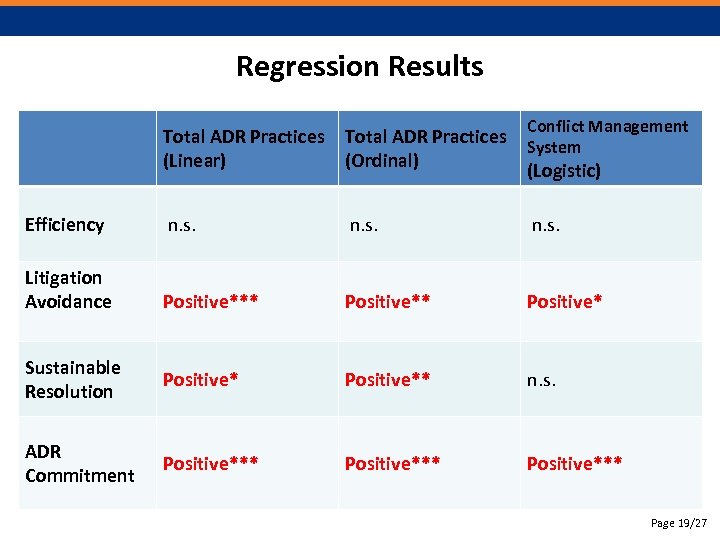 Regression Results Conflict Management System Total ADR Practices (Linear) Total ADR Practices (Ordinal) Efficiency n. s. Litigation Avoidance Positive*** Positive* Sustainable Resolution Positive** n. s. ADR Commitment Positive*** (Logistic) Page 19/27
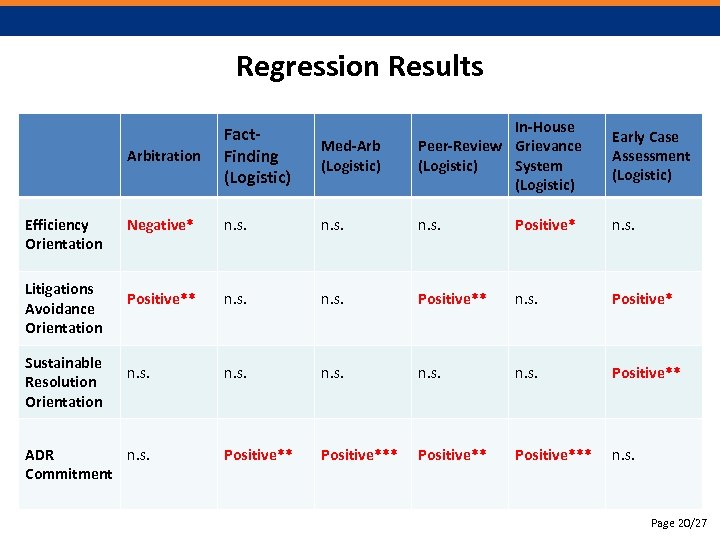 Regression Results Med-Arb (Logistic) In-House Peer-Review Grievance (Logistic) System (Logistic) Early Case Assessment (Logistic) n. s. Positive** n. s. Positive* n. s. Positive*** Positive*** n. s. Arbitration Efficiency Orientation Litigations Avoidance Orientation Sustainable Resolution Orientation Fact. Finding (Logistic) Negative* ADR n. s. Commitment Page 20/27
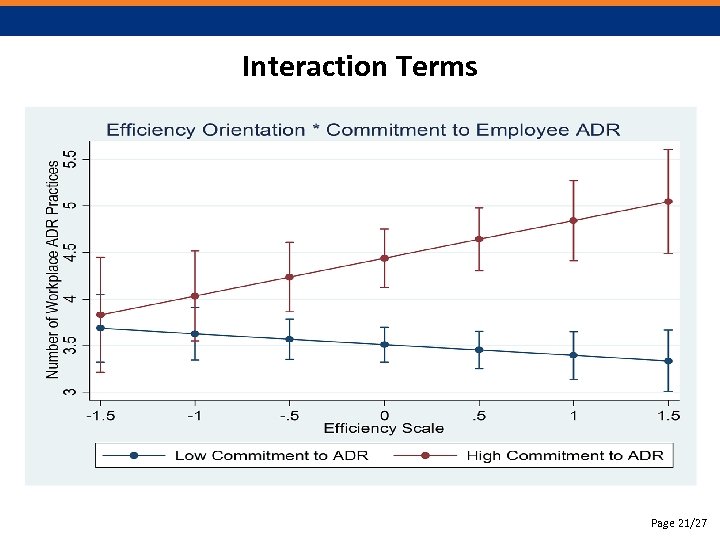 Interaction Terms Page 21/27
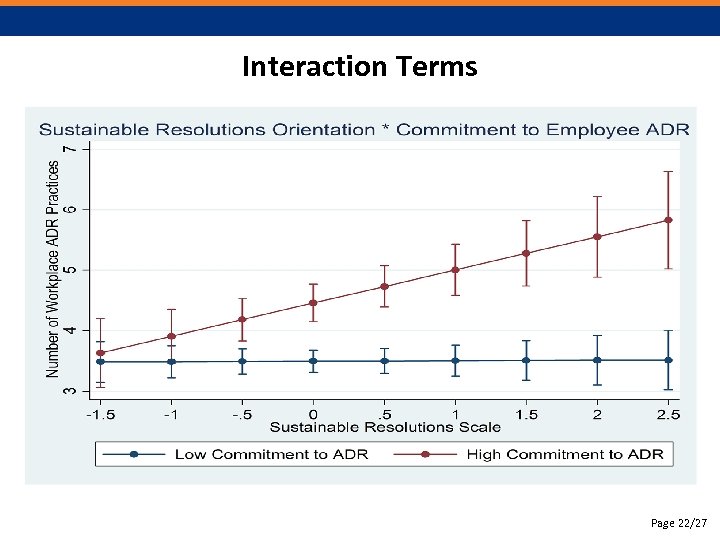 Interaction Terms Page 22/27
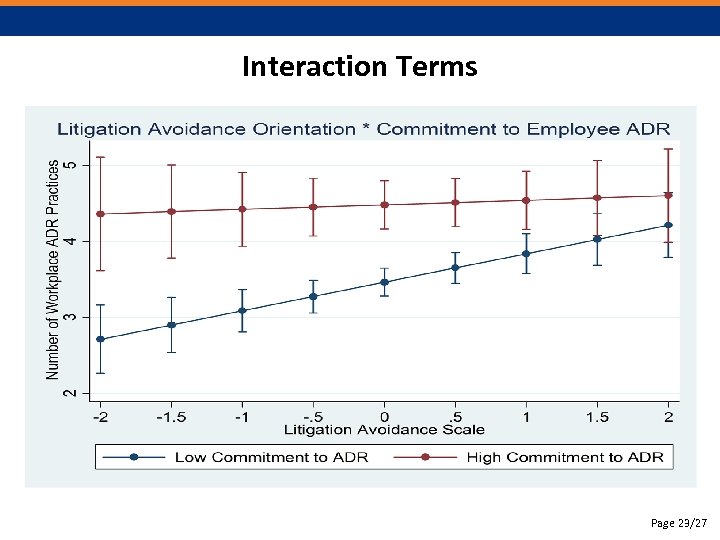 Interaction Terms Page 23/27
 Summary and Conclusions q Over the past 15 years, a growing number of major U. S. corporations – currently about 50 percent – have adopted ADR as their principal approach to resolving employment disputes q Many corporations have adopted a wider array of ADR techniques, including early neutral evaluation, early case assessment, and conflict coaching: they are using a growing portfolio of ADR techniques Page 24/27
 Summary and Conclusions q What factors have driven U. S. corporations to adopt and use ADR practices and conflict management systems? q Our results suggest that management’s strategic objectives and its commitment to ADR appear to be significant factors driving the corporate use of ADR practices and systems q Managerial conflict management strategy explains both variation in the total number of practices adopted and specific practices included in the portfolio Page 25/27
 Summary and Conclusions q We find strong support for a strategic choice model in the adoption of conflict management practices q Our findings suggest the need to expand the study of managerial conflict management strategies and their implications for organizational practices q Practitioners facilitating the adoption of ADR and CMS need to consider a firm’s strategic orientation q We also find that organizational commitment to ADR moderates the relationship between a firm’s conflict management strategy and adoption patterns Page 26/27