 Скачать презентацию Towards a Science of Cities Colin Harrison IBM
daa006f39627174d1eef28acb2123b27.ppt
- Количество слайдов: 12



Towards a Science of Cities Colin Harrison IBM Distinguished Engineer Emeritus colinh@us. ibm. com 1
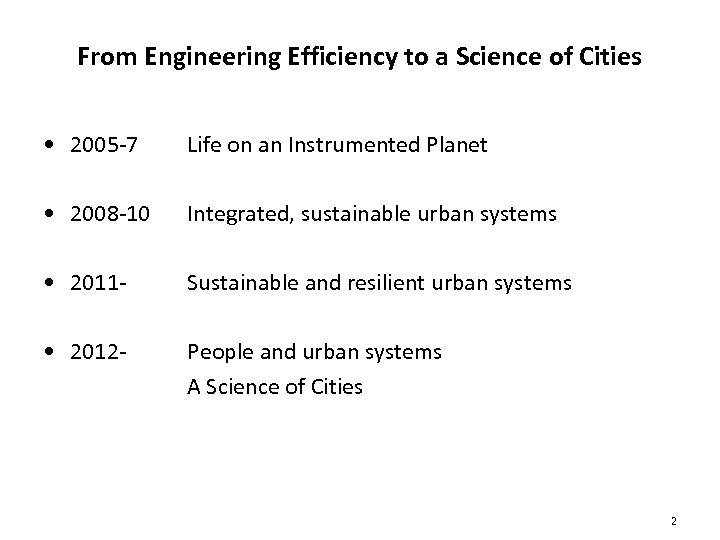
From Engineering Efficiency to a Science of Cities • 2005 -7 Life on an Instrumented Planet • 2008 -10 Integrated, sustainable urban systems • 2011 - Sustainable and resilient urban systems • 2012 - People and urban systems A Science of Cities 2
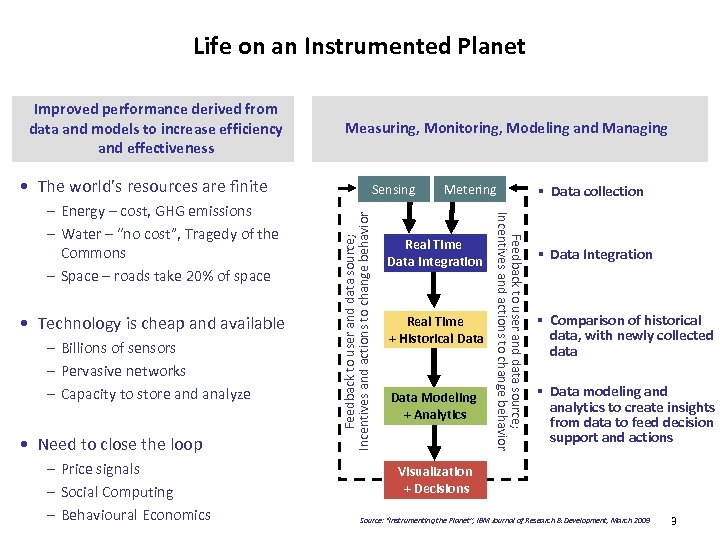
Life on an Instrumented Planet Improved performance derived from data and models to increase efficiency and effectiveness Measuring, Monitoring, Modeling and Managing • The world’s resources are finite – Billions of sensors – Pervasive networks – Capacity to store and analyze • Need to close the loop – Price signals – Social Computing – Behavioural Economics Feedback to user and data source; Incentives and actions to change behavior • Technology is cheap and available Metering Real Time Data Integration Real Time + Historical Data Modeling + Analytics Feedback to user and data source; Incentives and actions to change behavior – Energy – cost, GHG emissions – Water – “no cost”, Tragedy of the Commons – Space – roads take 20% of space Sensing § Data collection § Data Integration § Comparison of historical data, with newly collected data § Data modeling and analytics to create insights from data to feed decision support and actions Visualization + Decisions Source: “Instrumenting the Planet”, IBM Journal of Research & Development, March 2009 3
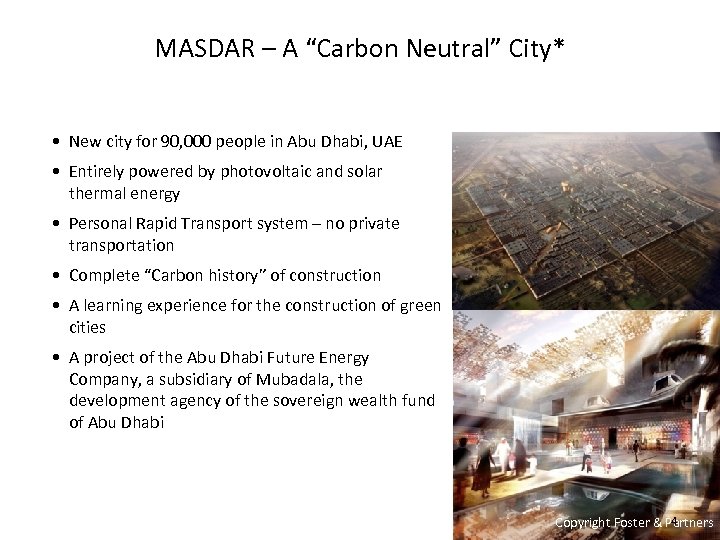
MASDAR – A “Carbon Neutral” City* • New city for 90, 000 people in Abu Dhabi, UAE • Entirely powered by photovoltaic and solar thermal energy • Personal Rapid Transport system – no private transportation • Complete “Carbon history” of construction • A learning experience for the construction of green cities • A project of the Abu Dhabi Future Energy Company, a subsidiary of Mubadala, the development agency of the sovereign wealth fund of Abu Dhabi *August 2008 4 Copyright Foster & Partners
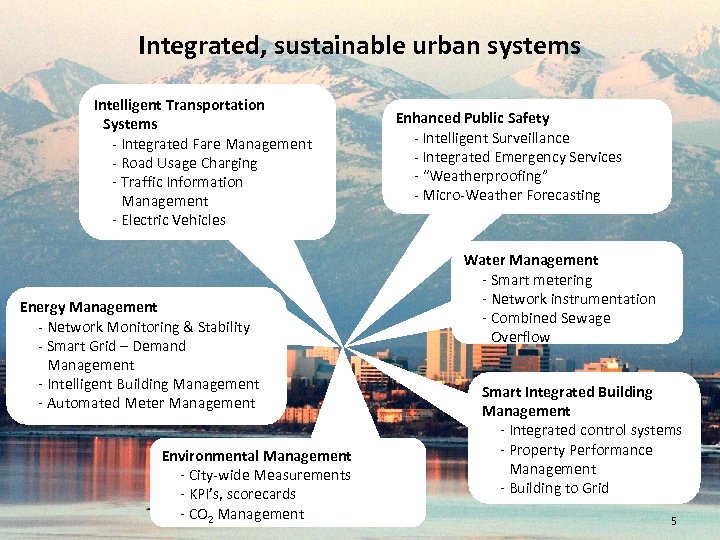
Integrated, sustainable urban systems Intelligent Transportation Systems - Integrated Fare Management - Road Usage Charging - Traffic Information Management - Electric Vehicles Energy Management - Network Monitoring & Stability - Smart Grid – Demand Management - Intelligent Building Management - Automated Meter Management Environmental Management - City-wide Measurements - KPI’s, scorecards - CO 2 Management Enhanced Public Safety - Intelligent Surveillance - Integrated Emergency Services - “Weatherproofing” - Micro-Weather Forecasting Water Management - Smart metering - Network instrumentation - Combined Sewage Overflow Smart Integrated Building Management - Integrated control systems - Property Performance Management - Building to Grid 5
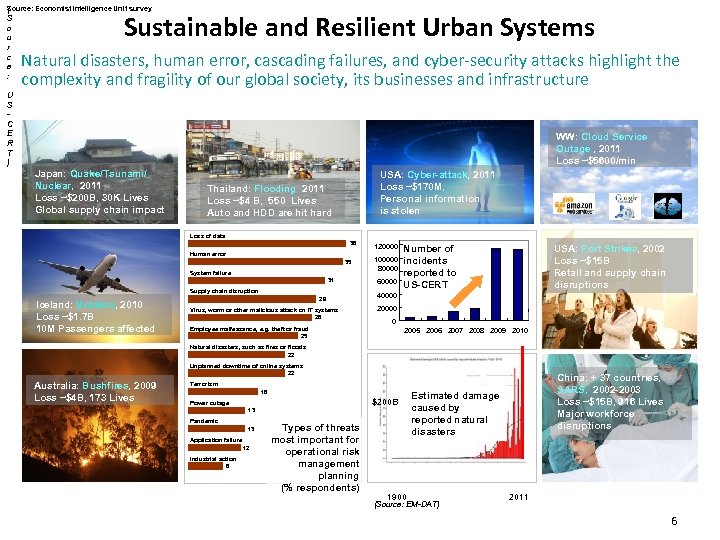
Source: Economist Intelligence Unit survey ( S o u r c e : Sustainable and Resilient Urban Systems Natural disasters, human error, cascading failures, and cyber-security attacks highlight the complexity and fragility of our global society, its businesses and infrastructure U S C E R T ) WW: Cloud Service Outage , 2011 Loss ~$5600/min Japan: Quake/Tsunami/ Nuclear, 2011 Loss ~$200 B, 30 K Lives Global supply chain impact USA: Cyber-attack, 2011 Loss ~$170 M, Personal information is stolen Thailand: Flooding 2011 Loss ~$4 B, 550 Lives Auto and HDD are hit hard Loss of data 36 Human error 35 System failure 31 Supply chain disruption Iceland: Volcano, 2010 Loss ~$1. 7 B 10 M Passengers affected 29 Virus, worm or other malicious attack on IT systems 28 Employee malfeasance, e. g. theft or fraud 25 120000 100000 80000 60000 USA: Port Strikes, 2002 Loss ~$15 B Retail and supply chain disruptions Number of incidents reported to US-CERT 40000 20000 0 2005 2006 2007 2008 2009 2010 Natural disasters, such as fires or floods 22 Unplanned downtime of online systems 22 Australia: Bushfires, 2009 Loss ~$4 B, 173 Lives China: + 37 countries, SARS, 2002 -2003 Loss ~$15 B, 916 Lives Major workforce disruptions Terrorism 16 $200 B Power outage 13 Pandemic 13 Application failure 12 Industrial action 8 Types of threats most important for operational risk management planning (% respondents) 1900 Estimated damage caused by reported natural disasters (Source: EM-DAT) 2011 6
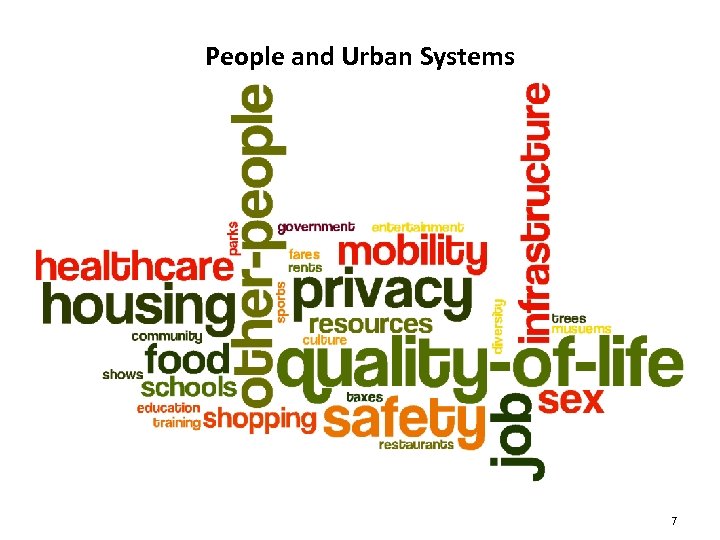
People and Urban Systems 7
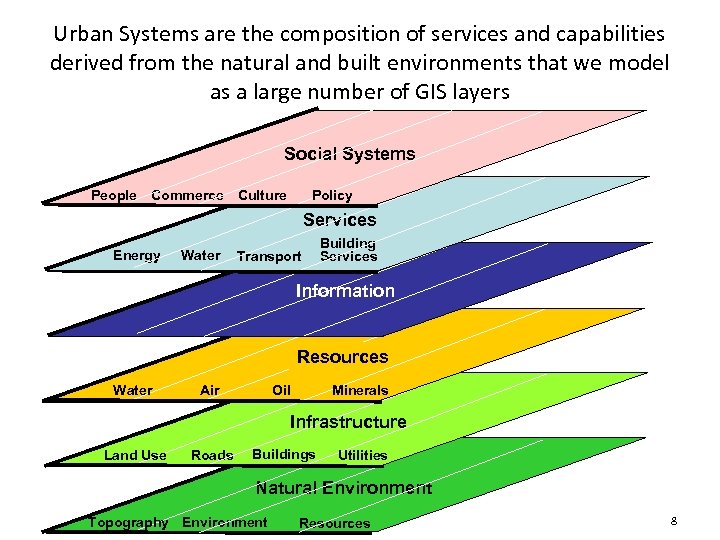
Urban Systems are the composition of services and capabilities derived from the natural and built environments that we model as a large number of GIS layers Social Systems People Commerce Culture Policy Services Energy Water Transport Building Services Information Resources Water Oil Air Minerals Infrastructure Land Use Roads Buildings Utilities Natural Environment Topography Environment Resources 8
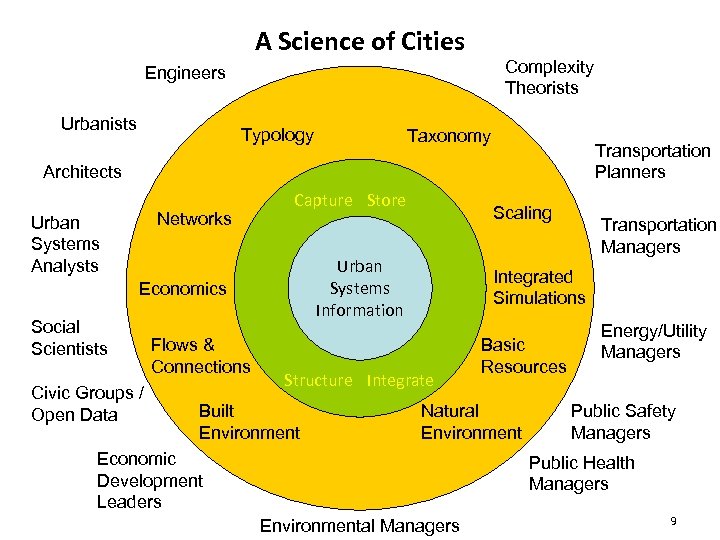
A Science of Cities Complexity Theorists Engineers Urbanists Typology Taxonomy Transportation Planners Architects Networks Urban Systems Analysts Capture Store Urban Systems Information Economics Social Scientists Civic Groups / Open Data Flows & Connections Scaling Integrated Simulations Structure Integrate Built Environment Transportation Managers Basic Resources Natural Environment Economic Development Leaders Energy/Utility Managers Public Safety Managers Public Health Managers Environmental Managers 9
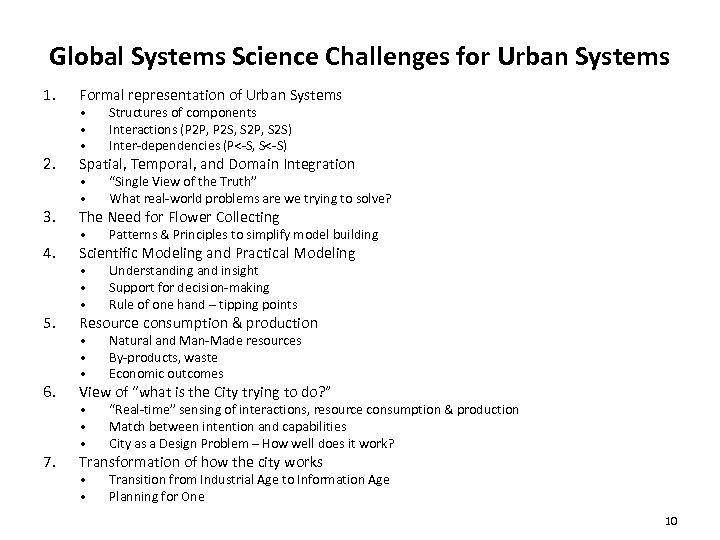
Global Systems Science Challenges for Urban Systems 1. Formal representation of Urban Systems 2. Spatial, Temporal, and Domain Integration 3. 4. 5. 6. 7. • • • Structures of components Interactions (P 2 P, P 2 S, S 2 P, S 2 S) Inter-dependencies (P<-S, S<-S) • • “Single View of the Truth” What real-world problems are we trying to solve? • Patterns & Principles to simplify model building • • • Understanding and insight Support for decision-making Rule of one hand – tipping points • • • Natural and Man-Made resources By-products, waste Economic outcomes • • • “Real-time” sensing of interactions, resource consumption & production Match between intention and capabilities City as a Design Problem – How well does it work? • • Transition from Industrial Age to Information Age Planning for One The Need for Flower Collecting Scientific Modeling and Practical Modeling Resource consumption & production View of “what is the City trying to do? ” Transformation of how the city works 10
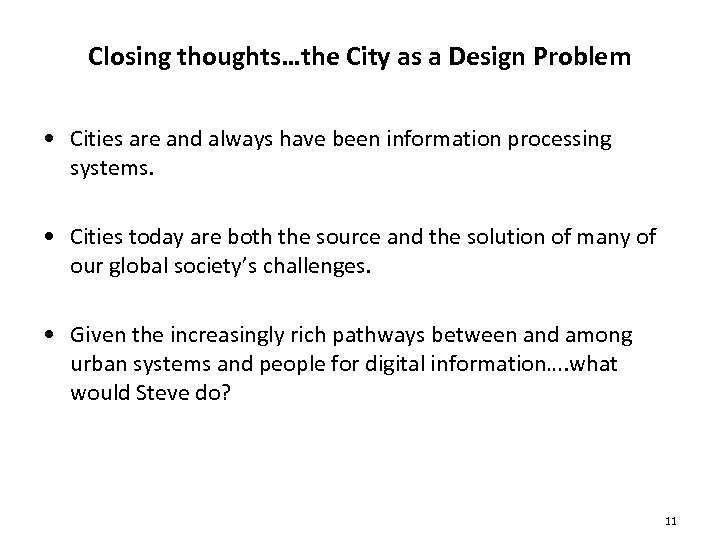
Closing thoughts…the City as a Design Problem • Cities are and always have been information processing systems. • Cities today are both the source and the solution of many of our global society’s challenges. • Given the increasingly rich pathways between and among urban systems and people for digital information…. what would Steve do? 11

Thanks for your attention! 12
Скачать презентацию Towards a Science of Cities Colin Harrison IBM
daa006f39627174d1eef28acb2123b27.ppt