 Скачать презентацию Towards A Migration System between Turkey and Russia
82f1678a237bebfa578e7a5b932e7875.ppt
- Количество слайдов: 43



Towards A Migration System between Turkey and Russia: Changing Migration Patterns and Profiles Ayşem Biriz KARAÇAY Migration Research Center at Koç University (Mi. Re. Koc) atokat@ku. edu. tr April 22, 2013 St. Petersburg
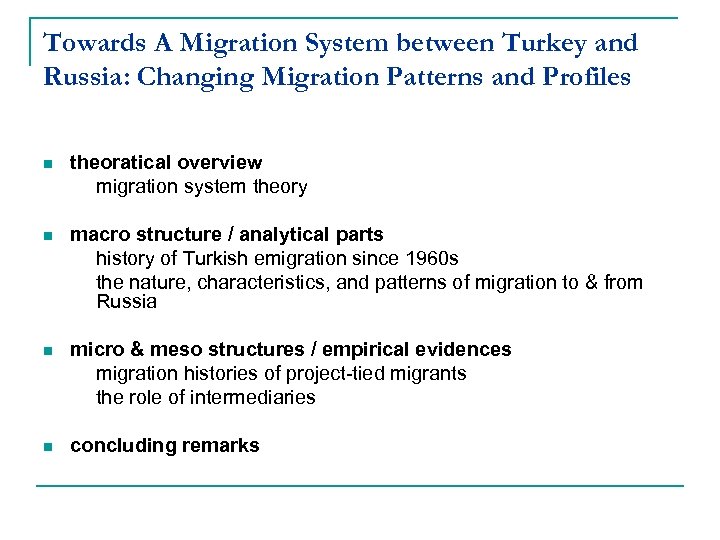
Towards A Migration System between Turkey and Russia: Changing Migration Patterns and Profiles n theoratical overview migration system theory n macro structure / analytical parts history of Turkish emigration since 1960 s the nature, characteristics, and patterns of migration to & from Russia n micro & meso structures / empirical evidences migration histories of project-tied migrants the role of intermediaries n concluding remarks
There have been numerous studies conducted on the Turkish emigration but n n no consistent research has been carried out on the migration flows including project-tied migration from Turkey to the former communist countries of the neighboring regions and vica-versa no use of migration system theory in the research on Turkish emigration to different destination regions.
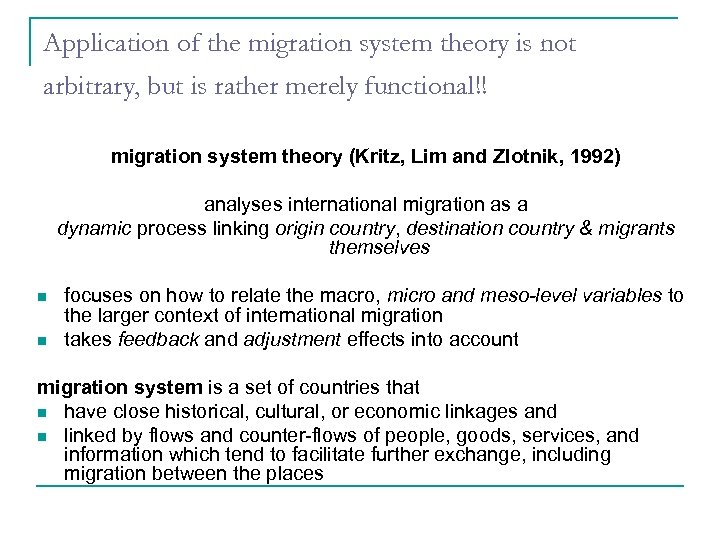
Application of the migration system theory is not arbitrary, but is rather merely functional!! migration system theory (Kritz, Lim and Zlotnik, 1992) analyses international migration as a dynamic process linking origin country, destination country & migrants themselves n n focuses on how to relate the macro, micro and meso-level variables to the larger context of international migration takes feedback and adjustment effects into account migration system is a set of countries that n have close historical, cultural, or economic linkages and n linked by flows and counter-flows of people, goods, services, and information which tend to facilitate further exchange, including migration between the places
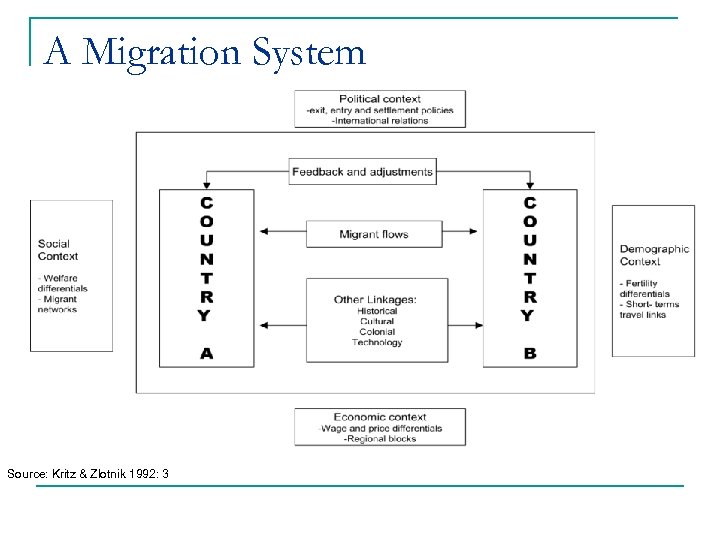
A Migration System Source: Kritz & Zlotnik 1992: 3
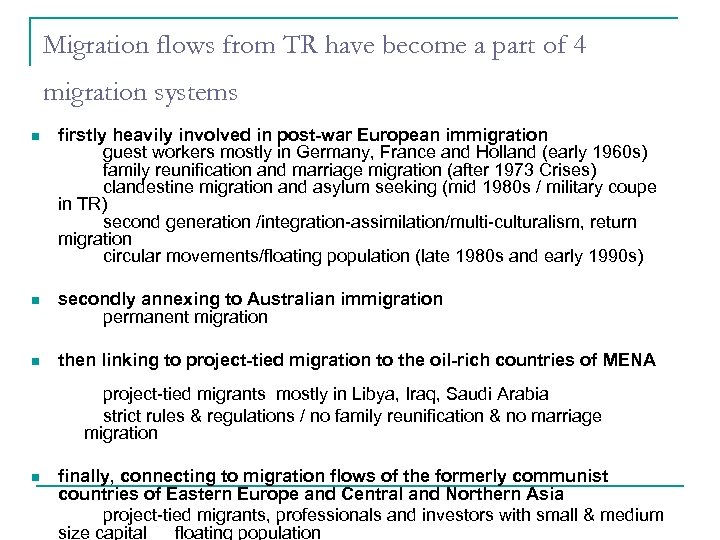
Migration flows from TR have become a part of 4 migration systems n firstly heavily involved in post-war European immigration guest workers mostly in Germany, France and Holland (early 1960 s) family reunification and marriage migration (after 1973 Crises) clandestine migration and asylum seeking (mid 1980 s / military coupe in TR) second generation /integration-assimilation/multi-culturalism, return migration circular movements/floating population (late 1980 s and early 1990 s) n secondly annexing to Australian immigration permanent migration n then linking to project-tied migration to the oil-rich countries of MENA project-tied migrants mostly in Libya, Iraq, Saudi Arabia strict rules & regulations / no family reunification & no marriage migration n finally, connecting to migration flows of the formerly communist countries of Eastern Europe and Central and Northern Asia project-tied migrants, professionals and investors with small & medium size capital floating population
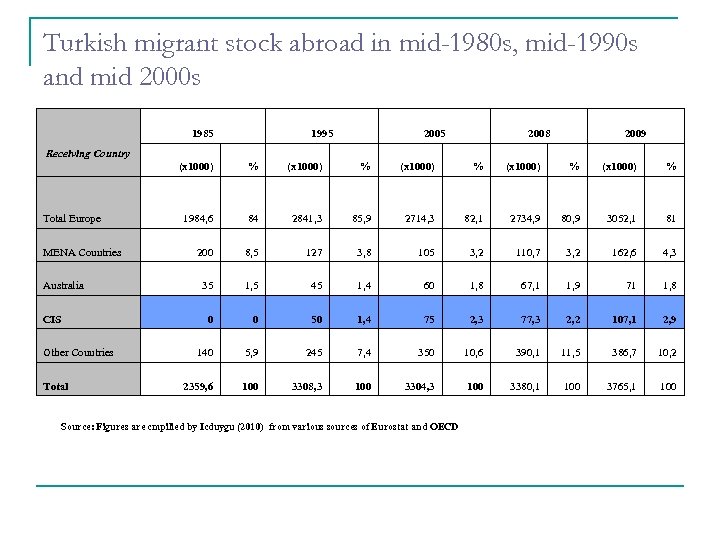
Turkish migrant stock abroad in mid-1980 s, mid-1990 s and mid 2000 s 1985 Receiving Country Total Europe MENA Countries Australia CIS Other Countries Total 1995 2008 2009 (x 1000) % (x 1000) % 1984, 6 84 2841, 3 85, 9 2714, 3 82, 1 2734, 9 80, 9 3052, 1 81 200 8, 5 127 3, 8 105 3, 2 110, 7 3, 2 162, 6 4, 3 35 1, 5 45 1, 4 60 1, 8 67, 1 1, 9 71 1, 8 0 0 50 1, 4 75 2, 3 77, 3 2, 2 107, 1 2, 9 140 5, 9 245 7, 4 350 10, 6 390, 1 11, 5 386, 7 10, 2 2359, 6 100 3308, 3 100 3304, 3 100 3380, 1 100 3765, 1 100 Source: Figures are cmpilied by Icduygu (2010) from various sources of Eurostat and OECD
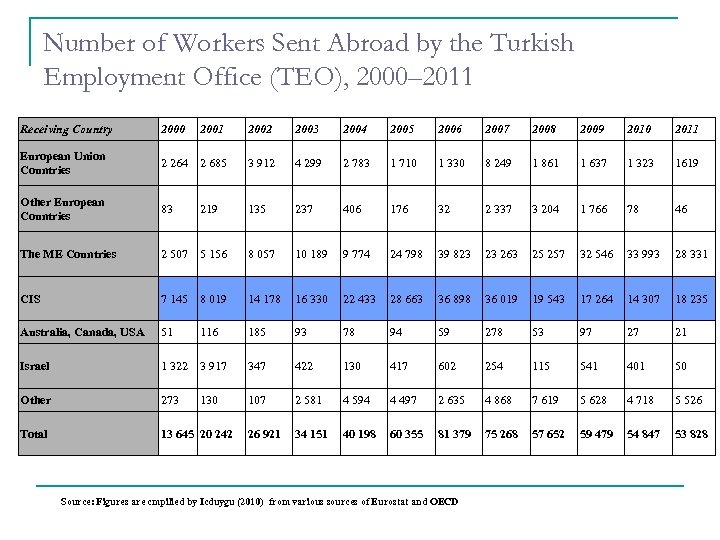
Number of Workers Sent Abroad by the Turkish Employment Office (TEO), 2000– 2011 Receiving Country 2000 2001 2002 2003 2004 2005 2006 2007 2008 2009 2010 2011 European Union Countries 2 264 2 685 3 912 4 299 2 783 1 710 1 330 8 249 1 861 1 637 1 323 1619 Other European Countries 83 219 135 237 406 176 32 2 337 3 204 1 766 78 46 The ME Countries 2 507 5 156 8 057 10 189 9 774 24 798 39 823 23 263 25 257 32 546 33 993 28 331 CIS 7 145 8 019 14 178 16 330 22 433 28 663 36 898 36 019 19 543 17 264 14 307 18 235 Australia, Canada, USA 51 116 185 93 78 94 59 278 53 97 27 21 Israel 1 322 3 917 347 422 130 417 602 254 115 541 401 50 Other 273 130 107 2 581 4 594 4 497 2 635 4 868 7 619 5 628 4 718 5 526 Total 13 645 20 242 26 921 34 151 40 198 60 355 81 379 75 268 57 652 59 479 54 847 53 828 Source: Figures are cmpilied by Icduygu (2010) from various sources of Eurostat and OECD
Migration System btwn TR & RF n Initiation period (1917 -1990) q 1984 Natural Gas Treaty n Transition period (1991 -2000) q dissolution of the Soviet Union (social & cultural traumas) q 1998 economic crises in RF q 1999 earthquakes & 2001 economic crises in TR n Consolidation period (2001 -onward) q reactive migration policy management in RF q liberalisation in the migration policy in RF q economic recovery in the construction sector both in RF& TR
Initiation period (1917 -1980): Early Years of the Republics n Close cooperation and military support during the Turkish War of Independence q An act against Western Imperialism q 1925 Friendship and Neutrality Agreement & 1927 Trade Agreement with Turkey q A branch of Ruskombank in Ankara n Turkey inspired by the Soviet centrally-planned state economy q Statist economic measures were taken with the advise of the Russian experts q The First Five-Year Plan prepared in 1932 -1933 and ratified in January 1934 q The first long-term Credit: Kayseri and Nazilli Textile Plants n Worsening relations between the Soviet Union & Turkey with the offer of cosovernity at the Straits & renewal of the Montreaux Convention signed in 1936 n Turkey became a member of NATO in 1952 & moved from statist economic policies towards economic liberalisation
Initiation period (1917 -1980): Cold War Politics Tension is high btwn the Super Powers & their allies BUT Credits rejected by the USA but received from the Soviet Union: in 1957 / Çayırova Glass Factory Credits rejected by the USA but received from the Soviet Union: in 1967, 1972 & 1979 /Iskenderun Iron & Steel Factory; Aliağa Oil Rafinery; Atrvin Plate Factory; Orhaneli Thermal Power Plant There are political disputes/increasing tensions between Turkey and the Soviet Union during the Cold War, BUT the economic relations btwn them enhanced & improved the cooperation which would lead to the first migratory flows between Turkey & Soviet Union
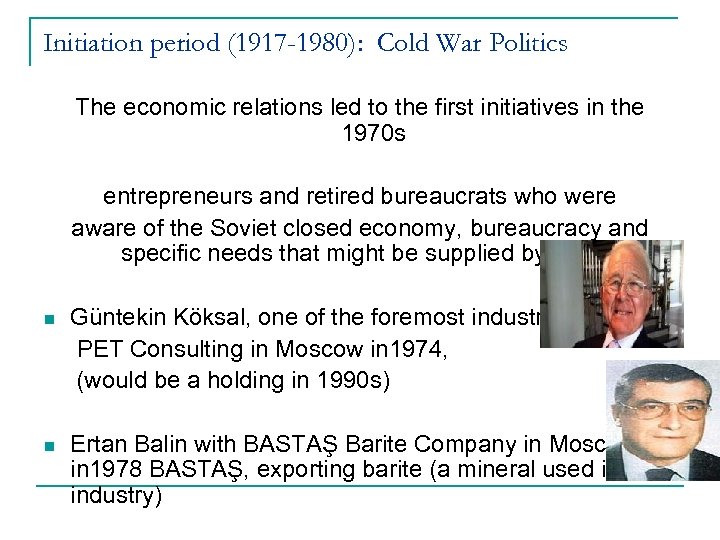
Initiation period (1917 -1980): Cold War Politics The economic relations led to the first initiatives in the 1970 s entrepreneurs and retired bureaucrats who were aware of the Soviet closed economy, bureaucracy and specific needs that might be supplied by Turkey n Güntekin Köksal, one of the foremost industrialists, PET Consulting in Moscow in 1974, (would be a holding in 1990 s) n Ertan Balin with BASTAŞ Barite Company in Moscow, in 1978 BASTAŞ, exporting barite (a mineral used in oil industry)
Initiation period (1980 -1990): Towards the End of the Cold War -1984 Natural Gas Agreement changing dynamics in the Turkish foreign policy q the economic liberalization policies in 1980's q the credit facilities provided by the Turkish Eximbank established with the aim of strengthening the competitiveness of Turkish companies abroad q the opening of the Sarp border gate between Turkey and Russia increasing attention of Turkish contractors to foreign markets q completion of large scale infrastructural projects in oil-exporting countries and unfavourable conditions in the MENA countries and in the region overall and Soviet search for new gas-import conutries through Barter Agreements (1981 Gas for Pipe Agreement with Federal Republic of Germany) led to 1984 Natural Gas Agreement between Turkey and the
Initiation period (1980 -1990) 1984 Natural Gas Agreement between Turkey and the USSR (Barter Agreement) q According to this agreement Some portion of the payment for Soviet natural gas was covered by Turkish construction services in USSR the expansion of trade has been almost on barter terms with one party exporting goods (natural gas), while the other balances the trade by contracting services (construction) (% 35) q With this agreement Turkish businessmen and project-tied migrants entered to the Soviet Union It is the core impetus leading to
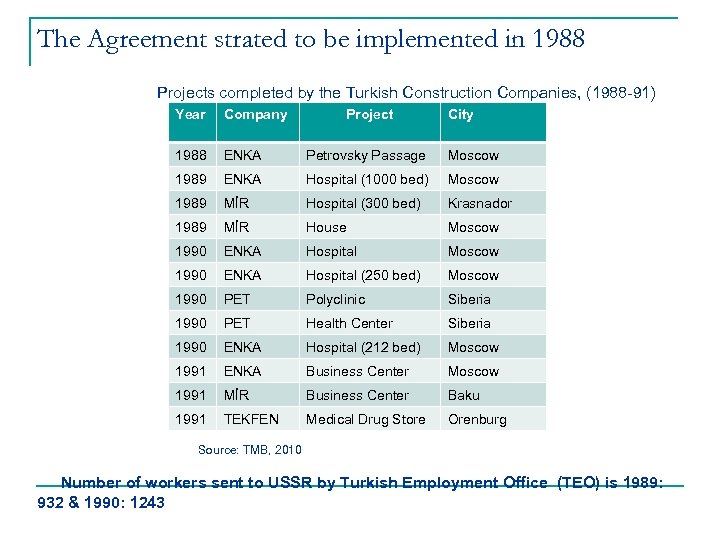
The Agreement strated to be implemented in 1988 Projects completed by the Turkish Construction Companies, (1988 -91) Year Company Project City 1988 ENKA Petrovsky Passage Moscow 1989 ENKA Hospital (1000 bed) Moscow 1989 MİR Hospital (300 bed) Krasnador 1989 MİR House Moscow 1990 ENKA Hospital (250 bed) Moscow 1990 PET Polyclinic Siberia 1990 PET Health Center Siberia 1990 ENKA Hospital (212 bed) Moscow 1991 ENKA Business Center Moscow 1991 MİR Business Center Baku 1991 TEKFEN Medical Drug Store Orenburg Source: TMB, 2010 Number of workers sent to USSR by Turkish Employment Office (TEO) is 1989: 932 & 1990: 1243
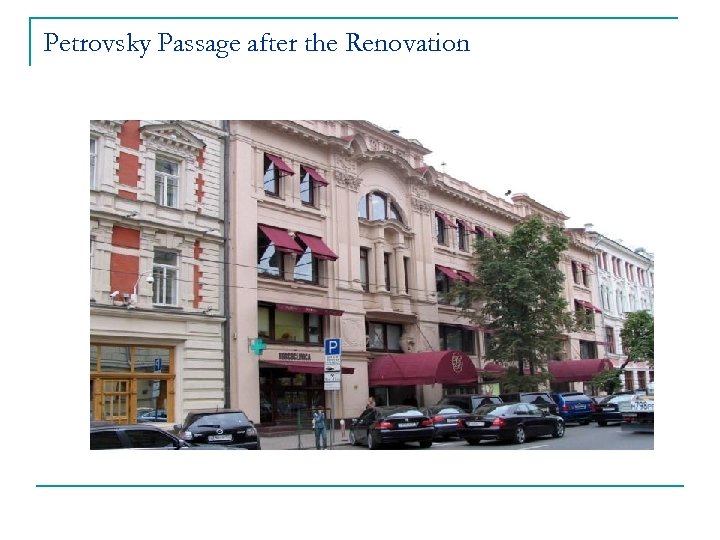
Petrovsky Passage after the Renovation
Transition period (1991 -2000) First half of the transition period q the collapse of the USSR led to nationalism, ethnic & religiousbased conflicts, minority discrimination and civil wars, created a totally new migration situation and produced n mass repatriation of Russian-speaking populations n flows of refugees, forced migrants, and displaced people from areas of armed conflict and n brain drain to the USA, Germany & Israel Second half of the transition period q the development of genuine labor market relations, the moderation of minority policies, and the official recognition of the freedom of exit and entrance resulted in n shuttle trade and short-term labor migration emerged as a means of survival in the post-Soviet economic crises, and led to substantially lower social tension and a higher standard of living, -irregular short-term migrants are mostly from the CIS countries &
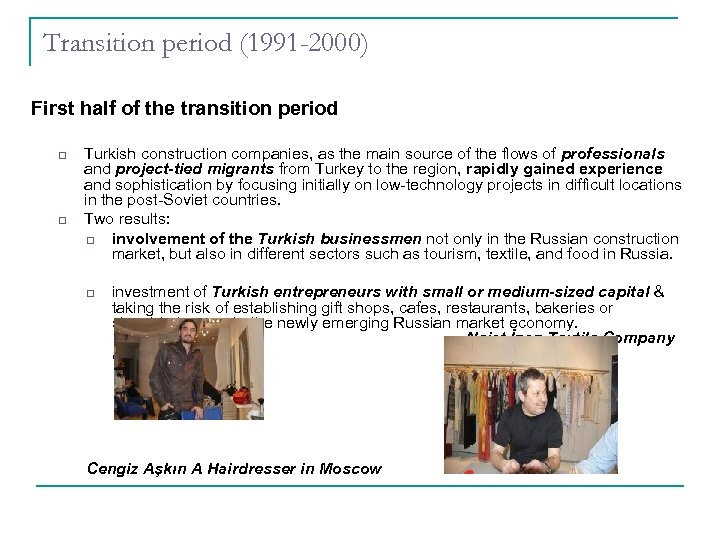
Transition period (1991 -2000) First half of the transition period q q Turkish construction companies, as the main source of the flows of professionals and project-tied migrants from Turkey to the region, rapidly gained experience and sophistication by focusing initially on low-technology projects in difficult locations in the post-Soviet countries. Two results: q involvement of the Turkish businessmen not only in the Russian construction market, but also in different sectors such as tourism, textile, and food in Russia. q investment of Turkish entrepreneurs with small or medium-sized capital & taking the risk of establishing gift shops, cafes, restaurants, bakeries or slaughterhouses in the newly emerging Russian market economy. Nejat İnan Textile Company in Moscow Cengiz Aşkın A Hairdresser in Moscow
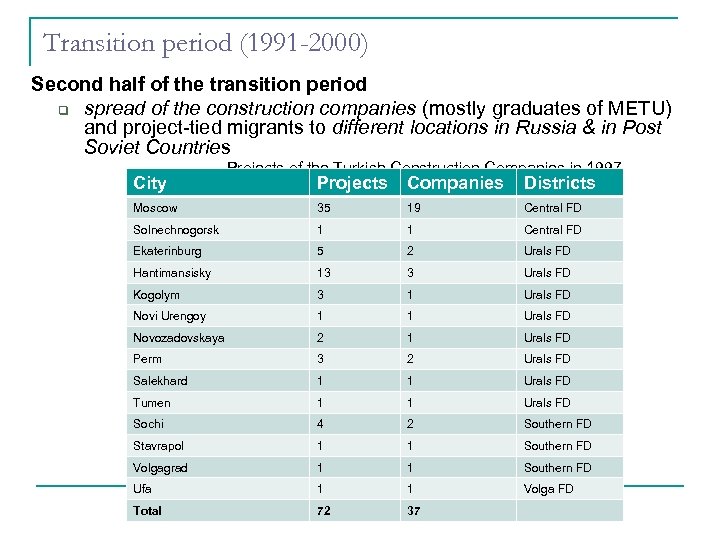
Transition period (1991 -2000) Second half of the transition period q spread of the construction companies (mostly graduates of METU) and project-tied migrants to different locations in Russia & in Post Soviet Countries City Projects of the Turkish Construction Companies in 1997 Projects Companies Districts Moscow 35 19 Central FD Solnechnogorsk 1 1 Central FD Ekaterinburg 5 2 Urals FD Hantimansisky 13 3 Urals FD Kogolym 3 1 Urals FD Novi Urengoy 1 1 Urals FD Novozadovskaya 2 1 Urals FD Perm 3 2 Urals FD Salekhard 1 1 Urals FD Tumen 1 1 Urals FD Sochi 4 2 Southern FD Stavrapol 1 1 Southern FD Volgagrad 1 1 Southern FD Ufa 1 1 Volga FD Total 72 37
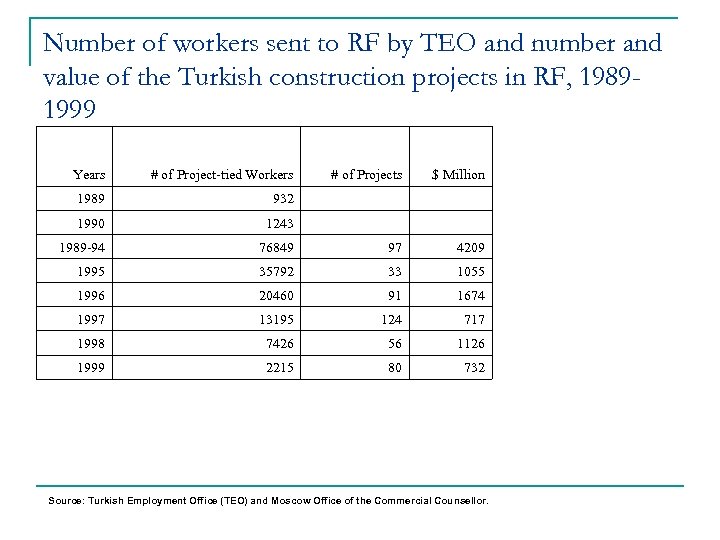
Number of workers sent to RF by TEO and number and value of the Turkish construction projects in RF, 19891999 Years # of Project-tied Workers # of Projects $ Million 1989 932 1990 1243 1989 -94 76849 97 4209 1995 35792 33 1055 1996 20460 91 1674 1997 13195 124 717 1998 7426 56 1126 1999 2215 80 732 Source: Turkish Employment Office (TEO) and Moscow Office of the Commercial Counsellor.
Transition period (1991 -2000) Second half of the transition period n n n n war in Chechnya, 1998 Russian financial and economic crises, growing difficulties in residence registration, existing administrative obstacles, and increasingly xenophobic attitudes in Russian society and the earthquakes of 1999 in TR the 2001 financial crisis in TR negatively affected the businesses of Turkish companies in the region and ongoing migration flows from TR to RF slowed in the late 1990 s
Consalidation period (2001 -onwards) First half of the consolidation period migration-control policies (2001 -2005) n attempts of the Putin administration were primarily oriented toward q the strengthening of law enforcement aspects of migration policies q concentrated mostly on refugees and forced migrants, and illegal migrants q with the aim of limiting the numbers coming in. Second half of the consolidation period open door policies (2005 -onward) n in 2005 the Putin administration adopted new acts with the aim of q general liberalization of migration policy, q increase of permanent migration, q improvement in migration statistics, q the expansion of the legal space for temporary migration, and
Consolidation period (2001 -onwards) Migration flows from Turkey to RF Turkish migrants in Russia mostly residing in Russia’s two migrantmagnet cities Moscow & St. Petersburg have already established their own distinctive Features with different profiles! n project-tied migrants n professionals and n small and medium-sized investors n seasonal agricultureal workers (? ) Various investments: Efes Pilsen, Yapı Kredi Bank, Boyner, n Foundations and research centers & business councils: RUTID, RTIB, RUTAM, RDKD n
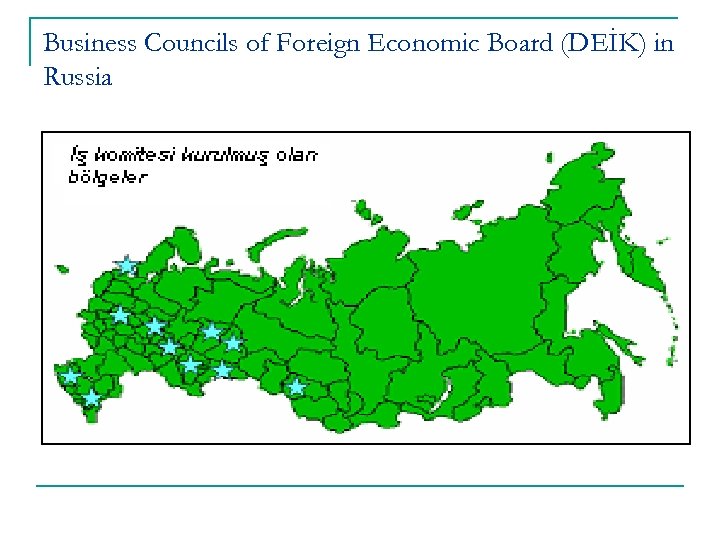
Business Councils of Foreign Economic Board (DEİK) in Russia
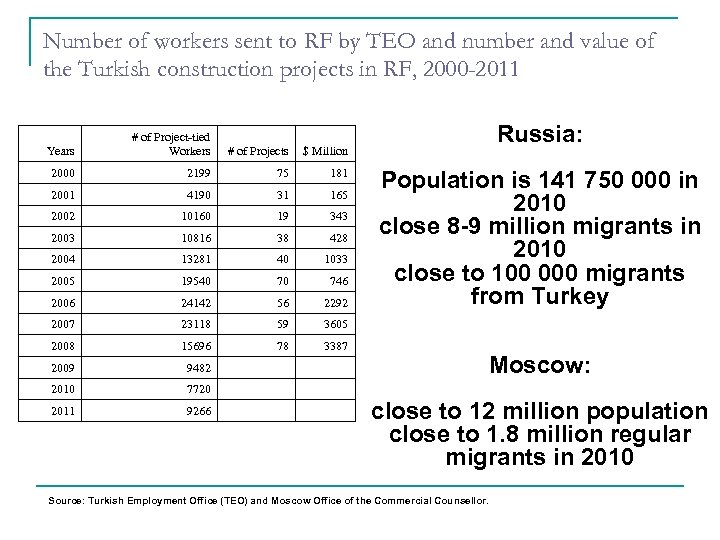
Number of workers sent to RF by TEO and number and value of the Turkish construction projects in RF, 2000 -2011 Years # of Project-tied Workers # of Projects Russia: $ Million 2000 2199 75 181 2001 4190 31 165 2002 10160 19 343 2003 10816 38 428 2004 13281 40 1033 2005 19540 70 746 2006 24142 56 2292 2007 23118 59 3605 2008 15696 78 3387 2009 9482 2010 7720 2011 9266 Population is 141 750 000 in 2010 close 8 -9 million migrants in 2010 close to 100 000 migrants from Turkey Moscow: close to 12 million population close to 1. 8 million regular migrants in 2010 Source: Turkish Employment Office (TEO) and Moscow Office of the Commercial Counsellor.
Consolidation period (2001 -onwards) Migration flows from RF to Turkey a decline in the shuttle trade during the consolidation period, an increasing migration flow towards the Aegean and Mediterranean cities in Turkey (mostly women migrants are crossing the borders for the seasonal work, especially in the tourism sector) -Shuttle traders -Circular migrants who works in various sectors -Inter-marriage migration/retirement migration -Tourists
Project-tied migrants in MOSCOW: micro level analysis Who are the project-tied migrants in the construction sector in Moscow? were btwn 23 -50 years old with an average of 33, mostly from urban backgrounds and fairly well-educated and skilled workers half of them were single and the married project-tied migrants did not think about the family reunification. “My contract will be finished in one year, so I have to move to another construction field, maybe in another city or in another country. In Russia, people have a very different culture and way of life. Religion is different, the language is very difficult. I don’t want to bring my family here. They will be very isolated. ” (Ali)
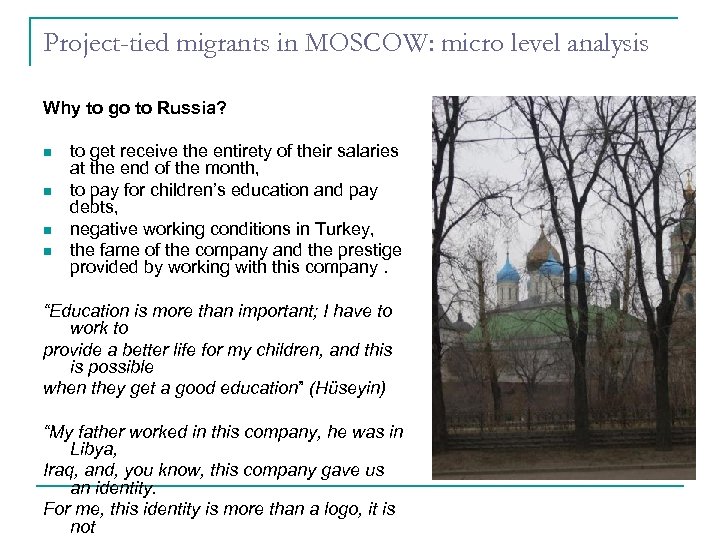
Project-tied migrants in MOSCOW: micro level analysis Why to go to Russia? n n to get receive the entirety of their salaries at the end of the month, to pay for children’s education and pay debts, negative working conditions in Turkey, the fame of the company and the prestige provided by working with this company. “Education is more than important; I have to work to provide a better life for my children, and this is possible when they get a good education” (Hüseyin) “My father worked in this company, he was in Libya, Iraq, and, you know, this company gave us an identity. For me, this identity is more than a logo, it is not
Project-tied migrants in MOSCOW: micro level analysis What about their earnings? salaries ranges btwn USD 1, 000 -1, 500 / salary advance ranges btwn USD 75 -100 most Turkish construction companies in Russia transfer the project-tied workers’ salaries to the workers’ shared bank accounts in Turkey n n most of the migrant workers interviewed share their bank accounts with either their father, wife or mother. migrants, holding shared accounts with their close relatives, leave their wages in Turkey and have their relatives manage these savings “in the early 1990 s, the payments were made to our own bank accounts in Russia. But some of the workers spent it in a very short period of time without taking their families into consideration. Some families broke up because of this salary mismanagement. So the company authorities took this situation into consideration and from then on they paid to our shared accounts in Turkey. ” (Ömer)
Project-tied migrants in MOSCOW: micro level analysis How to go to RF? the first project that brought Turkish project-tied workers to Moscow with the implementation of the 1984 Natural Gas Agreement was the restoration and renovation of Petrovsky Passage, a historic architectural landmark in Moscow. the first-comers had arrived in Kiev Train Station in Moscow after a threeday train trip, in October 1988. in the later stages of project-tied flows to RF, migrant workers used the 3 -4 day bus services which mainly departed from Istanbul (Has Turizm) to different regions of RF. today, the project-tied migrants transferred with airplane -- mostly cheap charter flights – and then arrive at the construction field, after a bus or train trip in RF.
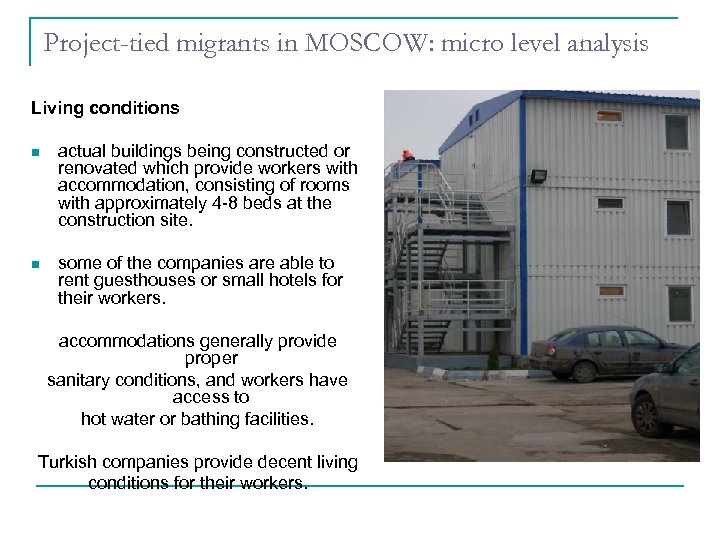
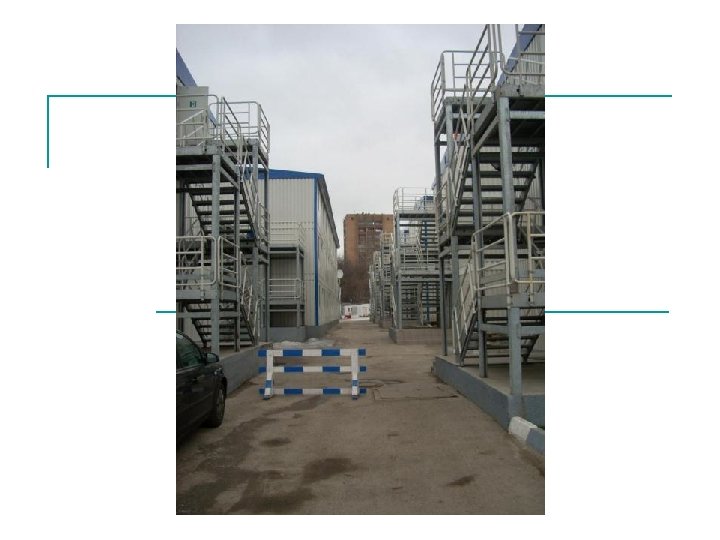
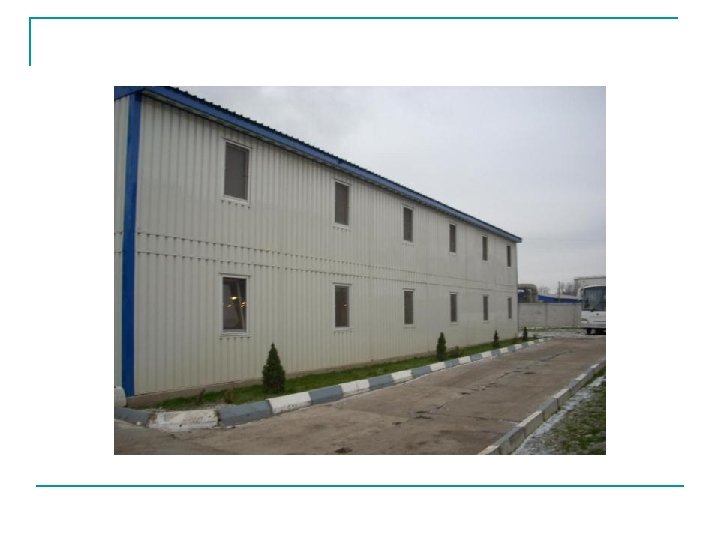
Project-tied migrants in MOSCOW: micro level analysis Living conditions n actual buildings being constructed or renovated which provide workers with accommodation, consisting of rooms with approximately 4 -8 beds at the construction site. n some of the companies are able to rent guesthouses or small hotels for their workers. accommodations generally provide proper sanitary conditions, and workers have access to hot water or bathing facilities. Turkish companies provide decent living conditions for their workers.
Project-tied migrants in MOSCOW: micro level analysis Who are the other foreign workers in the construction field? n Initiation period: Turkish construction companies prefer to employ mostly Turkish workers in the field to avoid possible communication problems & cultural incompatibility. n Transition period: Increasing costs of the Turkish Migrant workers were balanced with the overqualified Russian workers. Bribery and stealing, theft, communication/language were the main problems in the field. “a woman who is a space engineer worked with us in the field not as a secretary but as a driver of a the big construction maschine. ” (Orhan) n Consolidation period: Because of the internationally competitive construction market in Russia, today many companies prefer foreign workers who will be employed without going through a complicated employment procedure of Russia and/or are able to speak one of the dialects of the Turkish language. As a result, at the construction sites of the Turkish companies today, one can easily meet a Tajik, Uzbek, or Kyrgyz worker.
Project-tied migrants in MOSCOW: micro level analysis Future plans in Moscow n n n most of the project-tied migrants do not plan to go back to Turkey permanently. for many, migration for a work is a long term life strategy. the main intention of these migrants is to continue to circulate with different projects to various countries. The answer to the question of other possible destinations apart from Russia came as different company names with different job opportunities. In other words, project-tied workers are not tending to go to a specific country itself but preferring to circulate with companies providing themselves economic prosperity and job security.
Project-tied migrants in MOSCOW: meso level analysis How to hire project-tied migrants? Construction Companies: mostly used their own human resources as their major source of worker supply for their ongoing and forthcoming projects. are also cooperating with legal intermediary/subcontracting firms mostly initiated by their former workers. legal intermediary firms are the major protagonists in job placement of project-tied migrants from Turkey
Project-tied migrants in MOSCOW: meso level analysis but, the costly, unclear and long administrative and bureaucratic procedure to recruit project-tied migrants from abroad to Russia makes some companies/subcontracting agencies to recruit workers illegally they may *transfer the workers with tourist visa to the field, *failed to provide the promised salaries and conditions, *forced them to work for long hours, *left them with substandard onsite living and unsafe working conditions, *confiscated migrants’ passports and forced them to work without wages “One of my friends was deceived by an illegal subcontractor, and he came to Russia on a tourist visa; then the subcontractor took his passport. He said that at the construction site he slept on the basement floor of the house that they were building and ate only macaroni for two weeks. ” (Reşat)
Concluding Remarks n since the early 1990 s, new migration patterns have been experienced throughout the post-Soviet geographies. n the internalization process of Turkish constructors, the changing dynamics of the Turkish and Soviet foreign policy and economy has widened the direction of the migration flows btwn TR& RF introducing new migrant worker profiles in the post-Soviet geographies, q q project-tied migrants, businessmen, professionals, small and medium-sized investors, seasonal agricultural workers have joined to the migration flows -Shuttle traders n -Circular migrants who works in various sectors n -Inter-marriage migration/retirement migration n -Tourists n
Concluding Remarks YES! q q much more work remains to be done, and the analysis should be extended to other cases of different migrant categories/profiles through which some comparative studies could be conducted. YES WE CAN!!!!!

Thank you. .
 Скачать презентацию Towards A Migration System between Turkey and Russia
82f1678a237bebfa578e7a5b932e7875.ppt