 Скачать презентацию Towards a better understanding of executive wellbeing Karen
ed960659052ddc6a1bb55905d4b93372.ppt
- Количество слайдов: 28



Towards a better understanding of executive wellbeing Karen Gillespie
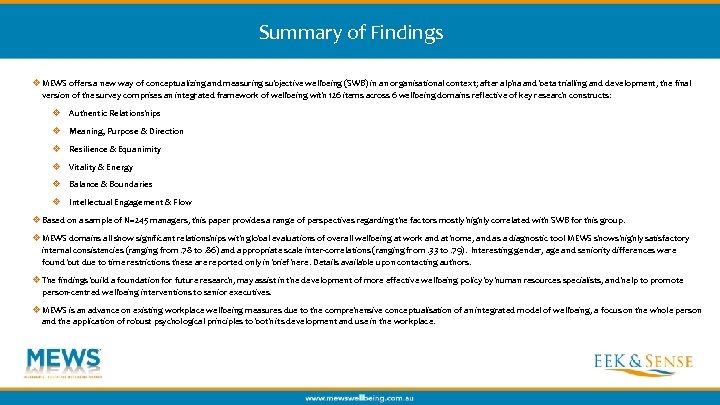
Summary of Findings v MEWS offers a new way of conceptualizing and measuring subjective wellbeing (SWB) in an organisational context; after alpha and beta trialling and development, the final version of the survey comprises an integrated framework of wellbeing with 126 items across 6 wellbeing domains reflective of key research constructs: v Authentic Relationships v Meaning, Purpose & Direction v Resilience & Equanimity v Vitality & Energy v Balance & Boundaries v Intellectual Engagement & Flow v Based on a sample of N=245 managers, this paper provides a range of perspectives regarding the factors mostly highly correlated with SWB for this group. v MEWS domains all show significant relationships with global evaluations of overall wellbeing at work and at home, and as a diagnostic tool MEWS shows highly satisfactory internal consistencies (ranging from. 78 to. 86) and appropriate scale inter-correlations (ranging from. 33 to. 79). Interesting gender, age and seniority differences were found but due to time restrictions these are reported only in brief here. Details available upon contacting authors. v The findings build a foundation for future research, may assist in the development of more effective wellbeing policy by human resources specialists, and help to promote person-centred wellbeing interventions to senior executives. v MEWS is an advance on existing workplace wellbeing measures due to the comprehensive conceptualisation of an integrated model of wellbeing, a focus on the whole person and the application of robust psychological principles to both its development and use in the workplace.
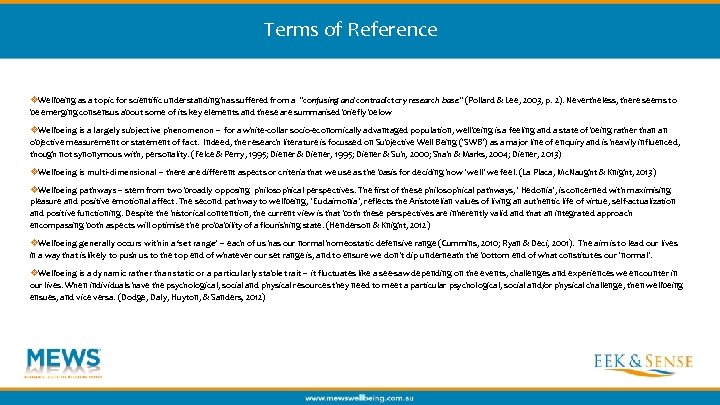
Terms of Reference v. Wellbeing as a topic for scientific understanding has suffered from a “confusing and contradictory research base” (Pollard & Lee, 2003, p. 2). Nevertheless, there seems to be emerging consensus about some of its key elements and these are summarised briefly below v. Wellbeing is a largely subjective phenomenon – for a white-collar socio-economically advantaged population, wellbeing is a feeling and a state of being rather than an objective measurement or statement of fact. Indeed, the research literature is focussed on Subjective Well Being (‘SWB’) as a major line of enquiry and is heavily influenced, though not synonymous with, personality. (Felce & Perry, 1995; Diener & Diener, 1995; Diener & Suh, 2000; Shah & Marks, 2004; Diener, 2013) v. Wellbeing is multi-dimensional – there are different aspects or criteria that we use as the basis for deciding how ‘well’ we feel. (La Placa, Mc. Naught & Knight, 2013) v. Wellbeing pathways – stem from two broadly opposing philosophical perspectives. The first of these philosophical pathways, ‘ Hedonia’, is concerned with maximising pleasure and positive emotional affect. The second pathway to wellbeing, ‘Eudaimonia’, reflects the Aristotelian values of living an authentic life of virtue, self-actualization and positive functioning. Despite the historical contention, the current view is that both these perspectives are inherently valid and that an integrated approach encompassing both aspects will optimise the probability of a flourishing state. (Henderson & Knight, 2012) v. Wellbeing generally occurs within a ‘set range’ – each of us has our normal homeostatic defensive range (Cummins, 2010; Ryan & Deci, 2001). The aim is to lead our lives in a way that is likely to push us to the top end of whatever our set range is, and to ensure we don’t dip underneath the bottom end of what constitutes our ‘normal’. v. Wellbeing is a dynamic rather than static or a particularly stable trait – it fluctuates like a see-saw depending on the events, challenges and experiences we encounter in our lives. When individuals have the psychological, social and physical resources they need to meet a particular psychological, social and/or physical challenge, then wellbeing ensues, and vice versa. (Dodge, Daly, Huyton, & Sanders, 2012)
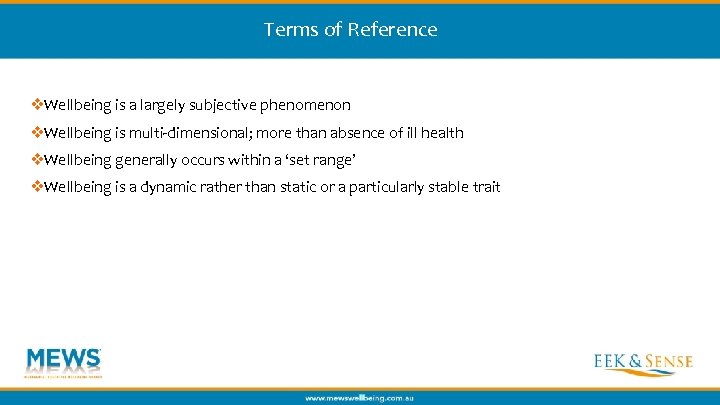
Terms of Reference v. Wellbeing is a largely subjective phenomenon v. Wellbeing is multi-dimensional; more than absence of ill health v. Wellbeing generally occurs within a ‘set range’ v. Wellbeing is a dynamic rather than static or a particularly stable trait
The Wellbeing Paradox v There can be no doubt wellbeing is key to achieving a range of positive business outcomes. (Harter, Schmidt & Hayes, 2003) For example, Sims (2010) reports a 40% improvement in employee engagement and 50% improvement in creativity and innovation. Margeson & Nahrgang (2005), Van Dierendonck, Haynes, Borrill & Stride (2004) and Skakona, Nielsen, Borgb & Guzmanc (2010) have all found a significant relationship between enhanced wellbeing and enhanced leadership performance. v Building on what has become universally referred to as the ‘happy-productive-worker thesis’ which examines the link between positive affect, employee engagement and business outcomes generally, Hosie et al (2013) investigated the relationship specifically within a management population and found that self-reports of affective wellbeing were positively associated with enhanced managerial and leadership performance and diminished affective wellbeing associated with poorer managerial performance. (Hosie & Sevastos, 2003) v Despite such data showing that investment in wellbeing makes good sense for individuals and organisations for both social and economic reasons, the levels of wellbeing among those at the top of organisations is in decline – the wellbeing of managers is under more threat than ever before. (Forster & Still, 2001) The incidences of personal sacrifice, burnout, emotional exhaustion, strain and pressure among those in management roles and those who have the largest responsibility and accountability in organisations are well documented trends and stress or burnout is increasingly common (Reinhold, 1997) and emotional exhaustion is prevalent in managers’ workplaces. (Lee & Ashforth, 1996) v Organisations therefore need to develop strategies to help avoid burnout, monitor wellbeing levels more effectively and assist senior leaders in reaching and sustaining the heightened performance expectations that are integral to survival in the corporate world. (Hosie, Forster & Sevastos, 2004) v Executive development is being increasingly seen as involving personal development related to how the individual deals with work/life issues, stress and preventative health. (Hall, 1995)
The Wellbeing Paradox v. Wellbeing is key to achieving a range of positive business outcomes. Numerous studies have found a significant relationship between enhanced wellbeing and enhanced leadership performance. v. The ‘happy-productive-worker thesis’ : vself-reports of affective wellbeing were positively associated with enhanced managerial and leadership performance and vdiminished affective wellbeing associated with poorer managerial performance. (Hosie et al 2013) v. Yet, the personal sacrifice, burnout, emotional exhaustion, strain and pressure among leaders is not abating. v. Wellbeing approaches tend to be generic, surface level or based on spot interventions with an overly medical emphasis, and which underplay the psychological factors of wellbeing.
The Wellbeing Paradox v. The Future of Wellness at Work 2016 report from the Global Wellness Institute findings: 1. The majority of formal wellness programs as they exist today, simply don’t work. Roughly one in ten report it has any positive impact on their health. 2. The problem is that the one-size-fits-all approach is viewed by employees as an empty gesture. If the goal is to improve employee wellness, then the opposite is being achieved, with 75% of workers cynical, believing workplace wellness programs to be self-serving and benefiting only the company. v. More needs to be understood about executive wellbeing before effective interventions can be implemented to enhance wellbeing. Without an accurate diagnosis of the specific wellbeing needs and circumstances of individual leaders, it becomes difficult to achieve enhanced wellbeing and consequent enhanced business outcomes
Development of the survey (1) Research Aims v. To develop a diagnostic tool for examining the subjective wellbeing (SWB) of people in professional, managerial or leadership roles. v. SWB is defined as “a delicate balancing act between an individual’s social, emotional, psychological and physical assets (resources) and the particular social, emotional, psychological and physical liabilities (challenges) they are facing in life and at work. ” (Dodge et al 2012) v. To examine wellbeing in the workplace as wellbeing outside of work – a whole of person approach v. To educate leaders about what factors impact wellbeing, identify their unique wellbeing enhancers and detractors and motivate to operate at the top end of their set range more of the time v. To provide a robust and evidence-based source of data for organisations to use in designing further wellbeing interventions
Development of the survey (2) Survey Design & Methodology v 2013: Literature review of wellbeing models & existing diagnostic tools. v 2014: Develop alpha trial tool: 150 item generation & alpha model conceptualisation of the MEWS Framework. v. Subject matter expert review. v. Alpha trialling with 106 executives & statistical analysis of results v 2015: Refinement of beta version of tool and MEWS Framework to create a diagnostic with 120 specific questions across 10 wellbeing domains, plus 5 global SWB items. Software development and migration to Qualtrics platform technology, and creation of individual and team output reports v 2016: Quantitative & qualitative review of first 245 respondents to the MEWS beta version, including an independent review by psychometricians Kendall Want Associates to verify design & methodology. Final version of MEWS created to comprise 121 domain items (11 items per domain, 11 domains), plus 5 global SWB items and final version of the MEWS Framework.
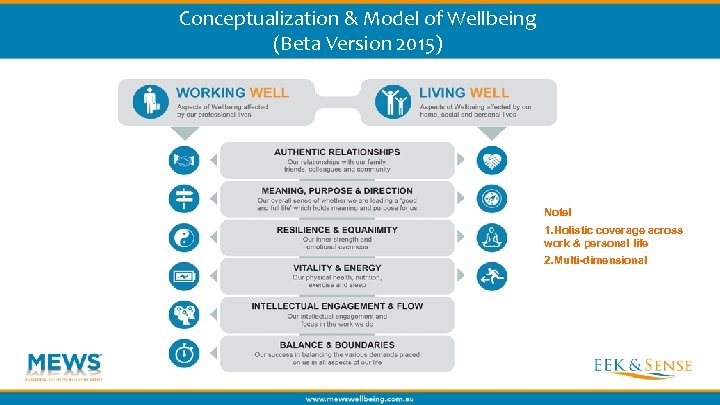
Conceptualization & Model of Wellbeing (Beta Version 2015) Note! 1. Holistic coverage across work & personal life 2. Multi-dimensional
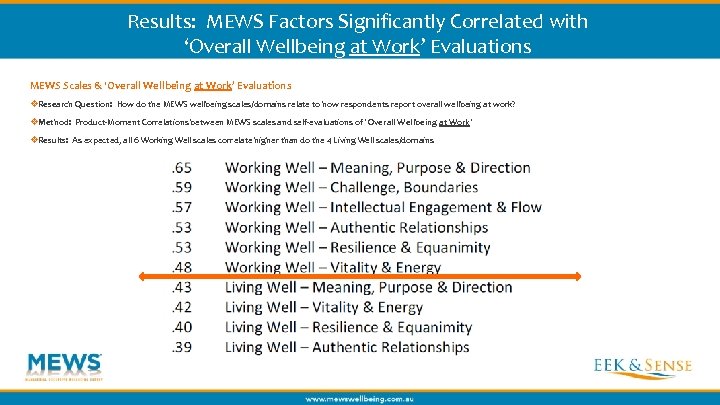
Results: MEWS Factors Significantly Correlated with ‘Overall Wellbeing at Work’ Evaluations MEWS Scales & ‘Overall Wellbeing at Work’ Evaluations v. Research Question: How do the MEWS wellbeing scales/domains relate to how respondents report overall wellbeing at work? v. Method: Product-Moment Correlations between MEWS scales and self-evaluations of ‘Overall Wellbeing at Work’ v. Results: As expected, all 6 Working Well scales correlate higher than do the 4 Living Well scales/domains
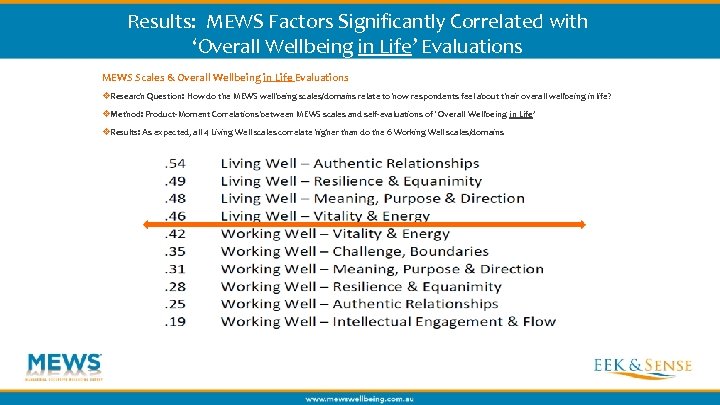
Results: MEWS Factors Significantly Correlated with ‘Overall Wellbeing in Life’ Evaluations MEWS Scales & Overall Wellbeing in Life Evaluations v. Research Question: How do the MEWS wellbeing scales/domains relate to how respondents feel about their overall wellbeing in life? v. Method: Product-Moment Correlations between MEWS scales and self-evaluations of ‘Overall Wellbeing in Life’ v. Results: As expected, all 4 Living Well scales correlate higher than do the 6 Working Well scales/domains
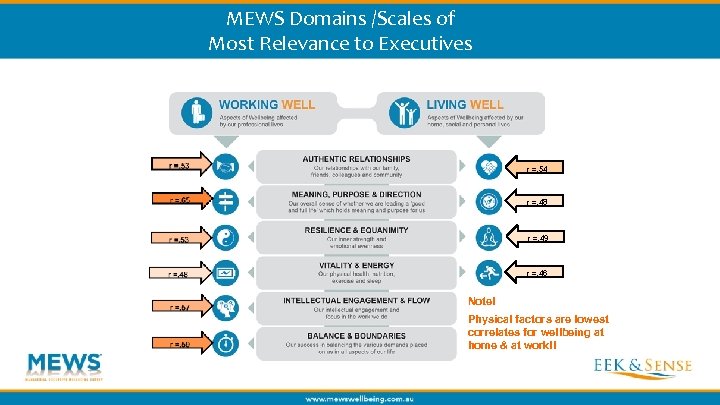
MEWS Domains /Scales of Most Relevance to Executives r =. 54 r =. 48 r =. 49 r =. 46 Note! Physical factors are lowest correlates for wellbeing at home & at work!!
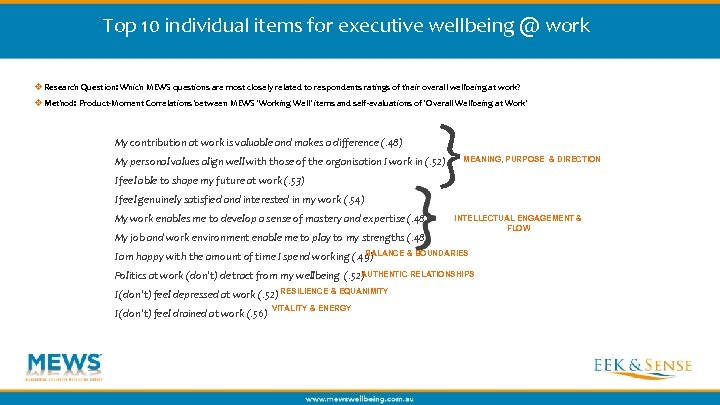
Top 10 individual items for executive wellbeing @ work v Research Question: Which MEWS questions are most closely related to respondents ratings of their overall wellbeing at work? v Method: Product-Moment Correlations between MEWS ‘Working Well’ items and self-evaluations of ‘Overall Wellbeing at Work’ My contribution at work is valuable and makes a difference (. 48) } My personal values align well with those of the organisation I work in (. 52) I feel able to shape my future at work (. 53) MEANING, PURPOSE & DIRECTION I feel genuinely satisfied and interested in my work (. 54) My work enables me to develop a sense of mastery and expertise (. 48) My job and work environment enable me to play to my strengths (. 48) INTELLECTUAL ENGAGEMENT & FLOW BALANCE & BOUNDARIES I am happy with the amount of time I spend working (. 49) AUTHENTIC RELATIONSHIPS Politics at work (don’t) detract from my wellbeing (. 52) I (don’t) feel depressed at work (. 52) RESILIENCE & EQUANIMITY I (don’t) feel drained at work (. 56) VITALITY & ENERGY
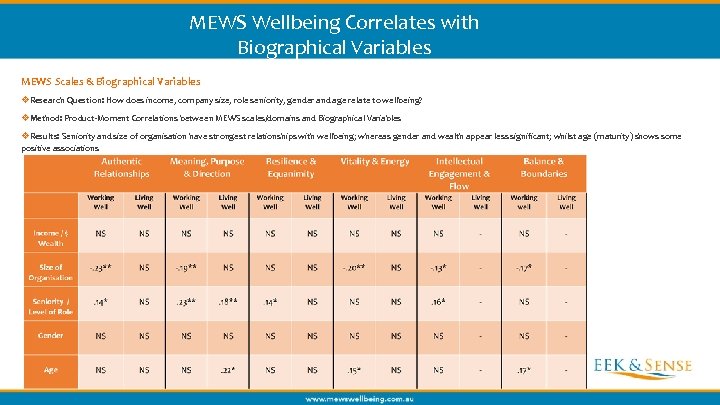
MEWS Wellbeing Correlates with Biographical Variables MEWS Scales & Biographical Variables v. Research Question: How does income, company size, role seniority, gender and age relate to wellbeing? v. Method: Product-Moment Correlations between MEWS scales/domains and Biographical Variables v. Results: Seniority and size of organisation have strongest relationships with wellbeing; whereas gender and wealth appear less significant; whilst age (maturity) shows some positive associations
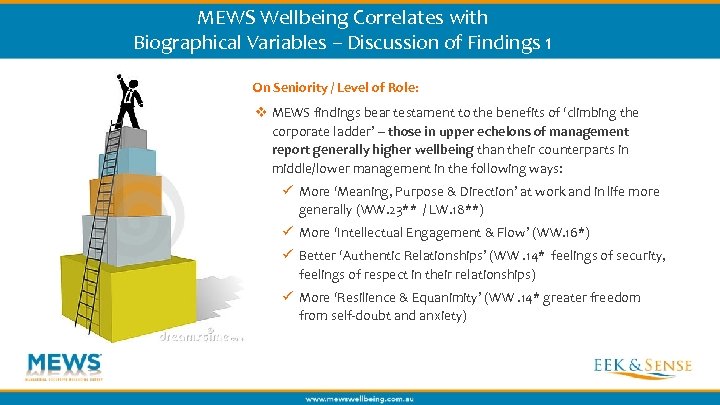
MEWS Wellbeing Correlates with Biographical Variables – Discussion of Findings 1 On Seniority / Level of Role: v MEWS findings bear testament to the benefits of ‘climbing the corporate ladder’ – those in upper echelons of management report generally higher wellbeing than their counterparts in middle/lower management in the following ways: ü More ‘Meaning, Purpose & Direction’ at work and in life more generally (WW. 23** / LW. 18**) ü More ‘Intellectual Engagement & Flow’ (WW. 16*) ü Better ‘Authentic Relationships’ (WW. 14* feelings of security, feelings of respect in their relationships) ü More ‘Resilience & Equanimity’ (WW. 14* greater freedom from self-doubt and anxiety)
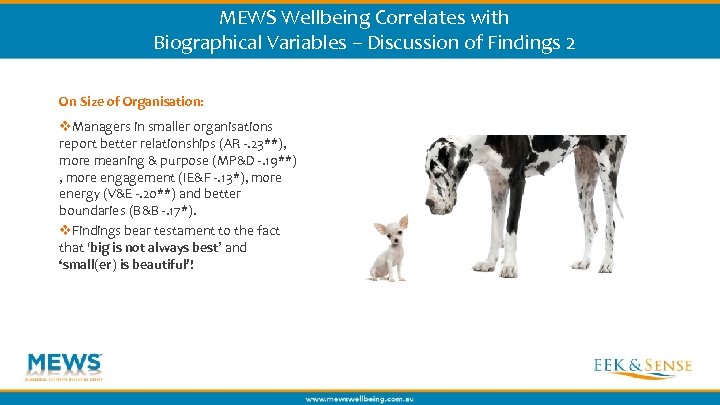
MEWS Wellbeing Correlates with Biographical Variables – Discussion of Findings 2 On Size of Organisation: v. Managers in smaller organisations report better relationships (AR -. 23**), more meaning & purpose (MP&D -. 19**) , more engagement (IE&F -. 13*), more energy (V&E -. 20**) and better boundaries (B&B -. 17*). v. Findings bear testament to the fact that ‘big is not always best’ and ‘small(er) is beautiful’!
MEWS Wellbeing Correlates with Biographical Variables – Discussion of Findings 3 On Income/Wealth: N/S v. Findings bear testament to the claim that for high earning tertiary qualified professionals – ‘money doesn't buy happiness’. v. Beware the affluenza virus!
MEWS Wellbeing Correlates with Biographical Variables – Discussion of Findings 4 On Gender: v MEWS findings suggest NO significant differences between males and females in any of the overall scales/domains of wellbeing from either a workplace (Working Well) or outside of work (Living well) perspective. v v However, item level analysis indicates some nuanced gender implications. Females significantly more likely to: ü Take care of themselves through recommended preventative health measures than their male counterparts (LW Vitality & Energy 0. 35**) ü Go out of their way to show empathy for others’ feelings and needs (WW Authentic Relationships 0. 23**) ü Be attuned to where they carry stress and tension in their bodies (WW Vitality & Energy 0. 23**) ü Use breathing techniques as a tool to slow down and stay calm (WW Vitality & Energy 0. 21**) ü Make more time to develop their spiritual side (LW Meaning, Purpose & Direction 0. 19**) v Males in our sample reported a significantly more positive wellbeing picture on only 2 counts: ü Lower occurrence of self-doubt (WW Resilience & Equanimity, -. 21**) and ü More likely to report sufficient energy to perform at their peak (LW Vitality & Energy -. 19**)
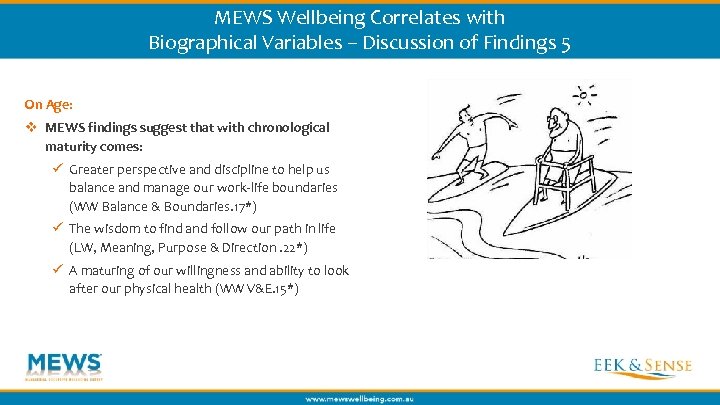
MEWS Wellbeing Correlates with Biographical Variables – Discussion of Findings 5 On Age: v MEWS findings suggest that with chronological maturity comes: ü Greater perspective and discipline to help us balance and manage our work-life boundaries (WW Balance & Boundaries. 17*) ü The wisdom to find and follow our path in life (LW, Meaning, Purpose & Direction. 22*) ü A maturing of our willingness and ability to look after our physical health (WW V&E. 15*)
Results: Reliability Coefficients of MEWS (Beta Version 2015) MEWS Reliability v. The literature regarding test and scale construction suggests that an acceptable level of reliability is a function of the intended use of the test results. If a test is to be used to make decisions about an individual, it is important for that test to be highly reliable. This need for higher levels of reliability goes up as the risk associated with a poor decision based on the test increases. The MEWS is not intended for use as a tool to make any selection decisions and is only for use in personal development applications v. Test-retest: Variability of behaviours between Time 1 and Time 2 is not necessarily a measurement error and in the case of SWB this is likely to be particularly true – because wellbeing is a dynamic and fluid state of being we would expect to see changes in wellbeing in accordance with either the benefits of any targeted wellbeing interventions and/or the degree of unforeseen challenges experienced during the elapsed time v. Internal consistency: The process of obtaining reliability estimates (e. g. Cronbach’s Alpha) through a single administration to a group of individuals. v. For MEWS, reliability coefficients (Coefficient Alpha) were computed on the data set for each scale (or ‘domain’) of the MEWS Framework which in the beta version, had 10 scales across the Living Well and Working Well sections v. Results (see Table 1 MEWS Beta Version Internal Consistency Reliability) show highly satisfactory Cronbach’s alpha coefficients for all 10 scales falling well within the currently recommended (by the International Test Commission) range of 0. 76 to 0. 86. Scale reliabilities higher than 0. 90 suggest some item redundancy whereas scale reliabilities lower than 0. 7 suggest possible multi-dimensionality
Reliability Results: Split-Half Internal Consistencies of MEWS (Beta Version 2015) Table 1 MEWS Beta Version Internal Consistency Reliability
MEWS Scale / Domain Inter-correlations (Beta Version 2015) Table 2 MEWS Beta Version Mean Scale / Domain Inter-correlations v. Results show mean scale inter-correlations all falling within a satisfactory range v. The 4 domain / scales that are parallel matched across Working Well and Living Well (highlighted) also indicate a unitary construct yet with sufficiently different aspects to warrant the Living Well and Working Well distinctions
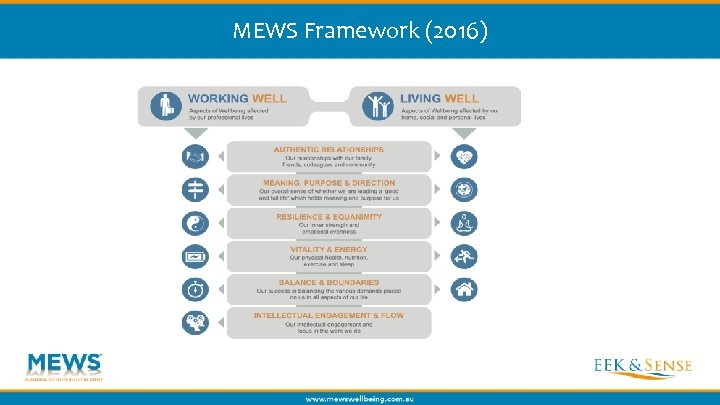
MEWS Framework (2016)

Sample Wellbeing Profile (Beta Version 2015)

Sample Vitality & Energy Item Level Reporting
Key messages ① Wellbeing needs are unique and variable - a ‘one size approach’ to wellbeing does not fit all ② It is important to consider a more holistic perspective of wellbeing than has been the case to date ③ For most leaders, the 6 factors (domains) in the MEWS Framework will be highly impactful for wellbeing ④ Drill down into these factors to obtain a thorough diagnosis of individual leader’s wellbeing needs ⑤ The MEWS Survey is a reliable, well constructed and detailed measurement tool that moves beyond global measures of wellbeing ⑥ MEWS is a diagnostic tool designed to help organisations support their executive wellbeing efforts in a strategic, targeted and holistic manner ⑦ Further research underway to examine construct validity of MEWS, using personality measures (Hogan’s Assessments) and a range of validated wellbeing and life satisfaction measures ⑧ Further research to repeat the analysis reported here with larger sample sizes and on new version www. mewswellbeing. com. au
Thank you! Questions? About the authors: v Audrey Mc. Gibbon’s career in organisational psychology began in the UK in 1990, where she worked in the psychometric test development unit of SHL (CEB) before moving into executive/career assessment and development consultancy. Audrey has over 15 years’ experience as an executive coach. Audrey has an MA (Hons) in Psychology and Business, and an MSc in Psychotherapy Studies. Her master’s research was on the factors that drive wellbeing for senior executives. She is a registered psychologist in both Australia and the UK, as well as a Chartered Occupational Psychologist with the British Psychological Society (BPS), an Associate Fellow of the BPS, and a member of the Division of Occupational Psychology and Psychotherapy Section of the BPS. v Karen Gillespie’s career as an organisational psychologist began in the UK in 1989, where she worked for two consultancy practices before migrating to Australia in 1996. She held senior roles as the Consulting Director and Employee Development Director of SHL (CEB) before setting up her own business in 2002. She has an MA (Hons) in Psychology, an MSc in Occupational Psychology, a Graduate Diploma in Wellness and is currently studying for a Practice Certificate in Sleep Psychology through the APS. Karen is a Registered Psychologist, a Member of the Australian Psychological Society, the College of Organisational Psychologists and the Interest Group in Coaching Psychology. v EEK & SENSE is the culmination of a long-term partnership between Audrey Mc. Gibbon and Karen Gillespie. Their interest in wellbeing has coincided with observations of leaders experiencing serious, persistent and unprecedented threats to their wellbeing, creating knock-on damage to performance and business outcomes. They embarked on the development of the MEWS in response to these concerns, with the goal of helping individuals and organisations achieve sustainable and strong performance, and flourish as contributors to the wellbeing of their teams, families and community at large www. MEWSwellbeing. com. au
Скачать презентацию Towards a better understanding of executive wellbeing Karen
ed960659052ddc6a1bb55905d4b93372.ppt